Indoor vs. Outdoor Housing for Guinea Pigs and Rabbits
By Dr. Zubair Khalid, DVM, MS, PhD ·
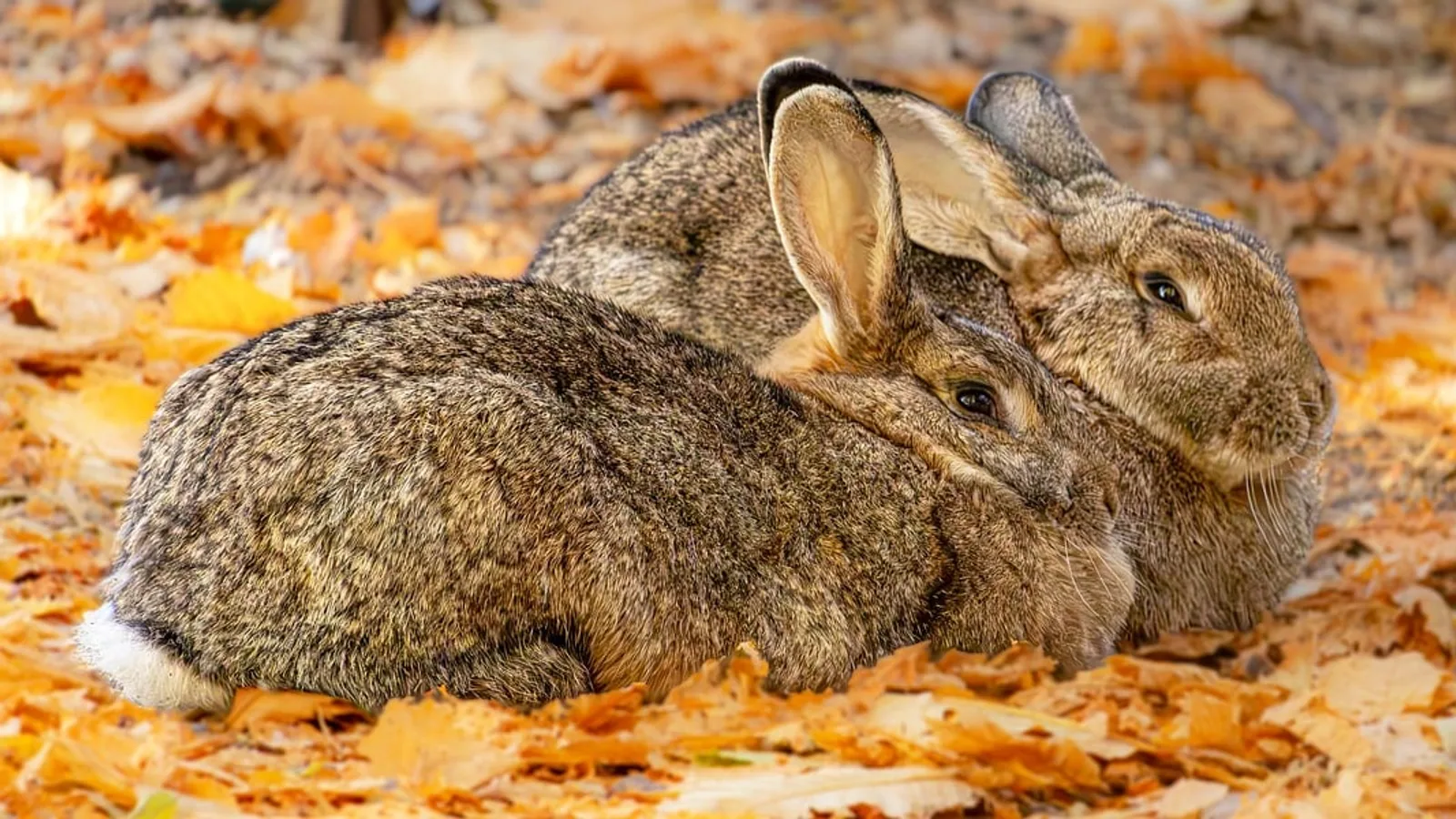
Indoor housing keeps your guinea pig or rabbit in a temperature-stable, closely supervised environment, while outdoor housing gives them natural light and fresh air but exposes them to weather swings, predators, and gaps in daily observation. The rule of thumb is simple: if you live in a climate with hot summers, freezing winters, or free-roaming predators, choose indoor housing. If you choose outdoor housing anyway, treat it as a full-time commitment to daily checks, weather-appropriate shelter, and twice-daily observation, not as a set-and-forget arrangement.
This guide walks through the difference between indoor and outdoor guinea pig housing, the same question applied to rabbits, what controlled research on small rodents shows about the health effects of each setting, and how to decide which option fits your home. Both species are prey animals with similar core needs, so most of the reasoning carries across, with a few species-specific points along the way.
Why Housing Choice Is a Welfare Decision, Not a Decoration Choice
Where your pet lives shapes how much you see them, how quickly you spot illness, and how much physiological stress their body carries day to day. Prey species mask illness by instinct. A guinea pig huddled in a hutch corner and a guinea pig resting quietly in a living room enclosure can look identical from a distance, but only one of those owners is close enough to notice the difference in appetite, droppings, and posture.
Research on small hystricomorph rodents gives this question real weight. In a study of wild cavies (Cavia aperea), the closest wild relative of the domestic guinea pig, animals transferred from outdoor enclosures to indoor enclosures lost about 8 percent of their body weight, while animals moved from indoor to outdoor enclosures gained about 12 percent. Both effects were reversible, and the animals kept outdoors had significantly lower basal cortisol levels than animals kept indoors, which the authors interpreted as a difference in physiological state between the two settings [1].
Two lessons follow from that study for pet owners. First, housing transitions are physically demanding events for these animals, not minor logistical changes. Any move between environments should be planned, gradual, and discussed with a veterinarian, especially for young, old, sick, or pregnant animals. Second, indoor conditions carry their own physiological consequences. The indoor animals in that study did not simply adjust without cost, which contradicts the comfortable assumption that "indoors is always better." What matters is the total environment: temperature stability, space, noise, air quality, and consistency of care [1].
Reference texts such as the Merck Veterinary Manual, which maintains an extensive Exotic and Laboratory Animals section covering guinea pigs and rabbits, treat housing as part of the husbandry picture alongside diet and disease prevention. Owner-facing organizations, including VCA Animal Hospitals for small mammal guides and the Rabbit Welfare Association and Fund (RWAF) in the United Kingdom, publish guidance that generally favors indoor living for companion rabbits on the grounds of companionship and closer health monitoring. House Rabbit Society takes a similar position through its rescue and education materials. None of these bodies claims indoor housing is medically mandatory in every situation, which is why the rest of this article compares the two settings honestly rather than declaring a universal winner.
Side-by-Side Comparison: Indoor vs. Outdoor Housing
| Criterion | Indoor Housing | Outdoor Housing |
|---|---|---|
| Temperature stability | Stable household climate, protected from heat waves and cold snaps | Exposed to daily and seasonal swings, highest risk in summer heat and winter cold |
| Predator exposure | Minimal, though household dogs and cats still require management | Direct exposure to predators and to stress from their presence even without contact |
| Health monitoring | Daily observation is easy, subtle changes in appetite and droppings are more likely to be caught | Requires deliberate daily trips outside, illness often noticed later |
| Human allergen exposure | Guinea pig allergens circulate in indoor air and settle in the home, a real consideration for allergic households | Allergens disperse outdoors, less household air contamination |
| Natural light and fresh air | Limited unless the enclosure is near windows or the pet gets supervised outdoor time | Abundant natural light and ventilation |
| Noise and household stress | Vacuum cleaners, televisions, and household activity can be stressful, placement matters | Quieter, but wind, rain, machinery, and wildlife sounds can also frighten prey animals |
| Social interaction | Animals live within the family's daily routine, interaction happens naturally | Interaction depends on scheduled visits, easier for the animal to go under-noticed |
| Weight and body condition tracking | Easier to weigh regularly as part of household routine | Requires carrying animals inside or bringing scales out, often skipped |
| Escape and security risks | Fewer, mainly household hazards such as electrical cords and other pets | Wire-chewing escapes, digging, and breaches by predators or wildlife |
| Suitability for sick or elderly animals | Strongly preferred, warmth and proximity support recovery and observation | Generally unsuitable for animals needing frequent treatment or monitoring |
No row in that table is automatically decisive. The weight you give each criterion depends on your climate, your household, your pet's age and health, and how your daily routine actually works. That is what the rest of this article works through.
Indoor Housing Explained
Indoor housing means your guinea pig or rabbit lives inside your home in a purpose-built enclosure, in a room where temperature stays within the comfortable range for the species and where family activity keeps the animal observed. For guinea pigs, this is the setup behind most modern guinea pig care guide recommendations. For rabbits, indoor living is what House Rabbit Society and RWAF have spent years normalizing through their house rabbit education.
The advantages, on their own terms
The clearest advantage is thermal stability. Guinea pigs and rabbits cannot sweat effectively and tolerate heat poorly, and both are vulnerable to heat stress on days that feel merely warm to humans. Indoors, you control that variable completely. Cold is the mirror-image risk outdoors, and indoors you remove it as well.
The second advantage is observation. Guinea pigs and rabbits are crepuscular or broadly active animals that show illness through small changes, a slightly reduced appetite, a dropping output change, a hunched posture, a reluctance to move. When the enclosure is in your living space, those changes surface during ordinary life rather than during a scheduled hutch visit. This matters because gastrointestinal stasis in rabbits and anorexia in guinea pigs are emergencies where hours count.
The third advantage is social integration. Both species are social and both benefit from predictable daily contact. Indoor animals get that contact incidentally, through the household's normal activity, which tends to produce tamer, more behaviorally engaged pets.
The disadvantage owners underestimate: allergens
Indoor housing concentrates your exposure to your pet. For guinea pigs, that exposure is well documented in the allergy literature. In a clinical study of laboratory workers with allergic symptoms after animal exposure, roughly half of the symptomatic workers' serum samples showed elevated IgE antibodies to guinea pig urine, pelt, or albumin, and skin testing confirmed allergenic activity for all three sources [2]. Air sampling found guinea pig urine allergen activity in all indoor air filter samples taken in the animal facility, and pelt allergen in nearly all of them, with urine identified as the major airborne allergen source [2]. The allergen was carried on particles both large and small, including a fine fraction small enough to remain suspended and reach deep airways [2].
For a pet owner, the practical translation is this. If anyone in your household has asthma or suspected animal allergies, the decision of when to use indoor housing changes character. Guinea pig allergen will enter your home's air and dust, it will persist, and the fine particle fraction means it travels beyond the immediate cage area. Placing the enclosure out of bedrooms, ventilating the room, and having an allergic family member evaluated by a physician before committing are reasonable steps. Outdoor housing genuinely reduces household allergen load, and for some families that alone settles the indoor versus outdoor question in the opposite direction from the welfare arguments.
Indoor housing also has ordinary, non-medical costs. Enclosures take floor space. Hay and bedding generate dust and debris. Guinea pigs vocalize, rabbits thump and dig at cage floors, and both species are more active at dawn and dusk than new owners expect. None of this is disqualifying, but honest planning beats surprised regret.
Outdoor Housing Explained
Outdoor housing means a hutch, shed-based setup, or purpose-built enclosure in a yard, protected from weather and predators, with the animal's welfare maintained through scheduled daily care rather than incidental observation. Outdoor keeping is traditional for both species and remains workable under the right conditions.
The advantages, on their own terms
Outdoor environments offer space, natural light, fresh air, and environmental variety that many indoor setups struggle to match. A large outdoor enclosure or run lets rabbits perform their full behavioral repertoire, running, rearing, digging, grazing, in ways that indoor floor time approximates but rarely equals. For owners whose homes are small, crowded, or shared with allergic family members, outdoor housing can be the difference between keeping the animal well and rehoming it.
The lower cortisol finding in the cavy study suggests that, at least for that wild species, the outdoor environment carried less physiological stress than the indoor one [1]. The authors attributed the difference to the animals' states being directly affected by their housing conditions. For a pet owner, the cautious reading is that a well-designed outdoor setup with adequate space, shelter, and stable social groups is not inherently stressful, and that cramming an animal into a small indoor cage in a busy household is not automatically the gentle option.
The risks that decide most cases
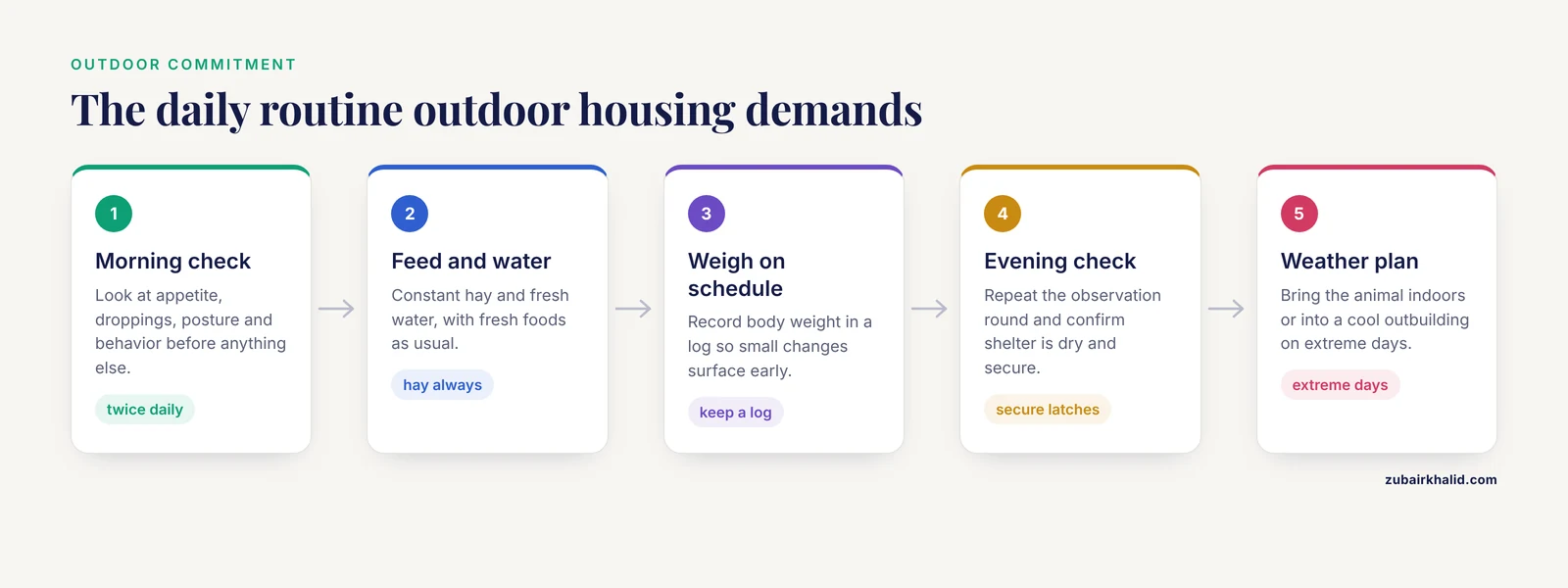
Heat is the leading killer in outdoor small-mammal keeping. A hutch in full sun on a warm day can reach lethal internal temperatures quickly, and guinea pigs are particularly heat intolerant. Shade, ventilation, and relocation during heat waves are minimum requirements, not upgrades.
Predators are the second decisive risk. Dogs, foxes, raccoons, hawks, and even cats can breach flimsy hutches, and the threat alone matters. Prey animals that hear and smell predators night after night can develop chronic fear responses even if they are never touched. Secure construction, predator-proof wire, and locked doors are baseline, and in areas with significant predator pressure, a solid outbuilding conversion is safer than any hutch.
The third risk is silence. An outdoor animal with a mild gut slowdown on a Tuesday can be critically ill by Friday if nobody is watching closely. Committing to outdoor housing means committing to visiting the enclosure at least twice daily, handling the animal regularly, weighing it on a schedule, and bringing it indoors whenever weather or health demands it. Owners who cannot sustain that routine should choose indoor housing instead.
The Real Difference Between Indoor and Outdoor Guinea Pig Housing
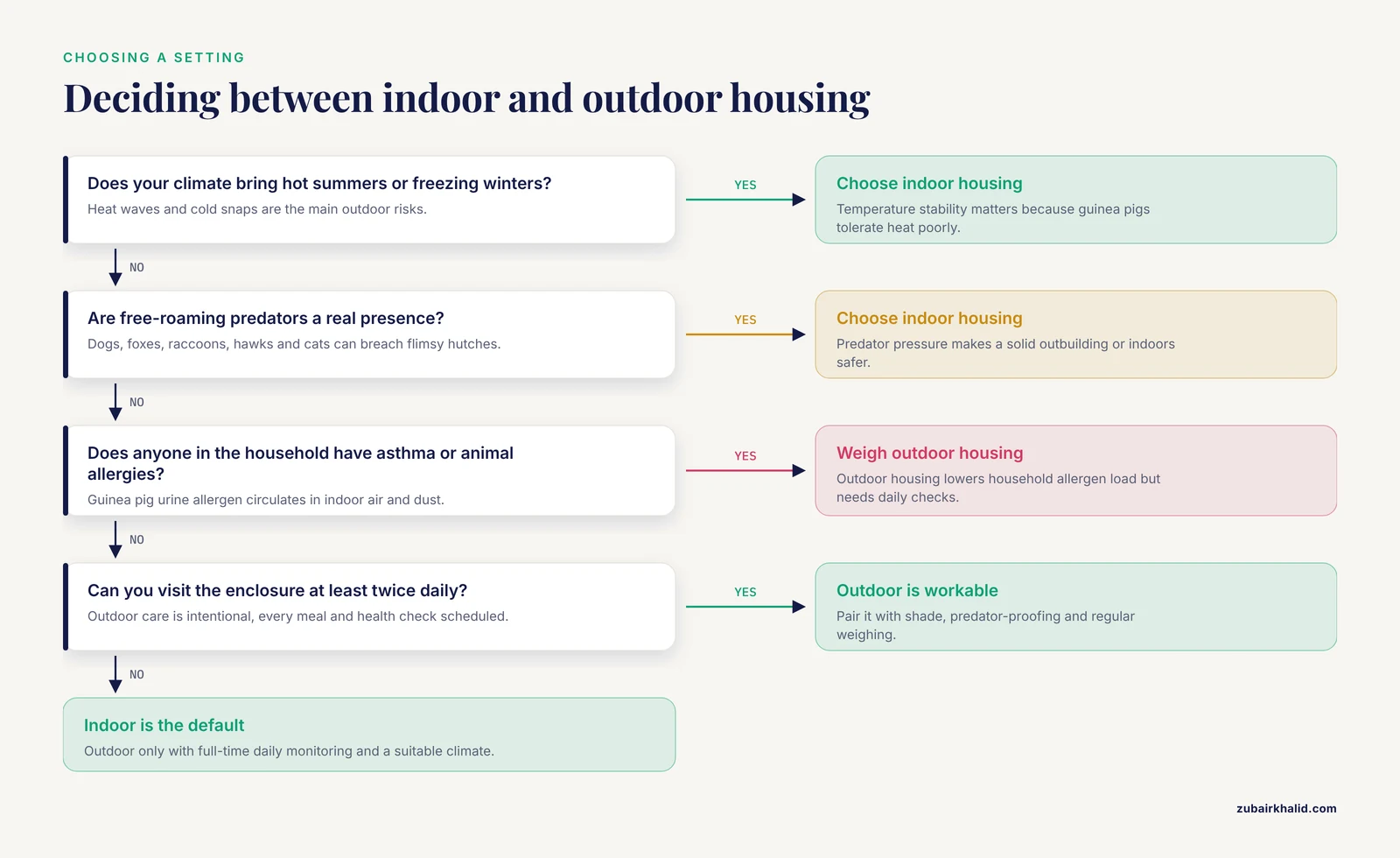
Strip away the preferences and the difference between indoor and outdoor guinea pig housing reduces to three trade-offs.
Trade-off one: thermal safety versus environmental richness. Indoors, you buy temperature stability and pay with a smaller, more artificial environment. Outdoors, you buy space, light, and air and pay with weather exposure. Both currencies are real. A large indoor enclosure with daily floor time can compensate for lost environmental variety, and a well-shaded, ventilated, winter-protected outdoor setup can compensate for thermal risk, so the trade-off is about effort, not fate.
Trade-off two: your health versus your pet's visibility. Indoor guinea pigs distribute allergen through household air, with urine the dominant source [2]. Outdoor guinea pigs stay out of your airways but also out of your sightline. If your family has no allergies and someone is home daily, indoor wins on visibility. If an allergic household member is affected, outdoor housing with excellent daily monitoring may serve the whole household better than forced indoor placement.
Trade-off three: intentionality versus incident. Outdoor care is intentional, every meal, water change, and health check happens because you scheduled it. Indoor care is incidental, and that is its strength and its risk. The indoor owner who stops truly looking at their pet because the pet is always there loses the main advantage indoor housing offers.
The same three trade-offs apply to rabbits, scaled up. Rabbits need more space than guinea pigs, are more destructive to household wiring and furnishings, and their gastrointestinal system makes rapid health decline an even sharper concern. Indoor vs. outdoor housing for rabbits and guinea pigs follows the same logic with heavier stakes on space and rabbit-proofing indoors, and heavier stakes on predator security outdoors.
Worked Scenarios
Scenario one. A family in a mild coastal climate with a 4-year-old guinea pig and no allergies. Heat waves are occasional rather than chronic, winters are mild, predators are moderate. Indoor housing remains the default recommendation because observation is easier and heat risk is never fully zero outdoors, but a substantial, shaded, predator-secure outdoor setup with a daily care routine is defensible. If the family chooses outdoor, the non-negotiables are twice-daily checks, regular weighing, and bringing the animal inside during heat alerts.
Scenario two. A household with a child recently diagnosed with asthma and wheezing that worsens in the room where the guinea pigs live. The allergy literature is directly relevant here. Symptomatic sensitization to guinea pig urine, pelt, and albumin allergens is documented, airborne urine allergen was detectable throughout the indoor air of the animal housing studied, and a fine respirable particle fraction was present [2]. This family should discuss both their child's evaluation and the pets' placement with their physician and veterinarian. Moving the enclosure out of bedrooms, improving ventilation, or relocating the animals to a well-built outdoor setup are all options. The point is that the housing decision now involves a human health variable, and continuing to ignore symptoms is the one wrong answer.
Scenario three. An owner moving a healthy adult rabbit from an outdoor hutch to a new indoor enclosure ahead of a house move. The cavy data showed that housing transitions moved body weight by meaningful margins in both directions, with roughly 8 percent loss on transfer from outdoor to indoor conditions and 12 percent gain in the reverse direction, effects that reversed over time [1]. A change of that size in a pet rabbit or guinea pig is worth catching early, not discovering at the next annual visit. The practical protocol is to weigh before the move, keep diet constant through the transition, weigh weekly for several weeks after, and report any change beyond mild fluctuation to a veterinarian. Gradual transition, where the animal experiences both environments before the permanent switch, is a sensible approach to discuss with your vet.
Scenario four. An elderly guinea pig with recurrent dental disease needing frequent syringe feeding and medication. Indoor housing is not a preference here, it is the only workable option. Frequent handling, temperature stability, and immediate access for treatment favor indoors unambiguously. The same applies to any animal recovering from surgery or living with chronic disease.
Common Mix-Ups Owners Make
Mixing the two species' outdoor requirements. A setup adequate for a rabbit is not automatically adequate for a guinea pig or vice versa. Guinea pigs' heat intolerance is more severe, rabbits' escape and digging capability is greater. Designs that suit one can quietly fail the other.
Assuming a hutch equals outdoor housing done right. The classic small hutch is a shelter, not a full environment. Both species need exercise space attached to or integrated with their resting area. RWAF has campaigned for years against undersized hutch-only living for rabbits, and the same spatial logic applies to guinea pigs.
Reading the indoor cortisol finding as "indoor is stressful, go outside." The cavy study measured a wild species under research conditions, and both directions of transfer produced measurable effects [1]. The correct lesson is that housing transitions and housing quality both matter physiologically, not that any outdoor setup beats any indoor one.
Ignoring household allergies until they become unmanageable. Because guinea pig allergen is airborne, persistent, and carried on small particles, waiting to see whether symptoms develop is a poor plan for households with known asthma or animal allergies. Decide with full information before the animal moves in.
Treating a housing move as a single-day event. New enclosure, new smells, new sounds, new light cycle, all at once. The weight data from the housing-transfer study show these events register physiologically [1]. Build in a transition period.
Skipping weighing outdoors. Body weight is the single most useful tracking signal an owner has in these species. Outdoor keeping makes it inconvenient, which is exactly why it gets skipped and exactly why it cannot be.
Housing Checklists
Rabbit care checklist for either setting
- Enclosure large enough for at least three hops end to end and rearing on hind legs, with an attached exercise area
- Constant access to hay, fresh water, and appropriate fresh foods
- Shelter from wind, rain, and direct sun, with bedding that stays dry
- Predator-proof construction with secure latches and heavy-gauge wire
- Twice-daily observation of appetite, droppings, posture, and behavior
- Regular weighing recorded in a log
- Daily exercise and interaction time outside the enclosure
- A plan for extreme weather days, which in practice means bringing outdoor rabbits indoors or into a cool outbuilding
- Companion consideration discussed with a rabbit-savvy veterinarian, since both species are social
Guinea pig care guide points for housing placement
- Indoor enclosures belong in a family room or similar occupied space, not a bedroom of an allergic household member, with ventilation in mind [2]
- Outdoor hutches need full shade, elevated floors that stay dry, and wind protection
- Vitamin C needs, dental health, and weight trends should be tracked regardless of location
- Avoid wire flooring, which injures the feet of both species
- Keep the enclosure away from direct household drafts, loud speakers, and young children's unsupervised access
- Any location change, indoor to outdoor or the reverse, should be gradual and weight-monitored, given the documented physiological effects of housing transitions in this group of animals [1]
Limitations and When to Contact a Veterinarian
The evidence base for this topic is thinner than owners expect. The strongest direct housing data come from a study of wild cavies, a related species, not domestic guinea pigs [1], and the allergen data come from laboratory animal facilities rather than homes [2]. Neither source maps perfectly onto your living room or backyard. Individual animals, local climates, household compositions, and existing medical conditions vary enormously, so any specific placement decision for your pet should be made with your veterinarian, who can weigh your animal's age, health status, and your region's weather.
Contact your veterinarian promptly, the same day, for any of the following:
- No eating or markedly reduced eating for more than a few hours, in either species
- No fecal droppings, or dramatically smaller or malformed droppings
- Hunched posture, reluctance to move, or hiding that is out of character
- Any breathing changes, open-mouth breathing, wheezing, or discharge from the nose or eyes
- Drooling, wet chin, or pawing at the mouth, which suggest dental disease
- Diarrhea or very soft stools
- Signs of heat stress, including rapid breathing, weakness, or collapse, which is an emergency
- Any wound, bleeding, or suspected predator contact, even if the animal looks fine
- Unexplained weight change after a housing move, which the research shows can occur [1]
- New or worsening respiratory symptoms in a household member after indoor housing of guinea pigs, which warrants physician evaluation alongside any changes you make for the pet
This article is educational and is not a substitute for veterinary diagnosis or treatment.
Frequently Asked Questions
Is indoor or outdoor housing better for guinea pigs?
For most US households, indoor housing is the better default because it offers temperature stability, easier health monitoring, and natural social contact, and heat tolerance is a serious weakness in guinea pigs. Outdoor housing becomes the reasonable choice when household allergies, space limits, or a genuinely mild climate and an excellent outdoor setup tip the balance.
Can I keep my rabbit outdoors year-round?
Some owners do successfully, but year-round outdoor living demands weather-proof shelter for both summer heat and winter cold, predator-proof construction, and strict twice-daily monitoring that never lapses. If you cannot commit to all of that in your climate, bring your rabbit indoors or into a suitably protected outbuilding for at least the extreme seasons.
Do indoor guinea pigs trigger allergies?
They can. Guinea pig urine, pelt, and albumin are documented allergens, urine is the major airborne source, and allergen activity has been measured in indoor air samples including on fine particles that remain suspended [2]. Households with asthma or known animal allergies should discuss placement and medical evaluation before committing to indoor housing.
Should guinea pigs and rabbits be housed together?
This is a real question to take to your veterinarian rather than a default. The two species have different dietary, spatial, and behavioral needs, and their housing requirements do not fully overlap, so a veterinarian familiar with both species can advise on your specific animals and setup.
How do I switch my pet from outdoor to indoor housing?
Gradually, with weighing before, during, and after the transition. Research in cavies showed housing transfers produced measurable, reversible body weight changes in both directions, so monitor weight weekly for several weeks and keep the diet consistent through the move [1]. Run the plan past your veterinarian first, especially for young, elderly, or unwell animals.
What should a guinea pig care guide say about cage placement?
Place the enclosure in an occupied, ventilated family space away from direct sunlight, drafts, loud noise, and the bedrooms of allergic household members, on solid flooring rather than wire, with room for exercise and hiding. Placement should serve both the animal's need for stable temperature and quiet, and your family's need to observe and interact daily.