How to Introduce Gerbils to Each Other and Other Pets
By Dr. Zubair Khalid, DVM, MS, PhD ·

Gerbils are highly social animals that thrive in same-sex pairs or small family groups, but a gerbil that smells wrong to another gerbil is treated as an intruder. The answer to how to introduce gerbils is patience with a structured process: quarantine the newcomer, swap scents between enclosures, house the gerbils on opposite sides of a divided tank, then move to short meetings on neutral ground before allowing them to live together full time. Rushed introductions cause serious bite wounds, and some pairs will simply never accept each other.
This guide walks through the full gerbil bonding process, explains how to introduce a new gerbil to a lone gerbil or an established group, and covers the separate problem of keeping gerbils safe around cats, dogs, and other household pets.
This article is educational and is not a substitute for veterinary diagnosis or treatment.
At a Glance: Your Introduction Checklist
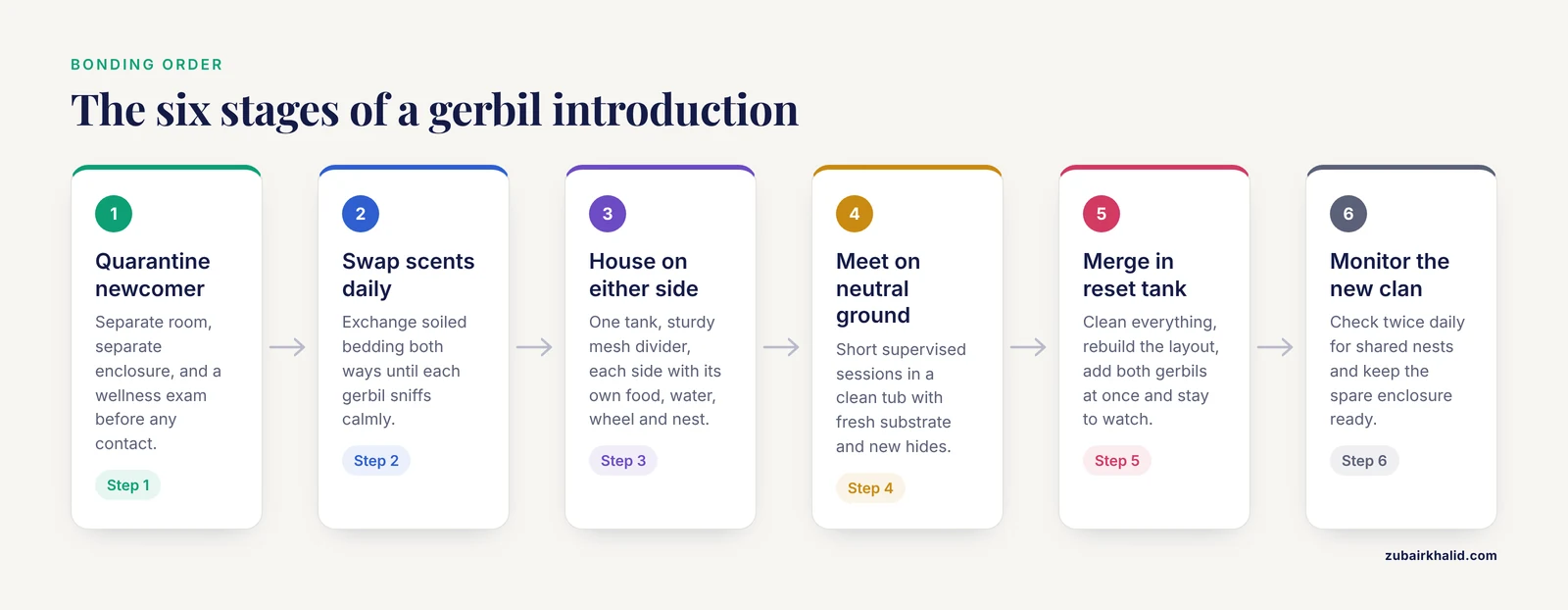
| Step | What to do | What success looks like |
|---|---|---|
| 1. Quarantine | House the new gerbil in a separate enclosure in a separate room, and schedule a wellness exam with a veterinarian experienced in small mammals | No signs of illness in either animal for the quarantine period, and a clean bill of health at the exam |
| 2. Scent swapping | Exchange soiled bedding, nest material, or a small amount of used substrate between the two enclosures every day | Both gerbils investigate the bedding calmly rather than frantically |
| 3. Divided housing | Place the gerbils in one large tank split by a secure mesh divider so they can see and smell each other without contact | Gerbils sleep near the divider, groom through it, and stop charging at it |
| 4. Neutral-territory meetings | Move both gerbils to a completely clean container with fresh substrate and new hiding spots for short, fully supervised sessions | Gerbils sniff, groom each other, or ignore each other. Chasing resolves on its own |
| 5. Full merge | Once meetings stay calm, place them in the clean, freshly furnished main tank together and keep watch | Gerbils sleep in one nest within the first day |
| 6. Long-term monitoring | Keep a spare enclosure ready and watch daily for renewed aggression over the following weeks | Calm coexistence, shared grooming, and shared sleeping |
Keep that spare enclosure set up permanently. Even bonded gerbils can suddenly fall out, a phenomenon owners call declanning, and you may need to separate them within minutes.
Can Gerbils Live Together?
Gerbils are among the most social of the commonly kept small mammals. In their natural state they live in family groups, and their welfare depends on companionship of their own kind. Research on laboratory housing found that gerbils develop stereotypic bar chewing when juveniles are separated from their family too early, before younger siblings are born, which points to how much family contact matters to this species [1]. The same research showed that gerbils denied the chance to dig and maintain a burrow develop stereotypic digging, so social and physical enrichment go hand in hand [1].
So can gerbils live together? Yes, and in most cases they should, with three caveats:
- Pairs must be compatible. Two gerbils from the same litter, or a parent and its offspring, usually bond easily. Two unfamiliar adult gerbils are the hardest match.
- Sex matters. Same-sex pairs avoid a population problem. A male and female pair will breed readily and repeatedly, so unless you are prepared for litter after litter, stick to same-sex pairings.
- Groups need space. A clan of three or four gerbils needs a larger enclosure and more careful observation than a pair, because group dynamics can shift as animals mature.
A survey of 723 UK small mammal owners found that the availability of suitable enclosures was the primary barrier to good welfare, even though most owners were willing and motivated to provide it [2]. Before you begin any introduction, confirm you have an enclosure large enough for two or more gerbils with deep substrate for burrowing. If you do not, solve the housing problem first, because crowding is a major trigger for fighting.
Understanding the Gerbil Bonding Process
The gerbil bonding process works through scent. Gerbils identify family and strangers largely by smell. A newcomer carries an unfamiliar odor, and a resident gerbil may attack instantly if the two meet directly on the first day. Every step below is designed to blend the two animals' scents gradually so that by the time they share space, they smell like clanmates rather than intruders.
Two principles govern the whole process:
- Never skip the divider stage. Contact before scent familiarity is how serious wounds happen.
- Always end a session on a good note. Stop while things are calm rather than waiting for a fight, then increase contact gradually.
Expect the process to take longer than you want. Some gerbil pairs accept each other within days, while wary adults may need weeks of divided housing. Age matters. Two young gerbils (roughly eight to twelve weeks old) usually bond fastest. Introducing a new gerbil to a mature adult with a settled territory is the slowest, most uncertain scenario, and it deserves the most caution.
How to Introduce Gerbils: Step by Step
Step 1: Quarantine the New Gerbil
House the newcomer in its own enclosure in a different room from your existing gerbils. Quarantine protects your resident animals from respiratory infections, parasites, and skin conditions the new gerbil may carry without visible symptoms. During this period, schedule a wellness examination. Small mammals like gerbils are presented to veterinary clinics for preventive care as well as illness, and a physical exam with history and husbandry review is the foundation of that assessment [3]. Ask the clinic whether they see gerbils before you book.
Wash your hands after handling either gerbil, and consider using separate equipment for each enclosure during quarantine. Gerbils in any new environment are also stressed, so give the newcomer deep bedding, a hideout, and food from day one.
Step 2: Swap Scents Daily
Once both animals are healthy, begin scent swapping. Take a handful of soiled bedding or nesting material from one enclosure and place it in the other, then repeat in the opposite direction. Do this daily. You are teaching each gerbil that the other's smell is ordinary background information, not an alarm signal.
Calm, brief sniffing at the swapped bedding is what you want. If one gerbil hisses, thumps, or bites at the swapped material, go slower and keep swapping for several more days before moving on.
Step 3: Use a Divided Enclosure
Place both gerbils in one large, thoroughly cleaned tank with a fine but sturdy mesh divider down the middle. Each side gets its own food, water, wheel, and nest. The gerbils can see, smell, and hear each other but cannot make contact.
Behavior tells you how the divided stage is going:
- Good signs: sleeping near the divider, grooming through the mesh, eating and digging normally, sitting calmly side by side.
- Neutral signs: ignoring each other entirely.
- Bad signs: constant charging at the divider, rearing up at the mesh, biting the bars between them, or refusing to eat. If bad signs persist, extend the divided stage and slow everything down.
Gerbils chew relentlessly at cage bars, and bar chewing is a recognized stereotypy in this species [1]. Because your divider invites chewing, check it daily for damage and make sure gaps are too small for a nose or paw to pass through.
Step 4: Hold Meetings on Neutral Territory
When divided housing stays calm, begin short, fully supervised meetings in a completely neutral container, such as a clean plastic tub or a cleaned bathtub lined with fresh substrate. Add a handful of new hiding spots and a sprinkle of sunflower seeds or millet so both gerbils are occupied foraging rather than fixated on each other.
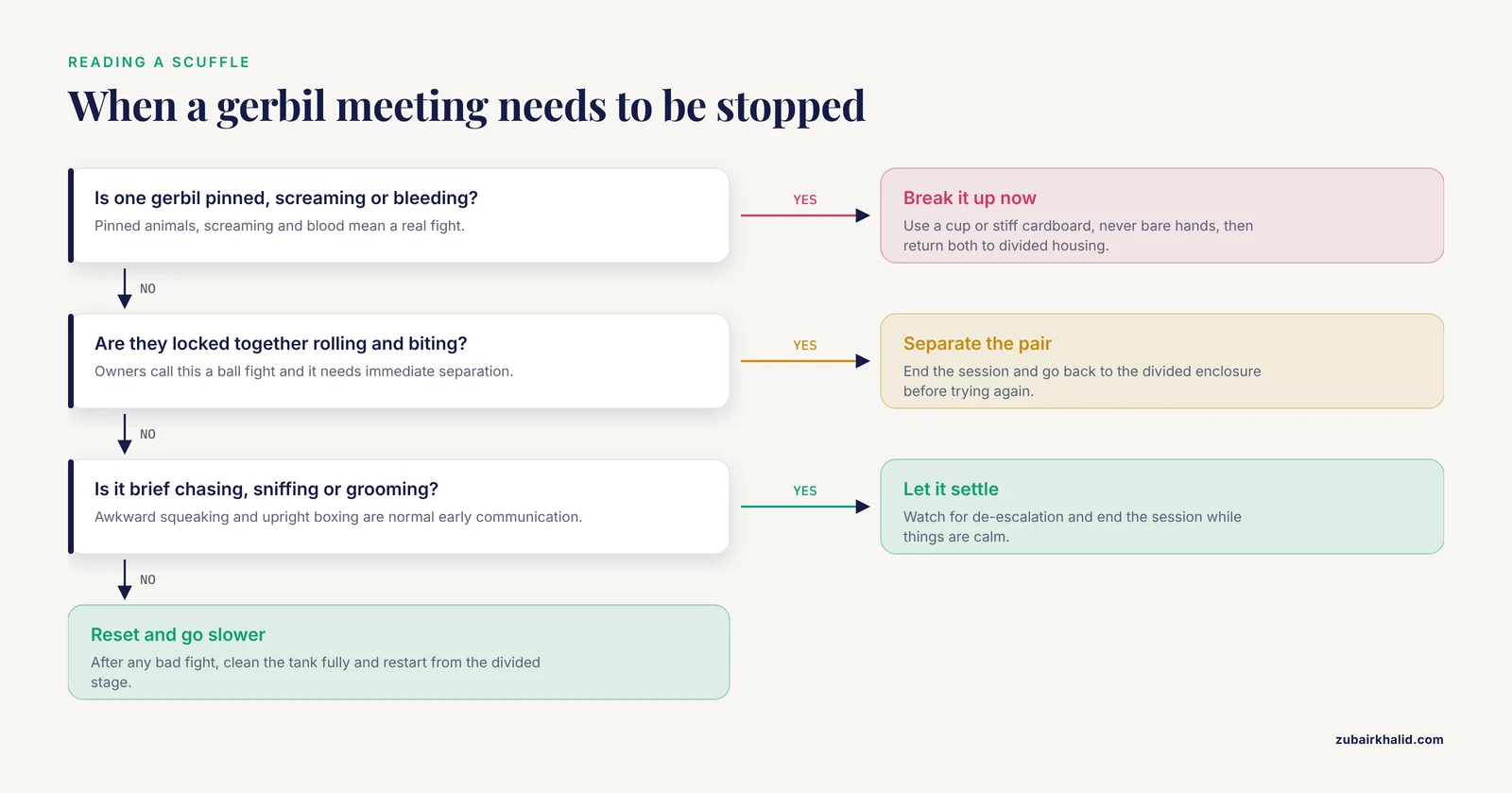
Short sessions, several times a day, work better than one long session. Expect an awkward first few minutes of squeaking, chasing, and upright boxing. This is normal communication while two gerbils establish their relationship. What matters is whether it de-escalates:
- Acceptable: brief chasing that stops, mutual sniffing, one gerbil grooming the other, both settling in separate hides.
- Intervene: a fight where one gerbil is pinned, screaming, bleeding, or a "ball fight" in which the two lock together rolling and biting. Break this up carefully using a cup or a piece of cardboard, never your bare hands, and return them to their divided housing.
If meetings repeatedly end in a ball fight, return to Step 3 and give them another stretch of divided time before trying again.
Step 5: Merge Them in a Fully Reset Enclosure
When neutral-territory meetings stay peaceful across multiple sessions, merge the pair. Clean the main tank completely, replace all substrate, and rebuild the layout with new or rearranged hides, wheels, and toys so neither gerbil holds a scent claim on the territory. Place both gerbils in at the same time and stay nearby to watch.
The first hours decide a lot. Two gerbils that curl up together to sleep have accepted each other. If serious fighting starts, separate them immediately into the divided setup or the two original enclosures and go back to the previous stage. Never merge gerbils and leave the house.
Step 6: Monitor the New Clan
For the first weeks, check the pair or group at least twice daily. Look for shared nests, mutual grooming, and relaxed body language. Keep the spare enclosure permanently ready, because declanning, in which previously bonded gerbils turn on each other, can happen months later, often around maturity or after a disturbance. If declanning occurs, separate the animals, let them settle, and restart the bonding process, or consider permanent separation with re-pairing of different animals.
Never separate bonded gerbils casually, though. A gerbil kept alone long term loses the companionship it needs, and premature separation from family groups is linked to the development of stereotypic bar chewing in this species [1].
Supplies for a Safe Introduction
You do not need brand names, but you do need the right categories of equipment, selected for gerbil-specific behavior:
- A large glass tank with a secure mesh or wire lid. Gerbils dig, so deep substrate is essential, and they chew, so plastic tubs fail quickly. Research shows that an integrated burrow setup prevents stereotypic digging, so provide a deep layer of substrate they can tunnel through [1].
- A sturdy metal mesh divider. Fine enough that no body part passes through, strong enough to withstand determined chewing, and inspected daily.
- A second complete setup or a spare tank. For quarantine, for neutral-territory meetings, and as an emergency separation enclosure.
- Unscented substrate and nesting material. Fragrances and dust add stress and respiratory risk.
- Small, high-value food rewards. Sunflower seeds or millet scatter well on neutral ground and redirect attention.
- A cup or piece of stiff cardboard. Your fight-breaking tools. Your hands must stay out of any scuffle.
- A small animal carrier. For vet visits and for moving gerbils between rooms during quarantine.
Introducing a New Gerbil to a Group
Introducing a single new gerbil to an established pair or clan is harder than forming a pair from scratch. Adult groups defend their territory and their hierarchy. If you want a group, the most reliable route is to start with littermates or to bond a newcomer when all animals are young.
When you do introduce a new gerbil to a group, extend every stage. Quarantine and scent swapping take on extra importance because three or four animals must all accept the newcomer's scent. Run neutral-territory meetings with the whole group, and watch for one specific gerbil becoming the aggressor, which is common. If one resident persists in attacking the newcomer, that pairing may never work, and a better outcome may be pairing the newcomer with someone else.
Also plan for group aging. As young gerbils mature, hierarchy friction increases. Keeping juveniles with their family group longer supports their welfare and reduces the risk of separation-related stereotypies [1], but monitor group dynamics closely as animals reach adulthood.
Gerbils and Other Pets
Gerbils and other pets in the same home require a completely different strategy than gerbil-to-gerbil bonding. A cat or dog does not go through a bonding process with a gerbil. To a predator, a gerbil is prey. The goal is not friendship, it is foolproof physical separation.
- Secure the enclosure. A heavy glass tank with a locking mesh lid is the standard for a reason. Gerbils chew through plastic and squeeze through surprising gaps, while cats and dogs can knock over lightweight habitats. Place the tank on a stable stand, out of the pet's reach if possible.
- Control access to the room. Keep small pets' room closed, especially at night when both gerbils and predators are most active.
- Never allow direct interaction. Do not hold your gerbil in front of the dog or let the cat "meet" the gerbil through the bars. Barrier contact still stresses the gerbil and rehearses predatory behavior in the cat or dog.
- Watch stress signals in the gerbil. Freezing, hiding for days, refusing food, or frantic digging after a predator encounter tells you the housing arrangement is failing. Relocate the enclosure.
- Handle gerbils only when other pets are shut out of the room. A startled jump from your hands with a cat nearby can end badly.
- Keep species separate. Hamsters, rabbits, guinea pigs, and other small mammals should never share an enclosure with gerbils, and different species can transmit infections to each other even without contact. The same quarantine discipline you use for a new gerbil applies to any new small mammal entering the home.
Owner research on small mammal welfare shows that owners rely heavily on behavioral observation to judge their animals' health and wellbeing at home [2]. Apply that habit to multi-pet households. Changes in how your gerbil behaves around the presence of a dog or cat are your early warning system.
Using Positive Reinforcement During and After Bonding
Handling quality shapes how gerbils cope with the stress of introductions. A recent study adapted clicker training, a form of positive reinforcement, to Mongolian gerbils. Forty-three gerbils learned through a short standardized protocol to voluntarily approach and interact with a human hand for a food reward, and the approach was described as fast, efficient, and well tolerated [4]. Trained animals, particularly females, showed more voluntary interaction afterward [4].
You can use the same principle at home. During introduction periods, offer small treats by hand or by scatter-feeding so both gerbils associate calm behavior near each other with good outcomes. This also reduces your need to grab or chase gerbils, which is stressful and can spike aggression. Voluntary, low-stress handling makes every stage of the bonding process smoother and makes health checks easier later.
Common Mistakes That Break Introductions
- Skipping quarantine. One incubating infection can wipe out a healthy clan.
- Letting gerbils meet on one gerbil's home turf. The resident will defend its territory. Neutral ground is the whole point of Step 4.
- Rushing the divider stage. Two days of divided housing is not enough for wary adults. Go by behavior, not by the calendar.
- Leaving new gerbils unsupervised after merging. Most serious injuries happen when owners are asleep or out.
- Missing the signs of a real fight. Loud squeaking with biting, pinned animals, and blood mean intervene now, not "they'll sort it out."
- Returning a fighting pair too soon. After a bad fight, reset to the divided stage with a full tank cleaning, not just a timeout.
- Reusing a scented enclosure for the merge. If one gerbil's scent is everywhere, the newcomer walks into claimed territory.
- Keeping a lone gerbil without companions. Gerbils need gerbil company. A single gerbil living its whole life alone is a welfare problem, not a solved one.
- Housing a male and female together without a plan. You will get litters, quickly and repeatedly.
Troubleshooting: When the Bonding Process Stalls
Some pairings stall. If weeks of divided housing still produce charging and bar biting, if neutral-territory meetings always end in ball fights, or if a merged pair fights after several peaceful days, you have options.
First, slow down. Extend the current stage by double the time you already gave it, increase scent swapping, and reduce excitement around the enclosures. Second, reset everything. Clean the tank, replace substrate and furnishings, and restart from the divided stage. Third, reassess the match. Two adult males from different origins are the most difficult pairing, and some combinations never succeed. A permanent side-by-side setup, with two gerbils living as neighbors in divided housing, is a legitimate long-term outcome for gerbils that cannot merge.
For any gerbil that has been in a serious fight, inspect it for wounds. Bite wounds can abscess under the fur even when the skin break looks minor, and an injured gerbil needs veterinary attention. Veterinarians can perform physical examination and blood assessment in gerbils just as in other small mammals, which supports diagnosis after trauma [3].
Limitations and When to Contact a Veterinarian
General guidance cannot predict how any two individual gerbils will respond to each other, and every case of persistent aggression or injury needs assessment by a veterinarian experienced in small mammals. Contact your veterinarian or an emergency clinic right away for:
- Bite wounds of any size, especially on the rump, tail base, or face, because abscesses and infection develop fast in small rodents.
- Bleeding, a torn ear or tail, or a degloved tail tip.
- A gerbil that stops eating, drinks excessively, or hides continuously for more than a day.
- Labored breathing, discharge from the nose or eyes, diarrhea, or a sudden weight drop.
- Limping, swelling, or a suspected fracture after a fight or a fall.
- Persistent stereotypic bar chewing or digging that damages teeth or pads, which signals unmet welfare needs that a veterinarian can help you troubleshoot [1].
- Any aggression sudden enough to seem out of character in a previously bonded pair, which can reflect pain or illness in one of the animals.
Routine preventive care for gerbils includes a wellness exam, review of diet and housing, and discussion of behavior, the same framework veterinarians use for other small mammals [3]. If your gerbil has never seen a vet, an introduction project is a good reason to establish care.
Frequently Asked Questions
Can gerbils live together?
Yes. Gerbils are social animals that live in family groups and do best with same-sex companionship, ideally a same-sex pair or a small group bonded through a gradual introduction process.
How long does the gerbil bonding process take?
It varies from a few days for two compatible young gerbils to several weeks or longer for wary adults, and some pairings never succeed. Move at the pace the animals' behavior dictates, not at a fixed schedule.
Should I get one gerbil or two?
Two, in most cases, ideally same-sex littermates from the same source. A single gerbil misses out on the social contact the species needs, and introducing a companion to a lone adult gerbil later is harder than starting with a pair.
Can I keep a male and female gerbil together?
Only if you want repeated litters, because opposite-sex pairs breed readily. Same-sex pairs or a neutered pairing discussed with your veterinarian are the practical options for most owners.
Why are my gerbils fighting after a peaceful introduction?
Declanning, in which bonded gerbils re-establish hierarchy or turn on each other, can occur weeks or months after a successful merge, often around maturity. Separate them if there are wounds or ball fighting, then restart the bonding process or re-pair them differently.
Can gerbils and hamsters live together?
No. Hamsters are largely solitary and territorial, and housing them with gerbils risks serious injury to both animals. Each species should live only with compatible members of its own kind.
How do I introduce gerbils to cats or dogs?
Do not aim for a friendship. Keep the gerbil tank secure and elevated, keep the room closed, supervise every moment the predator is near the gerbil's space, and never allow direct contact between the species.
How do I know if my gerbils are bonded?
Bonded gerbils sleep curled together in one nest, groom each other, and share space calmly. Occasional squabbles are normal, but relaxed coexistence with shared sleeping is the sign of a settled pair.
Sources
- Refinement of gerbil housing and husbandry in the laboratory.
- Small mammal owners' experiences of housing challenges and animal welfare: A COM-B and word frequency analysis.
- Hematologic Assessment in Pet Rats, Mice, Hamsters, and Gerbils: Blood Sample Collection and Blood Cell Identification.
- Enhancing Gerbil Welfare Through Positive Reinforcement Training in Research Environments.