Gerbil Grooming Guide: Coat, Nails, and Skin Checks
By Dr. Zubair Khalid, DVM, MS, PhD ·
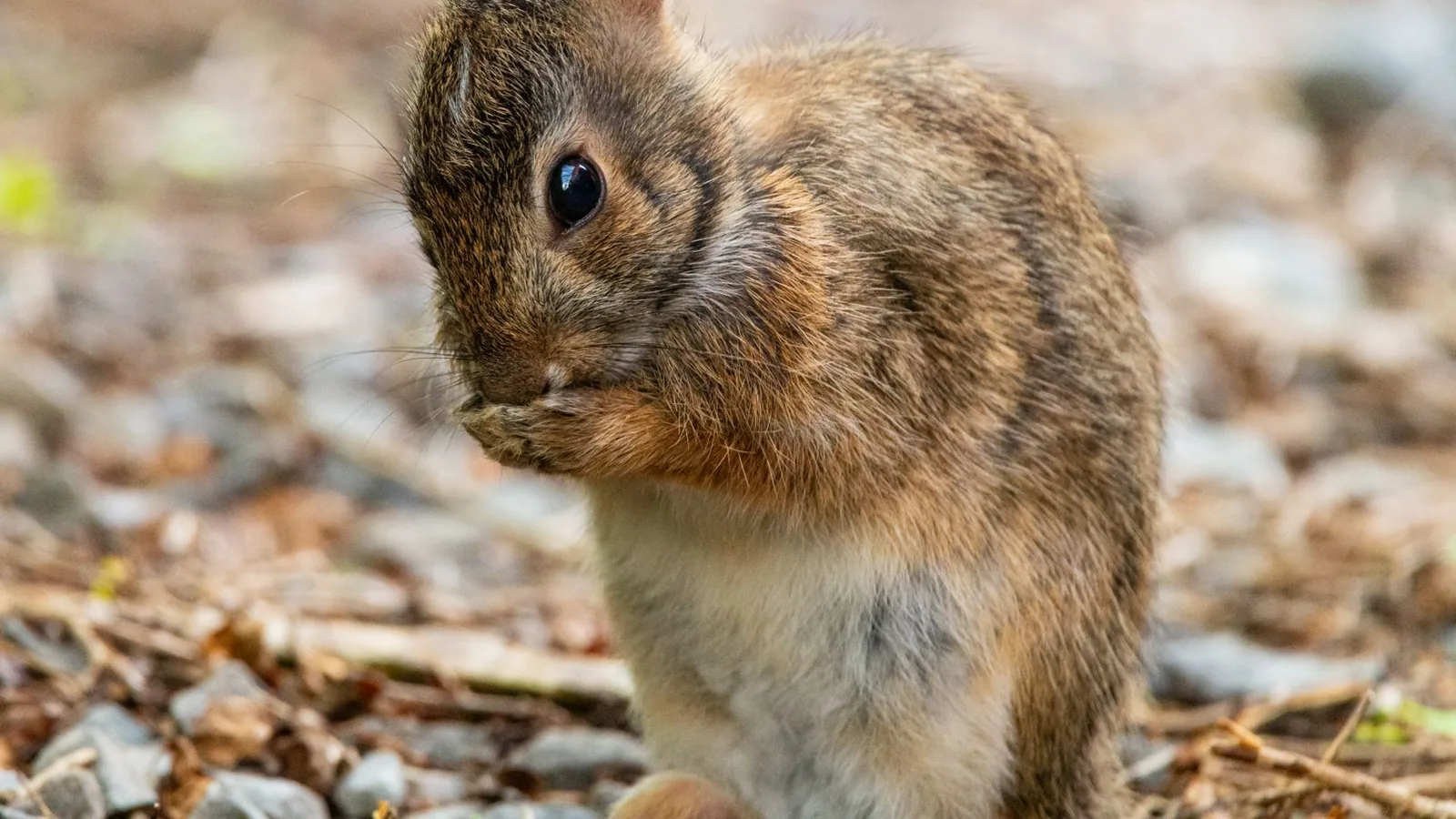
Healthy gerbils groom themselves and need very little hands-on help from their owners. A complete gerbil grooming routine comes down to three things: providing the right environment so your gerbil can maintain its own coat, trimming nails only when they overgrow, and running a short skin and coat check every week so you catch problems early. Most of the work is observational rather than mechanical. If your gerbil is active, eating well, and keeping its own coat tidy, your job is to watch, support, and intervene only when something changes.
This guide walks through each part of that routine, including how to groom a gerbil without causing stress, how to trim gerbil nails safely, and which gerbil skin problems warrant a veterinary visit.
Gerbil Grooming at a Glance
| Grooming task | How often | What you do |
|---|---|---|
| , - | , - | , - |
| Visual coat and skin check | Weekly | Look for bald patches, redness, scabs, lumps, dirt, or wetness around the tail and ventrum |
| Sand bath offer | Several times per week or on a rotating schedule | Provide a dish of appropriate sand for a limited period, then remove it |
| Nail check | Every 2 to 4 weeks | Look for nails curling, catching on bedding, or growing into the pads |
| Nail trimming | Only when needed | Trim the clear tip well away from the pink quick, one or two nails per session if your gerbil is tense |
| Deep environment refresh | Per your normal cleaning routine | Keep deep, diggable substrate so your gerbil can perform natural digging and self-care behaviors |
| Full hands-on exam | Monthly, plus whenever something looks off | Check teeth alignment, ventral scent gland, weight trend, and coat condition |
This article is educational and is not a substitute for veterinary diagnosis or treatment.
Why Gerbil Grooming Matters
Gerbils are fastidious animals. In a well-set-up home they spend part of every day grooming themselves, and their coat condition is one of the most reliable signals of how they are doing overall. That is why grooming matters even though gerbils mostly groom themselves. A dull, greasy, patchy, or overgrown coat is often the first visible sign that something is wrong with the environment, the diet, or the animal itself.
The welfare connection goes both directions. Research on Mongolian gerbils shows that the way they are housed directly shapes their stress levels and behavior. Gerbils deprived of the chance to burrow developed stereotypic digging, and simple changes to housing, including a burrow system and adjusted routines, measurably improved their welfare [1]. A gerbil that cannot dig, hide, and perform its natural maintenance behaviors is a stressed gerbil, and stress shows up in the coat and skin before it shows up anywhere else.
Owner behavior matters just as much. A large survey of small mammal owners found that most are willing and able to provide good welfare but that suitable enclosures are the biggest barrier, and that owners rely heavily on behavioral indicators to judge health at home [2]. Grooming checks are exactly that kind of behavioral indicator. When you run a weekly skin check, you are doing the same thing veterinary behavior researchers consider the foundation of at-home welfare assessment: watching the animal, not just the equipment.
How Often to Groom a Gerbil
For most healthy adult gerbils, a light-touch schedule is correct.
- Weekly: a visual and hands-on skin and coat check lasting two to three minutes.
- Several times per week: access to a sand bath on a rotating or scheduled basis, removed afterward.
- Every two to four weeks: a nail check. Trim only if nails are visibly long, curved, or catching.
- Monthly: a more complete check including the ventral scent gland, teeth visibility, and body condition.
- As needed: spot care such as removing soiled bedding stuck to the coat or assisting an elderly or arthritic gerbil that can no longer reach its own hindquarters.
How often to groom a gerbil changes with age and health. Young, active gerbils on good substrate often never need a nail trim and only need their weekly checks. Senior gerbils, overweight gerbils, and gerbils recovering from illness groom themselves less effectively, so their owners take on more of the work. If you find yourself brushing, trimming, or cleaning your gerbil more than once or twice a month, treat that as a signal to investigate the underlying cause rather than a routine to normalize.
Handling: The Foundation of Every Grooming Session
Before you touch a nail or a coat, you need a gerbil that tolerates your hands. Gerbils are quick, jumpy, and sensitive to restraint, and a frightened gerbil is far more likely to injure itself or you than a calm one.
Positive reinforcement makes this dramatically easier. In a study of Mongolian gerbils, a 10-day clicker training protocol taught the animals to voluntarily approach and interact with a human hand in exchange for food rewards, and the training was fast, efficient, and well tolerated [3]. You do not need a clicker or a formal protocol to use the same principle at home. Pair your hands with food, let the gerbil approach you rather than chasing it, and keep early sessions short.
Practical handling rules:
- Never grab a gerbil from above. Scoop from underneath with both hands cupped.
- Never restrain a gerbil by the tail. The skin of a gerbil tail is fragile, and degloving injuries of the tail are a recognized emergency in this species, as described in the Merck Veterinary Manual's exotic and laboratory animal resources. Tail skin that slips off cannot be replaced, and affected tails often require surgical amputation.
- Work over a soft surface or inside a low-sided container so a startle jump cannot end in a fall.
- End every session on your terms but at a calm moment, never mid-struggle. If the gerbil is panicking, stop and try again later.
- For tense gerbils, do one small task at a time. Check the coat one day, look at the nails another day.
If your gerbil never calms down during handling, that itself is information. Discuss low-stress handling and whether an examination under sedation would be appropriate with your veterinarian rather than forcing restraint at home.
Coat Care: Sand, Brushing, and Never Water
Sand baths are the core of gerbil coat care
Gerbils come from arid environments and maintain their coats by rolling in fine sand, not by being washed. Water strips natural oils from the fur, chills a small body rapidly, and causes enormous stress. Never bathe a gerbil in water. Instead, offer a heavy, tip-resistant dish with a shallow layer of sand designed for small animals and let the gerbil roll on its own schedule for a limited time, then remove the sand dish so it does not become a toilet. The Merck Veterinary Manual's exotic animal resources describe sand bathing as part of normal gerbil husbandry, and many owners offer it several times a week.
Brushing
Most gerbils never need brushing. A soft-bristled toothbrush or small animal brush can help in three situations:
- An elderly gerbil that no longer grooms its rump thoroughly.
- A gerbil recovering from illness or surgery.
- A long-haired gerbil that collects bedding or debris in its coat.
Brush gently in the direction of hair growth for a few seconds at a time. If your gerbil objects, stop. A matted or greasy coat that does not resolve with sand and light brushing is a reason for a veterinary appointment, not a reason to scrub harder.
What a healthy gerbil coat looks like
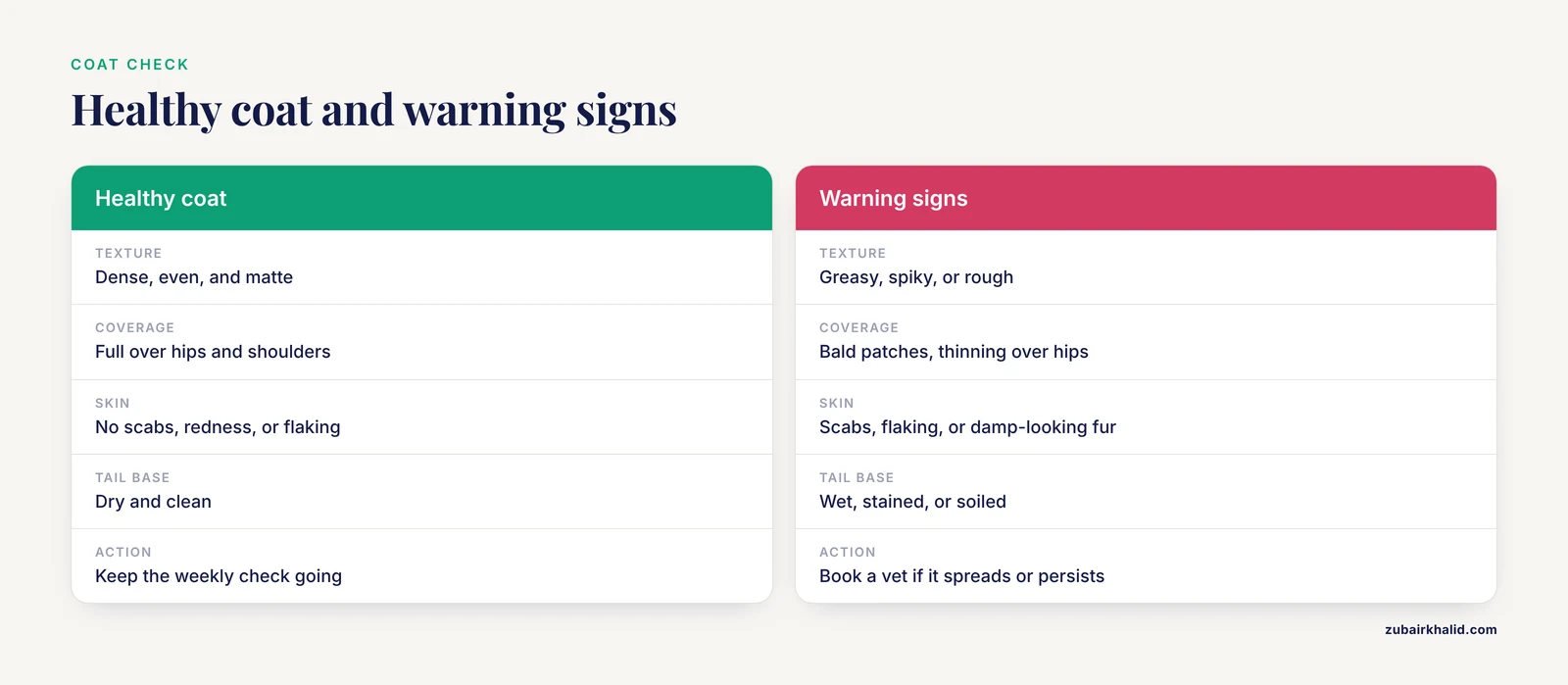
A healthy coat is dense, even, and matte. Warning signs include greasy or spiky fur, bald patches, thinning over the hips or shoulders, a wet or stained tail base, scabs, or a rough coat combined with reduced activity. Owners in the small mammal welfare survey relied on exactly these kinds of behavioral and appearance markers to judge their animals' health at home, which supports making this quick visual scan a fixed weekly habit [2].
How to Trim Gerbil Nails
Most gerbils wear their nails down naturally by digging in deep substrate. Overgrowth becomes a real problem mainly in older gerbils, less active gerbils, and animals kept on bedding that is too soft or too shallow. Overgrown nails curl, catch on fabric and bedding, and can eventually grow into the footpad.
What you need
- A small animal or kitten nail trimmer with a fine blade, or human baby nail clippers for very small nails.
- Styptic powder or cornstarch to stop bleeding if you cut the quick.
- A towel for gentle restraint.
- A light source so you can see the quick.
- A treat for afterward.
Step-by-step approach
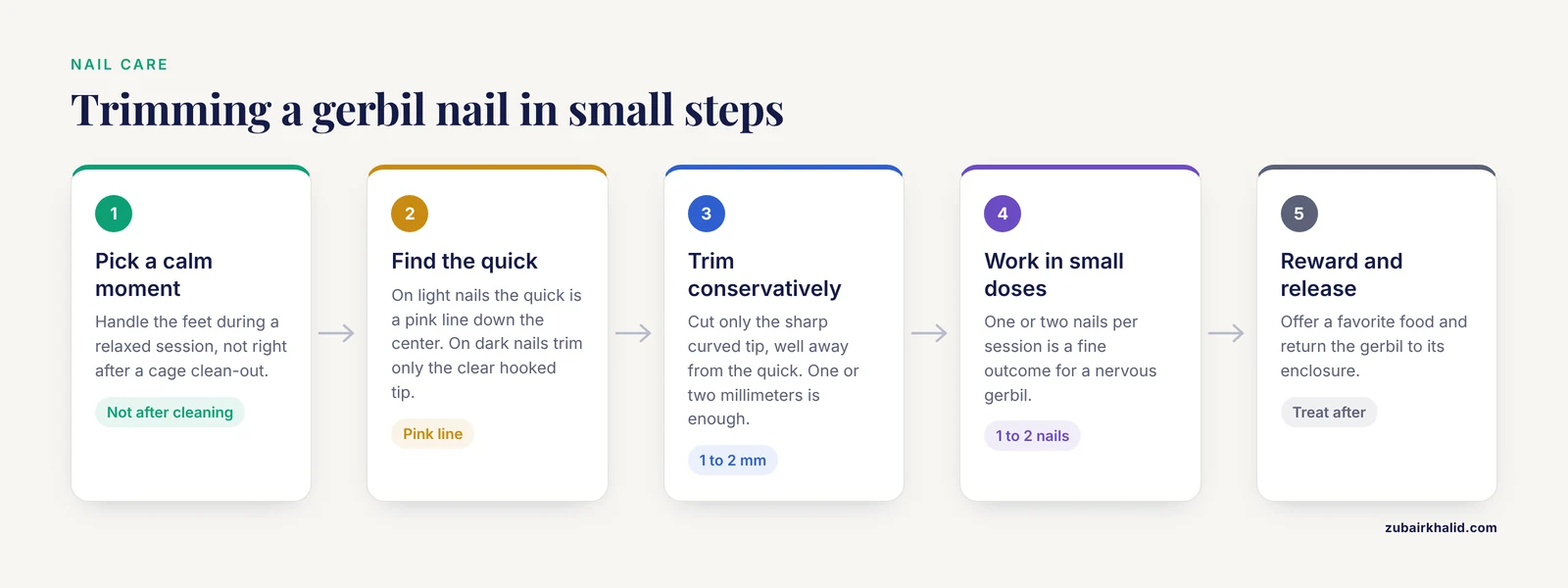
- Pick a calm moment. Handle the feet during a relaxed handling session, not after a cage clean-out when the gerbil is already aroused.
- Identify the quick. In gerbils with light nails, the quick appears as a pink line running down the center of the nail. In dark-nailed gerbils, trim only the clearly transparent hooked tip.
- Trim conservatively. Cut only the sharp curved tip, well away from the quick. Removing one or two millimeters is enough for a first session.
- Work in small doses. You do not have to finish all four feet in one session. One or two nails per session is a fully acceptable outcome for a nervous gerbil.
- Stop bleeding immediately if needed. If you nick the quick, apply pressure with styptic powder or cornstarch and keep the gerbil calm on clean bedding. A drop of blood on a tiny animal matters, and persistent bleeding is a veterinary call.
- Reward and release. Offer a favorite food and return the gerbil to its enclosure.
Prevention beats trimming
Because digging is how gerbils keep their nails short, the best nail care is environmental. Give your gerbil deep, diggable substrate so it can express normal burrowing behavior. This does double duty for welfare, since gerbils denied the opportunity to dig in a burrow-like environment developed stereotypic digging, a recognized behavioral abnormality [1]. Deep substrate supports both the behavior and the manicure.
If your gerbil's nails grow fast despite good substrate, ask your veterinarian to demonstrate trimming on your animal during a routine visit. A single demonstration on your own gerbil is worth more than any written description, and it lets the clinic see your pet's feet before there is a problem.
Skin Checks and Common Gerbil Skin Problems
The weekly skin check is the highest-value part of gerbil grooming. Run your eyes and then your fingertips over the whole animal and check systematically:
- Head and face: barbering around the face, whisker loss, wounds around the ears.
- Neck and shoulders: ruffling or hair loss from barbering by a cagemate.
- Ventrum: the ventral scent gland, a pigmented oval patch on the belly that is more prominent in males. Check it monthly for enlargement, ulceration, or discoloration. Scent gland tumors are among the most common tumors of gerbils, particularly older animals, as described in the Merck Veterinary Manual's exotic animal resources, and early detection matters because surgical removal is far simpler on a small mass.
- Tail base and hindquarters: wetness, staining, or fecal soiling, which can indicate diarrhea or mobility problems.
- Feet: swelling, redness, overgrown nails, or sores on the pads.
- General: lumps, scabs, flaking, or a coat that looks damp.
Gerbil skin problems owners most often report
Common causes of skin disease in gerbils include Barbering by cage mates or self barbering, parasitic mites, fungal infection such as dermatophytosis, allergic or irritant reactions to bedding, scent gland disease, and fight wounds in incorrectly paired animals. Two points deserve emphasis.
First, do not guess and treat. Skin conditions in rodents look alike from the outside, and the treatment for mites is wrong for a fungal infection and harmful if applied incorrectly. Gerbils are established laboratory models for skin-involving parasitic diseases, and researchers studying skin-dwelling filarial infections in gerbils have documented how differently these disease processes can behave even within closely related host species [4]. The practical takeaway for an owner is not academic. Visible skin changes are a diagnostic problem, and diagnosis requires a veterinarian who can examine the animal, perform skin scrapings or fungal testing, and prescribe species-appropriate treatment.
Second, unusual skin lesions can occasionally reflect disease processes with wider significance. Cutaneous leishmaniasis, a parasitic skin disease transmitted by sand flies, circulates in wild gerbil populations in endemic regions, where great gerbils serve as the main reservoir host of Leishmania major [5]. This is not a routine pet gerbil disease, and you should not panic about it, but it illustrates a broader truth. Skin lesions in any rodent are signs that need professional interpretation, and a veterinarian who sees the lesion in person can rule out infectious causes that no home remedy should be aimed at.
When the coat is the symptom and housing is the cause
Some coat problems trace back to the enclosure rather than the animal. Overcrowding and incompatible pairings produce barbering and wounds. Unsuitable bedding produces irritant dermatitis. An enclosure without deep burrowable substrate produces chronic stress, and chronic stress in gerbils is documented to express itself through abnormal behaviors such as stereotypic digging and bar chewing [1]. If a skin or coat problem keeps returning, evaluate the substrate, the bedding material, the social grouping, and the space provided before assuming the animal itself is the problem. For perspective on how often housing falls short, the multi-species owner survey found that suitable enclosures were the primary barrier to good welfare even among motivated owners [2].
What Happens at the Veterinary Clinic
When a skin or coat problem goes to the clinic, expect a hands-on examination, a discussion of your housing and diet, and possibly diagnostic tests. Skin scrapings, fungal cultures, and cytology of masses are the standard first-line tools. If a gerbil is systemically ill, a small blood sample may be collected to assess blood cell parameters, and published veterinary resources describe standardized approaches to blood collection and hemogram interpretation in gerbils alongside hamsters, mice, and rats [6]. Because gerbils are small, these samples are precious and are taken by trained staff, which is one more reason not to delay a visit until the animal is debilitated.
Ask your veterinarian two practical questions at any grooming-related visit: whether the problem needs medication, and whether any part of your enclosure setup should change. Both answers usually matter.
Common Gerbil Grooming Mistakes
- Water bathing. The single most common and most dangerous mistake. Water baths chill gerbils, strip coat oils, and cause panic. Sand is the answer to a dirty coat.
- Grabbing the tail. Even a gentle tail hold can cause a degloving injury. Always scoop the body.
- Chasing the gerbil around the cage to groom it. Stress during capture can outweigh the benefit of the task. Use a transfer cup and build cooperation with food rewards instead.
- Trimming nails too aggressively. Cutting to the quick once makes a gerbil afraid of foot handling for months. Trim less, more often, and stop early.
- Ignoring a coat change because the gerbil seems to eat normally. Rodents mask illness. A rough coat plus reduced grooming deserves a check even when appetite appears intact.
- Replacing substrate depth with grooming. If nails overgrow and the coat looks rough because the gerbil cannot dig and burrow, fix the enclosure. Grooming cannot substitute for husbandry.
- Treating skin problems with over-the-counter products made for cats, dogs, or birds. Small rodents are highly sensitive to many topical agents. Never apply a product to a gerbil unless your veterinarian has approved it for this species.
Supplies Checklist
- Small animal sand or dust-free bathing sand and a heavy, shallow, tip-resistant dish
- Soft-bristled brush or clean soft toothbrush
- Small animal or baby nail clippers with a fine blade
- Styptic powder or plain cornstarch
- Unscented paper towels and a soft towel for gentle containment
- A low-sided container or travel carrier for handling sessions
- Treats for positive reinforcement handling
- Good lighting for nail and skin inspection
Avoid scented dusts, powders marketed for chinchillas with fine particle sizes that can irritate small airways, and any medicated shampoo or spray not prescribed for your gerbil.
Limitations and When to Contact a Veterinarian
Every gerbil is an individual, and age, genetics, social history, and husbandry all shape what normal grooming looks like for your particular animal. Use this guide as a framework for observation, and bring anything abnormal to an exotic animal veterinarian rather than waiting to see whether it resolves on its own.
Contact a veterinarian promptly if you observe any of the following:
- Any skin lesion that spreads, bleeds, oozes, or fails to improve within a few days
- A lump anywhere on the body, especially on the ventral scent gland of a middle-aged or older gerbil
- Hair loss that is progressing, or barbering with visible wounds
- A wet, stained, or soiled tail base or hindquarters
- Bleeding after a nail trim that does not stop with pressure
- A broken, bleeding, or degloved tail, which is an emergency
- A rough coat combined with reduced activity, weight loss, or reduced eating
- Scratching intense enough to break the skin
- Any gerbil that panics repeatedly during handling, which may indicate pain or illness rather than a temperament problem
Find a veterinarian with small mammal or exotic pet experience before you need one urgently, because not every general practice sees gerbils.
Frequently Asked Questions
How often should I groom my gerbil?
For a healthy adult gerbil, run a weekly skin and coat check, offer sand baths several times per week, and check nails every two to four weeks. Increase the hands-on work only for senior, overweight, or unwell gerbils that cannot groom themselves adequately.
Do gerbils need sand baths?
Yes. Sand bathing is a natural grooming behavior for gerbils and is described in standard exotic animal husbandry resources such as the Merck Veterinary Manual. Offer a shallow dish of appropriate sand for a limited period several times a week, then remove it.
Can I give my gerbil a water bath?
No. Water baths strip the natural oils from a gerbil's coat, chill a very small body rapidly, and cause severe stress. Use sand instead, and keep the enclosure clean so the coat stays clean.
How do I trim gerbil nails safely?
Use fine small animal clippers, trim only the transparent hooked tip well away from the pink quick, and stop after one or two nails if your gerbil becomes tense. Have styptic powder ready, and ask your veterinarian for a demonstration if you are unsure.
What are the most common gerbil skin problems?
Barbering, mites, fungal infection such as ringworm, bedding irritants, fight wounds, and scent gland disease are among the most common causes of gerbil skin problems. Do not self-treat, because these conditions look similar but need different treatments. Have a veterinarian diagnose the cause.
Why is my gerbil losing patches of fur?
Patchy fur loss is most often barbering from a cage mate or self barbering driven by stress or an unsuitable environment, but mites and fungal infection cause hair loss too. Check the social setup and housing first, then have the skin examined if the loss progresses or the skin looks broken.
Is it safe to pick up my gerbil by the tail?
No. Never hold a gerbil by its tail. The tail skin is fragile and can slough off, an injury that usually requires surgical amputation. Always scoop the gerbil from underneath with both hands.
When should a skin or coat problem go to the veterinarian?
Seek veterinary care for spreading or bleeding lesions, any lump, progressive hair loss, a wet or soiled tail base, a rough coat with reduced activity, or any bleeding that does not stop with pressure. Early visits are shorter, cheaper, and easier on the gerbil than late ones.
Sources
- Refinement of gerbil housing and husbandry in the laboratory.
- Small mammal owners' experiences of housing challenges and animal welfare: A COM-B and word frequency analysis.
- Enhancing Gerbil Welfare Through Positive Reinforcement Training in Research Environments.
- Differential susceptibility of Onchocerca ochengi adult male worms to flubendazole in gerbils and hamsters.
- Leishmania spp Infection in Patients and Great Gerbils (Rhombomys opimus) in a High-Risk Focus of Zoonotic Cutaneous Leishmaniasis in Central Iran: A Microscopic and Molecular Survey.
- Hematologic Assessment in Pet Rats, Mice, Hamsters, and Gerbils: Blood Sample Collection and Blood Cell Identification.