Best Guinea Pig Pellet Brands Compared
By Dr. Zubair Khalid, DVM, MS, PhD ·
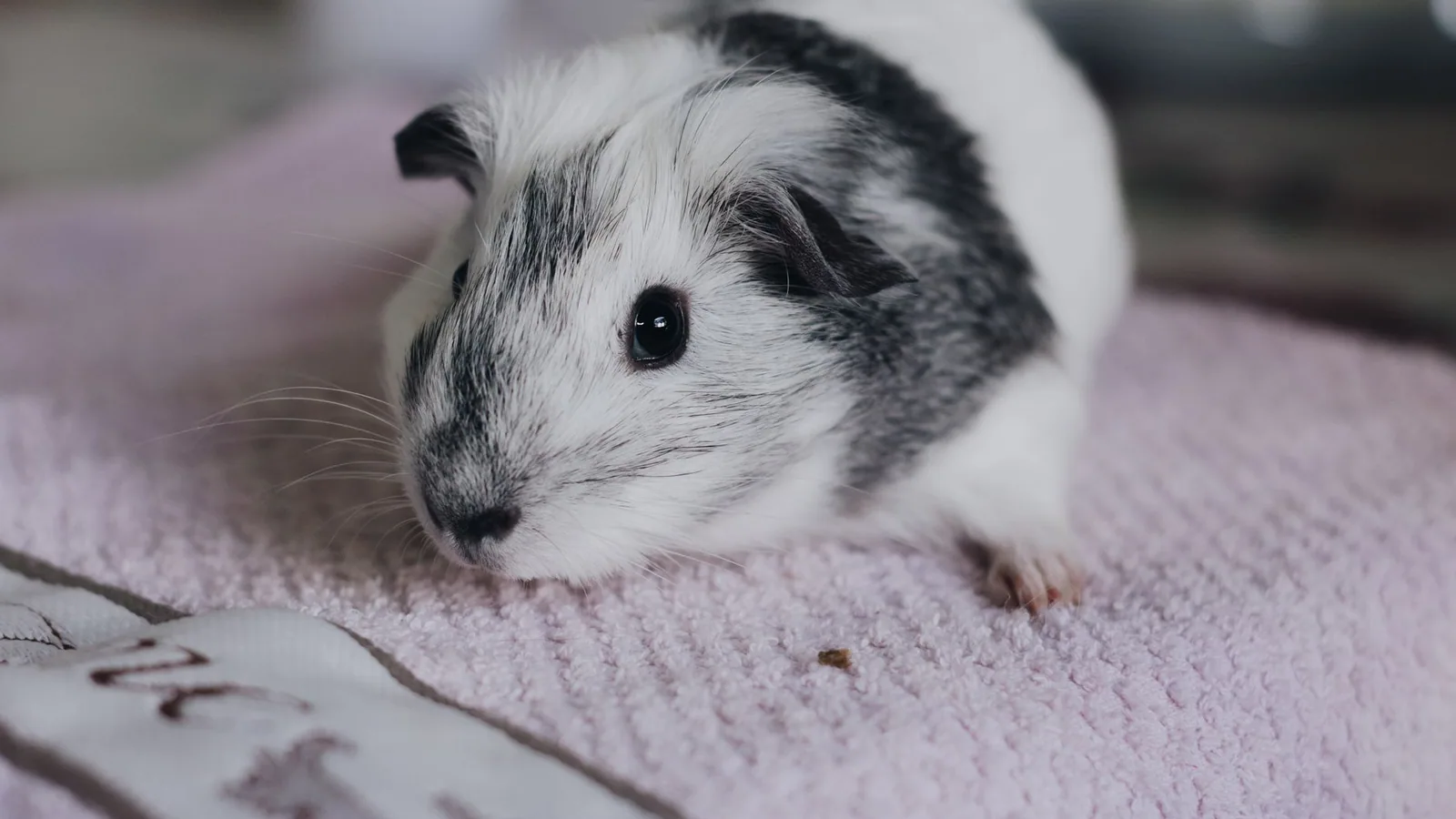
A guinea pig pellet is the fortified, measured supplement to a hay-based diet, and the best choice for your animal is a plain, timothy-based adult formula fed in a consistent daily portion, not the bag with the boldest claim on the front. The rule of thumb: buy a uniform, plain pellet built on timothy hay for any guinea pig past adolescence, portion it, and judge every brand by the label criteria in this article rather than by marketing.
Brand names change formulations more often than their packaging suggests, so the most useful comparison is not a list of logos. It is a comparison of the pellet categories every brand falls into, the label features that separate a sound product from a risky one, and the feeding practices that determine whether the pellet helps or harms. This framework works whether you are standing in a pet store aisle or comparing retailers online, and it is the same approach a veterinarian will apply when you ask for a recommendation at your next visit.
This article is educational and is not a substitute for veterinary diagnosis or treatment.
Where Pellets Fit in a Guinea Pig Care Guide
Any complete guinea pig care guide puts grass hay at the center of the diet. Pellets sit second, fresh vegetables third, and clean water always available. Survey data from Norwegian pet guinea pig owners show how this works in real homes: 93.3 percent of owners provided ad libitum hay, 80.6 percent fed a complete extruded or pelleted feed, and nearly 60 percent offered fresh vegetables daily [1]. That pattern, hay first, measured pellets second, vegetables third, is the structure you want regardless of which bag you buy.
Pellets exist for one practical reason. They are the most reliable vehicle for delivering stabilized vitamins and fortified minerals in a measured dose. Hay and vegetables carry most of the fiber and much of the nutrition, but a fortified pellet covers the gaps without relying on an animal to eat a precise salad. This matters because guinea pigs, like humans and unlike rabbits, cannot synthesize their own vitamin C and must consume it in their food. In the Norwegian survey, 63.7 percent of owners never offered a separate vitamin C supplement, presumably because daily vegetables and fortified feed covered the requirement [1]. A fortified pellet is what makes that arrangement safe.
Understanding what the pellet is for also tells you what it is not for. It is not a hay substitute. It is not a treat dispenser. It is not the main volume of the diet. Owners who treat it as the main course, filling the bowl to the brim and refilling it whenever it empties, run into the problems described later in this article: obesity, selective eating, reduced hay intake, and urinary disease.
How Pellet Brands Differ: The Criteria That Decide
Walk down the small mammal aisle and every bag looks similar. The differences that actually matter are few and specific.
Hay base. Some pellets are built on timothy or another grass hay. Others are built on alfalfa, a legume hay that is higher in calcium and energy. This single distinction separates adult formulas from growth formulas, and it is the distinction most closely tied to the urinary health concerns discussed below [2].
Uniformity. A plain pellet is one consistent piece. A mixed or muesli-style bag contains flakes, seeds, colored bits, and extruded shapes. Uniform pellets prevent selective eating. If an animal can pick its favorite pieces and leave the rest, the fortified fraction of the diet may be the fraction it leaves behind.
Fortification. Look for added vitamin C and a clear nutritional adequacy statement. Vitamin C is heat and moisture sensitive, so bag age and storage matter as much as the guarantee on the label.
Form and processing. Both extruded and coarse pelleted complete feeds are common in commercial practice [1]. Either can be sound. What matters more is whether the piece is dense enough that the animal has to chew it, which supports normal tooth function, and whether the brand discloses its ingredient base and feeding rate.
Protein and energy level. Guinea pig protein and energy requirements are real, measurable, and stage dependent. Research on Peruvian guinea pigs fed pelleted diets formulated to National Research Council (1995) recommendations shows that protein retention efficiency is highest under maintenance feeding and falls when animals are fed ad libitum [3]. A separate comparative slaughter study estimated net protein requirements for maintenance and for weight gain in male guinea pigs, establishing that protein needs scale with body weight and physiological state [4]. The practical takeaway for a pet owner is not a number but a principle: growing animals need a higher-protein, higher-energy formula, and adults need a maintenance formula fed in measured amounts. Brands that publish stage-specific formulas make that easier.
Feeding rate on the bag. A brand that prints a grams-per-animal feeding rate is easier to portion correctly than one that prints nothing. In a controlled colony study, adults on a timothy-based pellet received a portioned 1 oz (approximately 28 g) daily ration alongside ad libitum loose timothy hay [2]. That portioned-pellet-plus-free-hay structure is the model most veterinarians recommend for pets.
Best Guinea Pig Pellet Brands Options: Side-by-Side Comparison
The table below compares the pellet categories you will encounter under many brand names. Every bag on the shelf maps to one of these rows.
| Pellet category | Hay base | Best suited for | Pros | Cons | Watch for |
|---|---|---|---|---|---|
| Plain timothy-based adult pellet | Grass hay (timothy) | Healthy adults, the default choice for most pets | Lower calcium, moderate energy, uniform pieces, prevents selective eating | None for most adults. Juveniles and some pregnant animals need a growth formula | Bag age, vitamin C guarantee, feeding rate on label |
| Plain alfalfa-based growth pellet | Legume hay (alfalfa) | Weanlings, juveniles, pregnant or lactating sows under veterinary guidance | Higher calcium and energy for growth, higher protein | Excess calcium and energy for healthy adults | Do not continue past adolescence unless your veterinarian advises it |
| Muesli or mixed feed | Variable, often grain-based | No recommended use in guinea pigs | Palatable, visually varied | Encourages selective eating, fortification left in the bowl, uneven nutrition | Husk and seed fractions left uneaten as evidence of sorting |
| Extruded complete feed | Variable, read the label | Owners who want a fully fortified, uniform product | Consistent piece size, complete fortification, commonly fed by experienced owners [1] | Can be overfed easily because it is palatable | Hay base (grass vs legume) on the ingredient panel |
| Small-batch or natural branded pellet | Variable | Owners prioritizing short ingredient lists | Transparent sourcing in some cases | Fortification and storage quality vary more, dental benefit still limited compared with hay | Whether the formula is stage-appropriate and fortified |
| Medicated or medicated-looking feed | Variable | Only under explicit veterinary direction | Situational in production settings | Inappropriate and unnecessary for most pet adults | Any medication claim without a prescription context |
One category deserves an explicit flag. If you arrived here from a rabbit care checklist, note that rabbit pellets and guinea pig pellets are not interchangeable. The critical difference is vitamin C. A rabbit pellet formulated for a species that synthesizes its own vitamin C leaves a guinea pig without a source it requires. Rabbit owners who add a guinea pig to the household need a separate bag, separate bowl, and separate portion plan.
Timothy-Based vs Alfalfa-Based: The Decision That Matters Most
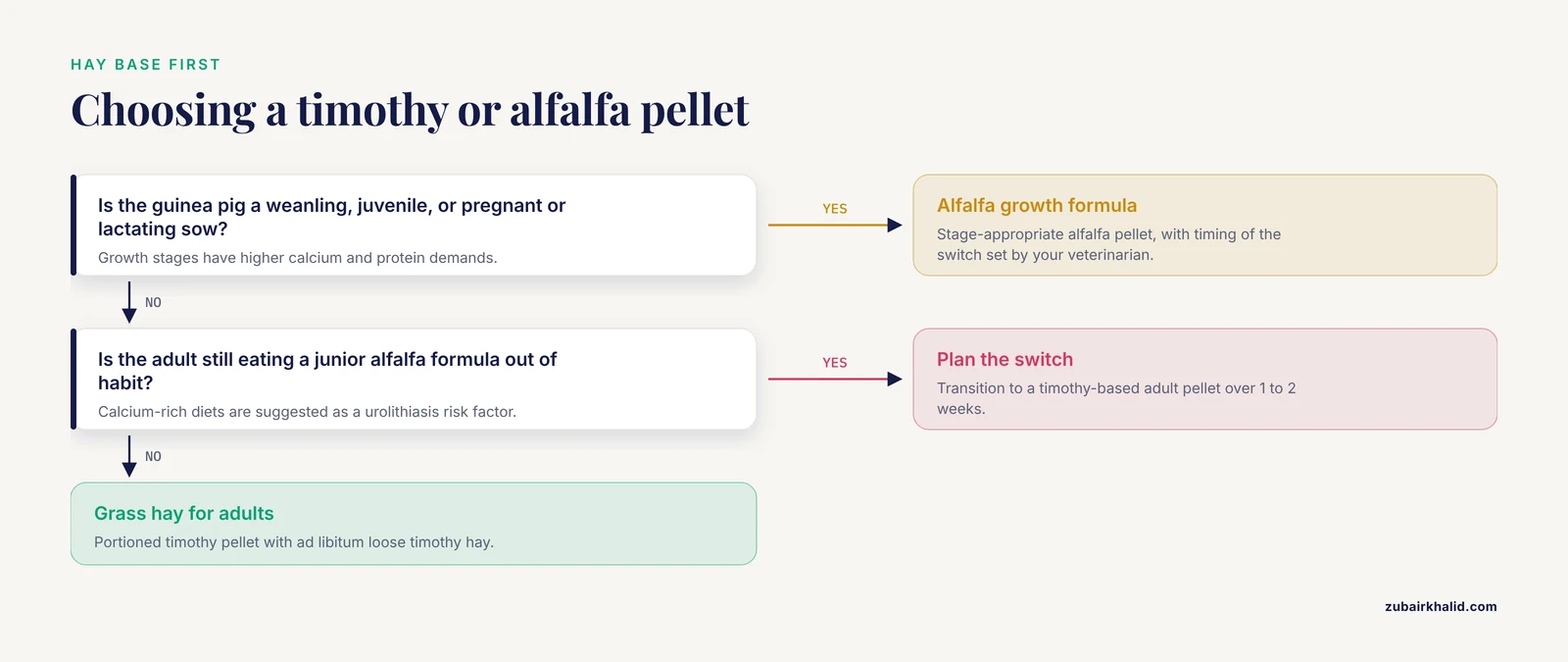
If you compare only one thing on a pellet label, compare the hay base. The clinical stakes are documented.
Urolithiasis, the formation of urinary stones, is a well-documented cause of lower urinary tract disease in guinea pigs, and calcium carbonate is the predominant calculus type reported in the guinea pig urinary tract. A calcium-rich diet has been suggested as a risk factor for urolithiasis, which is why numerous commercially available adult guinea pig diets are formulated to avoid ingredients that are higher in calcium [2].
The clearest evidence comes from a prospective controlled study in a guinea pig colony with a high incidence of urolithiasis. Researchers kept a control group on an ad libitum alfalfa hay-based pellet diet with restricted loose timothy hay, and moved an experimental group to a portioned, 1 oz daily timothy hay-based pellet with ad libitum loose timothy hay, following juveniles for 14 weeks and adults for 26 weeks and collecting longitudinal blood and urine samples to evaluate urinary parameters [2]. The design of that study reflects the current thinking in small mammal medicine: for adults, a grass-hay-based pellet fed in a measured portion, with unlimited grass hay, targets the known urinary risk factors.
The corollary is equally practical. Alfalfa-based formulas are not wrong. They are stage-specific. A weanling or juvenile has different calcium and protein demands than a three-year-old adult, and growth formulas built on alfalfa exist to meet those demands. The mistake to avoid is continuing a junior formula into adulthood out of habit or because an adult animal likes the taste.
Plain Pellets vs Mixed Muesli Feeds
The pros and cons here are asymmetric. Plain pellets have one con, boredom for the owner, and several pros. Muesli feeds have one perceived pro, visual variety that owners enjoy buying, and several cons that show up in the feeding bowl.
Selective eating is the core problem. In a mixed feed, the pieces differ in palatability, energy density, and fortification. A guinea pig that sorts the bowl eats a diet assembled by its own taste preferences rather than by a nutritionist. The fortified, often less palatable fraction is exactly the fraction most likely to be left behind. With a plain pellet, every piece is the same, so every mouthful delivers the same nutrition.
Palatability also drives overconsumption. Research measuring protein and energy utilization in guinea pigs under different feeding regimens found that protein retention efficiency was highest at maintenance feeding, at 83.5 percent, and declined to 73.6 percent in ad libitum-fed animals at 145 days of age [3]. Animals fed freely waste protein and gain fat. A highly palatable muesli offered free-choice pushes an animal toward exactly that ad libitum state. A plain pellet in a measured portion keeps intake at maintenance.
If your guinea pig currently eats a muesli feed and leaves the plain pieces, you are watching selective eating happen in real time. The transition plan later in this article applies.
Fortification and Vitamin C
Vitamin C is the nutrient that most clearly justifies buying a purpose-formulated guinea pig pellet rather than a generic small animal feed. Fortified pellets are designed to carry it in a stabilized form, and the Norwegian owner survey illustrates the two common strategies: among owners feeding daily fresh vegetables, 63.7 percent never gave a separate vitamin C supplement [1]. Vegetables plus a fortified pellet can meet the requirement. Pellets alone, particularly an old bag that has sat in a warm store, may not.
Two practical habits protect you. First, buy bags with a visible date and rotate stock so the pellet is fresh when served. Second, discuss your specific pellet and vegetable routine with your veterinarian, who can assess whether your animal's total vitamin C intake is adequate or whether a supplement belongs in the plan. Signs of deficiency are a veterinary matter, not a do-it-yourself diagnosis.
Dental Considerations: What Pellets Do and Do Not Do for Teeth
Guinea pigs are hypselodont, meaning their cheek teeth grow continuously and depend on wear to stay in balance. Owners often assume pellet texture handles this. The research says otherwise.
A study of macroscopic dental measures in guinea pigs fed pelleted diets with external abrasives of various shapes and percentages, compared with natural whole-leaf diets including low-phytolith lucerne, grass, and high-phytolith bamboo, found that macroscopic dental wear did not categorically differ between whole-leaf and pelleted diets or between diets with internal phytoliths and diets with external silicate abrasives. Tooth wear appeared to be a response to the biomechanical properties of the ingested feed, which broad descriptors like whole-leaf versus pelleted do not adequately capture [5]. Notably, bamboo-fed animals showed the lowest tooth height with deep dentine basins, similar to pellet-fed animals [5].
For a pet owner, the application is straightforward. Pellet hardness is not a substitute for hay. Long-stem grass hay, chewed for hours daily, is the primary driver of normal dental wear and normal chewing behavior. A pellet, however well made, is a compressed food that is consumed in minutes. When you compare brands, do not pay a premium for dental claims on a pellet bag. Spend the difference on better hay.
How Much Pellet to Feed: Portion Control and Body Condition
Portioning is where most pellet problems begin and end. The research offers a concrete model.
In the urinary health study described above, the experimental diet paired a portioned 1 oz daily timothy hay-based pellet with unlimited loose timothy hay [2]. That structure, a capped pellet ration and an open-ended hay rack, is the practical template for adult pets. The cap prevents the pellet from displacing hay, and the open hay supply protects gut motility, dental wear, and normal foraging behavior.
Feeding rhythm matters too. Guinea pigs show diurnal feeding behavior, with peaks at the beginning and end of the light period, and they consume a continual but day-accentuated stream of food, taking in 57 percent of total feed during the light period [6]. They are not meal eaters. They are grazers that expect food moving through the gut around the clock, which is why the hay rack, not the pellet bowl, is the engine of the diet. Their gastrointestinal transit time is approximately 5 hours, a fast cycle that depends on continuous intake [6]. An animal that fills up on pellet and ignores hay slows and disrupts that cycle.
Watch fecal output as your portion gauge. Fecal pellet output mirrors feeding activity in guinea pigs [6]. A dropping output after a diet change is an early warning sign that intake or gut function has shifted, and it warrants a call to your veterinarian before it becomes an emergency.
Worked Scenarios
Scenario one: two healthy adult boars. Choose a plain timothy-based adult pellet from any brand that meets the label criteria. Portion each animal's daily ration rather than free-feeding, since ad libitum feeding reduces protein retention efficiency and promotes weight gain [3]. Keep timothy hay available at all times. Reassess body condition monthly by feel over the ribs.
Scenario two: a 6-week-old weanling joined the family. Growth demands differ. An alfalfa-based junior pellet is the stage-appropriate choice here, paired with alfalfa or mixed hay as directed by your veterinarian. Plan the transition to a timothy-based adult formula around adolescence, and discuss timing at a wellness visit, because the urinary health rationale for grass-hay-based adult diets applies once the animal is grown [2].
Scenario three: an overweight adult on free-choice pellet. The fix is structural, not brand-shopping. Move to a portioned daily ration on the timothy-based pellet model [2], remove muesli components if present, and expand hay access. The efficiency data from feeding-regimen research support maintenance-level feeding over free access [3]. Expect to involve your veterinarian in setting the target portion for your animal's weight.
Scenario four: an owner feeding only vegetables and no pellet. This inverts the intended structure. Vegetables are valuable, and daily fresh feeding is common among experienced owners [1], but a fortified pellet is the controlled, measurable base that covers vitamin and mineral gaps. Reintroduce a plain fortified pellet gradually and review the full diet with your veterinarian.
Common Mix-Ups
Feeding rabbit pellets to guinea pigs. The most consequential error in small mammal feeding. Rabbit and guinea pig care overlap in hay-first structure, which is why a rabbit care checklist looks superficially similar, but the vitamin C requirement divides the two species. Separate products, always.
Keeping an alfalfa formula into adulthood. Junior formulas are for juniors. Adult animals on legume-based pellets carry a dietary pattern associated with urinary risk factors [2].
Free-feeding pellet because the bowl empties. An empty bowl signals that the ration was eaten, not that the animal needed more. Guinea pigs eat continually by design [6], and hay, not pellet, should supply that continual intake.
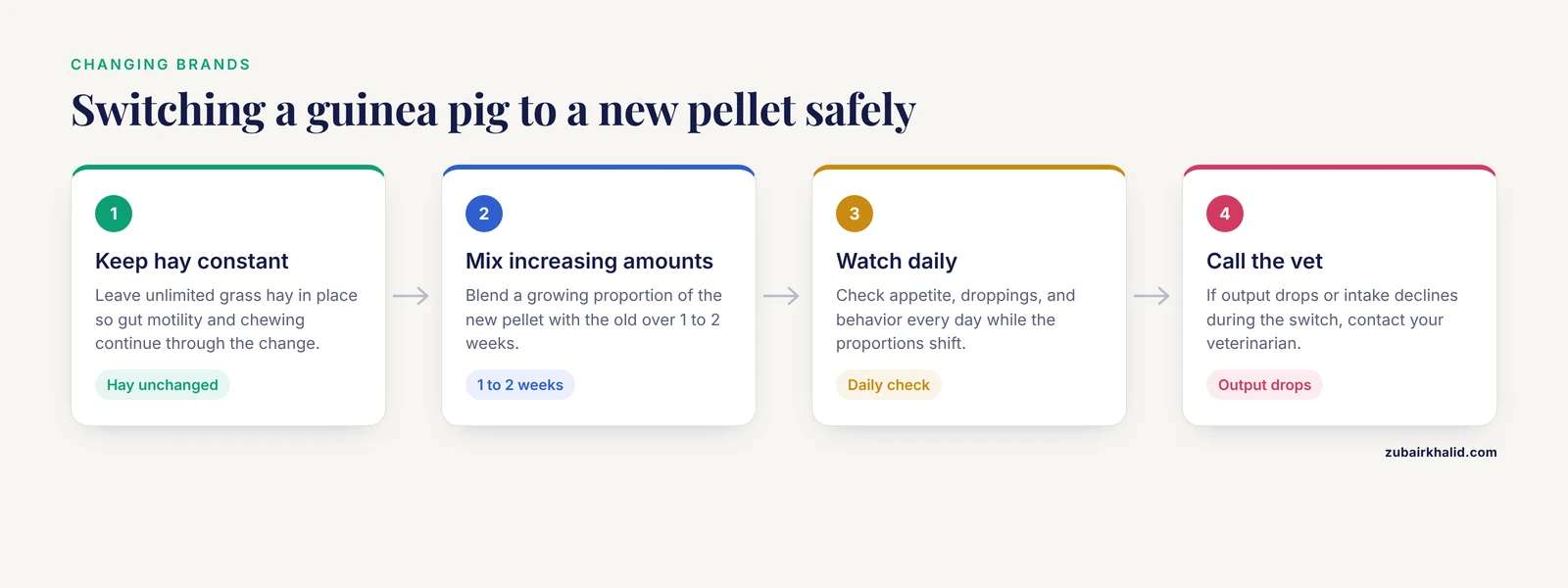
Switching brands overnight. Abrupt diet changes upset herbivore guts. Transition over 1 to 2 weeks by mixing increasing proportions of the new pellet, and monitor droppings and appetite throughout.
Trusting dental or calcium marketing over the ingredient panel. The hay base and the feeding rate tell you more than the front of the bag. Dental wear research shows the pellet-versus-natural distinction is a poor predictor of tooth wear, which depends on the physical properties of the whole diet [5].
Treating pellet refusal as pickiness. A guinea pig that stops eating pellet, hay, or anything else for more than about 12 hours is a veterinary case, not a fussy eater. Gut stasis escalates quickly in this species.
Limitations and When to Contact a Veterinarian
This comparison evaluates pellet categories and label criteria because formulations change, and individual animals differ in age, weight, dental status, pregnancy status, and concurrent disease. Your veterinarian, ideally one with exotic pet experience, can match a specific product to your specific animal. Individual cases need a veterinarian, and no general article replaces that examination.
Contact your veterinarian promptly, and treat these as same-day or emergency criteria rather than watch-and-wait items:
- No appetite or reduced appetite lasting more than roughly 12 hours.
- No fecal output, or dramatically reduced droppings, for more than several hours.
- Straining to urinate, blood in the urine, vocalizing during urination, or a hunched posture, which can indicate urinary stone disease of the type documented in this species [2].
- Drooling, wet chin or chest, or dropping food, which can indicate dental disease.
- Diarrhea, or soft, unformed, or foul-smelling droppings.
- Sudden weight loss, which you can detect by weekly weigh-ins on a kitchen scale.
- Lethargy, hiding, or a reluctance to move.
Guinea pigs are prey animals that mask illness. By the time a pet guinea pig looks sick, it is usually sicker than it looks. Err on the side of the call.
Frequently Asked Questions
What are the best guinea pig pellet brands?
There is no single best brand for every animal, and brand names reformulate often. Compare brands using the criteria in this article: a timothy-based hay foundation for adults, plain uniform pieces, clear vitamin C fortification, a stage-appropriate formula, and a printed feeding rate. Your veterinarian can recommend specific products available in your area.
Should adult guinea pigs eat timothy or alfalfa pellets?
Healthy adults do best on timothy-based pellets fed in a measured daily portion. Alfalfa-based formulas are appropriate for growth stages, but calcium-rich diets have been suggested as a risk factor for the calcium carbonate uroliths that commonly affect guinea pigs, so adults generally move to a grass-hay-based formula.
How much pellet should I feed my guinea pig each day?
A widely used model portions the daily pellet ration, about 1 oz for an adult in a controlled colony study, and provides unlimited grass hay alongside it. Your veterinarian should confirm the exact portion for your animal's weight, age, and body condition.
Can I feed rabbit pellets to my guinea pig?
No. Rabbit pellets are formulated for a species that makes its own vitamin C, while guinea pigs must obtain vitamin C from their diet. A guinea pig fed rabbit pellet exclusively risks deficiency. Keep the products, bowls, and feeding plans separate.
Do guinea pigs need a vitamin C supplement if the pellets are fortified?
A fortified pellet plus daily fresh vegetables can meet the requirement, and many experienced owners do exactly this without a separate supplement. Whether your specific routine needs additional vitamin C depends on the pellet's fortification, its age, and your animal's intake, so review it with your veterinarian rather than guessing.
How do I switch my guinea pig to a new pellet brand safely?
Transition gradually over 1 to 2 weeks, mixing increasing proportions of the new pellet with the old while keeping hay constant. Watch appetite, droppings, and behavior daily, and call your veterinarian if output drops or intake declines during the switch.
Sources
- Nutrition, health and welfare of Norwegian pet guinea pigs.
- Effect of Adopting a Timothy Hay-based Diet at Weaning or in Adulthood on Urinary Tract Parameters in Strain 13/N Guinea Pigs (Cavia porcellus).
- Multivariate evaluation of protein and energy utilization in Peruvian Guinea pigs (Cavia porcellus) under different feeding regimens
- Net Protein Requirements for Maintenance and Weight gain in Male Guinea Pigs (Cavia porcellus) of the Peru Breed
- Macroscopic dental measures in guinea pigs (Cavia porcellus) fed natural and pelleted diets of different abrasiveness: implications for wear and compensatory growth in a hypselodont species
- Good to Know: Baseline Data on Feed Intake, Fecal Pellet Output and Intestinal Transit Time in Guinea Pig as a Frequently Used Model in Gastrointestinal Research