How to Quarantine a New Bearded Dragon: Steps and Timeline
By Dr. Zubair Khalid, DVM, MS, PhD ·
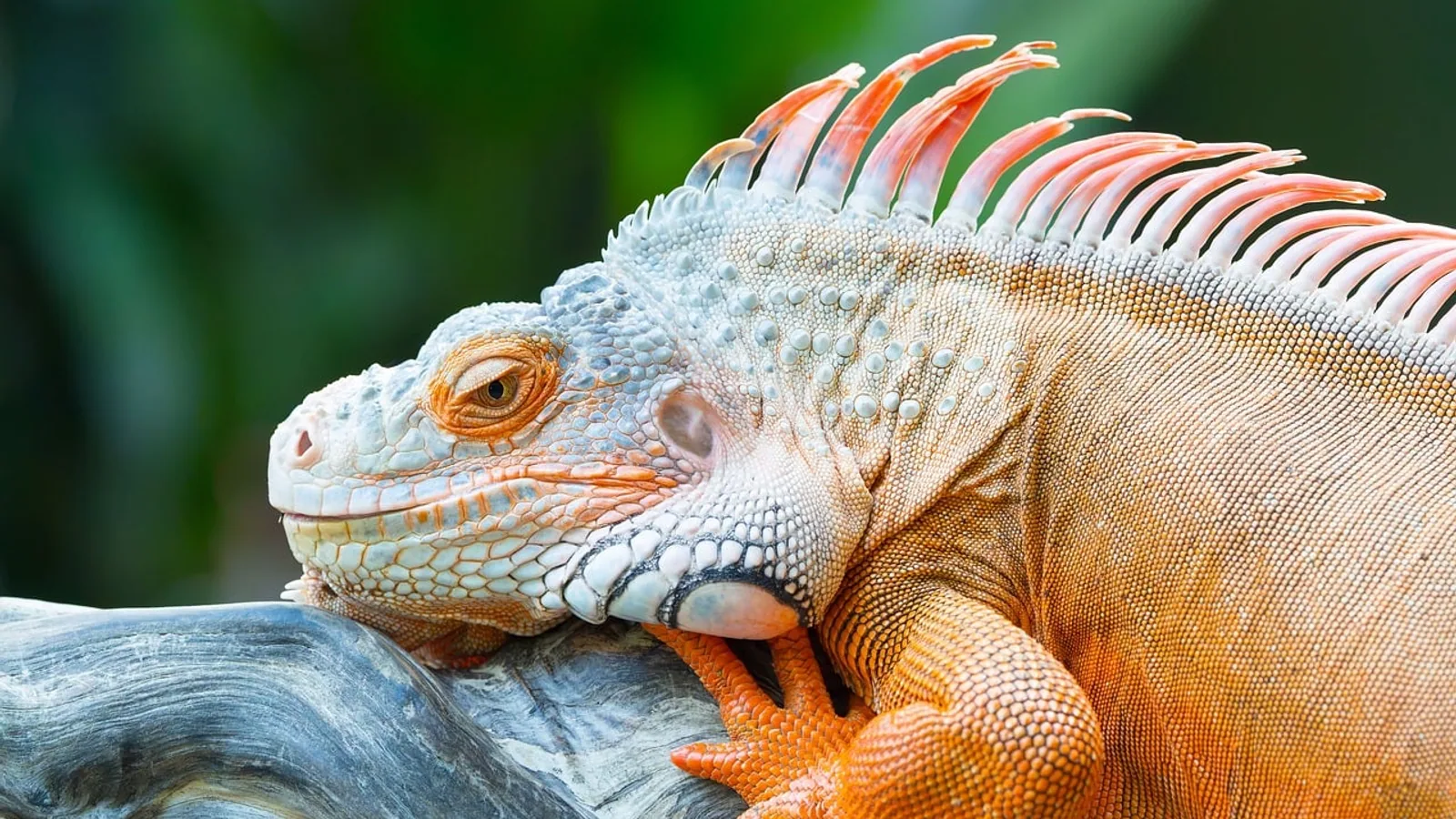
Quarantine a new bearded dragon in a separate room, in a simple and easy-to-disinfect enclosure, for at least 60 days before it shares any airspace, equipment, or handling contact with your existing reptiles. Reptile veterinarians, including guidance published by the Association of Reptilian and Amphibian Veterinarians and the Merck Veterinary Manual, treat 60 days as a minimum, with many clinicians preferring a 90 day period for animals from unknown or high turnover origins. The reason is simple. Bearded dragons can carry adenovirus, microsporidia, pathogenic fungi, and antibiotic resistant bacteria while looking completely healthy, and those infections can devastate a collection before you ever see a symptom [2][11].
This guide walks you through the full process, from the day your dragon arrives through the final days of the bearded dragon quarantine period and the first steps toward introducing new bearded dragons safely.
Why Quarantine Matters for Bearded Dragons
New bearded dragons are the single most common way infectious disease enters a home collection. Young dragons from pet stores, breeders, expos, and online sellers are often shipped in mixed lots, held in high density conditions, and sold during the exact life stage when pathogens spread fastest. A retrospective study of 36 bearded dragon deaths across private and zoological collections found that inflammatory disease, infectious or noninfectious, was the most frequent contributor to death, implicated in roughly 69 percent of cases [1]. Many of those pathogens are silent in the carrier animal.
Diseases spread by new bearded dragons
Understanding what you are keeping out of your collection makes the daily discipline of quarantine easier to sustain.
Atadenovirus (adenovirus). Adenovirus is one of the most significant viral threats in bearded dragons. In a Polish screening study of reptiles presented to exotic animal clinics, adenoviruses were detected primarily in bearded dragons, with 35.2 percent of sampled bearded dragons testing positive [2]. Infected dragons can shed virus in feces for life, spread it to cage mates through direct contact and contaminated surfaces, and pass it to offspring. Many carriers never look sick.
Microsporidia. Microsporidia are obligate intracellular fungi that cause granulomatous disease in bearded dragons. Australian researchers documented Encephalitozoon pogonae infections causing large granulomas in captive bearded dragons, and, critically, detected microsporidia alongside agamid adenovirus 1 in asymptomatic animals across two collections [3]. A dragon that looks vigorous can still be carrying organisms capable of eventually causing weight loss, organ masses, and death.
Nannizziomycosis (yellow fungal disease). Fungal dermatitis caused by Nannizziopsis species produces skin lesions, ulceration, and lethargy. A 2025 study using next generation sequencing on 51 bearded dragons found that the presence of Nannizziopsis does not always cause disease, and that skin disease may involve interactions between fungi and bacteria, including significant positive co-occurrence between Nannizziopsis and Salmonella enterica [4]. This cross kingdom complexity means a visually normal new arrival can still carry fungal organisms onto your surfaces and your other animals.
Antibiotic resistant bacteria. Bearded dragons commonly harbor Enterobacterales in the mouth and cloaca, and some of these bacteria are resistant to critically important antibiotics. A 2025 Portuguese study found third generation cephalosporin resistant Enterobacterales, including ESBL producing strains, in 17.9 percent of apparently healthy pet reptiles sampled [5]. Species identified included Klebsiella aerogenes and Citrobacter freundii. These organisms matter for two reasons. They can cause serious disease in a stressed reptile, and some, like Salmonella, also pose a zoonotic risk to the humans handling the animal, a point the Merck Veterinary Manual emphasizes for all reptile owners.
Bacterial infections of internal structures. Bacteria can localize in surprising places. A case report documented Klebsiella related infectious spondylitis in a two year old female bearded dragon presenting with reduced appetite, decreased activity, and constipation, confirmed by culture from a spinal lesion [6]. Systemic mycobacteriosis has also been reported in an inland bearded dragon [7]. These are not diseases you can rule out by eye, which is exactly why observation time and veterinary baseline testing matter.
Silent co-infection as the norm, not the exception. The Australian microsporidia study is the clearest warning in the literature. Every bearded dragon tested in one collection, all asymptomatic, carried both microsporidia and adenovirus [3]. Quarantine exists precisely because visual health is not evidence of freedom from disease.
At a Glance: Your Quarantine Checklist
Use this table to act today. Detailed instructions for each row follow in the sections below.
| Step | Action | When |
|---|---|---|
| 1 | Set up a dedicated quarantine enclosure in a separate room, ideally before the dragon arrives | Before arrival |
| 2 | Feed, clean, and handle the new dragon last each day, after all other reptiles | Every day, entire period |
| 3 | Book a wellness exam with a reptile veterinarian, including a fecal parasite exam and a discussion of adenovirus PCR testing | Within the first 1 to 2 weeks |
| 4 | Record weight weekly, plus appetite, urination, defecation, and behavior in a log | Every day or every week |
| 5 | Disinfect all quarantine tools, tubs, and surfaces with an appropriate disinfectant, never shared equipment | Every cleaning |
| 6 | Wash hands and change clothes after handling the new dragon or working in the quarantine room | Every session |
| 7 | Watch for red flags, including weight loss, anorexia, diarrhea, skin lesions, and lethargy | Entire period |
| 8 | Release from quarantine only if the dragon remains healthy for the full period and your veterinarian concurs | Day 60 to 90 |
Building Your Quarantine Setup for Bearded Dragons
A good quarantine setup for bearded dragons is deliberately simple. You are not building a showpiece habitat. You are building a hospital style environment that is easy to clean thoroughly, easy to observe, and adequate for the animal's thermal and behavioral needs.
Choosing the room
Pick a room your other reptiles never enter. A spare bedroom, a finished basement corner, or a dedicated office works. The key principle is separation of airspace and traffic. Adenovirus and fungal spores travel on hands, clothing, tools, and dust, so physical distance plus a strict one way traffic pattern (you move from clean animals toward the quarantine animal, never the reverse) provides most of your protection. If you own only the one dragon and plan to add more later, the same room rules still apply to your future animals.
The enclosure
A simple tub or tank in the 40 gallon size range suits most juvenile and adult bearded dragons during quarantine. Solid sided or smooth walled enclosures disinfect far better than wooden vivariums, which absorb moisture and harbor pathogens. For substrate, use plain paper towel, newspaper, or unprinted butcher paper. Loose substrate prevents accurate fecal monitoring, can be ingested, and cannot be disinfected. Replace paper substrate at least every other day, and daily if the dragon defecates on it.
A recent enclosure design study compared naturalistic and standard enclosures for bearded dragons and found that while naturalistic setups offered better thermal heterogeneity, welfare outcomes were equivocal and the animals spent most of the day inactive in one zone [8]. That finding is reassuring for quarantine purposes, because a simpler temporary setup does not inherently compromise the animal if the thermal gradient and lighting are correct. Enrichment can wait until after the quarantine period when the animal moves into its permanent, fully disinfected long term enclosure.
Heating and lighting
Provide a proper thermal gradient with a basking spot appropriate for bearded dragons and a cooler zone at the opposite end, verified with a temperature gun or probe thermometer at substrate level. Use quality UVB lighting on a timer matching a natural day length. Two husbandry points from the research literature are worth knowing during quarantine. First, bearded dragon morphs differ in water loss, with scaleless silkbacks losing evaporative water about twice as fast as wild types and leatherbacks falling between, so hydration monitoring and access to water deserve extra attention for these phenotypes [9]. Second, research on welfare indicators has shown that lizards in lower quality environments show measurable left eye preference during basking, a possible sign of negative affective state [10]. If your quarantined dragon seems to spend its basking time oddly one sided and also refuses food, that combination is worth mentioning to your reptile veterinarian.
Equipment and supplies
Keep everything dedicated to the quarantine animal. Nothing leaves the room until it has been disinfected or discarded.
- A dedicated water dish, food dishes, and feeding tongs
- A dedicated spray bottle and disinfectant for the enclosure, used per label directions with the required contact time before rinsing
- Paper substrate in bulk
- A dedicated digital scale readable in grams for weekly weights
- Disposable gloves for messy cleaning tasks
- A dedicated set of clothes or a smock, or at minimum a clean shirt change after each session
- A quarantine log book or phone note for weights, feeding, and droppings
The Quarantine Routine: Day by Day
Day 0, arrival day
Set the enclosure up completely before the dragon arrives. When you bring the animal home, place it directly into the quarantine enclosure in the quarantine room. Do not stop at the main reptile room, do not let it share a table with other animals for photos, and do not use your main collection's equipment. Offer water. Do not panic if the dragon will not eat for the first few days. Relocation stress suppresses appetite in this species, and a hydrated, warm, undisturbed dragon usually resumes eating within the first week.
Days 1 to 7, the settling window
Keep handling minimal. Spot clean droppings, refresh water, and observe. Your goals this week are to confirm the dragon is thermoregulating normally, drinking, and producing droppings. Book the wellness veterinary exam now if you have not already. A reptile veterinarian can perform a physical exam, a fecal parasite screening, and discuss whether baseline testing for adenovirus makes sense for your situation, since clinic based screening has shown adenovirus to be the leading viral detection in bearded dragons [2]. Baseline bloodwork is often recommended for adult animals and can identify problems such as significant hepatic lipid change before they become clinical, since necropsy based research shows hepatic lipidosis is a common finding in captive bearded dragons, with adult females showing increased grade and severity in one large postmortem series [11].
Weeks 2 to 8, monitoring
This is the heart of the bearded dragon quarantine period. Your job is consistent observation.
- Weigh the dragon weekly on the same day, at roughly the same time of day, and log the grams.
- Record every meal, including what was offered and whether it was eaten.
- Record every dropping, noting color, consistency, and urate quality.
- Photograph the skin weekly, paying attention to the toes, tail tip, vent, and around the mouth. Nannizziomycosis produces lesions that start subtly, and the microbial complexity behind this disease means early skin changes warrant a vet visit rather than a wait and see approach [4].
- Handle briefly a few times per week to build trust, always as the last animal you touch that day.
Cleaning and disinfection protocol
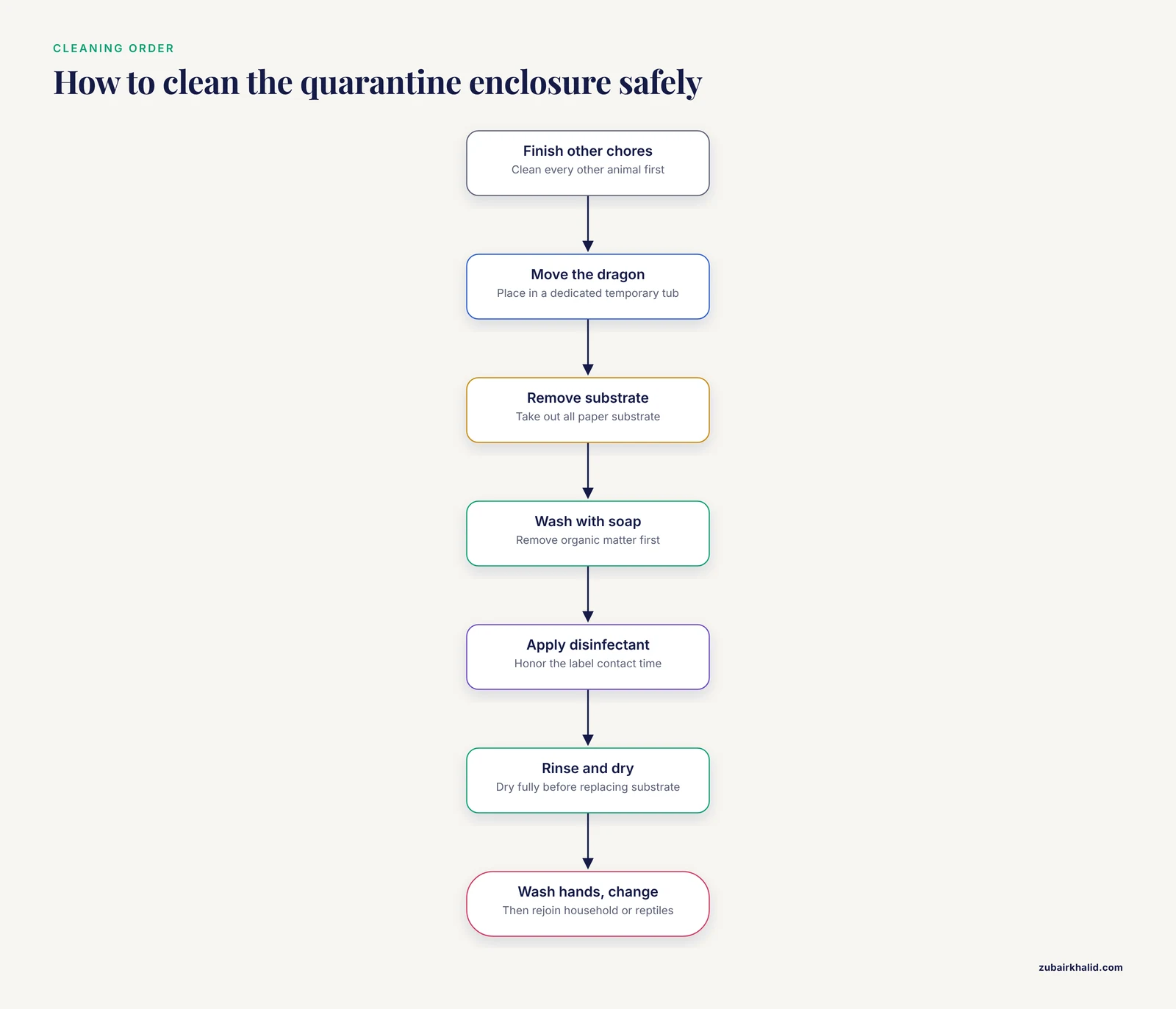
Clean the quarantine enclosure last, after every other animal chore is done. Remove the dragon to a dedicated temporary tub if you need to deep clean. Remove all substrate, wash the enclosure with soap and water to remove organic matter, then apply your disinfectant and honor the label contact time, then rinse and dry fully before replacing substrate and the animal. Disinfect the sink, tub, and any surfaces the enclosure water or waste touched. Wash your hands, then change clothes before rejoining the rest of your household or your other reptiles.
Watching for red flags
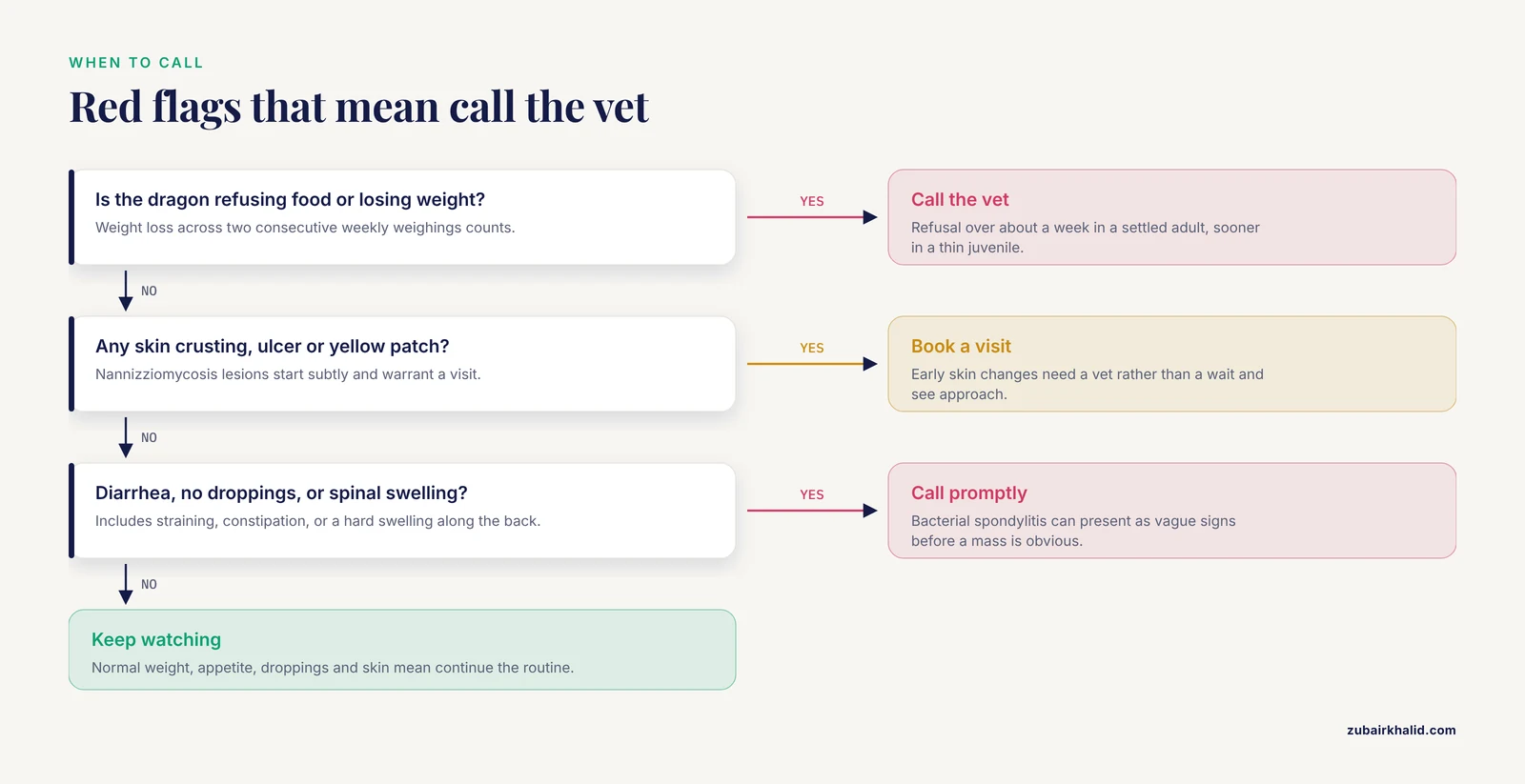
Contact your reptile veterinarian promptly if you observe any of the following during quarantine:
- Weight loss across two consecutive weekly weighings
- Refusal to eat for more than roughly a week in an otherwise settled adult, or sooner in a thin juvenile
- Diarrhea, unusually foul droppings, or lack of droppings
- Any skin discoloration, crusting, ulceration, or yellow patches
- Lethargy, gaping at the mouth, wobbling, or tremors
- Swellings along the spine or anywhere on the body, since bacterial spondylitis can present as vague signs like constipation and reduced activity before a spinal mass is obvious [6]
The Full Timeline at 60 to 90 Days
Here is how the complete bearded dragon quarantine period unfolds in practice.
Before arrival. Quarantine enclosure assembled, heated, and lit. Supplies purchased and staged in the quarantine room. Veterinary appointment tentatively scheduled.
Days 1 to 14. Acclimation and first veterinary visit. Baseline fecal exam completed. Feeding routine established. First weekly weights logged.
Weeks 3 to 6. Steady state monitoring. This is when early disease typically declares itself, because transport stress and the transition to a new environment suppress immune function in carrier animals. Skin photos and weights continue weekly.
Weeks 7 to 9. If every parameter has remained normal, the risk of late emerging clinical disease drops considerably, and the dragon can be scheduled for a final veterinary recheck if your veterinarian recommends one. Release from quarantine happens here, at the 60 day minimum or the 90 day target.
After release. Disinfect or permanently retire quarantine equipment. Paper substrate, disposable tubs, and cheap plastic dishes can simply be thrown away. Hard surfaces and tools should be fully disinfected before storage.
Common Quarantine Mistakes and How to Avoid Them
Shortening the period because the dragon looks great. Visual health means almost nothing in this species. Adenovirus and microsporidia carriers are frequently asymptomatic, and mixed infections in healthy looking animals have been documented in entire collections [3]. The clock exists to allow subclinical shedding to become detectable or to declare itself.
Keeping the quarantine enclosure in the same room as other reptiles. Shared airspace and shared human traffic defeat the purpose. If space truly forces a shared room, at minimum use dedicated equipment, strict one way handling order, and a physical barrier, and accept that your protection is reduced.
Reusing tools between the new dragon and the collection. One pair of feeding tongs used for both animals transfers material directly. Dedicate everything, or move items in one direction only, from quarantine into the trash or the disinfect bucket, never back.
Skipping the fecal exam. Parasites are among the most common and most treatable findings in new reptiles, and a fecal flotation in the first two weeks is inexpensive relative to the cost of treating a parasitized collection.
Cleaning the quarantine enclosure first. Working from clean to dirty and from your established collection to the newcomer is the single most effective habit in household biosecurity.
Handling the new dragon during household social visits. Well meaning guests and children want to hold the cute new lizard. Every extra handler adds a contaminated surface. Politely restrict handling to the primary keeper until quarantine ends.
Introducing New Bearded Dragons Safely
Introducing new bearded dragons safely means, first and foremost, never rushing cohabitation. Bearded dragons are not social animals in the way mammals are, and adult bearded dragons should generally be housed individually regardless of quarantine status. After your new dragon completes its full quarantine period, the safe sequence looks like this:
- Confirm the dragon completed the full bearded dragon quarantine period with normal weight, appetite, droppings, and skin throughout.
- Complete any veterinary testing you and your veterinarian agreed on, and review the results together.
- House the new dragon in its own permanent enclosure, in the main reptile room if you wish, with no physical contact with your established animals.
- Maintain separate equipment permanently. Bearded dragons do not benefit from shared bowls, shared basking rocks, or shared enclosures, and sharing equipment is the main disease bridge between animals.
- If visual introductions matter to you, supervise short visual contact only, with solid barriers and no shared surfaces. Do not practice scent swapping or shared tub time, because adenovirus spreads through feces and contaminated environments, and a moment of contact can undo months of discipline.
Owners sometimes hope a brief, supervised meeting will reveal whether animals get along. Bearded dragons do not need to get along. Territorial display, chasing, and bite injuries are well documented consequences of cohabiting this species, and disease transmission is the quieter risk behind them.
Welfare During Quarantine
Quarantine does not mean neglect. The enclosure still needs a correct thermal gradient, UVB lighting, fresh water, and appropriate food. Weekly handling sessions keep the dragon accustomed to human contact and give you hands on practice detecting body condition changes. The eye use research cited earlier suggests that even reptiles show measurable behavioral signals associated with housing quality [10], so pay attention to basking posture, activity patterns, and responsiveness. A dragon that basks normally, alert and oriented, and that tracks movement in the room is telling you its basics are met.
Limitations and When to Contact a Veterinarian
This article is educational and is not a substitute for veterinary diagnosis or treatment. Individual cases always need a veterinarian, and the right quarantine length and testing plan for your animal depends on its source, age, and your collection goals, so discuss those specifics with a reptile veterinarian, ideally one affiliated with the Association of Reptilian and Amphibian Veterinarians.
Contact a veterinarian promptly, or an emergency exotic animal clinic after hours, if your quarantined dragon shows any of the following:
- Not eating combined with visible weight loss or prominent hip bones and a sunken fat pad area
- Open mouth breathing, gaping, or excess mucus at the mouth
- Any skin ulcer, yellow or discolored patch, or spreading crusting lesion, given the association between Nannizziopsis and bacterial co-pathogens on dragon skin [4]
- Diarrhea lasting more than a couple of days, or blood in the stool
- Constipation, straining, or a hard swelling along the back, which in one documented case signaled Klebsiella spondylitis requiring imaging and culture directed antibiotics [6]
- Sudden lethargy, inability to lift the head or body normally, or tremors
- Any dragon that dies unexpectedly, since necropsy is the only reliable way to identify causes of death in this species, and inflammatory disease was the leading contributor in one large retrospective series [1]
Frequently Asked Questions
How long should a bearded dragon quarantine period last?
Plan on at least 60 days, with 90 days as the safer target recommended by many reptile veterinarians for animals from unknown or high turnover origins. The length reflects how long subclinical infections can take to declare themselves, not how long the dragon takes to settle in.
Can I keep my new bearded dragon in the same room as my other reptiles?
No, if you can avoid it. Separate airspace and separate traffic patterns are the backbone of quarantine, because pathogens travel on hands, clothes, tools, and dust. If a separate room is impossible, use airtight dedication of equipment, handle the new dragon last, and understand your protection is reduced.
What diseases can a new bearded dragon spread to my collection?
The major concerns are adenovirus, microsporidia, Nannizziopsis fungal skin disease, antibiotic resistant Enterobacterales, and parasites. All of these have been documented in bearded dragons, and several have been documented in animals that appeared completely healthy.
Do I need to quarantine a bearded dragon from a reputable breeder?
Yes. Even well run breeding operations can harbor silent infections, and shipping exposes animals to new pathogens during transport and holding. The duration might be shortened with documented negative testing from the breeder, but some quarantine period applies to every new arrival.
Can I handle and bond with my new bearded dragon during quarantine?
Yes, briefly and with hygiene. Short handling sessions a few times per week after the first settling week help the dragon acclimate and give you practice assessing body condition. Always handle the new dragon last, wash your hands afterward, and change your shirt before touching other reptiles.
What supplies do I need for a proper quarantine setup?
A smooth sided enclosure, paper substrate, a correct heat gradient with UVB lighting, dedicated food and water dishes, dedicated cleaning tools and disinfectant, a gram scale, disposable gloves, and a log book. All of it stays in the quarantine room for the full period.
How do I disinfect everything after quarantine ends?
Discard paper substrate and any disposable items, then clean hard surfaces with soap and water to remove organic material before applying a disinfectant according to its label contact time, rinsing, and drying fully. Anything porous, including wood decor from the quarantine enclosure, is safest thrown away.
When can I introduce my new bearded dragon to my existing one?
After the full quarantine period and any agreed veterinary testing, and even then only as separate housing with no shared equipment. Adult bearded dragons should not be cohabited at all, because they are territorial and cohabitation risks both fighting and disease transmission regardless of quarantine history.
Sources
- Pathology of the Bearded Dragon (Pogona vitticeps): a Retrospective Analysis of 36 Cases.
- Detection of Infectious Agents in Samples from Reptiles Presented at Veterinary Clinics in Poland
- MICROSPORIDIA-ASSOCIATED GRANULOMATOUS DISEASE IN TWO AUSTRALIAN COLLECTIONS OF CAPTIVE INLAND BEARDED DRAGONS (POGONA VITTICEPS)
- The cutaneous microbiota and Nannizziomycosis in bearded dragons (Pogona vitticeps): Associations between infectious Nannizziopsis species and common bacterial pathogens.
- ESBL/pAmpC-producing Enterobacterales in common leopard geckos (Eublepharis macularius) and central bearded dragons (Pogona vitticeps) from Portugal.
- Klebsiella sp.-related infectious spondylitis in a bearded dragon (Pogona vitticeps)
- Systemic mycobacteriosis in an inland bearded dragon (Pogona vitticeps)
- Influence of enclosure design on the behaviour and welfare of Pogona vitticeps.
- Bearded dragons (Pogona vitticeps) with reduced scalation lose water faster but do not have substantially different thermal preferences.
- Visual lateralization as an indicator of animal welfare.
- Prevalence and risk factors of hepatic lipid changes in bearded dragons (Pogona vitticeps)