How Long Do Kittens Keep Their Blue Eyes?
By Dr. Zubair Khalid, DVM, MS, PhD ·
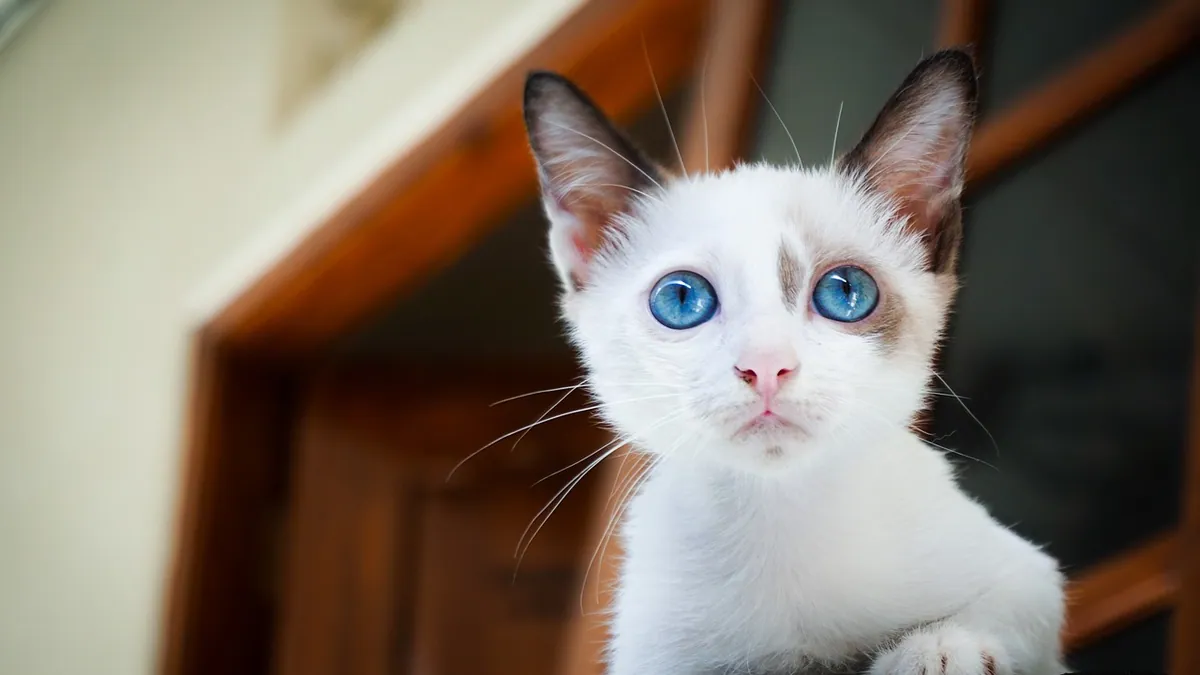
Most kittens are born with blue eyes and keep them for roughly the first 6 to 8 weeks of life. The color then shifts toward the adult shade, and the final eye color is usually settled by about 3 to 4 months of age. So if you are wondering how long kittens have blue eyes, the short answer is weeks, not months, unless the cat carries a specific blue-eye gene.
This article is educational and is not a substitute for veterinary diagnosis or treatment.
Quick Answer
- Kittens open their eyes at about 7 to 14 days old, and those eyes look blue at first.
- The blue color comes from pigment that has not yet migrated into the iris, not from true blue pigment.
- Eye color begins changing around 6 to 8 weeks and is usually final by 3 to 4 months.
- Some cats keep blue eyes for life because of genetics, including certain breeds bred for a trait called dominant blue eyes (DBE) [1][2].
- Any eye that turns cloudy, red, squinty, or suddenly different in color needs a vet visit, not a wait-and-see approach.
How Long Do Kittens Have Blue Eyes? The Normal Timeline
Kitten eye color follows a fairly predictable schedule. The exact timing varies a little between individuals, but the pattern is consistent.
At birth, a kitten's eyes are closed. They open over the first one to two weeks. At that stage the iris looks a flat, cloudy blue. This is sometimes called "baby blue" or "kitten blue."
The blue is a temporary color. The iris has not yet built up melanin, the pigment that gives eyes their adult color. As melanin production ramps up, the eye color darkens and shifts.
Most kittens start showing a color change between 6 and 8 weeks. By 3 to 4 months, the adult color is usually in place. Some cats take a bit longer, and a few keep a greenish or amber tone that keeps deepening slightly into the first year.
How Long Do Kittens' Eyes Stay Blue?
For the average kitten, blue eyes last about 6 to 8 weeks. After that, you will see the color move toward green, gold, amber, copper, or brown. If your kitten is 10 weeks old and still has bright blue eyes, that can be normal, but it is worth watching whether the color is shifting at all.
When Do Cats Lose Their Blue Eyes?
Cats lose their kitten blue when melanin fills in the iris. That process usually finishes by 3 to 4 months. If a cat still has blue eyes as an adult, it is not a leftover kitten trait. It is a genetic feature, and it is common in breeds selected for blue eyes [1][3].
What Controls Eye Color in Cats
Eye color is a pigment story. Melanin in the iris determines whether eyes look blue, green, gold, or copper. Blue eyes happen when there is little or no melanin in the front layers of the iris. Light scatters in a way that looks blue to us.
Genetics decide how much melanin shows up and when. In most cats, the kitten blue fades as pigment arrives. In some cats, a gene keeps pigment low in the iris, so the blue stays.
Researchers have identified several variants in the PAX3 gene linked to blue eyes with minimal white spotting, a trait breeders call dominant blue eyes, or DBE [1][3][2]. This trait has been selected in breeds such as the Altai, Topaz, and Celestial, and it also appears in some British shorthair, British longhair, and Maine Coon lines [1][3][2][4]. Different breeding lines carry different PAX3 variants, which tells us the trait arose more than once [1][2][4].
That matters for owners because it explains why two blue-eyed cats can pass on very different genetics. It also means a blue-eyed adult cat is not automatically a health concern.
Step-by-Step: Checking Your Kitten's Eyes at Home
You can track eye color changes yourself with a simple routine. Do this in good light, ideally near a window during the day.
- Wait until your kitten is calm, sleepy, or just waking up. That is when the pupils are easiest to see.
- Hold your kitten gently and look at the iris, the colored ring around the pupil. Do not stare into the pupil with a bright light.
- Note the color in plain words, such as gray-blue, blue-green, or gold.
- Take a photo every two weeks in the same lighting. Photos make small changes easier to spot than memory does.
- Check both eyes. They should match each other in color and clarity.
- Look at the white of the eye and the eyelids. They should be white, not red or yellow.
- Write down the date and what you saw. Bring this to your kitten's vaccine visits.
This routine takes a minute and gives your vet useful information if anything looks off.
Kitten Eye Color Schedule and Checklist
| Age | What you will likely see | What to do |
|---|---|---|
| Birth to 2 weeks | Eyes closed, then opening. Cloudy blue. | Keep the area clean. Do not force eyes open. |
| 2 to 6 weeks | Blue eyes, pupils responsive. | Watch for discharge, swelling, or squinting. |
| 6 to 8 weeks | Color begins to shift. Blue may fade. | Start photos every two weeks. First vet visit often happens here. |
| 8 to 12 weeks | Green, gold, or amber tones appear. | Continue vaccine visits and eye checks. |
| 3 to 4 months | Adult color usually set. | Ask your vet to confirm both eyes look normal. |
| 4 months and older | Color stable. Blue only if genetically blue-eyed. | Report any new color change, cloudiness, or redness. |
If you are also planning preventive care, it helps to know when do kittens get microchipped so you can bundle that visit with an eye check.
Signs That Something Is Wrong With Your Kitten's Eyes
Normal eye color change is slow, even, and painless. Problems tend to look different. Watch for these signs.
- Cloudiness or a blue-gray haze that appears after the eyes were clear. This can point to fluid buildup or damage inside the eye.
- Redness, swelling, or a swollen third eyelid.
- Squinting, pawing at the eye, or keeping one eye shut.
- Yellow or green discharge, or crusting that returns after you clean it.
- One eye changing color while the other stays the same.
- A pupil that stays large or small in both bright and dim light.
- Bumping into furniture or seeming to see poorly.
- Any eye change in a kitten that also seems sick, sleepy, or is not eating.
Kitten eyes are fragile. Untreated eye problems in young cats can lead to lasting vision loss, so early care matters.
Iris Color Changes in Adult Cats
In adult cats, a new dark spot or patch on the iris deserves attention. Iris hyperpigmentation can progress over time, and in some cats it is linked to feline diffuse iris melanoma, a serious cancer of the eye [5]. In one review of 92 cats with iris hyperpigmentation, 20 (22%) had an eye removed and all 20 were confirmed as feline diffuse iris melanoma on histopathology [5].
That does not mean every freckle is cancer. It means new iris pigment should be examined by a veterinarian and monitored. Early detection gives you more options.
Common Mistakes Owners Make
- Assuming all blue-eyed adult cats are part Siamese. Many breeds and mixed cats carry blue-eye genetics, including lines selected for dominant blue eyes [1][4].
- Expecting the final color at 8 weeks. The iris often keeps shifting until 3 to 4 months.
- Using a phone flash to check color. Bright light distorts what you see and can stress the kitten.
- Ignoring a color change in one eye only. Asymmetry is a reason to call your vet.
- Waiting on a squinting kitten. Eye pain in kittens can worsen quickly.
- Cleaning the eye with anything other than what your vet recommends. Some home remedies irritate the eye.
- Skipping the eye check at vaccine visits. A quick exam catches problems you cannot see at home.
Supplies and Setup That Help
You do not need much to monitor kitten eyes well. A few basics make a difference.
- A soft, clean cloth and warm water for gentle wiping around the eye, only if your vet approves.
- A phone camera for dated photos in consistent lighting.
- A notebook or phone note for color observations and dates.
- A carrier that opens from the top, so vet eye exams are less stressful.
- A quiet room for your kitten to rest. Stress and poor sleep slow healing.
If your kitten is not urinating normally, that is a separate concern. Learn the warning signs in how long can a house cat go without peeing and how long can a healthy cat go without peeing. If you are tracking both bladder and bowel habits, see how long can a cat go without peeing or pooping.
If you are adding a second kitten and the resident cat is unhappy, cat hissing at new kitten: how long will it last explains what is normal.
Limitations and When to Contact a Veterinarian
This guide covers the usual timeline for kitten eye color. It cannot tell you what is happening in your specific kitten's eyes. Individual cases need a veterinarian who can examine the eye directly.
Call your veterinarian the same day if you see:
- Sudden cloudiness in one or both eyes
- Squinting, tearing, or pawing at an eye
- Yellow or green discharge
- One eye a different color than the other
- A pupil that does not react to light
- Any new dark spot on an adult cat's iris [5]
Go to an emergency clinic now if:
- Your kitten's eye looks bulging, ruptured, or badly injured
- Your kitten is in obvious pain, crying, or cannot open the eye
- Both eyes are cloudy and your kitten is bumping into things
- Your kitten is lethargic, not eating, or has a fever with eye signs
Schedule a routine visit if:
- Your kitten is past 4 months and eye color still seems to be changing
- You notice a small iris freckle that was not there before
- You want a baseline eye exam before breeding or before a breed-specific screening
Your veterinarian calculates any medication dose from your kitten's weight and health. Never use leftover eye drops from another pet or from a previous prescription.
Frequently Asked Questions
Do all kittens have blue eyes at birth?
Yes, essentially all kittens start with blue-looking eyes. The color comes from a lack of melanin in the iris, not from blue pigment itself. As pigment develops, the eyes shift to their adult color.
Can a kitten's eyes stay blue forever?
Yes, some cats keep blue eyes for life. This happens when genetics keep melanin low in the iris, including cats with the dominant blue eyes trait linked to PAX3 gene variants [3][2]. Breeds such as the Celestial, Altai, and Topaz were developed around this trait [1].
Why does one eye look a different color than the other?
Different eye colors, called heterochromia, can be inherited and is often harmless. It can also follow eye injury or inflammation. Because a single changing eye can signal disease, have your veterinarian examine it.
Does eye color affect my kitten's vision?
No, iris color does not determine how well a cat sees. Vision depends on the health of the eye's internal structures and the brain. A blue-eyed cat can see just as well as a copper-eyed cat.
Should I worry if my adult cat's eyes are turning darker?
Yes, new or spreading dark pigment on the iris should be checked. Iris hyperpigmentation can progress, and some cases are linked to feline diffuse iris melanoma [5]. A veterinarian can document the spots and monitor them over time.
Related Articles
- How Long Can A House Cat Go Without Peeing
- When Do Kittens Get Microchipped
- How Long Can A Healthy Cat Go Without Peeing
- How Long Can A Cat Go Without Peeing Or Pooping
- Cat Hissing at New Kitten: How Long Will It Last?
- How Long Can A Cat Live Without Peeing
- Do Kittens Have Blue Eyes? When Eye Color Changes
- When Do Kittens' Eyes Change Color? A Timeline for Owners
- When Do Kittens Open Their Eyes? Timeline and Care
References
- Different Founding Effects Underlie Dominant Blue Eyes (DBE) in the Domestic Cat. Animals : an open access journal from MDPI, 2024.
- Dominant blue eyes in Maine Coon cats: New PAX3 variant and updated phenotypic data. Animal genetics, 2025.
- A PAX3 insertion in the Celestial breed and certain feline breeding lines with dominant blue eyes. Animal genetics, 2024.
- Additional PAX3 Variants for Dominant Blue Eyes in Cats. Animal genetics, 2026.
- Iris Hyperpigmentation in Cats: Progression, Globe Retention and Long-Term Survival. Veterinary ophthalmology, 2026.