Dog Cone Guide: How Long to Wear It, Fit, and Alternatives
By Dr. Zubair Khalid, DVM, MS, PhD ·
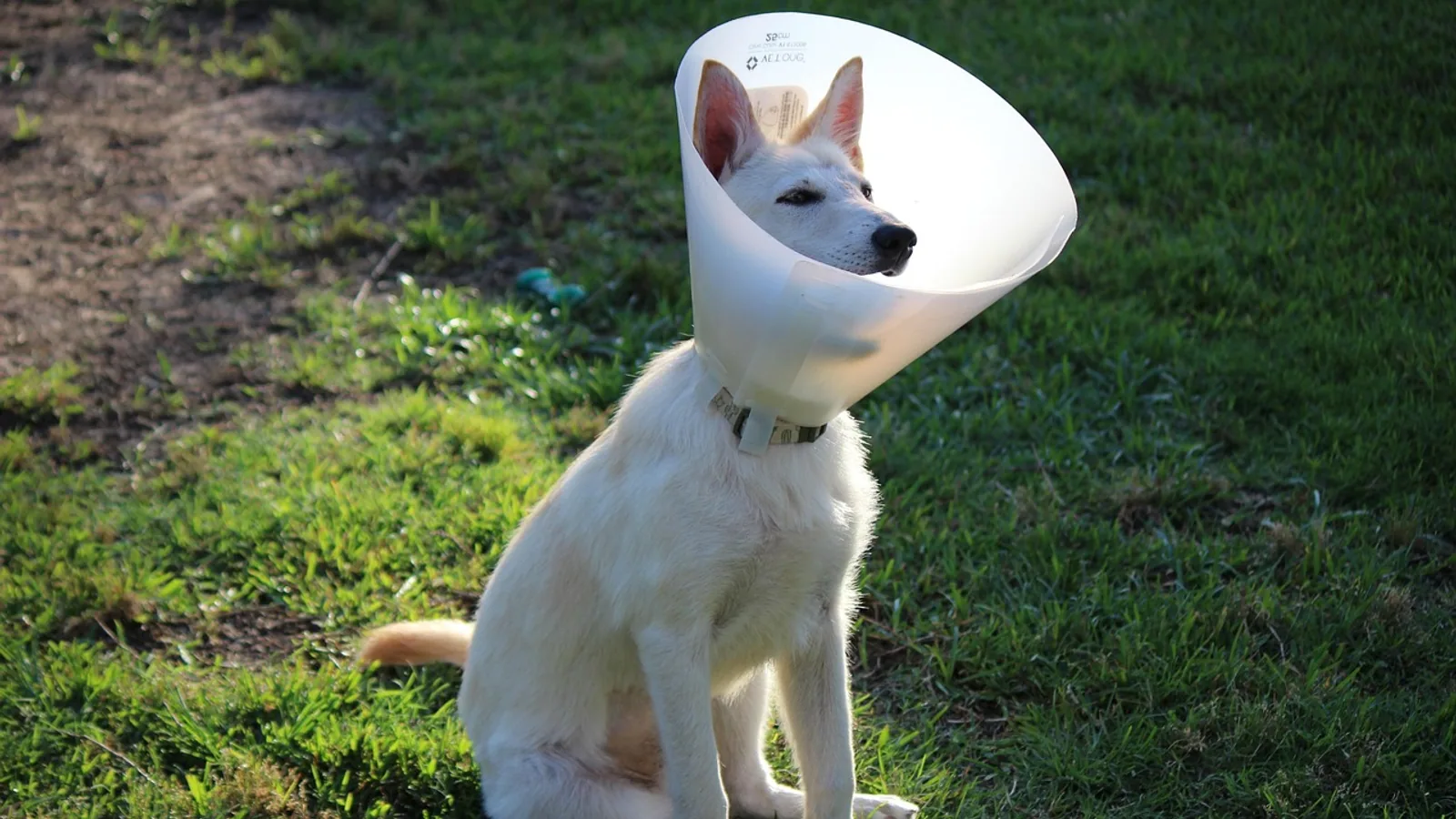
A dog cone, also called an Elizabethan collar or E-collar, is a protective barrier that stops a dog from licking, chewing, or scratching a wound, incision, or bandage. Most dogs wear a cone for 10 to 14 days after routine surgery, or until the veterinarian clears them at a recheck. The exact time depends on the procedure, the healing stage, and the dog's behavior. A cone that is too short or too loose fails at its only job, so correct fit matters as much as wear time.
This article is educational and is not a substitute for veterinary diagnosis or treatment.
At a Glance
| Question | Practical answer |
|---|---|
| Why use a cone? | Prevents self-trauma to incisions, wounds, bandages, and topical treatments |
| Typical wear time after routine surgery | 10 to 14 days, or until the veterinarian clears the dog |
| How to check length | The cone rim should extend past the tip of the nose |
| How to check the neck | Two fingers should fit flat between the collar and the neck |
| Can the dog eat and drink? | Usually yes. Raise bowls or remove the cone briefly under supervision if needed |
| Can the dog sleep in it? | Yes. Most dogs adapt within a few nights |
| Best alternative for most dogs? | Depends on the wound. Soft cones and suits cover the body but not always the paws |
| When to call the vet | Non-healing wound, swelling, discharge, pain, or a dog that defeats the cone |
Why Veterinarians Use a Dog Cone
A cone exists to break the itch-scratch-lick cycle. After surgery, the incision is a fresh wound. Licking introduces oral bacteria, creates friction, and can pull sutures or staples loose. Chewing can open a closed incision entirely. Scratching can tear skin grafts, bandages, and topical medications off the surface.
The stakes are not theoretical. Surgical site infections after clean-contaminated abdominal surgery in dogs raised median total treatment costs by 24.1 percent compared with matched controls, even though the initial surgery cost the same [1]. In a prospective study of 208 dogs undergoing laparoscopic ovariectomy, surgical site infection occurred in 7.2 percent of dogs, and improper use of the Elizabethan collar was identified as a risk factor, along with surgical time longer than 46 minutes [2]. That finding is the clearest published link between how a cone is used and whether an incision becomes infected.
The most dramatic consequence of skipping protection is evisceration, where a dog opens its own abdominal incision and pulls out internal tissue. A survey of veterinarians identified 333 cases of post-surgical evisceration in dogs, 221 of which also involved autocannibalism, meaning the dog ingested the eviscerated tissue [3]. Most cases followed reproductive surgery such as spaying, cesarean section, or pyometra surgery. Most dogs did not wear an E-collar after surgery, and most eviscerated within three days of the operation [3]. About 64 percent underwent surgical repair and survived long term, and survival was more likely when the dog had not eaten the tissue [3]. This is the scenario a cone is designed to prevent, and it is the reason veterinarians are firm about cone use after abdominal procedures.
How Long Should a Dog Wear a Cone?
There is no single universal number, but there is a reliable default. For routine soft tissue surgery such as a spay, neuter, or mass removal, plan on 10 to 14 days. That window matches the typical time for skin to seal and for sutures or staples to be removed. The laparoscopic ovariectomy study used clinical evaluations on postoperative days 5 to 7 and 10 to 12, with a 30-day follow-up phone call, which shows the standard surveillance rhythm after routine surgery [2].
How long should a dog wear a cone after neuter?
After a routine neuter, most dogs wear a cone for 10 to 14 days. The scrotal incision and the ligatures inside are vulnerable to licking for the full healing period, and a dog can reopen the incision in minutes of unsupervised licking. Your veterinarian will confirm the exact stop date at the discharge appointment or the recheck.
Factors that extend wear time
Several situations push the timeline longer than two weeks.
- Abdominal surgery. Spays, gastrointestinal surgery, and other laparotomies carry evisceration risk, and most evisceration happens within three days of surgery [3]. Expect strict cone use through at least the first week.
- Orthopedic surgery. Bone healing takes far longer than skin healing. A dog that licks a surgical site over a plate or pin can cause implant-related complications. In one study of antebrachial deformity correction, surgical site infection occurred in 3 of 20 limbs and implant-related soft tissue irritation in 4 of 20 limbs, both treated with implant removal [4].
- Skin surgery and tumor removal. Surgical site infection rates after skin tumor removal were 9.6 percent overall and 11.5 percent after mast cell tumor removal in a prospective surveillance study [5]. Incisions in reachable locations need protection until the skin is sealed.
- Wounds managed by second-intention healing. Large open wounds that heal by contraction and granulation need protection for weeks, not days. A case report of a 143 cm2 postsurgical wound used a multimodal protocol with dressings and topical therapies over an extended period [6].
- A dog with a history of licking or chewing. Behavior drives the timeline as much as tissue does.
How to know when the cone can come off
The cone comes off when the veterinarian says so, not when the incision looks closed. Skin can look sealed while deeper layers are still healing. Ask at the recheck whether the cone can be discontinued, reduced to supervised-only use, or swapped for an alternative. If your dog has been wearing a cone continuously, plan the transition for a time when you can watch them for the first few hours.
How to Fit a Dog Cone Collar Correctly
A poorly fitted cone is worse than useless because it gives a false sense of security. Two measurements decide whether a cone works.
Length: the rim must pass the nose
The cone must extend beyond the tip of the dog's nose. When the dog turns its head and stretches, the rim should still block the mouth and front paws from reaching the incision. A cone that ends at the neck or mid-chest lets the dog reach a spay incision, a leg bandage, or a paw. If the cone is too long, the dog struggles to eat, drink, and navigate doorways, which increases stress and the chance the owner removes it early.
Neck: two fingers under the collar
The neck opening should sit snug but not tight. You should be able to slide two flat fingers between the cone's neck edge and the dog's neck. If you cannot fit two fingers, the cone is too tight and can press on the trachea or cause skin damage. If you can fit more than two fingers easily, the cone is loose enough that the dog may paw it off or catch it on furniture.
Fit checks to run at home
- Put the cone on and fasten it according to the manufacturer's instructions.
- Slide two fingers under the neck edge. Adjust until they fit flat.
- Watch the dog walk. The cone should not slide down over the shoulders or rotate freely.
- Offer a treat by hand. If the dog can reach your hand and the treat with its mouth, the cone is too short.
- Watch the dog try to reach the incision. If any part of the mouth or front paw touches the surgical site, refit or change size.
- Check the neck daily for redness, hair loss, or moisture under the edge.
Common fitting mistakes
- Choosing a cone by weight or breed instead of by nose length and neck circumference.
- Leaving the cone too loose because the dog seems uncomfortable. A loose cone gets removed by the dog within hours.
- Using a cone that is too short because it looks more comfortable. Short cones fail on rear and flank incisions.
- Failing to recheck fit after the neck fur compresses or after the dog loses or gains weight.
Eating, Drinking, and Sleeping With a Cone
Most dogs can eat and drink with a cone on. The cone makes the approach angle awkward, so the practical fix is to raise the bowls. Place food and water on a low stool or a stack of books so the dog does not have to push the cone rim into the floor. Some dogs do better with a shallow, wide bowl. A few dogs need the cone removed for meals, but only under direct supervision, and it goes straight back on when the meal ends.
Sleep is the part owners worry about most. Dogs generally adapt within a few nights. Provide a quiet, familiar sleeping spot with enough clearance for the cone. A dog that sleeps on the bed may need a floor bed during recovery so the cone does not catch on bedding. If your dog is restless, panting, or pacing at night for more than a couple of nights, call your veterinarian. Sedation or a different collar style may be appropriate.
The owner-reported welfare data are worth knowing before you decide the cone is optional. In a survey of 434 owners whose pets wore an Elizabethan collar in the previous 12 months, 77.4 percent reported a worse quality of life score while the collar was on [7]. The negative scores were significantly worse when the collar irritated the pet or interfered with drinking or play [7]. The authors recommended that owners be told about these potential effects and about harm-minimization strategies [7]. That is not an argument against cones. It is an argument for fitting them properly, checking them daily, and using the least restrictive option that still protects the wound.
Dog Cone Alternatives and What Each One Protects
Alternatives are not interchangeable. Each design covers a different part of the body, and the wrong choice leaves the incision exposed. Match the alternative to the location of the wound and to your dog's determination.
Soft fabric cones
A soft cone replaces rigid plastic with fabric or padded material in the same cone shape. It protects the same zones as a hard cone when it is long enough to pass the nose. The advantage is comfort and less noise when the dog bumps furniture. The limitation is that a soft cone can collapse or fold when the dog pushes it against a surface, which creates a gap the dog can exploit. Soft cones work best for dogs that lick rather than chew, and for wounds on the head, neck, and front of the body.
Inflatable dog collars
An inflatable dog collar, sometimes called a donut collar, is a ring that sits around the neck and physically blocks the head from turning far enough to reach the body. It is comfortable, allows normal eating, drinking, and sleeping, and does not block peripheral vision the way a cone does. The limitation is coverage. An inflatable collar does not stop a dog from scratching its own ears or face with a hind paw, and it does not reliably block a determined dog from reaching a front paw or a lower leg. It works well for flank and abdominal incisions in dogs with average flexibility. It fails for paw, tail, and head wounds.
Dog recovery suits and body suits
A dog recovery suit is a fitted garment that covers the torso and sometimes the hindquarters. It protects abdominal, flank, and back incisions by putting fabric between the mouth and the skin. It does not protect the paws, head, ears, or tail, and a determined dog can sometimes chew through the fabric. Suits are useful for dogs that panic in a cone, for cats and small dogs, and for incisions that a suit can cover completely. Measure carefully. A suit that is too loose bunches and rubs. A suit that is too tight restricts movement and can cause skin problems. Suits also need to be removed for urination and defecation or designed with an opening for both, and they must be laundered regularly because they sit against a healing wound.
Neck braces and cervical collars
A rigid neck brace limits how far the neck can bend. It is a niche option for some neck and head wounds. It does not protect the body, and it should only be used on veterinary advice because an incorrectly sized brace can press on the airway.
Bitter sprays, bandages, and topical deterrents
Deterrent sprays and dressings are adjuncts, not substitutes. A bandage can be chewed off. A spray can be licked off. Neither one physically stops a dog from reaching an incision. Use them only as part of a plan that includes a physical barrier.
Alternative comparison table
| Alternative | Best for | Does not protect |
|---|---|---|
| Soft fabric cone | Head, neck, front body, dogs that lick | Anything if it collapses or folds |
| Inflatable dog collar | Flank and abdominal incisions, flexible-average dogs | Paws, tail, head, ears, face |
| Dog recovery suit | Torso, flank, back, dogs that panic in cones | Paws, head, ears, tail |
| Neck brace | Selected neck and head wounds | Body, limbs, paws |
| Sprays and dressings | Adjunct only | Everything if used alone |
| Hard plastic cone | All of the above when fitted correctly | Nothing within its coverage zone |
The safest rule is simple. If the alternative does not block the dog's mouth and paws from the incision, it is not a substitute for a properly fitted cone. Ask your veterinarian which alternative is acceptable for your dog's specific procedure before you switch.
Step-by-Step: Introducing the Cone Without a Fight
Most cone problems are training problems, not equipment problems. A short introduction period prevents days of struggle.
- Start before you need it if possible. Let the dog sniff and investigate the cone at home before surgery day.
- Pair it with food. Put the cone on, feed a high-value treat, then take it off. Repeat several times.
- Build duration gradually. Two minutes, then five, then fifteen, always with rewards.
- Fit it properly every time. Two fingers at the neck, rim past the nose.
- Reward calm behavior. Treat the dog when it lies down or sleeps with the cone on.
- Keep the routine normal. Walks on a leash, meals at normal times, and normal sleeping arrangements reduce stress.
- Do not remove the cone to stop whining. Removing it teaches the dog that whining works. If distress is real and persistent, call your veterinarian for help rather than giving in.
Common Mistakes Owners Make
- Taking the cone off "just for a minute." Most incision damage happens in unsupervised minutes, and most evisceration occurs within three days of surgery [3].
- Using a cone that is too short. If the dog can reach the incision, the cone is not doing anything.
- Switching to an inflatable collar for a paw or head wound. These collars do not cover those areas.
- Leaving a recovery suit on without checking the skin. Moisture, urine, and feces trapped against skin cause problems.
- Skipping the recheck. The recheck is when the veterinarian confirms healing and authorizes cone removal.
- Ignoring a dog that has learned to defeat the cone. A dog that can reach the wound needs a different size, a different design, or both, today.
- Using a cone as punishment. The cone is medical equipment. It should be paired with treats and calm handling, not scolding.
Troubleshooting Cone Problems
The dog will not eat or drink. Raise the bowls, try a shallow wide dish, or remove the cone for supervised meals only.
The dog keeps getting the cone off. The neck is too loose or the fastening method is wrong. Refit with two fingers of clearance and check the manufacturer's instructions.
The dog is depressed or frozen. Some dogs shut down in a cone. Try a soft cone or a recovery suit if the wound location allows it, and ask your veterinarian about short-term anti-anxiety or sedative options.
The cone is rubbing the neck. Check for moisture and redness daily. A cone cover or padded edge can reduce friction. If skin is broken, call your veterinarian.
The dog cannot navigate stairs or doorways. Guide the dog on a leash and clear tight spaces. Remove throw rugs that catch the rim.
The dog is scratching at the cone with a hind paw. This often means the cone is uncomfortable or the wound itches. Check the fit and call your veterinarian if the scratching is intense.
The dog is panting heavily or overheating. Cones trap heat. Keep the dog in air conditioning, offer water frequently, and avoid exercise beyond short leash walks.
Welfare and Safety Points
A cone is a welfare trade-off. It prevents a worse outcome (infection, dehiscence, evisceration) at the cost of short-term discomfort. The owner survey data show that most owners perceive a worse quality of life during collar use, and that irritation and interference with drinking and play drive the worst scores [7]. The practical response is not to abandon protection. It is to fit the cone correctly, check it daily, minimize the time it causes distress, and use the least restrictive device that still protects the specific wound.
Safety points to hold onto:
- Never leave a cone on a dog that is unsupervised in a crate that is too small for the cone. The rim can catch on crate bars.
- Check the neck daily for redness, swelling, hair loss, or moisture.
- Keep the cone clean. Wipe the inside with a damp cloth and mild soap, then dry it.
- Do not use a cone as a substitute for pain control. A dog that is licking constantly may be in pain. Call your veterinarian.
- Do not let the dog swim or bathe with a cone on unless your veterinarian approves it.
- Keep identification and a leash on for walks. A cone can make a dog feel vulnerable, and a startled dog may bolt.
Limitations and When to Contact a Veterinarian
Individual dogs heal at different rates, and the right wear time for your dog depends on the procedure, the incision, and your dog's behavior. Your veterinarian's instructions override any general timeline in this article.
Contact your veterinarian promptly if you see any of the following:
- The incision is open, gaping, or has visible tissue protruding. This is an emergency. Go to the nearest veterinary hospital immediately.
- Swelling, redness, warmth, or pain at the surgical site that is getting worse rather than better.
- Discharge that is pus-like, bloody, or foul-smelling.
- The dog has removed sutures or staples, or you can see them missing.
- The dog is licking or chewing through the cone or suit and reaching the wound.
- The dog is not eating or drinking for more than 24 hours.
- The dog is vomiting, has diarrhea, or seems lethargic.
- The dog is in obvious distress, panting continuously, or cannot settle.
- The cone is causing skin wounds, eye irritation, or breathing difficulty.
Do not wait for a scheduled recheck if any of these appear. Early intervention is cheaper and safer than treating an established infection. Surgical site infections after clean-contaminated abdominal surgery raised median total treatment costs by 24.1 percent in one study, and the increase was driven by the intensity of treatment required [1].
Frequently Asked Questions
How long should a dog wear a cone after neuter?
Most dogs wear a cone for 10 to 14 days after a routine neuter, or until the veterinarian clears them at the recheck. The incision and internal ligatures need protection for the full healing period, and a dog can reopen the site with a few minutes of licking.
Can a dog eat and drink with a cone on?
Yes, most dogs can eat and drink with a cone on if you raise the bowls. Put food and water on a low stool or stack of books so the cone rim does not hit the floor. If your dog still struggles, remove the cone for supervised meals only and put it back on immediately afterward.
What is the correct fit for a dog cone collar?
The cone rim should extend past the tip of the nose, and you should be able to slide two flat fingers between the neck edge and the dog's neck. A cone that is too short lets the dog reach the wound. A cone that is too tight can press on the airway and rub the skin.
Are inflatable dog collars as good as a cone?
Inflatable dog collars work for some flank and abdominal incisions in dogs with average flexibility, but they do not protect paws, tails, heads, ears, or faces. They also do not stop a determined dog from reaching a lower leg. Ask your veterinarian whether an inflatable collar is acceptable for your dog's specific wound.
Can I use a dog recovery suit instead of a cone?
A dog recovery suit can replace a cone for torso, flank, and back incisions if it covers the wound completely and fits snugly without rubbing. It does not protect paws, heads, ears, or tails, and a determined chewer can damage the fabric. Suits also need regular laundering because they sit against a healing wound.
What happens if my dog licks the incision?
Licking introduces bacteria, creates friction, and can pull sutures or staples loose. In a study of 208 dogs after laparoscopic ovariectomy, improper use of the Elizabethan collar was identified as a risk factor for surgical site infection [2]. If your dog is reaching the incision, refit the cone or switch to a design that blocks access.
How do I get my dog to sleep with a cone on?
Give the dog a quiet, familiar sleeping spot with clearance for the cone, and keep the routine normal. Most dogs adapt within a few nights. If your dog is pacing, panting, or unable to settle for more than two nights, call your veterinarian. Sedation or a different collar style may help.
When can I take the cone off for good?
Take the cone off when your veterinarian says the incision is healed enough to stop protecting it, usually at the recheck. Do not decide based on appearance alone. Skin can look sealed while deeper layers are still healing. If you remove the cone early, watch the dog closely for the first few hours and put the cone back on if the dog shows interest in the wound.
Related Articles
- Dog Neuter Recovery
- How To Wear A Dog Harness
- Dog Potty Training Regression After Neuter
- How Long Should Dog Eat Puppy Food
- Dog Collar
- How To Find A Dog Collar
- Cat Cone Guide: Fit, How Long, and Cone Alternatives
- Cat Diapers: When They Help, Fit, and Preventing Skin Problems
- Feral Cats: What They Are, TNR, and How to Help Safely
Sources
- Surgical site infection following clean-contaminated abdominal surgery in dogs is associated with increased postoperative costs.
- Incidence and risk factors of surgical site infection in dogs undergoing laparoscopy ovariectomy. Multicentric prospective cohort study.
- Post-surgical evisceration with or without autocannibalism in 333 dogs-a survey of veterinarians.
- Long-term outcome and complications of acute correction of canine antebrachial deformities with patient-specific three-dimensional printed osteotomy and reduction guides in 15 dogs.
- Impact of perioperative prophylactic antibiotics on surgical site infection rate after skin tumor removals in dogs: a prospective observational study.
- Multimodal Management of a Large Postsurgical Wound Secondary to Nodulectomy in a Dog: Application of the TIME Framework, Tie-Over Fixation, Fluorescence Biomodulation, and Electrobioregulation.
- "The Cone of Shame": Welfare Implications of Elizabethan Collar Use on Dogs and Cats as Reported by their Owners.