Cat Cone Guide: Fit, How Long, and Cone Alternatives
By Dr. Zubair Khalid, DVM, MS, PhD ·
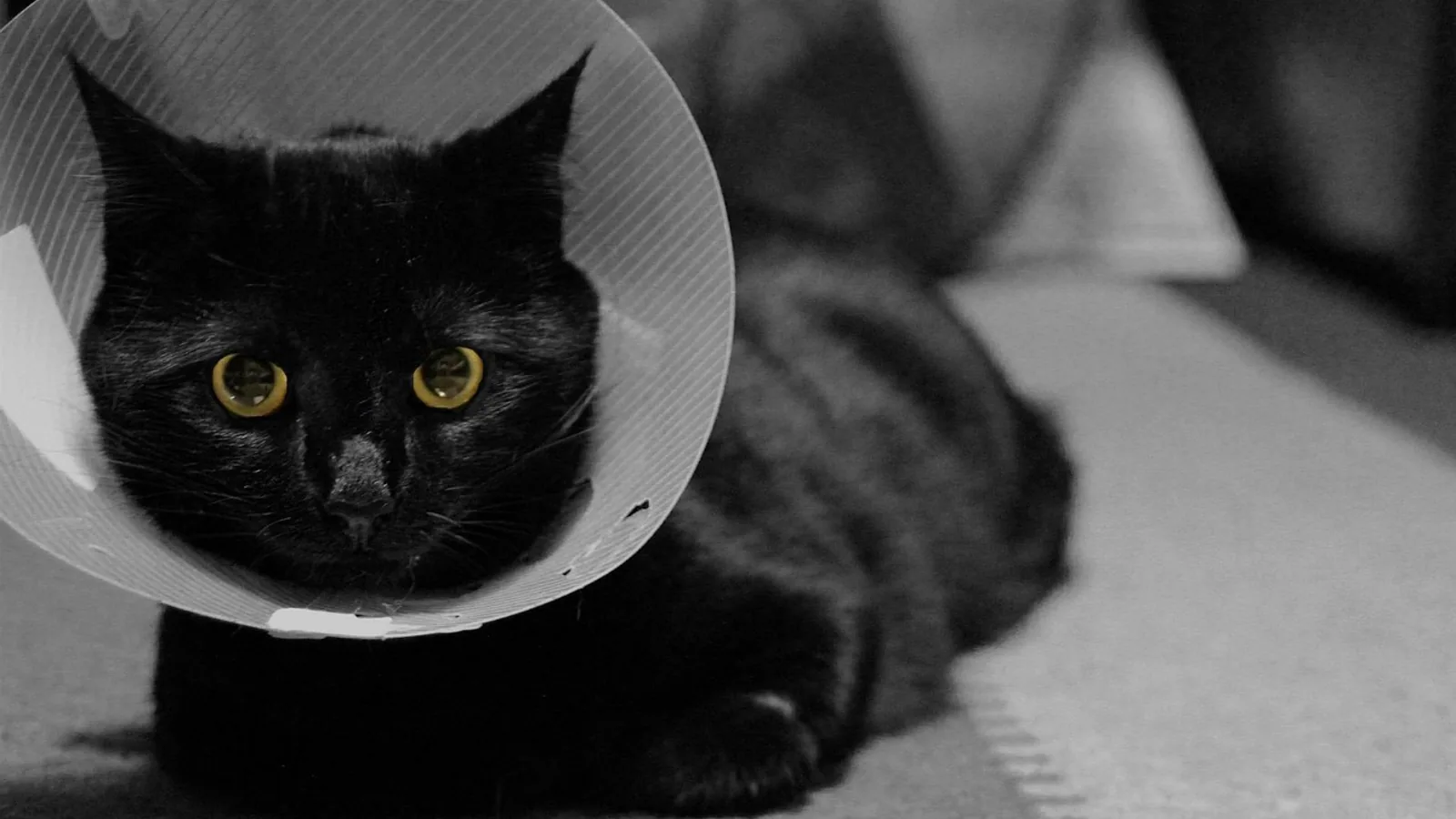
A cat cone, also called an Elizabethan collar or E-collar, is a barrier device that stops your cat from licking, chewing, or scratching a wound, incision, or medical device. For most cats recovering from a spay, the cone stays on for roughly 10 to 14 days, or until your veterinarian clears the cat at a recheck. The collar should stay on continuously during that window, including at night and during meals. Removing it "just for a minute" is the single most common reason a healing incision reopens, because a few seconds of licking is enough to pull apart a fresh suture line.
This guide covers how to fit a cone correctly, how to help your cat eat, drink, and use the litter box while wearing one, how to reduce whisker stress, when to choose a soft cone for cats or a cat recovery suit instead, and which signs mean you need to call a veterinarian right away.
This article is educational and is not a substitute for veterinary diagnosis or treatment.
At a Glance
| Decision point | What to do |
|---|---|
| How long after a spay | About 10 to 14 days, or until your veterinarian clears the incision |
| Can I take it off for breaks | No, unless your veterinarian specifically told you to |
| Fit check | Snug at the neck, two fingers should not slide under the rim, no gap the paw can hook |
| Eating and drinking | Raise bowls to chest height, use a shallow wide dish |
| Litter box | Low-entry box, unscented litter, clear a path |
| Whisker stress | Keep the cone rim off the whisker pads, switch to a soft fabric cone if the cat keeps pawing at the face |
| Alternatives | Soft cones, recovery suits, wound protection corsets, inflatable donuts |
| Red flags | Open incision, swelling, discharge, odor, bleeding, not eating for over 24 hours |
Why Cats Wear Cones After Surgery
A cone exists to prevent self-trauma. When a cat has an incision, a skin wound, a hot spot, or a bandage, the natural feline response is to lick it. Licking introduces bacteria, disrupts clot formation, and can pull sutures loose. The cone physically blocks the cat from reaching the area.
Veterinarians use Elizabethan collars across a wide range of procedures and conditions. A survey of 434 pet owners whose dogs and cats had worn an Elizabethan collar in the previous year found that 77.4 percent reported a worse quality of life score while the collar was on [1]. The negative scores were strongest when the collar irritated the pet or interfered with drinking or play [1]. That finding matters for cat owners because it tells you two things: cones are genuinely uncomfortable for many cats, and the discomfort is often tied to poor fit and blocked access to water and food. A well-fitted cone and an adjusted feeding station can remove much of that burden.
The welfare cost of the cone is real, but so is the cost of a reopened incision. A cat that licks a spay incision open may need a second anesthesia event, additional sutures, antibiotics, and a longer recovery. The trade-off almost always favors keeping the cone on.
How Long Should a Cat Wear a Cone After Spay?
Plan on 10 to 14 days. That is the standard postoperative window for a routine feline spay, also called an ovariohysterectomy. During that period the skin layer is closing and the deeper tissue is healing. Your veterinarian will give you the exact stop date at discharge and will confirm it at a recheck.
Some cats heal faster and some heal slower. A study of postoperative monitoring in cats after ovariohysterectomy tracked blood markers of inflammation at 24 hours, 72 hours, 7 days, and 14 days after surgery, which reflects the fact that the body's healing response continues across roughly a two-week arc [2]. That timeline is why the cone usually stays on for the full two weeks rather than a few days.
Cats that had a minimally invasive or very small incision may still need the full collar period. A clinical case series describing a modified feline spay technique with a very small flank incision reported complete wound healing by day 7 in that specific series, but the same report contrasted it with conventional spay protocols that call for 10 to 14 days of recovery [3]. Do not shorten the collar period on your own based on how the incision looks from the outside. The surface can look sealed while the deeper layers are still knitting together.
The rule about cone breaks
Do not take the cone off for breaks unless your veterinarian told you to. This is the most important instruction in this entire guide. Cats are fast. A cat can rotate its head and lick an incision in the two seconds it takes you to set the collar down. One or two licks can open a fresh suture line, and once the incision is open the cat will keep working at it.
If your veterinarian has approved short supervised breaks, follow their exact instructions on duration and supervision. Otherwise, the cone stays on through eating, sleeping, litter box visits, and cuddling.
When the cone can come off early
The cone comes off when your veterinarian says so. That decision is usually made at a postoperative recheck where the incision is examined directly. Signs that support early removal include a fully closed, dry, flat incision with no swelling, no discharge, and no redness at the margins. If any of those are present, the collar stays on.
How to Fit a Cat Cone Correctly
Fit is the difference between a collar that works and a collar that fails. A cone that is too loose slides down, exposes the incision, and lets the cat hook a paw under the rim. A cone that is too tight presses on the neck, restricts swallowing, and causes distress.
Step-by-step fit check
- Measure the neck. Use a soft tape or a piece of string around the base of the neck, just behind the ears. The collar's neck opening should match that measurement.
- Slide the cone on from the front, over the head, so the wide end faces forward.
- Check the gap. You should be able to slide one finger, and only one finger, under the neck edge. If two fingers fit easily, the collar is too loose. If you cannot fit one finger, it is too tight.
- Check the reach. The wide rim must extend past the tip of the nose. If the cat can extend a foreleg and touch its nose or belly, the cone is too short.
- Check the paw test. Watch the cat try to scratch its face or neck. If a hind paw can hook the rim, the collar needs to be longer or the neck strap tightened.
- Check the walk. The cat should be able to walk, turn, and lie down without the rim catching on furniture or the floor.
Common fit mistakes
The most frequent error is a collar that is too short. Owners often trim a cone because the cat bumps into doorframes. Trimming the length defeats the purpose, because a shortened cone lets the cat reach the incision. If the collar is too long for your home layout, adjust the environment instead: move furniture, block tight spaces, and clear a wide walking path.
The second most common error is a neck strap that is too loose. Cats are experts at backing out of loose collars and then licking the wound. Recheck the neck fit twice a day, especially in the first 48 hours when the cat is most likely to work at the collar.
Eating and Drinking With a Cone On
A cat in a cone cannot easily see the food in a flat bowl on the floor. The rim blocks the downward view and the cat ends up pushing the bowl around or giving up. This is one of the welfare problems owners report most often, and the survey data show that collars which interfere with drinking are linked to worse quality of life scores [1].
Fix the feeding station before the cat gets frustrated.
- Raise the bowls. Put food and water on a small box or a stack of books so the bowl sits at roughly chest or chin height. The cat can then reach the food without the rim scraping the floor.
- Use a shallow, wide dish. A plate or a shallow saucer works better than a deep bowl because the cone rim does not have to enter the bowl.
- Offer water in more than one place. Cats drink less when they have to work for it. A second water bowl in a quiet spot helps.
- Watch intake for the first 24 hours. If your cat will not eat or drink at all with the cone on, call your veterinarian. Do not remove the cone on your own to solve the problem.
Some cats eat better if you hand-feed a few bites or hold the bowl steady. Others do better with a soft cone for cats, which is more flexible and lets the cat lower its head closer to the bowl.
Litter Box Use With a Cone
The litter box is a common source of trouble. A cone changes the cat's field of view and makes it harder to judge the box edge. A high-sided box can trap the cone rim, and the cat may refuse to enter.
Practical adjustments:
- Switch to a low-entry box during recovery. A shallow pan or a box with a low front wall lets the cat step in without the cone catching.
- Keep the box in the same place. Do not move it during recovery. Cats navigate by memory and a moved box adds stress.
- Use unscented litter. A cat that cannot groom well after using the box may be more sensitive to strong litter scents.
- Check the incision after every litter box visit. Litter can stick to a healing incision. If you see debris, call your veterinarian for guidance rather than scrubbing it yourself.
- Clean the box more often. A cat in a cone may step in stool it cannot see. Scoop twice a day during recovery.
If your cat stops using the litter box entirely, that is a veterinary call, not a training problem. A cat that holds urine or stool because the box is difficult to use can develop a medical problem on top of the surgical recovery.
Whisker Stress and the Cat Cone
Whiskers are highly sensitive touch organs. They detect air movement, object distance, and the shape of the space around the cat's face. A hard plastic cone sits directly against or over the whisker pads, and that constant pressure and blocked input is a real source of distress for many cats.
Signs of whisker stress with a cone:
- Repeated head shaking or head rubbing
- Pawing at the face or the collar rim
- Turning away from food or refusing to eat
- Hiding more than usual
- Grinding the cone against walls or furniture
A soft cone for cats, made of fabric or a flexible foam, often reduces whisker pressure because the material gives when the cat moves. The clinical trial data support this. In a randomized study of 26 cats after ovariohysterectomy, 10 of 13 cats in the hard Elizabethan collar group tried to remove the collar or showed head shaking, while no cats in the wound protection corset group showed those behaviors [4]. The study found no significant difference between the two groups in pain scores, rescue analgesia, or cortisol levels, which means the softer option controlled the wound without adding pain or stress [4].
If your cat is fighting a hard cone and the incision is protected, ask your veterinarian whether a soft cone or a recovery suit is appropriate for your cat's specific wound.
Cat Cone Alternatives
Several alternatives exist. Each has trade-offs. The right choice depends on the wound location, the cat's temperament, and your veterinarian's preference.
Soft cones for cats
A soft cone is a fabric or foam collar that keeps the same basic shape as a hard cone but flexes on contact. Advantages include less noise, less furniture damage, easier eating, and less whisker pressure. The main risk is that a soft cone can compress or fold, which may allow a determined cat to reach the incision. Check the reach test every day.
Cat recovery suits
A cat recovery suit is a fitted garment that covers the torso and the incision. It replaces the cone for many abdominal surgeries, including spays. The cat can eat, drink, and use the litter box normally. The suit must be sized correctly, kept clean, and checked for moisture or soiling. A suit is not appropriate for every wound. Face wounds, ear wounds, and some limb wounds cannot be covered by a suit, and the cat can still reach those areas.
The wound protection corset used in the randomized trial is a version of this concept. Cats wearing the corset after ovariohysterectomy showed no collar-removal behaviors and had pain and stress measures comparable to the hard cone group [4]. That is good evidence that a well-fitted body garment can protect an abdominal incision without the behavioral problems of a hard collar.
Inflatable donuts and neck pillows
An inflatable ring around the neck stops the cat from bending its head far enough to reach the incision. It is softer than plastic and does not block the whiskers as much. The limitation is reach. A flexible cat can often curl around an inflatable ring, especially for a wound on the flank or hind end. This option works best for cats with a short body and a midline abdominal incision.
Bite-not collars and neck brace styles
Some collars use a stiffened fabric that stands up around the neck. They are quieter and more comfortable than plastic but can be less effective for cats that are determined to reach a wound. Fit and length still matter.
When an alternative is not safe
Do not switch from a hard cone to any alternative without checking with your veterinarian first. The choice depends on where the wound is and how flexible your cat is. A cat that can reach its incision through a recovery suit or around a soft cone needs the hard cone back. The goal is wound protection, not comfort alone.
Keeping Your Cat Indoors During Recovery
Keep your cat strictly indoors for the entire cone period. This is not optional.
Reasons:
- Outdoor cats climb, jump, and squeeze through tight spaces, all of which can pull an incision or dislodge a collar.
- A cone reduces peripheral vision, which makes traffic, dogs, and other cats far more dangerous.
- Dirt, moisture, and bacteria from outdoors raise the risk of wound contamination.
- If the incision opens outdoors, you may not notice until the wound is badly contaminated.
If your cat normally goes outside, plan the indoor confinement before surgery day. Set up a quiet recovery room with the litter box, food, water, and a soft bed. Keep the room warm and dim. Limit visitors and other pets for the first few days.
Pain, Behavior, and Comfort During Recovery
Postoperative pain control is a veterinary decision, and modern feline spay protocols use several approaches. Research on cats undergoing ovariohysterectomy has compared epidural levobupivacaine, intraperitoneal levobupivacaine with or without dexmedetomidine, erector spinae plane blocks, quadratus lumborum blocks, and intravenous lidocaine infusions, all aimed at reducing intraoperative and postoperative pain [5][6][7][8][9]. These techniques are chosen by the surgical team. Your job as an owner is to give pain medication exactly as prescribed and to report signs of pain.
Signs your cat is uncomfortable:
- Hunched posture or a tense abdomen
- Ears flattened or rotated outward (part of the feline pain expression)
- Whiskers pulled forward and down
- Reduced grooming or refusing to move
- Growling, hissing, or flinching when touched near the incision
- Not eating or not using the litter box
The Feline Grimace Scale is a validated tool that veterinarians use to score pain from facial expression, and it has been studied in cats after ovariohysterectomy [10][11]. If your cat's face looks tense, narrow-eyed, or grimacing, that is a reason to call your veterinarian.
Do not give human pain medications to a cat. Many common human pain drugs are toxic to cats. Use only what your veterinarian prescribed.
Common Mistakes Owners Make
- Taking the cone off for a break. Seconds of licking can open an incision. Do not do it unless your veterinarian approved it.
- Shortening the cone. A shortened cone lets the cat reach the wound.
- Leaving the neck strap loose. A loose collar slides off or lets the cat hook a paw under it.
- Skipping the feeding station adjustment. A cat that cannot reach food or water will not eat or drink.
- Letting the cat outside. Indoor confinement is required for the full recovery period.
- Switching to a recovery suit without veterinary approval. Not every wound can be covered by a garment.
- Assuming a closed-looking incision means healing is complete. Deeper tissue takes longer than skin.
Troubleshooting Common Problems
The cat keeps backing out of the cone. The neck strap is too loose. Tighten it to the one-finger fit and recheck twice daily.
The cat cannot eat or drink. Raise the bowls to chest height and use a shallow dish. If the cat still will not eat after 24 hours, call your veterinarian.
The cat is depressed or hiding. This is common in the first 24 to 48 hours. Provide a quiet, dim room and minimize handling. If the behavior continues past 48 hours or the cat stops eating, call your veterinarian.
The cat is vomiting or has diarrhea. Call your veterinarian. Gastrointestinal signs after surgery can be related to anesthesia, pain medication, or a separate problem.
The cone is rubbing the neck raw. Check the fit and look for a rough edge. A soft cone or a padded neck edge may help. Report skin breakdown to your veterinarian.
The cat is panting or breathing fast. Call your veterinarian right away. This is not a normal cone problem.
When Licking Is an Emergency
Licking becomes an emergency when the incision is no longer intact or when infection is present. Call your veterinarian immediately if you see any of the following:
- An open incision. The skin edges have separated and you can see tissue underneath.
- Swelling that is new, growing, or firm around the incision.
- Discharge. Any pus, yellow or green fluid, or cloudy drainage.
- Bleeding that does not stop with gentle pressure.
- A bad smell from the incision.
- Redness spreading away from the incision margins.
- Fever, lethargy, or refusal to eat.
- The cat is actively licking or chewing and the cone is not stopping it.
An open incision is a same-day problem. Do not wait to see if it closes on its own. Do not apply human antibiotic ointments or home remedies. Cover the area loosely with a clean cloth if you must transport the cat, and call the clinic before you arrive.
Limitations and When to Contact a Veterinarian
Every cat heals differently, and every incision is different. The guidance in this article is general. Your veterinarian knows your cat's surgical details, wound location, and medical history, and their instructions override anything here.
Contact your veterinarian if:
- The incision opens, swells, bleeds, or drains
- The cat will not eat or drink for more than 24 hours
- The cat has not urinated within 24 hours of surgery
- The cat is vomiting, has diarrhea, or is lethargic
- The cat is in obvious pain despite prescribed medication
- The cone is causing skin wounds on the neck
- The cat cannot be kept away from the incision with the current collar
- You are unsure whether the recovery suit or soft cone is protecting the wound
Call the clinic that performed the surgery first. If they are closed, use the emergency contact they gave you at discharge.
Frequently Asked Questions
How long should a cat wear a cone after spay?
About 10 to 14 days, or until your veterinarian clears the incision at a recheck. Keep the cone on continuously during that window.
Can I take the cone off while my cat eats?
No, unless your veterinarian specifically told you to. Adjust the feeding station instead by raising the bowls and using a shallow dish.
What if my cat cannot reach its food or water with the cone on?
Raise the bowls to chest height and use a wide, shallow dish. If your cat still will not eat or drink within 24 hours, call your veterinarian.
Is a soft cone for cats as effective as a hard plastic cone?
It can be, if it fits correctly and the cat cannot reach the incision. Check the reach test daily and switch back to a hard cone if the cat can touch the wound.
Can I use a cat recovery suit instead of a cone?
Sometimes. A recovery suit works well for abdominal incisions, but it is not appropriate for every wound. Ask your veterinarian before switching.
How do I know if the cone fits properly?
The neck strap should allow one finger underneath, no more. The wide rim must extend past the tip of the nose, and the cat must not be able to hook a paw under the rim.
What are signs the incision is infected?
Swelling, redness, discharge, a bad smell, or an opening in the skin. Any of these needs a same-day call to your veterinarian.
Can my cat go outside while wearing a cone?
No. Keep your cat strictly indoors for the entire recovery period to protect the incision and prevent the collar from catching on objects.
Related Articles
- Cat Spay Recovery
- How Long Can A Cat Go Without Peeing After Surgery
- Post-Spay and Post-Neuter Care for Dogs and Cats
- Cat Dry Coughing Fits
- Home Dental Care for Cats: Brushing Alternatives and Dental Treats
- Can Cats Have Peanut Butter? Risks and Healthier Alternatives
- Dog Cone Guide: How Long to Wear It, Fit, and Alternatives
- Cat Diapers: When They Help, Fit, and Preventing Skin Problems
- Feral Cats: What They Are, TNR, and How to Help Safely
Sources
- "The Cone of Shame": Welfare Implications of Elizabethan Collar Use on Dogs and Cats as Reported by their Owners.
- Postoperative monitoring of ovariohysterectomy carried out with two types of surgical sutures in shelter cats and differences in selected blood parameters between shelter and pet cats.
- The 1-1-1 technique: A modified novel approach to feline ovariohysterectomy with minimal incision, rapid recovery and antibiotic free outcomes.
- Effects of Elizabethan Collar and Wound Protection Corset on Pain and Discomfort Levels in Cats Undergoing Ovariohysterectomy.
- Erector spinae plane block with bupivacaine contributes to intraoperative opioid sparing but provides limited postoperative pain control in cats undergoing elective ovariohysterectomy under continuous propofol infusion.
- A comparison of intra and postoperative analgesic effects of sacrococcygeal and lumbosacral epidural levobupivacaine in cats undergoing ovariohysterectomy.
- Comparison of intra and postoperative analgesia efficacy of intraperitoneal levobupivacaine alone or in combination with dexmedetomidine in cats undergoing ovariohysterectomy; a randomized, prospective, blinded, clinical trial.
- Ultrasound-guided quadratus lumborum block vs lumbosacral epidural anesthesia in cats undergoing ovariohysterectomy: a randomized pilot clinical trial.
- Intravenous lidocaine may contribute to postoperative analgesia without detectable adverse effects in cats undergoing ovariohysterectomy: a randomized trial.
- Comparison of the effects of an opioid-free anesthetic protocol with two opioid-based protocols on the intraoperative cardiovascular response and postoperative pain in cats undergoing elective ovariohysterectomy: A prospective, randomized, blinded, clinical study.
- Reproducibility and diagnostic accuracy of the Unesp-Botucatu Feline Pain Scale and the visual analogue scale among laypeople, cat owners, students and experienced veterinarians.