Trifexis for Dogs: Uses, Safety, and Side Effects
By Dr. Zubair Khalid, DVM, MS, PhD ·
Trifexis is a prescription, beef-flavored chewable tablet for dogs that combines two drugs in a single monthly dose. Spinosad kills adult fleas. Milbemycin oxime prevents heartworm disease and clears three common intestinal worms. The product is labeled for dogs and puppies from 8 weeks of age that weigh at least 5 pounds, and it is given once every 30 days with food. It is not a tick product, it does not cure an existing adult heartworm infection, and it is not for cats.
This article explains what each ingredient does, which parasites the product covers, how well it works in controlled studies, what side effects owners should watch for, and which dogs should not receive it. It closes with practical questions to bring to your veterinarian.
This article is educational and is not a substitute for veterinary diagnosis or treatment.
At a Glance
| Feature | Detail |
|---|---|
| Active ingredients | Spinosad and milbemycin oxime |
| Drug classes | Spinosad is a spinosyn insecticide. Milbemycin oxime is a macrocyclic lactone (milbemycin) anthelmintic |
| Species | Dogs only. Not for cats |
| Minimum age and weight on the label | 8 weeks of age and 5 pounds of body weight |
| How it is given | Oral chewable tablet, once every 30 days, with food |
| Labeled dose band | Spinosad 30 to 60 mg/kg plus milbemycin oxime 0.5 to 1.0 mg/kg [1][2][3] |
| Flea kill speed | 100% reduction of an existing flea infestation at both the 24-hour and 48-hour counts in a laboratory study [4] |
| Duration per dose | 30 days |
| Heartworm prevention | Yes, monthly |
| Intestinal worms covered | Hookworm, roundworm, whipworm |
| Ticks | Not covered |
| Prescription status | Prescription only in the United States |
What Trifexis Is and What Is in It
Trifexis is a fixed-dose combination product made by Elanco Animal Health. Each chewable tablet contains spinosad and milbemycin oxime in a ratio designed so that a dog receiving the full label dose of one ingredient receives the full label dose of the other [5]. Tablets come in several strengths keyed to body weight, and the prescribing veterinarian selects the strength that matches the dog's current weight.
Spinosad was first developed as a stand-alone flea adulticide. Milbemycin oxime was first developed as a stand-alone broad-spectrum anthelmintic and heartworm preventive, marketed in combination with other compounds and on its own. Combining them into one tablet means a single monthly chew treats fleas, prevents heartworm infection, and deworms for the three most common intestinal nematodes at the same time [1][6][7].
The combination is not simply two products added together. When spinosad and milbemycin oxime are given at the same time, the systemic exposure to milbemycin oxime is higher than when milbemycin oxime is given alone [5]. That pharmacokinetic interaction was studied deliberately, and target animal safety studies at dose multiples of both ingredients found that the higher milbemycin exposure did not produce additional adverse clinical reactions [5]. In other words, the interaction is known, measured, and accounted for in the product design.
Trifexis is available by prescription only in the United States. It is not an over-the-counter product, and it should not be purchased from an unverified source or given on the basis of a guess about body weight.
How the Two Ingredients Work
Spinosad
Spinosad is a mixture of fermentation-derived spinosyn compounds that act on the insect nervous system. In dogs it is absorbed orally and distributed systemically, which means fleas are exposed when they take a blood meal rather than only when they contact the skin surface. This systemic route explains why the flea kill in laboratory studies is measured within hours of treatment and why the effect does not wash off or rub off.
In a controlled flea study using the KS1 strain of Ctenocephalides felis, a single label dose of the spinosad and milbemycin oxime combination produced 100% reduction of an existing infestation at both 24 and 48 hours [4]. The same study showed that flea control persists for weeks after a single dose, with efficacy remaining high through subsequent weekly reinfestations and then declining somewhat by day 28 [4]. That decline in the fourth week is exactly why the label requires monthly redosing rather than a longer interval.
Milbemycin oxime
Milbemycin oxime is a macrocyclic lactone. It paralyzes and kills nematodes by interfering with glutamate-gated chloride channels in the parasite nervous system. At the dose contained in Trifexis it acts on:
- Tissue-stage heartworm larvae acquired in the previous 30 days
- Adult hookworm, roundworm, and whipworm living in the intestinal tract
- Larval and immature adult stages of hookworm and roundworm before they mature [8]
The heartworm effect is prophylactic. Milbemycin oxime eliminates infective larvae before they develop into adult worms. It does not kill adult Dirofilaria immitis already living in the pulmonary arteries, and it is not a substitute for the adulticidal treatment protocol used in heartworm-positive dogs.
Labeled Uses in Dogs
Flea control
Trifexis is labeled for the treatment and prevention of flea infestations. Two kinds of evidence support this.
In the laboratory, the combination killed 100% of existing fleas within 24 hours of a single dose and maintained strong control through day 21 of the month, with day 28 efficacy of 84.7% at 24 hours and 87.5% at 48 hours after reinfestation [4]. Notably, the combination outperformed spinosad alone at that late time point, where spinosad by itself was 72.9% and 76.3% effective [4].
In the field, a multicenter European trial enrolled dogs with at least seven fleas on the day of treatment and followed them for 30 days. Effectiveness against fleas was 98.97% on day 14 and 97.37% on day 30, and 89.3% of treated dogs had no live fleas at day 14, with 80.0% flea-free at day 30 [3]. Those field numbers matter because they reflect real households with re-exposure pressure, not just a controlled infestation.
Rapid flea kill is not a cosmetic feature. Fast reduction of flea numbers limits the direct discomfort of bites, reduces the antigen load that drives flea allergy dermatitis, and interrupts egg production before a household infestation can establish [2].
Heartworm prevention
Trifexis is labeled for the prevention of heartworm disease caused by Dirofilaria immitis. The evidence comes from challenge studies in which dogs were inoculated with infective larvae and then treated.
In three randomized, blinded, vehicle-controlled studies, a single treatment with the spinosad and milbemycin oxime combination given 30 or 45 days after inoculation was completely effective (100%) at preventing establishment of a Michigan isolate of D. immitis [7]. Efficacy against a Georgia isolate was incomplete under the same single-dose conditions, which is why the label calls for monthly administration rather than a one-time dose [7]. Repeated monthly dosing closes that gap by killing newly acquired larvae before they can develop.
The practical rule for owners: the preventive works on larvae from the past 30 days. A dog that misses doses has a window in which infection can establish.
Intestinal worms
Trifexis is labeled for the treatment and control of adult hookworm (Ancylostoma caninum), roundworm (Toxocara canis and Toxascaris leonina), and whipworm (Trichuris vulpis).
Four controlled, blinded studies using naturally infected dogs produced efficacy values of 100% for whipworm, 99.8% for hookworm, 100% for Toxocara canis, and 93.3% for Toxascaris leonina when the combination was given at the lower half of the commercial dose band [6]. Those numbers come from necropsy counts, which is the most rigorous way to measure worm burden.
The product also works on immature stages. In experimentally infected dogs, treatment on day 14 or day 24 after inoculation with T. canis eggs, and on day 7 or day 11 after inoculation with A. caninum larvae, was effective against L4 and immature adult worms [8]. Killing the parasite before it reaches adulthood means fewer eggs shed into the environment and less contamination of yards, parks, and sandboxes. That matters for households with children, because both hookworm and roundworm are zoonotic.
A separate field comparison in 200 naturally infected dogs found that the spinosad and milbemycin oxime combination reduced Toxocara egg counts by 87% at 14 days and 94% at 28 days, compared with 71% and 88% for ivermectin plus praziquantel, and produced a greater reduction in the number of dogs still testing positive [9].
Uses outside the US label
Two additional uses appear in the veterinary literature. They are not US label claims, and owners should not expect the product to be prescribed for them routinely.
Cutaneous myiasis (screw-worm and related fly larvae). In a comparative study of 40 naturally infested dogs, the spinosad and milbemycin oxime combination killed all larvae within 7 hours of a single oral dose [10]. A case series of three dogs infested with Chrysomya bezziana reported that a single oral dose at 31 to 62 mg/kg spinosad and 0.5 to 1.0 mg/kg milbemycin oxime killed all larvae within 8 hours, and no sedation or surgical debridement was needed [11]. Myiasis is uncommon in US dogs but does occur in wound contamination.
Angiostrongylus vasorum (French heartworm). A controlled, randomized, partially blinded laboratory study evaluated whether the combination prevents development of A. vasorum infection in dogs inoculated with third-stage larvae [12]. A. vasorum is an emerging parasite in Europe that can cause respiratory, neurologic, and coagulation disease [12]. This parasite is not a routine concern in most of the United States.
What Trifexis Does Not Cover
Understanding the gaps is as important as understanding the coverage.
- Ticks. Trifexis contains no acaricide. A dog on Trifexis still needs a separate tick control plan in tick-endemic areas. Tick-borne disease prevention is a conversation to have with your veterinarian, since the right product depends on region and lifestyle.
- Adult heartworm infection. The product prevents infection. It does not treat it. A heartworm-positive dog needs a different plan.
- Tapeworms. There is no praziquantel or other taeniacide in the product. Dogs with flea exposure or hunting behavior may need separate tapeworm treatment.
- Giardia and coccidia. These are protozoa, not nematodes, and are outside the labeled scope.
- Mites and lice. Not labeled uses.
- Flea life stages in the environment. Trifexis kills adult fleas on the dog. Eggs, larvae, and pupae in bedding, carpet, and yard soil are not affected. Environmental control and vacuuming remain part of a complete flea program.
- Cats. Trifexis is a dog product only. Cats require a different preventive.
- Mosquito exclusion. Heartworm prevention does not stop mosquito bites. It stops the larvae those bites deliver from becoming adult worms.
How to Give Trifexis
Trifexis is a chewable tablet, and the label dose is weight-based. Do not split, combine, or improvise strengths without veterinary direction, because the two active ingredients are formulated to deliver the correct dose of each together.
Give it with food. In the Angiostrongylus prevention study, all dogs were treated in the fed state [12]. In the immature-worm studies, all dogs were fed just before dosing [8]. Feeding around the time of dosing also reduces the chance of stomach upset and improves absorption of the chewable formulation.
Keep a 30-day schedule. Monthly means roughly every 30 days, not once per calendar month. Pick a fixed date, such as the first of the month, and stay consistent. Heartworm prevention depends on continuous coverage.
Watch the dose go down. Confirm the tablet is swallowed rather than dropped, hidden in bedding, or chewed and spat out by a picky dog. Some dogs will take the chewable as a treat. Others need it crumbled into a small amount of wet food.
Do not double up after a missed dose without guidance. If a dose is skipped or given late, call your veterinarian for a schedule adjustment. The correct plan depends on how many days were missed and on the dog's heartworm test history.
Test before you start. A negative heartworm antigen test is the standard starting point for any monthly heartworm preventive. Giving a preventive to a heartworm-positive dog without knowing the status is a common and avoidable mistake.
Side Effects and What to Do About Them
Vomiting
Vomiting is the most consistently reported adverse event in the clinical literature for this combination. In a safety study of 32 heartworm-positive, microfilaremic Beagles given three treatments at 28-day intervals, mild transient emesis occurred in one dog in the label-dose group, three dogs in the 3-times-label-dose group, and one dog in the 5-times-label-dose group [13]. No other pattern of serious adverse events emerged, and adult heartworm counts were similar across all groups [13].
In the intestinal nematode dose-confirmation studies, minor non-serious adverse events were observed in a small number of dogs in both the control and treated groups [6]. In a flea speed-of-kill comparison, there were no adverse reactions to treatment [2]. A 150-dog field trial in Europe also supported the safety of the combination under household conditions [3].
What the pattern tells you
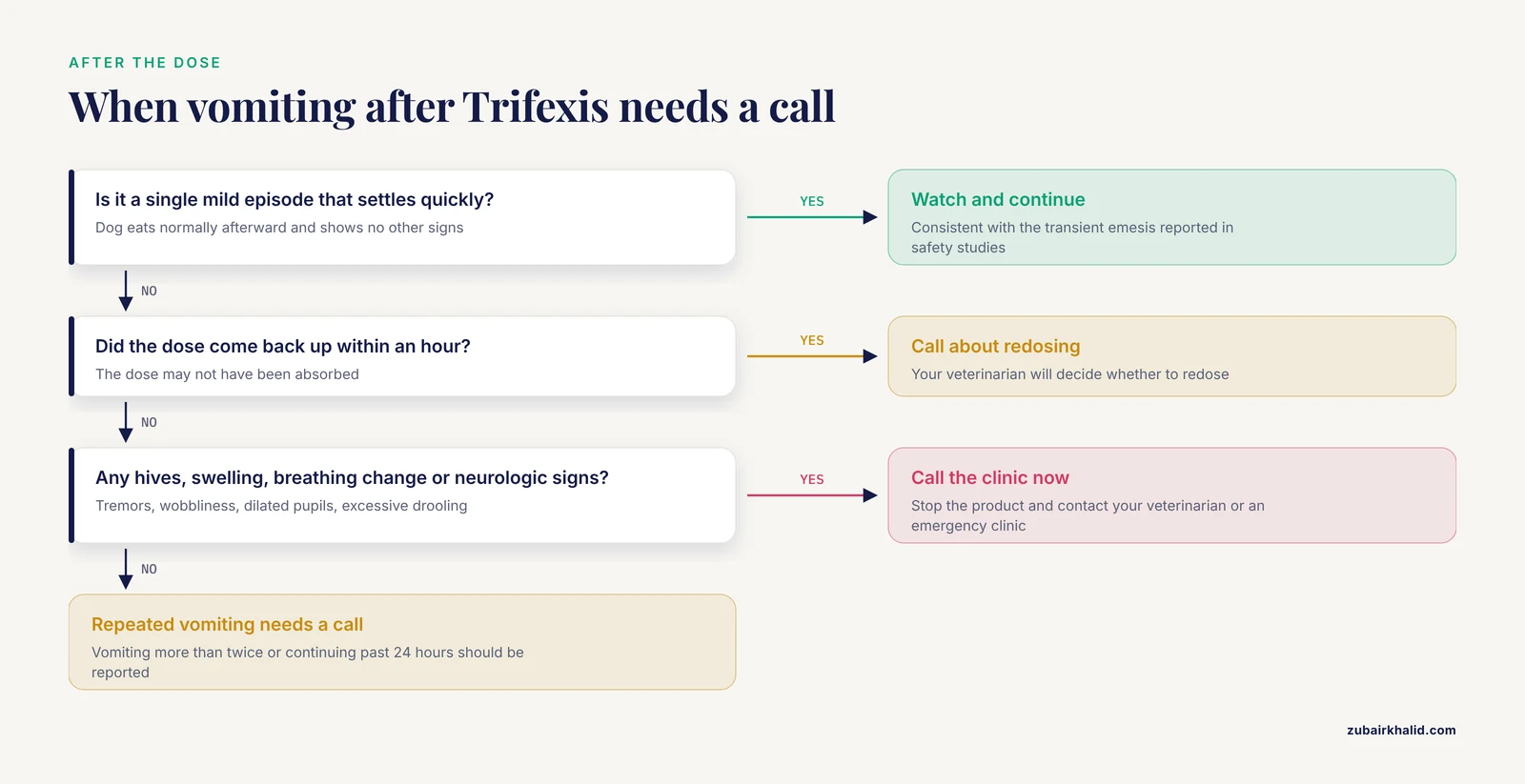
Most vomiting after a Trifexis dose is a single episode within a few hours and resolves without treatment. The dog eats normally afterward and shows no other signs. That pattern is consistent with the transient emesis reported in the safety studies [13].
A different pattern deserves a call to the clinic:
- Repeated vomiting, or vomiting that continues past 24 hours
- Vomiting accompanied by lethargy, weakness, or refusal to eat
- Vomiting the dose within an hour of administration (the dose may not have been absorbed, and your veterinarian will decide whether to redose)
- Hives, facial swelling, or difficulty breathing
- Tremors, wobbliness, dilated pupils, or excessive drooling
Neurologic signs and the MDR1 question
The macrocyclic lactone class, which includes milbemycin oxime, carries a well-known risk of neurologic toxicity in dogs with the MDR1 (also called ABCB1) gene mutation. Collies and related herding breeds are overrepresented. This is the single most common safety question owners ask about Trifexis.
The direct evidence is reassuring. Twenty adult Collies that were homozygous or heterozygous for the MDR1 mutation and that had previously shown signs of toxicosis after oral ivermectin were given spinosad alone at 300 mg/kg, or spinosad with milbemycin oxime at 3, 5, or 10 times the maximum label dose, on five consecutive days, twice over the study period [14]. No signs of avermectin or milbemycin toxicosis were attributed to treatment in any dog [14]. That is a well-designed, deliberately provoked study in the most sensitive population available, and it supports the safety of the combination at label doses in MDR1-affected Collies.
That does not mean neurologic signs are impossible. It means the risk is low enough that the label does not exclude MDR1-affected dogs, and your veterinarian can weigh the product against alternatives if your dog has a known mutation or a prior reaction to a macrocyclic lactone.
Special Populations
Heartworm-positive dogs
Trifexis is a preventive, not a treatment. The safety study described above was conducted specifically in microfilaremic heartworm-positive dogs, and it showed that three monthly treatments at label dose and at 3 and 5 times label dose did not eliminate adult worms and did not cause serious adverse events beyond mild transient vomiting [13]. Microfilaria counts fell in treated dogs while rising in untreated controls [13].
The clinical takeaway is that the product can be given to a heartworm-positive dog under veterinary supervision, but it does not replace adulticidal therapy. A positive antigen test changes the entire treatment plan.
Puppies
The label minimums are 8 weeks of age and 5 pounds of body weight. Below those thresholds, the product has not been formulated or studied for safe use, and a different preventive should be chosen.
Collies and herding breeds with MDR1
See the section above. The label does not require exclusion, and the dedicated Collie study found no toxicosis at doses up to 10 times the milbemycin label dose [14].
Dogs with concurrent parasite preventives
Many heartworm preventives and some tick products contain macrocyclic lactones. Stacking them is a decision for the prescribing veterinarian, not a do-it-yourself choice. Bring every product your dog receives, including supplements and seasonal items, to the appointment.
Which Dogs Should Not Receive Trifexis
- Puppies younger than 8 weeks or weighing less than 5 pounds. Outside the label.
- Dogs with a known hypersensitivity to spinosad or milbemycin oxime. A prior reaction is a reason to stop and switch.
- Cats. Never give a dog product to a cat.
- Dogs with an unknown or positive heartworm status until a veterinarian has reviewed the test result and decided on the plan.
- Dogs already receiving another macrocyclic lactone without veterinary review.
- Debilitated, emaciated, or severely ill dogs until stabilized and cleared by a veterinarian.
Drug Interactions and Testing
The most important interaction to understand is the one built into the product. Spinosad increases systemic exposure to milbemycin oxime compared with milbemycin oxime given alone [5]. That is intentional and was evaluated in target animal safety studies at dose multiples, which found no additional adverse clinical reactions attributable to the higher exposure [5].
Beyond that, three practical rules cover most situations:
- Test for heartworm before the first dose and annually after. Antigen testing is how you know the preventive is working and how you avoid giving a preventive to an infected dog without a plan.
- Disclose every other parasite product. Flea collars, tick chews, topical spot-ons, and deworming products all count. Your veterinarian needs the full list to avoid duplicating drug classes.
- Do not use a leftover dose from a different-sized dog. The weight bands exist because the dose is milligram-per-kilogram, and underdosing a large dog leaves gaps in flea and heartworm coverage.
How Trifexis Compares With the Main Alternatives
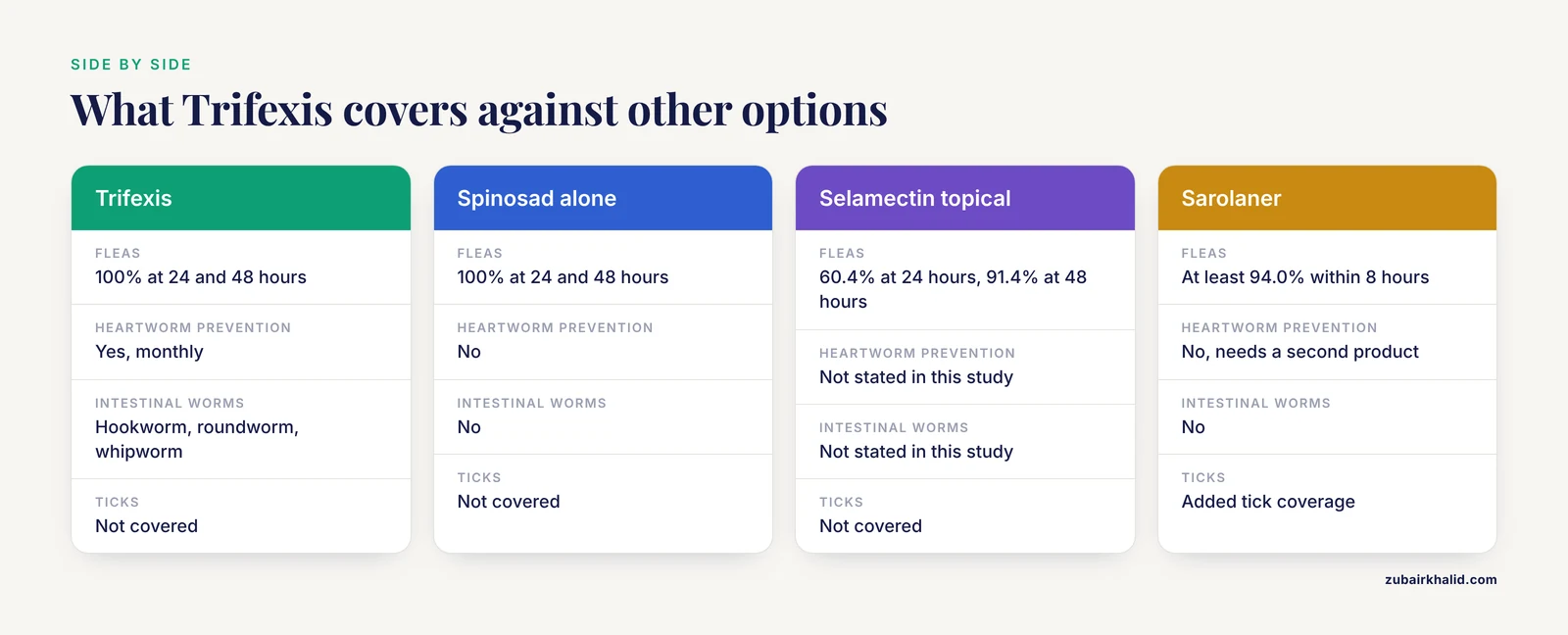
There is no single best parasite product. The right choice depends on which parasites are actually a risk for your dog, which is a regional and lifestyle question.
Trifexis versus spinosad alone (Comfortis). Spinosad by itself is a flea-only product. In the KS1 flea study, the combination and spinosad alone were both 100% effective at 24 and 48 hours against an existing infestation, but at day 28 the combination was 84.7% and 87.5% effective versus 72.9% and 76.3% for spinosad alone [4]. The combination also adds heartworm prevention and deworming, which is the entire reason most owners choose it.
Trifexis versus topical selamectin (Stronghold). In the same laboratory flea study, selamectin was 60.4% effective at 24 hours and 91.4% at 48 hours against an existing infestation, compared with 100% at both time points for the spinosad and milbemycin combination [4]. In the European field trial, the combination produced 98.97% and 97.37% flea reduction at days 14 and 30, compared with 97.43% and 93.96% for the comparator, and more combination-treated dogs were completely flea-free at both rechecks [3]. Topical products have the advantage of not requiring the dog to swallow a tablet.
Trifexis versus sarolaner (Simparica). Sarolaner is an isoxazoline with a very fast flea kill. In a direct comparison, sarolaner produced at least 94.0% efficacy within 8 hours of treatment and subsequent weekly reinfestations through day 35, while the spinosad and milbemycin combination was evaluated on the same schedule [2]. No adverse reactions occurred in either group [2]. The practical difference is speed of flea kill and the isoxazoline class's added tick coverage. Isoxazolines are not heartworm preventives on their own, so a second product is needed for heartworm coverage unless the isoxazoline is paired with a macrocyclic lactone in a combination tablet.
Trifexis versus ivermectin plus praziquantel. Both are monthly-style broad-spectrum dewormers, but the praziquantel component adds tapeworm coverage that Trifexis lacks. In the Toxocara field comparison, the spinosad and milbemycin combination reduced egg counts more than ivermectin plus praziquantel at both 14 and 28 days [9].
What to weigh. Flea-only products leave heartworm and worms uncovered. Heartworm-only products leave fleas uncovered. Products that combine an isoxazoline with a macrocyclic lactone add tick coverage but are a different drug class with a different safety profile. Trifexis sits in the middle: strong flea kill, proven heartworm prevention, three intestinal worms, no ticks, no tapeworms.
Questions to Ask Your Veterinarian
Bring these to the appointment, especially before a first dose:
- Has my dog had a heartworm antigen test in the last 12 months, and is the result negative?
- Which ticks and internal parasites are actually a risk where we live and travel?
- Does my dog need tapeworm coverage, and if so, how should that be handled alongside Trifexis?
- Does my dog's breed or known MDR1 status change your recommendation?
- What should I do if my dog vomits within an hour of the dose?
- What is the plan if a dose is missed by one week, or by three weeks?
- Should my dog stay on this product year-round, or is seasonal use appropriate here?
- What is the recheck schedule for fecal testing and heartworm testing?
Limitations and When to Contact a Veterinarian
Trifexis is well studied, but no preventive is right for every dog. Individual health status, concurrent medications, pregnancy or nursing, age, weight, and regional parasite pressure all change the calculus. That is why the product is prescription-only and why the dose is set by body weight at the time of the visit.
Contact a veterinarian promptly if any of the following occur after a dose:
- Vomiting that repeats more than twice, or continues into the next day
- Vomiting within an hour of the dose, so the dose may not have been absorbed
- Hives, facial swelling, or any breathing change
- Tremors, wobbliness, dilated pupils, excessive drooling, or collapse
- Refusal to eat, marked lethargy, or yellowing of the gums or skin
- Live fleas still present two weeks after a correctly given dose
- Any sign of illness in a dog that is heartworm-positive, pregnant, nursing, or under 8 weeks old
Signs of neurologic toxicity in this drug class can appear as depression, ataxia, dilated pupils, and hypersalivation. If you see them, stop giving the product and call your veterinarian or an emergency clinic.
Related Guides
- Side Effects of Flea and Tick Medication for Dogs: More detail on flea and tick medication side effects
- Side Effects Of Flea Medicine For Dogs: Flea medicine side effects and safety information for dogs
Frequently Asked Questions
Is Trifexis safe for dogs?
Yes, for dogs within the label range of 8 weeks and 5 pounds and above, when dosed correctly by a veterinarian. Controlled studies report mostly mild, transient vomiting and no serious adverse events at label dose or at multiples of it [13][2][3]. Dogs with the MDR1 mutation, including Collies, showed no signs of toxicosis at doses up to 10 times the milbemycin label dose in a dedicated safety study [14].
What does Trifexis kill?
It kills adult fleas, prevents heartworm infection by killing larval Dirofilaria immitis, and treats adult hookworm, roundworm, and whipworm [6][7]. It does not kill ticks, tapeworms, or adult heartworms.
Does Trifexis prevent ticks?
No. Trifexis contains no tick-active ingredient. Dogs at risk for ticks need a separate tick control product chosen with veterinary input.
Can I give Trifexis to a heartworm-positive dog?
Only under veterinary direction. The product does not kill adult heartworms, and a positive antigen test means the dog needs a specific adulticidal plan. Safety data in microfilaremic heartworm-positive dogs at label dose and up to 5 times label dose showed no serious adverse events beyond mild transient vomiting [13].
What are the most common side effects of Trifexis?
Vomiting is the most commonly reported side effect, usually a single mild episode soon after dosing [13]. Less common or more serious signs such as hives, swelling, tremors, or wobbliness warrant a call to the clinic.
How often do I give Trifexis?
Once every 30 days, with food, on a consistent schedule. Monthly dosing is required because the flea efficacy measured in the fourth week after a dose is lower than in the first three weeks [4].
Can Trifexis be given to Collies or other MDR1 dogs?
The label does not exclude them, and a dedicated study in MDR1-affected Collies with a prior ivermectin reaction found no signs of toxicosis at up to 10 times the milbemycin label dose [14]. Tell your veterinarian if your dog has a known mutation or a prior reaction to a macrocyclic lactone.
What happens if my dog vomits after taking Trifexis?
A single mild episode that resolves quickly is consistent with the transient emesis seen in safety studies [13]. Repeated vomiting, vomiting within an hour of the dose, or vomiting with lethargy or other signs should be reported to your veterinarian, who will decide whether the dose needs to be repeated.
Sources
- Dose confirmation and non-interference evaluations of the oral efficacy of a combination of milbemycin oxime and spinosad against the dose limiting parasites, adult cat flea (Ctenocephalides felis) and hookworm (Ancylostoma caninum), in dogs.
- Comparative speed of kill of sarolaner (Simparica) and spinosad plus milbemycin oxime (Trifexis) against induced infestations of Ctenocephalides felis on dogs.
- Field evaluation of the efficacy and safety of a combination of spinosad and milbemycin oxime in the treatment and prevention of naturally acquired flea infestations and treatment of intestinal nematode infections in dogs in Europe.
- Efficacy of selamectin, spinosad, and spinosad/milbemycin oxime against the KS1 Ctenocephalides felis flea strain infesting dogs.
- Pharmacokinetics of spinosad and milbemycin oxime administered in combination and separately per os to dogs.
- Confirmation of the efficacy of a combination tablet of spinosad and milbemycin oxime against naturally acquired infections of canine intestinal nematode parasites.
- Assessment of the effectiveness of a combination product of spinosad and milbemycin oxime on the prophylaxis of canine heartworm infection.
- Efficacy of milbemycin oxime in combination with spinosad in the treatment of larval and immature adult stages of Ancylostoma caninum and Toxocara canis in experimentally infected dogs.
- Efficacy of two anthelmintic treatments, spinosad/milbemycin oxime and ivermectin/praziquantel in dogs with natural Toxocara spp. infection.
- The comparative efficacy of afoxolaner, spinosad, milbemycin, spinosad plus milbemycin, and nitenpyram for the treatment of canine cutaneous myiasis.
- Chrysomya bezziana (Diptera: Calliphoridae) infestation: case report of three dogs in Malaysia treated with spinosad/milbemycin.
- Assessment of the combination of spinosad and milbemycin oxime in preventing the development of canine Angiostrongylus vasorum infections.
- Effects of milbemycin oxime, combined with spinosad, when administered orally to microfilaremic dogs infected with adult heartworms (Dirofilaria immitis).
- Evaluation of the safety of spinosad and milbemycin 5-oxime orally administered to Collies with the MDR1 gene mutation.