What Is a Group of Horses Called? Herds, Bands, and Horse Society
By Dr. Zubair Khalid, DVM, MS, PhD ·
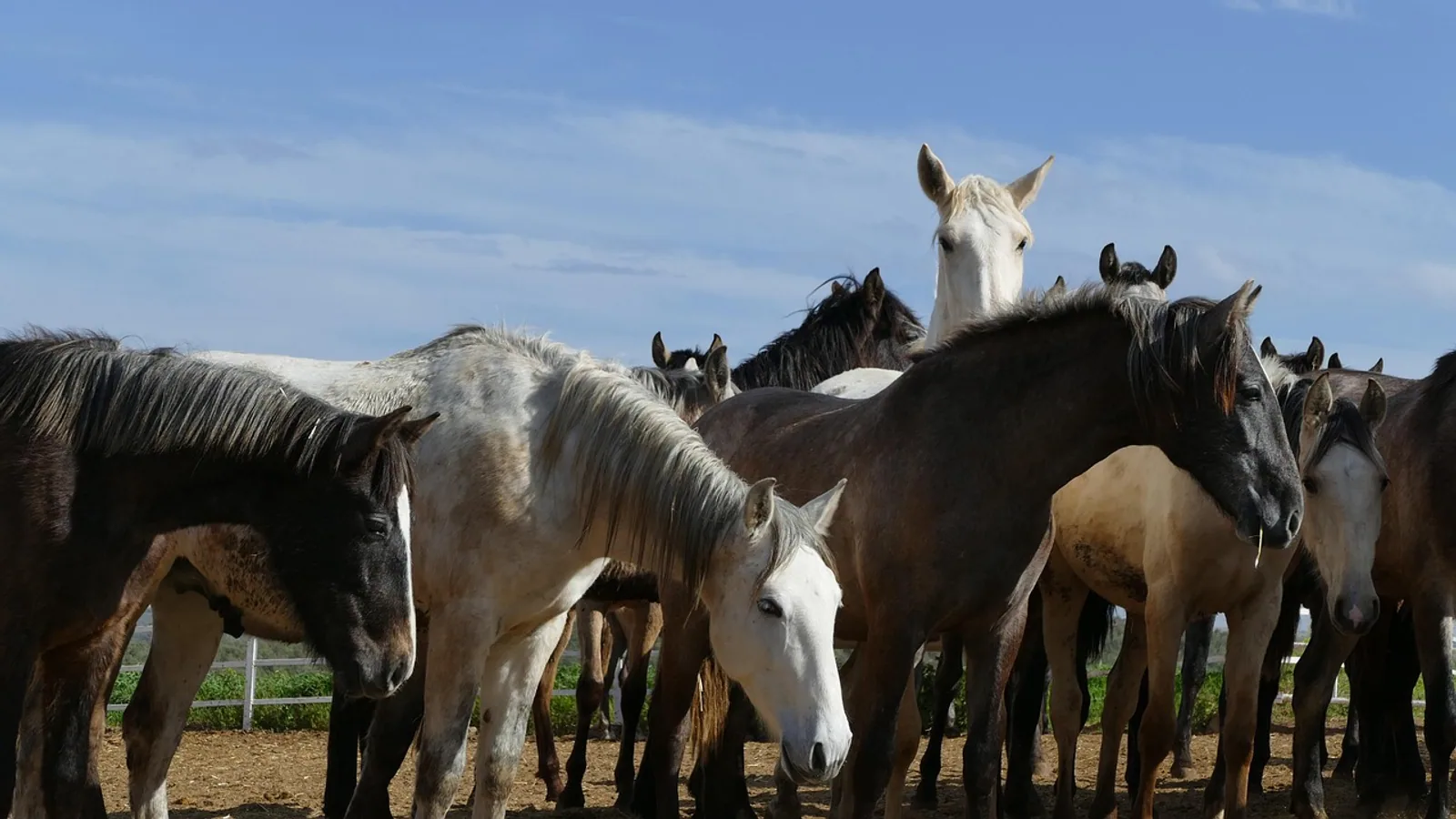
A group of horses is called a herd. Within that herd, the core family unit is called a band, and when that band centers on one breeding stallion with his mares, it is also called a harem. Other collective horse terms exist for specific contexts: a string is a group of horses used together for work or travel, a team is a matched group driven or ridden together, a stud is a group of horses kept for breeding, and a remuda is the working herd of saddle horses on a ranch.
The word you choose depends on what you are describing. A field of thirty pastured horses is a herd. The five horses that graze together in one corner of that field, led by the same older mare, are a band. The stallion and his mares are a harem. This article explains the vocabulary, the social biology that produced it, and why the distinction matters for anyone who keeps horses.
This article is educational and is not a substitute for veterinary diagnosis or treatment.
The Core Vocabulary: Herd, Band, and Harem
Herd is the umbrella term. It covers any collection of horses living or kept together, from two companions in a paddock to hundreds of free-ranging animals on open range. The word carries no implication about relatedness, age, or sex. A herd can be all geldings, all mares, or a mixed breeding group.
Band is the more precise term. In free-ranging and semi-feral populations, horses organize into small, stable family groups. A band typically contains one mature stallion, several mares, and their immature offspring. The bonds within a band are long-lasting. Mares stay with the same band for years, and daughters often remain until they reach maturity. The stallion's role is primarily defensive and reproductive rather than managerial.
Harem is used interchangeably with band when the emphasis is on the stallion's reproductive association with his mares. The term is common in the scientific literature. One study of a captive Przewalski's horse described how suppressing a stallion's testicular function with an anti-GnRH vaccine reduced his serum testosterone and caused him to lose his "harem stallion role," with offspring no longer observed in his group [1]. That phrasing reflects the standard meaning: a harem is a breeding band anchored by a stallion.
A bachelor band is a separate social unit. These are groups of males, often young or without mares, that live together outside the family bands. Researchers studying nine older male Przewalski's horses in a non-breeding bachelor group found that the horses formed stronger social bonds with individuals of similar gregariousness and dominance level, and that the group split into three distinct subgroups with different activity patterns [2]. Bachelor bands are not failed harems. They are a normal, stable social arrangement.
A Table of Horse Group Terms and Horse Terms by Age and Sex
The table below covers the collective nouns and the individual horse terms owners are most likely to encounter. These are standard terms in equine practice and in the scientific literature.
| Term | What it describes |
|---|---|
| Herd | Any group of horses kept or living together |
| Band | Small, stable family group, usually one stallion, several mares, and young |
| Harem | A band described in terms of the stallion's breeding association |
| Bachelor band | A group of males living together without mares |
| String | A group of horses used together for a specific job, such as trail or ranch work |
| Team | A matched group of horses driven or ridden together, as in a hitch |
| Stud | A group of horses maintained for breeding, or the facility housing them |
| Remuda | The working herd of saddle horses on a ranch |
| Foal | A horse of either sex under one year of age |
| Colt | A male horse under four years of age |
| Filly | A female horse under four years of age |
| Yearling | A horse between one and two years of age |
| Mare | A mature female horse, generally four years or older |
| Stallion | An intact mature male horse |
| Gelding | A castrated male horse |
Two clarifications prevent common confusion. First, "stud" refers to the breeding operation or the collection of breeding horses, not to an individual animal, though people often use "stud" casually for a stallion. Second, "colt" and "filly" are age terms, not size terms. A two-year-old racehorse prospect is a colt or filly regardless of how tall it stands.
How Horse Society Actually Works
Horse society is not a hierarchy with one animal commanding the rest. It is a network of overlapping relationships, and the structure varies with the environment, the sex ratio, and the age of the animals involved.
The Lead Mare
In many bands, an older mare consistently leads movement. She is often the first to move toward water, the first to change grazing direction, and the animal others follow. This is a functional role rather than a title. The mare's influence comes from tenure and social relationships, not from physical aggression. Researchers reviewing equine social ethograms found that agonistic behaviors are actually rare in stable horse groups, which contrasts sharply with how heavily the scientific literature has historically focused on aggression [3]. The lead mare's position is maintained through familiarity and affiliation more than through force.
The Stallion
The stallion's contribution is defense of the band and reproduction. He is not the animal that decides where the group grazes. His presence matters most when the band is threatened or when another male approaches. When researchers immuno-neutered a captive Przewalski's stallion, his testosterone fell, his sperm count dropped to near zero, and he lost his harem role [1]. That outcome shows how tightly the harem structure is tied to intact male endocrine function.
Bachelor Bands
Males without mares do not simply live alone. They form their own groups, and those groups have real social structure. In the bachelor group of nine Przewalski's horses, social network analysis identified three distinct subgroups, and membership in a subgroup affected how much each horse moved, how much it foraged, and where it spent time. Some horses overused or underused critical resource areas such as hay and water [2]. The practical implication is that even in a bachelor group, social position shapes access to resources.
Affiliative Bonds and the Real Texture of Herd Life
The most important thing to understand about horse society is that its foundation is affiliation, not conflict. Horses form preferred partnerships. Using wearable ultra-wideband sensors, researchers measured how close horses stayed to each other and found that the animals remained a median of about 5.8 meters apart overall but spent roughly 20 percent of their time within 3 meters of a preferred partner [4]. That is a measurable, repeatable expression of friendship.
The same research group documented 37 distinct equine social behaviors in a standardized video ethogram, including the subtle cues that separate aggression from play, such as ear position and facial expression [5]. Horses have a rich social vocabulary. Most of it is not about fighting.
Why Space and Social Contact Both Matter
Horses need company. They also need room. These two needs interact, and understanding the interaction is central to good management.
A study of 34 horses in paddock and field conditions used continuous position tracking to see how space changed social dynamics. When horses had larger enclosures, the median distance between individuals increased from about 8.3 meters in the paddock to about 19 meters in the field. But the horses did not spread out to the maximum available distance. Closest associates stayed nearer to each other than other pairs in both settings, and the group stayed within range of even its least frequent associates, suggesting a threshold distance for group cohesion [6].
That finding has a direct management meaning. Horses in a small paddock cannot avoid each other. The same study found that agonistic interactions were more frequent in the paddock than in the field and correlated negatively with interindividual distance [6]. When horses cannot step away from a conflict, conflict increases. Space is not a luxury. It is a mechanism for social regulation.
The study also found that agonistic interactions occurred more often between close associates than between distant ones [6]. This is counterintuitive until you consider that horses who spend time together have more opportunities for friction over resources. Familiarity and conflict coexist.
Social Contact and the Welfare of Domestic Horses
Domestication did not erase the horse's need for other horses. A systematic review of equine social behavior concluded that sociality is an ethological need of horses that remained unchanged by domestication, and that management systems and welfare assessments should account for the opportunity to form stable affiliative bonds [3].
The evidence from domestic settings supports that conclusion.
Stabling and Social Contact
A cross-sectional study of stabled horses compared three stall architectures. Stalls that allowed tactile contact between neighboring horses had significantly higher social interaction time than stalls that allowed only visual contact. All horses in the study developed abnormal or stereotypic behaviors, which occupied about 21 percent of their time budget, and eating occupied only about 14 percent [7]. The stall design did not eliminate stereotypies, but tactile access increased social behavior. That is a meaningful difference in a housing system where horses spend most of their day confined.
Training and Racing Environments
Social contact is often restricted in high-performance settings. A longitudinal welfare assessment of 16 young French jump racehorses found that the horses had no free turnout and that social contact was often limited to visual interaction in 68 percent of cases [8]. A separate study of 353 racehorses across 13 English training yards found that 54.1 percent of stabled horses had physical social contact [9]. These figures show that physical contact with other horses is not guaranteed in performance barns, even though the animals are social by nature.
What Owners Believe Versus What Horses Need
A qualitative study of 31 equine practitioners and enthusiasts in Brazil identified three themes in how people think about horse welfare. One theme, "Let the horse be a horse," captured awareness of the animal's natural needs. Another, "Everyone does it like that," captured the social norms that keep harmful practices in place [10]. The gap between knowing what a horse needs and doing it is often a social gap, not a knowledge gap. Owners who isolate horses frequently do so because it is customary, not because they believe it is best.
Recognizing What a Horse Is Feeling
Improving welfare requires recognizing when a horse is struggling. An educational tool called RAiSE (Recognizing Affective State in Equine) was developed to help horse industry participants assess equine emotional states. Participants who used the tool reported improvements in their ability to assess affective states and expressed intent to change their behavior. Themes that emerged included awareness of the horse's emotional state, observation of body language, interpreting equine senses, and recognizing pain and its effect on behavior and well-being [11].
The takeaway for owners is straightforward. A horse that cannot interact with other horses needs closer observation, not less. Behavior problems in isolated horses are often communication, not disobedience.
Common Myths About Horse Groups
Several persistent beliefs about horse herds do not match the evidence.
Myth: The stallion leads the herd. In practice, mares typically lead movement, and the stallion's role centers on defense and reproduction. The harem structure depends on his endocrine function, but his day-to-day influence over group direction is limited [1].
Myth: Herds are organized by strict dominance with one alpha horse. Horses form preferred partnerships and stable affiliations. Agonistic behavior is rare in stable groups, and the scientific literature's heavy emphasis on aggression overstates how much conflict actually occurs [3]. Social network analysis of a bachelor group found that horses bonded with others of similar gregariousness and dominance level rather than forming a single linear chain [2].
Myth: A horse alone is fine as long as it can see other horses. Visual contact is better than total isolation, but it is not equivalent to physical contact. Stalls permitting tactile contact produced more social interaction than stalls permitting only visual contact [7]. Proximity tracking shows that horses seek closeness to preferred partners, spending about a fifth of their time within 3 meters of them [4]. Seeing is not the same as touching.
Myth: Geldings do not need company the way mares and stallions do. Bachelor groups of males form stable social bonds and distinct subgroups [2]. Sex does not remove the need for social contact.
Myth: More space always means less social contact. Horses in larger enclosures did spread out more, but they did not disperse maximally. They stayed within range of the group, and preferred partners stayed closer than other pairs [6]. Space changes the geometry of the herd. It does not dissolve it.
Practical Implications for Owners and Keepers
The research supports several concrete management principles. These are general welfare considerations, not prescriptive protocols, and individual horses vary.
Provide physical contact when possible. Tactile access between neighboring horses increased social interaction time in a controlled comparison of stall designs [7]. If full turnout is not feasible, adjacent stalls with bars or openings that permit touching are a meaningful improvement over solid walls.
Give horses room to step away. Agonistic interactions were more frequent in smaller paddocks and decreased as interindividual distance increased [6]. A paddock large enough for a low-ranking horse to move away from a higher-ranking one reduces friction.
Expect and support preferred partnerships. Horses form specific friendships, not just general tolerance of a group. Preferred partners stay closer and spend more time in proximity [4]. When you move horses between groups, expect disruption to those bonds and allow time to re-form.
Watch isolated horses more closely. Horses in individual housing develop abnormal and stereotypic behaviors at high rates. In one study, every horse in the sample showed them, occupying about 21 percent of the time budget [7]. Stereotypies are a welfare signal, not a personality quirk.
Do not rely on visual contact alone. Visual-only arrangements are common in performance barns, with one study finding that 68 percent of young racehorses had social contact limited to visual interaction [8]. Visual contact is a partial measure, not a full substitute for physical companionship.
Use the horse's own behavior as your guide. Tools like RAiSE were designed to help owners read affective states through body language, sensory cues, and signs of pain [11]. Learning to read a horse's social behavior accurately is a welfare skill, not an optional one.
Question customary practice. The belief that "everyone does it like that" is one of the strongest forces keeping suboptimal housing in place [10]. Custom is not evidence.
What Is Still Uncertain
The research on equine social behavior has real gaps. A systematic review found that the scientific literature has focused disproportionately on agonistic behaviors, with 67.7 percent of the reviewed publications emphasizing aggression and only 26 percent emphasizing affiliation, even though agonistic behavior is rare in stable groups and affiliation is well established as important [3]. That imbalance means the science of horse friendship is less developed than the science of horse conflict.
The mechanisms behind preferred partnerships are not fully mapped. Proximity tracking can identify who spends time with whom, and it can distinguish affiliative from agonistic approaches based on approach speed and the resulting distance and duration of proximity [4]. What it cannot yet explain is why particular horses choose each other.
The relationship between group size, space, and welfare has no single optimal number supported by the evidence. The reviewed studies covered groups averaging 9.1 horses with a range of 2 to 33 [3]. What works for one management system may not work for another.
There is also the question of how much social contact is enough. The finding that horses spend about 20 percent of their time within 3 meters of a preferred partner [4] describes what horses do, not necessarily what they need. The minimum requirement for good welfare is not established.
Limitations and When to Contact a Veterinarian
This article describes general social biology and welfare research. It cannot tell you what is right for an individual horse, and every management decision should account for that horse's health, temperament, and history.
Contact a veterinarian promptly if a horse shows any of the following.
- Stereotypic behaviors that are new, intensifying, or accompanied by weight loss, including cribbing, weaving, or stall walking
- Signs of pain or discomfort, such as the facial expressions and postural changes used in grimace-based pain assessment
- Injuries that could have come from a herdmate, especially kicks, bites, or wounds of unknown origin
- Sudden changes in social behavior, including a horse that becomes withdrawn from its group or is repeatedly chased away from feed and water
- Lameness, reluctance to move, or changes in appetite in a horse that has recently changed groups
- Any horse kept alone that develops new behavior problems, poor condition, or signs of stress
A veterinarian can assess physical health, pain, and management factors together. Behavior problems in horses frequently have a physical component, and pain changes how horses interact with each other.
Frequently Asked Questions
What is a group of horses called?
A group of horses is called a herd. A smaller family group within a herd is called a band, and a breeding band centered on a stallion is also called a harem.
What is a band of horses?
A band is a small, stable family group, usually made up of one stallion, several mares, and their young offspring. Band members stay together for long periods and form lasting social bonds.
What is a harem of horses?
A harem is a band described in terms of the stallion's breeding association with his mares. The term appears frequently in the scientific literature on wild and semi-feral horses.
What do you call a group of male horses?
A group of male horses living together without mares is called a bachelor band. These groups are stable and have their own social structure.
What is a female horse called?
A mature female horse is called a mare. A female horse under four years of age is called a filly, and a female under one year is called a foal.
What is a male horse called?
An intact mature male horse is called a stallion. A castrated male is called a gelding, and a male under four years of age is called a colt.
Do horses need to live in groups?
Horses are social by nature, and sociality is considered an ethological need that domestication did not change. Horses kept alone or with only visual contact show more abnormal behaviors and less social interaction than horses with physical contact.
What is a group of horses used for work called?
A group of horses used together for a specific job is called a string. A matched group driven or ridden together is called a team, and the working herd of saddle horses on a ranch is called a remuda.
Related Articles
- Miniature Horse Care Guide
- Horse Blanketing: When and How
- Senior Horse Care Guide
- How To Groom A Sensitive Horse
- Horse Trailering Stress
- Horse Choke Signs
- Thoroughbred Horse: Traits, Off-Track Care, and Health Problems
- Roan Horse: Red, Blue, and Bay Roan Color and Genetics
- Norwegian Fjord Horse: Size, Temperament, Color, and Care
Sources
- Case Report: Suppression of Harem Stallion Behavior and Fertility Following Anti-Gonadotropin-Releasing Hormone Vaccination of a Captive Wild Przewalski's Horse (Equus ferus przewalskii).
- Social Relationships of Captive Bachelor Przewalski's Horses and Their Effect on Daily Activity and Space Use.
- Equine Social Behaviour: Love, War and Tolerance.
- Proximity tracking using ultra-wideband technology for equine social behaviour research.
- Video Ethogram of Equine Social Behaviour.
- The role of space availability and affiliation in shaping equine social distances and dynamics.
- Time-Budget and Welfare Indicators of Stabled Horses in Three Different Stall Architectures: A Cross-Sectional Study.
- Longitudinal welfare assessment in French jump racehorses during season preparation.
- Racehorse welfare across a training season.
- The Easiest Becomes the Rule: Beliefs, Knowledge and Attitudes of Equine Practitioners and Enthusiasts Regarding Horse Welfare.
- Enhancing equine welfare: a qualitative study on the impact of RAiSE (Recognizing Affective States in Equine) as an educational tool.