Do Cats Like Music? What Science Says About Feline Hearing
By Dr. Zubair Khalid, DVM, MS, PhD ·
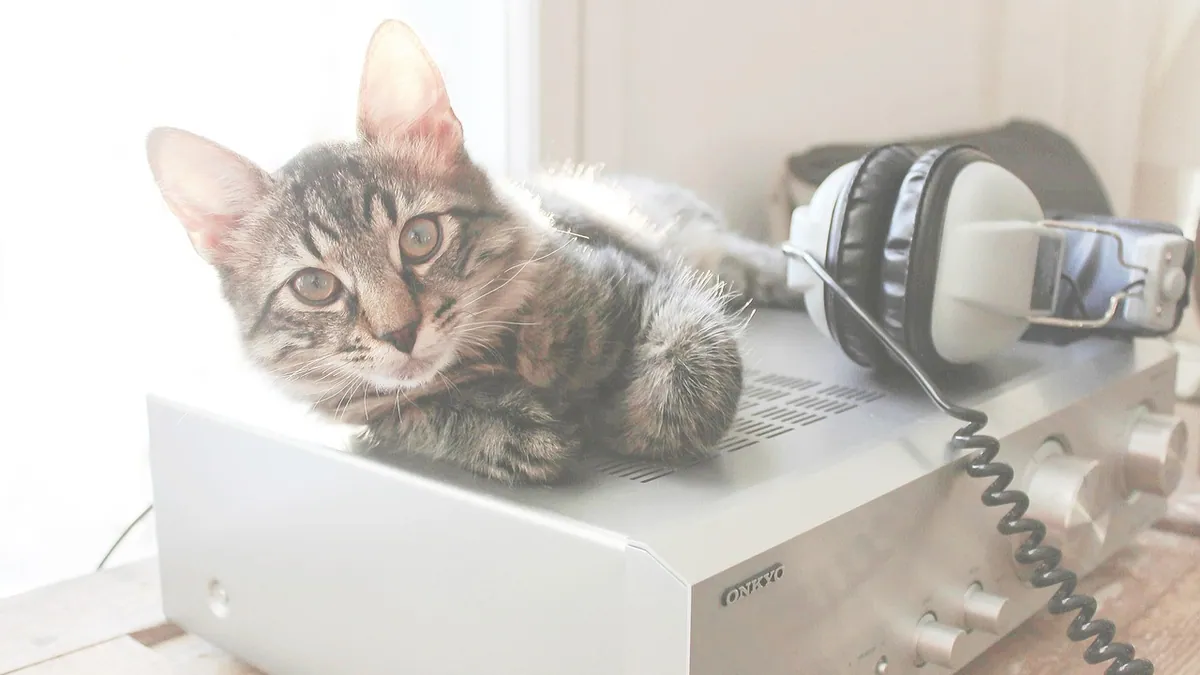
Yes, cats can respond to music, but they do not hear it the way you do. Their ears are built for a wider range of frequencies than human ears, so some sounds that please you may be meaningless or even irritating to them [1]. Whether a cat actually enjoys music depends on the type of sound, the volume, and the individual cat.
This article is educational and is not a substitute for veterinary diagnosis or treatment.
Quick Answer
- Cats hear a wider range of frequencies than people and most dogs, so their experience of sound is different from yours [1].
- Music can lower stress and anxiety in cats and dogs in stressful settings, partly by masking disturbing background noise [2].
- Music type matters. Tempo, pitch, and instrumentation all affect how an animal responds, and responses differ between species and between individuals [3][4].
- Music is a non-drug tool. It supports, but does not replace, veterinary treatment for pain, anxiety, or illness [2].
- Keep volume low and watch your cat's body language. If your cat leaves, flattens its ears, or hides, the music is not helping.
How Cats Hear Sound
A wider range than yours
Cats are highly sensitive to sound. They hear a wider range of frequencies than people and most dogs [1]. That sensitivity helped their ancestors locate small prey, and it still shapes how they react to noise in your home.
The ear has three parts: the outer, middle, and inner ear. The inner ear contains the cochlea, which is the hearing center, plus the structures that control balance [1]. The semicircular canals are fluid-filled and help cats keep their remarkable agility and balance [1]. Hearing and balance are wired together in the same organ, which is one reason ear disease in cats can show up as wobbliness, not just as trouble hearing.
Why human music may not translate
Music is a complex sound stimulus, and different species perceive tempo, rhythm, and pitch in different ways [4]. A piece that sounds calm to you may sit in a frequency range your cat barely registers, or it may contain sharp, high sounds that feel harsh.
Research on cats exposed to controlled music stimulation found measurable changes in the auditory system, including a 1.38-fold increase in a type of inhibitory neuron compared with cats kept in ambient noise [5]. The music-exposed group also showed a 2.1-fold increase in certain signaling components [5]. This suggests that sound environments can shape how a cat's brain processes what it hears, though the practical meaning for daily life at home is still being worked out.
Do Cats Like Music? What the Evidence Suggests
There is no simple yes or no. The honest answer is that it depends on the sound and the cat.
What is better established is that music can act as environmental enrichment for cats. It can mask disturbing background noises and reduce anxiety or aggressive behavior in stressful settings [2]. That is a welfare benefit even if your cat never appears to "enjoy" a song the way a person would.
The effect also depends on how the music is delivered. A proposed framework for using music in veterinary settings lists the components that matter: genre, tempo, pitch, and instrumentation, plus volume, delivery method, duration, timing, frequency of presentation, and the animal's previous music experience [3]. In other words, "playing music" is not one intervention. It is many, and the details change the outcome.
Work in other species shows how much the specific track matters. In sheep, one piece of music at 55 dB helped the animals learn a spatial task faster and improved average daily gain, while a different piece at the same volume made them more restless and hurt their performance [6]. Same volume, opposite results. The takeaway for cat owners is that you should test sounds instead of assume all music is calming.
Do Kittens Like Music?
Kittens are still developing, and their sound world is especially important. Music exposure may promote neuroplasticity that affects emotional processing pathways, auditory discrimination, and cognitive development [5]. That is a research finding about brain changes, not a promise that playing Mozart will make your kitten smarter.
Practically, kittens startle easily and have less experience with household noise. Keep any music quiet, keep sessions short, and let the kitten move away if it wants to. Never use music to cover up a problem like crying, litter box issues, or constant hiding. Those need a veterinary look.
Medical Causes to Rule Out First
If your cat reacts oddly to sound, do not assume it is a musical preference. Ear disease and hearing loss can change behavior.
Watch for these signs and have your veterinarian examine your cat:
- Scratching at the ears or head shaking, which often points to ear problems. See Cat Scratching Their Ears and Cat Head Shaking and Ear Problems: What to Know.
- Not responding to your voice, or sleeping through sounds that used to wake your cat.
- Tilting the head, losing balance, or walking unsteadily, since the inner ear controls balance as well as hearing [1].
- Sudden sensitivity to normal household sounds, which can accompany pain or anxiety.
Your veterinarian may recommend tests to confirm a diagnosis. These can include x-rays, CT, MRI, or electronic hearing tests when deafness is suspected, and a biopsy may be needed if a tumor is suspected [1]. Deafness in cats is manageable, but it should be diagnosed instead of guessed at.
When Music Becomes a Problem
Music helps when it lowers arousal. It becomes a problem when it adds stress.
Signs the sound environment is working against your cat include hiding, flattened ears, a twitching tail, dilated pupils, pacing, vocalizing, or refusing to eat while the music plays. Some cats become more alert or restless with certain tracks, similar to the sheep that performed worse with the waltz [6].
Volume is a common mistake. Cats are sensitive to sound [1], and loud music in a small room is a lot of input. If you have to raise your voice over the music, it is too loud for your cat.
How to Use Music for Your Cat, Step by Step
1. Start quiet
Set the volume low, well below what you would use for yourself. The sheep study used 55 dB, which is roughly the level of a normal conversation [6]. That is a reasonable ceiling to aim for, and quieter is fine.
2. Choose simple, predictable sound
Look for slow tempo, low pitch, and simple instrumentation. The framework for veterinary music intervention treats genre, tempo, pitch, and instrumentation as separate variables that should be chosen deliberately [3]. Smooth, steady sound is a better starting point than percussion-heavy or highly dynamic tracks.
3. Test one thing at a time
Play one type of music for a short period and watch your cat. Then try a different type on another day. Because previous music experience affects how an animal responds [3], your cat's reaction may change over repeated sessions.
4. Pair music with good things
Play the music during meals, grooming, or quiet resting time. This builds a positive association. Music can support a calm environment, but it works best alongside other enrichment, not instead of it.
5. Use music to mask scary sounds
Music is useful for covering up disturbing background noise such as traffic, construction, or a barking dog [2]. This is one of the clearest practical uses for cat music at home.
6. Try it during car rides and vet visits
Stressful settings are where music has the most evidence behind it in dogs and cats [2]. If your cat hates the carrier, start the music before you put the cat in, keep the volume low, and keep the same track each time so it becomes a familiar cue.
7. Consider species-specific recordings
Some commercially available recordings are designed around feline hearing instead of human taste. The research supports the idea that species differences in music perception are real [4], so a track made for cats is a reasonable thing to try. Whether your individual cat prefers it is something only your cat can tell you.
8. Keep a simple log
Note the track, the volume, the time of day, and your cat's behavior. Patterns show up fast, and you can share the log with your veterinarian if anxiety is a concern.
What Not to Do
- Do not punish your cat for hiding, meowing, or leaving the room when music plays. Punishment adds stress and does not change how sound feels to your cat.
- Do not assume all music is calming. The sheep results show that the wrong track at the right volume can increase restlessness [6].
- Do not crank up the volume to "get your cat used to it." Cats are sensitive to sound [1], and flooding a nervous cat with noise usually backfires.
- Do not use music as a substitute for treatment. Music is a supportive, non-drug approach that works alongside veterinary care, not in place of it [2].
- Do not expect the same result for every cat. Responses vary with species and individual, and the research base in cats is still limited compared with human medicine [3][4].
Music in the Veterinary Clinic
If your cat is scheduled for surgery or a procedure, ask whether the clinic uses music. Music has strong evidence in human perioperative care as a non-drug addition to a multimodal approach, and the evidence in dogs and cats is more limited but promising [3]. Music exposure is linked to release of endorphins, endocannabinoids, and dopamine, favorable effects on the autonomic nervous system, and reduced pain perception and stress response [2].
That does not mean music replaces pain medication or anesthesia. It means a calm sound environment is one more layer of comfort. If you want to bring a specific track for your cat, ask the team in advance. Clinics have their own protocols for volume, timing, and delivery.
Limitations and When to Contact a Veterinarian
Music research in cats is still developing. Many findings come from other species, and individual cats vary widely. Your veterinarian is the right person to assess your cat's specific situation.
Contact a veterinarian the same day if your cat:
- Suddenly stops responding to sound, or seems deaf in one or both ears.
- Has discharge, swelling, or a bad smell from the ear.
- Is scratching or shaking the head hard enough to cause injury.
- Becomes suddenly fearful of normal household sounds.
Seek emergency care now if your cat:
- Loses balance, falls over, or cannot walk straight.
- Has a head tilt that appeared suddenly along with vomiting or eye flicking.
- Collapses, has a seizure, or becomes unresponsive.
Schedule a routine visit if your cat:
- Has had gradual hearing changes over weeks or months.
- Shows ongoing anxiety around noise that is not improving with a calm environment.
- Needs help with stress related to car travel, grooming, or vet visits.
For a broader look at feline health and behavior, see Facts About Cats: Surprising Health and Behavior Insights.
Frequently Asked Questions
Do cats prefer silence over music?
Many cats do well in a quiet home, but silence is not required. Music can help by masking disturbing background noise [2]. The key is keeping the volume low and letting your cat choose whether to stay in the room.
Is classical music best for cats?
There is no single best genre. Tempo, pitch, and instrumentation all influence how an animal responds, and the right combination is chosen deliberately instead of assumed [3]. Slow, simple, low-pitched sound is a sensible starting point, and your cat's reaction is the real test.
Can music help my cat during fireworks or thunderstorms?
Music can mask scary background sounds and reduce anxiety in stressful settings [2]. Pair it with a safe hiding spot, and start the music before the noise begins so it becomes a familiar cue instead of a surprise.
Does music change a cat's brain?
Research in cats found that music exposure was linked to changes in inhibitory neuron density and signaling components in the auditory system [5]. What those changes mean for everyday behavior at home is not yet well established in veterinary research.
Should I leave music on all day for my cat?
Long sessions are not automatically better. Duration and timing are part of how a music intervention is designed [3], so short, purposeful sessions are easier to evaluate. If your cat seems calmer with quiet, quiet is a valid choice.
Related Articles
- Why Are Cats So Cute? The Science Behind Feline Adorableness
- Cat Scratching Their Ears
- Can Cats See in the Dark? Feline Vision Explained
- Facts About Cats: Surprising Health and Behavior Insights
- Cat Head Shaking and Ear Problems: What to Know
- Why Is My Cat Scratching Its Ears?
- Are Cat Ears Sensitive to Loud Noise? What Owners Should Know
- How to Tell If Your Cat Is Deaf or Hard of Hearing
- Do Dogs or Cats Have Better Hearing? Ear Anatomy Compared
- Tympanic Ear: Eardrum, Ear Bones, and How Hearing Works
References
- Ear Structure and Function in Cats - Cat Owners. Merck Veterinary Manual.
- Proposed Physiological and Neurobiological Mechanisms of Music's Effect, with a Focus on the Perioperative Period: Literature Evidence from Human, Canine and Feline Medicine. Veterinary sciences, 2025.
- Music as a perioperative, non-pharmacological intervention in veterinary medicine. Establishing a feasible framework for music implementation and future perspectives with a focus on the perioperative period of dogs and cats. Frontiers in veterinary science, 2025.
- Music and animal welfare: from behavioral and physiological effects to potential applications in animal husbandry. PeerJ, 2026.
- Morphological Correlates of Music-Induced Plasticity in the Central Auditory System. International journal of developmental neuroscience : the official journal of the International Society for Developmental Neuroscience, 2026.
- Effects of music on the spatial cognitive performance, growth performance and stress response of sheep. Animal bioscience, 2025.