White Leghorn Chickens: Egg Production, Temperament and Health
By Dr. Zubair Khalid, DVM, MS, PhD ·
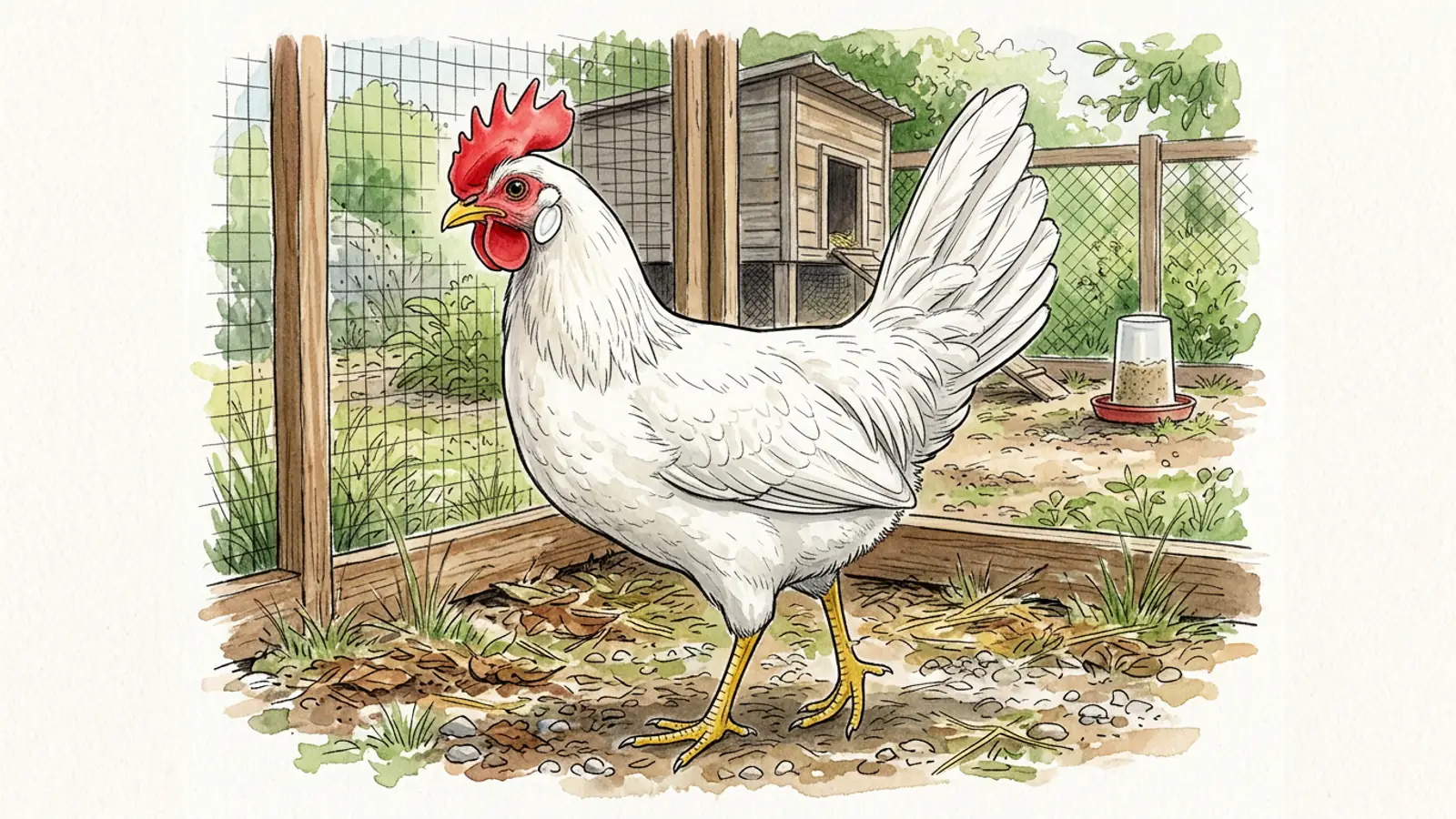
The White Leghorn chicken is the archetypal white-egg layer. It is a light-bodied Mediterranean breed that originated around Livorno in Italy, matured early, lays large numbers of white eggs, and rarely goes broody. The breed's white plumage, large single comb, white earlobes, and yellow legs make it easy to identify, and its genetics sit behind a large share of the world's commercial white-egg production. It is not a cuddly backyard pet. The White Leghorn is alert, active, and quick to take flight, which suits keepers who want eggs and can provide secure housing, tall fencing, and plenty of space. This guide covers the breed's history, appearance, temperament, egg output, and the health problems most relevant to backyard flocks.
This article is educational and is not a substitute for veterinary diagnosis or treatment.
Key Takeaways
- The White Leghorn is a light-bodied Mediterranean chicken from the Livorno area of Italy, kept mainly for white table-egg production and known for a large single comb, white earlobes, and yellow legs.
- Production-type White Leghorns are commonly cited at roughly 250 to 300 large white eggs a year, while heritage exhibition lines often lay fewer and the breed rarely goes broody.
- The White Leghorn is active, alert, and flighty rather than a lap bird, so it needs secure housing, tall fencing, and plenty of space, and it handles heat well but its large comb is prone to frostbite.
- Egg and shell quality decline in the late laying period, so a White Leghorn hen in her second or third year may lay larger eggs with thinner shells and needs a balanced layer ration plus free-choice oyster shell.
- Fatty liver hemorrhagic syndrome is linked to an energy-dense, low-protein diet, and a White Leghorn with a swollen abdomen, persistent straining, or a sudden drop in production needs veterinary assessment.
At a Glance
| Attribute | White Leghorn |
|---|---|
| Origin | Livorno area, Italy [1] |
| Primary purpose | White table-egg production [1] |
| Plumage | White [1] |
| Comb | Large single comb [1] |
| Earlobes | White [1] |
| Legs | Yellow [1] |
| Body type | Light [1]; standard weights about 6 lb for males and 4.5 lb for females |
| Temperament | Active and flighty |
| Broodiness | Low to absent |
| Egg color | White [1] |
| Heat tolerance | Good |
| Cold tolerance | Moderate, large comb is prone to frostbite |
| Good with children | Limited, not a lap bird |
| Best suited to | Keepers prioritizing egg numbers and secure containment |
Origin and History of the White Leghorn
The Leghorn takes its name from the English rendering of Livorno, the Tuscan port city near where the breed was developed [1]. Italian farmers kept small, active, high-laying fowl in the region for generations. Birds moved from Italy to North America in the nineteenth century, and American breeders refined them into the standardized Leghorn we recognize today. The White Leghorn became the foundation of the commercial white-egg industry because it combined a light body with heavy egg output [1].
The breed's role in commercial production is not incidental. White Leghorn genetics were used to build the modern layer hybrids that dominate white-egg barns, and the breed is still used in layer breeding programs today [2]. That history explains a key point for backyard keepers: the White Leghorn you buy from a hatchery is usually not the same bird as the commercial layer hybrid in an egg barn, even though both trace back to the same Mediterranean stock.
Heritage Leghorns Versus Commercial Strains
Heritage Leghorns are the exhibition and farmyard lines. They retain the breed's original type, including the large single comb, white earlobes, and yellow legs, and they are typically kept for a mix of egg production and show quality [1]. Their egg numbers are respectable but generally below what a commercial hybrid delivers.
Commercial strains are the product of decades of selection for feed efficiency, egg numbers, and egg quality across an extended laying cycle. Research on White Leghorn hens tracked egg quality traits from 35 to 100 weeks of age, a reflection of how far the commercial laying cycle has been extended [3]. Selection for age at first egg has also been studied in White Leghorns, because early maturity interacts with long-term production and egg quality [2]. A backyard keeper buying a "Leghorn" from a hatchery is usually getting a production-oriented line, while a breeder focused on the standard is selling a heritage bird. Both lay white eggs. The heritage bird is generally hardier in a mixed flock and easier to keep as a long-term hen.
Appearance
The White Leghorn's appearance is defined by contrast. The plumage is white, the comb is a large single comb, the earlobes are white, and the legs are yellow [1]. The body is light, built for flight and foraging rather than meat.
The large single comb is the breed's most visually striking feature and its main cold-weather liability. A comb that size radiates heat in summer, which helps the breed tolerate hot weather, but the same surface area is vulnerable to frostbite in hard freezes. The white earlobes are a breed marker and distinguish the Leghorn from breeds with red earlobes that lay brown eggs. The yellow legs are another identifying trait, though leg color can fade in a hen in heavy lay.
The white plumage has a practical cost. A white bird stands out against green pasture and against most coop backgrounds, which makes it more visible to hawks and other predators than a camouflaged breed. The light body also means the White Leghorn has less insulation and less muscle mass than a heavy dual-purpose breed.
Temperament and Behavior
The White Leghorn is active, alert, and flighty. It is a forager and a flier rather than a lap bird. Hens move constantly, scratch aggressively, and are quick to spook. A White Leghorn rooster shares the same alert, active disposition and is typically more interested in watching the flock than in being handled.
This temperament has real consequences for housing and handling. Flighty birds are harder to catch, harder to confine with low fencing, and more likely to injure themselves in a panic. Keepers who want a chicken that walks up to be picked up should look at a docile dual-purpose breed instead. Keepers who want a self-sufficient forager that lays well and does not sit on nests will find the Leghorn's temperament an asset.
The breed's activity level also affects how it uses space. In a small free-range pilot study, Isa Brown hens ate significantly more pasture than White Leghorn hens, and both preferred broadleaf plants over legumes and grasses [4]. The takeaway for keepers is that the White Leghorn forages, but it grazes less aggressively than a brown commercial hybrid, so pasture recovery is faster under Leghorns.
Heat Tolerance and Cold Risk
The White Leghorn handles heat well. The light body, large comb, and white plumage all help the bird shed heat, and the breed's Mediterranean origin fits a warm climate. Cold is a different story. The large single comb is the breed's frostbite risk, and a hard freeze with moisture in the coop can damage comb tips. Keepers in cold climates should manage ventilation and moisture to reduce frostbite risk rather than relying on heat alone.
Egg Production
The White Leghorn is one of the highest white-egg producers among standard breeds, and production-type White Leghorns are commonly cited at roughly 250 to 300 large white eggs a year, with heritage exhibition lines often laying fewer. Leghorn egg production is the trait the breed was built for, and the hen matures early and lays consistently through her first cycle. The eggs are white [1]. A White Leghorn hen typically lays well for a long first season, and the breed's low broodiness means she keeps laying instead of sitting on a clutch.
Egg quality changes with age, and this matters to keepers who keep hens into a second or third year. In a study of 2,577 White Leghorn hens followed from 35 to 100 weeks of age, egg and shell quality traits shifted across the laying cycle, with quality declining in the late laying period [3]. For a backyard keeper, the practical reading is that shell quality is most vulnerable late in the laying cycle, and a hen's eggs change measurably as she ages.
Age at first egg is another production variable. In a study using White Leghorns and Beijing-You chickens, extremely early-maturing hens showed initial production advantages that diminished at later stages across the combined population, although within White Leghorns earlier maturity went with higher egg production [2]. Age at first egg had little influence on egg quality [2]. For a keeper, early maturity is a normal Leghorn trait, not a problem in itself.
Egg Size and Shell Quality
Egg size in the White Leghorn is moderate to large, and shell quality tends to decline with age [3]. A hen in her third year may lay larger eggs with thinner shells. Feeding a properly balanced layer ration and providing supplemental calcium supports shell formation, and the hen's calcium demand rises with each egg.
Feeding and Nutrition for Backyard Keepers
A White Leghorn hen in lay has a high calcium demand because she is producing eggshell on a near-daily schedule. Shell formation draws calcium from the diet and from bone reserves, and a hen that cannot meet the demand will mobilize bone calcium, which is a welfare concern over time. Backyard keepers should offer a complete layer ration and provide supplemental calcium separately so each hen can self-regulate. Oyster shell offered free-choice is the standard way to do this. The hen takes what she needs, and a hen in heavy lay will take more than a hen that has stopped.
The breed's light body and high metabolism mean it eats less than a heavy dual-purpose hen, but it also has less body reserve to draw on when feed quality drops. A White Leghorn hen that goes off feed loses condition quickly. Keepers should watch feed intake and body condition, especially in hot weather and during molt.
Fatty liver hemorrhagic syndrome (FLHS) is a metabolic condition of concern in laying hens, and diet composition is central to it. In a study of commercial white-egg hens, a high-energy, low-protein diet designed to induce FLHS reduced feed intake and egg production and caused more liver damage than a standard diet [5]. A backyard flock fed a balanced layer ration and kept from excessive treats and scratch is less exposed to that dietary pattern.
Health Problems in White Leghorns
The White Leghorn's high production is the source of most of its health risks. A hen that lays heavily for a long cycle places sustained demand on her reproductive tract, her liver, and her skeleton.
Reproductive Disease
The laying hen's reproductive tract is under constant activity, and reproductive disease is a recognized problem in older layers. Ovarian adenocarcinoma (OAC) is a concern in aging hens, and research has linked it with avian leukosis virus infection in older laying flocks [6]. The practical point is that older laying hens can develop reproductive tract disease, and a hen with a swollen abdomen, persistent straining, or a sudden drop in production needs veterinary assessment.
Fatty Liver Hemorrhagic Syndrome
FLHS is a major concern in laying hen production and causes both economic losses and welfare problems [5]. The condition is linked to an energy-dense, low-protein diet, and the study cited above used exactly that dietary pattern to induce it [5]. A backyard hen with FLHS may show a sudden drop in egg production, a pale comb, or sudden death from internal bleeding. The condition is more likely in hens fed heavy scratch, table scraps, and other energy-dense extras on top of a complete ration. Keeping the diet balanced and the hen lean is the main preventive measure a keeper controls.
Keel Bone Damage
Keel bone damage (KBD) is a welfare problem across laying hen strains. Damage to the keel bone is influenced more by the type of production system and its complexity than by breed alone, and hens in cage-free systems are more likely to have a higher prevalence of the condition than hens in cages [7]. Multi-tier aviaries are especially associated with it, and clumsy ascents or descents from perches and collisions during flight with objects in the poultry house are additional risk factors [7]. Strain and age also cause variation, with older hens more prone to KBD than younger hens [7]. Damage to the keel bone has a significant effect on growth, production, behavior, and welfare, and hens with KBD are more likely to have impaired mobility, which leads to lower feed intake, lower egg production, and poor eggshell quality [7]. Hens with KBD may fail to reach nests, which increases floor eggs and microbial contamination of eggs, and severe damage can limit use of perches and pop-holes in free range [7]. Hens with KBD may experience severe pain [7].
The White Leghorn's light body and flighty nature may raise its risk of keel damage in a backyard setting. A hen that flies up to a high perch and misjudges the landing can strike the keel. Keepers should provide perches at graduated heights and avoid obstacles in flight paths.
Keel bone fractures are not limited to high-production hybrids. In a study of the traditional British dual-purpose breed Ixworth, 69.2 percent of hens exhibited keel bone fractures, particularly in the caudal region, which challenges the idea that lower-performing breeds are less prone to the problem [8]. Egg size during the critical ossification age (31, 34, and 35 weeks of age) was the primary risk factor for keel bone fracture, rather than total egg count [8]. The relevance for White Leghorn keepers is that bone development during the pullet phase and early lay matters, and that reduced productivity does not automatically mean reduced welfare risk [8].
The longer-term outlook after healing is more reassuring. In a study of hens from a commercial farm, hens with healed keel fractures did not differ from fracture-free hens in fear tests, home pen behavior, or most production measures, and researchers found no evidence of lasting detrimental welfare effects once the fracture had healed [9]. The fracture and healing period is the painful phase, when a hen benefits from low perches, easy access to food and water, and veterinary assessment.
Calcium Needs and Oyster Shell
Calcium is a critical nutrient for a laying hen. A White Leghorn hen in heavy lay produces eggshell daily, and shell formation pulls calcium from the diet or from medullary bone. When dietary calcium is short, the hen draws down bone, which weakens the skeleton and raises the risk of keel damage and fractures. Free-choice oyster shell lets each hen match her own calcium intake to her production level. A hen in peak lay takes more. A hen in molt or a non-laying hen takes less. Keepers should offer oyster shell in a separate dish rather than mixing it into the ration, because mixing removes the hen's ability to self-regulate.
Feather Pecking and Cannibalism
Feather pecking and cannibalism are major welfare concerns in table egg laying birds [10]. The behavior is multifactorial and linked to lighting, stocking density, diet, and genetics. For backyard keepers, the practical point is that feather pecking is a serious welfare problem in layers and that environment and management are part of the solution. Providing space, foraging opportunities, and enrichment reduces the boredom and crowding that drive the behavior.
Frostbite Risk of the Large Comb
The large single comb is a breed feature and a cold-weather vulnerability. Frostbite risk rises with moisture, drafts, and prolonged freezing temperatures. Keepers in cold climates should prioritize dry, well-ventilated housing that removes moisture without blowing cold air directly on the birds. A comb that has been frostbitten turns dark and can slough. The tissue damage is painful, and a keeper who sees blackened comb tips after a cold snap should have the bird assessed.
Housing, Space, and Predator Protection
The White Leghorn's flighty nature and light body shape every housing decision. The breed flies well, so fencing must be tall enough and covered or angled to prevent escape. A standard low garden fence will not hold a Leghorn. A fully roofed run is more reliable, because Leghorns can fly over most fences, including electric poultry netting.
Space matters for welfare. Crowding drives feather pecking and cannibalism [10], and it increases the risk of collisions and keel damage in an active breed [7]. A White Leghorn flock needs room to move, scratch, and dust bathe. Enrichment in the form of perches, dust baths, and foraging areas reduces boredom and redirects the bird's activity into safe outlets.
Perch design deserves attention because of keel bone risk. Multi-tier aviaries are associated with higher keel damage prevalence [7], and clumsy ascents and descents are a recognized risk factor [7]. In a backyard coop, that translates to graduated perch heights, clear landing zones, and no sharp obstacles in the flight path. A hen that has to make a long, steep jump to a high perch is a hen at risk.
Predator protection is a constant concern for a white, light-bodied bird. The white plumage makes the Leghorn more visible to hawks, and the light body makes it easier for a fox or raccoon to carry off. A secure coop with hardware cloth, a covered run, and a locking door at night is the baseline. Free-ranging a White Leghorn flock without a guardian animal or overhead cover invites losses.
Health Screening and Preventive Care
A responsible breeder or hatchery provides healthy, vaccinated stock and can tell you the birds' rearing history. Ask about the flock's disease status and whether the pullets were reared on a complete ration with appropriate calcium and phosphorus for bone development. Bone development during the pullet phase and early lay is a key risk factor for keel bone fracture later [8], so pullet nutrition is not a minor detail.
Routine preventive care for a backyard laying flock includes parasite monitoring, a balanced layer ration, free-choice calcium, clean water, and dry housing. A veterinarian who works with poultry can advise on vaccination and parasite control for your region and flock size. The Merck Veterinary Manual and your state poultry diagnostic laboratory are useful resources for flock health questions.
Who Should Not Get a White Leghorn
The White Leghorn is a poor fit for keepers who want a docile, handleable pet. It is a poor fit for families with young children who expect to carry chickens. It is a poor fit for anyone who cannot provide tall, secure fencing, because the breed flies well and will leave an open yard. It is a poor fit for a cold-climate keeper who cannot manage coop moisture and comb frostbite risk. It is also a poor fit for a keeper who wants a broody hen to hatch chicks, because the breed rarely goes broody.
The White Leghorn is a good fit for keepers who want high white-egg output, early maturity, heat tolerance, and a self-sufficient forager, and who can provide secure housing, space, and enrichment.
Limitations and When to Contact a Veterinarian
Individual birds vary, and a veterinarian who examines your flock is the only reliable source of a diagnosis. Contact a veterinarian promptly if a hen has a swollen or fluid-filled abdomen, persistent straining, a sudden and sustained drop in egg production, a pale or blackened comb, labored breathing, or a sudden collapse. Seek veterinary care if a bird is limping, reluctant to move, or unable to reach food and water, since these signs can indicate keel bone damage or another painful condition [7]. A hen that has stopped eating or has lost body condition needs assessment. Sudden death in a laying hen warrants a postmortem examination, because conditions such as fatty liver hemorrhagic syndrome can present as sudden death [5].
Frequently Asked Questions
How many eggs does a White Leghorn hen lay?
A White Leghorn hen is one of the highest white-egg producers among standard breeds, with production-type hens commonly cited at roughly 250 to 300 large white eggs a year, and she lays consistently through her first laying cycle. Leghorn egg production is the trait the breed was developed for, and the hen matures early and rarely goes broody, so she keeps laying instead of sitting.
Are White Leghorns good backyard chickens?
They are excellent for egg production and poor for handling. The breed is active, alert, and flighty, so it suits keepers who want eggs and can provide secure fencing, space, and enrichment rather than a lap bird.
Do White Leghorns go broody?
Rarely. The breed has very low broodiness, which is one reason commercial white-egg production relies on Leghorn genetics. A keeper who wants a hen to hatch chicks should choose a different breed.
Are White Leghorns cold hardy?
They tolerate cold moderately but the large single comb is prone to frostbite. Dry, well-ventilated housing that removes moisture without direct drafts is the main protection.
What color eggs do White Leghorns lay?
White eggs. White earlobes often go with white eggshells in Mediterranean breeds such as the Leghorn, although earlobe color is not a reliable egg-color rule in every breed, and white-egg production is the breed's defining purpose [1].
Can White Leghorns fly?
Yes. The light body and active nature mean the breed flies well, so fencing must be tall and ideally covered or angled. A low garden fence will not contain a White Leghorn.
Do White Leghorns need oyster shell?
Yes. A hen in heavy lay has a high calcium demand, and free-choice oyster shell lets each hen match her calcium intake to her production level. Offer it in a separate dish rather than mixing it into the ration.
What health problems are common in White Leghorns?
Reproductive disease, fatty liver hemorrhagic syndrome, keel bone damage, and feather pecking are the main concerns. The breed's high production places sustained demand on the reproductive tract, liver, and skeleton, and the flighty temperament raises the risk of keel injury in a coop with poorly designed perches.
Related Articles
- Raising Chickens for Eggs: Breed Selection, Care, and Egg Production
- Cage-Free Chicken Farm Management: Housing, Welfare, and Egg Production
- Layer Chicken Farming: Pullet Development, Egg Production, Nutrition, and Flock Health
- Chicken Breeds for Beginners: Eggs, Housing, Climate, and Flock Welfare
- Grit and Oyster Shell: Essential Supplements for Chicken Digestion and Eggs
- Egg Bound Chicken: Recognizing Symptoms and Emergency Warm Bath Protocol
- Raising Meat Chickens: Broiler Production for Small Farms
- Australorp Chickens: Egg Laying, Temperament and Care
- Olive Egger Chickens: Genetics, Egg Color and Care
- How Long Do Chickens Live? Lifespan by Breed and Care
Sources
- The White Leghorns: From the Shell to the Exhibition Room (nal.usda.gov)
- Research note: Genetic background influences the relationship between age at first egg and long-term egg production in layers.
- Study on changes in egg quality traits and genetic parameters of white leghorn hens from 35 to 100 weeks of age.
- Research Note: A pilot study comparing White Leghorn and Isa Brown breeds under a free-range system on performance, egg quality and pasture characteristics.
- Phytogenic feed additives as an approach to prevent fatty liver hemorrhagic syndrome in laying hens.
- Retroviral association with ovarian adenocarcinoma in laying hens.
- Keel Bone Damage in Commercial Laying Hen Hybrids.
- Beyond productivity: Investigating keel bone fractures and welfare issues in the British dual-purpose breed Ixworth.
- Fear, anxiety, and production in laying hens with healed keel bone fractures.
- Blue light during rearing: Does it impact the health and production of leghorn pullets and hens?