Salmon Faverolle Chicks: Care Guide From Day One
By Dr. Zubair Khalid, DVM, MS, PhD ·
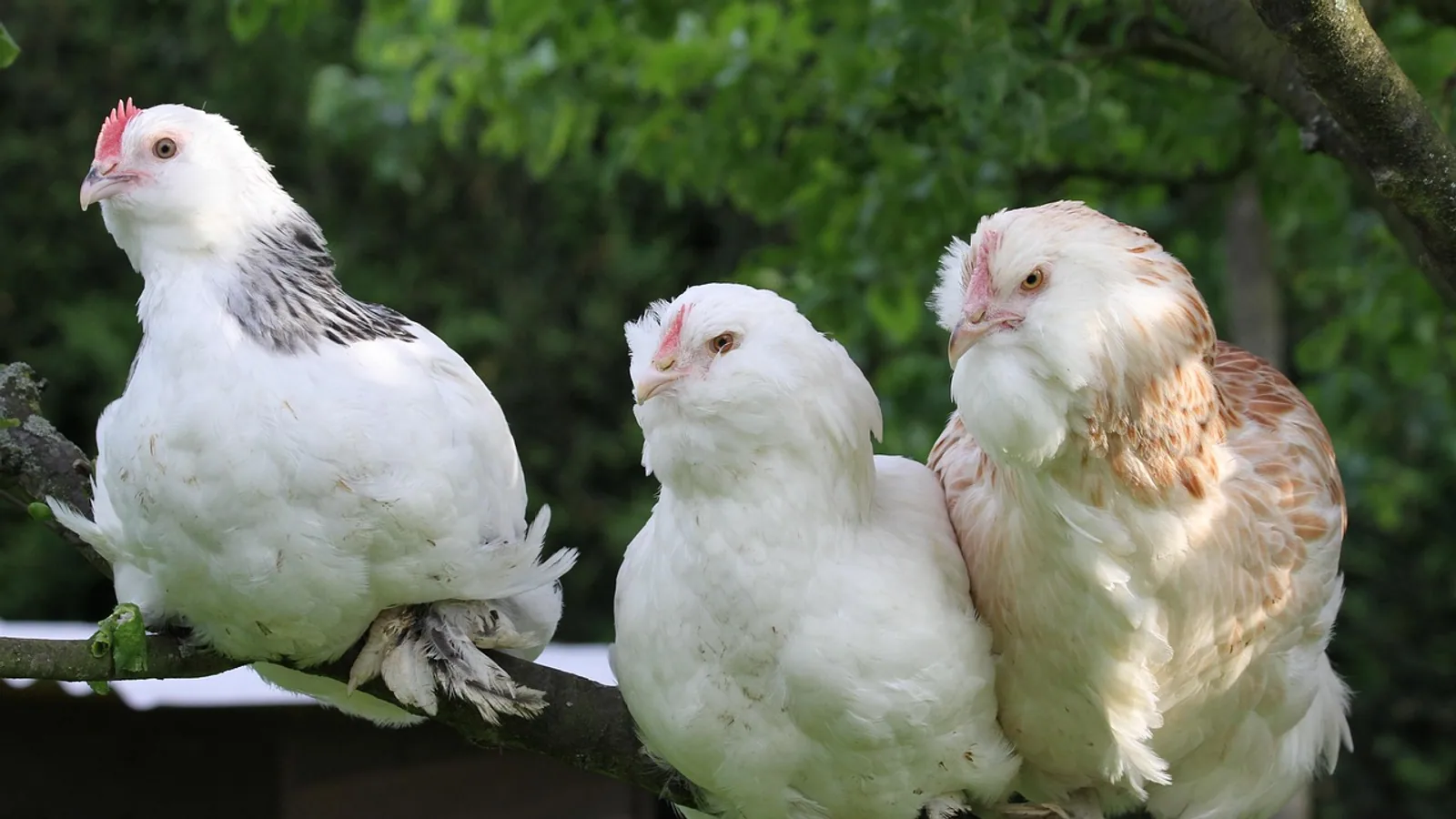
Salmon Faverolle chicks need a brooder that starts at 35 C (95 F) in week one and drops roughly 3 C (5 F) each week until the brooder sits near 21 C (70 F) at the end of week four to five. Feed a 20 to 22 percent protein starter crumble for the first six to eight weeks, keep the bedding bone dry because this breed has feathered shanks and a fifth toe, and expect slow feathering and difficult sexing for the first several weeks. Everything below covers the first eight weeks in order, with a week-by-week table you can print and tape to the brooder lid.
This article is educational and is not a substitute for veterinary diagnosis or treatment.
At a Glance: The First Eight Weeks
| Week | Brooder temp (chick level) | Feed | Water | What to watch |
|---|---|---|---|---|
| 1 | 35 C / 95 F | 20 to 22% starter crumble | Shallow dish, room temperature | Pasting, chilled chicks, dry bedding |
| 2 | 32 C / 90 F | Starter crumble | Same, refreshed 2 to 3 times daily | Shank feathering begins, foot soiling |
| 3 | 29 C / 85 F | Starter crumble | Same | Rapid body growth, more floor space |
| 4 | 27 C / 80 F | Starter crumble | Same | Feather coverage expanding |
| 5 | 24 C / 75 F | Starter crumble | Same | Partial weaning off heat |
| 6 | 21 C / 70 F | Starter crumble, transition to grower | Same | First cockerel combs may appear |
| 7 | 21 C / 70 F or ambient | Grower ration | Same | Sex-linked color differences clearer |
| 8 | Ambient if above 21 C / 70 F | Grower ration | Same | Move toward coop acclimation |
Use the table as a starting point, not a fixed prescription. Chicks tell you what they need, and the behavior cues are described in the next section.
Why the First Eight Weeks Decide the Rest of the Bird
A chick is not a small chicken. It is a bird with an immature thermoregulatory system that cannot hold its own body temperature steady against a cold room. Brooding is the period when the keeper supplies the heat the bird cannot make for itself, and that period runs roughly from day zero to eight weeks [1]. During that window the microclimate is the single most decisive factor governing survival, growth rate, and physiological health [2].
The reason is straightforward. Day-old chicks are functionally poikilothermic. Their thermoregulatory centers are not mature, and they lack the thermal insulation that adult plumage provides, so they are highly susceptible to ambient temperature drops and humidity swings [2]. A chick that is too cold burns energy it should be spending on growth. A chick that is too hot pants, dehydrates, and eats less. Both outcomes show up in the eight-week weights.
The research on this is consistent. Chicks brooded at 20 C during the first week gained less weight and ate less feed than chicks held at 25 C, and they drank less water than chicks held at 35 C [3]. The same study found that cold stress reduced bone growth as well as live weight during the first seven days, which matters for a breed with feathered shanks and an extra toe because those structures are still forming. A separate trial found that brooding temperature affected body weight at seven days, with the high-temperature group producing the heaviest birds, and that the effect on body weight faded after 14 days [4]. In other words, the early thermal window has an outsized effect on the trajectory, even though the bird eventually catches up.
Setting Up the Brooder Before the Chicks Arrive
Temperature targets and how to hold them
Start the brooder at 35 C (95 F) measured at chick level, not at the ceiling and not at the wall. That figure sits at the top of the 33 to 35 C range used for hatchlings in controlled brooding systems [5], and it matches the 32.0 to 35.0 C boundary described for day-old chicks in precision brooding work [6]. A brooder that begins at 35 C and steps down about 3 C (5 F) per week reaches roughly 21 C (70 F) by week five or six, which is the point at which most chicks no longer need supplemental heat in a normal indoor space.
Measure temperature where the chicks actually are. A thermometer clipped at the brooder wall reads wall temperature. A thermometer lying on the bedding reads bedding temperature. Neither is the air the chick is breathing. Hang or place the sensor so it sits at the height of a standing chick's back, and check it at the same time each day.
Thermal stability matters as much as the set point. Conventional on-off and manual control systems produce severe thermal oscillations, actuator chatter, and wasted energy [2]. A brooder that swings several degrees every few minutes is harder on a chick than one that holds a steady temperature with a small tolerance band. If your heat source cycles hard, add thermal mass (a wrapped brick or a sealed water bottle) near the lamp to smooth the swing, and use a dimmer or a proportional controller rather than a simple on-off switch where possible.
Humidity and ventilation
Temperature alone is not the whole microclimate. Relative humidity in the brooding environment is typically targeted in the 60 to 70 percent range alongside the 32.0 to 35.0 C temperature band [6]. Humidity that is too low dries the chick's airways and dehydrates the yolk-dependent bird. Humidity that is too high, combined with warm bedding and droppings, produces damp litter and ammonia.
Ammonia is the practical concern for a backyard brooder. In a controlled day-old chick brooding box, ammonia concentrations were held below 4 ppm across both rainy and drought seasons with an active control system [7]. You do not need a sensor to manage this. You need ventilation that moves air without creating a draft on the chicks, and you need to remove wet litter promptly. If you can smell ammonia at chick height, the litter is too wet and the ventilation is too low.
The bedding problem specific to Faverolles
Salmon Faverolles are a French dual-purpose breed with two features that change brooder management: feathered shanks and a fifth toe. Feathers on the shanks trap moisture and droppings against the skin. The extra toe adds surface area that contacts wet litter. Together they make this breed more prone to pasty, caked feet than a clean-legged breed.
The fix is dry bedding and frequent turnover. Use a bedding material that absorbs and releases moisture, keep the top layer dry to the touch, and remove any caked or matted patches daily rather than weekly. Check the shanks and the fifth toe at every handling. Caked material that is allowed to harden can restrict the toe and irritate the skin underneath. A soft toothbrush and lukewarm water will loosen dried material if you catch it early.
Space, feeders, and waterers
Give chicks room to move away from the heat. A brooder where every chick must crowd under the lamp to stay warm has no cool zone, and a brooder with no cool zone produces panting, dehydration, and pasting. Aim for a brooder that is roughly twice as wide as the heat footprint so a chick can choose its own temperature. Expand the space as the birds grow, because crowding increases litter moisture, which is the enemy of feathered feet.
Use shallow waterers for the first week. Deep dishes drown small chicks. Set waterers on a slight elevation or a wire platform so spilled water drains away from the bedding rather than soaking it. Refresh water two to three times daily, more often in warm weather. Chicks drink less when the water is very cold, so offer room-temperature water.
Feeders should be shallow and wide enough that several chicks can eat at once. Chicks spill feed, and spilled crumble in wet bedding becomes a mold risk. Clean up spills the same day.
Heat source selection
Infrared lamps, ceramic heat emitters, and heated brooder plates all work. The differences are in how they deliver heat and how they fail. Infrared lamps heat the air and the surfaces below them, which means the brooder cools quickly when the lamp cycles off. Heated concrete floors and similar high-mass systems hold temperature longer and cycle less often [8]. The practical lesson is that the inertia of your heat source determines how stable your brooder temperature is. A low-mass lamp needs tighter control. A high-mass system tolerates a wider control band.
Whatever you choose, secure it. A heat lamp that falls into bedding starts a fire. Use a chain and a backup fastener, never rely on the clamp alone, and keep the lamp a safe distance from any combustible surface.
Reading Chick Behavior Instead of Staring at the Thermometer
The thermometer tells you the air temperature. The chicks tell you whether that temperature is right.
Chicks that are comfortable spread out across the brooder, eat and drink at intervals, and settle to sleep in loose groups. Chicks that are cold pile into a tight heap directly under the heat source, cheep loudly and continuously, and may huddle against the brooder wall. Chicks that are hot move to the perimeter, pant, hold their wings away from the body, and drink more than they eat.
Adjust the heat source, not the chicks. If they pile, lower the lamp or raise the set point. If they spread to the walls and pant, raise the lamp or lower the set point. Make changes in small steps and give the birds 30 to 60 minutes to respond before adjusting again.
One caution about the cold end of the range. Cold snaps that reduce food availability and increase chick mortality are well documented in wild altricial birds, with a critical temperature around 18.5 C for insect flight activity in one long-term study [9]. That study is about tree swallows, not chickens, so it does not set a brooder target. It does illustrate a general principle that applies to any young bird: sustained cold reduces the food supply and increases mortality risk. For backyard chicks, the food supply is your feeder, so the risk is lower, but the thermal stress is real.
Feeding Salmon Faverolle Chicks: The 20 to 22 Percent Protein Starter
Weeks 1 through 6 to 8: starter crumble
Feed a starter crumble formulated at 20 to 22 percent protein from day one. Crumble rather than pellet for the first weeks, because small beaks handle crumble more easily. Keep the feeder about one-third full and top it up several times a day so the feed stays fresh and the chicks can always reach it.
The protein level matters because the first weeks are a growth phase. A chick that is short on protein in the starter phase does not build the muscle and skeletal frame that the grower and finisher phases depend on. Do not dilute starter with scratch grains, kitchen scraps, or treats during this window. Treats displace complete feed and drop the effective protein and micronutrient intake.
Weeks 6 to 8: transition to grower
Switch to a grower ration at six to eight weeks. Make the change over three to five days by mixing increasing proportions of grower into the starter. An abrupt switch can cause a temporary drop in intake, which is exactly what you do not want going into the juvenile growth phase.
The exact timing depends on the birds. Faverolles feather slowly, and a slowly feathering bird holds heat less efficiently, so some keepers stay on starter slightly longer in cool weather. Use body condition and feather coverage as your guide alongside the calendar.
Water
Clean water is the most important nutrient. Chicks drink more than you expect, and a chick that is not drinking will not eat. Provide water at all times, refresh it two to three times daily, and clean the waterer with a dedicated brush or sponge that does not touch anything else. Do not add anything to the water unless a veterinarian has told you to.
Water consumption rises with temperature. Chicks held at 35 C drank more water than chicks held at lower temperatures in one brooding trial [3], which is expected. If your brooder runs at the top of the range, check the waterer more often.
Growth Milestones and What Normal Looks Like
Weight
Faverolles are a dual-purpose breed, so they grow on a moderate curve rather than the fast curve of a commercial broiler. Expect steady weekly gains rather than dramatic jumps. Weigh a sample of chicks weekly on the same scale at the same time of day, and track the trend rather than any single number. A chick that gains steadily is doing fine even if it is smaller than a breed-standard figure you found online.
Two research findings shape what you should expect. First, brooding temperature during the first week affects body weight at seven days, with the heaviest birds coming from the warmer brooding group in one trial [4]. Second, that weight advantage faded by 14 days in the same study, meaning the early thermal effect on weight is not permanent. Do not panic if your week-one weights are modest. Do fix the temperature if the chicks are piling.
Feathering
Salmon Faverolles feather slowly. Do not compare their wing and tail development to a Leghorn or a production layer. Slow feathering means the birds hold less heat, so they may need supplemental warmth a little longer than a fast-feathering breed, and they should not be moved to an unheated coop until they are fully covered.
The breed's signature traits appear early. Shank feathering begins in the first weeks, and the fifth toe is present from hatch. Check both at every handling, and keep them clean and dry.
Comb and color development
Salmon Faverolles show sex-linked color differences, but the differences are subtle in young chicks and become clearer over the first several weeks. Some cockerels develop visible comb growth earlier than pullets. Do not rely on a single trait.
Sexing Difficulty and Slow Feathering: What to Expect
Sexing Salmon Faverolle chicks is difficult. The breed does not offer a clean, reliable day-one visual sexing method the way some sex-linked crosses do, and the slow feathering rate removes feather-sexing as an option. Most keepers wait until comb development, color, and body shape differentiate the sexes over the first several weeks, and even then the call is not certain until the birds are older.
Plan your housing around that uncertainty. If you ordered straight-run chicks, assume you may get cockerels and have a plan for them. If you need a specific number of pullets, buy more chicks than you need and rehome the extras, or buy from a source that offers vent sexing and accept that it is not perfect.
Slow feathering also affects brooder management. A slowly feathering chick loses heat faster, so it depends on supplemental heat longer. Watch feather coverage rather than the calendar when you decide to reduce heat or move birds out of the brooder.
Week-by-Week Care Plan
Week 1
Set the brooder to 35 C (95 F) at chick level before the chicks arrive, and let it stabilize for several hours. Offer 20 to 22 percent starter crumble and room-temperature water in shallow dishes. Dip each chick's beak in the water once on arrival. Keep bedding dry and check shanks and the fifth toe daily. Watch for piling (too cold) and panting (too hot). Expect the chicks to sleep a great deal.
Week 2
Drop the temperature to about 32 C (90 F). Shank feathering starts to show. Pasting is most common in this window, so check vents and feet daily and clean gently with warm water. Increase floor space slightly.
Week 3
Drop to about 29 C (85 F). Growth accelerates. Feed and water intake rise. Clean the waterer more often, because warmer brooder air plus more droppings means faster water fouling. Begin handling the birds briefly each day so they stay calm.
Week 4
Drop to about 27 C (80 F). Feather coverage expands across the body. Watch the shanks for caked litter and clean as needed. If the brooder smells of ammonia at chick height, increase ventilation and change the litter.
Week 5
Drop to about 24 C (75 F). The birds may begin spending time away from the heat source voluntarily. This is the start of weaning off supplemental heat. Keep the heat available but do not force the birds under it.
Week 6
Drop to about 21 C (70 F). Begin the transition from starter to grower ration over three to five days. First cockerel combs may become visible. Continue daily foot checks.
Week 7
Hold at 21 C (70 F) or ambient if the room is warmer. The birds should be on grower ration. Sex-linked color differences become clearer. Increase space again if the birds look crowded.
Week 8
If the ambient temperature is at or above 21 C (70 F), the birds can come off supplemental heat. Begin acclimating them to the coop during the day, with full transition once they are fully feathered and the coop is draft-free and dry. Keep the grower ration in place.
Common Mistakes With Salmon Faverolle Chicks
Letting the bedding stay wet. This is the single most common mistake with this breed. Feathered shanks and a fifth toe trap moisture, and wet bedding turns a minor management issue into caked, irritated feet. Change or turn the litter daily and remove wet patches immediately.
Starting too cool or dropping too fast. A brooder that starts at 30 C instead of 35 C puts the chicks behind from day one. A brooder that drops 5 C in a single step instead of 3 C shocks them. Follow the step-down schedule and adjust based on behavior.
Feeding treats too early. Scratch grains, bread, and kitchen scraps dilute the starter ration and drop the effective protein intake during the growth phase. Wait until the birds are on grower ration and even then keep treats to a small fraction of intake.
Assuming sex at hatch. Faverolle chicks cannot be reliably sexed at day one by feathering or color. Plan for straight-run outcomes.
Overcrowding. Crowding increases litter moisture, which is the specific risk for this breed's feet. Expand space as the birds grow.
Ignoring ventilation. A closed brooder with wet litter accumulates ammonia. Ventilate without drafting the chicks.
Using a single thermometer in the wrong place. Measure at chick level, not at the wall or the ceiling.
Troubleshooting: What You May See and What to Do
Piling under the heat source. The brooder is too cold. Lower the lamp or raise the set point in small steps. Check for drafts.
Chicks spread to the walls and panting. The brooder is too hot. Raise the lamp or lower the set point. Check that water is available and cool enough to drink.
Pasting around the vent. Clean gently with warm water and a soft cloth. Keep the brooder warm and the bedding dry. Pasting is more common when chicks are chilled or stressed. If it recurs or the vent area looks red or swollen, contact a veterinarian.
Caked material on the shanks or fifth toe. Soak in lukewarm water to soften, then remove with a soft brush. Do not pull hardened material off dry skin. Check daily until resolved.
Chicks not eating. Check temperature first, then water access, then feed freshness. A chick that is too cold or too hot will not eat well. If a chick is isolated, hunched, or not eating after you have corrected the environment, contact a veterinarian.
Loud, continuous cheeping. Usually temperature. Check the brooder before assuming illness.
Watery droppings with wet litter. Often a sign of excess heat, excess water spillage, or a waterer set too high. Correct the environment first. Persistent abnormal droppings need veterinary input.
One chick lagging in growth. Weigh it weekly alongside the others. A single small chick may just be a slow starter. A chick that stops gaining needs veterinary assessment.
Welfare and Safety Points
Heat sources are the main fire risk in a backyard brooder. Secure every lamp with a chain and a secondary fastener, keep it clear of bedding and curtains, and never leave a brooder lamp clamped by its spring clip alone.
Handle chicks calmly and briefly. Long, rough handling stresses young birds and can cause injury to the legs and wings. Support the body and keep the bird close to the ground.
Keep the brooder clean. Wet litter, spilled feed, and standing water create conditions for skin problems and respiratory irritation. Daily maintenance takes minutes and prevents most problems.
Provide a draft-free but ventilated space. Chicks need fresh air without a direct breeze. A brooder in a sealed closet accumulates moisture and ammonia.
Keep other animals out. Household pets and wild birds can injure chicks or introduce disease. Use a secure cover.
Wash your hands before and after handling chicks, and keep young children supervised. Backyard poultry can carry organisms that affect people, and hand hygiene is the simplest control.
Limitations and When to Contact a Veterinarian
This guide covers routine brooding management for healthy Salmon Faverolle chicks. Individual birds vary, and a chick that is failing to thrive may have a problem that no amount of temperature adjustment will fix.
Contact a veterinarian promptly if you see any of the following: a chick that will not stand or walk, a chick that is isolated and unresponsive, labored or open-mouth breathing that does not resolve when you correct the temperature, a vent that is red, swollen, or bleeding, a shank or toe that is swollen, hot, or has an open wound, a chick that has not gained weight over a full week, sudden deaths in the brooder, or droppings that are persistently bloody or unusually colored.
Do not start medications on your own. Dosages, drug choices, and withdrawal periods depend on the diagnosis, the age of the bird, and the regulatory status of the product in the United States. A veterinarian can examine the bird, run appropriate testing, and prescribe treatment if one is needed.
Frequently Asked Questions
What temperature should Salmon Faverolle chicks be kept at?
Start at 35 C (95 F) at chick level in week one, then drop about 3 C (5 F) per week until the brooder reaches roughly 21 C (70 F) around week five to six. Adjust based on chick behavior, not the calendar alone.
What protein level do Salmon Faverolle chicks need?
Feed a 20 to 22 percent protein starter crumble from day one, then transition to a grower ration at six to eight weeks. Do not dilute the starter with treats during the growth phase.
When can Salmon Faverolle chicks go outside?
They can begin acclimating to the coop around week eight if the ambient temperature is at or above 21 C (70 F) and the birds are fully feathered. Move them out fully only when the coop is dry and draft-free.
Why do my Faverolle chicks have caked feet?
Feathered shanks and the fifth toe trap moisture and droppings against the skin. Keep the bedding dry, remove wet patches daily, and check the shanks and toe at every handling.
Can you sex Salmon Faverolle chicks at hatch?
No. The breed does not offer a reliable day-one visual sexing method, and slow feathering rules out feather sexing. Most keepers wait for comb, color, and body shape differences over the first several weeks.
Why are my Faverolle chicks feathering so slowly?
Slow feathering is normal for the breed. It means the birds hold less heat and may need supplemental warmth longer than a fast-feathering breed. Judge readiness to leave the brooder by feather coverage, not by age alone.
How do I know if my brooder is too hot or too cold?
Watch the chicks. Piling under the heat source means too cold. Spreading to the walls and panting means too hot. Comfortable chicks spread out, eat and drink at intervals, and sleep in loose groups.
When should I switch from starter to grower feed?
Switch at six to eight weeks, mixing increasing proportions of grower into the starter over three to five days. In cool weather, slowly feathering birds may benefit from staying on starter slightly longer.
Related Articles
- Cat Not Eating for One Day: Why Cats Are at Higher Risk
- Dog Not Eating for One Day: When to Start Worrying
- Technical Skills Veterinary Graduates Must Demonstrate on Day One
- Raising Baby Chicks: A Brooder Guide
- Brooder Design for Chicks: Temperature Control and Safety
- Can Cats Eat Tuna And Salmon
- Chick in Egg: Development Stages Day by Day
Sources
- Comparing the Growth Performance of Baby Chicks under Hay-Box Brooder Technology and Infra-Red Electric Brooder
- Analysis of the Effect of Fuzzy Logic-Based Environmental Control on Temperature and Humidity Stability in KUB Day-Old Chick Brooders
- Effect of Environmental Temperature During the First Week of Brooding Period on Broiler Chick Body Weight, Viscera and Bone Development
- Effect of egg storage duration and brooding temperatures on chick growth, intestine morphology and nutrient transporters.
- SmartBrood: An Internet of Things-Based Thermal Control System for Sustainable Small-Scale Poultry Chick Brooding
- Design and Implementation of an IoT-Based Real-Time Monitoring and Closed-Loop Control System for KUB Day-Old Chick Brooding Houses
- Efficient hygro-thermal and ammonia control in day-old chick brooding box using internet of things and Tsukamoto Fuzzy controller
- Schedule of the Total Sum of Loads from Electrical Brooders with the Two-Position Temperature Regulators
- Temperature effects on food supply and chick mortality in tree swallows (Tachycineta bicolor)