Composting Chicken Manure Safely for the Garden
By Dr. Zubair Khalid, DVM, MS, PhD ·
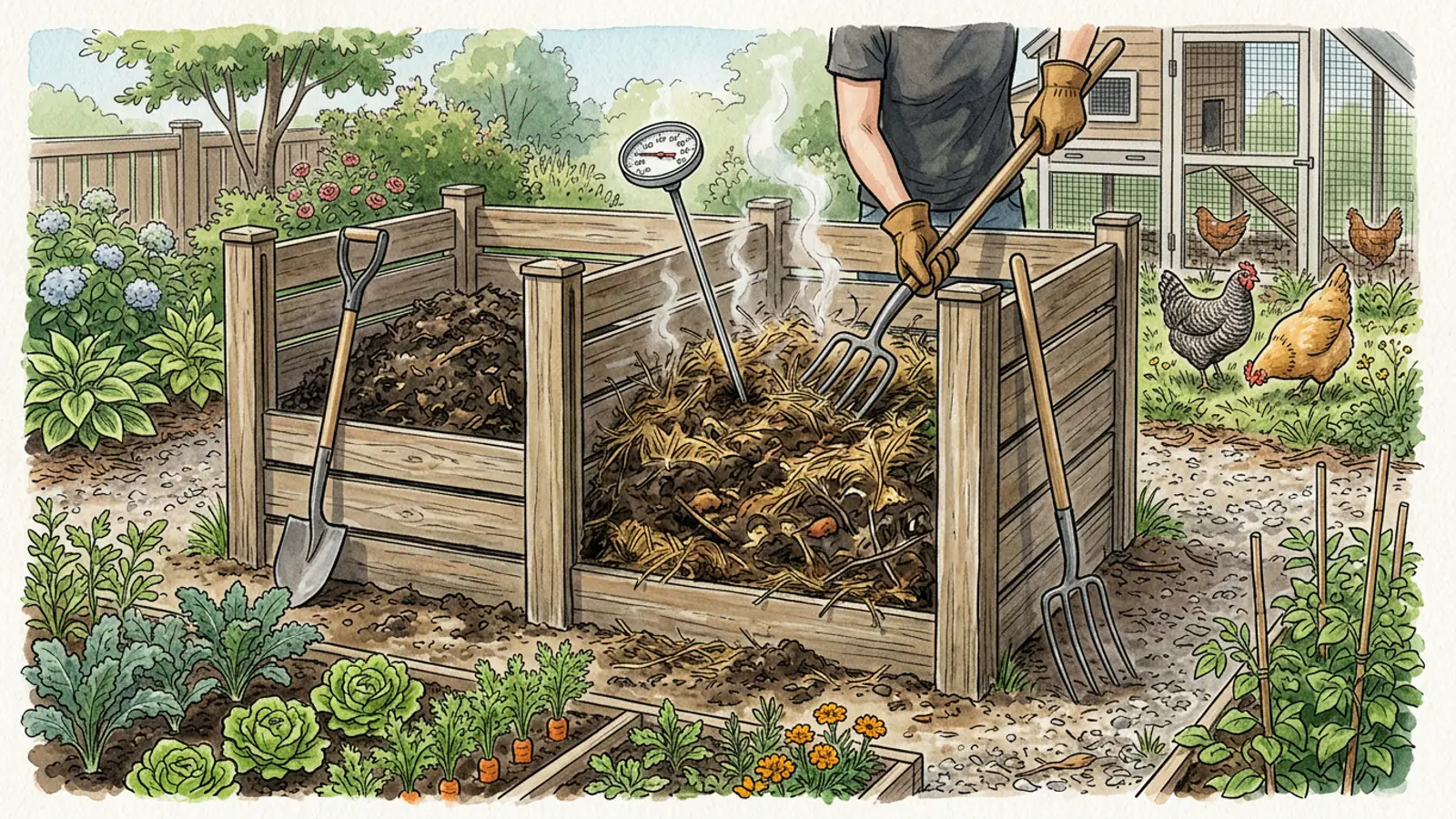
Fresh chicken manure is one of the richest natural nitrogen sources a backyard flock can produce, and it is also one of the riskiest materials to handle carelessly. Used raw, it can burn plant roots, carry Salmonella, Campylobacter, and E. coli, and contaminate vegetables that people later eat. The safe path is controlled thermophilic composting: blend manure with carbon-rich bedding, manage moisture and oxygen, hold the pile hot long enough to kill pathogens, then cure the finished compost before it touches soil where food crops grow.
This article is educational and is not a substitute for veterinary diagnosis or treatment.
Key Takeaways
- Composting chicken manure safely means thermophilic composting that holds the pile at 131 to 170 F for 3 days in an in-vessel or static aerated system, or 15 days with at least 5 turnings for windrows.
- Fresh chicken manure is high in nitrogen as uric acid and ammonia, which draws water out of roots and causes fertilizer burn within a day or two of application.
- The target carbon to nitrogen ratio for active composting is roughly 25 to 30 parts carbon to 1 part nitrogen by weight, using straw, wood shavings, leaves, or shredded cardboard.
- Salmonella in poultry compost with optimal moisture survived 96, 72, and 24 hours at 50, 55, and 60 C, compared with 264, 144, and 72 hours at suboptimal moisture.
- Raw manure must be incorporated into soil at least 120 days before harvest of crops whose edible portion contacts soil, and at least 90 days for crops that do not.
At a Glance: The Safe Composting Workflow
| Step | Action | Target |
|---|---|---|
| 1 | Collect manure with bedding | Straw, wood shavings, leaves, or other dry carbon |
| 2 | Build the pile | Roughly 2 to 3 parts carbon to 1 part manure by volume, aiming for a C:N near 25 to 30:1 |
| 3 | Add moisture | Squeeze test: damp like a wrung-out sponge, about 40 to 60 percent moisture |
| 4 | Heat phase | 131 to 170 F for 3 days in an in-vessel or static aerated pile system, or 15 days with at least 5 turnings for windrows |
| 5 | Turn or aerate | Keep oxygen moving so the pile stays hot and does not go anaerobic |
| 6 | Cure | Let the pile rest until it cools and stabilizes |
| 7 | Test readiness | Earthy smell, crumbly texture, no recognizable food or bedding, cool temperature |
| 8 | Apply | Follow crop waiting intervals and keep it out of reach of children and pets |
Why Fresh Chicken Manure Is Not Garden-Ready
Fresh chicken poop compost is a phrase people use loosely. Fresh manure is not compost. It is a raw biological material that changes dramatically as it decomposes.
Nitrogen Burn
Chicken manure is high in nitrogen, and that nitrogen is largely in the form of uric acid and ammonia. When fresh manure contacts plant roots, the soluble nitrogen and ammonia salts can draw water out of root tissue and scorch leaves. Gardeners call this fertilizer burn. The plant looks wilted, then the leaf margins turn brown and crisp even when the soil is moist. The damage happens fast, often within a day or two of application.
Composting solves this problem by letting microbes convert the unstable nitrogen into more stable organic forms. The finished product releases nitrogen slowly and does not overwhelm roots.
Pathogens in Poultry Manure
Chicken manure can carry Salmonella, Campylobacter, and E. coli, along with other bacteria, viruses, and parasite eggs. These organisms are not a hypothetical concern. The CDC has documented repeated multistate outbreaks of salmonellosis tied to backyard poultry contact. From 2015 through 2022, there were 88 multistate backyard poultry-associated salmonellosis outbreaks and 7,866 outbreak-associated illnesses caused by 21 different Salmonella serotypes [1]. Children under 5 years old made up 24 percent of patients with available information, 30 percent of patients were hospitalized, and nine deaths were attributed to Salmonella infection [1].
These numbers matter for composting because the manure you are handling comes from the same birds implicated in these outbreaks. A survey of backyard poultry owners in the Seattle area found that reported and observed hygiene practices would not consistently reduce Salmonella transmission risk [5].
Composting is not optional if you plan to use the manure. It is the barrier between your flock and your food.
Is Chicken Manure Good for the Garden?
Yes, when it is properly composted. Chicken manure fertilizer is prized for its nitrogen content, and composting concentrates and stabilizes that nitrogen while reducing pathogens, antibiotic residues, and antimicrobial resistance genes.
A field-scale study of poultry manure composting found that ciprofloxacin and doxycycline decreased by 90 percent after 3 weeks of composting [6]. Most of the antimicrobial resistance genes detected also declined over 10 weeks of composting [6]. Potentially pathogenic bacteria such as Campylobacter coli and commensal E. coli decreased along the composting process [6].
Composted chicken manure improves soil organic matter, water-holding capacity, and microbial activity. It feeds plants without the burn risk of raw manure. The catch is that these benefits only appear when the composting process is done correctly.
The Carbon to Nitrogen Ratio: Getting the Blend Right
Composting chicken manure is a balancing act between nitrogen-rich manure and carbon-rich bedding. The target carbon to nitrogen ratio for active composting is roughly 25 to 30 parts carbon to 1 part nitrogen by weight. Chicken manure alone has a very low C:N ratio, often below 10:1, which is why it heats up fast and smells like ammonia when piled alone.
Carbon Sources That Work
Straw, wood shavings, dried leaves, shredded cardboard, and pine needles all serve as carbon amendments. A study of manure-based compost mixtures found that pathogens consistently survived longer in mixtures prepared with pine needles than in mixtures prepared with wheat straw, peanut hulls, or rice hulls [8]. Wheat straw and peanut hull amendments performed better for pathogen inactivation, though results depended on the target pathogen, moisture level, and storage temperature [8].
For backyard composting, the bedding from your coop is usually the easiest carbon source. If you use wood shavings or straw as litter, scoop the manure and bedding together. The bedding provides structure and air pockets as well as carbon.
How Much Carbon to Add
A practical starting point is 2 to 3 parts carbon material to 1 part manure by volume. If the pile smells strongly of ammonia, add more carbon. If it is dry and not heating, add more manure or water.
The C:N ratio drops as composting progresses and carbon is consumed. A starting ratio near 25 to 30:1 gives microbes enough carbon to work through the nitrogen without losing it as ammonia gas.
Step-by-Step: How to Compost Chicken Manure
Step 1: Collect Manure and Bedding Together
Scoop manure with the bedding it sits on. Do not separate them. The bedding is your carbon source and the manure is your nitrogen source. Collect into a bucket or wheelbarrow and move it directly to the compost area.
Do not use manure from sick birds. If a bird has diarrhea, respiratory illness, or has been treated with antibiotics, keep that manure out of the compost pile. Composting reduces antibiotic residues and resistance genes over time, but the process is not instant [6]. The safest approach is to compost only manure from healthy flocks and to dispose of manure from sick birds separately according to your veterinarian's guidance.
Step 2: Build the Pile
Alternate layers of manure and bedding, or mix them thoroughly. A pile that is at least 3 feet by 3 feet by 3 feet holds heat better than a small pile. Smaller piles lose heat to the surrounding air and may never reach thermophilic temperatures.
If you use a compost bin or tumbler, fill it in layers and mix. Tumblers make turning easier but can dry out faster than open piles.
Step 3: Manage Moisture
The pile should be as damp as a wrung-out sponge. That corresponds to roughly 40 to 60 percent moisture. A study of poultry compost found that Salmonella survived longer in compost with suboptimal moisture of 40 percent than in compost with optimal moisture of 50 percent during thermophilic composting [10]. The same study found that high nitrogen content contributed to Salmonella inactivation through ammonia volatilization during thermal exposure [10].
If the pile is too dry, add water while turning. If it is too wet, add more carbon material and turn to aerate.
Step 4: Heat the Pile
This is the pathogen-killing phase. The USDA National Organic Program compost standard (7 CFR 205.203) requires a starting C:N ratio between 25:1 and 40:1 and a temperature between 131 F and 170 F for 3 days in an in-vessel or static aerated pile system, or for 15 days in a windrow system that is turned at least 5 times during that period.
A preliminary study also found that composting rapidly inactivated H9N2 avian influenza virus in poultry manure [11].
Use a compost thermometer with a probe long enough to reach the center of the pile. Check temperature daily during the active phase. If the pile is not reaching 131 F, it is either too dry, too wet, too small, or lacking nitrogen. Adjust and turn.
Step 5: Turn or Aerate
Turning does three things: it moves cooler outer material into the hot center, it adds oxygen, and it releases trapped gases. For windrow systems, the NOP standard requires at least 5 turnings during the 15-day period. For static aerated piles, air is forced through the pile and turning is not required for the temperature standard, though many backyard composters turn anyway to ensure even heating.
Turn when the temperature drops below 131 F or when the pile starts to smell sour or anaerobic. A pitchfork or compost aerator tool works for small piles. Tumblers are turned by rotating the drum.
Step 6: Cure the Pile
After the active heating phase, let the pile cure. Curing is a lower-temperature maturation period where the remaining organic matter stabilizes and the microbial community shifts. The pile will cool gradually. Do not add fresh manure during curing.
A study of pathogen communities during manure composting found that some bacteria, mainly species with low optimal growth temperatures, survived the hot phase and increased in abundance and activity during curing [12]. This finding means curing is not a guaranteed pathogen-free period. Handle finished compost with the same hygiene precautions you use for raw manure.
Step 7: Test for Readiness
Finished compost should smell earthy, not like ammonia or rot. It should be crumbly and dark, with no recognizable bedding, food scraps, or manure clumps. The pile should be cool to the touch, within 10 F of ambient temperature.
A germination test is a simple check. Plant a few radish or lettuce seeds in a sample of the compost mixed with potting soil. If they sprout and grow normally, the compost is mature. If they fail to germinate or the seedlings yellow and die, the compost is still immature or too high in salts.
Step 8: Apply to the Garden
Apply finished compost as a soil amendment, not as a mulch piled against stems. Work it into the top few inches of soil or side-dress established plants. Keep it away from direct contact with seeds and young seedlings until it is fully cured.
Temperature and Time Standards: What the NOP Requires
The USDA National Organic Program sets the standard for composting manure intended for organic crop production. The rule (7 CFR 205.203) requires a starting C:N ratio between 25:1 and 40:1 and a temperature between 131 F and 170 F for 3 days using an in-vessel or static aerated pile system, or for 15 days using a windrow system turned at least 5 times.
These standards exist because pathogens like Salmonella and E. coli are killed by sustained heat. A study of thermal inactivation found that Salmonella in poultry compost with optimal moisture survived for 96, 72, and 24 hours at 50, 55, and 60 C respectively, compared with 264, 144, and 72 hours at the same temperatures in compost with suboptimal moisture [10]. The NOP temperature and time combination is designed to exceed these survival windows.
Waiting Intervals: Raw Manure and Crop Harvest
The NOP also sets waiting intervals between manure application and crop harvest. Under 7 CFR 205.203(c)(1), raw manure must be incorporated into the soil at least 120 days before harvest of a crop whose edible portion contacts the soil surface or soil particles, and at least 90 days before harvest of a crop whose edible portion does not contact the soil.
These intervals apply to raw manure, not finished compost. Properly composted manure that meets the NOP temperature and time standards is not subject to these waiting intervals. However, the curing-phase pathogen study found that some pathogens can survive and regrow in mature compost [12], so a conservative approach is to avoid applying compost to leafy greens or root crops close to harvest.
A study of E. coli survival in soils amended with heat-treated poultry pellets and composted poultry litter found that amended soils had higher E. coli survival than non-amended soils after 140 days, notably in Florida [14]. Location, amendment type, and time all influenced survival [14]. This does not mean composted litter is unsafe, but it does mean that even finished compost can support pathogen survival in soil under some conditions.
Hygiene: Protecting Yourself and Your Family
Composting chicken manure is a zoonotic risk activity. The same Salmonella that causes outbreaks in backyard poultry owners can be present in the manure you are handling.
Wear gloves when handling manure, compost, or finished product. Wash hands thoroughly with soap and water after any contact with poultry, manure, compost, or gardening tools. Do not eat, drink, or smoke while working with manure or compost.
Keep children and pets away from the compost pile and from areas where manure or compost is stored. The CDC data show that children under 5 years old made up 24 percent of backyard poultry-associated salmonellosis patients with available information [1]. Young children are more likely to put contaminated hands or objects in their mouths.
Do not use manure from sick birds. If your flock has a Salmonella outbreak or you suspect illness, consult your veterinarian about safe disposal. Composting reduces but does not eliminate all pathogens, and the curing-phase study shows that some pathogens can survive and regrow [12].
Clean tools and footwear after working with manure or compost. Dedicate a pair of boots or shoes to coop and compost work, and leave them outside the house.
Application Rates and Garden Use
Finished chicken manure compost is a slow-release fertilizer. A typical application rate is 1 to 2 inches spread over the garden surface and worked into the top 4 to 6 inches of soil. For side-dressing, apply a thin layer around plants and water it in.
Do not over-apply. Excess nitrogen from compost can leach into groundwater or run off into surface water. It can also cause lush, weak plant growth that is more susceptible to pests and disease.
Compost can be used as a component of potting mixes, but it should be blended with other materials such as peat, coir, or aged bark. Straight compost in a container can compact and hold too much water.
Troubleshooting Common Composting Problems
| Problem | Likely Cause | Fix |
|---|---|---|
| Pile not heating | Too dry, too small, or not enough nitrogen | Add water, add manure, or enlarge the pile |
| Pile smells like ammonia | Too much nitrogen | Add carbon material and turn |
| Pile smells like rotten eggs or sour | Anaerobic conditions | Turn immediately to add oxygen, add dry carbon |
| Pile is too wet | Too much water or too much green material | Add carbon, turn, cover to keep rain out |
| Pile is too dry | Not enough water or too much carbon | Add water while turning |
| Temperature drops below 131 F | Pile needs turning or is running out of nitrogen | Turn and check moisture, add manure if needed |
| Finished compost still smells like manure | Not fully cured | Let it cure longer, turn occasionally |
| Seeds fail to germinate in compost | Immature or high salt content | Cure longer, leach with water, blend with soil |
| Pathogens survive curing | Low-temperature pathogens regrow | Handle with gloves, avoid food crops close to harvest |
Common Mistakes to Avoid
Using fresh manure directly on garden beds is the most common and most damaging mistake. It burns plants and introduces pathogens to the soil surface where they can splash onto edible crops.
Adding manure to a cold compost pile and assuming it is safe is another error. Cold composting does not reliably reach pathogen-killing temperatures. A study of compost mixtures stored at sublethal temperatures of 20 to 40 C found that pathogens survived for extended periods, with pine needle amendments supporting longer survival than wheat straw or peanut hull amendments [8].
Assuming that finished compost is pathogen-free is a mistake. The curing-phase study found that some pathogens can survive and even increase during curing [12]. Treat finished compost as a low-risk but not zero-risk material.
Composting manure from sick birds is a mistake. Keep that material separate and follow veterinary guidance for disposal.
Skipping the thermometer is a mistake. You cannot manage what you do not measure. A compost thermometer is inexpensive and tells you whether the pile is actually reaching the temperatures required for pathogen reduction.
When to Contact a Veterinarian
Contact your veterinarian if any bird in your flock has diarrhea, lethargy, ruffled feathers, or other signs of illness. Salmonella and other pathogens can spread through a flock quickly, and early diagnosis helps prevent wider contamination of your compost and garden.
If you or a family member develops diarrhea, fever, or abdominal cramps after handling poultry, manure, or compost, see a doctor and mention the poultry contact. Salmonellosis is a reportable disease, and your flock veterinarian can help if public health authorities ask for the birds to be tested.
Contact your veterinarian before using manure from birds that have been treated with antibiotics. The composting process reduces antibiotic residues and resistance genes over time [6], but the timeline depends on the specific drug and the composting conditions.
Limitations and When to Contact a Veterinarian
This article provides general guidance for backyard poultry owners composting manure for garden use. Individual flocks, compost systems, and garden situations vary. A veterinarian who knows your flock and your goals can help you decide whether composting is appropriate for your manure and how to manage the risks.
Contact a veterinarian if your flock has signs of infectious disease, if you are unsure whether manure is safe to compost, or if you have questions about zoonotic risk in your household. If you or a family member becomes ill after contact with poultry or manure, seek medical care and tell your healthcare provider about the poultry exposure.
Frequently Asked Questions
How long does it take to compost chicken manure?
Active composting typically takes 4 to 8 weeks when the pile is managed properly, followed by a curing period of several weeks to several months. The NOP standard requires 131 to 170 F for 3 days in an in-vessel or static aerated pile or 15 days with at least 5 turnings in a windrow system.
Can I put chicken manure directly on my garden?
No. Fresh chicken manure is high in nitrogen and can burn plants, and it can carry Salmonella, Campylobacter, and E. coli. Compost it first and let it cure before applying it to soil.
Is chicken manure good for garden vegetables?
Yes, when it is properly composted and cured. Composted chicken manure improves soil organic matter and provides slow-release nitrogen. Avoid applying fresh or partially cured compost to leafy greens or root crops close to harvest.
What is the best carbon material for composting chicken manure?
Wheat straw, peanut hulls, and rice hulls supported better pathogen inactivation than pine needles in one study of manure-based compost mixtures [8]. In practice, the bedding you already use in the coop, such as wood shavings or straw, is the most convenient carbon source.
How do I know when chicken manure compost is finished?
Finished compost smells earthy, is crumbly and dark, has no recognizable bedding or manure clumps, and is cool to the touch. A germination test with radish or lettuce seeds can confirm maturity.
Can I get sick from composting chicken manure?
Yes. Salmonella, Campylobacter, and E. coli can be present in poultry manure and compost. Wear gloves, wash hands thoroughly, keep children and pets away from the pile, and do not use manure from sick birds.
Do I need to turn my compost pile?
Turning adds oxygen, mixes cooler outer material into the hot center, and releases trapped gases. The NOP windrow standard requires at least 5 turnings during the 15-day heating period. Static aerated piles do not require turning for the temperature standard, but turning helps ensure even heating.
What should I do if my compost pile is not heating up?
Check moisture first. The pile should be as damp as a wrung-out sponge. If it is too dry, add water. If it is too wet, add carbon and turn. If moisture is correct and the pile is still not heating, add more manure for nitrogen and turn to aerate.
Related Articles
- Bumblefoot in Chickens: Recognition, Treatment, and Prevention
- Chicken Coop Fencing and Predator Protection
- Avian Biosecurity for Small Flocks: Preventing Disease Introduction and Spread
- Duck Manure Management: Composting and Nutrient Recycling
- Manure Nutrient Management Planning
- How Long Do Chickens Live? Lifespan by Breed and Care
- Raising Backyard Chickens: A Complete Beginner's Guide
Sources
- Multistate outbreaks of salmonellosis linked to contact with backyard poultry-United States, 2015-2022.
- Salmonella in Backyard Poultry: Prevalence, Outbreaks, Trends, Antimicrobial Resistance, and Emerging Risks.
- Antimicrobial resistance in nontyphoidal Salmonella associated with multistate outbreaks linked to backyard poultry, United States, 2018-2023.
- Chick paper sampling: a One Health approach to inform public health action during salmonellosis outbreaks linked to backyard poultry in the United States, 2023.
- Salmonella Knowledge, Attitudes and Practices: A Survey of Backyard Poultry Owners Residing in Seattle, Washington and the Surrounding Metropolitan Area.
- Assessing the benefits of composting poultry manure in reducing antimicrobial residues, pathogenic bacteria, and antimicrobial resistance genes: a field-scale study.
- Effect of biochar amendment on compost quality, gaseous emissions and pathogen reduction during in-vessel composting of chicken manure.
- Survival of Salmonella or Escherichia coli O157:H7 during holding of manure-based compost mixtures at sublethal temperatures as influenced by the carbon amendment.
- Biological activity during co-composting of sludge issued from the OMW evaporation ponds with poultry manure-Physico-chemical characterization of the processed organic matter.
- Heat inactivation of Salmonella spp. in fresh poultry compost by simulating early phase of composting process.
- Composting Reduces the Vitality of H9N2 in Poultry Manure and EMCV in Pig Manure Allowing for an Environmentally Friendly Use of These Animal Wastes: A Preliminary Study.
- Hidden pathogen risk in mature compost: Low optimal growth temperature confers pathogen survival and activity during manure composting.
- Selection of indigenous indicator micro-organisms for validating desiccation-adapted Salmonella reduction in physically heat-treated poultry litter.
- Survival of Escherichia coli TVS353 in Southeastern U.S. Soils Amended with Heat-Treated Poultry Pellets and Composted Poultry Litter: Influence of Location and Soil Nutrient Composition on Population Dynamics.