Sea Angelfish Care for Marine Aquariums
By Dr. Zubair Khalid, DVM, MS, PhD ·
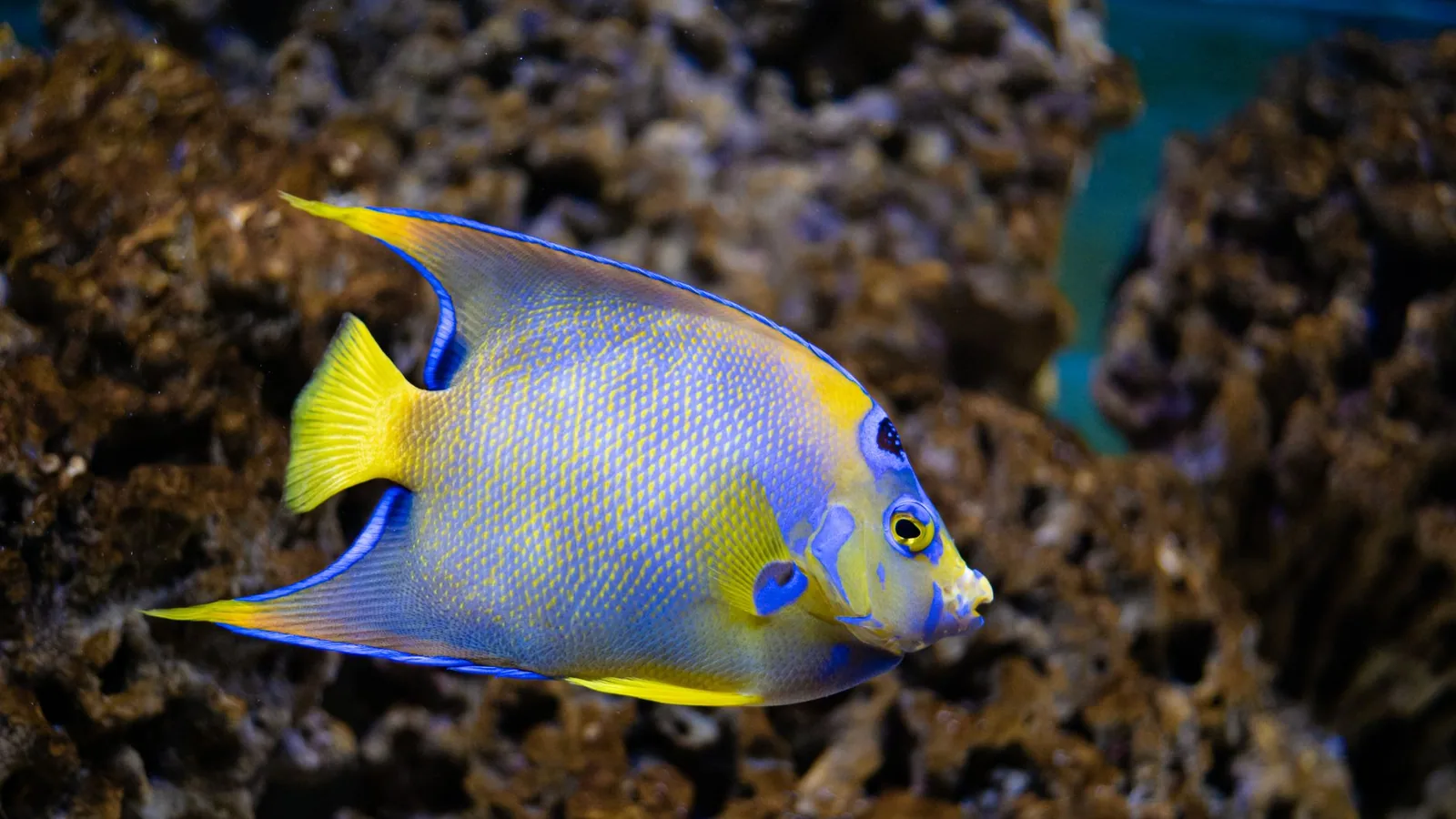
Sea angelfish are among the most sought-after fish in the saltwater aquarium trade [1]. Their vivid colors, bold patterns, and active behavior make them the centerpiece of many marine tanks. They are also intelligent and responsive fish that quickly learn their keeper's routine. But they are not beginner pets. Sea angelfish need a mature, stable marine system, a diet that mirrors their natural sponge-heavy intake, and a clear disease-prevention plan. This guide covers every part of sea angelfish care, from choosing a species to setting up the tank, feeding, breeding, and knowing when to call a veterinarian.
At a Glance: Sea Angelfish Care Checklist
| Care area | What you need to know |
|---|---|
| Scientific family | Pomacanthidae [1][2] |
| Natural diet | Sponges and algae, with copepods for larvae [3][4] |
| Water temperature | Research on eggs used 26.0 ± 0.2°C (about 79°F) [1] |
| Lighting | Affects growth, survival, and skin color [5] |
| Key health risk | Head and Lateral Line Erosion Syndrome |
| Captive breeding | Achieved for several species; copepods improve larval growth [1][4][6] |
| Conservation | Most trade fish are wild-caught; never release aquarium fish [3][4] |
What Is a Sea Angelfish?
Marine angelfish belong to the family Pomacanthidae [1][2]. This family includes dwarf angelfish in the genus Centropyge, large angelfish in the genera Pomacanthus and Holacanthus, and distinctive species such as the regal angelfish (Pygoplites diacanthus) and the vermiculated angelfish (Chaetodontoplus mesoleucus) [7][1][8][4]. They are not related to freshwater angelfish (Pterophyllum scalare), which belong to the cichlid family and are not covered in this guide.
Pomacanthid fish are known for their vivid coloration and species-specific patterns. Their patterns are not random. Research on the skin of Pomacanthus angelfish showed that striped patterns form through a reaction-diffusion wave during development [9]. This mathematical process, in which chemical signals interact across the skin, produces the consistent patterns seen in adult fish [9].
Genetic research has also reshaped how scientists understand angelfish diversity. The regal angelfish shows deep evolutionary partitions between the Red Sea, Indian Ocean, and Pacific Ocean [8]. The yellowbar angelfish (Pomacanthus maculosus) is divided into three genetic groups within the Northwestern Indian Ocean [10]. These findings matter to aquarists because they show that regional populations are genetically distinct. Wild collection from one region cannot be replaced by fish from another region without losing unique genetic diversity.
The family also has a growing genomic toolkit. The King Angelfish (Holacanthus passer) genome assembly is 583 Mb in size and contains roughly 33,889 predicted protein-coding genes [7]. Comparative studies of angelfish mitochondrial genomes show an average length of 16.8 kbp with 13 protein-coding genes, all of which evolved under purifying selection [2]. This research helps explain how angelfish adapt to their environments and informs future conservation efforts.
Choosing a Sea Angelfish
Dwarf Angelfish
Dwarf angelfish in the genus Centropyge are the most practical choice for home aquariums. The bicolor angelfish (Centropyge bicolor) and the coral beauty angelfish (Centropyge bispinosa) are two popular species that have spawned spontaneously in captivity [1]. Their smaller adult size makes them suitable for tanks that cannot house large angelfish.
Large Angelfish
Large angelfish grow substantially and need correspondingly large systems. Wild specimens of the yellowbar angelfish have been recorded at 245 mm total length, and Emperor angelfish (Pomacanthus imperator) at 175 mm total length [11]. The bluering angelfish (Pomacanthus annularis) is another large Indo-West Pacific species. The regal angelfish (Pygoplites diacanthus) is prized for its vertical stripes and shows deep evolutionary partitions across its range [8].
Other Notable Species
The King Angelfish (Holacanthus passer) is an iconic species of the Tropical Eastern Pacific [7]. The vermiculated angelfish (Chaetodontoplus mesoleucus) has become a focus of captive-breeding research because of its popularity in the trade [4][6]. The yellowtail angelfish (Apolemichthys xanthurus) has been studied for how light levels affect its growth, survival, and skin color [5].
Aquarium Setup and Water Quality
Sea angelfish are sensitive to water-quality fluctuations. A mature marine aquarium with stable biological filtration is the foundation of success. Research on captive spawning of dwarf angelfish incubated eggs at 26.0 ± 0.2°C [1]. Temperature and salinity both influence hatching and early larval development in the vermiculated angelfish [6]. For adult fish, the same principle applies: sudden swings in temperature or salinity cause stress, and stressed fish are more vulnerable to disease.
Step-by-Step Tank Setup
- Choose a tank large enough for the adult size of your chosen species. Large angelfish such as Pomacanthus species need much more space than dwarf Centropyge species [1][11].
- Cycle the tank fully before adding fish so the biological filter is mature and stable.
- Maintain stable temperature near 26°C (79°F), the temperature used in angelfish research.
- Match salinity to the species' natural habitat. Research on the vermiculated angelfish shows that salinity directly affects hatching and larval development [6].
- Provide efficient mechanical and biological filtration. Angelfish produce a steady biological load, and leftover food degrades water quality quickly [4].
- Add rockwork and hiding places so each fish can establish its own territory.
Lighting
Light levels affect growth, survival, and skin color in marine angelfish. A study on the yellowtail angelfish examined how different light levels influenced these outcomes [5]. The practical takeaway is that lighting is not just for the aquarist's viewing pleasure. It directly affects fish health and coloration. Provide lighting that matches the species' natural habitat, and give fish time to adjust to any lighting change.
Diet and Feeding
The single most important dietary fact for sea angelfish owners is this: wild sea angelfish eat mostly sponges. Gut content analysis of a yellowbar angelfish captured in the southwestern Atlantic showed that sponges made up 86.9% of the stomach contents and algae another 6.0% [3]. That fish was a released aquarium specimen, but its diet matched the natural feeding behavior of the species.
For captive fish, this means a diet built around sponge-based and algae-based foods. Offer small amounts several times a day rather than one large feeding. Remove uneaten food promptly, because leftover food degrades water quality and angelfish are sensitive to water-quality fluctuations [4].
For larvae and juveniles, the first food is critical. Marine ornamental fish have a narrow larval gape that limits prey selection [4]. Research on the vermiculated angelfish found that feeding copepods improved growth, while a mix of live prey improved survival [4]. Copepods are a key dietary component for successful larviculture [4]. For home breeders, this means culturing or purchasing copepods before attempting to rear angelfish larvae.
Behavior and Compatibility
Sea angelfish are active reef fish that compete for food resources in the wild. When a nonnative yellowbar angelfish established in Brazilian waters, researchers noted potential negative impacts through dietary overlap with native congeneric species [3]. The same logic applies in an aquarium: mixing multiple angelfish species in one tank raises the risk of resource competition.
The genetic structure of wild populations also reflects how sensitive these fish are to their surroundings. Ocean circulation, geographic distance, and seascape heterogeneity shape where populations can establish [10]. In an aquarium, the equivalent is a stable, well-structured environment with rockwork that lets each fish claim its own space.
Health, Disease, and Prevention
Head and Lateral Line Erosion Syndrome
Head and Lateral Line Erosion Syndrome (HLLE) is one of the most recognized health problems in marine angelfish. As the name suggests, the condition involves erosion of tissue on the head and along the lateral line. A study characterized a virus associated with HLLE in marine angelfish. If you see erosion or pitting on your fish's head or flanks, contact an aquatic veterinarian.
Quarantine and Biosecurity
Quarantine is the most effective way to prevent disease outbreaks in a marine aquarium. Keep new fish in a separate system for observation before introducing them to the display tank. The World Aquatic Veterinary Medical Association (WAVMA) is the international professional body for aquatic veterinarians and a reliable resource for finding a veterinarian with fish expertise. The Merck Veterinary Manual also includes practical information on pet fish health.
Nutrition and Immunity
Good nutrition is the foundation of disease prevention. A diet that mirrors the natural sponge-heavy intake of wild angelfish supports normal health. Poor nutrition, unstable water quality, and inappropriate lighting all contribute to poor outcomes [5][4].
Common Mistakes and Troubleshooting
Common Mistakes
- Adding angelfish to an immature or unstable tank. Water-quality fluctuations are especially harmful to angelfish.
- Feeding a diet without sponge-based foods. Wild angelfish eat mostly sponges.
- Ignoring lighting needs. Light levels affect growth, survival, and color [5].
- Keeping too many angelfish in one tank. Resource competition is a real risk.
- Releasing unwanted fish into natural waters. Released fish can become invasive.
Troubleshooting
- Fish refuses to eat: check water quality and offer sponge-based foods [4].
- Color is fading: review your lighting setup [5].
- Erosion on head or lateral line: this may be HLLE, and a veterinarian should examine the fish.
- Fish is gasping at the surface: check water quality immediately and contact a veterinarian.
Breeding and Early Life Stages
Captive breeding of marine angelfish is one of the most rewarding and challenging aspects of the hobby. It is also important for conservation, because the marine ornamental trade is heavily dependent on wild collection [4].
Spawning in Captivity
Several species have spawned spontaneously in captivity. The bicolor angelfish and the coral beauty angelfish both produced fertilized eggs from broodstock held in captivity [1]. The vermiculated angelfish was the subject of the first successful hatchery production for its species [6].
Egg and Larval Development
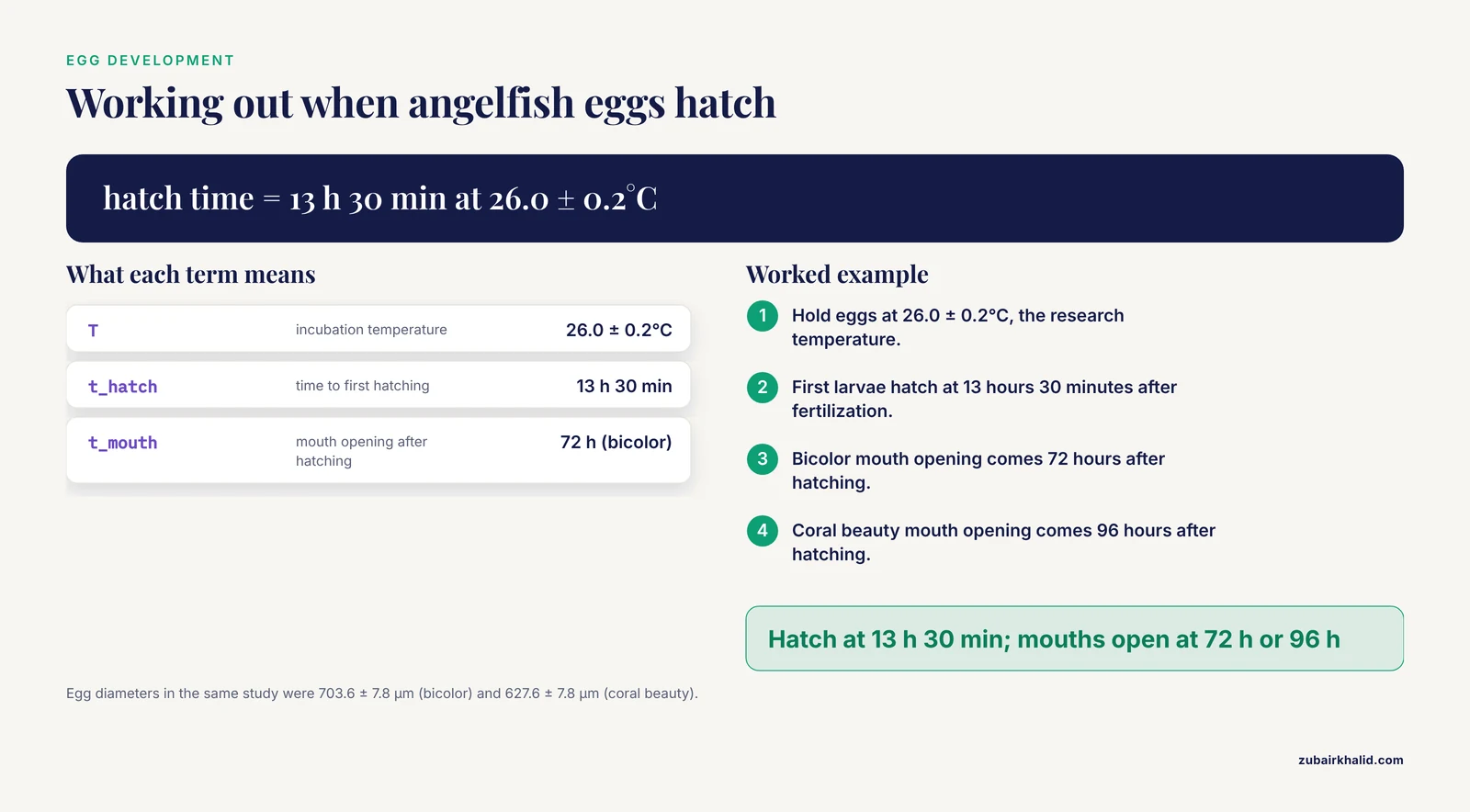
The eggs of the bicolor and coral beauty angelfish are transparent, pelagic, and spherical, with a narrow perivitelline space, a smooth thin chorion, and a single oil globule [1]. Mean egg diameters were 703.6 ± 7.8 μm for the bicolor angelfish and 627.6 ± 7.8 μm for the coral beauty [1]. At 26.0 ± 0.2°C, larvae of both species began hatching at 13 hours 30 minutes after fertilization [1]. Mouth opening occurred at 72 hours after hatching for the bicolor angelfish and at 96 hours after hatching for the coral beauty [1].
Temperature and Salinity
Temperature and salinity are critical for early development. Research on the vermiculated angelfish identified the best temperature range for eggs to hatch into healthy larvae and the right salinity for successful development [6]. These findings give breeders a practical starting point for rearing this species [6].
Feeding Larvae
The larval stage is the hardest part of angelfish breeding. Marine ornamental larvae have a narrow gape that limits prey selection [4]. Research on the vermiculated angelfish showed that a mix of live prey improved survival, while feeding only copepods led to better growth [4]. Copepods are a key dietary component for improving breeding outcomes [4].
Conservation and Responsible Ownership
The Wild Collection Problem
The marine aquarium trade is heavily dependent on wild collection. Nearly 90% of marine ornamental fish are still harvested directly from coral-reef ecosystems [4]. Destructive collection methods, such as cyanide use, can damage coral reef habitats. Choosing captive-bred fish when available and supporting hatcheries that produce fish sustainably reduces this pressure [4][6].
The Invasive Species Problem
Releasing aquarium fish into the ocean is never acceptable. A yellowbar angelfish sampled in a Brazilian marine protected area was traced through otolith chemistry to an aquarium trade release [3]. The fish had been seen at the site 420 days before capture, suggesting it survived for over a year in the wild. Its gut contents were dominated by sponges and algae, indicating potential negative impacts through dietary overlap with native species.
Similar patterns are emerging elsewhere. Emperor angelfish and yellowbar angelfish have been captured in Syrian marine waters, suggesting viable populations are establishing in the Eastern Mediterranean [11]. The bluering angelfish was recorded for the first time in the marine waters of the Odisha coast in the Bay of Bengal. These records show that nonnative angelfish can survive and spread when released.
What Owners Can Do
- Buy from sources that sell captive-bred or sustainably collected fish [4][6]
- Never release aquarium fish into natural waters
- Support research on captive breeding and sustainable aquaculture [4][6]
Limitations and When to Contact a Veterinarian
This article is educational and is not a substitute for veterinary diagnosis or treatment.
Individual cases need a veterinarian. No article can predict how a specific angelfish will respond to a specific aquarium. Contact an aquatic veterinarian promptly if your fish shows any of the following signs:
- Visible erosion or pitting on the head or lateral line
- Loss of appetite lasting more than a day or two
- Rapid or labored breathing
- Abnormal swimming, such as listing, spinning, or floating
- Visible lesions, white spots, or fin damage
- Sudden death of one or more fish
The World Aquatic Veterinary Medical Association (WAVMA) maintains resources for locating veterinarians with fish expertise. Your local exotic animal veterinarian can also refer you to an aquatic specialist.
Clinical Reasoning in Sea Angelfish Cases
When a sea angelfish becomes ill, the veterinarian must think like a detective. The fish cannot describe its symptoms, and the physical examination is limited by the small size and aquatic environment of the patient. Clinical reasoning in fish medicine therefore depends on integrating three streams of information: the owner's history, the water quality of the tank, and the clinical signs observed in the fish. Each stream is incomplete on its own, but together they usually point toward a workable diagnosis.
The first question the veterinarian asks is whether the problem is primary or secondary. A primary disease is caused by a specific pathogen, such as a parasite, bacterium, or virus. A secondary problem is the result of environmental failure, such as a spike in ammonia, a sudden drop in salinity, or a prolonged period of poor nutrition. In marine angelfish, secondary problems are far more common than primary ones. The published research repeatedly emphasizes how sensitive these fish are to water-quality fluctuations and to temperature and salinity changes [6]. A fish that is suddenly lethargic, refusing food, or breathing rapidly is often responding to something in the water rather than to an infectious agent.
The species and its geographic origin also shape the clinical reasoning. A dwarf angelfish in the genus Centropyge has a smaller body mass and a faster metabolic rate than a large Pomacanthus species, so it may show signs of stress more quickly [1][11]. The regal angelfish shows deep evolutionary partitions between the Red Sea, Indian Ocean, and Pacific Ocean [8], and the yellowbar angelfish is divided into three genetic groups within the Northwestern Indian Ocean [10]. These genetic differences are not merely academic. They suggest that fish from different regions may have different environmental tolerances, which means a husbandry protocol that works for one population may not work for another. The veterinarian should ask where the fish came from, whether it was wild-caught or captive-bred, and how long it has been in the owner's system.
Differential diagnosis is the core of clinical reasoning. For a sea angelfish presenting with lethargy and reduced appetite, the list includes environmental toxicity, osmotic stress, nutritional deficiency, infectious disease, and social aggression. The veterinarian ranks these possibilities based on the history. If the owner recently added a new fish, infectious disease moves up the list. If the owner skipped water changes for several weeks, environmental toxicity moves up. If the fish is a newly imported wild specimen, nutritional deficiency and parasite burden are more likely. The goal is not to test for everything at once, but to use the history to narrow the list and then confirm with targeted diagnostics.
Clinical reasoning also requires an understanding of what is normal for the species. Sea angelfish are active reef fish that compete for food resources in the wild. A fish that is hiding may be showing normal territorial behavior, or it may be sick. The veterinarian relies on the owner's description of the fish's baseline behavior to distinguish between the two. This is why owner observation is so important, and why the veterinarian should always ask what is different from the fish's usual routine.
Diagnostic Workflow for the Aquatic Veterinarian
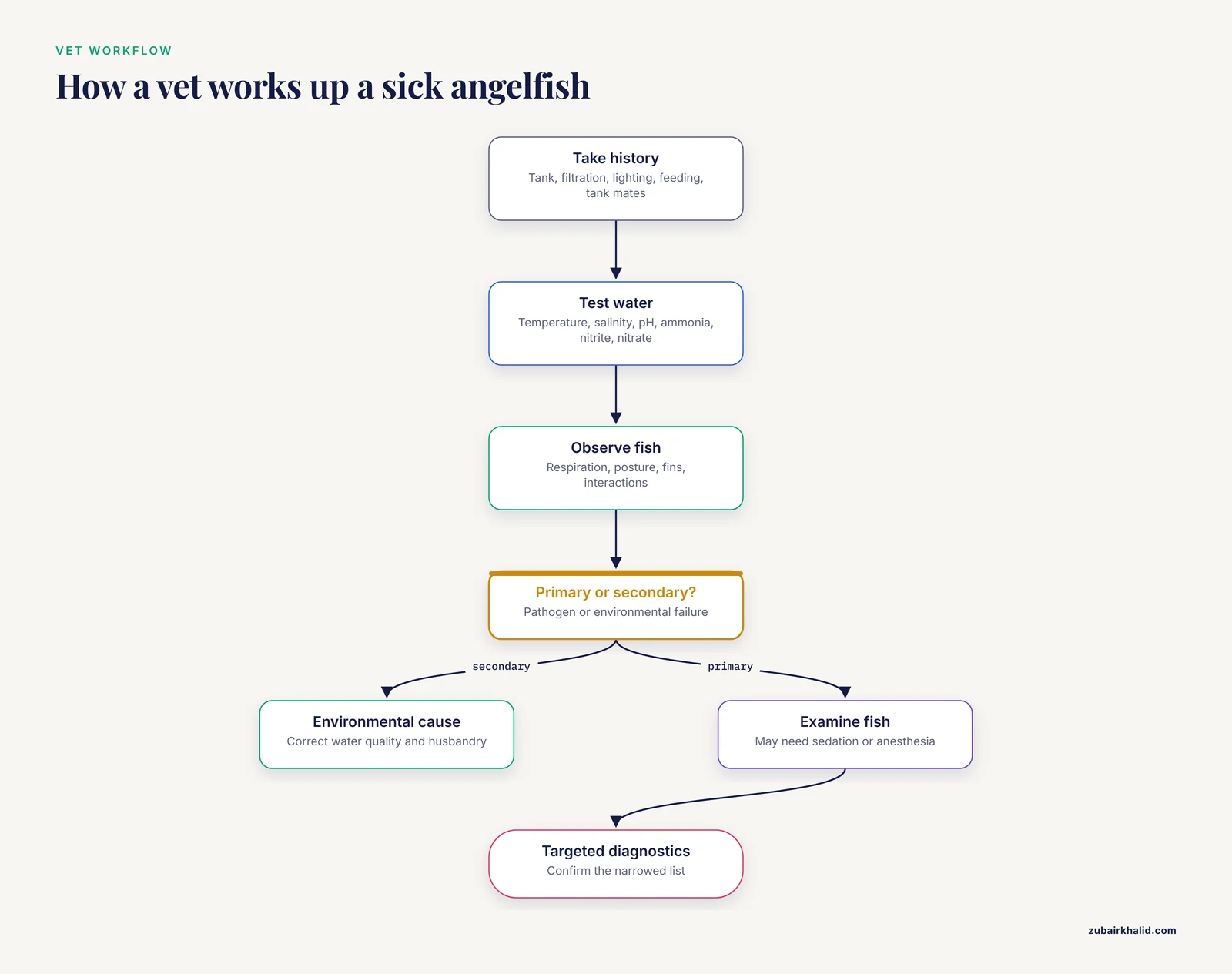
The diagnostic workflow for a sick sea angelfish follows a logical sequence that moves from least invasive to most invasive. The first step is always a detailed history. The veterinarian needs to know the tank size, the filtration system, the lighting schedule, the feeding routine, the water change schedule, and the complete list of tank inhabitants. The lighting history is especially relevant because light levels affect growth, survival, and skin color in marine angelfish [5]. A change in coloration may be a lighting problem rather than a disease.
The second step is water quality testing. The veterinarian will measure temperature, salinity, pH, ammonia, nitrite, nitrate, alkalinity, and dissolved oxygen. These parameters provide a snapshot of the environment the fish is living in. The research on the vermiculated angelfish shows that temperature and salinity directly affect hatching and larval development [6], and the same principle applies to adults. A fish living outside its optimal temperature or salinity range is a fish under chronic stress, and chronic stress predisposes to disease.
The third step is observation. The veterinarian may watch the fish in its home tank or in a hospital tank. Observation focuses on respiration rate, swimming posture, fin position, and interactions with other fish. A fish that is scraping against rocks may have an ectoparasite. A fish that is gasping at the surface may have gill damage or low dissolved oxygen. A fish that is listing to one side may have a swim bladder problem.
The fourth step is physical examination. This may require sedation or anesthesia, depending on the size of the fish and the procedures needed. The veterinarian examines the skin
Acclimating and Introducing a New Sea Angelfish Safely
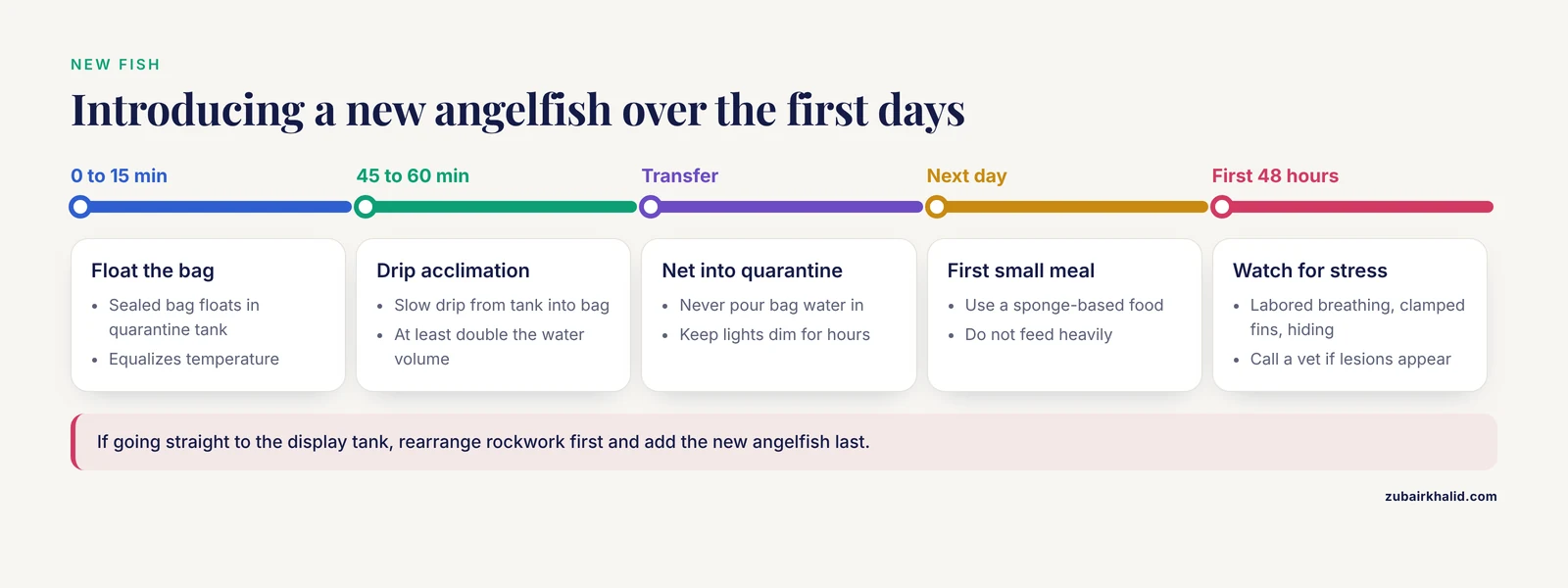
Move a newly purchased sea angelfish into a quarantine tank before it enters the display tank. Quarantine prevents disease outbreaks and lets you observe the fish without exposing established residents. The water in the shipping bag is not the same as your aquarium water. Temperature and salinity differences cause stress, and sea angelfish are sensitive to water-quality fluctuations.
Begin by floating the sealed bag in the quarantine tank for 15 minutes to equalize temperature. Then open the bag and start drip acclimation. Use airline tubing with a slow drip from the tank into the bag or a clean bucket. Aim to at least double the water volume over 45 to 60 minutes. This gradually matches salinity and pH without sudden shifts. Research on the vermiculated angelfish shows that temperature and salinity directly affect early development [6], and adult fish respond just as poorly to abrupt changes.
After acclimation, transfer the fish with a net into the quarantine tank. Do not pour bag water into the tank. Keep the lights dim for the first few hours. Offer the first small meal the next day, using a sponge-based food. Do not feed heavily.
If you introduce the fish directly to a display tank, rearrange the rockwork before adding it. This disrupts existing territories and reduces aggression. Add the new angelfish last, and provide multiple hiding places so it can avoid dominant tank mates.
Watch the fish closely for the first 48 hours. Signs of stress include rapid or labored breathing, clamped fins, hiding, and refusing food. If labored breathing or visible lesions appear, contact an aquatic veterinarian promptly. Early intervention improves the chance of recovery.
Practical Sponge-Based Feeding Plans for Captive Angelfish
Wild sea angelfish eat mostly sponges, with algae making up a much smaller share of stomach contents. A captive ration should follow that ratio: a commercial sponge-based frozen or gel food as the staple, an algae-based food as the daily companion, and small amounts of meaty items such as mysis or chopped shrimp as a supplement rather than the base.
Daily Routine
- Feed two to three times a day at fixed times. Angelfish learn routines quickly, and predictable meals make intake easier to judge.
- Per feed, offer roughly what the fish clears in two to three minutes. For a medium angelfish, start with a piece of sponge food about the size of its eye and adjust from there.
- Alternate sponge and algae foods across the day rather than feeding sponge at every meal.
- Deliver food into the water flow so pieces drift and can be picked from rockwork.
- Net or siphon uneaten food within a few minutes. Leftover food degrades water quality, and angelfish are sensitive to water-quality fluctuations [4].
Weekly Routine
- Include one or two sponge-dominant days and rotate algae types so the fish does not fixate on a single food.
- Thaw frozen foods in tank water, rinse, and never refreeze.
- Review the week's total intake. A slow decline is easier to spot in a log than from memory.
Records and Diet Changes
- Keep a simple log: date, food type, amount offered, amount eaten, and any refusal. Bring it to a veterinary visit, since appetite history is useful clinical information.
- Introduce new foods gradually, mixing them with familiar food over several days. Sudden diet changes can reduce intake.
- If intake stays low for more than a day or two, check water quality and contact an aquatic veterinarian.
Monitoring Water Quality and Early Illness Signs Between Veterinary Visits
A simple home routine catches problems before fish show severe signs. Test temperature and salinity daily, ideally at the same time. Test ammonia, nitrite, nitrate, and pH two to three times weekly in a new or heavily stocked tank, then weekly once the system is stable. Record every value in a notebook or spreadsheet, along with the date, time, and any recent change such as a water change, new fish, or food switch. Trends matter more than single readings.
What to Record
- Temperature: keep it stable near 26°C (79°F), the temperature used in angelfish research.
- Salinity: hold it steady at the level suited to the species; temperature and salinity changes affect angelfish development [6].
- Ammonia and nitrite: should stay at zero in a cycled tank.
- Nitrate: watch the direction of change over weeks, not one number.
- pH: a stable value is safer than chasing a “perfect” number.
Observe fish at feeding time. Note appetite, swimming, hiding, aggression, fin position, color, and breathing rate. If respiration looks fast or labored, count breaths for 15 seconds and record the result beside the water values.
A parameter that is slightly outside a target but unchanged for weeks is usually less urgent than a sudden shift. A rapid swing, or a slow drift with no explanation, deserves attention. Do not add medications or adjust salinity, pH, or temperature blindly. Water-quality fluctuations are especially harmful to angelfish. Contact an aquatic veterinarian if ammonia or nitrite is present, if pH or salinity has swung sharply, if appetite is reduced for more than a day or two, if breathing is rapid or labored, or if you see erosion on the head or lateral line.
Related Guides
- Coral Reef Food Webs: A Veterinary Perspective on Marine Aquarium Nutrition: Explains marine aquarium nutrition and coral reef food webs relevant to angelfish diets
- Coral Care: Essential Practices for Healthy Reef Aquariums: Healthy reef aquariums support angelfish; coral care practices are useful for tank setup
- Cryptocaryon irritans in Marine Aquaculture: Life Cycle and Control Strategies: Marine white spot disease is a key threat; learn life cycle and control
- Coral Reef Facts: Essential Knowledge for Marine Aquarists: Background on coral reef ecosystems helps aquarists understand natural angelfish habitat
- Understanding and Adjusting pH in Your Aquarium: Maintaining stable pH is essential for sensitive marine fish like angelfish
- Reverse Osmosis Water for Aquariums: Benefits, Risks, and Remineralization: RO water quality and remineralization matter for stable marine aquarium conditions
- Aquarium Snails and Shrimp: Care and Benefits: Snails and shrimp can be compatible tank mates and cleanup crew for angelfish systems
Frequently Asked Questions
Are sea angelfish hard to keep in a marine aquarium?
Sea angelfish are not beginner fish. They need a mature, stable marine system, a diet heavy in sponge-based foods, and careful disease prevention [4].
What do sea angelfish eat?
Wild sea angelfish eat mostly sponges, with some algae. Captive fish should be offered sponge-based and algae-based foods in small amounts several times a day.
How big do sea angelfish get?
Size varies by species. Large angelfish such as the yellowbar angelfish and Emperor angelfish grow much larger than dwarf Centropyge species [1][11].
Can sea angelfish be bred in captivity?
Yes. Several species have spawned in captivity, including the bicolor angelfish, coral beauty angelfish, and vermiculated angelfish [1][6]. Larval feeding with copepods improves growth and survival [4].
What causes Head and Lateral Line Erosion in marine angelfish?
A virus has been associated with HLLE in marine angelfish. Stable water quality and good nutrition are the best prevention.
Which sea angelfish are best for a home aquarium?
Dwarf angelfish such as the bicolor angelfish and coral beauty angelfish are more practical for home tanks because of their smaller size [1].
Do sea angelfish need special lighting?
Lighting affects growth, survival, and skin color in marine angelfish [5]. Provide lighting that matches the species' natural habitat.
Why should I never release a sea angelfish into the ocean?
Released aquarium fish can survive and establish invasive populations. A yellowbar angelfish in Brazil was traced to an aquarium release, and nonnative angelfish have also been recorded in the Mediterranean and the Bay of Bengal [11][3].
Sources
- Embryonic and early larval development of two marine angelfish, Centropyge bicolor and Centropyge bispinosa
- Comparative mitogenomics of marine angelfishes (F: Pomacanthidae)
- Tracing yellowbar angelfish invasion pathways in the SW Atlantic using otolith chemistry
- Early Feeding Strategies for the Larviculture of the Vermiculated Angelfish Chaetodontoplus mesoleucus: The Key Role of Copepods
- Effect of Light Levels on Growth, Survival and Skin Colour Enhancement of Marine Angelfish, Apolemichthys xanthurus (Bennett, 1833)
- Natural Spawning, Early Development, and First Successful Hatchery Production of the Vermiculated Angelfish (Chaetodontoplus mesoleucus), Exploring the Influence of Temperature and Salinity
- Whole genome assembly and annotation of the King Angelfish (Holacanthus passer) gives insight into the evolution of marine fishes of the Tropical Eastern Pacific
- Regal phylogeography: Range-wide survey of the marine angelfish Pygoplites diacanthus reveals evolutionary partitions between the Red Sea, Indian Ocean, and Pacific Ocean.
- A reactiondiffusion wave on the skin of the marine angelfish Pomacanthus
- Consequences of marine barriers for genetic diversity of the coral-specialist yellowbar angelfish from the Northwestern Indian Ocean
- Additional records of three exotic teleost species Dory snapper Lutjanus fulviflamma (Lutjanidae), Emperor angelfish Pomacanthus imperator and yellow bar angelfish P. maculosus (Pomacanthidae) from the Syrian coast (Eastern Mediterranean Sea)