Arowana Fish Care Guide
By Dr. Zubair Khalid, DVM, MS, PhD ·
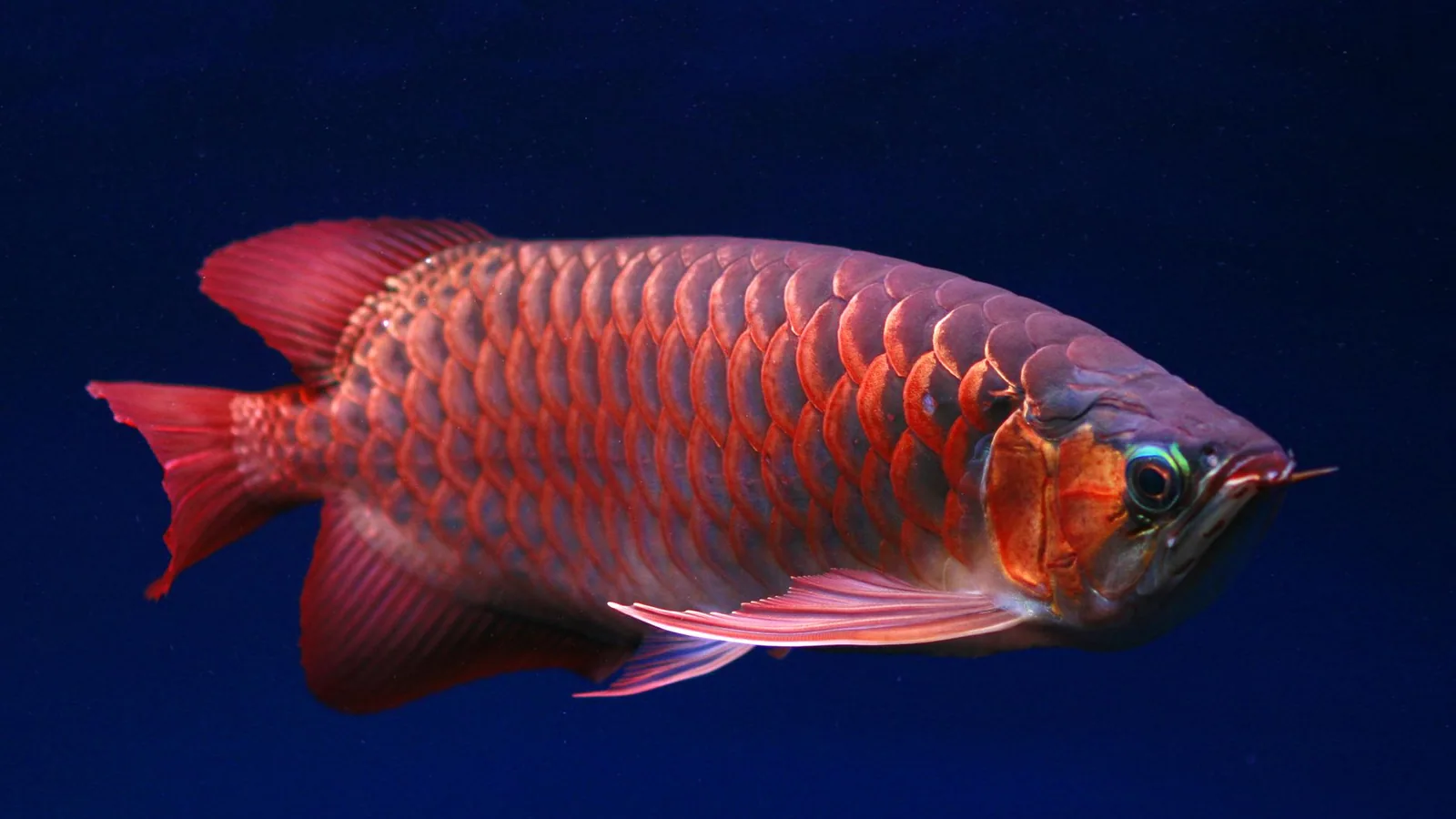
The arowana fish, Scleropages formosus, is a large freshwater teleost that has earned the title king of aquariums [1]. Its bright charismatic appearance and magnificent swimming performance make it one of the most admired fish in the hobby [1]. This endangered species also carries serious responsibilities. Owners must provide a very large aquarium, stable water quality, a veterinarian-designed feeding plan, and proof of legal origin.
This guide covers the full scope of arowana ownership. You will learn what makes this fish unique, how to set up its environment, how to feed it, how to protect its health, and when to call a veterinarian. Whether you already own an arowana or are researching before a purchase, the information below will help you make informed decisions.
At a Glance: Arowana Fish Care Checklist
| Task | What to Do | Why It Matters |
|---|---|---|
| , - | , - | , - |
| Confirm the species | Verify your fish is Scleropages formosus [1] | Correct identification guides every care decision |
| Check legal status | Confirm CITES documentation before purchase [1] | The species is endangered and trade is regulated [1] |
| Provide space | Use a very large aquarium with open swimming lanes | Arowanas are large fish with powerful swimming [1] |
| Manage water quality | Test water regularly and keep conditions stable | Water quality is the foundation of fish health |
| Plan nutrition | Ask your veterinarian for a feeding plan | Individual fish have different needs |
| Monitor behavior | Watch for appetite loss or abnormal swimming | Early signs lead to better outcomes |
| Find a veterinarian | Locate an aquatic veterinarian before problems start | Fish need veterinary care just like other pets |
Why Arowana Fish Are Different
A Large, Majestic Freshwater Teleost
The Asian arowana, Scleropages formosus, was formally described by Müller and Schlegel in 1844 [1]. It belongs to the family Osteoglossidae, a group of ancient bony-tongued fishes. The scientific literature describes it as a large majestic freshwater teleost [1]. This is not a fish that fits in a small tank. It is a powerful, active species that needs room to move.
The common name arowana fish is used for several related species, but the Asian arowana is the one most often called the king of aquariums [1]. Its reputation comes from its appearance and its movement. The bright charismatic appearance and magnificent swimming performance are the traits that made it famous [1]. In many cultures, this fish is seen as a symbol of status and good fortune. That cultural value has driven demand for decades.
In the wild, S. formosus lives in freshwater habitats such as lakes and river systems [1]. The Bukit Merah Lake and the Kerian River Basin in Malaysia are home to the most expensive color form [1]. Even among arowanas, individual fish vary widely in color, pattern, and value.
Not a Beginner Pet
Arowana fish are not suitable for first-time fish keepers. They grow large, live long, and require consistent care. They also carry legal and conservation obligations that many other aquarium fish do not. Anyone considering an arowana should research local laws, verify the fish's origin, and talk to a veterinarian who treats fish. Ask your veterinarian about the expected lifespan and adult size for your specific fish so you can plan accordingly.
Legal and Conservation Status
Endangered Under the IUCN
The International Union for Conservation of Nature (IUCN) lists Scleropages formosus as endangered [1]. Wild populations face pressure from habitat loss and collection. This status matters to owners because it affects how the fish can be bought, sold, and transported.
Regulated Under CITES Appendix 1
The Asian arowana is regulated under Appendix 1 of the Convention on International Trade in Endangered Species (CITES) [1]. Appendix 1 is the highest level of trade protection under CITES. Commercial trade in wild-caught specimens is tightly controlled, and international movement requires permits.
For owners in the United States, this means you should only buy arowana fish from sellers who can provide proper documentation. Ask for proof that the fish was legally bred or imported. If a seller cannot provide documentation, walk away. Illegal trade harms wild populations and puts buyers at legal risk.
The Golden Blue-Based Malayan Arowana
The most expensive Asian arowana is the Golden Blue-based Malayan Arowana [1]. This fish is endemic to Bukit Merah Lake and the Kerian River Basin in Perak, Malaysia [1]. Endemic means it is found in that region and nowhere else in the wild. Its limited range and distinctive color drive its high value. The Malaysian government regulates this fish under its national CITES legislation, and conservation programs monitor wild populations [1].
Questions to Ask Before You Buy
Before you purchase an arowana, ask the seller for proof of legal origin. The species is endangered and regulated under CITES Appendix 1, so documentation is not optional [1]. Ask about the fish's age, size, diet, and current water conditions. Ask whether the fish has seen a veterinarian. Ask for a recommendation for an aquatic veterinarian in your area. A responsible seller will welcome these questions. A seller who cannot answer them is a red flag.
How eDNA Monitoring Protects Wild Arowanas
Environmental DNA (eDNA) analysis has become widely accepted in biodiversity monitoring [1]. The method detects traces of genetic material that fish shed into the water. When an arowana swims, it releases skin cells, mucus, and waste into the environment. These materials contain DNA. Researchers collect water samples and look for species-specific genetic sequences. This allows them to detect rare and endangered species without catching or harming them [1].
Researchers have developed a species-specific eDNA primer for S. formosus using sequences from GenBank [1]. A primer is a short piece of DNA that binds to a specific target sequence. This primer is designed to detect S. formosus DNA and distinguish it from other species. The tool makes it possible to monitor wild populations and support CITES enforcement [1]. This research also supports conservation monitoring under Malaysia's CITES legislation [1]. For owners, this work is a reminder that the arowana in your aquarium is part of a species that needs protection in the wild.
Aquarium Setup and Water Quality
Tank Size and Swimming Space
The arowana is a large fish with magnificent swimming performance [1]. Its aquarium must be very large. A fish that swims powerfully needs unobstructed open water. Decorations and plants should not crowd the swimming lanes.
The exact tank size depends on the individual fish. Ask your veterinarian for guidance based on your fish's size and growth. A general rule is that larger is always better. Arowanas are active swimmers, and a cramped tank causes stress.
Water Quality Is the Foundation of Health
Aquatic veterinary medicine centers on water quality. The Merck Veterinary Manual and the AVMA's aquatic animal health resources emphasize that most fish disease traces back to poor water conditions. Owners should test water regularly and keep parameters stable.
Sudden changes in temperature, pH, or nitrogen waste are dangerous. Arowanas need clean, stable water at all times. A filtration system should be powerful enough to handle the waste load of a large fish. Regular partial water changes keep nitrogenous waste low.
The Nitrogen Cycle
The nitrogen cycle is the biological process that keeps aquarium water safe. Fish produce ammonia as waste. Beneficial bacteria convert ammonia to nitrite, then to nitrate. Nitrate is less toxic and is removed through water changes. A new tank needs time to build this bacterial colony before fish are added. Adding an arowana to an uncycled tank exposes it to toxic ammonia and nitrite. Ask your veterinarian or an experienced aquatic professional how to cycle a new tank safely.
Filtration and Maintenance
Choose a filter rated for a very large aquarium. Canister filters and sump systems are common choices for large freshwater tanks. The goal is continuous biological and mechanical filtration. Biological filtration removes ammonia and nitrite through beneficial bacteria. Mechanical filtration removes solid waste. Both are needed for a healthy aquarium.
Test water on a schedule and keep records. Watch for trends. If ammonia, nitrite, or nitrate levels rise, take action before your fish shows signs of stress. A sudden change in water chemistry is more dangerous than a gradual one. Ask your veterinarian how often to test water and perform partial water changes for your specific tank.
Building a Care Routine
Consistency matters more than any single action. Feed your fish on a schedule. Test water on a schedule. Observe your fish at the same time each day. Ask your veterinarian to help you build a routine that fits your tank. A predictable environment reduces stress and makes problems easier to spot.
Tank Cover and Jump Prevention
Ask your aquatic veterinarian whether your arowana needs a secured lid. Large active fish can injure themselves if they leap from open tanks. A well-fitted cover also reduces stress by keeping the fish from feeling exposed.
Substrate and Decor
Keep the tank layout simple. A bare bottom or thin layer of substrate is easier to clean. Decorations should be smooth and secure. Sharp objects can injure a large fish. Leave wide open swimming lanes from one end of the tank to the other. Lighting should follow a consistent day and night cycle to support the fish's natural rhythms.
Nutrition and Feeding
A Feeding Plan Designed for Your Fish
Arowanas are large, active fish with high energy needs. The best diet for your fish depends on its age, size, and health. Ask your veterinarian to design a feeding plan. A varied diet is generally better than a single food type.
Your veterinarian can recommend appropriate food types and portion sizes. Large freshwater fish often do well on high-quality commercial foods supplemented with other protein sources. The exact balance depends on the individual fish. What works for one arowana may not work for another.
Feeding Frequency
Feeding frequency depends on the fish's age and size. Young fish often need more frequent meals than adults. Your veterinarian can help you set a schedule. Overfeeding is a common mistake. Uneaten food degrades water quality and can make fish sick. Feed only what the fish can consume in a short period, and remove any uneaten food promptly.
Observation During Feeding
Feeding time is a chance to check your fish's health. A healthy arowana usually eats eagerly. A fish that refuses food may be stressed or ill. If your arowana stops eating, contact a veterinarian. Changes in feeding behavior are often the first sign of a problem. Regular observation during feeding helps you notice subtle changes early.
Health and Disease Prevention
Prevention Comes First
Fish health starts with the environment. Stable water quality, appropriate nutrition, and low-stress conditions prevent most disease. Aquatic veterinarians, including those affiliated with the World Aquatic Veterinary Medical Association (WAVMA), focus on prevention as the first line of defense. A veterinarian who treats fish can help you build a prevention plan that fits your tank and your fish.
Signs That Warrant Attention
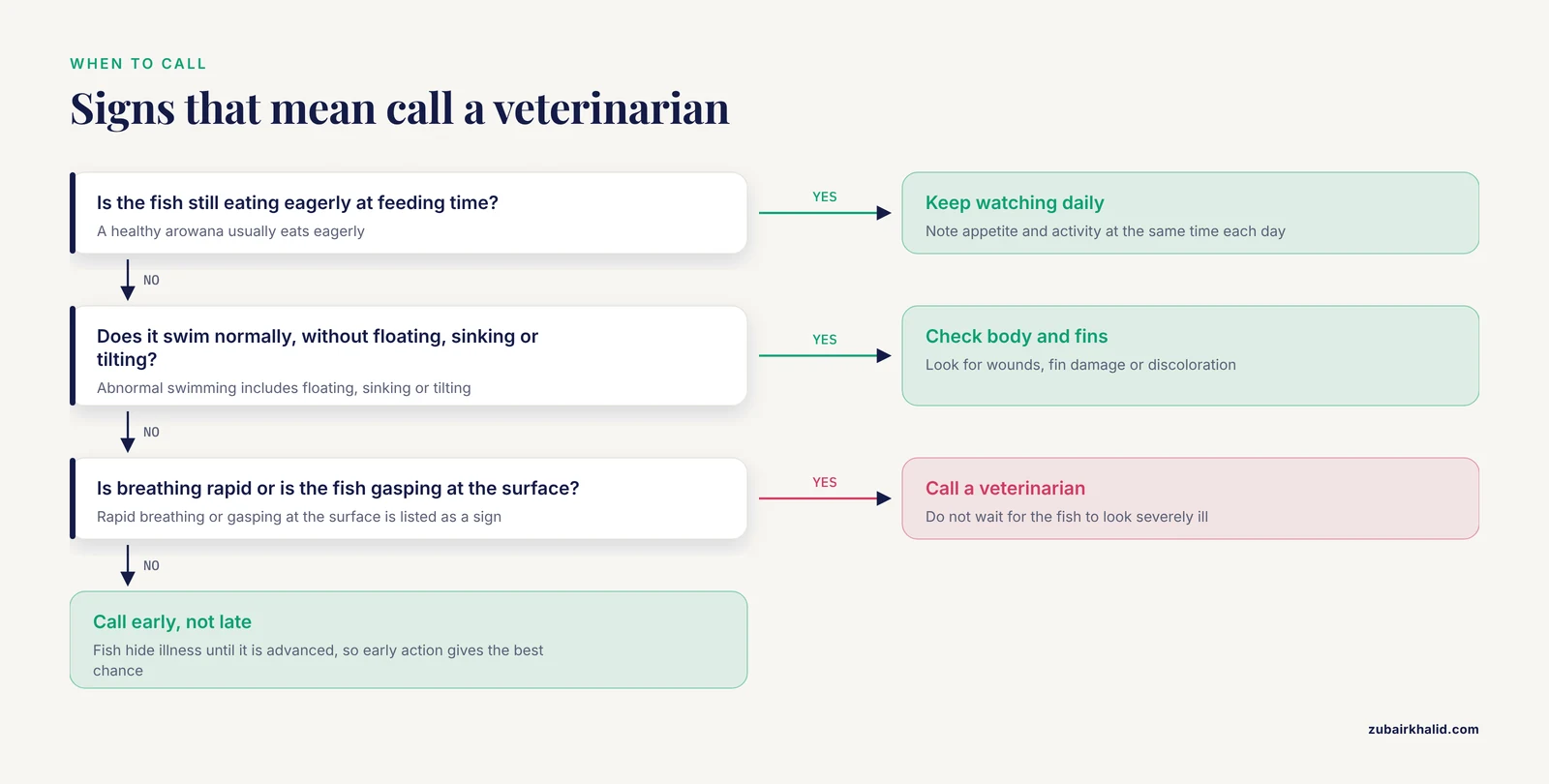
Watch your arowana daily. Signs that something may be wrong include:
- Loss of appetite
- Lethargy or reduced activity
- Abnormal swimming, such as floating, sinking, or tilting
- Visible wounds, fin damage, or discoloration
- Rapid breathing or gasping at the surface
Any of these signs should prompt a call to a veterinarian. Do not wait for the fish to look severely ill. Fish often hide illness until it is advanced. By the time a fish looks sick, the problem may have been developing for days or weeks.
Finding an Aquatic Veterinarian
Not every veterinary clinic treats fish. The World Aquatic Veterinary Medical Association (WAVMA) is a professional organization for aquatic veterinarians, and its resources can help owners find a veterinarian with fish experience. Locate one before you need one. An emergency is the wrong time to search for a fish veterinarian.
A veterinarian who treats fish can perform a physical examination, review water quality records, and recommend next steps. Fish medicine has advanced significantly, and many conditions can be managed successfully when caught early. The key is to act quickly and follow the veterinarian's advice.
Quarantine and Biosecurity
If you keep other fish, ask your veterinarian about quarantine protocols. New fish can carry disease. Separating new arrivals protects your arowana. Keep separate nets and equipment for different tanks when possible. Wash your hands between tanks and avoid moving water or equipment from one tank to another.
Behavior, Handling, and Welfare
A Fish Built to Swim
The arowana's magnificent swimming performance is central to its identity [1]. This is a fish that moves. It needs an aquarium that allows full expression of that behavior. A cramped tank causes stress and poor welfare. Arowanas are active swimmers that use open water throughout the tank. Watching a healthy arowana swim is one of the rewards of keeping this species.
Enrichment and Structure
Arowanas do best in an environment that feels secure. Open swimming space combined with minimal, safe decor gives them room to move without stress. Ask your veterinarian about appropriate enrichment for your fish. A consistent daily routine for feeding and lighting helps reduce stress.
Handling
Fish should never be lifted out of water unless absolutely necessary. Handling causes stress and can damage the protective slime coat. When handling is required, it should be done by a veterinarian or trained professional. Owners should never grab an arowana by the body or gills.
Welfare and Conservation Go Together
Keeping an endangered species is a privilege. Owners who provide excellent care support the welfare of their individual fish. Choosing legally sourced fish and supporting conservation efforts helps the species as a whole [1]. The eDNA monitoring work described earlier is one example of how science and responsible ownership can work together [1].
Common Mistakes to Avoid
- Starting with too small an aquarium. Arowanas are large fish [1]. A small tank causes stress, stunts growth, and leads to health problems. Plan for the adult size of the fish, not the size at purchase. A tank that seems large at first may be too small within a year.
- Skipping water quality testing. Water quality is the foundation of fish health. Test regularly and keep records. Guessing is not a strategy. A test kit and a logbook cost little compared to the price of a sick fish.
- Buying without documentation. The Asian arowana is endangered and regulated under CITES Appendix 1 [1]. Always verify legal origin before purchase. A legitimate seller should be able to explain the paperwork.
- Overfeeding. Uneaten food pollutes the water and can sicken fish. Follow your veterinarian's feeding plan and remove uneaten food promptly.
- Waiting to call a veterinarian. Early intervention improves outcomes. If your fish stops eating or swims abnormally, call for help. Delay can turn a treatable problem into a fatal one.
- Housing incompatible fish together. Ask your veterinarian whether your arowana should be housed alone or with tank mates. Arowanas are large, active fish that may not tolerate crowding.
- Ignoring conservation status. This is an endangered species [1]. Responsible ownership includes supporting legal trade and conservation.
Limitations and When to Contact a Veterinarian
This article is educational and is not a substitute for veterinary diagnosis or treatment. Individual cases need a veterinarian. No online guide can tell you exactly what is wrong with your fish or how to treat it.
Contact a veterinarian if:
- Your arowana stops eating for more than a day or two.
- Your fish swims abnormally, floats, sinks, or tilts.
- You see wounds, fin damage, or discoloration.
- Your fish shows rapid breathing or gasping.
- Water quality tests show problems you cannot correct.
- You are unsure about the legal documentation for your fish.
When in doubt, call. A veterinarian who treats fish can examine your arowana, review your water quality records, and recommend next steps. Early action gives your fish the best chance. Your veterinarian is the only person who can diagnose a specific health problem and prescribe treatment.
Breeding and Reproduction
Home breeding of arowanas is rarely successful. These fish need pond-scale water volume, stable conditions, and mature adults that accept each other. Arowanas are large, long-lived, and often aggressive toward mates outside a compatible pair. Spawning is triggered by seasonal and environmental cues that a home aquarium seldom reproduces. Even when eggs are produced, raising the fry demands separate grow-out space, careful feeding, and strict water quality. Most home aquariums cannot provide these conditions.
In the wild, Asian arowanas spawn in slow-moving freshwater habitats such as lakes and river systems. A compatible pair courts, the female releases eggs, and the male fertilizes them. The male then picks up the eggs in his mouth and carries them through incubation, which lasts several weeks. He does not feed normally during this period. When the fry are free-swimming, the male releases them. This paternal mouthbrooding is a key reason breeding is difficult to manage in captivity. Removing eggs or fry too early, disturbing the male, or housing him in a crowded tank can cause loss of the brood or injury.
Because Scleropages formosus is endangered and its trade is regulated under CITES Appendix 1 [1], breeding is not just an aquarium project. Commercial breeding and sale generally require permits, registration, and documentation of captive-bred stock. National and local rules vary. Before attempting to breed an arowana, confirm the requirements with the relevant wildlife authority and keep records for every offspring. Unpermitted breeding can carry legal penalties.
Consult a veterinarian experienced with fish for reproductive health concerns. Seek advice if a female has a persistently swollen abdomen, strains without producing eggs, or shows a prolapse. Seek help if a mouthbrooding male does not resume eating after the expected period, shows mouth or jaw injury, or is repeatedly disturbed by tank mates. A pre-breeding examination and review of water quality and body condition can identify problems before spawning begins.
Tank Mates and Compatibility
Arowanas are large, predatory, territorial fish. In most cases, the safest choice is to keep an arowana alone. If you want tank mates, you must plan for aggression, space, and disease risk before adding any fish.
Which Fish May Coexist With an Arowana
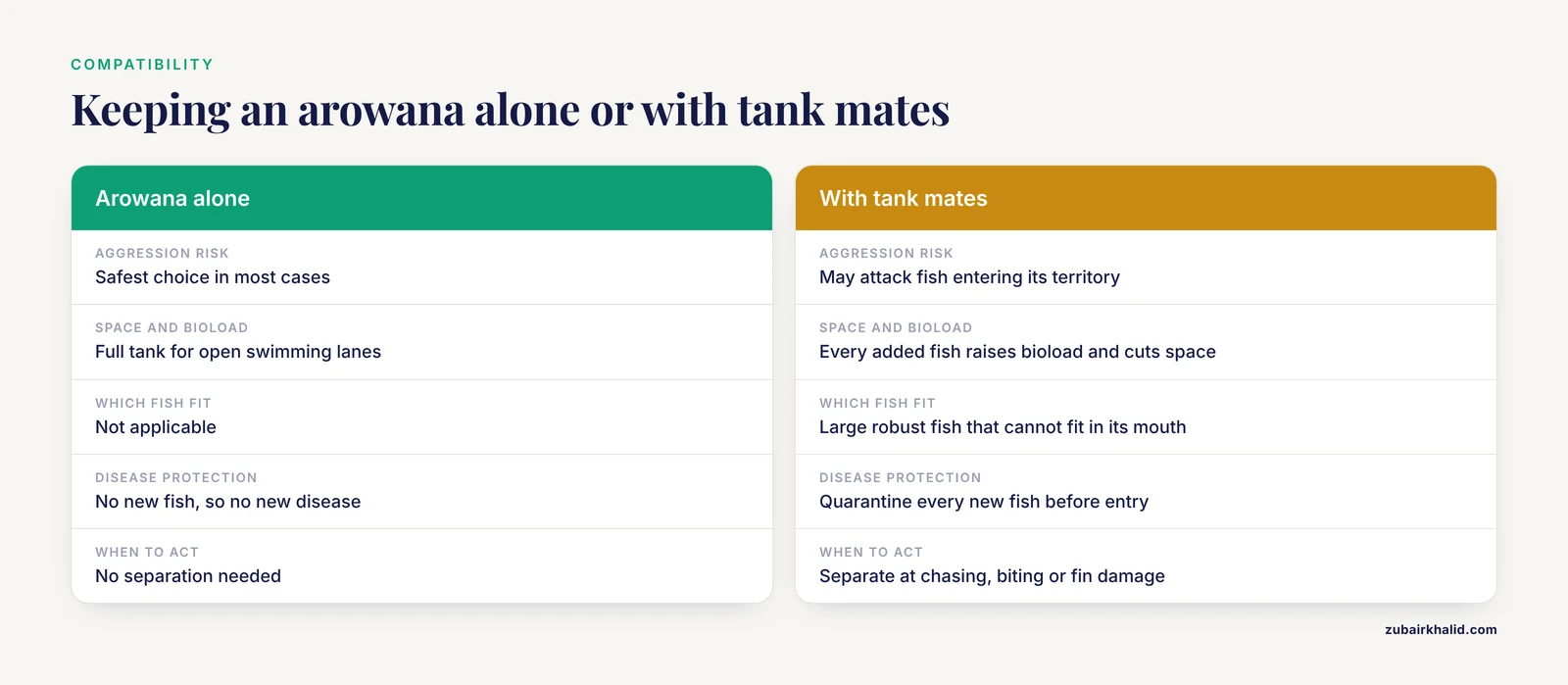
Only large, robust fish that cannot fit in the arowana's mouth are worth considering. Good candidates usually occupy different water zones and are not overly aggressive themselves. Examples include large plecos, bichirs, silver dollars, tinfoil barbs, and large cichlids such as oscars. Small fish, slow-moving fish, and surface-dwelling fish are likely to be eaten or injured.
Aggression Risks
Arowanas defend their territory and may attack fish that enter it. They also treat smaller fish as prey. Aggression often increases during feeding, when the arowana is stressed, or when the tank is overcrowded. Even a normally calm arowana may turn on a tank mate without warning. Arowanas are powerful jumpers, so a tank mate that shares the surface zone is at higher risk.
Size and Territory Considerations
An arowana needs a very large aquarium with open swimming lanes. Every added fish increases the bioload and reduces available space. Arowanas typically claim the upper and middle parts of the water column, so bottom-dwelling tank mates are more likely to coexist peacefully. Add tank mates while the arowana is still young, or rearrange the decor before introducing new fish, to disrupt an established territory.
Quarantine New Fish
Quarantine every new fish before it enters the arowana's tank, as described in the health section. This protects the arowana from disease and gives you time to observe the new fish for signs of illness or aggression. Do not skip quarantine to save time.
When to Separate Tank Mates
Separate tank mates immediately if you see persistent chasing, biting, fin damage, or if either fish stops eating. Have a spare, fully cycled tank ready before you add any companion. If the arowana hides, refuses food, or swims abnormally after a new fish is added, remove the new fish. When in doubt, ask your veterinarian whether a particular species is compatible with your arowana.
Transporting and Acclimating Your Arowana
Moving an arowana is a stressful event for the fish and a logistical task for the owner. Plan the move before you net the fish. For any cross-border shipment, confirm CITES documentation first.
Bagging and Oxygen
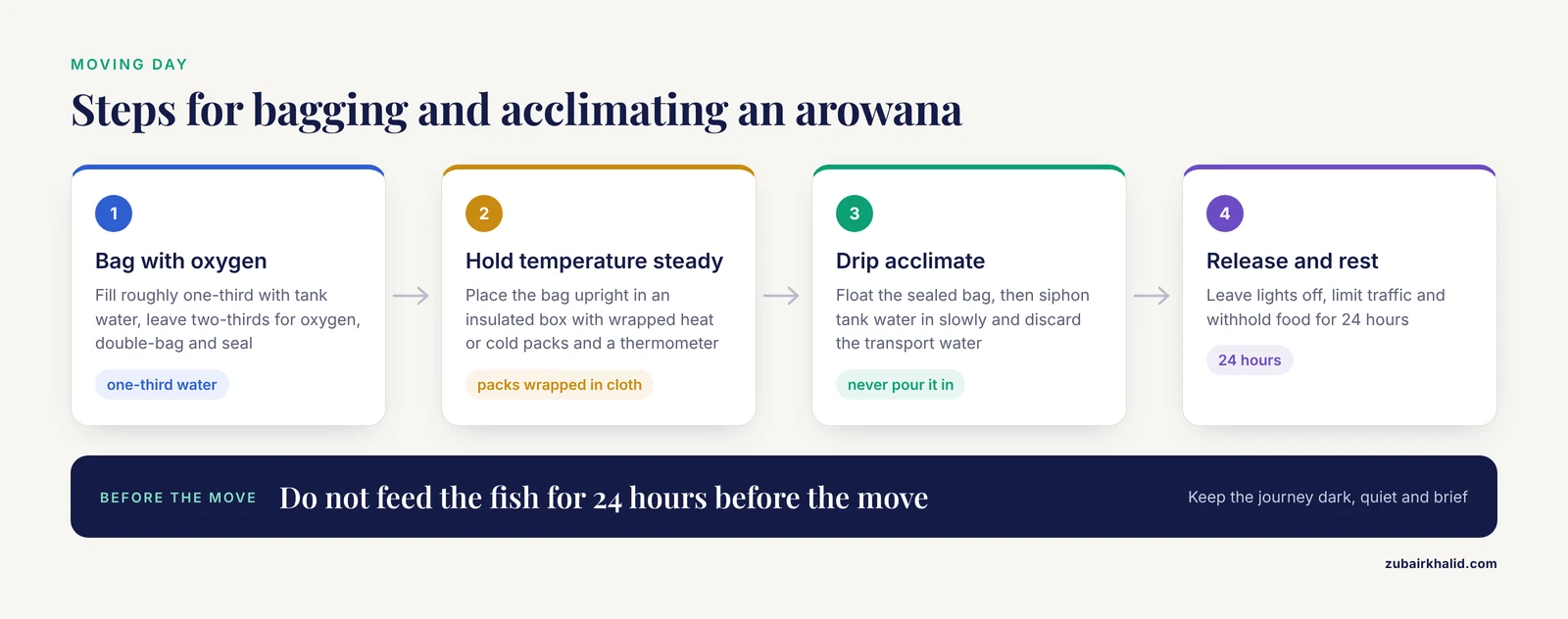
Use a clean fish bag large enough that the fish can stay submerged without bending. Fill roughly one-third with tank water and leave two-thirds for oxygen. Double-bag the fish, expel excess air, fill the space with medical oxygen, and seal with rubber bands. Place the bag upright in a rigid insulated box. Do not overfill with water. Water is heavy, and sloshing increases stress and risks injury. For short local moves, a covered bucket or cooler with a secure lid can work if the fish is not crowded.
Temperature Stabilization
Keep the bag at a stable temperature during transit. Use an insulated box, and place heat or cold packs wrapped in cloth so they never touch the bag directly. Include a thermometer in the box and check it during longer trips.
Drip Acclimation
Float the sealed bag in the destination tank to equalize temperature. Then open the bag and start a slow siphon of tank water into the container. Discard the transport water. Never pour it into the aquarium. Transfer the fish gently with a soft net or smooth container. A large arowana may need a veterinarian or trained handler for the transfer.
Reducing Stress
Do not feed the fish for 24 hours before the move. Keep the journey dark, quiet, and brief. After release, leave tank lights off, limit traffic near the tank, and withhold food for 24 hours. Observe from a distance.
When to Call a Veterinarian
Call a veterinarian if the fish gasps, floats, tilts, shows wounds or fin damage, or does not settle after the move. Call before moving a sick fish, and never use sedatives without veterinary guidance.
Estimating Costs and Long-Term Commitment
Arowana ownership is a long-term financial commitment. The purchase price of the fish is only a fraction of the total cost. Plan for the adult size and lifespan of the fish from the start.
Initial Setup Costs
The largest upfront expense is the aquarium and filtration system. A very large tank, a powerful canister or sump filter, a heater, lighting, and a secure lid are all required. A tank cover is not optional for a fish known for leaping. Water testing equipment and a quarantine setup add to the initial outlay. Buy the largest tank you can afford and place it where it can remain permanently. Moving a large aquarium later is difficult and stressful for the fish.
Ongoing Expenses
Monthly costs include electricity for heating and filtration, water treatment supplies, replacement filter media, and food. Arowanas are large, active fish with high energy needs, so food costs are higher than for most aquarium fish. Budget for regular water testing supplies and for periodic equipment replacement. Filters wear out, heaters fail, and lids crack. Setting aside a small amount each month for equipment replacement prevents financial surprises.
Lifespan and Growth Expectations
Arowanas are long-lived fish. With good care, they commonly live 10 to 20 years, and some individuals live longer. They also grow steadily. An arowana purchased at 15 cm can reach 60 to 90 cm within a few years, depending on species and individual genetics. The tank you buy must accommodate the adult fish, not the juvenile. Ask your veterinarian for a growth and lifespan estimate for your specific fish so your plan matches reality.
Financial Planning for Veterinary Care
Veterinary costs are part of responsible arowana ownership. A preventive wellness visit, including a physical examination and water quality review, costs less than emergency treatment. Plan for the possibility of illness. If your fish stops eating, swims abnormally, or shows wounds, a veterinary consultation is warranted immediately. Delaying care because of cost usually leads to more expensive treatment and a worse outcome. An emergency fund for veterinary care is a reasonable part of the overall budget.
| Category | Examples |
|---|---|
| Initial setup | Tank, filter, heater, lighting, lid, test kit |
| Ongoing | Electricity, food, filter media, water treatment |
| Equipment reserve | Replacement heater, pump, test kits |
| Veterinary | Wellness visits, diagnostics, emergency care |
Related Guides
- Discus Fish Care: Tank Setup, Water, Diet, and Health: Care guide for another large freshwater species with demanding water quality
- Ichthyophthirius multifiliis (White Spot / Ich): A Comprehensive Reference on the Ciliate Parasite of Freshwater Fish: Comprehensive reference on a common freshwater parasite that can affect many species
- Hatchery Egg Incubation and Hatching Techniques: Techniques for egg incubation, relevant if you consider breeding arowanas
- Pond Preparation Before Stocking Fish: Pond preparation steps for anyone considering large-scale arowana breeding
- Nutritional Requirements of Farmed Fish: Proteins, Lipids, and Carbs: Detailed nutritional requirements to help understand arowana dietary needs
- Pond Liner Selection and Installation Guide: Guidance on pond liners for large-scale breeding or grow-out projects
- Fish Farm Escape Prevention and Response: Escape prevention strategies, important because arowanas are powerful jumpers
Frequently Asked Questions
What is an arowana fish?
An arowana fish is a large freshwater teleost, Scleropages formosus, known as the king of aquariums for its bright appearance and powerful swimming [1].
Are arowana fish endangered?
Yes. The Asian arowana is listed as endangered by the IUCN and regulated under CITES Appendix 1 [1].
Where do Asian arowana fish come from?
The species is found in Southeast Asia. The Golden Blue-based Malayan Arowana is endemic to Bukit Merah Lake and the Kerian River Basin in Perak, Malaysia [1].
Why are some arowana fish so expensive?
The Golden Blue-based Malayan Arowana is the most expensive Asian arowana [1]. Rarity, color, and legal documentation all influence value.
How big of an aquarium does an arowana need?
Arowanas are large fish, so they need a very large aquarium with open swimming space. Ask your veterinarian for tank size guidance for your specific fish.
What do arowana fish eat?
Ask your veterinarian to design a feeding plan. A varied diet appropriate to your fish's age and size is generally best.
How are wild arowana fish protected?
Researchers use environmental DNA (eDNA) analysis to detect and monitor wild populations without harming them, which supports CITES enforcement [1].
When should I take my arowana to a veterinarian?
Contact a veterinarian if your fish stops eating, swims abnormally, shows wounds or discoloration, or if water quality problems persist.