Pipette Brands Comparison: Options Compared
By Dr. Zubair Khalid, DVM, MS, PhD ·

Every major pipette brand sells instruments that meet the same international accuracy classes, so the differences that actually matter between Eppendorf, Gilson, Rainin, Sartorius, Thermo Scientific, and Hamilton live in ergonomics, tip ecosystems, calibration support, and how each instrument feels after two hours at the bench. The best pipette brands comparison rule of thumb is simple: buy the pipette whose tips, service network, and hand fit match your lab and your applications, not the one with the most impressive specification sheet.
This article walks through how micropipettes work, what genuinely separates the brands, a side-by-side table of the major options, the pros and cons of each approach, worked scenarios from teaching labs to core facilities, the pipetting technique that any brand requires, and the pipette calibration practices that keep every instrument honest.
How Pipettes Work Before You Compare Brands
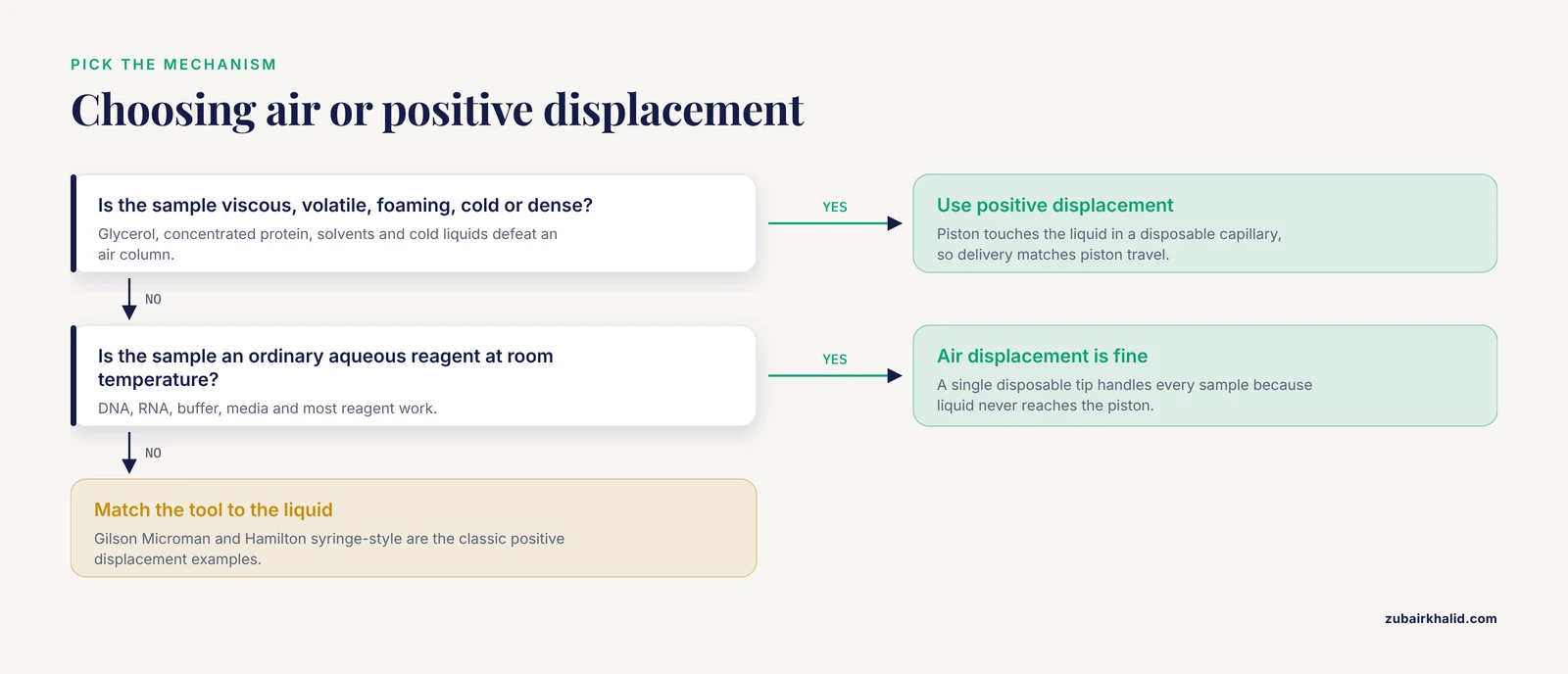
A comparison only means something once you know what the instrument is doing. Nearly all handheld laboratory pipettes fall into one of two families, and knowing which family a brand emphasizes tells you more than any marketing sheet.
Air displacement pipettes are the standard bench tool. A piston inside the handpiece moves a fixed distance, and a column of air between the piston and the liquid acts as the transfer medium. The piston pushes air, the air pushes liquid. Because the liquid never touches the piston, a single disposable tip handles every sample. Air displacement pipettes excel with aqueous solutions at room temperature and are the default for DNA, RNA, buffer, media, and most reagent work in molecular biology.
Positive displacement pipettes eliminate the air column. The piston sits in direct contact with the liquid inside a disposable capillary or piston-equipped tip, so what the piston moves is what the sample moves. This design handles viscous liquids (glycerol, concentrated protein solutions), volatile solvents, foaming samples, cold liquids, and dense liquids that an air column compresses or siphons unpredictably. Gilson's Microman line and Hamilton's syringe-style pipettes are the classic examples. Brands such as Eppendorf and Sartorius also sell positive displacement attachments or dedicated instruments.
Two vocabulary terms decide every specification conversation. Accuracy (also called systematic error) is how close the delivered volume sits to the set volume on average. Precision (also called repeatability) is how tightly repeated deliveries cluster together, usually reported as a coefficient of variation. A pipette can be precise but inaccurate (consistent but wrong, fixable by adjustment), accurate on average but imprecise (scattered deliveries), or both. Calibration addresses the first problem. Technique, tip fit, and instrument condition address the second.
Volume behavior also matters more than beginners expect. Manufacturers calibrate a pipette over its full range, but performance degrades toward the bottom of that range. A 100 µL pipette set to 10 µL will always be relatively less accurate and less precise than the same instrument set to 50 or 100 µL, because a small volume is a small fraction of a large air column and a small piston travel. For the most demanding measurements, choose a pipette whose nominal capacity sits close to the volume you actually use.
What a Pipette Brands Comparison Actually Measures
If accuracy classes are similar across reputable brands, what is a fair comparison actually comparing? Six criteria decide real purchasing choices.
Accuracy class parity. Reputable manufacturers design and test to the international standard for piston-operated volumetric apparatus, ISO 8655. At matched volumes, a well-maintained Eppendorf, Gilson, Rainin, Sartorius, or Thermo Scientific pipette delivers within a few tenths of a percent of the set volume at nominal volume. Spec-sheet differences at this level are smaller than the drift a neglected calibration schedule produces. Treat raw accuracy claims as a tie unless an instrument is outside its class.
Ergonomics. Plunger force, tip ejection force, grip geometry, and hand weight dominate long sessions. A student plating 96 wells eight times a day, or a technician serially diluting 200 samples, feels the difference between a stiff plunger and a light one within the hour. Brands diverge sharply here. Rainin's LTS (LiteTouch System) design exists specifically to cut plunger and ejection forces. Sartorius's Tacta line advertises low and adjustable tip ejection force. Eppendorf's Research plus uses a lightweight housing and a soft-ejection spring. These differences are measurable, documented by the manufacturers, and experienced at the bench.
Tip ecosystem. This is the most underestimated criterion. Tips are the consumable you will buy thousands of times, and the wrong tip on the right pipette produces leaks, splash contamination, and calibration errors. Each brand markets its own certified tips (Eppendorf epT.I.P.S., Gilson DIAMOND, Rainin LTS and RT, Sartorius Optifit, Thermo Scientific ClipTip and Finntip). Rainin's LTS uses a distinct short, self-aligning tip cone, so LTS pipettes require LTS-style tips and will not seal reliably on standard geometry. Thermo's ClipTip interface physically clips the tip onto the shaft rather than relying on friction alone. Generic tips can work on standard-barrel pipettes, but fit and seal must be verified rather than assumed.
Calibration and service support. Pipettes drift as seals wear, springs relax, and vapor gets into the barrel. Every major brand offers adjustment mechanisms and factory or authorized service. A brand with a fast, affordable local service partner, or with a design you can verify and adjust in-house under your quality program, is worth more over five years than a slightly cheaper brand with slow service. Consider also who in your institution already calibrates a given brand. Shared service contracts and existing reference instruments often make one brand the practical choice for a whole building.
Durability and maintenance. Which parts are user-serviceable, which components tolerate autoclaving, and how the housing survives drops and 70% ethanol wipes all matter in a shared instrument room. Most modern midrange models have fully or largely autoclavable bodies and shafts, but verify per model because a brand's budget line often differs from its flagship.
Electronic versus manual operation. Motorized pipettes (Eppendorf Xplorer, Gilson PIPETMAN M, Rainin E4 XLS+, Sartorius Picus 2, Thermo Scientific E1-ClipTip) replace thumb force with a motor and add modes such as reverse pipetting, serial dispensing, mixing, and programmed step dilution. They cost more, need charging infrastructure, and add a battery to the failure list, but they transform repetitive multichannel work. The pros and cons section below treats this choice in detail.
Side-by-Side Comparison of the Major Brands
The table below summarizes the brands that dominate US molecular biology labs. Treat every entry as a family description rather than a claim about any single catalog number, because each brand spans manual, electronic, single-channel, and multichannel models with different tolerances.
| Brand | Representative manual lines | Electronic lines | Tip system | Distinctive design point | Typical best fit |
|---|---|---|---|---|---|
| Eppendorf | Research plus, Reference 2 | Xplorer, Xplorer plus | epT.I.P.S. | Lightweight body, single-button operation, spring-assisted ejection, broad multichannel range | General molecular biology, teaching and research labs, widest local availability |
| Gilson | PIPETMAN L, PIPETMAN Classic heritage | PIPETMAN M | DIAMOND | Metal-and-polycarbonate handpieces descended from the original 1970s Pipetman, robust adjustable volume dial | Labs with long Gilson traditions, established service partners, users who prefer a heavier tool |
| Rainin (Mettler Toledo) | Rainin Classic, Pilot | E4 XLS+ | LTS and RT | LTS tip cone with self-alignment and markedly lower plunger and ejection forces | High-repetition work, users with hand strain, labs standardizing on LTS tips |
| Sartorius | Tacta | Picus 2 | Optifit | Low, adjustable tip ejection force, strong electronic pipetting modes on Picus | Labs converting from Biohit heritage, multichannel plating, electronic-first workflows |
| Thermo Scientific | Finnpipette F1, F1 ClipTip | E1-ClipTip | ClipTip, Finntip | ClipTip interface locks tips mechanically, electronic E1 models adjust tip spacing between plate formats | Plate-based workflows, labs needing variable tip spacing for 96- and 384-well work |
| Hamilton | Syringe-style positive displacement heritage, newer air displacement lines | Robotic liquid handling platforms | Dedicated tips and syringes | Positive displacement and syringe precision, strong automation integration | Viscous, volatile, or precious samples, automated workflows |
The Brands on Their Own Terms
Eppendorf
Eppendorf is the default answer in many US molecular biology departments, and the reasons are practical rather than sentimental. The company dates its microliter pipette heritage to the earliest piston-stroke designs of the late 1950s, and its modern lines reflect that accumulated iteration. The Research plus line is light in the hand, fully autoclavable, and built around a single-button operation where the same control does aspiration, dispensing, and ejecting, which shortens the learning curve for new students. The Reference 2 line moves volume setting to a separate dial with a locking mechanism, which some users prefer for fixed-volume work because it prevents accidental volume drift during dispensing. The Xplorer electronic line covers single- and multichannel formats with stepped dispensing and mixing programs.
The practical case for Eppendorf rests on three legs: an enormous installed base that makes loaner instruments and secondhand replacement parts easy to find, a tip line (epT.I.P.S.) with certified variants including low-retention and filtered formats, and wide service availability. The practical caveat is that Eppendorf barrels use a standard geometry that behaves well with many third-party tips, which is convenient but means fit must still be verified tip lot by tip lot.
Gilson
Gilson's PIPETMAN is the instrument that made microliter pipetting routine, descending from designs developed in the 1970s. The modern PIPETMAN L keeps the philosophy: a metal-internal, polycarbonate-external handpiece that feels substantial, a volume dial with a lock, and a construction style that generations of technicians already know how to service. PIPETMAN M brings motorized operation to the same familiar form factor. Gilson's DIAMOND tips are manufactured to match Gilson geometries tightly, and Gilson's authorized service network is long established in North America.
A pipette brands comparison of pros and cons here is blunt. The pros are durability, familiarity, service depth, and the fact that a well-maintained Pipetman from a decade ago still works. The cons are weight and plunger force relative to newer ergonomic designs, which matters in high-repetition work, and a tip interface that, while standard-geometry, still rewards brand-matched tips for certification-sensitive work.
Rainin (Mettler Toledo)
Rainin, now part of Mettler Toledo, built its modern reputation on ergonomics. The LTS (LiteTouch System) design shortens the tip cone and lets the tip self-align on the shaft, which reduces both plunger stroke force and tip ejection force substantially compared with conventional geometry. For a technician performing hundreds of aspirations per day, or for any user managing hand strain or repetitive stress symptoms, this is the feature set to look at first. The E4 XLS+ electronic multichannel line extends that philosophy with programmable protocols and electronic tip ejection.
Rainin's comparison trade-off follows directly from its design. LTS instruments require LTS-geometry tips, so adopting Rainin means committing to that tip ecosystem, which is excellent but locks in a consumable relationship. Labs that want a pipette accepting the widest range of commodity tips may prefer Rainin's own classic-barrel models or another brand entirely. Rainin's RT line addresses standard-tip users, and the company's Pipetman heritage means Rainin also distributes the Gilson-designed PIPETMAN legacy in North America, a historical relationship worth knowing when you encounter older instruments.
Sartorius
Sartorius entered liquid handling by acquiring the Biohit liquid handling business, and its current portfolio descends from that engineering. The Tacta manual pipette's headline features are a low tip ejection force that users can adjust and a light, autoclavable body. The Picus 2 electronic line is one of the strongest electronic platforms in a pipette brands comparison of options, with programmable modes for reverse pipetting, dilution, mixing, and sequential dispensing, plus electronic tip spacing on multichannel models that lets one instrument serve both 96-well and other formats where spacing-adjustable models apply.
The pros are ergonomics, a genuinely modern electronic platform, and competitive pricing in many markets. The cons are a smaller US installed base than Eppendorf or Rainin in some institutions, which affects borrowing, shared service contracts, and the informal knowledge pool in your department. Its Optifit tip line is well made but again rewards brand-matched use.
Thermo Scientific (Finnpipette)
Thermo Scientific's liquid handling line descends from the Finnish Labsystems Finnpipette family. Its distinctive contribution is the ClipTip interface, in which the tip clicks onto the shaft with a mechanical lock rather than relying on friction and O-ring compression alone. The practical consequence is that tips do not loosen or fall off mid-protocol, a real failure mode when a loaded multichannel pipette is held over a plate while you fumble for a corner. The F1 ClipTip manual line and the E1-ClipTip electronic line, with its adjustable tip spacing ("equalizer") between formats, make Thermo's offering particularly coherent for plate-heavy workflows.
The pros are the locking tip interface, strong multichannel options, and integration with the broader Thermo consumable and equipment ecosystem that many US labs already buy from. The cons are the ClipTip lock-in (ClipTip tips are required for ClipTip instruments), and models outside the ClipTip family competing in a crowded midrange where they are excellent but less distinctive.
Hamilton
Hamilton Company occupies a different niche. Its reputation was built on syringe-based precision liquid handling, including positive displacement syringe pipettes and the robotic liquid handling platforms that anchor many high-throughput screening and genomics operations. For handheld use, Hamilton's air displacement pipettes are a newer line, and the company's center of gravity remains positive displacement accuracy and automation.
Choose Hamilton when your problem is not ordinary aqueous transfers but rather viscous, volatile, or precious samples, or when your handheld work must eventually translate into an automated workflow that Hamilton platforms can mirror. The cons are a narrower handheld ergonomics story than the dedicated handheld brands and a tip ecosystem that is purpose-built rather than commodity.
Second-tier and budget brands
Several other brands appear regularly in US labs. BrandTech's Transferpette lines are competent and widely used in industrial and teaching settings. Nichiryo (Nichipet), Socorex, Corning/Axygen, Labcon, Benchmark, Heathrow Scientific, and various VWR-branded instruments all sell serviceable manual pipettes, frequently at lower purchase prices. For a teaching lab that expects hard use, student mishandling, and replacement rather than repair, budget brands can be a rational choice provided the instruments are gravimetrically verified on arrival and on a schedule. The comparison trap to avoid is assuming a low purchase price means a low total cost. Tips dominate lifetime consumable spending for any pipette, so a brand whose matched tips cost more per rack can erase its instrument-price advantage within a year of heavy use.
Pros and Cons at a Glance
Because brand-level trade-offs were covered above, this section addresses the decision layers that sit around brand choice, since they shape the pipette brands comparison options most buyers actually face.
Manual versus electronic. Manual pipettes cost less, never need charging, fail less often, and are simpler to calibrate and service. Electronic pipettes remove plunger thumb force entirely, enforce consistent aspiration and dispensing speeds across users, and offer programming for reverse pipetting, serial dilution, repeat dispensing, and mixing. The cons of electronic instruments are purchase price, battery logistics, more complex service, and the reality that some experienced users find manual instruments faster for simple one-off transfers.
Single-channel versus multichannel. Single-channel instruments are cheaper, easier to calibrate, and sufficient for tubes and small series. Eight- and twelve-channel instruments transform anything done in 96- or 384-well plates, cutting time roughly by the channel count and reducing pipetting variability across a row, provided every channel is actually calibrated. The cons are higher purchase cost, more channels to keep in calibration, and a wider instrument that needs bench space and a careful hand at the plate.
Standard tips versus filter tips versus specialty tips. Standard tips suit most reagent work. Aerosol-resistant filter tips are the default precaution for PCR and qPCR setup, for work with radioactive or hazardous material, and whenever cross-contamination between samples would end an experiment. Low-retention tips, with hydrophobic inner surfaces, improve recovery of detergents, proteins, and small volumes where liquid films on conventional polypropylene rob you of microliters. Wide-bore tips shear genomic DNA less. Specialty work that treats the tip as part of the measurement system exists too. One environmental health study, for example, collected e-cigarette aerosol by droplet deposition directly into a series of conical pipette tips before quantifying twelve metals and metalloids by ICP-MS [1], a design in which the tip functions as the sampling vessel and its properties matter to the analytical result.
Brand lock-in versus flexibility. Standard-geometry barrels (typical of Eppendorf and Gilson) accept the widest range of tips, including vetted generics. Proprietary-geometry systems (Rainin LTS, Thermo ClipTip) buy real performance, lower forces or mechanical locking, at the price of a dedicated consumable line. Neither choice is wrong. Decide deliberately rather than by default.
Worked Scenarios
Abstract pros and cons resolve quickly when you put a specific lab in front of them.
Scenario 1: A university teaching lab with 24 students per section. Priorities are durability, tolerance of rough handling, easy cleaning, simple calibration, and modest cost. A midrange manual single-channel set covering 2-20 µL, 20-200 µL, and 100-1000 µL from any major brand meets the need, and brand selection should follow your institution's existing service contract and tip inventory. Standard-geometry barrels and generic compatible tips reduce consumable cost, filter tips being reserved for the one PCR exercise in the course.
Scenario 2: A qPCR core running 96-well plates daily. Priorities are multichannel consistency, low-retention filtered tips, low user fatigue, and fast plate work. An electronic multichannel instrument (Eppendorf Xplorer plus, Rainin E4 XLS+, Sartorius Picus 2, or Thermo E1-ClipTip) pays for itself in throughput and reduced variability across users. Each of those four platforms is credible here. Choose by tip ecosystem and the ergonomics your operators prefer, because all four meet the same accuracy classes. Verify each channel gravimetrically at calibration, since a single weak channel silently corrupts an entire row.
Scenario 3: A protein biochemistry lab dispensing 50% glycerol stocks and viscous lysates. Air displacement pipettes underperform with viscous liquids because the air column compresses slowly and delivery lags. The right tools are reverse pipetting technique on an air displacement instrument for moderately viscous solutions, or a positive displacement instrument (Gilson Microman, Hamilton syringe-style, or a brand's positive displacement module) for the worst offenders. Wide-bore tips protect genomic DNA during cell-lysis additions. The brand that matters here is whichever sells the positive displacement option your volume range needs, which points toward Gilson or Hamilton more often than the general-purpose brands.
Scenario 4: An exposure-assessment lab doing trace-metal sample preparation. Trace-level analytical work makes the tip part of the method. Collection into conical pipette tips as a sampling substrate, followed by acid digestion or direct analysis, is an established pattern in environmental studies, as in the ICP-MS metal aerosol study cited above [1]. Priorities shift toward certified trace-metal-clean or ICP-MS-grade consumables, low-retention tips, lot documentation, and avoiding any unverified generic tip whose extractables are unknown. Brand choice matters less than the certification and consistency of the tip line paired with the instrument.
Scenario 5: A clinical microbiology lab pipetting specimens and controls all day. Priorities are repetitive-motion protection, chemical resistance to disinfectants, sealed shafts against contamination, and a tight in-house calibration program with documented monthly checks. A low-force tip-ejection design (Rainin LTS or Sartorius Tacta style) reduces thumb load across hundreds of cycles. Autoclavability of shafts and ejectors simplifies decontamination between users. The brand decision should be settled jointly with the hospital's laboratory quality office, whose calibration documentation requirements will drive the choice as much as the instrument itself.
Pipetting Technique That Any Brand Requires
A pipette brands comparison ends at the door of technique, because a calibrated instrument in uncalibrated hands still delivers the wrong volume. The habits below apply to every brand and are the difference between published performance and bench performance.
Pre-wet the tip. Aspirate and dispense the liquid two or three times before the measured uptake. Dry polypropylene inner surfaces and the residual air cushion cool and humidify unevenly on the first draw, and the first delivery after a dry pick-up can lose volume to condensation and film retention. Pre-wetting matters most for small volumes, viscous liquids, and volatile solvents.
Watch the immersion depth and angle. Immerse the tip only a few millimeters below the liquid surface, deeper for larger volumes, shallow for small ones. Deep immersion leaves a liquid film on the outside of the tip that travels with the tip and inflates delivery. Hold the pipette within about 20 degrees of vertical during aspiration. A tilted pipette at small volumes wicks liquid up the tip wall and changes the hydrostatic head the air column sees.
Move the plunger smoothly and pause. Release the plunger at a controlled speed rather than snapping it open. Snapping aspiration pulls aerosol, bubbles, and in the worst case liquid into the shaft. Pause about a second at full aspiration on large volumes or viscous liquids so the liquid column catches up with the piston. Dispense against the receiving vessel wall, touch off, and eject with the ejector rather than flicking.
Use reverse pipetting for the right liquids. Standard forward mode presses to the first stop to aspirate and to the first stop again to dispense. Reverse mode presses to the second stop to aspirate and dispenses only to the first stop, leaving a small residual volume in the tip. Reverse mode suits viscous, foaming, or volatile liquids because it never blows an air bubble through the sample, at the cost of the residual volume, which is by design. Do not use reverse mode for expensive reagents unless you plan for the loss.
Respect the calibrated range. Work within the pipette's range and preferentially at or above half of nominal volume for demanding measurements. Setting a 1000 µL pipette to 50 µL, or a 20 µL pipette to 2 µL, trades away accuracy and precision that a smaller instrument would have given you for free.
Match technique to liquid physics. Air displacement pipettes assume an aqueous, room-temperature, water-density sample. Cold samples deliver low because the cold air column contracts and liquid clings. Hot samples deliver high. Volatile solvents can siphon and drip as vapor expands in the barrel. Viscous liquids deliver low and slowly. Denser or lighter liquids differ from water at the same set volume. None of these are brand defects. They are the physics of the air column, and they are managed by technique (slow pre-wetted aspiration, reverse mode, positive displacement) rather than by buying a different brand.
Handle the instrument like part of the measurement. Never lay a pipette down with liquid in the tip, because the liquid can wick into the shaft and reach the piston and seals, where it corrodes and contaminates. Store pipettes on a stand or hook, dialed toward the top of their range so the spring is not held compressed. Many manufacturers also advise against dialing below the minimum or above the maximum indicated volume, which deforms the volume mechanism.
Pipette Calibration
Pipette calibration is the practice of verifying and, where needed, adjusting the delivered volume against a traceable reference. Every pipette brand recommends it, and every quality system, from academic core-facility SOPs to clinical and regulated laboratories, requires it. Calibration matters because pipettes drift predictably in one direction: seals wear, springs relax, and delivered volume falls short, usually silently.
Why pipettes drift. The seals and O-rings that hold the air column are elastomers that wear with every stroke. Vapor from aggressive solvents degrades them. Drops and tip jams bend ejectors and shift pistons. The result is a slow loss of volume that no user notices at the bench, because a consistent 5% low delivery still looks like a confident pipetting motion.
How gravimetric calibration works. The reference method is gravimetric, meaning the pipette delivers water into a tared vessel on a balance and the delivered mass is converted to volume. At room temperature the density of water is close to 1 mg per µL, and the small deviations from that ideal, driven by temperature, air pressure (altitude), and humidity, are handled with a correction factor, conventionally called the z-factor. For small volumes the balance must be a microbalance with microgram readability, because a 10 µL delivery weighs about 10 mg and 0.1 mg of weighing noise is already a 1% error. Calibration is performed at the volumes specified by the ISO 8655 convention for piston-operated volumetric apparatus, at nominal volume, at half of nominal, and at the bottom of the range (100%, 50%, and 10% of nominal), with repeated deliveries at each point. The mean of the deliveries gives the systematic error (accuracy) and the scatter gives the coefficient of variation (precision), and both are compared with the manufacturer's limits for the model.
Calibration frequency. Common practice is full gravimetric calibration every 6 to 12 months, with the exact interval set by your institution's quality plan, usage intensity, and the criticality of the work. Many laboratories add quicker in-house verification checks between full calibrations, either gravimetric spot checks at one volume or photometric checks using a dye solution on a spectrophotometer. Calibrate or quarantine immediately any pipette that has been dropped, that has visible liquid in the shaft, or that produced results someone cannot explain.
Verification versus adjustment. Verification is the measurement above. Adjustment is changing the instrument to bring delivered volume back into specification. Most brands support user adjustment within limits, typically with a dedicated tool (Eppendorf models) or a built-in adjustment mechanism (Gilson's calibrated dial system), but adjustment must always be followed by re-verification gravimetrically. Adjusting a pipette without weighing its output afterward is worse than not adjusting, because it converts a known error into an unknown one. Full service, meaning seal and O-ring replacement, piston care, and recalibration, belongs with the manufacturer's service center or an accredited calibration provider, and most providers require decontamination before shipment, typically autoclaving where the model allows, UV exposure, or a 70% ethanol wipe with a signed decontamination statement.
Documentation. A calibration program is only as good as its records. Each instrument needs an ID, its calibration history, the test volumes and results, the pass or fail decision against limits, the balance used with its own calibration status, and the next due date. In regulated and core-facility settings, an uncalibrated pipette's data are challengeable no matter whose brand is on the barrel.
Common Mistakes and Limitations
The mistakes below account for most failed pipetting verifications and most wasted pipette budgets.
- Assuming the brand with the best spec sheet is the most accurate. All reputable brands meet the same ISO 8655 classes at matched volumes. Delivered accuracy in your lab is determined by tip fit, technique, and calibration status, and those three overwhelm any spec-sheet difference.
- Mixing tip brands and geometries casually. A pipette calibrated with brand-matched tips can fail verification on an unvetted generic tip. LTS and ClipTip instruments require their own tip geometries outright. Verify any tip change gravimetrically before trusting it.
- Pipetting outside the range or far below nominal. Setting a 100 µL pipette to 5 µL is a self-inflicted accuracy problem. Use a smaller instrument.
- Forgetting pre-wetting and angle discipline. The first delivery from a dry tip is systematically low, especially at small volumes. Tilted aspiration and deep immersion both inflate error. These habits are free and fix more bad data than any purchase.
- Letting liquid into the shaft. Liquid in the barrel contaminates downstream samples and destroys seals, the leading preventable cause of drift. Never lay a loaded pipette on the bench.
- Autoclaving parts that are not rated for it, and wiping aggressive solvents on plastics that swell. Check the model documentation rather than the brand reputation, because lines within a brand differ.
- Trusting the calibration sticker between calibrations. A pipette dropped on Tuesday has no sticker problem, it has a performance problem. Quarantine and recheck after any drop.
- Adjusting calibration without a balance. Turning the adjustment screw until numbers look right is how labs create pipettes that agree with nothing.
- Ignoring the consumable economics. Matched, certified tips cost more than generics and are worth it where certification matters. Where they are not required, a standard-geometry pipette with vetted generic tips is a legitimate cost strategy, provided fit is verified.
- Buying electronic instruments for occasional use, or manual instruments for plate work. Matching the operation type to the workload matters more than matching the logo to the department.
One limitation belongs on the record. The comparisons here are qualitative and grounded in standard volumetric-measurement practice and manufacturer design philosophy, not in a head-to-head benchmark of specific catalog numbers, because such results depend on the exact model, tips, and calibration state in your hands. Verify any instrument you buy with a gravimetric check on arrival and fold it into your laboratory's quality plan, and follow your institution's SOPs and, where applicable, your biosafety or clinical quality office for application-specific requirements.
Frequently Asked Questions
Which pipette brand is the most accurate?
At matched volumes, all major brands (Eppendorf, Gilson, Rainin, Sartorius, Thermo Scientific) design to the same ISO 8655 accuracy classes, so brand-to-brand accuracy differences are smaller than the effects of tip fit, technique, and calibration status. Choose on ergonomics, tips, and service rather than on spec-sheet decimals.
How often should a pipette be calibrated?
Common practice is full gravimetric calibration every 6 to 12 months, set by your laboratory's quality plan, with quicker in-house checks in between. Any pipette that has been dropped, shows liquid in the shaft, or produces unexplained results should be quarantined and rechecked immediately.
Can I use generic tips with a name-brand pipette?
Often yes on standard-geometry barrels, but verify the fit and seal before trusting them, and re-verify calibration with the tips you intend to use routinely. Rainin LTS and Thermo ClipTip instruments require their own tip geometries and will not work correctly with standard tips.
Are electronic pipettes worth the extra cost?
For high-repetition work, multichannel plate loading, and protocols that benefit from programmed modes (serial dilution, repeat dispensing, mixing), electronic pipettes reduce fatigue and user-to-user variability enough to justify their price. For occasional simple transfers, a manual pipette does the job at lower cost and with fewer failure points.
What is the difference between air displacement and positive displacement pipettes?
Air displacement pipettes move liquid with a cushion of air and are the standard tool for aqueous reagents. Positive displacement pipettes put the piston in direct contact with the liquid inside a disposable capillary, which makes them the right choice for viscous, volatile, foaming, cold, or dense liquids that an air column handles unpredictably.
Do I need filter tips for PCR?
Yes, aerosol-resistant filter tips are the standard precaution when setting up PCR and qPCR reactions, because a aerosol or splash back into the tip during aspiration can carry template from one reaction into the next. Use them for any workflow where cross-contamination would destroy the experiment.