Strep Throat: Streptococcus pyogenes, Symptoms and Treatment
By Dr. Zubair Khalid, DVM, MS, PhD ·

Strep throat is a bacterial infection of the throat and tonsils caused by Streptococcus pyogenes, also called group A Streptococcus (Streptococcal Pharyngitis - StatPearls - NCBI Bookshelf; Strep Throat: Symptoms, Causes & Treatment). It typically causes a sudden sore throat, fever, and swollen lymph nodes in the neck, and it most often affects children ages 5 to 15 (Strep Throat: Symptoms, Causes & Treatment).
Most sore throats are caused by viruses, so symptoms alone cannot confirm strep throat (Strep Throat: Symptoms, Causes & Treatment; Strep throat). A rapid strep test or throat culture can confirm the infection, and antibiotics can shorten illness, reduce spread, and lower the risk of complications (Strep Throat: Symptoms, Causes & Treatment; Streptococcal Infections).
Key Points
- Group A Streptococcus (Streptococcus pyogenes) is the bacterium that causes strep throat, and the infection is contagious (Streptococcal Pharyngitis - StatPearls - NCBI Bookshelf; About Strep Throat).
- Strep throat is common in children ages 5 to 15, but people of any age can get it (Strep Throat: Symptoms, Causes & Treatment).
- Common symptoms include sudden painful sore throat, fever, and swollen lymph nodes; the tonsils may look red and swollen with white spots or streaks, and a rash can occur with scarlet fever.
- Strep throat cannot be diagnosed reliably from symptoms or throat appearance alone; a rapid strep test or throat culture is needed.
- Antibiotics help people feel better sooner, make them less contagious, and reduce the risk of complications.
- Most strep A infections are mild and get better on their own in about a week, but serious invasive group A strep infections need hospital treatment with antibiotics (Strep A).
At a Glance
| Feature | Detail |
|---|---|
| Cause | Streptococcus pyogenes, a group A beta-hemolytic bacterium (About Strep Throat) |
| Spread | Respiratory droplets, saliva, and shared utensils |
| Typical age | School-aged children, ages 5 to 15 years (Strep Throat: Symptoms, Causes & Treatment) |
| Signs | Sore throat, fever, red tonsils with white exudate (Streptococcal Pharyngitis - StatPearls - NCBI Bookshelf) |
| Test | Rapid antigen detection or throat culture |
| Treatment | Penicillin or amoxicillin, usually ten days |
Strep throat is a bacterial infection of the pharynx and tonsils caused by group A Streptococcus (Streptococcal Pharyngitis - StatPearls - NCBI Bookshelf). A throat swab confirms the diagnosis, and antibiotics help people feel better sooner and reduce spread (Strep Throat: Symptoms, Causes & Treatment).
What Is Strep Throat?
Strep throat is an infection of the pharynx and tonsils caused by group A Streptococcus, chiefly Streptococcus pyogenes (Streptococcal Pharyngitis - StatPearls - NCBI Bookshelf). It is one of the most common bacterial causes of sore throat, and it occurs in children and adults. The illness can begin abruptly with throat pain and fever, and the tonsils may look red and swollen with white patches (Strep Throat: Symptoms, Causes & Treatment).
A
Symptoms in Children and Adults
Strep throat tends to arrive fast. Symptoms often start quickly, and a child who was fine at breakfast may be refusing food by mid afternoon (Strep Throat: Symptoms, Causes & Treatment). The sore throat is usually sudden and hurts most when swallowing (Strep throat). Fever and chills appear at the onset of illness, often before any other complaint.
The Classic Picture
- Sudden sore throat with pain on swallowing (Strep throat)
- Fever and chills at the start of the illness
- Red tonsils covered with white or yellow exudate (Streptococcal Pharyngitis - StatPearls - NCBI Bookshelf)
- Tender, enlarged anterior cervical lymph nodes, the nodes just under the jaw
- Headache, nausea, and abdominal pain in children
The combination that pushes a clinician toward testing is fever plus tonsillar exudate plus tender neck nodes (Streptococcal Pharyngitis - StatPearls - NCBI Bookshelf). One symptom alone is weak evidence. A red throat with no fever and no node tenderness fits many mild infections.
Features That Point to a Virus
- Cough (Streptococcal Pharyngitis - StatPearls - NCBI Bookshelf)
- Runny nose
- Hoarseness
Viruses cause most sore throats, and cough, nasal discharge, and hoarseness are typical of viral pharyngitis (Strep Throat: Symptoms, Causes & Treatment; Streptococcal Pharyngitis - StatPearls - NCBI Bookshelf). When these features dominate and fever is low or absent, the probability of strep falls sharply, and testing may not be needed (About Strep Throat). This matters because antibiotics given for a viral sore throat do nothing for the infection and still carry side effects.
Children and Adults Compared
| Feature | Children | Adults |
|---|---|---|
| Age most affected | 5 to 15 years (Strep Throat: Symptoms, Causes & Treatment) | Any age, but less common |
| Sudden sore throat, pain on swallowing | Common (Strep throat) | Common |
| Fever and chills at onset | Common | Common |
| Tonsillar exudate | Common (Streptococcal Pharyngitis - StatPearls - NCBI Bookshelf) | Common |
| Headache, nausea, abdominal pain | Often reported | Not a typical presenting complaint |
| Tender anterior cervical nodes | Common | Common |
The headache, nausea, and stomach pain listed in the table are described mainly in children (Streptococcal Pharyngitis - StatPearls - NCBI Bookshelf). In a young child, vomiting and abdominal pain can draw attention away from the throat, and the child may be assessed first for a stomach illness. A parent who reports that the child will not swallow saliva, or who notices swollen glands under the jaw, is giving useful information.
What the Timeline Looks Like
Most strep A infections improve on their own within about a week, and antibiotics speed that recovery (Strep A). Fever typically settles before the throat pain fully resolves. A sore throat that worsens after four or five days, or one that comes with one-sided swelling, needs re-assessment.
When to Seek Care
Symptoms alone cannot confirm strep throat (Strep Throat: Symptoms, Causes & Treatment). Seek medical advice for a sore throat with fever, for difficulty swallowing fluids, for a rash, or for a child who is drowsy, dehydrated, or breathing with effort (Strep A). Trust your own sense of whether a child is behaving normally; that judgment is often more informative than a single temperature reading.
What a Throat Exam Shows
A throat exam is quick, but it requires decent light and a clear view. The clinician asks the patient to open the mouth, presses the tongue down with a depressor, and inspects the tonsils, the back wall of the throat, the soft palate, and the uvula. The neck is palpated for tender nodes, and the skin of the chest, neck, and folds is checked for a rash.
Findings Inside the Mouth
- Bright red, swollen tonsils and posterior pharynx (Strep Throat)
- White patches or pus on the tonsillar surface
- Petechiae, small red dots, on the soft palate (Streptococcal Pharyngitis - StatPearls - NCBI Bookshelf)
- A swollen red uvula; deviation to one side suggests an abscess
Tonsillar exudate can be thin streaks or a thick coating. Palatal petechiae are easy to miss and are best seen with the tongue held down and the patient saying "ah." They appear as pinpoint red spots on the soft palate (Streptococcal Pharyngitis - StatPearls - NCBI Bookshelf).
Findings on the Skin and Tongue
- A fine red rash on the chest, neck, and skin folds, which can signal scarlet fever (Streptococcal Pharyngitis - StatPearls - NCBI Bookshelf)
- Strawberry tongue in scarlet fever (Strep A)
Scarlet fever is caused by the same organism as strep throat, so a rash does not indicate a different infection (Strep Throat: Symptoms, Causes & Treatment). The rash feels like rough sandpaper and is most concentrated in skin folds.
Reading the Exam as a Whole
| Finding | Where to look | What it suggests |
|---|---|---|
| Tonsillar exudate | Tonsil surface | Strep is possible (Strep Throat) |
| Palatal petechiae | Soft palate | Strep is possible (Streptococcal Pharyngitis - StatPearls - NCBI Bookshelf) |
| Tender anterior nodes | Under the jaw | Strep is possible |
| Uvular deviation | Midline of palate | Peritonsillar abscess |
| Sandpaper rash | Chest, neck, folds | Scarlet fever |
Why the Exam Cannot Stand Alone
How a throat looks cannot tell you for sure whether strep is present, because other infections produce similar redness, swelling, and exudate (Strep Throat: Symptoms, Causes & Treatment). A viral pharyngitis can look convincing. This is why the exam is used to build a probability estimate that a rapid test or culture then settles.
Red Flags on Exam
A uvula pushed away from the midline by a swollen tonsil points to a peritonsillar abscess, which needs urgent assessment and drainage (Streptococcal Pharyngitis - StatPearls - NCBI Bookshelf). Severe one-sided throat pain, a muffled voice, drooling, and difficulty opening the mouth are reasons to escalate care immediately.
Strawberry tongue and a widespread rash should prompt a conversation about scarlet fever, which is treated with the same antibiotics as strep throat (Strep A).
How Doctors Diagnose Strep Throat
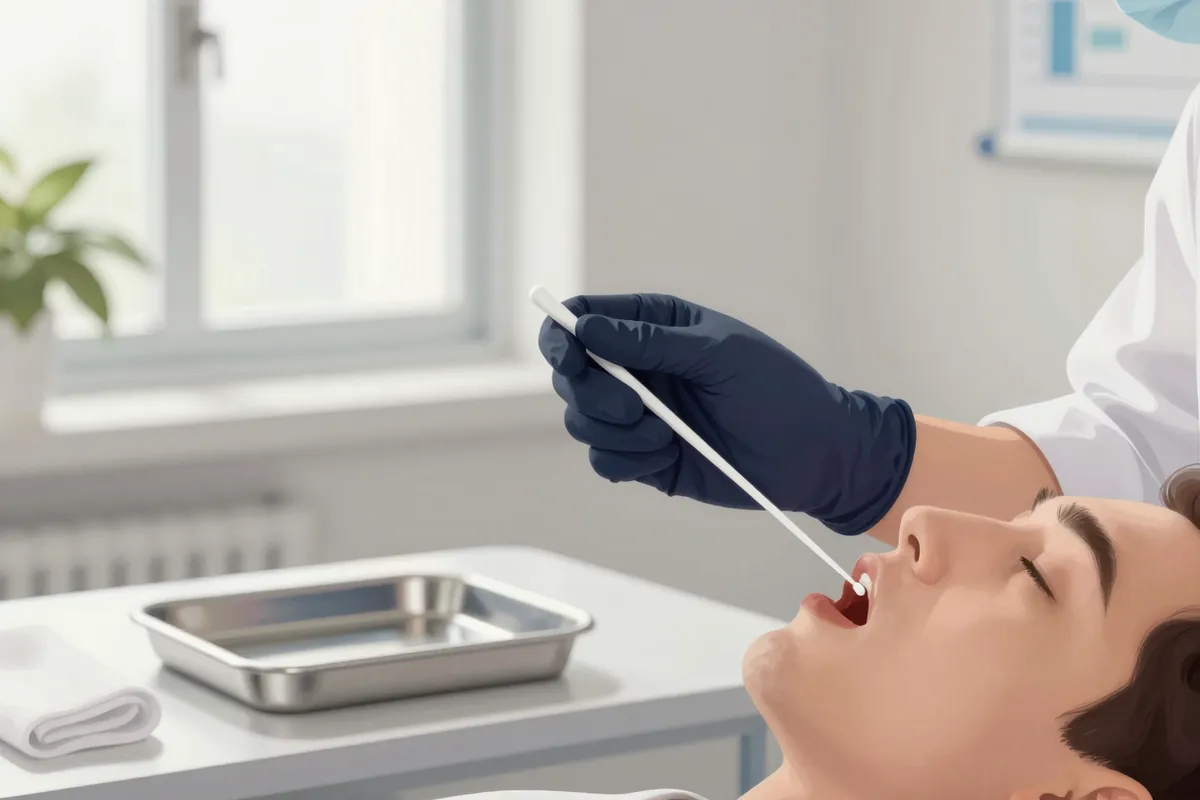
Diagnosis rests on two laboratory tests and one clinical judgment call: whether to test at all. A rapid antigen detection test gives an answer in minutes, and a throat culture remains the reference standard (Streptococcal Pharyngitis - StatPearls - NCBI Bookshelf).
The Rapid Antigen Test
A swab is rubbed over the tonsils and posterior pharynx. The result is available during the visit, which allows treatment to start the same day (Streptococcal Pharyngitis - StatPearls - NCBI Bookshelf). Rapid tests are specific, so a positive result is usually trusted. Sensitivity is lower in some settings, which is why a negative result in a child is handled differently.
The Throat Culture
Culture takes longer, usually overnight, but it detects organisms the rapid test can miss (Streptococcal Pharyngitis - StatPearls - NCBI Bookshelf). In children, a negative rapid test is confirmed with a culture before strep is ruled out. Some guidelines skip the backup culture in adults, where the risk of later rheumatic fever is lower; in children the backup culture is standard practice.
Centor and McIsaac Scores
These scores estimate the probability of strep before any swab is taken.
| Centor criterion | Points |
|---|---|
| Fever by history | 1 |
| Tonsillar exudate | 1 |
| Tender anterior cervical nodes | 1 |
| Absence of cough | 1 |
Scores of 0 to 1 make strep unlikely, while scores of 3 to 4 make it likely enough that testing is worthwhile (Streptococcal Pharyngitis - StatPearls - NCBI Bookshelf). The McIsaac modification adds an age adjustment, raising the score in younger children and lowering it in older adults.
Worked example. A 7-year-old has a temperature of 38.3 C, white tonsillar exudate, tender nodes under the jaw, and no cough. That is 4 Centor points. McIsaac adds a point for age 3 to 14, giving 5. A rapid test is performed in the office. If it is negative, a throat culture follows to confirm or exclude the diagnosis (Streptococcal Pharyngitis - StatPearls - NCBI Bookshelf).
When Testing Adds Little
Testing is unnecessary when the features clearly suggest a virus, such as cough, runny nose, and hoarseness without high fever (About Strep Throat; Streptococcal Pharyngitis - StatPearls - NCBI Bookshelf). Swabbing in that setting mostly finds carriers, people who harbor the bacteria without being ill from it.
Tests That Do Not Help Acutely
Streptococcal antibody titers are not used to diagnose acute pharyngitis (Streptococcal Pharyngitis - StatPearls - NCBI Bookshelf). They are used to look back at a past infection, for example when evaluating suspected acute rheumatic fever. Ordering titers during a sore throat adds cost and delay without answering the question.
Treatment: Antibiotics and Supportive Care
Treatment has two tracks: antibiotics to clear the bacteria, and supportive measures to make the patient comfortable while the infection resolves.

First-Line Antibiotics
Penicillin V or amoxicillin is first-line therapy (Streptococcal Pharyngitis - StatPearls - NCBI Bookshelf). A ten-day oral penicillin course is the standard regimen. Ten days feels long when the throat stops hurting on day two, but the duration is chosen to eradicate the organism fully. A single intramuscular penicillin dose is an option when completing an oral course is unlikely.
| Antibiotic | Class | Typical role |
|---|---|---|
| Penicillin V | Penicillin | First-line, ten-day oral course (Streptococcal Pharyngitis - StatPearls - NCBI Bookshelf) |
| Amoxicillin | Aminopenicillin | First-line, often used in children |
| Benzathine penicillin | Penicillin | Single intramuscular dose when adherence is a concern |
Penicillin Allergy
Cephalexin, azithromycin, or clindamycin can be used when penicillin allergy is documented (Streptococcal Pharyngitis - StatPearls - NCBI Bookshelf). The choice depends on the type of reaction and local resistance patterns. Macrolide resistance among group A strep varies by region, so local guidance matters.
What Antibiotics Achieve
Antibiotics shorten the illness, reduce transmission to others, and lower the risk of complications (About Strep Throat). They do not help a viral sore throat, which is why the test comes before the prescription.
Supportive Care at Home
- Analgesics such as acetaminophen or ibuprofen for throat pain and fever, dosed according to the label or a pharmacist's advice (Strep throat; Strep A)
- Fluids, offered often in small amounts (Strep throat)
- Rest
- Soft foods that are easy to swallow
Children with strep A infections, and anyone prescribed antibiotics for one, should stay away from nursery, school, or work for 24 hours after starting treatment to reduce spread (Strep A). Most strep A infections improve on their own within about a week, and antibiotic treatment shortens that course.
Finishing the Course
Complete the full course to prevent rheumatic fever, even after symptoms settle (About Strep Throat). Stopping early leaves bacteria behind and removes the protection the course was meant to provide. Return for review if fever persists beyond a few days of treatment, if swallowing becomes impossible, or if one side of the throat swells and the voice changes, since these can point to a complication such as an abscess (Streptococcal Pharyngitis - StatPearls - NCBI Bookshelf).
Complications of Untreated Strep Throat
Most cases of strep throat improve after antibiotic treatment, but infection that is untreated or treated late can produce complications. These problems fall into two groups: infections that spread beyond the tonsils and immune reactions that appear after the throat infection has started to settle. Prompt antibiotics reduce the chance of several of these outcomes (Streptococcal Pharyngitis - StatPearls - NCBI Bookshelf).
Infections That Spread Locally
A peritonsillar abscess is a collection of pus beside one tonsil. It causes severe one-sided throat pain, swelling, a muffled or "hot potato" voice, difficulty opening the mouth, and sometimes deviation of the uvula. This complication needs urgent medical assessment, drainage, and antibiotics (Streptococcal Pharyngitis - StatPearls - NCBI Bookshelf).
Scarlet fever occurs when the strep bacteria produce a particular toxin. It brings a widespread rash, flushed cheeks, and a strawberry tongue, along with fever and sore throat. The same bacterium causes strep throat and scarlet fever, and antibiotic treatment is needed (Strep A).
Invasive group A strep is uncommon but serious. The bacteria enter normally sterile areas of the body and can cause necrotizing fasciitis, a rapidly progressive infection of deep tissue. Severe pain, fever, and spreading redness or swelling are warning signs that require emergency care (Strep A).
Immune Reactions After Infection
Acute rheumatic fever can follow untreated strep throat by weeks. It is an inflammatory reaction that can affect the heart valves, joints, skin, and brain. Preventing rheumatic fever depends on recognizing and treating strep pharyngitis promptly (About Strep Throat).
Post-streptococcal glomerulonephritis is kidney inflammation that appears after a strep infection. It can cause blood in the urine, swelling, and high blood pressure. The condition needs medical evaluation and monitoring (Streptococcal Pharyngitis - StatPearls - NCBI Bookshelf).
Complication Summary
| Complication | When it appears | Key signs | What to do |
|---|---|---|---|
| Peritonsillar abscess | During or shortly after strep throat | One-sided swelling, muffled voice, trouble opening mouth | Urgent evaluation and drainage (Streptococcal Pharyngitis - StatPearls - NCBI Bookshelf) |
| Scarlet fever | During strep infection | Rash, flushed cheeks, strawberry tongue | Antibiotics and clinician review (Strep A) |
| Invasive group A strep | During infection, can progress quickly | Severe pain, fever, spreading redness | Emergency care |
| Rheumatic fever | Weeks after untreated infection | Joint pain, fever, heart murmur, rash | Prompt medical assessment (About Strep Throat) |
| Post-streptococcal glomerulonephritis | Weeks after infection | Blood in urine, swelling, high blood pressure | Medical evaluation |
Why Early Treatment Matters
Early antibiotics shorten illness, lower contagiousness, and sharply reduce suppurative complications (Streptococcal Pharyngitis - StatPearls - NCBI Bookshelf). A person with a confirmed strep infection should complete the prescribed course and seek care if symptoms worsen or new symptoms appear. A sore throat with trouble breathing, trouble swallowing saliva, severe one-sided pain, or a rapidly spreading skin infection needs urgent care (Streptococcal Pharyngitis - StatPearls - NCBI Bookshelf; Strep A).
Common Misconceptions About Strep Throat
Strep throat is common, but several beliefs about it lead to unnecessary antibiotics or missed infections. The points below separate what the evidence supports from what symptoms alone cannot show.
Misconception: All Sore Throats Are Strep
Viruses cause most sore throats (About Strep Throat). A sore throat with cough, runny nose, hoarseness, or mouth sores is more likely viral, although no symptom pattern proves the cause. Testing is needed when strep is suspected (Strep Throat: Symptoms, Causes & Treatment).
Misconception: White Patches Always Mean Strep
White spots or streaks on the tonsils are common in strep, but other infections can cause similar changes. How the throat looks cannot confirm strep (Streptococcal Pharyngitis - StatPearls - NCBI Bookshelf). A throat exam supports the assessment, but testing decides treatment.
Misconception: A Negative Rapid Test Rules Out Strep
A rapid antigen test can miss group A strep. When suspicion remains, a throat culture may be needed (Streptococcal Pharyngitis - StatPearls - NCBI Bookshelf). A negative rapid result does not by itself exclude the infection, especially in a child with classic symptoms or a known contact.
Misconception: Antibiotics Can Stop Once Symptoms Fade
Symptoms improve before the bacteria are fully cleared. Stopping antibiotics early can allow remaining bacteria to regrow and increases the risk of spreading infection or complications (About Strep Throat). People should finish the prescribed course unless a clinician gives different instructions.
Misconception: Strep Throat Always Produces a Rash
Many people with strep throat have fever, sore throat, and swollen lymph nodes without a rash. A widespread rash with flushed cheeks and a strawberry tongue suggests scarlet fever, which is caused by the same bacterium (Strep A). A rash is a useful clue, but its absence does not rule out strep.
Misconception: Home Remedies Can Replace Antibiotics
Warm salt water gargles, fluids, rest, and soft foods can ease discomfort (Strep throat). They do not clear the bacteria or lower the risk of complications. Antibiotics are used for confirmed strep throat, while home care supports recovery.
A Practical Summary
| Belief | More accurate view |
|---|---|
| Every sore throat is strep | Most sore throats are viral (About Strep Throat) |
| White tonsillar patches prove strep | Other infections can look similar (Streptococcal Pharyngitis - StatPearls - NCBI Bookshelf) |
| A negative rapid test is final | A throat culture may be needed |
| Antibiotics can stop when symptoms ease | Finish the prescribed course |
| Strep always causes a rash | Rash suggests scarlet fever but is often absent (Strep A) |
| Home remedies are enough | They ease symptoms but do not replace antibiotics for confirmed strep (Strep throat) |
The practical rule is simple: symptoms and throat appearance can raise or lower suspicion, but testing guides antibiotic use. Treatment decisions should follow a clinician's assessment, not a single sign or a home remedy.
Prevention and Home Care
Strep throat spreads through respiratory droplets and close contact (Strep A). Prevention centers on hand hygiene, respiratory etiquette, and keeping shared items separate during illness. Home care does not replace antibiotics for confirmed infection, but it makes the recovery period more comfortable.
Reduce Transmission at Home
- Wash hands with soap and water for 20 seconds, especially after coughing, sneezing, or caring for someone who is ill (About Strep Throat).
- Cover coughs and sneezes with a tissue or the inside of the elbow.
- Avoid sharing cups, utensils, water bottles, and towels.
- Keep the sick person home until they have been fever-free for 24 hours on antibiotics.
- Replace the toothbrush after starting antibiotics to avoid reintroducing bacteria (Strep Throat: Symptoms, Causes & Treatment).
- Clean frequently touched surfaces, such as counters and door handles, during the illness.
Home Care for a Sore Throat
- Drink fluids to stay hydrated (Strep throat).
- Gargle with warm salt water for temporary relief. Avoid salt water gargles for a young child who cannot gargle safely.
- Use humidified air to soothe a dry, irritated throat.
- Choose soft foods if swallowing is painful.
- Rest the voice and avoid smoke or other throat irritants.
Home remedies ease symptoms but do not treat the bacterial infection. A person with confirmed strep needs antibiotics to shorten illness and reduce complications (Streptococcal Pharyngitis - StatPearls - NCBI Bookshelf; Strep throat). Antibiotics do not help viral sore throats, so testing before treatment limits unnecessary use (Strep Throat: Symptoms, Causes & Treatment).
When to Seek Care
Seek medical care for sore throat with fever, swollen lymph nodes, or tonsillar exudate, especially in a child aged 5 to 15 (Strep Throat: Symptoms, Causes & Treatment). Urgent signs include trouble breathing, trouble swallowing saliva, drooling, severe one-sided throat pain, a muffled voice, or rapidly spreading redness (Streptococcal Pharyngitis - StatPearls - NCBI Bookshelf; Strep A). A rash with fever and sore throat needs assessment for scarlet fever (Strep A).
Prevention Summary
| Measure | Purpose |
|---|---|
| Handwashing for 20 seconds (About Strep Throat) | Removes bacteria from hands |
| Cover coughs and do not share utensils | Limits droplet and contact spread |
| Stay home until fever-free for 24 hours on antibiotics | Reduces transmission |
| Replace the toothbrush after starting antibiotics (Strep Throat: Symptoms, Causes & Treatment) | Avoids re-exposure from contaminated bristles |
| Warm salt water, fluids, humidified air (Strep throat) | Eases throat discomfort |
| Finish antibiotics as prescribed | Clears bacteria and lowers complication risk |
Related Guides
- Strangles in Horses: Streptococcus equi Isolation and Treatment: Another streptococcal infection with isolation and treatment guidance
- Streptococcosis in Farmed Tilapia: Streptococcus agalactiae and Streptococcus iniae Pathogenesis, Rapid Diagnostic Tests, and Vaccine Development: Streptococcal disease in farmed fish with diagnostics and vaccines
- Trueperella pyogenes: Taxonomy, Virulence, Pathogenesis, Antimicrobial Resistance, and Molecular Epidemiology: Pyogenes-related veterinary pathogen with virulence and resistance details
- Streptococcus iniae Infections in Tilapia: Clinical Presentation and Antibiotic Sensitivity: Streptococcal fish infection with antibiotic sensitivity information
- Streptococcus zooepidemicus Bacterial Infection in Poultry: Etiology, Pathogenesis, and Diagnostic Approaches: Streptococcal poultry infection with pathogenesis and diagnostic approaches
- Swine Streptococcus suis Infection: Diagnosis and Management: Streptococcal swine infection diagnosis and management overview
Frequently Asked Questions
What bacteria causes strep throat?
Strep throat is caused by Streptococcus pyogenes, also called group A Streptococcus or group A strep (Streptococcal Pharyngitis - StatPearls - NCBI Bookshelf). These bacteria infect the throat and tonsils and cause a sudden painful sore throat, fever, and swollen lymph nodes in the neck (Strep Throat: Symptoms, Causes & Treatment). Group A strep bacteria are contagious (About Strep Throat). Not every sore throat is strep throat, however. Viruses cause most sore throats, and symptoms alone cannot confirm the diagnosis. A rapid strep test or throat culture can confirm group A strep infection.
How long is strep throat contagious?
Group A strep bacteria spread through close contact with an infected person, including coughs and sneezes (Strep A). People without symptoms can carry the bacteria and still pass it to others. After a person with strep starts antibiotics, guidance is to stay away from childcare, school, or work for 24 hours to help stop spread. Antibiotics also make a person less contagious (Strep Throat: Symptoms, Causes & Treatment). Without antibiotics, the infection may improve on its own after about a week, but a person can still pass bacteria through close contact.
Can strep throat go away without antibiotics?
Most strep A infections get better on their own after about a week (Strep A). However, antibiotics can help a person with confirmed strep throat feel better sooner, make them less contagious, and reduce the risk of complications (Strep Throat: Symptoms, Causes & Treatment). A healthcare provider uses a rapid strep test or throat culture to confirm group A strep before treatment. People with severe symptoms, worsening illness, or risk factors for complications should seek medical advice. Do not use leftover antibiotics or start treatment without a diagnosis.
What
References and Further Reading
- Streptococcal Pharyngitis - StatPearls - NCBI Bookshelf, ncbi.nlm.nih.gov
- Strep Throat: Symptoms, Causes & Treatment, my.clevelandclinic.org
- Strep throat, mayoclinic.org
- Streptococcal Infections, medlineplus.gov
- About Strep Throat, cdc.gov
- Strep A, nhs.uk
- Strep Throat, hopkinsmedicine.org