Streaming Genomic Data Analysis: A Primer on Cloud Architectures
By Dr. Zubair Khalid, DVM, MS, PhD ·

Streaming genomic data analysis in the cloud is the practice of computing on sequencing reads while those reads are still in motion, whether they are moving from an instrument or public archive into cloud storage or flowing through a distributed engine as continuous chunks. The goal is to overlap data transfer with computation so that quality control, alignment, profiling, or variant calling starts before the complete dataset has arrived.
That definition matters because of arithmetic. A single whole-genome sequencing experiment produces tens to hundreds of gigabytes, and a large study moves terabytes. A pipeline that copies everything first and analyzes second pays for data movement twice, once in wall-clock delay and again in storage and transfer charges. Cloud bioinformatics promised the opposite bargain, scalable resources on demand with pay-as-you-go pricing, and streaming is one of the main techniques that closes the gap between that promise and daily practice [1]. This primer explains the concept, the four architectural patterns behind it, five published systems spanning Amazon Web Services, Google Cloud, and Microsoft Azure, and the mistakes teams make when adopting it.
What Is Streaming Genomic Data Analysis in the Cloud?
Start with the data itself. A sequencer reads fragments of DNA and reports each fragment as a read, a short string of bases (the A, C, G, and T characters of the genetic code) with a per-base quality score. Reads arrive in FASTQ, a four-line text format in which each read takes two lines and its quality scores take the other two. Millions of reads per sample are normal, which is why compressed FASTQ files for one individual routinely reach several gigabytes.
Streaming genomic data analysis treats those reads as a flow to be processed as they arrive, not a pile to be processed after arrival. The phrase covers two related ideas, and students often conflate them.
Network streaming processes data during transfer. A sequencer, a campus server, or a public archive pushes chunks of FASTQ toward the cloud, and cloud workers align, filter, or summarize each chunk while the remaining chunks are still on the wire [1].
Engine-level streaming processes data as a continuous sequence of chunks inside a compute framework. Apache Spark, the engine behind several landmark cloud genomics systems, implements this idea with micro-batches, small discrete partitions of records processed on a fixed schedule. The framework treats a stream as a series of tiny batches, which preserves fault tolerance while delivering near-continuous throughput [2].
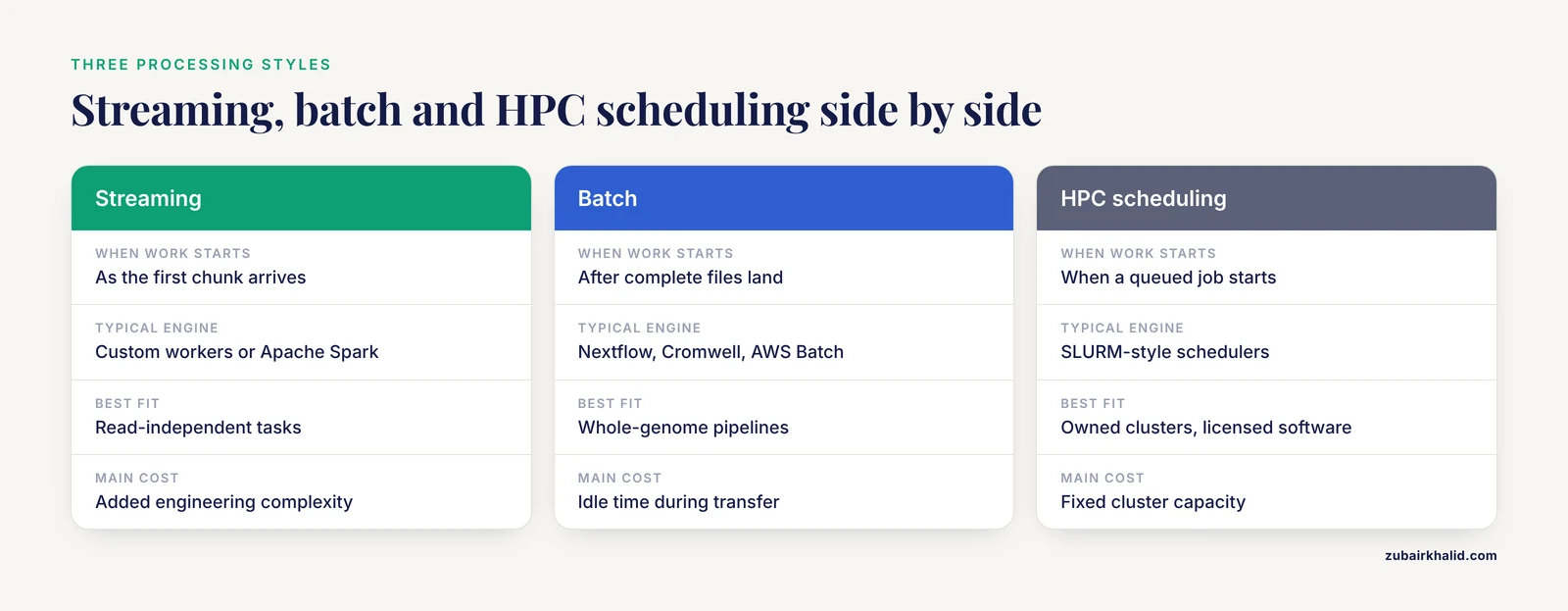
Batch processing, the traditional alternative, waits for complete files, stages them in durable storage, and then runs each analysis stage to completion across the whole dataset. Batch is simpler and remains the right choice for many workflows. Streaming trades some of that simplicity for a shorter wait before the first result, better overlap of transfer and compute, and in some designs a smaller memory footprint [3].
Two terms recur throughout this article. Latency is the delay between a request and its result. Throughput is the amount of data processed per unit of time. Streaming improves each in a specific way: it cuts the latency to a first result and can raise sustained throughput by keeping every worker busy while transfers run.
| Term | What it means | Typical engine | Where it wins |
|---|---|---|---|
| Streaming (network) | Processing data during transfer into the cloud | Custom workers, elastream-style wrappers | First-mile uploads, read-independent tasks |
| Micro-batch streaming | Continuous input consumed as small scheduled batches | Apache Spark | Cluster-scale pipelines with fault tolerance |
| Batch | Complete files staged, then processed stage by stage | Workflow engines such as Nextflow or Cromwell, AWS Batch | Whole-genome pipelines, correctness-critical stages |
| HPC scheduling | Jobs queued on a fixed cluster through a scheduler | SLURM-style schedulers | Owned clusters, licensed software |
| Serverless | Event-triggered functions with no server management | AWS Lambda-style functions | Small per-file tasks, glue logic |
A compact way to remember the difference: batch asks what the answer is once the file is complete, streaming asks what can already be known from the reads that have arrived.
Why Streaming Matters: The Transfer Bottleneck
Cloud computing offered genomics a way out of the capital-cost trap. Under the resources-on-demand and pay-as-you-go model, a laboratory with no cluster of its own can rent thousands of cores for a few hours and release them afterward [1]. The model works well for computation. It works poorly for the first mile, moving data from the client's site into the cloud.
The work that named this problem put it plainly: the large size of NGS (next-generation sequencing) data causes significant transfer latency from the client's site to the cloud, and that latency becomes a bottleneck for adopting cloud services [1]. The arithmetic is unforgiving. Moving a 100 GB FASTQ file over a 1 Gbps (gigabit per second) link requires at least about 13 minutes under ideal conditions, and real links rarely sustain their rated speed. Over a 100 Mbps connection, the same file needs hours. During all of that time, a batch pipeline sits idle.
The streaming answer is to process NGS data while it is being transferred to the cloud. Workers begin analysis on the first chunks as soon as they arrive, so transfer and computation overlap instead of running in sequence [1]. The scheme targets the wide class of analyses in which individual reads can be processed independently of one another, which covers read-level quality control, adapter trimming, alignment of single reads, and k-mer counting (k-mers are the short substrings of length k used for fast similarity and abundance estimates). Tasks that need the whole file at once, such as genome assembly or joint genotyping across samples, do not fit this pattern and remain batch jobs.
The same reasoning extends past the first mile. Public archives, sequencing cores, and instruments all feed cloud pipelines, and every hop where data waits is a hop that streaming can compress.
Core Architectural Patterns
Four patterns cover most streaming designs in cloud genomics, and production systems combine them freely.
Pattern 1: Stream While You Transfer
The producer, whether an instrument, a sequencing core, or a client workstation, splits its output into chunks and pushes them to cloud storage. A pool of workers polls for arriving chunks and starts work immediately. The pipeline's effective start time moves from "when the last byte lands" to "when the first byte lands." The elastream package published in 2013 embodies this pattern and supports both individual analysis programs and workflow systems [1].
Three design rules keep the pattern sound. Chunks must be self-contained, meaning a whole number of FASTQ records. Workers must be idempotent, meaning safe to rerun on the same chunk after a failure. The result sink must accept out-of-order completion, because chunks finish at unpredictable times.
Pattern 2: In-Memory Distributed Streaming with Apache Spark
Apache Spark is a distributed compute engine that runs across a cluster managed by one driver process and many executor processes. Spark represents a computation as a DAG (directed acyclic graph, a dependency graph of transformation steps) and evaluates it lazily, which lets the scheduler fuse steps and minimize data movement. Its in-memory caching keeps intermediate data in RAM rather than writing every intermediate to disk, a property that memory-constrained genomics frameworks exploit and must also manage deliberately [3]. Genomics pipelines pass over reads repeatedly, for filtering, trimming, alignment, and counting, so keeping intermediates in RAM avoids rereading disk between stages.
Spark's streaming layer wraps continuous input as micro-batches. A genomic pipeline built this way reads FASTQ or BAM partitions as RDDs (resilient distributed datasets, Spark's fault-tolerant record collections), applies per-read transformations in parallel, and pays the expensive shuffle cost (the all-to-all exchange of data between executors) only at stages that genuinely need it, such as sorting reads by genomic coordinate [2], [3].
Pattern 3: Stream Straight from Public Archives
Public repositories and open data buckets remove the first mile entirely. When data already lives in the same cloud region as the compute, transfer latency collapses to local network speeds. LSTrAP-Cloud demonstrates the pattern at its most accessible, running inside Google Colaboratory (a free, browser-based notebook environment) and streaming RNA-seq (RNA sequencing, which measures transcript abundance) data directly from the European Nucleotide Archive for quality control and downstream coexpression analysis [4].
Pattern 4: Confidential Streaming in Enclaves
Human genomics raises privacy stakes that ordinary cloud security does not answer. Trusted execution environments (TEEs, hardware-isolated memory regions often called enclaves) run computation on data that stays encrypted from the cloud operator's perspective. Intel SGX is the leading hardware implementation, and Microsoft Azure exposes it as a managed confidential computing platform. The catch is that enclave memory is small and TEE overheads are heavy, which is precisely where streaming and batching help. SECRET-GWAS shows that feeding data through enclaves in controlled batches, combined with data parallelization, lets population-scale regression analyses run inside this hardened boundary [5].
Streaming Genomic Data Analysis in the Cloud: Five Reference Systems
Five systems, published between 2013 and 2025, map the design space better than any single example. The table summarizes each one, and the subsections give the details.
| System | Platform | Engine | Workload | Core idea |
|---|---|---|---|---|
| Ela-stream (2013) | Generic cloud infrastructure | Streaming wrapper over existing tools | Read-independent NGS tasks | Analyze during upload |
| Flint (2019) | Amazon EMR | Apache Spark | Metagenomic profiling | Stream reads against a very large reference |
| SparkGA2 (2019) | Cloud cluster | Apache Spark | Germline variant pipeline | Stream input with on-the-fly compression |
| LSTrAP-Cloud (2020) | Google Colaboratory | Notebook pipeline | RNA-seq coexpression networks | Stream from a public archive in a browser |
| SECRET-GWAS (2025) | Azure Confidential Computing | Hail-compatible, SGX enclaves | Collaborative GWAS regression | Stream and batch inside trusted hardware |
Ela-stream: Analyze During Upload
Issa and colleagues framed the transfer bottleneck and answered it with a streaming scheme for the wide class of tasks in which sequences can be processed independently. Their elastream package supports the scheme with individual analysis programs or with workflow systems, so laboratories can adopt streaming without rewriting their tools. Experiments showed the approach mitigates the effect of data transfer latency and saves both time and cost of computation [1]. The design remains the reference point for stream-while-transfer architectures.
Flint: Metagenomic Profiling on Amazon EMR
Metagenomic profiling estimates which microbes are present in a mixed sample and at what abundance, usually by aligning sequencing reads against a collection of reference genomes. Existing profiling tools were designed for small, curated reference collections and scale poorly to large ones, yet larger collections give more complete and accurate profiles. Flint, built on Apache Spark and running on Amazon EMR (Amazon's managed Hadoop and Spark service), streams reads against a 170 GB reference collection of 43,552 bacterial genomes from Ensembl. In benchmarking, Flint profiled 1 million Illumina paired-end reads (reads sequenced from both ends of each DNA fragment) against the full collection on 64 machines in 67 seconds, an order of magnitude faster than the state of the art while using a much larger reference [2]. For anyone evaluating aws genomics in practice, Flint is the canonical demonstration that Spark streaming on managed EMR infrastructure can turn an intractable alignment problem into a sub-minute query.
SparkGA2: Streaming with Memory Discipline
The standard DNA analysis pipeline, from raw reads to called variants, is memory hungry, and Spark's habit of caching intermediates in RAM can exhaust a cluster. SparkGA2 addresses this with two complementary techniques. It compresses intermediate data on the fly, cutting memory requirements by up to 3x, and it streams input data gradually so processing proceeds while loading continues [3]. The framework ran up to 22% faster than the state of the art on a 67-node big data cluster and up to 9% faster on a smaller 6-node cluster, and the streaming design lets users adapt it to clusters with lower memory at a modest performance cost [3]. The lesson generalizes: streaming and memory engineering are joint design problems, not separate ones.
LSTrAP-Cloud: Archive-to-Notebook Streaming
LSTrAP-Cloud targets biologists rather than infrastructure engineers. It runs on Google Colaboratory, streams public RNA-seq data from the European Nucleotide Archive, performs quality control, and builds a gene coexpression network (a graph linking genes whose expression patterns correlate across samples) that shortlists candidate genes for a biological process. A case study on nicotine biosynthesis in tobacco (Nicotiana tabacum) used a single bait gene to surface enzymes, transporters, and transcription factors involved in making, moving, and regulating the compound [4]. The system shows that streaming from archives, combined with free notebook compute, puts cloud-scale analysis within reach of a laptop and a browser.
SECRET-GWAS: Confidential Streaming for Collaborative GWAS
A GWAS (genome-wide association study) regresses genetic variants against a trait across many individuals, and no single institution holds enough diverse samples, especially for rare variants and diseases. Confidential computing enables collaborative GWAS without exposing raw genomes, but earlier solutions failed to support widely used regression methods because secure memory is limited and TEE overheads are high. SECRET-GWAS combines streaming, batching, data parallelization, and reduced trusted-hardware overheads to scale linear and logistic regression to over a thousand processor cores on an Intel SGX-based cloud platform. On Azure's Confidential Computing platform, it completed multivariate linear and logistic regression GWAS queries on population-scale datasets from ten independent sources in 4.5 and 29 minutes, respectively, while protecting against several hardware side-channel attacks. The tool is open source and works with Hail, the widely used Spark-based genomics framework [5].
Beyond benchmarks, the translational point deserves a sentence. The same architectural moves that shave minutes off a profiling query also compress the path from sequencer to clinical or epidemiological insight, whether the output is a variant call feeding a diagnostic pipeline, a microbial profile feeding surveillance, or a population-scale association result feeding drug discovery.
Anatomy of a Streaming Pipeline, Step by Step
The steps below describe a production-shaped pipeline. The commands are standard and runnable, with placeholders in the obvious places.
1. Chunk at the source. A FASTQ record is four lines, so chunk on a fixed record count or on compression block boundaries. Record-aligned chunks keep every worker's input valid. Chunking a compressed file by raw bytes alone risks splitting records mid-read.
2. Land chunks in object storage. Amazon S3 (Simple Storage Service, AWS's object store) is the usual landing zone because it is durable, inexpensive, and readable directly by compute engines.
aws s3 cp sample_R1.fastq.gz s3://my-lab-ingest/run_2024/3. Partition the work. Choose a partition key that balances load. For read-level tasks, split by chunk index. For alignment files, split by reference region. BAM (the standard binary, sorted, indexed alignment format) supports this directly through its index:
for r in chr1 chr2 chr3 chr4 chr5
do
  samtools view -b in.bam "$r" > "part_${r}.bam" &
done
wait
Each command requires the BAM index file alongside the BAM. The ampersand runs the splits concurrently, and wait holds the shell until all of them finish.
4. Process chunks as they arrive. A modest pipeline needs nothing more than a stream from object storage into standard tools:
aws s3 cp s3://my-lab-ingest/sample_R1.fastq.gz - | gzip -dc | awk 'NR%4==2{n++} END{print n}'The trailing hyphen tells the AWS CLI to write to standard output, gzip decompresses the stream, and the awk one-liner counts reads, because the sequence line is the second line of every four-line record. Swap the awk stage for a quality filter or an aligner and the pattern is unchanged.
5. Orchestrate at cluster scale with Spark. For workloads that outgrow one machine, submit the job to a managed cluster:
spark-submit profile_reads.py s3://my-lab-ingest/run_2024/ s3://my-lab-out/profiles/On a cluster, this submission runs the script across many executors. The tuning knobs that matter are the number of executors, cores per executor, and memory per executor, all set through the submission options. Memory sizing deserves respect: caching intermediates in RAM speeds processing until it exhausts the nodes, which is why production frameworks compress intermediates on the fly or spill to disk [3].
6. Respect the shuffle boundary. Sorting, duplicate marking, and pairing reads by position require all-to-all exchanges or global order. Streaming designs either confine shuffles within chunks, run partitioned parallel sorts with a final merge, or accept one batch stage at the end of an otherwise streaming pipeline. Pretending these stages stream cleanly is a classic source of wrong results.
7. Write sinks and checkpoints. Outputs land as BAM or CRAM (its more compact cousin), as VCF (variant call format, the standard file for called variants), or as columnar tables. Long-running streams checkpoint progress to durable storage, for example a dedicated S3 prefix, so a failed executor resumes from the last checkpoint instead of recomputing the stream.
8. Monitor the flow. Track records in flight, chunk lag, executor memory, and time-to-first-result. Alert when lag grows, because growing lag signals backpressure, a queue filling faster than workers drain it. Unattended lag is how streaming pipelines quietly turn into batch pipelines with extra steps.
How Streaming Pipelines Are Tested in Practice
Six measurements dominate. Time-to-first-result, the elapsed time from data availability to the first usable output, is the metric streaming most directly improves. End-to-end latency measures completion. Throughput, usually in reads or gigabytes per second, measures sustained rate. Speedup compares the streaming system against a staged batch baseline on identical inputs. Memory footprint per node determines what hardware the pipeline needs. Cost per sample, where reported, ties the engineering to the budget.
Two scaling tests reveal behavior under load. Strong scaling holds the dataset fixed and adds nodes, exposing the point where coordination overhead eats the gains. Weak scaling grows the dataset with the node count, exposing throughput ceilings. Published systems report both styles. SparkGA2, for example, was benchmarked on both a small departmental cluster and a large big data cluster, and its streaming design improved performance in both regimes [3].
Ablation isolates the contribution of streaming itself. Run the pipeline with streaming on and off while holding data, software versions, and hardware fixed, and the difference is the streaming effect. Memory profiling during the run shows whether caching or compression is doing the work.
Correctness testing matters as much as speed. Streaming outputs must match batch outputs, either byte-for-byte or after canonical sorting, and variant outputs should be compared by genotype concordance. Reproducibility requires pinning reference versions, tool versions, and machine types, then reporting exact node counts and input sizes. The Flint benchmark is a model of the genre: a fixed read set, a fixed reference collection, a fixed machine count, and a single wall-clock figure [2].
Choosing Between Streaming, Batch, and Managed Services
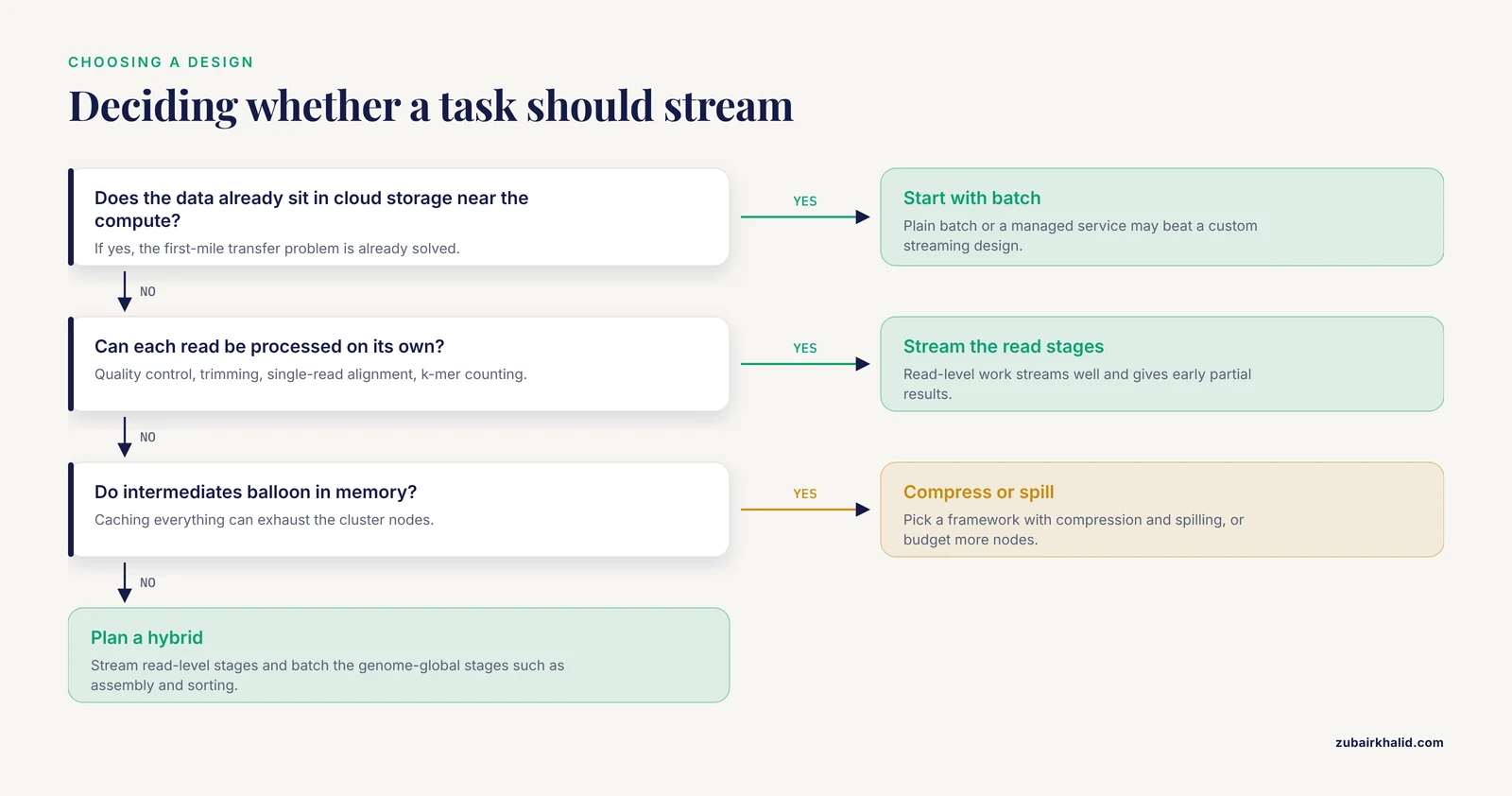
Six questions sort most decisions.
- Where does the data live? If it already sits in cloud storage near the compute, plain batch or a managed service may beat a custom streaming design, because the first-mile problem is already solved.
- Are the tasks read-independent? Read-level work streams well. Genome-global work such as assembly, sorting, and joint genotyping does not, so plan a hybrid.
- What is the memory profile? If intermediates balloon, pick a framework with compression and spilling, or budget more nodes.
- How sensitive is the data? Multi-institution human data points toward confidential computing patterns.
- What does the team know? Spark expertise justifies Spark designs. Teams invested in workflow engines such as Nextflow, Snakemake, or Cromwell can often get the overlap they need by parallelizing stages instead.
- What do managed services already provide? AWS for genomics includes Amazon EMR for Spark clusters, AWS Batch for queue-driven jobs, and Amazon Omics, a managed service for storing and processing omics data. Reaching for managed capacity before building custom streaming is usually the cheaper first move.
The rule of thumb: start with batch, measure, and add streaming where a measured bottleneck, whether transfer wait, idle time, or memory pressure, justifies the added complexity.
Security and Privacy in Streaming Genomics
Human genomic data is identifiable, and streaming does not change that. It changes the exposure surface, because data in motion crosses more boundaries than data at rest. The baseline controls are standard: encryption in transit with TLS, encryption at rest, least-privilege access on buckets, region pinning so data stays in an approved jurisdiction, and audit logging on every read and write.
Collaborative analysis across institutions needs stronger guarantees, and this is where trusted execution environments earn their complexity. An enclave is a hardware-isolated memory region. Attestation is the cryptographic proof that genuine, expected code is running inside one. Side-channel attacks infer secrets from timing, cache, or power behavior rather than reading memory directly, and any enclave design must account for them. SECRET-GWAS demonstrates the full pattern, streaming data through SGX enclaves in controlled batches so that population-scale collaborative regression runs without any party seeing raw genomes, with explicit protections against several hardware side-channel attacks [5]. The design constraint to remember is enclave memory: streaming exists in that architecture precisely because enclaves cannot hold population-scale datasets all at once.
Common Mistakes and Limitations
Practical Mistakes
- Streaming tasks that need global context. Sorting, duplicate marking, genome assembly, and joint genotyping require whole-dataset views. Forcing them into per-chunk processing produces wrong or unmergeable outputs.
- Confusing micro-batch latency with real time. A fixed batch interval still adds queueing, and one slow downstream stage turns the stream into a backlog.
- Ignoring partition skew and stragglers. A straggler is a slow worker that holds up an entire stage. One oversized chunk or one hot genomic region creates stragglers reliably.
- Caching everything. In-memory caching speeds processing until it exhausts the cluster. Size executor memory deliberately, compress intermediates, or spill to disk.
- Skipping checkpoints. Long streams without durable checkpoints recompute from scratch after every failure.
- Benchmarking on toy data. A ten-thousand-read demo proves the code runs, not that the architecture scales. Test at production scale before committing.
- Forgetting the first mile. Streaming inside the cloud does not help if uploads from the laboratory still dominate the schedule.
Misconceptions
- "Streaming means real time." In genomics it usually means overlap and pipelining, not sub-second latency.
- "Streaming replaces batch." Most production designs are hybrids, streaming the read-level stages and batching the genome-global stages.
- "Spark streaming is a separate product." It is the same engine consuming chunked input on a schedule.
- "Streaming saves money automatically." It removes the idle time between transfer and compute, which was one of the original demonstrated benefits [1], but oversized clusters and forgotten running jobs erase the savings quickly.
Honest Limitations
Streaming adds engineering complexity that small laboratories may never recoup on modest workloads. Published speedups are workload-specific, and a result on metagenomic profiling or germline variant calling does not transfer automatically to transcriptomics or assembly. Confidential computing remains heavier than plain compute, and enclave memory limits constrain what fits. Pipeline outputs that inform clinical interpretation require validation in an appropriately certified setting before they touch patient care, regardless of how fast the pipeline runs.
Quick Review
- Streaming genomic data analysis overlaps data movement with computation, attacking the transfer bottleneck that motivated the earliest cloud genomics streaming work [1].
- It fits read-independent tasks best, and genome-global tasks need hybrid designs with batch stages.
- Apache Spark's micro-batch model, in-memory caching, and lazy DAG execution underpin most cloud genomics streaming systems.
- Memory engineering, through compression, spilling, and deliberate caching, is as decisive as parallelism.
- Public archives enable stream-from-source designs that skip the upload problem entirely.
- Trusted execution environments extend streaming to privacy-critical collaborative analyses.
- Benchmark with time-to-first-result, throughput, strong and weak scaling, and correctness comparisons before adopting any design.
Frequently Asked Questions
What is streaming genomic data analysis in the cloud?
It is the practice of processing sequencing reads while they are still moving, either during upload from an instrument or archive or as chunked input to a distributed engine, instead of waiting for complete files. The point is overlap, with transfer and compute running at the same time so first results arrive sooner.
How is streaming different from batch processing in cloud bioinformatics?
Batch stages complete files and runs each analysis step to completion across the whole dataset, while streaming overlaps transfer with computation and produces partial results early. Batch is simpler and deterministic, streaming cuts latency and idle time but adds engineering complexity.
Which genomic tasks are good candidates for streaming?
Tasks in which reads can be processed independently, such as quality control, adapter trimming, single-read alignment, k-mer counting, and metagenomic profiling against a large reference. Tasks needing whole-file context, such as assembly, sorting, and joint genotyping, belong in batch or hybrid designs.
Do I need Apache Spark to stream genomic data?
No. Shell pipelines that stream from object storage handle modest workloads, and workflow engines can overlap stages through parallelism. Spark earns its complexity at cluster scale, for memory-heavy pipelines, and when you want fault-tolerant micro-batch semantics.
Is streaming genomic data in the cloud safe for human data?
With encryption in transit and at rest, least-privilege access, and region pinning, streaming is as safe as the surrounding cloud design. For multi-institution collaboration, confidential computing platforms run the analysis inside hardware enclaves so that raw genomes stay hidden even from the cloud operator.
Does streaming actually save money in cloud genomics?
It can, because it removes the idle time between transfer and compute and lets clusters scale with the arriving workload, a benefit demonstrated in the earliest streaming experiments [1]. Savings depend on right-sizing clusters and shutting them down promptly, not on streaming alone.
Sources
- Streaming support for data intensive cloud-based sequence analysis.
- Large scale microbiome profiling in the cloud.
- SparkGA2: Production-quality memory-efficient Apache Spark based genome analysis framework.
- LSTrAP-Cloud: A User-Friendly Cloud Computing Pipeline to Infer Coexpression Networks.
- Confidential computing for population-scale genome-wide association studies with SECRET-GWAS.