Scalable Bioinformatics Data Management: How to Choose
By Dr. Zubair Khalid, DVM, MS, PhD ·

Scalable bioinformatics data management is the practice of storing, organizing, and serving biological data so that the system keeps working as file counts, sample numbers, and analysis workloads grow by orders of magnitude, instead of collapsing into scattered spreadsheets and orphaned files. The one-sentence rule of thumb for choosing: pick the simplest option that satisfies your metadata, access-control, and query needs for the next three to five years, then layer more structure on top only when a concrete workload demands it. Most labs over-buy infrastructure they cannot maintain and under-invest in the metadata layer, which is the part that actually determines whether anyone can reuse the data later.
This guide covers the realistic scalable bioinformatics data management options, the pros and cons of each, and a bioinformatics tools comparison framework you can apply to any candidate system before committing.
What Scalability Actually Means Here
Before comparing options, define the term, because vendors use it loosely. A data management system is scalable when three things grow without a rewrite:
- Data volume. A single whole-genome sequence can run to tens of gigabytes in compressed form. Reviews of biomedical infrastructure estimate that 60 to 500 million whole genomes would be sequenced by 2022, which gives a sense of the aggregate volumes that public and clinical genomics infrastructure must plan for [1]. Your lab may never reach that scale, but the growth curve is the same shape at every size.
- Metadata complexity. Biological data carries sample provenance, assay conditions, ontology terms, and ethical-use restrictions. Metadata often lives in separate spreadsheets or disconnected databases, which produces fragmented datasets and orphaned files that undermine reproducibility, a failure mode documented across life science data management work [2].
- Concurrent access. Pipelines, interactive analysts, and external collaborators hit the same storage simultaneously. A system that serves one analyst well can saturate at ten.
A related term you will see constantly is FAIR: Findable, Accessible, Interoperable, and Reusable. FAIR is a set of principles for research data, not a piece of software. Systems earn FAIR compliance through identifiers, rich metadata, standard formats, and clear licensing. Any option you evaluate should be scored against FAIR criteria, because data that cannot be found or interpreted by others has near-zero reuse value [1][3].
Three architectural paradigms dominate the current discussion:
- Data warehouse. A centralized repository with a fixed schema, optimized for structured queries and governance. Strong consistency, weak flexibility.
- Data lake. A large pool of raw data in native formats, cheap and flexible, but historically weak on governance and organization.
- Data lakehouse. A newer paradigm that combines the flexibility of a data lake with the governance of a data warehouse. A 2025 review of open-source software for heterogeneous bioinformatics data management concluded that warehouses and non-relational databases often fall short on the flexibility and scalability complex projects need, and that the lakehouse model, while promising, remains underexplored in bioinformatics [4].
The Options at a Glance
This table is the core of the bioinformatics tools comparison. Score every candidate against these rows before you look at any marketing material.
| Option | What it is | Best for | How it scales | Main drawback |
|---|---|---|---|---|
| Flat files plus a workflow engine | FASTQ, BAM, VCF, and tables on shared storage, orchestrated by Nextflow, Snakemake, or WDL | Small to mid-size labs running standard pipelines | Parallelism across jobs and files, horizontal compute scaling | Metadata lives outside the data, so file sprawl grows faster than organization |
| Relational database (PostgreSQL, MySQL) | Structured tables with schemas and SQL queries | Sample tracking, LIMS, structured assay results | Vertical scaling, read replicas, careful indexing | Poor fit for multi-gigabyte binary blobs and rapidly evolving schemas |
| NoSQL and key-value stores | Document stores and in-memory key-value systems | High-throughput lookups, caching, session-scale reads | Distributed sharding, in-memory serving | Weak ad-hoc query and joins, operational complexity |
| Hadoop ecosystem | Distributed storage and batch processing (HDFS, Spark, MapReduce patterns) | Very large batch analytics on commodity clusters | Horizontal scaling across many nodes | Heavy operational burden, batch-oriented, aging relative to cloud object storage |
| Data lake | Raw files in cloud object storage (S3-style buckets) with a catalog on top | Cheap archival of heterogeneous raw data | Object storage scales essentially without limit | Weak governance and organization without added tooling [4] |
| Data lakehouse | Lake storage plus table formats, schema enforcement, and transactional metadata | Projects needing both raw flexibility and governed querying | Combines object-storage scale with warehouse-style management | Newer paradigm, fewer bioinformatics-specific references and templates [4] |
| Knowledge graph with ontology-based access | Entities and relationships stored as a graph, queried through ontology-annotated virtual integration | Cross-dataset harmonization, federated queries over heterogeneous sources | Virtual integration avoids physically merging every dataset | Requires ontology expertise and upfront modeling effort [3] |
| Scientific container file formats | Purpose-built formats such as Pithos with chunking, deduplication, and append-only structure | Large-scale genomic studies in distributed cloud environments | Content-defined chunking enables deduplication, append-only design enables incremental updates | Emerging formats have limited ecosystem support versus established ones [2] |
| Public repositories and catalogs (Figshare, domain databases) | Managed deposition platforms and curated biomolecular resources | Publishing, sharing, and reusing data across institutions | Managed by the hosting organization | You control neither the schema nor the long-term service terms [5][1] |
The Options Explained on Their Own Terms
Flat Files Plus a Workflow Engine
This is the default state of most bioinformatics and, for many groups, the right starting point. Data sits in standard formats on shared storage. A workflow engine such as Nextflow or Snakemake expresses analyses as reproducible pipelines.
The scaling mechanism is embarrassingly parallel compute. Because most genomics tasks decompose into independent per-sample or per-chunk jobs, you scale by adding compute nodes, not by redesigning storage. The weakness is metadata. When sample information lives in a spreadsheet on someone's laptop while the sequence files sit on a network share, the two drift apart. Formats that bundle metadata with data, or a lightweight catalog that indexes the file tree, mitigate this. The lesson from life science data management research is blunt: metadata separated from data into spreadsheets or disconnected databases leads directly to fragmented datasets and compromised reproducibility [2].
Choose this when your team runs standard pipelines, your sample count is in the hundreds to low thousands, and you have one or two people who can maintain the workflow code. Move on from it when collaborators start asking questions that require joining across studies, because that is a query problem, and flat files answer query problems badly.
Relational Databases
A relational database stores data in tables with declared schemas and enforces relationships between them. PostgreSQL and MySQL are the workhorses. Every laboratory information management system (LIMS) you have used almost certainly sits on one.
Relational systems scale through careful indexing, partitioning, and read replicas, and they remain unmatched for transactional integrity. If you need to know that a sample record, its consent status, and its assay results are always consistent, a relational database with constraints does that by design.
The limits appear with binary bioinformatics payloads. Pushing multi-gigabyte alignment files through a relational engine is an anti-pattern. The standard pattern is a hybrid: relational tables hold sample metadata, identifiers, and status, and a pointer column references the binary file in object storage. This is not a compromise, it is how most production genomics platforms are actually built.
NoSQL and Key-Value Stores
NoSQL covers databases that abandon the fixed relational schema. Document stores hold flexible JSON-like records. Key-value stores retrieve records by a single key at extremely low latency.
Key-value architectures matter at the high-throughput end. Work on RDMA-Memcached demonstrated scalable and distributed key-value data management using remote direct memory access networking, showing how in-memory serving scales when the access pattern is simple lookups at massive volume [6]. In bioinformatics, this pattern fits caching layers, variant lookup services, and metadata serving for busy web APIs. It does not fit exploratory analysis, where analysts need joins, aggregations, and ad-hoc filters.
The operational cost is real. A distributed key-value or document store needs capacity planning, sharding strategy, and monitoring that a managed relational database does not. Deploy one when a specific service-level need exists, not as a general lab database.
Hadoop and Distributed Batch Ecosystems
The Hadoop ecosystem, including HDFS for distributed storage and Spark for distributed computation, was the dominant answer to big data in healthcare and biomedicine for a decade. Reviews of big data in healthcare describe how structured, unstructured, and semi-structured medical data was organized using Hadoop ecosystem tooling across the care continuum [7].
The honest 2026 assessment: cloud object storage has absorbed much of HDFS's role, and Spark survives as the computation layer rather than the storage layer. Hadoop remains a legitimate choice where you already operate an on-premises cluster, have data-residency constraints, or run very large recurring batch jobs. It is a poor choice for a new five-person lab because the operational burden is severe. Cluster administration is a job, and someone has to do it.
Data Lakes
A data lake is raw data in its native formats, typically in cloud object storage, with a catalog or metadata layer added on top. Object storage scales essentially without practical limit and costs little per terabyte, which makes lakes the default archival tier for genomics.
The failure mode is well documented. Lakes accumulate data faster than they accumulate organization. Without governance, a lake becomes a swamp: files without owners, formats without schemas, copies without provenance. The bioinformatics data management review cited earlier notes that while the lake paradigm offers flexibility for large volumes of diverse data, it lacks robust data governance and organization [4]. If you adopt a lake, adopt the catalog and naming conventions on day one, not after the third incident of a lost batch.
Data Lakehouses
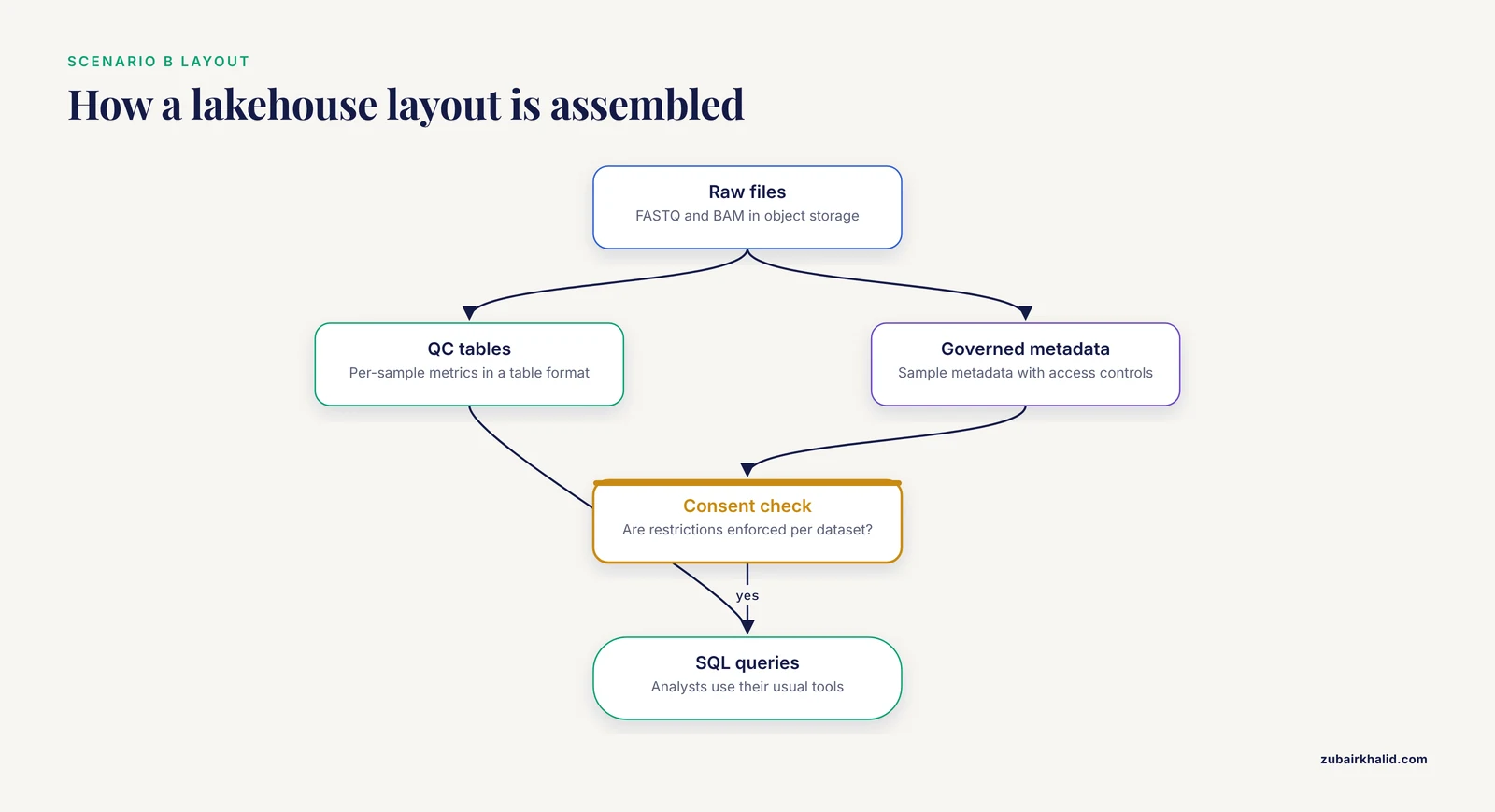
The lakehouse adds three things to a lake: open table formats that support schema and partitioning, transactional guarantees so concurrent readers and writers do not corrupt each other, and a metadata layer that makes the lake queryable with SQL. In effect, you get warehouse discipline on commodity object storage.
For bioinformatics specifically, the appeal is heterogeneity. Bioinformatics and health science data are diverse in format and subject, and the lakehouse is proposed as a way to manage that diversity without forcing everything into one rigid schema [4]. A plausible lakehouse layout for a genomics project looks like this: raw FASTQ and BAM files in object storage, per-sample metrics and QC tables in a lakehouse table format, sample metadata in a governed table with access controls, and analysts querying everything through SQL and their usual tools.
The honest caveat is maturity. The lakehouse model remains underexplored in bioinformatics, with limited discussion in the current literature, so expect to assemble the stack yourself and to find fewer domain-specific templates than in finance or retail analytics [4].
Knowledge Graphs and Ontology-Based Access
A knowledge graph stores data as entities (samples, genes, phenotypes, publications) and typed relationships between them. Ontology-based data access and integration (OBDI) layers map heterogeneous source datasets onto shared ontologies so that queries work across them without physically merging everything first.
This approach earned its place in bioinformatics through concrete results. An OBDI framework built to harmonize publicly available, heterogeneous plant nutritional datasets annotated them with established plant science ontologies inside a knowledge graph, enhancing Findability, Accessibility, Interoperability, and Reusability while providing a scalable mechanism for virtual integration [3]. The same pattern applies to clinical-genomic linkage, multi-omics harmonization, and any problem where the hardest part is agreeing on what a term means across ten databases.
The cost is upfront. Someone on the team must understand ontologies and semantic modeling, and building the mappings is skilled labor. The payoff compounds over time, because each newly mapped dataset joins the graph rather than starting a new integration project.
Scientific Container File Formats
Sometimes the right data management decision is the file format itself. Next-generation formats attack problems that plain gzip-compressed files create in cloud environments. Pithos, a file format designed for FAIR-compliant research data management in the life sciences, uses content-defined chunking to enable deduplication across distributed storage systems, reducing storage costs and bandwidth, and uses an append-only structure for immutability and incremental updates. The motivating problem is familiar to anyone in genomics: researchers working with cloud-stored datasets must decompress multi-gigabyte files to access specific regions, creating computational bottlenecks and wasteful network transfers [2].
The broader principle generalizes. Columnar and chunked formats (Parquet for tabular data, CRAM for alignments, Zarr for arrays) exist because chunk-level access beats whole-file access at scale. When you evaluate a format, ask three questions: can a reader fetch one region without downloading everything, does the format carry metadata inline, and can multiple tools read it without conversion.
Public Repositories and Managed Platforms
Two distinct services live in this category. General research data repositories, such as Figshare, provide institutions with platforms for sharing and preserving research data, supporting reproducibility and new research questions, with attention to architecture, metadata handling, interoperability, and compatibility [5]. Domain biomolecular resources, reviewed comprehensively by Vamathevan, Apweiler, and Birney, include data deposition databases, added-value databases and knowledgebases, and biology-driven portals, and their sustainable operation depends on collaboration, coordination, and funding that keeps pace with technology shifts [1].
Treat repositories as the last mile, not the whole system. Data deposited without internal management upstream tends to arrive poorly documented. Data managed internally with FAIR principles from the start deposits cleanly. Also treat scalability here as someone else's problem, which is the point: the hosting organization runs the infrastructure, and your responsibility is compliant, well-described deposition.
Criteria That Decide Real Choices
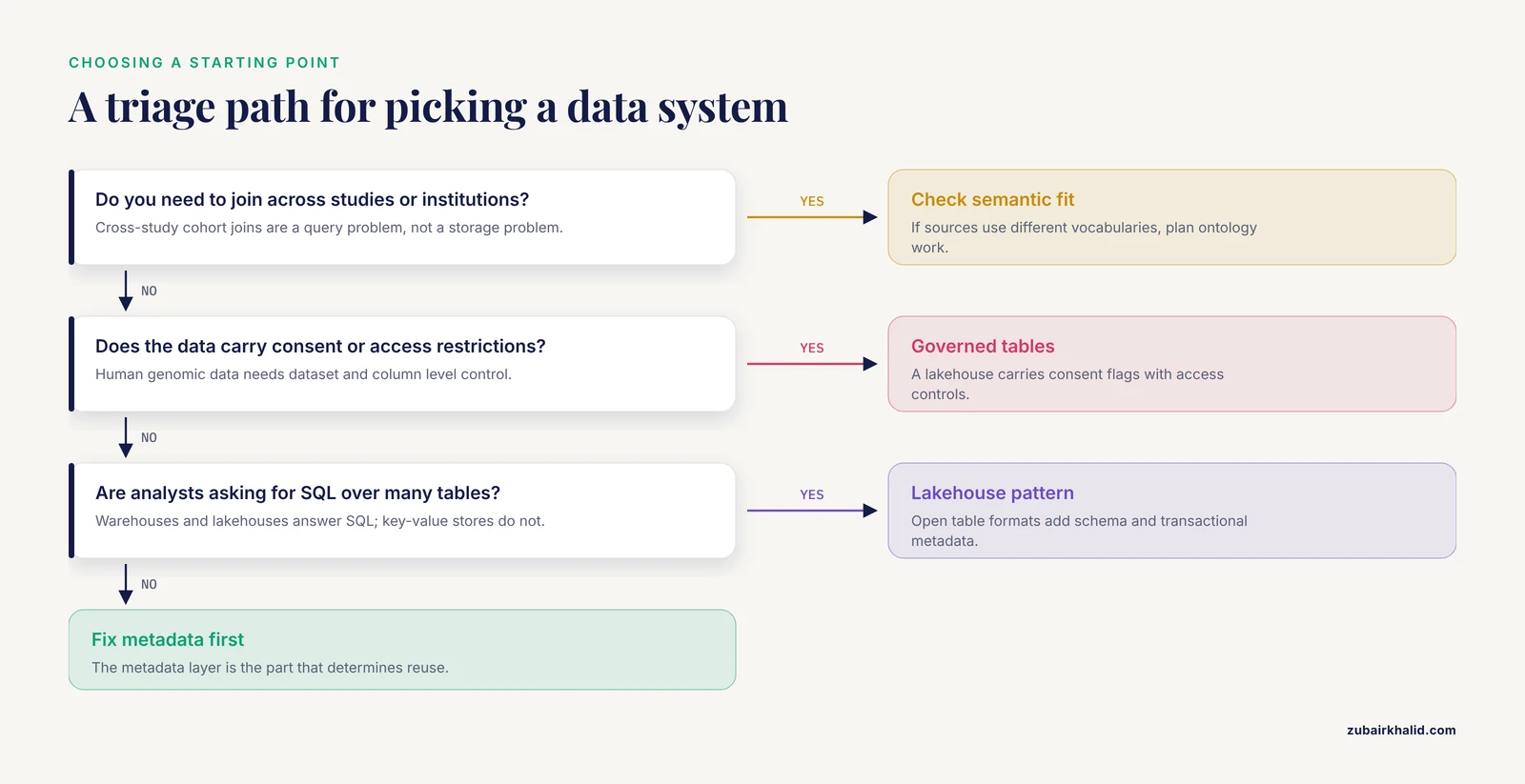
Marketing compares features. Procurement should compare the following, roughly in order of how often they sink projects.
1. Metadata model. Can the system store the metadata you actually have, including provenance, ontology terms, and access restrictions? Data management failures in life sciences trace back to metadata separation more than to storage capacity [2]. A system with a weak metadata layer fails slowly and invisibly.
2. Access patterns. List your real queries. Whole-file streaming to pipelines? Region-level random access? Cross-study cohort joins? Ad-hoc analyst SQL? Match the system to the dominant pattern. Key-value stores excel at lookups [6], warehouses and lakehouses at SQL, knowledge graphs at relationship traversal [3].
3. Governance and access control. Human genomic data carries consent terms and often regulatory constraints. The system must enforce who sees what at the dataset and column level. This is a primary differentiator between bare lakes and lakehouses.
4. Operational burden. Who maintains it, at what salary, with what on-call expectations? A managed object store plus a lakehouse table format may beat a self-hosted distributed cluster that nobody can debug at 2 a.m.
5. Cost model alignment. Cloud billing rewards data layouts that minimize retrieval and egress. Work on cloud-based trajectory management showed explicitly that data layout should be designed against the performance features and billing models of cloud storage, not just against abstract performance benchmarks [8]. The same reasoning transfers to bioinformatics object storage: partitioning and format choices directly change your monthly bill.
6. Ecosystem compatibility. The best bioinformatics software ecosystem is the one your pipelines already speak. Choosing storage that requires format conversion on every pipeline run imposes a permanent tax. Established textbook practice favors open, widely supported formats for exactly this reason.
7. Exit path. Can you leave? Open formats, open table formats, and standard dumps make migration possible. Proprietary lock-in at the storage layer is the most expensive mistake in this domain over a five-year horizon.
Worked Scenarios
Scenario A: A five-person academic genomics lab
A lab sequencing bacterial isolates, roughly 500 samples per year, currently stores FASTQ files on a network-attached storage box with metadata in spreadsheets. Nobody can answer "which isolates came from which farm in 2023" without an afternoon of manual work.
Recommendation: stay on flat files plus a workflow engine, but fix the metadata layer now. Move the sample metadata into a small relational database (PostgreSQL is free and sufficient), require sample identifiers to match filenames, and add a basic catalog that indexes the storage tree. This costs almost nothing and addresses the fragmentation problem that produces orphaned data and reproducibility failures [2]. Full lakehouse infrastructure is overkill here, and the underexplored state of bioinformatics lakehouses means the lab would spend maintenance effort on assembling tooling rather than on science [4].
Scenario B: A hospital-affiliated multi-omics program
Fifty terabytes growing by five per month, clinical metadata with consent restrictions, analysts requesting cohort joins, and a collaborative requirement to share subsets with external partners under defined terms.
Recommendation: a lakehouse pattern on cloud object storage. Raw data stays in the lake tier at low cost, governed tables carry sample metadata and consent flags with access controls, and analysts query with SQL. The lakehouse paradigm exists precisely for this combination of flexibility and governance that warehouses and bare lakes each fail to provide [4]. Pair it with chunk-aware formats so that analyses read only needed regions rather than decompressing whole multi-gigabyte files [2]. Budget the majority of the first year's effort for the metadata and access-control layers, not the storage.
Scenario C: A cross-institution data harmonization consortium
Six groups hold nutritional, phenotypic, and genomic datasets in different formats and vocabularies. The goal is comparative queries without forcing anyone to surrender custody of their data.
Recommendation: ontology-based data access over a knowledge graph. This is the demonstrated pattern: annotate each source dataset with shared ontologies, expose them through a semantic layer, and query virtually, which enhanced FAIR characteristics across heterogeneous sources while remaining scalable because no physical merge is required [3]. Add a managed deposition path (a Figshare-style institutional repository or a domain archive) for outputs that need public permanence [5]. This approach front-loads modeling work, so staff it accordingly.
A fourth pattern appears at the research frontier. Workshops at the intersection of data mining and bioinformatics have moved through high-performance computing for large models, then large language models and generative AI, toward themes including generative biomolecular design and digital twins [9]. Groups feeding foundation models face data organization problems of their own, where frameworks such as DataSculpt treat training-data organization as a multi-objective optimization over relevance, document integrity, and computational cost [10]. If your workload includes model training at that scale, borrow the framing: data management decisions are optimization decisions, and someone must own them explicitly.
Common Mistakes and Limitations
Buying infrastructure before defining queries. Teams pick a platform, then discover their actual questions need joins the platform cannot express. Write down the ten most valuable queries first, then choose.
Letting metadata live outside the system. Spreadsheets beside the data directory feel convenient and fail silently. Metadata separation is the documented root of fragmented datasets and reproducibility loss in life science data management [2].
Treating a data lake as a finished system. A lake without a catalog, naming conventions, and ownership assignment becomes unsearchable within a year. Governance is the difference between a lake and a swamp [4].
Ignoring the exit path. Formats and platforms without export routes turn a five-year decision into a permanent one. Prefer open table formats and standard file formats even when a proprietary alternative looks easier this quarter.
Assuming scale problems arrive on schedule. They arrive as a sudden collaborator, grant, or instrument purchase. The systems that survive surprises are the ones built on open formats with a clean metadata layer, because those can be re-tiered or migrated.
Confusing compute scaling with data management. Adding cluster nodes speeds up pipelines but does nothing for findability, governance, or reuse. These are separate problems that require separate solutions.
Underestimating semantic heterogeneity. Two databases calling the same measurement by different names is a harder problem than two databases on different servers. Plan for vocabulary harmonization, not just storage harmonization.
Skipping the limitations conversation. Every option here has a failure mode. The lakehouse paradigm is promising but thin in bioinformatics-specific literature and tooling [4]. Next-generation file formats are technically elegant but young [2]. Individual projects have constraints this article cannot anticipate, and platform decisions for clinical or regulated data need review by your institution's data governance and security teams before procurement.
Frequently Asked Questions
What is the best scalable bioinformatics data management option for a small lab?
For most small labs, flat files on shared storage plus a workflow engine, with sample metadata in a relational database and consistent identifier conventions. This handles hundreds to thousands of samples, costs almost nothing to maintain, and upgrades cleanly to a lakehouse later because the underlying formats stay open.
How is a data lakehouse different from a data lake?
A data lake is raw data in object storage with little built-in organization. A lakehouse adds open table formats, schema enforcement, transactional metadata, and SQL queryability on top of that storage, combining lake flexibility with warehouse governance [4].
Do I need Hadoop for big data in bioinformatics?
Usually no for new projects. Cloud object storage has replaced most of HDFS's role, and Spark remains useful as a computation layer. Hadoop makes sense mainly where you already run an on-premises cluster or face data-residency constraints [7].
How do FAIR principles affect my choice of data management system?
FAIR (Findable, Accessible, Interoperable, Reusable) is the yardstick for reuse value. Systems score well when they provide stable identifiers, rich and ontology-linked metadata, standard formats, and defined access terms. Knowledge graph and OBDI approaches were shown to enhance FAIR characteristics across heterogeneous datasets [3], and any option you choose should be scored against the same criteria.
What role do public repositories play if I run my own system?
Repositories handle publication-grade sharing and preservation that internal systems are not designed for. Platforms such as Figshare provide institutions with managed accessibility, stability, and metadata services for sharing data [5], and domain biomolecular resources provide curated reference data and knowledgebases that your internal system should link to rather than duplicate [1].
When should I consider newer formats like Pithos or knowledge graphs instead of conventional databases?
Consider next-generation formats when cloud-stored genomic files are being decompressed wholesale for region-level access, wasting bandwidth and compute, which content-defined chunking and append-only designs address [2]. Consider knowledge graphs when the dominant problem is semantic heterogeneity across multiple sources that must be queried together without physical merging [3]. Neither replaces a relational metadata database, they complement it.
Sources
- Biomolecular Data Resources: Bioinformatics Infrastructure for Biomedical Data Science
- Pithos - a scalable and secure data container for FAIR-compliant research data management in life sciences.
- Improving annotation, access, and comparison of nutritional composition data for underutilized crops.
- Review of open-source software for developing heterogeneous data management systems for bioinformatics applications
- Figshare: A One-Stop Shop for Research Data Management with Diverse Features and Services
- Scalable and Distributed Key-Value Store-based Data Management Using RDMA-Memcached
- A Review: Importance of Big data in Healthcare and its Key Features
- A Spatio-Temporal Series Data Model with Efficient Indexing and Layout for Cloud-Based Trajectory Data Management
- 23rd International Workshop on Data Mining in Bioinformatics (BIOKDD 2024)
- DataSculpt: A Holistic Data Management Framework for Long-Context LLMs Training