Scalability in Bioinformatics: Web vs. Local Platforms
By Dr. Zubair Khalid, DVM, MS, PhD ·

Web-based bioinformatics platforms scale by shifting compute, storage, and maintenance onto hosted infrastructure that grows independently of your lab, while local platforms scale by adding hardware and expertise inside your own institution. The rule of thumb is simple. If your analysis follows a standard, well-trodden workflow on moderate data volumes, a web platform usually gets you results faster with less overhead. If your data are large, sensitive, custom, or part of a pipeline you must control and reproduce for years, a local setup wins. Most productive groups end up using both, and the real skill is knowing which job belongs where.
This article is a practical bioinformatics tools comparison across that boundary. It defines what scalability actually means in this context, explains each platform type on its own terms, compares them on the criteria that decide real projects, and works through concrete scenarios drawn from published implementations.
What Scalability Means in Bioinformatics
Scalability is the ability of a system to handle growing amounts of work without a proportional increase in effort, cost, or failure. In bioinformatics that work grows along several axes at once, and it helps to name them separately.
Data volume. A single Illumina NovaSeq run can produce terabases of sequence. Whole-genome surveillance programs, population-scale variant catalogs, and longitudinal cohort studies all turn a one-time analysis problem into a continuous data-processing problem. Storage, transfer, and indexing costs grow with the data, and a laptop that handled last year's project becomes unusable this year.
Sample throughput. A diagnostic or surveillance laboratory that processed 50 samples per month may face 5,000. The pipeline itself may not change, but sample tracking, batch submission, and incremental updating of results become the bottleneck. INSaFLU, an automated web-based suite for influenza whole-genome sequencing surveillance, was designed around exactly this problem, automatically updating project outputs as more samples are uploaded [1].
Analysis complexity. Some questions need one tool run. Others need chained steps across heterogeneous data sources, which is a different kind of scaling. Systems such as PIBAS FedSPARQL were built to scale query complexity, letting researchers run federated SPARQL queries across multiple linked data sources rather than downloading and reconciling dozens of databases by hand [2].
User base. A core facility serving one lab scales differently from a public resource serving thousands. When a platform's user base grows, the challenge shifts from raw compute to concurrency, availability, and maintenance. This is the scaling dimension that monolithic and microservice architecture studies measure directly, and the findings matter for anyone choosing or building a platform, as discussed below [3].
Sustainability over time. A less obvious axis is whether the tool still works next year. A large survey screened the availability of 2,396 bioinformatics web tools published over a decade, accessing them over 133 days. Only 31 percent were always working during that window, 48.4 percent worked occasionally, and 20.6 percent were never reachable. Availability was roughly 90 percent for tools published in 2019 and 2020 but only about 50 percent for tools published in 2010 [4]. Scalability without sustainability is a short-term win.
Keeping these five axes in mind prevents the most common category error in this debate, which is treating "scalability" as if it meant only compute size.
Web-Based Bioinformatics Platforms Explained
A web-based platform hosts the analysis engine on remote infrastructure. You upload data or point the service at public data, configure a job through a browser interface, and receive results. The provider handles software installation, versioning, compute allocation, and often the underlying reference databases.
The spectrum of web platforms
Web platforms range from narrow, single-purpose suites to broad data resources with built-in analysis.
Purpose-built analysis suites. INSaFLU was the first influenza-oriented free web-based suite that took raw NGS reads and produced the core outputs a surveillance laboratory needs, including type and subtype calling, consensus sequences, variant annotation, alignments, and phylogenetic trees. It was designed so that any laboratory could run multi-step, software-intensive analyses without previous advanced bioinformatics training [1]. Its successor, INSaFLU-TELE-Vir, extended the same model to SARS-CoV-2 and accepts data from Illumina, Ion Torrent, and Oxford Nanopore sequencing, with applicability to other amplicon-based pathogens [5]. Both platforms exist because the limiting resource in many laboratories is not compute but the combination of infrastructure and expertise, a barrier public health authorities repeatedly identified during the transition to whole-genome surveillance [5].
Workflow platforms with curated content. GA-VirReport implements virus and viroid detection workflows on Galaxy Australia for post-entry quarantine screening of plants. The developers identified the two classic bottlenecks of local analysis, lack of computational resources and lack of command-line expertise, and removed both by hosting the workflow and a curated plant virus database (PVirDB) on national infrastructure. In a large-scale test, the workflow processed 105 imported plants at an Australian quarantine facility and detected pathogens in 14 of them [6]. This is web scalability in the operational sense. The screening program scaled to hundreds of samples because the analytical burden lived on Galaxy Australia, not on quarantine station computers.
Integrated data resources. FungiDB integrates genomic and large-scale omics data for hundreds of fungal and oomycete species, supporting 674 datasets and more than 300 genomes as part of the VEuPathDB Bioinformatics Resource Center. Beyond data browsing, it offers a built-in search strategy system for omics-scale hypothesis testing, a private data analysis option through the integrated VEuPathDB Galaxy platform, and community curation tools such as user comments and the Apollo genome annotation editor [7]. The scalability here is curated scale. No laboratory could locally mirror, harmonize, and keep current that volume of integrated data.
Automated end-to-end pipelines. H3NGST runs ChIP-seq analysis from raw data retrieval through quality control, alignment, peak calling, and annotation with minimal user input. The developers explicitly note that it eliminates the need for local installations, programming skills, or large file uploads, and that the system is designed to be scalable for high-throughput studies [8].
Cloud-hosted interactive pipelines. ColabCuraTE implements a transposable element curation pipeline in Google Colaboratory, so users get guided, notebook-based analysis with built-in visualization without installing anything locally. It was validated on both megabase-sized and gigabase-sized genomes, and its stated goal was removing the infrastructure and expertise requirements that typically limit participation in genomic research [9].
Platform-plus-database builds. On the infrastructure side, new resources such as TefDB for the crop Eragrostis tef are built with a React.js frontend, a Django and Python backend, and PostgreSQL data management, integrating nearly 78,000 biological records. The developers list data accessibility, centralization, security, management, and scalability as the core benefits of the web-based approach [10].
Where web scalability comes from
Web platforms scale in ways local setups generally cannot match without significant investment.
- Elastic compute. Hosted infrastructure can allocate more CPUs, memory, or job slots when demand rises, and release them afterward. A user never provisions anything.
- Centralized maintenance. One team patches, updates, and tests the software for all users. Tool references that resolve to a maintained server stay usable. Reference database updates propagate to everyone at once.
- Zero local footprint. Large file uploads, local installations, and dependency conflicts simply disappear as failure modes [8].
- Lowered expertise barriers. Browser interfaces with sensible defaults let wet-lab scientists run sophisticated pipelines. This is the recurring design rationale in INSaFLU [1], GA-VirReport, H3NGST, and ColabCuraTE.
- Built-in collaboration and sharing. User-restricted project databases, shareable results, and web APIs come with the platform rather than as a project you build [1] [11].
The costs of web scalability
The same survey that documented broad tool availability also documented the downside. Nearly half of the web tools tested worked only intermittently, and one in five was never reachable during the test period. Consecutive downtimes were typically short, with a median of one day, but the authors found a positive association between citation count and the probability that a server remained reachable, meaning popular tools survive and obscure ones decay [4]. Practical consequences follow:
- A web service can disappear, move, or change its interface without notice, breaking a published workflow or an automated script that depended on it.
- You inherit the provider's queue times, usage limits, and maintenance schedule.
- Data transfer becomes part of every analysis. Uploading hundreds of gigabytes of reads is slow and sometimes infeasible.
- Data governance questions are unavoidable. Clinical, agricultural quarantine, and controlled-access human data may have terms that prohibit or complicate upload to third-party servers.
Local Bioinformatics Platforms Explained
A local platform runs on hardware you control, from a workstation under a desk to an institutional high-performance computing (HPC) cluster or a private cloud tenancy you operate. The defining property is ownership. You control the hardware, the software versions, the reference data, and the data itself.
The local stack
A functioning local environment typically includes:
- A workflow manager. Nextflow or Snakemake expresses a pipeline as code, so that the same analysis runs identically on a laptop, a cluster, or the cloud. Nextflow pipelines written in DSL2 syntax are now a de facto standard, and platforms like Flow accept new pipelines through a simple JSON schema file precisely because the DSL2 format is predictable [11].
- Containerization. Docker, Apptainer (formerly Singularity), or Conda environments pin exact tool versions. This is what makes a local pipeline reproducible across machines and years.
- A scheduler. On shared clusters, SLURM or an equivalent queues and allocates jobs so that hundreds of samples can be processed in parallel batches.
- Local copies of reference data. Genome builds, variant databases, and curated pathogen databases held locally never depend on someone else's server staying online. A lesson from the web services survey is that local mirrors of critical resources are a hedge against remote decay [4].
Where local scalability comes from
- Horizontal scale on your own terms. Add nodes to a cluster, buy more storage, or rent capacity in a private cloud tenancy. You decide when and how.
- Parallelism per job. Workflow managers parallelize within and across samples. A well-written Nextflow pipeline scales from one sample to thousands with the same code, given enough executors.
- Full data control. Sensitive data never leave your perimeter. This is non-negotiable in clinical genomics, controlled-access research, and quarantine material handling.
- Reproducibility by construction. Versioned code, containers, and frozen reference data make it possible to rerun a 2024 analysis in 2030 and get the same answer.
- No external dependency for critical operations. A diagnostic pipeline that must run during an outbreak cannot fail because a remote server is down for maintenance.
The costs of local scalability
- Capital and personnel. Hardware, storage systems, electricity, cooling, and above all skilled staff. A cluster without a sysadmin and a pipeline maintainer is an expensive space heater.
- Expertise requirements. Command-line fluency, workflow authoring, and troubleshooting are real skills. This is precisely the barrier web platforms were built to remove.
- Slow setup. Standing up a reproducible local environment for a new assay can take weeks. A web suite often takes minutes.
- Scaling ceilings. A single workstation saturates quickly. Even clusters have finite capacity, and competing internal demands for it are common.
Side-by-Side Comparison
The table below is the core bioinformatics tools comparison for the web vs. local decision.
| Criterion | Web-based platform | Local platform |
|---|---|---|
| Startup time | Minutes to hours. Register, upload, run [1] [8] | Days to weeks. Install, configure, containerize, test |
| Expertise required | Low to moderate. Browser interfaces with defaults [6] [9] | High. Command line, workflow languages, cluster usage |
| Compute scaling | Elastic, provider-managed, often opaque | You provision it. Linear cost, full visibility [3] |
| Data volume ceiling | Set by provider limits and upload bandwidth | Set by your storage and cluster capacity |
| Data control and privacy | Weak. Data leave your institution | Strong. Data stay inside your perimeter |
| Reproducibility | Depends on the service staying alive and versioned | Strong, via workflow code and containers |
| Software currency | Maintained centrally, updates automatic | You maintain it, on your schedule |
| Failure modes | Remote downtime, interface changes, service retirement [4] | Local hardware failure, dependency breakage, staff turnover |
| Custom analyses | Limited to what the platform exposes | Unlimited. Any tool, any modification |
| Collaboration | Built-in sharing, project databases, APIs [1] [11] | Must be built or adopted internally |
| Cost model | Often free to the user, subsidized by funders or providers [1] [5] | Capital plus salaries plus electricity |
| Best suited for | Standard workflows, moderate data, non-specialist users, surge capacity | Large or sensitive data, custom pipelines, long-term reproducibility |
Reading the table row by row reveals the deeper pattern. Web platforms buy you time and lower barriers by giving up control. Local platforms buy you control and durability by paying in expertise and infrastructure. Neither is strictly better, and the "best bioinformatics software" question is usually a workflow-matching question, not a platform-loyalty question.
The Criteria That Decide Real Choices
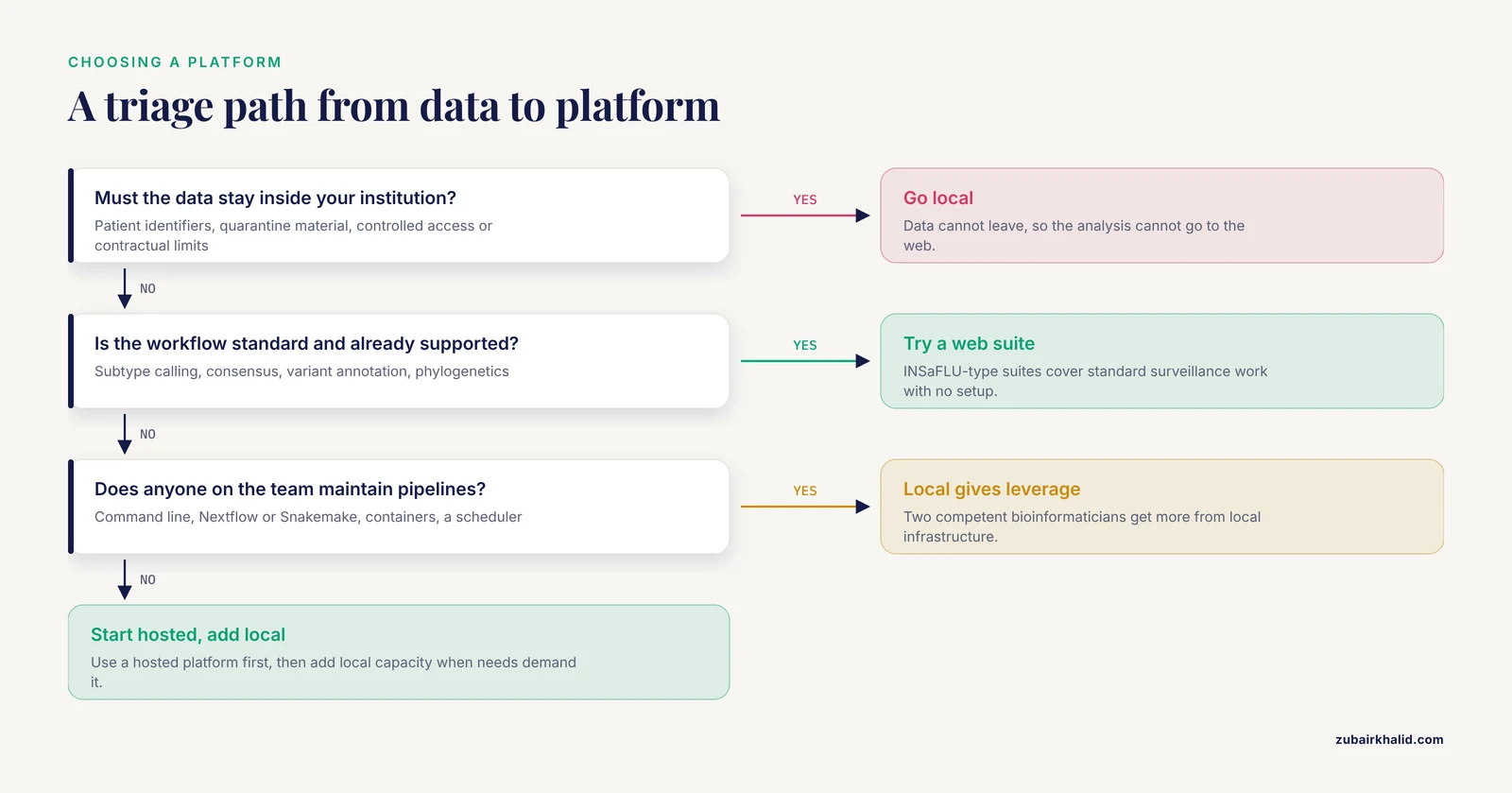
Data size and shape
Match data volume to the platform honestly. A 30-sample viral amplicon sequencing batch is comfortable on a web suite such as INSaFLU-TELE-Vir, which was built exactly for laboratories without heavy compute [5]. A 2,000-sample whole-genome cohort with long reads is a local or dedicated cloud job, both because of transfer time and because intermediate files will dwarf the uploads. ColabCuraTE's validation on gigabase-sized genomes shows that browser-hosted notebooks can stretch further than many assume, but interactive curation workloads differ from batch production workloads [9].
Data sensitivity
Any dataset with access restrictions, patient identifiers, quarantine material, or contractual limits points toward local execution. Public web platforms are usually unsuitable regardless of their technical merits. This criterion overrides most others. If the data cannot leave, the analysis cannot go to the web.
Expertise on the team
This is the single most decisive practical factor, and the literature on platform design says so repeatedly. GA-VirReport was created because plant quarantine laboratories lacked command-line expertise [6]. INSaFLU exists because surveillance laboratories lacked bioinformatics infrastructure and trained staff [1]. ColabCuraTE targets researchers without bioinformatics expertise or access to sufficient computing resources [9]. If your team has no one who can maintain a Nextflow pipeline, a local deployment will decay. If your team has two competent bioinformaticians, local infrastructure gives them leverage that browser interfaces cannot.
Reproducibility horizon
Ask how long the result must remain rerunnable. A one-off screen whose answer is recorded in a report has modest reproducibility needs. A method embedded in a diagnostic service or a multi-year surveillance program needs pipelines that will still execute years from now. Workflow-as-code on local infrastructure, with containers and frozen references, is the stronger answer. A web service with a demonstrated multi-year maintenance record, such as the INSaFLU lineage that ran from its 2018 description through its 2021 expansion [1] [5], is the stronger answer within the web category, but you are still trusting someone else's continuity. The availability survey puts hard numbers on why that trust is earned selectively. Only about a third of surveyed tools were continuously available over a 133-day observation window, and availability dropped to roughly half for decade-old tools [4].
Cost structure
Web platforms are frequently free at the point of use because they are funded by institutions, governments, or grants. INSaFLU-TELE-Vir is free [5], FungiDB is supported as part of a bioinformatics resource center [7], and Galaxy Australia supported the quarantine screening program without per-sample charges to the quarantine facility [6]. Free at the point of use is not free to the community, but for a single laboratory the practical effect is that web platforms shift capital expenditure toward zero and hide operational cost. Local platforms make every cost visible and internal. The correct financial comparison is therefore not web versus local in the abstract, but web versus your fully loaded local cost including staff time.
Throughput pattern
Steady moderate throughput favors a stable local pipeline you tune once. Bursty throughput, such as an outbreak surge, favors elastic capacity. A hybrid is common in practice. Run routine work locally and overflow peaks to a hosted platform. Flow was designed with exactly this flexibility in mind, deployable on local systems or cloud services while presenting the same interface and API either way [11].
Worked Scenarios
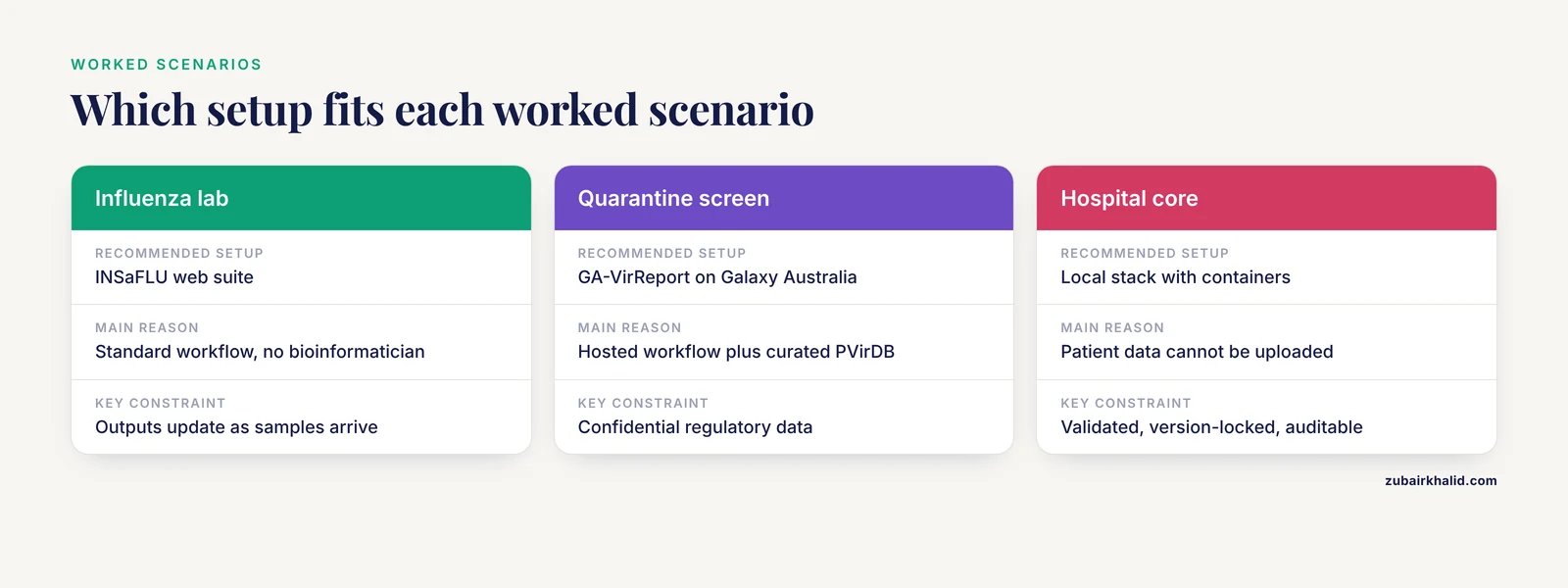
Scenario 1. A public health laboratory starting whole-genome influenza surveillance
A diagnostic laboratory sequences influenza A and B samples weekly. The staff are experienced molecular biologists with no dedicated bioinformatician. The analysis needs are standard and well defined, covering subtype calling, consensus generation, variant annotation, and phylogenetics. INSaFLU fits this job almost perfectly. It takes raw reads and produces the first-line genetic requests for surveillance automatically, manages samples in user-restricted projects, and updates outputs as new samples arrive [1]. The 2021 extension to SARS-CoV-2 and multiple sequencing chemistries means the same platform absorbs a new pathogen without new infrastructure [5]. Choosing a from-scratch local pipeline here would delay the surveillance program by months and add a permanent maintenance burden the laboratory cannot staff. This is a clear case of when to use web scalability.
Scenario 2. A quarantine facility screening imported plants
A plant quarantine program must screen every imported plant for viruses and viroids using host small RNA sequencing. The data are confidential, the protocol is regulatory, and the workload is continuous but manageable. GA-VirReport solved this by hosting the workflow on Galaxy Australia rather than installing software at each station, combining national compute with a curated virus database. The program processed 105 imported plants at scale and characterized the sensitivity and specificity of different detection approaches, finding that de novo assembly of the 21 to 22 nucleotide small RNA fraction with megablast gave better sensitivity and specificity [6]. The lesson generalizes. Even where data sensitivity pushes toward local thinking, a trusted national or institutional hosted platform can satisfy the governance requirement while providing web-level scalability. The distinction that matters is not web versus local but trusted-provider-hosted versus third-party-ad-supported.
Scenario 3. A research group curating transposable element consensus sequences
A lab studying genome evolution needs to manually curate TE families across several species with genomes ranging from megabases to gigabases. The work is interactive, visualization-heavy, and periodically intense. ColabCuraTE runs the pipeline in Google Colaboratory, so the group avoids local installation entirely and can work from any machine, while the validation showed reliable improvement in consensus quality across genome sizes [9]. If the same group later needed to curate thousands of species automatically, the interactive web model would become the bottleneck and a local scripted pipeline would take over.
Scenario 4. A consortium running large-scale sequencing meta-analyses
A consortium aggregates published sequencing data for meta-analysis. The challenges are data provenance, quality control, curation, and sharing, more than raw compute. Flow combines a web platform with an open database, wraps analyses in DSL2-compliant Nextflow pipelines that can be added via a JSON schema, and can be deployed on local systems or cloud services. An instance is freely available to academic researchers [11]. This design acknowledges the central insight of the scalability debate. The platform layer and the execution layer are separable. You can have a web-style user experience on local or cloud infrastructure you choose.
Scenario 5. A hospital genomics core with patient data
A clinical laboratory sequences patient tumors under privacy rules that prohibit upload to third-party services. The pipeline must be validated, version-locked, and auditable. Everything points local. Workflow managers, containers, an internal scheduler, and local reference copies are the appropriate stack, and no published web platform cited here claims to satisfy clinical data governance requirements. The relevant web-platform benefits, such as reproducibility and user-friendly operation, must be reconstructed locally, which is precisely what workflow-as-code and containers provide.
Hybrid Architectures: The Growing Middle Ground
The binary framing of web versus local is increasingly obsolete because the two worlds interoperate.
Command-line access to web services. KBWS packages proxy clients for 42 major bioinformatics web services as EMBOSS-style UNIX command-line tools, letting a local script call remote alignment, phylogeny, and prediction services as if they were local programs [12]. This pattern lets a local pipeline offload individual steps to maintained remote services without abandoning local control.
Browser-to-desktop data flow. The Firegoose browser extension moved data between web resources such as KEGG, STRING, and DAVID and desktop tools including Cytoscape and R, in both directions, removing the file-reformatting and database-mirroring overhead that made mixed analyses painful [13]. The pattern it established, treating web resources as live participants in a local analysis session, is now standard.
Structured integration across services. Bio Search Computing (Bio-SeCo) described how to register bioinformatics web services in a framework that combines results from distinct sources into ranked answers to complex questions [14]. On the data layer, PIBAS FedSPARQL runs federated SPARQL queries across sources including Bio2RDF, Chem2Bio2RDF, and EMBL-EBI resources, detecting equivalent data items identified by different URIs through text-mining based similarity measures [2]. Federated query approaches were compared with web-service-based integration as early as 2007, and the tradeoffs between pushing queries to data versus pulling data to queries remain live design questions [15].
Managed service portfolios. At institutional scale, a web service management system can handle the full life cycle of services, covering semantic description, discovery, selection, composition, execution, and presentation of results. In one case study, a skyline-query-based selection algorithm helped users choose services based on reliability, performance, and analysis quality, and the evaluation demonstrated the efficiency and scalability of the selection approach. This is what scaling looks like from the provider side, and it explains why well-run web platforms feel effortless to their users.
Deploy-anywhere platforms. Flow's design, deployable on local systems or cloud services with a consistent interface [11], and FungiDB's integration of a Galaxy instance for private user data inside a public resource [7], both dissolve the hard boundary. The practical question shifts from "web or local" to "which execution target for each step, behind which interface."
What Software Architecture Tells Us About Scalability
For anyone building rather than merely using a platform, the monolith versus microservices question matters, and the evidence is more nuanced than industry folklore suggests.
In a controlled comparison, a reference web application was implemented as both a monolith and a set of microservices in two technology stacks and deployed in three environments, including local and Azure-based options. The key finding was that on a single machine, the monolith performed better than its microservice-based counterpart. Microservices buy improved availability, fault tolerance, and horizontal scalability, but for systems without thousands of concurrent users that can be scaled vertically, the expected benefits of migration are not guaranteed and existing evidence is inconsistent [3].
Translated into bioinformatics terms, a small laboratory resource with a few dozen users should probably stay monolithic and be scaled by bigger hardware. A public resource expecting thousands of concurrent users during an outbreak, the way surveillance platforms were stressed during the COVID-19 pandemic, has a genuine case for distributed architecture. Ahsan and colleagues addressed scaling techniques for web-based bioinformatics management systems directly, underlining that this is an engineering discipline with its own methods rather than an afterthought [16].
The same logic applies to choosing among existing platforms. A platform built on solid architecture degrades gracefully under load. One built casually will fail exactly when your samples pile up.
Common Mistakes and Limitations
Mistake 1. Choosing a platform before characterizing the data. Teams pick a tool because a colleague recommended it, then discover the upload limit, the unsupported sequencing chemistry, or the missing organism. Characterize data volume, sensitivity, and throughput pattern first, then match the platform.
Mistake 2. Treating a web tool as permanent infrastructure. Given that roughly one in five surveyed web tools was unreachable at every check over a 133-day window [4], any workflow that depends on a single remote URL is fragile. Record tool versions, archive critical reference data locally, and have a fallback execution path.
Mistake 3. Confusing free at the point of use with free of risk. A free web suite removes your compute bill but introduces dependency on someone else's funding cycle. The INSaFLU lineage survived and grew from 2018 into the TELE-Vir expansion [1] [5], which is evidence of good stewardship, but the 2010-era tools that fell to around 50 percent availability show the base rate for the category [4].
Mistake 4. Underestimating local hidden costs. A local cluster's true cost includes the fraction of a bioinformatician's salary spent maintaining it. Groups that compare only hardware prices against free web platforms systematically overestimate the local option's value.
Mistake 5. Rebuilding locally what already exists well. Curated, integrated resources such as FungiDB, with 674 datasets across more than 300 genomes and built-in omics search tools [7], cannot be reproduced by a single group. Downloading raw data to run a worse local version of an existing integrated analysis wastes months. Use the hosted resource for what it does well, and go local only for the steps it cannot do.
Mistake 6. Assuming a browser interface means small science. ColabCuraTE handles gigabase-sized genomes in a browser notebook [9], and H3NGST positions itself for high-throughput ChIP-seq studies [8]. Interface simplicity is not a proxy for analysis triviality. Conversely, a local pipeline can be trivially simple. Judge by workload, not by interface.
Mistake 7. Ignoring version drift on both sides. Local pipelines drift when someone updates a Conda environment without pinning. Web platforms drift when the backend is upgraded silently. In both cases, the fix is the same. Record versions at analysis time and re-verify key outputs after any change.
Limitation. Platform choices also depend on institutional factors that vary widely, including procurement rules, network bandwidth, and funding timelines. The criteria above cover the technical and operational dimensions that generalizable evidence supports. Individual project decisions need evaluation against your own constraints, and where human or animal diagnostic results are involved, applicable professional and regulatory standards for assay validation govern what platform changes are permissible.
Frequently Asked Questions
What is the main difference between scalability in web-based and local bioinformatics platforms?
Web platforms scale by adding capacity on managed remote infrastructure that the provider maintains and grows for all users at once, while local platforms scale by adding hardware, storage, and staff within your own institution. The web route trades control for convenience and elasticity. The local route trades convenience for control, data custody, and reproducibility you own.
When should I use a web-based bioinformatics platform instead of a local one?
Use a web platform when your data are moderate in size and unrestricted in sensitivity, your analysis follows a standard workflow the platform already supports, and your team lacks dedicated bioinformatics engineering capacity. Published examples include influenza surveillance suites [1], quarantine screening workflows on Galaxy [6], and browser-based ChIP-seq pipelines [8]. If any of those three conditions fails, move that job local.
Are web-based bioinformatics tools reliable enough for production work?
Popular, well-funded ones often are, but the category as a whole is uneven. In a survey of 2,396 web tools monitored for 133 days, 31 percent were always working, 48.4 percent worked only occasionally, and 20.6 percent never worked, and tool availability declined with publication age [4]. Vet the specific platform's track record and keep a local fallback for anything critical.
Which bioinformatics software should a small laboratory start with?
Start with a hosted platform that matches your organism or assay, such as an INSaFLU-type suite for viral surveillance [5] [1] or a curated resource like FungiDB for fungal genomics [7], and learn workflow concepts through it. Add local capability, built around Nextflow or Snakemake with containers, only when data sensitivity, custom analyses, or reproducibility requirements demand it. The best bioinformatics software is the one matching your workload, not the one with the most features.
Can I combine web and local approaches in one project?
Yes, and it is often the best design. Local pipelines can call remote web services through command-line proxy tools such as KBWS [12], browser resources can exchange data with desktop tools as the Firegoose demonstrated [13], and platforms like Flow run identically on local or cloud infrastructure [11]. A common pattern runs routine analyses locally and offloads bursts, or uses hosted resources for reference data lookups inside a local pipeline.
How does data privacy affect the web versus local choice?
If data are confidential, regulated, or contractually restricted, local execution is usually mandatory because upload to third-party servers may be prohibited. Trusted institutional or national platforms can be an acceptable middle ground, as the Australian quarantine screening program showed by running confidential analyses on Galaxy Australia [6]. Always check the data governance terms before the technical comparison, because privacy constraints can end the debate before scalability enters it.
Sources
- INSaFLU: an automated open web-based bioinformatics suite “from-reads” for influenza whole-genome-sequencing-based surveillance
- PIBAS FedSPARQL: a web-based platform for integration and exploration of bioinformatics datasets
- Monolithic vs. Microservice Architecture: A Performance and Scalability Evaluation
- On the lifetime of bioinformatics web services
- INSaFLU-TELE-Vir: an open web-based bioinformatics suite for influenza and SARS-CoV-2 genome-based surveillance
- Implementation of GA-VirReport, a Web-Based Bioinformatics Toolkit for Post-Entry Quarantine Screening of Virus and Viroids in Plants
- What is new in FungiDB: a web-based bioinformatics platform for omics-scale data analysis for fungal and oomycete species
- H3NGST: a fully automated, web-based platform for end-to-end ChIP-seq analysis
- ColabCuraTE: an easy-to-use, web-based pipeline for the manual curation of transposable elements
- Developing a web-based platform for Eragrostis tef resource management and analysis
- Flow: a web platform and open database to analyse, store, curate and share bioinformatics data at scale
- KBWS: an EMBOSS associated package for accessing bioinformatics web services
- The Firegoose: two-way integration of diverse data from different bioinformatics web resources with desktop applications
- Bio Search Computing: Bioinformatics web service integration for data-driven answering of complex Life Science questions
- A Comparison of Federated Databases with Web Services for the Integration of Bioinformatics Data
- Scaling Technique for Web Based Management Systems in Bioinformatics