The Role of Sample Annotations in Reproducible Genomics
By Dr. Zubair Khalid, DVM, MS, PhD ·

Sample annotations are the structured, machine-readable descriptions that record what each biological sample is, where it came from, and how it was processed. Reproducible genomics depends on them because an analysis can only be repeated, checked, or combined with other studies if every sample carries an accurate and unambiguous record of its identity, source, and provenance.
Without annotations, a FASTQ file is a pile of reads with no biological meaning. A researcher who downloads a ChIP-seq dataset needs to know the antibody target, the tissue, the disease state, the donor characteristics, and the sequencing protocol before the data can be interpreted at all. When these facts are recorded as free text in inconsistent formats, datasets that should combine cleanly instead fracture into noise, and reanalysis of public repositories becomes guesswork. This article explains what sample annotations are, how they underpin reproducibility, how they fail, and how modern infrastructure tries to keep them honest.
What Sample Annotations Actually Are
Sample annotations, sometimes called contextual metadata or biosample metadata, are the attributes attached to each specimen in a study. They answer questions the sequence data itself cannot. Common categories include the following.
- Identity attributes. A stable sample identifier, the subject or donor it came from, and links to paired samples such as tumor and normal tissue.
- Biospecimen attributes. Species, tissue or cell type, anatomical site, disease state, treatment status, time point, and passage number for cell lines.
- Provenance attributes. Extraction protocol, library preparation, sequencing platform, read length, laboratory, operator, and date.
- Analytical attributes. Quality-control summaries, contamination estimates, alignment statistics, and tags for known problems in the data.
- Population attributes. Genetic ancestry, self-reported ethnicity, sex, age, and geographic sampling location where relevant.
The distinction between sample annotations and gene annotations matters and is a frequent point of confusion. Gene or feature annotations describe locations and functions of genes on a reference genome. Sample annotations describe the biological material itself. Both are required for interpretation, but only one travels with each specimen. A well-annotated study records both, and tools that integrate databases across both layers are increasingly common, as in the chicken functional genomics resource GEGA, which combines genome catalogues with expression profiles across 47 tissues from 36 datasets and 1,400 samples [1].
Sample Annotations Compared With Terms They Are Often Confused With
| Term | What it describes | Typical example | Relationship to reproducibility |
|---|---|---|---|
| , - | , - | , - | , - |
| Sample annotation | Attributes of a specimen | "liver, male donor, age 54, RNase-free frozen" | Determines whether samples can be found, compared, and reused |
| Gene (feature) annotation | Location and function of genomic elements | Exon coordinates, gene symbols, KEGG pathways | Determines how reads are assigned and interpreted |
| Reference metadata | Versioned resources used in analysis | Genome assembly build, database release | Determines whether a rerun yields identical outputs |
| Workflow metadata | Computational provenance | Pipeline version, container digest, parameters | Determines whether processing is repeatable |
| Quality-control tags | Documented data issues | "low read depth, known index hopping" | Prevents misuse of suboptimal datasets |
Why Annotations Decide Whether Genomics Is Reproducible
A genomic analysis has two halves. One half is the computation, which modern workflow systems can make deterministic and repeatable. The other half is the input, meaning the samples and their descriptions. If the descriptions are wrong, incomplete, or written in a private shorthand, then a rerun of the computation reproduces the error rather than the result. This asymmetry is the core reason annotation quality sits at the center of reproducibility discussions.
The scale of the reuse problem is large. Public repositories of large-scale biological data hold hundreds of thousands of experiments, and combining samples that were never originally associated is a major untapped opportunity, one that requires the ability to associate samples with clear annotations and to relate experiments that carry different annotation terms [2]. More than 1.3 million human -omics samples are publicly available, yet this resource remains underused because finding particular samples is difficult when attributes are described in varied, unstructured natural language [3]. The bottleneck is rarely the sequence data. It is the description of the samples.
Reproducibility has a computational side too, and the two reinforce each other. Deterministic pipeline strategies such as Churchill, which parallelizes variant calling so that a high-depth whole genome can be analyzed in under two hours and the raw 1000 Genomes dataset can be processed in a week on cloud resources, demonstrate that the processing layer can be made scalable and repeatable [4]. The same principle applies at the surveillance scale, where the COVID-MVP visualization platform runs on a portable Nextflow workflow, nf-ncov-voc, so that mutation tracking and functional annotation curation rest on a reproducible processing backbone [5]. But a perfectly deterministic pipeline fed ambiguous sample metadata produces perfectly reproducible ambiguity. Both halves must be sound.
Anatomy of a Good Sample Annotation
From free text to controlled terms
The single largest failure mode in genomics metadata is free text. A sample described as "liver ca sample #3, pt 12, post-tx" may be interpretable by the person who wrote it and by nobody else a year later. Controlled vocabularies and ontologies replace such shorthand with terms that have stable identifiers, definitions, and defined relationships to other terms. An ontology is a formal, machine-readable vocabulary in which concepts are connected by typed relationships, so that "hepatocellular carcinoma" can be computationally recognized as a kind of liver cancer, and liver can be recognized as an organ.
Structured population descriptors illustrate the point concretely. The Human Ancestry Ontology, HANCESTRO, was developed to standardize reporting of population descriptors in resources such as the NHGRI-EBI GWAS Catalog and the Human Cell Atlas, and it separates genetic ancestry derived from the analysis of genetic information from self-reported ethnicity, which reflects social and cultural factors that do not necessarily align with genetic populations. Its recent expansion to include under-represented populations is explicitly framed around increasing FAIRness, meaning that data are findable, accessible, interoperable, and reusable, and around promoting inclusive and reproducible science [6].
The layered structure of an annotation record
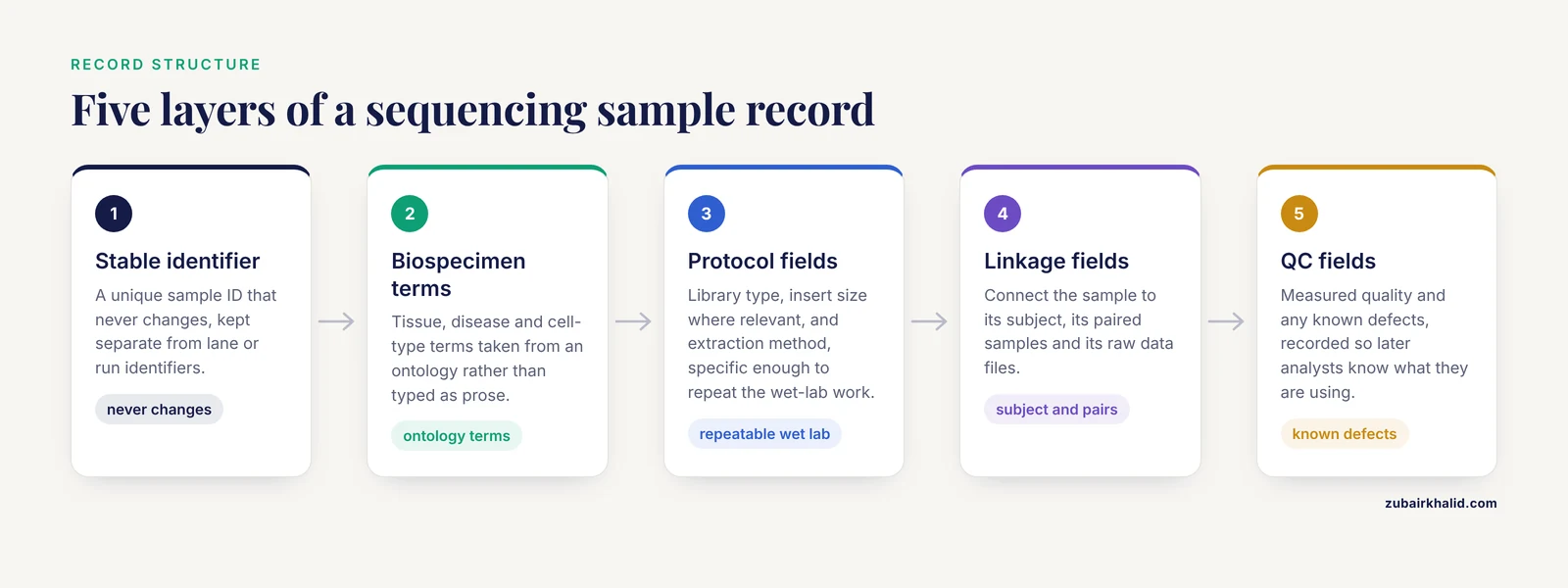
A practical annotation record for a sequencing sample typically contains the following layers, each of which should be internally consistent and versioned.
- A unique identifier that never changes, distinct from the lane or run identifier.
- Biospecimen terms drawn from an ontology, such as a tissue term, a disease term, and a cell-type term where applicable.
- Protocol fields with enough specificity to repeat the wet-lab work, including library type, insert size where relevant, and extraction method.
- Linkage fields connecting the sample to its subject, its paired samples, and its raw data files.
- QC fields recording measured quality and any known defects.
The public health genomics community has formalized this last layer. The Public Health Alliance for Genomic Epidemiology, PHA4GE, published a set of quality-control contextual data tags that provide standardized attributes for sharing public sequence datasets with known quality issues. The rationale is direct. Lower-quality datasets are often vital for validation, training, and optimization, but sharing them safely requires careful annotation of known issues so the data cannot be mistaken for higher-quality information and so derivatives remain identifiable in repositories [7]. A QC tag is an annotation, and it changes how a downstream analyst is allowed to use the sample.
Provenance as an annotation
Annotations are not limited to biology. A sample's computational history is part of its record. Reviews of microbial genomics infrastructure describe pipelines running from sample preparation through read preprocessing, assembly, and structural and functional annotation before submission to public databases, with standard tools at each stage such as FastQC, SPAdes, Prokka, Bakta, GTDB-Tk, QIIME 2, and Kraken2, alongside automated workflow systems like nf-core and Bactopia and emerging ontology-driven annotation frameworks [8]. Recording which of these tools, at which versions, touched a sample converts a mysterious result into a traceable one. In the same spirit, the placental genomics literature emphasizes that being consistent, thoroughly assessing potential confounders, and communicating key variables in the methods section are critically important for letting researchers build on each other's work [9].
How Annotations Enable Reproducible Interpretation, Step by Step
The role of sample annotations in reproducible genomics is easiest to see by following one reanalysis from start to finish.
Step 1. Discovery. An analyst searches a repository for samples matching a design, for example ChIP-seq experiments on a specific transcription factor in a specific tissue. This search runs entirely on annotations. If tissue and target were recorded with ontology terms, the search is precise. If they were recorded as idiosyncratic text, the search misses relevant samples or returns wrong ones.
Step 2. Annotation harmonization. The retrieved samples come from many labs and use many vocabularies. The analyst maps each sample's attributes onto shared terms. This is where structured approaches earn their keep. One study of Gene Expression Omnibus metadata mapped thousands of ChIP-seq samples to ontology concepts for target, tissue, and disease state, then used the resulting annotations to compute semantic similarity between samples. Semantic similarity is a quantitative measure of how close two annotated entities are in an ontology, and it allowed the authors to combine experiments with the same or similar annotations into large datasets without new experiments. Notably, tools based on topic-specific ontologies outperformed tools based on the Unified Medical Language System for both the annotation process and the similarity computation [2].
Step 3. Integration and batch awareness. With samples harmonized, the analyst can model the technical structure of the dataset, including which samples share a laboratory, a protocol, or a processing date. These are annotation-derived variables. Reproducibility reviews of large-scale genomics and brain imaging emphasize that analytic choices and data characteristics interact in ways that determine whether findings generalize across datasets [10].
Step 4. Interpretation. Annotation-derived covariates carry the biology. In landscape genomics, the association between genetic variation and environment only makes sense if the environmental conditions at each sampling location were recorded and processed consistently. The R.SamBada pipeline was built for exactly this, spanning retrieval of environmental conditions at sampling locations through to gene annotation, and standardizing the workflow specifically to enhance reproducibility of landscape genomic studies [11]. In exposure science, linking genomic data to the exposotype, meaning the individual's composite exposure profile measured through metabolomics, depends on sample-level context about diet, environment, and timing [12].
Step 5. Verification. The analyst checks whether the annotations match the data themselves. This step, discussed below, is where misannotation is caught.
Step 6. Re-release. The analyst deposits derived datasets with annotations of their own, closing the loop for the next reuser.
Each step is annotation-dependent. Remove any one of them and the chain breaks at that point, and every step after it inherits the failure.
How Annotations Fail in Practice
Mislabeling is common and measurable
The most alarming failure mode is not vagueness but wrongness. In a study of human transcriptomics datasets, researchers compared the sex annotations provided for each sample against the expression of sex-specific genes. Apparent mislabeled samples appeared in 46% of the datasets studied, which yields a 99% confidence lower-bound estimate of 33% across all studies. In a separate analysis of datasets from a single cohort of subjects, 2 of 4 datasets contained mislabeled samples, a pattern pointing to laboratory mix-ups rather than data recording errors. Because the method can only detect a subset of possible mix-ups, the authors described their estimate as conservative and stressed that reusers of published data must be alert to annotation and labeling errors [13].
Two lessons follow. First, annotation errors include wet-lab sample swaps, which no amount of better documentation at the spreadsheet stage can prevent after the fact. Second, the burden of detection falls partly on the reuser, which means annotation verification belongs in every reanalysis workflow.
Unstructured metadata suppresses discovery
Even accurate annotations fail when they are unstructured. The machine learning study of tissue annotations showed the scale of the opportunity. Working only from free-text sample descriptions, an NLP-ML approach that created numerical representations of sample descriptions and used them in a supervised classifier to predict tissue and cell-type terms significantly outperformed both an advanced graph-based reasoning method, MetaSRA, and an exact string-matching baseline, TAGGER. The learned models captured biologically meaningful signals, correctly classifying tissue-associated biological processes and diseases from text alone, and they approached the accuracy of models built on gene-expression profiles while working across experiment types regardless of the underlying genomics assay [3]. The existence and success of such methods is itself evidence of the problem. Machine learning is compensating for metadata that should have been structured in the first place.
Silent ambiguity in related fields
The same annotation discipline applies outside sequencing, and cross-omics comparisons inherit sequencing's standards. In human fecal 1H-NMR metabolomics, an evaluation of 10 extraction protocols across three solvents found that solvent type induced the highest variation in the data, and the study introduced a signature mapping method, SigMa, with a library covering the chemical shift ranges of 81 common fecal metabolites for unambiguous annotation. The explicit motivation was that generating comparable data across laboratories and cohorts requires standard operating procedures [14]. The parallel is exact. A metabolite peak without an annotation is as unusable as a sequencing sample without a tissue label, and both problems are solved by standardized, shareable vocabularies.
How Annotations Are Tested and Verified
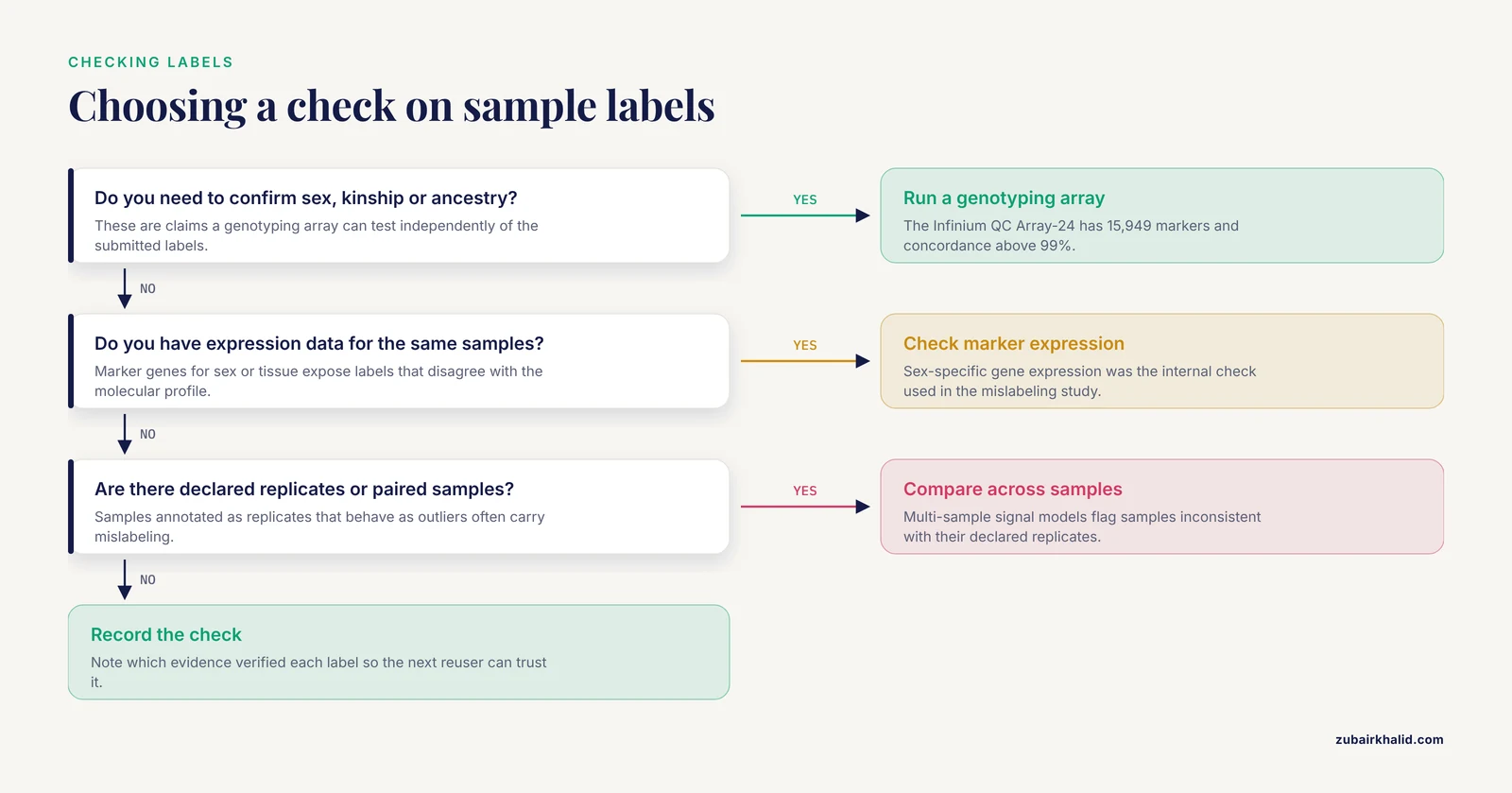
Annotation quality is not taken on faith. Several verification strategies are established practice.
Genotype-based identity checks. Genotyping arrays provide an independent check on sample identity, sex, relatedness, and ancestry. The low-density Infinium QC Array-24 BeadChip, with 15,949 markers, was evaluated as an independent quality-control option for NGS-based diagnostic laboratories. Concordance of genotype calls with other platforms exceeded 99%, and ancestry-informative markers supported ethnicity determination at continental and sometimes subcontinental levels, with mean regional provenance prediction accuracy ranging from 81% for Asia to 98% for Europe and 100% for India [15]. The practical lesson is that annotations such as sex, kinship, and population provenance are testable claims, not just labels, and a modest genotyping investment can validate them.
Expression-based consistency checks. The mislabeling study discussed above used expression of sex-specific genes as an internal check on sex annotations [13]. The same logic generalizes. Tissue-specific marker expression, expected correlation patterns among technical replicates, and concordance between paired samples all let the data audit the annotations.
Multi-sample signal analysis. In functional genomics, reproducible regulatory activity across samples is the signal, and locus- and sample-specific noise can obscure it. The Consenrich method uses a state-space model to estimate epigenomic signals across multiple ATAC-seq and ChIP-seq samples, and it improved the breadth of relevant biological findings when applied upstream of a class-imbalanced differential accessibility analysis in a 20-sample Alzheimer's cohort [16]. Multi-sample approaches implicitly test annotation consistency, because samples that are annotated as biological replicates but behave as outliers often carry mislabeling or undocumented protocol differences.
Operator and replicate audits. In spatial transcriptomics, a reproducibility assessment ran the Xenium assay on serial sections of FFPE breast, lung, and colon carcinoma samples prepared independently by two different operators, then co-registered the data to estimate reproducibility and quality across the platform and across operators [17]. Recording operator identity in the annotations is what makes such an audit possible after the fact.
The Infrastructure Layer: Bioinformatics Data Management and Genomics Data Storage
Annotations are only as durable as the systems that store them, which is why sample annotation policy belongs in any discussion of bioinformatics data management and genomics data storage.
Repository standards. Public archives, including NCBI resources such as the Gene Expression Omnibus and the Sequence Read Archive, define structured submission schemas for biosample attributes precisely because annotations are the access layer for everything else. The semantic annotation work on GEO metadata demonstrates what those schemas make possible when they are filled in well and what limitations remain when they are filled in as prose [2].
Versioned storage and deterministic processing. Reproducible pipelines require that inputs be pinned. Deterministic parallelization strategies like Churchill treat sample metadata as part of the fixed input specification, so that a rerun consumes the same samples described in the same way [4]. Containerized workflow systems, exemplified in pathogen surveillance by the Nextflow implementation behind COVID-MVP, extend the same pinning to software [5].
Standardized tags for imperfect data. The PHA4GE contextual data tags fill a gap that pure aspirational standards miss. Real repositories contain datasets of mixed quality, and standardized attributes for known quality issues let those datasets circulate safely, remain searchable, and support validation and training rather than contaminating analyses that assume clean data [7]. This is annotation policy serving reproducibility directly, not indirectly.
Community databases as annotation products. A curated database is, in essence, a large annotation exercise. The Astragalus functional genomics database AmDB collected 62 transcriptome samples from the SRA database and built a co-expression network covering 94.87% of coding genes, which was only possible because the samples could be located and grouped by their recorded tissue and treatment context [18]. Functional annotation tools show the other side of the same coin. KEGGaNOG translates eggNOG-mapper orthology annotations into KEGG module completeness scores and supports multi-sample analysis, meaning function-level annotations become sample-comparable features [19]. Orthology and pathway annotation of genes and consistent contextual annotation of samples are the two halves of any comparative framework.
Workflow-level standardization in ecology and agriculture. The R.SamBada package standardizes the landscape genomics pipeline from environmental data retrieval to gene annotation, framing that standardization explicitly as a reproducibility enhancement for the field [11]. The pattern generalizes. Wherever a subfield agrees on a shared pipeline and a shared annotation vocabulary, reproducibility stops depending on the habits of individual laboratories.
Comparative Relevance: What Breaks Without Annotations
It is useful to consider concrete scenarios in which annotation quality changes the scientific outcome.
- A meta-analysis across cohorts. If one cohort records sex as a controlled term and another records it inconsistently, the combined analysis either drops samples or imputes them. Genotype-based checks can recover some of this, but at added cost and with residual uncertainty.
- A cell-type deconvolution. Signature-based deconvolution assumes the bulk sample's tissue and disease context is known. A mislabeled tissue propagates through the entire model, and the mislabeling study shows such errors are far from rare [13].
- A pathogen surveillance report. Variant prevalence statistics depend on sample collection date and location. The COVID-MVP platform couples curated mutation annotations with a portable workflow so that spatio-temporal analyses rest on consistent inputs [5].
- A gene-environment association. Without consistent environmental annotations at each sampling location, local adaptation signals cannot be distinguished from structure artifacts. R.SamBada's standardization exists for exactly this reason [11].
- A tissue atlas. Databases spanning dozens of tissues and hundreds of samples, such as the 47-tissue chicken atlas in GEGA, are only navigable because sample-level tissue, sex, and age contexts are recorded comparably [1].
Common Misconceptions
Several misconceptions recur among students and new analysts.
"The reads contain all the information." Reads contain the sequence of one specimen under one condition. Everything that makes the specimen interpretable, including tissue, treatment, donor, and platform, lives in annotations. Two samples with identical reads from different tissues would tell you nothing without metadata.
"Metadata is a spreadsheet concern, not an analysis concern." Annotation variables are analysis variables. Batch, protocol, and laboratory membership enter statistical models directly, and the placental genomics experience highlights confounder assessment and explicit communication of key variables as core analytical practice, not clerical work [9].
"If the paper published it, the annotation is right." The mislabeling evidence says otherwise. Published sex annotations disagreed with expression data in a large fraction of surveyed datasets, and in a single-cohort comparison the errors pointed to physical sample mix-ups [13].
"Ancestry and ethnicity are the same field." HANCESTRO separates genetic ancestry, derived from analysis of genetic information, from self-reported ethnicity, which reflects social and cultural factors. Conflating the two damages both interpretation and inclusiveness of genomics research [6].
"Reproducibility is a software problem." Deterministic pipelines solve the computational half. The input half, meaning accurate sample descriptions and versioned references, requires annotation infrastructure. Reviews of big-data reproducibility across brain imaging and genomics treat both halves as first-class concerns [10].
Common Mistakes and Limitations
- Recording annotations as free text when a controlled term exists. Free text defeats search, integration, and semantic comparison. Map fields to ontology terms at the point of data entry, not at the point of reanalysis [2].
- Conflating sample annotations with gene annotations. They answer different questions and live in different files. Both are needed, and neither substitutes for the other.
- Assuming sex, tissue, and ancestry labels are correct. Screen for mislabeling using genotype or expression evidence whenever the data permit it. The published error rates justify the check.
- Discarding known quality issues instead of tagging them. A dataset with a documented defect is more useful than a silently flawed one. Use standardized QC tags so derivatives stay identifiable [7].
- Leaving provenance out of methods sections. Key variables that are not communicated cannot be reproduced. State cohort characteristics, processing steps, and confounder handling explicitly [9].
- Treating annotation harmonization as a one-off script. Ontology terms evolve, resources expand, and mappings need versioning. Annotate the annotations, meaning record which ontology version and mapping produced each harmonized field.
- Overtrusting automated annotation. Machine-learning annotation of free text performs well and even approaches expression-based accuracy, but it is a reconstruction from imperfect inputs. It recovers value from legacy metadata rather than replacing good practice at the bench.
- Ignoring population descriptor granularity. Coarse continental ancestry labels hide the diversity that modern resources are explicitly trying to capture. Use the most specific descriptor the data support [6].
Quick Review
- Sample annotations are structured, machine-readable descriptions of each specimen's identity, source, and processing, and they are the access layer for all genomic data reuse [2][3].
- Reproducible computation cannot rescue ambiguous input. Deterministic pipelines [4] and accurate metadata are both required.
- Controlled vocabularies and ontologies, such as HANCESTRO for population descriptors, convert prose into computable, FAIR attributes [6].
- Semantic similarity computed over ontology-annotated samples lets unrelated experiments be combined into large datasets without new data collection [2].
- Misannotation is common. Apparent mislabeled samples appeared in 46% of surveyed transcriptomics datasets, with a conservative lower bound of 33% of studies affected [13].
- Annotations are testable claims. Genotyping arrays, expression consistency checks, and multi-sample signal models can audit labels against the data [16].
- Standardized QC tags, such as those from PHA4GE, make imperfect datasets shareable without corrupting downstream interpretation [7].
Frequently Asked Questions
What does "sample annotations reproducibility genomics" mean?
It refers to the relationship between how thoroughly genomic samples are described and how reliably genomic analyses can be repeated or reused. Sample annotations are the structured metadata attached to each specimen, and reproducibility in genomics depends on those descriptions being accurate, complete, and standardized, because a rerun or reanalysis can only reproduce the original finding if the samples themselves are unambiguously defined.
What is the difference between sample annotations and gene annotations?
Sample annotations describe the biological material, including tissue, disease state, donor attributes, and processing history. Gene annotations describe genomic features, including exon coordinates, gene symbols, and pathway membership. A reanalysis needs both. The sample annotations define what was measured and under what conditions, and the gene annotations define how the measurements are assigned and interpreted.
How do annotations affect reanalysis of public data?
Discovery, harmonization, and interpretation of public samples all run on annotations. Researchers assembling large datasets from repositories need clear sample-level annotations to find relevant experiments and to relate samples carrying different annotation terms, which is why ontology-based mapping of repository metadata is treated as a prerequisite for large-scale data reuse [2].
How can mislabeled samples be detected?
The main strategies compare annotations against the data itself. Genotyping arrays verify sex, kinship, and ancestry independently of the submitted labels, with platform concordance above 99% in one evaluation [15]. Expression of sex-specific or tissue-specific marker genes exposes inconsistencies between labels and molecular profiles. Multi-sample epigenomic signal models flag samples that behave inconsistently with their declared replicates.
Which standards and ontologies should I use for sample annotations?
Use the submission schema of the target repository for required fields, ontology terms for biospecimen attributes such as tissue, disease, and cell type, and dedicated population descriptors such as HANCESTRO for ancestry and ethnicity [6]. For shared public health sequencing data, adopt the PHA4GE quality-control contextual data tags so that known quality issues travel with the dataset in a standardized form [7].
Can machine learning fix bad metadata automatically?
Machine learning can reconstruct missing structure from free text. A natural-language-processing approach that classifies tissue and cell type from unstructured sample descriptions outperformed graph-based reasoning and string-matching alternatives and worked across experiment types [3]. This makes legacy datasets far more usable, but it is recovery, not a substitute for structured annotation at the point of data collection, because the classifier can only infer what the original text hinted at.
Sources
- GEGA (Gallus Enriched Gene Annotation): an online tool providing genomics and functional information across 47 tissues for a chicken gene-enriched atlas gathering Ensembl and Refseq genome annotations
- Ontology-based annotations and semantic relations in large-scale (epi)genomics data
- Systematic tissue annotations of genomics samples by modeling unstructured metadata
- Churchill: an ultra-fast, deterministic, highly scalable and balanced parallelization strategy for the discovery of human genetic variation in clinical and population-scale genomics
- COVID-MVP: an interactive visualization for tracking SARS-CoV-2 mutations, variants, and prevalence, enabled by curated functional annotations and portable genomics workflow
- Expanding the Human Ancestry Ontology to include under-represented populations and ethnicities for broader utility in annotations
- PHA4GE quality control contextual data tags: standardized annotations for sharing public health sequence datasets with known quality issues to facilitate testing and training
- Advancements and challenges in bioinformatics tools for microbial genomics in the last decade: Toward the smart integration of bioinformatics tools, digital resources, and emerging technologies for the analysis of complex biological data.
- Considerations when processing and interpreting genomics data of the placenta
- Big Data Reproducibility: Applications in Brain Imaging and Genomics
- Rapid identification and interpretation of gene-environment associations using the new R.SamBada landscape genomics pipeline
- Beyond genomics: understanding exposotypes through metabolomics
- Whose sample is it anyway? Widespread misannotation of samples in transcriptomics studies
- Human faecal 1H-NMR metabolomics: Evaluation of solvent and sample processing on coverage and reproducibility of signature metabolites.
- Clinical utility of the low-density Infinium QC genotyping Array in a genomics-based diagnostics laboratory
- Genome-Wide Uncertainty-Moderated Extraction of Signal Annotations from Multi-Sample Functional Genomics Data
- 832 Reproducibility and quality assessment study of xenium and visium spatial transcriptomics assays from multiple carcinoma samples via an end-to-end spatial multi-omics platform weave
- AmDB: functional genomics database of Astragalus membranaceus
- KEGGaNOG: A Lightweight Tool for KEGG Module Profiling From Orthology-Based Annotations