How to Evaluate Protein Motif Discovery Tools
By Dr. Zubair Khalid, DVM, MS, PhD ·

A motif discovery tool infers an unknown, repeated pattern from a set of unaligned sequences, while a motif scanning tool only looks for a pattern you already possess. That distinction drives every other decision in this article, because discovery is a statistical inference problem with false positives, false negatives, and tuning choices, whereas scanning is a lookup problem.
The rule of thumb for choosing: first match the tool class to the motif class you are hunting and to the number of sequences you have, then judge the remaining candidates on published benchmark design, on how they model "uninteresting" background sequence, and on whether a realistic validation path exists after discovery. A tool that wins a benchmark built for long DNA transcription factor binding sites tells you almost nothing about its ability to find a four-residue kinase docking motif inside a disordered protein region.
This guide walks through the full protein motif discovery tool evaluation process. It defines the vocabulary, lays out the major tool options side by side, compares them on the criteria that actually decide real projects, works through concrete scenarios, and lists the mistakes that most often sink an analysis.
What Protein Motif Discovery Actually Means
A protein motif is a short pattern of amino acids that recurs across proteins and carries biological meaning. The meaning can be a binding site for another protein, a targeting signal, a post-translational modification site, or a catalytic residue cluster. Motifs range from short and highly degenerate, such as the LXXLL nuclear receptor coactivator motif used in receptor ligand assays [1], to longer and much more specific patterns.
Several terms come up constantly in tool documentation, and each one matters during evaluation.
De novo discovery means the tool receives raw sequences and reports overrepresented patterns without being told what to look for. Pattern matching means the tool receives a known pattern, often as a regular expression such as [RK]..[DE], and scans sequences for it. Confusing these two modes is the single most common category error in bioinformatics tools comparison discussions.
A position weight matrix (PWM), sometimes called a position-specific scoring matrix, represents a motif as a table of per-position amino acid probabilities. A consensus string compresses a motif into allowed residues per position. PWMs preserve more information than consensus strings but can misrepresent dependencies between positions.
A short linear motif (SLiM) is a compact, degenerate interaction module, typically between roughly 3 and 10 residues, that sits in intrinsically disordered regions of proteins. Large portions of higher eukaryotic proteomes are intrinsically disordered, and those regions are rich in regulatory interaction interfaces, which is exactly why computational methods are used to focus scarce experimental discovery effort on candidate SLiMs [2].
A background model describes what "uninteresting" sequence looks like. A discovery tool distinguishes real motifs from noise by asking whether the pattern appears more often than the background predicts. If the background model is wrong, the ranked list of motifs is wrong, no matter how sophisticated the search algorithm is.
Finally, intrinsic disorder refers to protein segments that do not fold into a stable three-dimensional structure on their own. Many functional motifs live in these regions, and several tools deliberately restrict their search to disordered segments to cut false positives.
The Evaluation Framework: Five Questions Before Any Tool Is Run

How to evaluate protein motif discovery tools comes down to five questions, asked in order. Skipping a question is how analyses produce impressive-looking motifs that collapse on inspection.
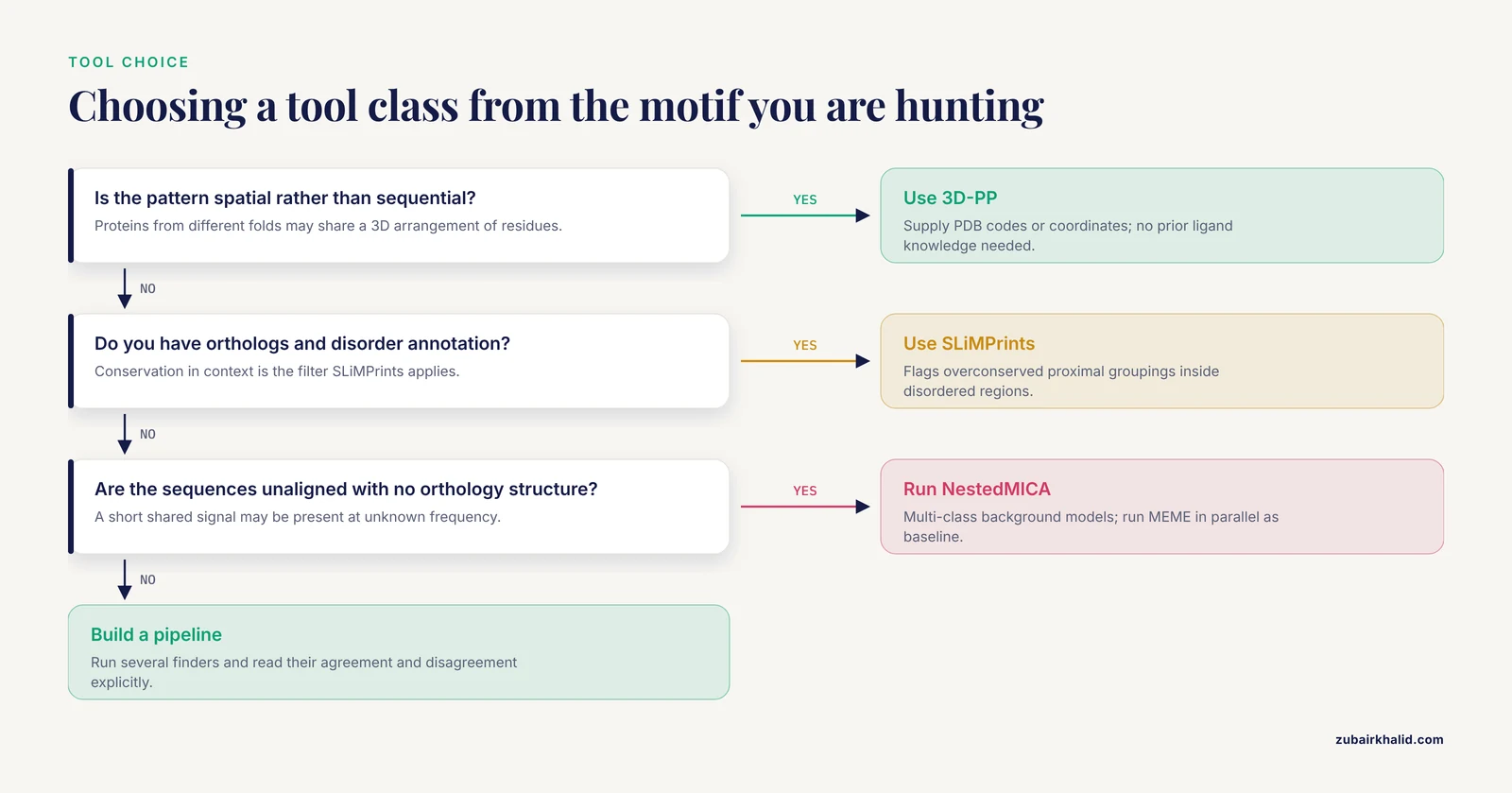
1. What motif class am I hunting? Short linear motifs in disordered regions, overrepresented short signals across an unaligned protein set, post-translational modification site signatures, domain architecture features, and conserved three-dimensional residue patterns are different problems. A de novo sequence finder such as NestedMICA targets overrepresented short signals in protein sequence sets [3]. SLiMPrints targets conserved residue groupings inside disordered regions [2]. 3D-PP targets spatial residue patterns in protein structures, independent of sequence similarity [4]. Running the wrong tool class for the motif class wastes weeks.
2. What does the tool model, and what does it ignore? NestedMICA, for example, uses multi-class sequence background models to represent the different uninteresting parts of sequences that do not contain motifs of interest, and it is driven by a Monte Carlo technique called Nested Sampling [3]. SLiMPrints introduces a statistical framework that quantifies the likelihood a residue will show a particular level of conservation given the conservation of its surrounding residues, and extends that framework to assess groupings of conserved residues [2]. The modeling choice is the tool. When a paper describes a tool's model, read that section before reading any accuracy claim.
3. How was it benchmarked, on what data, and against what competitors? A credible benchmark states the motif lengths tested, the frequency at which motif instances were planted, the background composition, and the comparison baselines. The NestedMICA study is a useful template because it used two complementary designs: synthetic datasets produced by spiking instances of known motifs into randomly selected protein sequences, and a biologically authentic test set where performance was evaluated with respect to varying sequence length [3]. Synthetic spiking gives ground truth. Authentic sets test whether the ground-truth conclusions survive contact with real biology. A tool evaluation backed by only one of the two is weaker than its headline numbers suggest.
4. Does it scale, and is the workflow reproducible? User queries vary greatly in size, scope, and character, so the trade-offs in speed, accuracy, and scale need to be considered when choosing which methods to adopt [5]. A server that is excellent for ten proteins may be unusable for a proteome. Reproducibility means you can record versions, parameters, and inputs, and rerun the analysis next year.
5. What is the validation path after discovery? Discovery produces candidates, not facts. A well-designed project pairs the discovery tool with structural mapping, biochemical affinity measurement, and cellular readouts. The THAHIT project is a strong model: it mapped PKA binding motifs across A-kinase anchoring proteins, predicted specificity toward PKA-RIα and PKA-RIIα, and then verified the newly predicted anchoring sites with computational modeling using HADDOCK, biochemical affinity studies using fluorescence anisotropy, and cellular colocalization studies, before demonstrating the tool on chemical proteomics datasets and the human proteome [6]. That loop, from prediction to modeling to affinity to cells, is the standard a serious evaluation should aim for.
Protein Motif Discovery Tool Evaluation Options: Side-by-Side Comparison
The table below is the core of this protein motif discovery tool evaluation. It covers the tool families a working analyst is most likely to choose between, using only documented capabilities.
| Tool or tool family | Class | Typical input | What it models | Documented strengths | Key caveats |
|---|---|---|---|---|---|
| NestedMICA [3] | De novo, ab initio | Unaligned protein sequence sets | Multi-class background models, Nested Sampling Monte Carlo | Recovered most short 3-9 aa test motifs, finds multiple motifs at once, outperformed MEME in its assessment experiments | Runtime can be substantial, detection depends on motif frequency in the input set |
| MEME (as the standard comparator) [3] | De novo, expectation-maximization | Unaligned sequence sets | Shared enriched motifs | Ubiquitous, many downstream wrappers exist | In head-to-head protein motif tests, NestedMICA showed better overall discovery performance [3] |
| SLiMPrints [2] | De novo, conservation-based | Orthologous alignments of proteins with disordered regions | Relative overconservation of proximal residue groupings | Statistical framework for conserved residues in context, applied to the human proteome | Needs reliable orthologs and disorder annotation, conservation alone is not proof of function |
| 3D-PP [4] | De novo, structural | PDB accession codes or coordinate files | Three-dimensional residue patterns independent of sequence similarity | Finds convergent spatial patterns without prior ligand knowledge, graph-database backed | Requires structural data, results depend on the quality and provenance of the structures used |
| MODSIDE [7] | Pipeline, multi-tool consensus | Sequences with mapped peak regions (DNA benchmark) | Consensus across four de novo finders plus similarity detection | Better accuracy than individual motif finders across 16 benchmark datasets, reports motifs found by some tools but not others | Benchmarked on DNA datasets, pipeline overhead, agreement is not truth |
| MDDLogo-based workflows [8] | Motif characterization inside a classifier | Labeled positive and negative site datasets | Substrate motifs for modification sites combined with sequence features | Motif-discovery features improved SVM model accuracy to an average of 68.70 percent under five-fold cross-validation | Requires curated labeled datasets, motif discovery is a component rather than a standalone answer |
| THAHIT [6] | Family-specific motif mapper | Annotated members of a protein family | Family-specific motif rules and isoform specificity | Maps binding motifs and predicts RIα versus RIIα preference, validated by modeling and affinity assays | Designed for one family, not general-purpose discovery |
| d-Omix [9] | Domain architecture analysis | InterProScan result files | Domain combinations, versatility, co-presence, domain-domain interactions | Unified platform for comparing proteins by domain architecture, exports standard formats | Analyzes precomputed domain calls, does not discover sequence motifs itself |
| Distill suite and related servers [5] | Prediction infrastructure | Protein sequences | Structural features, disorder, functional site propensity | Guided access to prediction of structural features, disorder, and SLiM-relevant signals | A suite of predictions, the analyst still owns tool selection and interpretation |
One honest note on scope. Several of the most rigorous motif discovery benchmarks in recent literature were run on DNA motifs, including a large cross-platform study that applied ten different DNA motif discovery tools to 4,237 experiments covering 394 human DNA-binding proteins [10]. The biology differs from proteins, but the evaluation logic, cross-platform consistency checks, benchmark-supported curation, and skepticism toward tools tested only by their own authors, transfers directly to protein work.
Explaining Each Tool Option on Its Own Terms
NestedMICA, the ab initio short-signal finder
NestedMICA was adapted and extended from a transcription binding site motif finder into a protein motif discovery tool for short signals, and it is written in Java and open source [3]. Its defining design choice is the multi-class sequence background model. Instead of assuming one statistical description of non-motif sequence, it represents several kinds of uninteresting sequence separately, which matters enormously in proteomes where coding regions, low-complexity segments, and disordered tails have very different amino acid statistics.
In assessment experiments, the authors spiked instances of known motifs at different frequencies into test sets and evaluated recovery of short, 3-9 amino acid test motifs. NestedMICA recovered most of the planted motifs and also demonstrated the ability to find multiple motifs at the same time. Across the assessment experiments carried out, its overall motif discovery performance was better than that of MEME, the other popular protein motif finder used as the comparator [3].
The evaluation lesson embedded in this study is as valuable as the tool itself. Spiking synthetic motifs gives you sensitivity curves, meaning how recovery changes as the motif becomes rarer in the input. The biologically authentic test set, evaluated across varying sequence lengths, checks that the synthetic results were not an artifact of the simulation. Any tool you evaluate seriously should be able to point to both kinds of evidence.
MEME and the role of the standard comparator
MEME appears throughout this literature not because it loses, but because it is the reference point everyone knows. When the NestedMICA authors wanted to establish that their approach was competitive, MEME was the tool they compared against [3]. When you run your own protein motif discovery tool evaluation, you need an equivalent baseline, a widely available, well-understood tool whose behavior on your data type is broadly familiar to the community. Reporting that your chosen tool beat an unspecified "alternative method" is not evidence. Reporting that it beat a named, standard baseline on data you describe is.
SLiMPrints, conservation as a filter inside disordered regions
SLiMPrints answers a specific and important question: within an intrinsically disordered region, which residue groupings are unusually conserved relative to their local context? Large parts of higher eukaryotic proteomes are intrinsically disordered and rich in regulatory interfaces, but experimental identification and validation of SLiMs is difficult, which is precisely why computational methods are needed to focus experimental discovery [2].
The statistical framework does two things. First, it assesses the significance of a relatively conserved residue by asking how likely that residue is to show a given level of conservation given the conservation of its surroundings. Second, it extends to groupings of conserved residues, identifying relatively overconstrained proximal groupings that indicate putatively functional motifs. The authors applied the method to the human proteome to generate a set of highly conserved putative motif instances, including a novel site on a translation-related protein [2].
For evaluation purposes, SLiMPrints illustrates the principle of narrowing the search space with biology before running statistics. Restricting a motif search to disordered segments removes an enormous amount of structural noise, because a degenerate linear motif is unlikely to function as an exposed binding interface inside a folded core.
3D-PP, discovery in structure space
Sequence-level tools cannot see convergent evolution, where two proteins with no detectable sequence similarity arrange residues in three dimensions to perform the same chemistry. 3D-PP is a free web server for discovering and recognizing similar three-dimensional amino acid patterns among a set of protein structures, independent of their sequence similarity, and it does not require any previous structural knowledge about ligands. Input can be PDB accession codes or a zip file of coordinates, from X-ray crystallography or homology modeling, and results are presented as lists of sequence patterns that can be analyzed further on the site [4].
Most prior tools of this type only consider previously known 3D-patterns such as orthosteric binding sites or established structural motifs, which leaves allosteric sites and enzyme-cofactor interaction motifs out of reach. 3D-PP was designed to address that gap, and the authors tested its accuracy and suitability using two sets of proteins drawn from the Protein Data Bank [4].
MODSIDE and the case for pipelines
Single tools have failure modes, and the simplest way to reduce them is to run several and look at agreement. MODSIDE is a motif discovery pipeline and similarity detector that integrated four de novo motif finders, ChIPMunk, MEME, Weeder, and XXmotif, along with a motif similarity detection tool called MOTIFSIM. Its design goal is broader than a ranked list: it delivers predictive results from individual finders, comparison results across tools, the common significant motifs, the motifs detected by some tools but not others, and the best matches for each motif in a collection. It can also merge similar motifs and cluster motifs into motif trees [7].
Evaluated on 16 benchmark datasets, MODSIDE achieved better accuracy than individual motif finders, and comparison against two popular pipelines, MEME-ChIP and RSAT peak-motifs, showed it attains similar performance [7]. The structural insight for evaluators is that the pipeline reports disagreements explicitly. Knowing that two of four finders see a motif and two do not is more informative than any single tool's confidence score, because it reveals which tools are sensitive to which features of your data.
The same integration principle has been demonstrated outside motif discovery. In subcellular localization prediction, dozens of tools are available, each performs well on certain datasets, and their predictions often disagree for a given protein. Shen and Burger integrated the outputs of multiple localization tools by several strategies and found that integration via a two-layer decision tree clearly outperformed simpler methods, reaching accuracy up to 92 percent and surpassing individual tools by a wide margin, because it could emphasize biologically relevant features such as targeting peptides and transmembrane domains [11]. The method of integration proved crucial to the performance, a finding that applies whenever you combine motif tools.
MDDLogo within classification workflows
Sometimes motif discovery is not the end product but a feature generator. In work on protein ubiquitination sites, the researchers assessed amino acid composition, amino acid pair composition, and evolutionary information individually and in hybrid combinations, applied support vector machines to build prediction models, and adopted the motif discovery tool MDDLogo to characterize potential substrate motifs of ubiquitination sites. SVM models integrating the MDDLogo-identified substrate motifs reached an average accuracy of 68.70 percent under five-fold cross-validation, with further independent testing reported [8]. When you evaluate a tool used this way, the relevant question is whether adding its output measurably improves the downstream model, which is a clean and honest way to benchmark.
THAHIT, a family-specific mapper with a full validation loop
Not every tool needs to be a general discovery engine. THAHIT was built to accurately map the PKA binding motif, and additional motifs, across the more than 40 reported A-kinase anchoring proteins, and to predict whether a given anchoring helix binds PKA-RIα, PKA-RIIα, or both. Validation went beyond computation: fluorescence anisotropy measured affinity, cellular colocalization tested the biology, and the tool was further applied to identify novel AKAPs in cAMP-based chemical proteomics discovery datasets and across the human proteome [6]. For evaluation, THAHIT shows what a mature, narrow tool looks like when its claims are tested by orthogonal methods, and it is a template for the validation section of your own evaluation.
d-Omix and PDBminer, context tools that sharpen interpretation
Two adjacent tools rarely appear in motif discovery discussions but belong in any serious evaluation. d-Omix takes InterProScan files for protein sets and provides four services, including phylogenetic trees built from protein domain architectures, visualization of domain versatility, abundance and co-presence via a domain graph, similarity comparison based on domain architecture alignment, and a putative protein network from domain-domain interactions. It also lets users prepare an InterProScan file from raw protein sequences and choose among domain search tools such as hmmpfam and superfamily for specific analyses [9]. Domain context tells you whether a sequence motif you found is embedded in a conserved domain architecture, which changes how much weight you give it.
On the structural side, PDBminer searches the AlphaFold Database and the PDB for available structures of your proteins and produces an up-to-date, quality-ranked table reporting coverage aligned to the UniProt sequence, model quality, and information on complexes, ligands, and nucleic acid chain binding, with helper tools for visualizing results [12]. Because experimental structures and high-quality in silico models each carry significant advantages and drawbacks [12], structure selection is a genuine evaluation step, not an afterthought, whenever your motif hypothesis will be checked against a three-dimensional context.
How the Options Compare on the Criteria That Decide Real Choices
Sensitivity on short, degenerate motifs
Short motifs are the hardest case. The NestedMICA study chose the 3-9 amino acid range deliberately, because that is where degeneracy makes statistical detection brutal, and its background modeling and nested sampling approach recovered most planted motifs at different frequencies while outperforming MEME overall [3]. If your target is a short linear motif, weight evidence from benchmarks in that length range far above evidence from longer-motif benchmarks.
Statistical grounding and background modeling
A discovery tool is a hypothesis test wearing a software interface. Tools that articulate their null hypothesis explicitly are easier to evaluate. SLiMPrints formalizes the null as the conservation a residue would show given its surroundings, then asks whether proximal groupings exceed it [2]. NestedMICA formalizes the null through multi-class background models of uninteresting sequence [3]. Tools whose documentation cannot answer the question "more frequent than what, exactly?" should lose points in any protein motif discovery tool evaluation.
Agreement across tools and platforms
Consensus analysis is now standard practice. MODSIDE's benchmark results, better accuracy than individual finders, were built directly on running four finders and analyzing their agreement and disagreement [7]. The cross-platform DNA motif study pushed the idea further, running ten tools across 4,237 experiments on five platforms and finding that a benchmark-supported curated subset, about 30 percent of experiments and 50 percent of tested proteins, showed motifs consistent across platforms and replicates, while also demonstrating that with high-quality experimental data most popular tools detect valid motifs [10]. The dual lesson: agreement across diverse tools raises confidence, and even then a large fraction of raw results fail consistency checks, so curation remains unavoidable.
Scale, speed, and the data-centric alternative
The trade-offs in speed, accuracy, and scale must be considered for every query, because queries vary greatly in size, scope, and character [5]. A newer wrinkle is letting data properties choose the tool. MLProbs used shallow machine-learning classifiers, trained on existing benchmark data, to select a better alignment tool and decide whether and how much to realign, and it consistently gave the highest TC score compared with ten other popular alignment tools over four benchmark databases. On the hardest data, 1,356 protein families with similarity at or below 50 percent, it reached a TC score of 56.93 against a next-best range of 55.41 to 55.91 [13]. The general lesson for motif work: a small amount of benchmark-informed routing, choosing the tool per dataset rather than per lab, outperforms a fixed pipeline.
Consensus building as a deliberate method
Integration is not limited to motif finders. Beyond the localization example where a two-layer decision tree drove accuracy to 92 percent [11], the motif model layer offers the same opportunity. abc4pwm clusters PWMs from multiple sources with or without DNA-binding domain information, generates a representative motif per cluster, automatically evaluates clustering quality, filters out incorrectly clustered PWMs, and performs motif discovery through a new ensemble learning approach [14]. Cluster quality assessment is the piece most analysts skip, and it is the piece that makes consensus meaningful.
Orthogonal evidence streams
The most underused evaluation asset is evidence that does not come from sequence at all. Pánek's study of orphan neurotransmitter transporters combined standard multiple sequence alignment with an alternative analysis of hydropathy distribution, then validated and biologically interpreted the resulting classifications through literature and knowledgebase annotation mining, producing a consensus classification that identified and functionally characterized three families of uncharacterized NSS proteins [15]. The stated principle deserves to be quoted directly: various sources of protein data are available, and the matter becomes one of choosing the tools most appropriate for the specific task and the specific proteins, with combinations of standard and alternative tools leading to biologically significant results [15].
Worked Scenarios
Scenario 1: Hunting a short docking motif in a signaling protein family
You have 30 orthologous proteins from a signaling family and you suspect a short interaction motif in a disordered linker. Start by mapping disorder, since prediction of protein intrinsic disorder and prediction of functional sites and SLiMs are established parts of the in silico toolkit, with servers such as the Distill suite providing structural feature prediction from sequence [5]. Then apply SLiMPrints to the orthologous alignments, using its statistical framework to flag proximal groupings of residues that are overconserved relative to their neighbors within disordered regions [2]. Cross-check candidates with d-Omix by building the domain architecture tree and domain graph, to see whether motif-containing members share a domain combination, using InterProScan files as input [9]. Finally, for the strongest candidates, pull structures with PDBminer and check whether the motif region is modeled and exposed, reading the quality-ranked coverage table against the UniProt sequence [12]. If the motif is absent from structures, that absence is itself information about disorder.
Scenario 2: An unknown short signal shared across an unaligned protein set
You have 500 proteins, possibly sharing a short degradation or trafficking signal, with no orthology structure to exploit. This is the exact problem NestedMICA was adapted to solve. Run it with its multi-class background models, and note that it can report multiple motifs at once, which matters when your set contains more than one shared signal [3]. Run MEME in parallel as the named baseline. In the published head-to-head on short protein motifs, NestedMICA outperformed MEME overall [3], but your data is not their test set, and the comparison on your own data, with the same input files for both tools, is the result that counts. For any candidate motif, search for literature support using the annotation-mining approach that proved decisive in the NSS transporter study [15].
Scenario 3: Proteome-scale post-translational modification site characterization
You have a large set of experimentally verified modification sites and want both a predictor and interpretable motifs. Build hybrid features from amino acid composition, amino acid pair composition, and evolutionary information, train SVM models, and use MDDLogo to characterize substrate motifs within the site groups. The published workflow reached an average accuracy of 68.70 percent under five-fold cross-validation when integrating motif features, with independent testing also reported [8]. Evaluate honestly by holding out an independent test set, because cross-validation alone flatters models on small-scale data, a limitation the authors of that study themselves identified in prior tools focused on small datasets [8].
Scenario 4: A convergent three-dimensional pattern without sequence similarity
You suspect that proteins from different fold families bind the same cofactor using a recurring spatial arrangement of residues. Sequence-based discovery will fail by construction. Use 3D-PP, supplying PDB accession codes or a coordinate archive, and let it enumerate similar three-dimensional amino acid patterns across the set without needing prior ligand knowledge [4]. Before interpreting the hits, apply structure selection discipline. Experimental PDB structures and AlphaFold models have different strengths and drawbacks, and PDBminer's quality-ranked table, with coverage aligned to UniProt numbering, exists precisely because choosing suitable structures is error-prone and needs to be made faster and less error prone [12]. For mapped sites, iMolTalk offers sequence-to-structure residue mapping, searches for contacts of residues or heterogeneous groups, and identifies protein-protein interfaces between chains, presenting results as two-dimensional graphics and text suitable for further processing [16].
Common Mistakes and Limitations
Trusting a tool's own benchmark uncritically. Every developer benchmarks against competitors they chose. The cross-platform motif study found that with high-quality experimental data most popular tools detect valid motifs, yet only a curated minority of raw experiments showed consistent motifs across platforms and replicates, about 30 percent of experiments and 50 percent of tested proteins [10]. Read benchmarks for design quality, planted motif lengths, motif frequencies, background composition, named baselines, before reading the accuracy figures.
Running discovery tools on the wrong motif class. A tool tuned for overrepresented short signals across unaligned sets [3] is not interchangeable with a conservation-based disordered-region scanner [2] or a structural pattern finder [4]. Wrong-class evaluations produce confident nonsense.
Ignoring the background model. The uninteresting sequence determines the noise floor. Multi-class background modeling was a central design feature of NestedMICA and a central reason it outperformed MEME on short protein motifs [3]. If you cannot state what background a tool assumes, you cannot interpret its output.
Confusing pipeline gains with universal gains. MODSIDE beat individual finders on 16 benchmark datasets [7], and integrated localization prediction reached 92 percent accuracy with the right integration strategy [11]. But integration methods differ, the method of integration proved crucial [11], and a pipeline benchmarked on DNA peak-region data does not automatically transfer its numbers to protein SLiM discovery. Verify on your own data.
Skipping the validation loop. Discovery output is a candidate list. THAHIT's predictions earned credibility through HADDOCK modeling, fluorescence anisotropy affinity measurements, and cellular colocalization [6]. An evaluation that stops at the ranked motif list is incomplete.
Overreading conservation. SLiMPrints identifies relatively overconstrained groupings that are indicative of putatively functional motifs [2]. Indicative means a hypothesis to test, not a result to publish as established function. Conversely, underusing conservation wastes your strongest filter, since conservation in context was developed exactly because experimental SLiM identification is difficult and computation must focus the experiments [2].
Neglecting structure and domain context. A motif sitting inside a folded hydrophobic core or in a protein whose domain architecture differs from its functional relatives deserves suspicion. Domain architecture comparison [9], structure quality ranking [12], and residue-level contact analysis [16] are cheap checks that catch expensive mistakes.
Forgetting scale and reproducibility. Speed, accuracy, and scale trade against each other and against query characteristics [5]. Record tool versions, parameters, and input files. A result you cannot rerun is a result you cannot defend.
Treating benchmark scores as portable. MLProbs beat ten alignment tools consistently on four benchmark databases, with the largest gains on low-similarity families [13], yet those numbers describe those databases. Use published scores to shortlist tools, then run your own controlled comparison on representative data.
Frequently Asked Questions
Is there a single best protein motif discovery tool?
No, and any protein motif discovery tool evaluation that crowns one winner is answering a different question than yours. NestedMICA outperformed MEME on short protein motifs in head-to-head tests [3], SLiMPrints wins for conservation-informed scanning of disordered regions [2], and 3D-PP wins when the pattern is spatial rather than sequential [4]. The best bioinformatics software for your project is the tool whose model matches your motif class.
How many sequences does motif discovery need?
Enough sequences, at a high enough motif frequency, for the pattern to rise above the background. The NestedMICA assessment tested performance on motifs spiked at different frequencies and across varying sequence lengths [3], which is the right way to think about it: required sequence count depends on motif frequency and degeneracy, not on a universal threshold.
Should I run one tool or a pipeline of several?
Prefer a pipeline when the stakes are high, because multi-tool consensus improved accuracy over individual finders in benchmark testing [7] and integrated multi-tool strategies surpassed individual tools in adjacent prediction tasks [11]. The payoff is not just accuracy, it is knowing which tools disagree and why.
How do I validate a motif that a tool found?
Pair at least two orthogonal methods with your discovery result. The strongest published template combines computational modeling through HADDOCK, biochemical affinity measurement through fluorescence anisotropy, and cellular colocalization, applied to predicted PKA anchoring motifs [6]. Add structural context and literature mining where possible.
Can DNA motif discovery tools be used on protein sequences?
No. The alphabets, substitution patterns, and biological logic differ, so a DNA-optimized finder is not a protein finder. However, the evaluation methodology, cross-platform benchmarking, replicate consistency checks, and curated benchmark subsets, developed in large DNA studies [10] and in DNA-focused pipelines [7], transfers well to protein work.
What should I look for when reading a tool's benchmark paper?
Look for three things: a synthetic benchmark with planted motifs at stated frequencies, a biologically authentic test set [3], and named comparison baselines. Benchmarks that include all three, as the NestedMICA study did [3], deserve the most weight in your protein motif discovery tool evaluation.
Sources
- Novel split luciferase-based biosensors for evaluation of vitamin D receptor ligands and their application to estimate CYP27B1 activity in living cells.
- SLiMPrints: conservation-based discovery of functional motif fingerprints in intrinsically disordered protein regions.
- NestedMICA as an ab initio protein motif discovery tool.
- 3D-PP: A Tool for Discovering Conserved Three-Dimensional Protein Patterns.
- In silico protein motif discovery and structural analysis.
- A systematic evaluation of protein kinase A-A-kinase anchoring protein interaction motifs.
- MODSIDE: a motif discovery pipeline and similarity detector.
- A New Scheme to Characterize and Identify Protein Ubiquitination Sites.
- d-Omix: a mixer of generic protein domain analysis tools.
- Cross-platform DNA motif discovery and benchmarking to explore binding specificities of poorly studied human transcription factors.
- 'Unite and conquer': enhanced prediction of protein subcellular localization by integrating multiple specialized tools.
- PDBminer to Find and Annotate Protein Structures for Computational Analysis.
- MLProbs: A Data-Centric Pipeline for Better Multiple Sequence Alignment.
- abc4pwm: affinity based clustering for position weight matrices in applications of DNA sequence analysis.
- A comparative computational analysis of protein sequences and literature mining classify 'orphan' neurotransmitter transporters.
- iMolTalk: an interactive, internet-based protein structure analysis server.