NCBI Virus vs. GenBank vs. RefSeq: Which Database Should You Use
By Dr. Zubair Khalid, DVM, MS, PhD ·

In one sentence: GenBank is the archival record of every submitted virus sequence, RefSeq is the small curated set of reference standards drawn from that record, and NCBI Virus is a specialized search and retrieval layer that indexes both so you can filter virus data by host, geography, lineage, and completeness. The rule of thumb is simple. Start every virology project at NCBI Virus to find and filter sequences, anchor your analysis to RefSeq when you need a stable, curated reference, and go to GenBank when you need the complete, raw, as-submitted record of everything that exists for your virus of interest.
This guide explains what each resource actually is, how they relate to each other, which criteria should drive your choice, and how to run the retrieval steps at the command line. It closes with worked scenarios and the mistakes that cost people the most time.
The Rule of Thumb
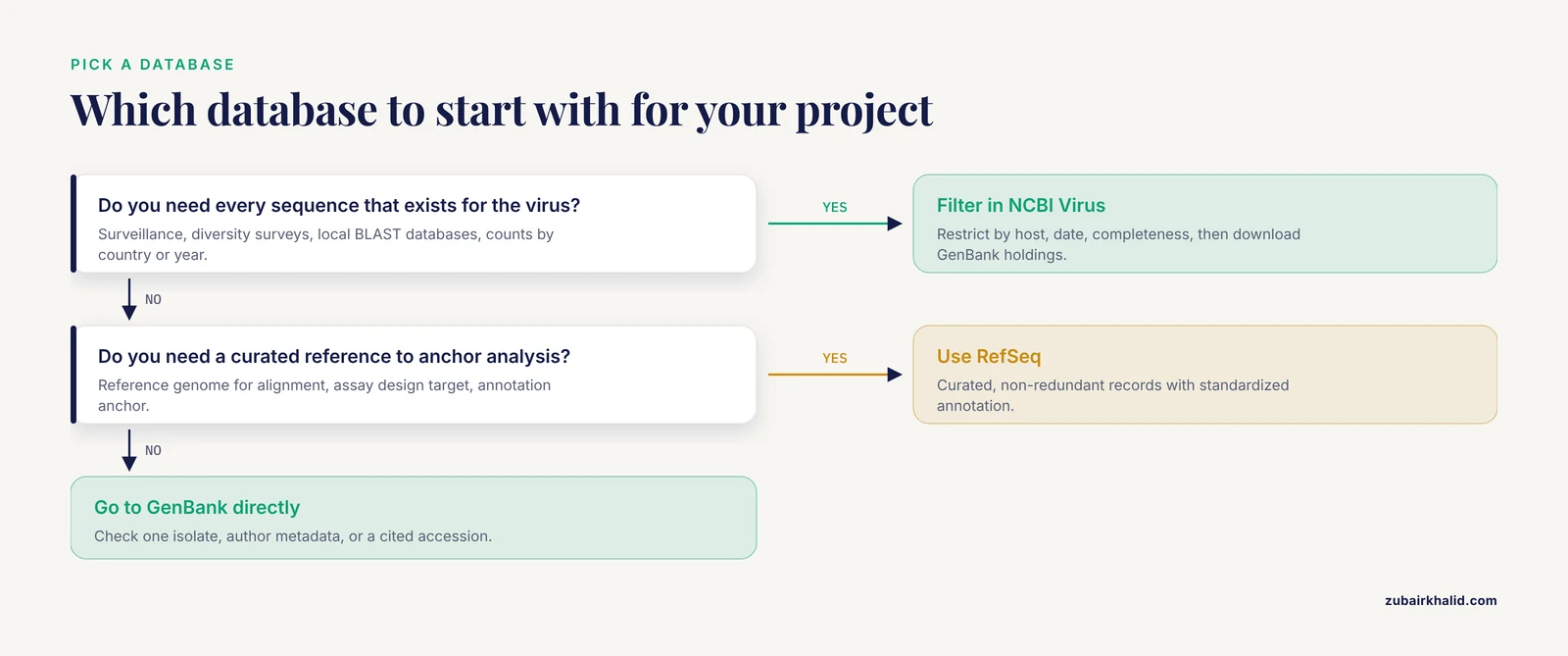
Ask one question before you download anything: do you need everything, or do you need the best?
- Need everything (surveillance, diversity surveys, building a local BLAST database, counting sequences by country or year)? Use NCBI Virus to filter, then download from GenBank holdings.
- Need a gold standard (a reference genome for alignment, a nomenclature anchor, a target for diagnostic assay design, a training set for annotation models)? Use RefSeq.
- Need to verify what a specific isolate contains, check author-submitted metadata, or pull a single accession someone cited in a paper? Go to GenBank directly.
For most analyses you will use all three in one project: NCBI Virus to discover, GenBank for the full corpus, RefSeq as the yardstick.
What GenBank Is
GenBank is the National Center for Biotechnology Information's archival nucleotide sequence database. It is the US node of the International Nucleotide Sequence Database Collaboration, which exchanges data daily with ENA in Europe and DDBJ in Japan, so a sequence deposited anywhere in that network appears in all three. Archive is the operative word. GenBank accepts author-submitted sequences, stores them largely as submitted with basic structural validation, assigns a permanent accession number, and never deletes or overwrites them.
Scale matters here. GenBank holds over 3 million viral sequences, a volume that has grown far faster than any curation team can annotate by hand [1]. That scale is the point. GenBank is comprehensive and permanent, which makes it the corpus of record for viral diversity. A metavirome study, a biodiversity survey, or an epidemiological count of sequences per country must draw on GenBank holdings, because a curated subset would silently drop most of the data.
The trade-off is variable quality. Records arrive with whatever annotation the submitting laboratory provided. Features can be missing, mislabeled, or inconsistent between records of the same virus. This is not carelessness, it is the design: an archive reflects what was deposited, when it was deposited. A 2009 dengue genome and a 2024 dengue genome may carry differently structured annotations, different gene naming, and different levels of completeness even when both are accurate records of their submissions.
Two consequences follow for anyone working in this space:
- Accession numbers are the currency. Cite the accession, retrieve the accession, and build pipelines that reference accessions rather than free-text organism names, which drift.
- Anything computable from the sequence itself (open reading frames, translated proteins, homology) is safer to derive yourself than to trust from the submission's annotation.
What RefSeq Is
RefSeq, the Reference Sequence database, is the opposite philosophy. It is a curated, non-redundant collection of records representing genomes, transcripts, and proteins, including viral genomes, in which NCBI staff and outside collaborators review sequence quality, validate record format, and apply consistent annotation [2]. RefSeq records integrate information from multiple sources and carry explicitly linked nucleotide and protein sequences, structured names, cross-references, and standardized feature annotation [3].
Non-redundant is the key property. For a given virus species, RefSeq typically holds one or a small number of representative genomes rather than thousands of near-identical isolates. Each RefSeq accession carries a distinct accession format (accessions such as NC_, NC_, NP_, YP_ with an underscore separator) that signals its curated status, which makes RefSeq records easy to identify programmatically.
Curation is not a one-time pass. RefSeq records are validated and re-evaluated as methods improve, and NCBI has published explicit criteria for selecting type variants, type sequences, and names, working through cases such as the filoviruses where official species names, isolate names, and variant designations had accumulated a decade of inconsistency [4]. That kind of nomenclature hygiene is exactly what an archive like GenBank cannot impose retroactively, because GenBank records belong to their submitters.
The practical payoffs of the curated model are concrete:
- Downstream databases build on RefSeq because they need a stable, complete, well-annotated backbone. MRPrimerV, a PCR primer database for RNA virus detection, explicitly designed primers against 100 percent of the RNA viruses in the RefSeq database, covering 7,144 coding sequences across 1,818 viruses, because a curated, non-redundant target set is the only sane substrate for exhaustive assay design [5].
- Annotation models are trained and anchored on RefSeq. The VADR system, which validates and annotates viral submissions to GenBank, classifies incoming sequences using hidden Markov models built from curated RefSeqs and maps feature annotation from the matching RefSeq onto the submitted sequence [1].
- Reference-guided analysis (read mapping, consensus calling, phylogeny rooting, protein numbering) behaves reproducibly when every user starts from the same accession.
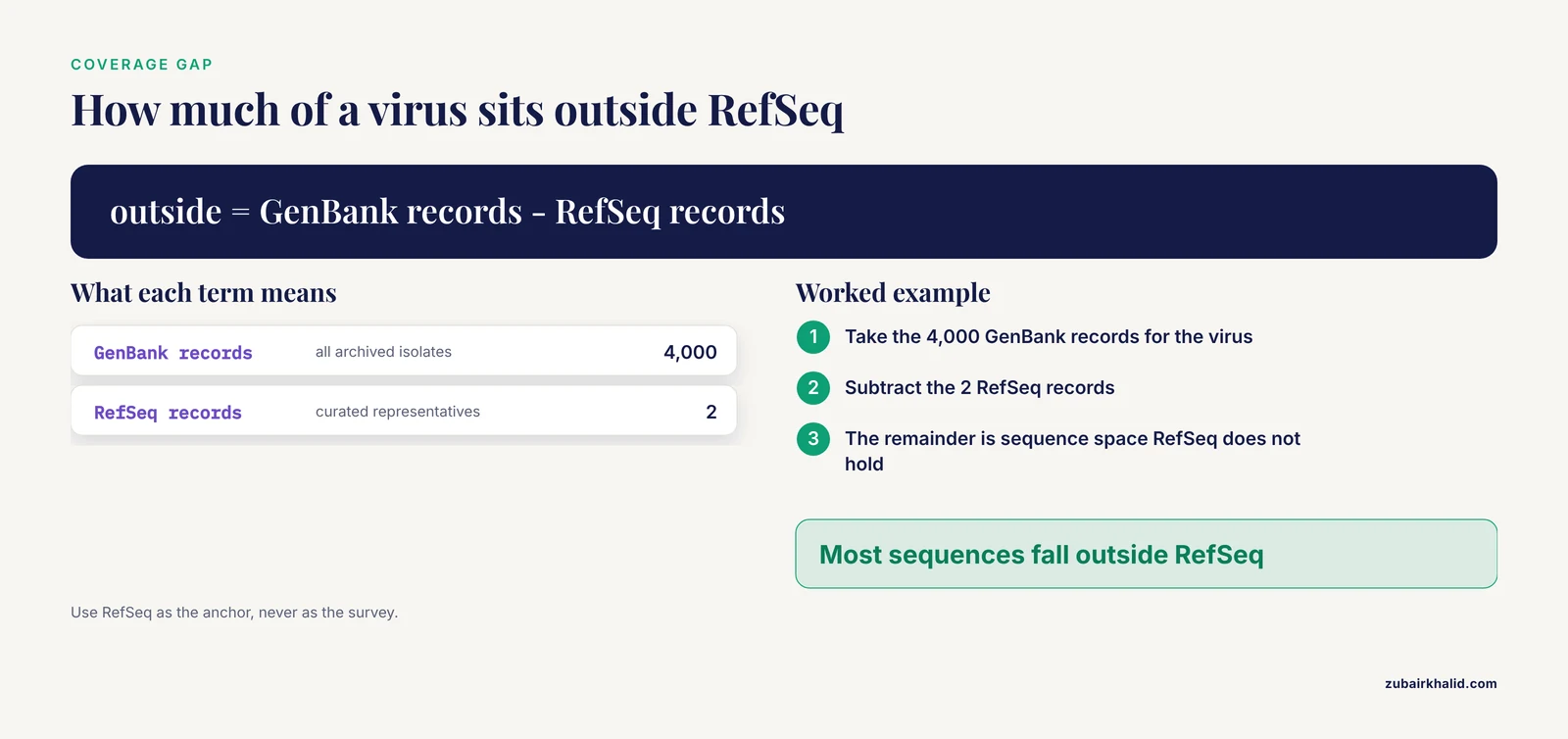
The limitation mirrors the strength. RefSeq is deliberately incomplete. If your virus has 4,000 GenBank records and two RefSeqs, three thousand nine hundred and ninety-eight sequences exist outside RefSeq. Use RefSeq as the anchor, never as the survey.
What NCBI Virus Is
NCBI Virus (historically grown out of the NCBI Influenza Virus Resource and the virus-specific Virus Variation Resources, which began with dengue virus) is a web interface and data service purpose-built for viruses [6]. It is not a third archive. It is a virus-aware front end and retrieval system over GenBank and RefSeq viral records.
What makes it different from searching GenBank's general Entrez interface is the vocabulary of its filters. NCBI Virus lets you restrict results by:
- Host (human, mosquito, swine, environmental)
- Country and region of collection
- Collection date and date ranges
- Genome completeness (complete, coding-complete, partial)
- Molecule type and segment
- Taxonomic lineage from species down to serotype or genotype
- Whether the record is a RefSeq
That last filter is the conceptual hinge of this whole comparison. NCBI Virus does not compete with GenBank or RefSeq. It indexes both, and the difference between ncbi virus and genbank and refseq is largely the difference between a search tool and its underlying data stores.
For virus work, the filter set is not a convenience, it is the difference between a feasible and an infeasible query. Try asking the plain GenBank interface for all complete dengue virus genomes sampled from humans in Southeast Asia between 2015 and 2020, and you will find yourself writing nested Boolean queries against uncontrolled metadata fields. NCBI Virus presents those same attributes as structured filters because Virus Variation Resources was built precisely to let users run complex queries against cleaned and harmonized virus metadata [6].
The same logic extends to computation. Studies of vector microbiomes have used the NCBI total virus, RNA virus, and eukaryotic virus databases as reference sets for read classification in metagenomic pipelines [7]. Those reference files are the machine-readable expression of what the NCBI Virus interface shows interactively.
Side-by-Side Comparison
| Feature | GenBank | RefSeq | NCBI Virus |
|---|---|---|---|
| What it is | Archival sequence database, INSDC US node | Curated, non-redundant reference database | Virus-specific search and retrieval interface |
| Relation to the others | Source of raw submissions | Curated records drawn from GenBank-quality data | Indexes and filters both GenBank and RefSeq virus records |
| Redundancy | Complete, includes all near-duplicates | Deliberately reduced to representative records | User-controlled (deduplicate via filters) |
| Curation | Structural validation only, annotation as submitted | Staff-reviewed, validated format, standardized annotation [2] | Inherits record status, adds cleaned metadata |
| Annotation quality | Variable across records and eras | Consistent, cross-referenced, nucleotide-protein linked [3] | Mapped features where available |
| Accession format | Submitter-assigned INSDC accessions | Curated prefixes (NC_, NP_, YP_ and similar) | Underlying GenBank or RefSeq accessions |
| Metadata filters | Generic Entrez fields | Limited set on records | Host, geography, date, completeness, lineage, segment |
| Best for | Completeness, citing exact isolates, archiving | Reference-guided analysis, assay design, annotation anchors [1] | Discovering and filtering virus sequences [6] |
| Weakest for | Consistent annotation, redundancy control | Coverage of diversity (small by design) | It holds no unique sequences of its own |
How the Three Fit Together
The cleanest way to remember the relationship is a pipeline.
A laboratory sequences a virus genome and submits it to GenBank, often through BankIt or the annotation-assisted submission systems. For viral submissions, the VADR tool now sits inside the GenBank processing pipeline. VADR classifies the submitted sequence against hidden Markov models built from curated RefSeqs, maps the RefSeq feature annotation onto the submission via alignment, validates predicted proteins with nucleotide-to-protein BLAST alignments, and reports 43 types of alerts covering unexpected characteristics. Submissions that pass all checks are accepted and annotated automatically, without human indexer intervention [1].
Notice what this means: RefSeq is not merely a downstream product of GenBank, it actively disciplines what flows into GenBank, because curated RefSeq genomes serve as the models that validate and annotate new viral submissions. The databases are coupled, not parallel.
Separately, NCBI curators select well-qualified genomes as RefSeq records. The selection is explicit and standards-driven, as the filovirus work showed when curators evaluated candidate complete genomes and designated type variants, type sequences, and names against published nomenclature templates [4]. Selection continues as new viruses and better isolates appear. Researchers who sequence a novel or under-represented virus regularly recommend their genomes for RefSeq inclusion after depositing them in GenBank, which is exactly what happened with the Mogiana tick virus genome segments deposited under accessions MT080097 through MT080100 [8].
NCBI Virus sits on top of both stores, harmonizing their metadata so one query can return RefSeq references and GenBank isolates together, correctly labeled.
Choosing on the Criteria That Decide Real Projects
Curation and trust
If your pipeline's correctness depends on annotation being right (gene boundaries, protein products, mature peptide coordinates), prefer RefSeq. Its records are format-validated and annotated under a combined approach of expert input, automated annotation, propagation from GenBank, and NCBI curation [2]. If your analysis depends on your own annotation pass anyway (you are running VADR or a homology-based annotator yourself), GenBank's variable annotation matters less, because you will overwrite it.
Redundancy and sampling bias
Phylogenies built on everything in GenBank are built on sampling effort, not biology. Hospitals submit more SARS-CoV-2 genomes than field ecologists submit insect nidoviruses. NCBI Virus helps you control this by filtering to complete genomes, but it cannot remove oversampling of outbreaks. For sampling-bias-sensitive analyses, downsample deliberately. For reference-anchored analyses, skip the problem and use RefSeq.
Coverage
GenBank wins on raw coverage of viral diversity, full stop. When a reviewer asks whether you checked all available sequences for your virus, the honest answer requires GenBank holdings, usually reached through NCBI Virus filters so you can restrict to relevant genomes rather than fragments [1].
Search ergonomics
How to use ncbi effectively is often a question of which interface you type into. For viruses, NCBI Virus's structured filters replace fragile text queries [6]. For a single accession lookup, plain GenBank pages are fastest. For bulk programmatic access, both databases are available through Entrez and FTP, described below.
Stability for citations and pipelines
RefSeq accessions are the most stable handles for analysis because the record behind them is maintained. A GenBank accession is stable too (archives never delete), but the record is frozen as submitted. When you need a citation of the form "reference genome X," a RefSeq accession communicates that a curator stands behind it.
Worked Scenarios
Scenario 1: Rooting an outbreak phylogeny
You have 400 newly sequenced genomes of an RNA virus and need to place them on a tree with context. Strategy: retrieve the RefSeq reference for the species as your outgroup and coordinate anchor, then use NCBI Virus to pull a temporally and geographically balanced set of complete GenBank genomes as context. Running your whole phylogeny on every GenBank record would swamp the tree with duplicate outbreak lineages, and running it on RefSeq alone would leave you with a tree of references that misses the circulating diversity. The mixed design, anchored on RefSeq, populated from filtered GenBank, is the standard solution.
A practical retrieval command using NCBI's Entrez Direct toolkit:
esearch -db nuccore -term "Zaire ebolavirus[Organism] AND srcdb_refseq[PROP]" \
  | efetch -db nuccore -format fasta > ebolavirus_refseq.fa
The srcdb_refseq[PROP] filter isolates curated records inside the nucleotide database, demonstrating that the RefSeq layer is queryable without ever leaving the Entrez system.
Scenario 2: Designing a diagnostic PCR panel
Diagnostic assay design is where the difference between ncbi virus and genbank becomes costly if you get it wrong. Designing primers against a single GenBank isolate risks anchoring your assay to one idiosyncratic sequence. The published approach taken by MRPrimerV was to test candidate primers exhaustively against the full reference set, and the authors anchored their entire design on RefSeq because it covers the RNA viruses comprehensively in curated form, with 152 million primer pairs covering 7,144 coding sequences [5]. The workflow generalizes: gather all near-complete genomes for your target species via NCBI Virus, align them, find conserved regions, then BLAST candidate primer pairs against broader sequence space to check specificity. That specificity screen, run through NCBI BLAST tools, is standard practice in published assay and epitope workflows [9].
Scenario 3: Metavirome read classification
You have metagenomic reads from mosquito pools and need to know what viruses are present. Classification pipelines need a reference database of manageable size with broad coverage. Published metavirome analyses in this exact system used the NCBI total virus, RNA virus, and eukaryotic virus databases as their classification references [7]. Those files contain the GenBank-derived viral corpus organized by molecule type. RefSeq alone would under-detect, because a novel or divergent virus may lack a close curated reference, and classification is homology-based. Here the comprehensive GenBank-derived viral sets, not the curated subset, are the correct choice.
Scenario 4: Submitting a new virus genome
You assembled a full-length segmented RNA virus genome from sequencing data and want it published. The path runs through GenBank. Deposit the segments, receive accessions (as in the Mogiana tick virus case, where the four segments became MT080097 through MT080100), and cite those accessions in your paper [8]. Expect VADR to process the submission if it is a recognized virus group, and expect its alerts to demand fixes before acceptance when features do not match the RefSeq-derived model [1]. If your genome is a strong candidate to represent the species, you or the community can recommend it for RefSeq consideration, which is precisely the route the tick virus authors took [8]. Submission target: always GenBank. RefSeq is not a submission destination, it is a curation outcome.
How to Use NCBI at the Command Line
Web interfaces are fine for exploration, but reproducible pipelines need scriptable retrieval. Three mechanisms cover nearly every need.
Entrez Direct (edirect). The Unix toolkit for the Entrez system, covering both GenBank and the RefSeq records within it:
esearch -db nuccore -term "Dengue virus[Organism] AND complete genome[All Fields]" \
  | efetch -db nuccore -format fasta > dengue_complete_genomes.fa
Chain esearch, efilter, and efetch to build queries that mirror the NCBI Virus filters. Adding AND srcdb_refseq[PROP] keeps only curated records, dropping it returns the full GenBank corpus.
NCBI Datasets command-line tool. For virus genomes specifically, the Datasets tool understands the virus data model natively:
datasets download virus genome taxon "dengue virus" --reference --filename dengue_ref.zip
unzip dengue_ref.zip
The -reference flag returns the RefSeq reference genomes, which is the one-line version of the "give me the curated anchor" question. Dropping the flag returns the broader set with data report metadata you can filter in a spreadsheet or script.
FTP bulk download. For local BLAST databases or repetitive pipelines, skip per-record retrieval entirely. The RefSeq viral release is available at ftp.ncbi.nlm.nih.gov/refseq/release/viral/ as batched flat files, and the GenBank full release is served in partitioned flat files including the viral partition. Build a local BLAST or minimap2 index once per release cycle and every downstream job runs against a frozen, citable dataset version.
A sensible hygiene practice for all three: record the retrieval date and the exact query string in your methods. GenBank grows continuously, so a statement like "retrieved via NCBI Virus on [date], filtered to complete genomes, host human" is the difference between a reproducible analysis and an unreproducible one.
Common Mistakes and Limitations
Treating NCBI Virus as a third database with its own accessions. It has none. Every record it returns resolves to a GenBank or RefSeq accession. Citing "retrieved from NCBI Virus" in a methods section is incomplete, cite the underlying accessions.
Designing assays or analyses against a single GenBank isolate. One isolate carries one strain's quirks. Either survey the diversity through NCBI Virus filters or anchor on RefSeq, as the primer-design and annotation communities do [1] [5].
Assuming RefSeq annotation transfers automatically to related isolates. RefSeq annotation is record-level. A divergent isolate can carry rearranged genes, split ORFs, or unannotated proteins, which is precisely the class of problem VADR's 43 alert types were built to catch in submissions [1]. Run your own annotation when divergence is substantial.
Building phylogenies or prevalence claims from unfiltered GenBank downloads. Raw holdings overrepresent intensely sampled outbreaks, humans, and easily sampled hosts, and they mix complete genomes with 500-base fragments. Filter for completeness and frame the sampling in your methods, or the tree describes submission behavior rather than viral evolution.
Ignoring metadata inconsistency in GenBank. Host names, collection dates, and geographic fields are author-supplied and only lightly standardized. NCBI Virus's harmonized metadata reduces this burden [6], but fields can still be missing or coarse. Treat "country: unspecified" records as real records with missing data, not as noise to delete silently.
Confusing "non-redundant" with "one record per species." RefSeq may legitimately hold multiple records per species where distinct reference genomes are warranted, as the filovirus curation work shows with its explicit type variant and type sequence designations [4]. Do not hard-code assumptions about record counts.
Assuming a curated reference exists for your virus at all. RefSeq coverage of viral diversity, while broad, is incomplete by design, and under-studied viruses may have no RefSeq record. In that case, choose the best-annotated complete GenBank genome, document the choice, and consider recommending it for RefSeq inclusion [8].
One overarching limitation: database choice shapes your conclusions. The same virus has different pictures in each resource, comprehensive and messy in GenBank, curated and partial in RefSeq, filtered and harmonized in NCBI Virus. State explicitly which view your analysis used.
Frequently Asked Questions
Is NCBI Virus a separate database from GenBank?
No. NCBI Virus is a specialized search and retrieval interface that indexes virus records held in GenBank and RefSeq, adding virus-specific filters for host, geography, date, completeness, and taxonomy [6]. Every record you retrieve there resolves to an underlying GenBank or RefSeq accession.
Which database should I download genomes from for a phylogenetic analysis?
Both, in different roles. Anchor your tree with the RefSeq reference for the species, then use NCBI Virus to select a filtered, representative set of GenBank isolates for the diversity you need. Downloading every GenBank record produces redundancy-driven artifacts, and downloading only RefSeq misses circulating diversity.
Can I cite a GenBank accession as a reference genome?
You can cite it, and archives guarantee it will remain retrievable, but a GenBank accession represents one as-submitted isolate with annotation of whatever quality arrived. For a reference genome in the analytical sense, prefer the corresponding RefSeq accession, which is curated, format-validated, and consistently annotated [2].
What is the difference between a RefSeq record and a GenBank record of the same sequence?
The GenBank record is the archival submission, frozen as deposited. The RefSeq record is NCBI's curated representation, with validated format, standardized features, linked protein records, and ongoing maintenance [2] [3]. RefSeq annotation is derived and improved, sometimes with pipeline assistance like the prokaryotic annotation system, and records are updated as curation improves.
How do I submit a new virus genome and where does it end up?
Submit to GenBank through its submission systems. Viral submissions are processed through VADR, which validates and annotates them against models built from curated RefSeqs and accepts clean submissions automatically [1]. Your accession becomes part of the GenBank archive, appears in NCBI Virus searches, and may subsequently be evaluated for RefSeq inclusion if it qualifies as a reference-grade representative [8].
Does NCBI Virus include RefSeq records?
Yes. NCBI Virus indexes both RefSeq and GenBank viral records and lets you filter for RefSeq records specifically, which is the fastest interactive way to pull every curated reference for a genus or species in one query [6].
Sources
- VADR: validation and annotation of virus sequence submissions to GenBank.
- NCBI reference sequences (RefSeq): a curated non-redundant sequence database of genomes, transcripts and proteins.
- NCBI Reference Sequence (RefSeq): a curated non-redundant sequence database of genomes, transcripts and proteins.
- Filovirus RefSeq entries: evaluation and selection of filovirus type variants, type sequences, and names.
- MRPrimerV: a database of PCR primers for RNA virus detection.
- Virus variation resources at the National Center for Biotechnology Information: dengue virus.
- High prevalence of Phasi Charoen-like virus from wild-caught Aedes aegypti in Grenada, W.I. as revealed by metagenomic analysis.
- Full-length genome sequence of segmented RNA virus from ticks was obtained using small RNA sequencing data.
- Peptide microarray analysis of in-silico predicted B-cell epitopes in SARS-CoV-2 sero-positive healthcare workers in Bulawayo, Zimbabwe.