Hybrid Cloud for Bioinformatics
By Dr. Zubair Khalid, DVM, MS, PhD ·

Hybrid cloud for bioinformatics is the practice of splitting analysis work between infrastructure you physically control, such as an on-premise compute cluster or science cloud, and rented capacity in a public cloud. The rule of thumb is simple: keep sensitive or steady-baseline work on the infrastructure you control, and burst peak or embarrassingly parallel work, such as aligning a sudden batch of whole-genome samples, to the public cloud. If you read only one section, read the comparison table, because that is where the real decision lives.
This article walks through the hybrid cloud bioinformatics options available to research groups, hospital genomics programs, and core facilities, compares them on the criteria that actually decide purchases, works through published case studies, and covers the pros and cons, security model, scheduling approaches, and the mistakes teams make most often.
What Hybrid Cloud Means in Bioinformatics
Bioinformatics workloads have a shape that makes hybrid architecture attractive. Sequencing output arrives in bursts that follow instrument runs, not in a smooth stream. A single Illumina flow cell can produce terabases of sequence in days, and downstream analysis, from adapter trimming to joint genotyping, must scale to match. Meanwhile, clinical and patient-linked data often carry legal or institutional constraints that make it unwise or impermissible to copy them to shared infrastructure.
Cloud bioinformatics is the broader field of running sequence analysis, genome annotation, statistical genetics, and machine learning on rented or virtualized compute. A hybrid cloud bioinformatics environment combines at least two of the following tiers:
- On-premise cluster or supercomputer. Hardware your institution owns and operates, typically a Linux cluster with a scheduler such as Slurm, with direct-attached or parallel storage.
- Science cloud or private cloud. A virtualized pool run inside your institution or consortium, often OpenStack-based, that behaves like a cloud but stays within your security boundary.
- Public cloud. Elastic, metered compute from providers such as Amazon Web Services, Microsoft Azure, or Google Cloud, including managed genomics services. The term aws genomics refers to Amazon's genomics-focused offerings on AWS, such as S3 object storage for sequence data and elastic compute for pipeline execution.
- Data lake tier. Object storage organized into zones (raw, curated, governed) that serves both clinical and research consumers, often straddling on-premise and cloud storage.
The word hybrid does not mean "half and half." Most productive hybrid deployments place 80 or 90 percent of steady-state compute on owned infrastructure and use the public cloud for peaks, new pipeline bring-up, or data that must live near a collaborator.
A note on terminology, because the literature is inconsistent. In life sciences, "hybrid" has also been used to describe combining programming models, for example MapReduce on the cloud with MPI on a cluster, within one analysis environment [1]. That is a real and useful pattern, and this article covers it, but it is distinct from the infrastructure hybrid described above. The two meanings converge in practice: when you split a workflow across tiers, you often split the compute model with it.
The Main Hybrid Cloud Bioinformatics Options
There is no single best hybrid cloud bioinformatics architecture. The right choice depends on data sensitivity, workload shape, existing hardware, and staff. Here are the four options that account for most real deployments, each explained on its own terms.
Option 1: On-Premise Supercomputer Plus Public Cloud Bursting
This is the classic research-center pattern. You own a supercomputer or HPC cluster for baseline capacity, and you spill over to a public cloud when a project exceeds it. Kyoto University's Center for Genomic Medicine implemented exactly this arrangement, combining an on-premise supercomputer, a science cloud, and a public cloud into one hybrid system designed to handle heterogeneous, compute-hungry bioinformatics tools while scaling capacity up and down [2].
The strengths of this option are control and cost predictability for steady workloads. Your scheduler, your versions, your data never leaves the building unless you choose to send it. The weakness is integration cost: you must configure identity, networking, and data transfer between tiers, and you need staff who can operate both an HPC scheduler and a cloud environment. Bursting also requires that your workflow engine can target both a local scheduler and cloud compute targets, which is a practical argument for standardized workflow languages.
Option 2: Science Cloud Plus Public Cloud for Peak Elasticity
A science cloud is a smaller, institution-run virtualization layer that sits between the bare-metal cluster and the public cloud. It gives researchers self-service virtual machines with institutional policies applied, and it absorbs workloads that are too interactive for the batch scheduler but too sensitive for the public cloud. The Kyoto implementation included a science cloud tier alongside the supercomputer and public cloud, which allowed the center to match different bioinformatics tools to different resource characteristics instead of forcing everything through one queue [2].
This option suits centers that serve many small- to medium-scale projects. Researchers get fast turnaround on modest jobs, the center preserves scarce HPC cycles for large jobs, and the public cloud handles the rare project that dwarfs everything.
Option 3: Hybrid Data Lake for Clinical and Research Genomics
Clinical genomics changes the calculus. When sequencing data is tied to identifiable patients, and when results arrive from multiple vendors on different schedules and formats, the problem is less about compute and more about integration and governance. A hybrid data lake architecture addresses this by storing genomic data in the cloud, synchronized with vendor storage, while clinical systems and governance workflows control access.
A cancer center described a four-layer design, with ingestion, storage, transformation, and interaction layers implemented across hybrid cloud infrastructure. Rich metadata built from both patient and genomic records enables patient-centered queries, and a data governance committee controls access. The deployed system served 149 clinicians across 31 disease groups, held 240 TB of data covering 5,800 patients, and cost approximately $350 per month to operate [3]. That monthly figure deserves a caveat: it reflects storage and sync costs for an incremental, object-storage-based design, not the cost of building the system or running analysis compute on top of it.
This option is the best hybrid cloud bioinformatics choice for organizations whose primary driver is clinical integration, vendor heterogeneity, and audit-friendly access control rather than raw compute.
Option 4: Split-Compute-Model Hybrids (MapReduce Plus MPI)
Older but still instructive, this option splits by compute model rather than by data location. MapReduce-style frameworks handle embarrassingly parallel, data-intensive stages well, while iterative algorithms common in data mining and machine learning perform poorly under basic MapReduce because each iteration rereads data. Those iterative stages run efficiently on clusters under MPI (Message Passing Interface, a standard protocol for parallel programs on tightly coupled machines). A hybrid cloud and cluster environment chains the two: cloud-based MapReduce stages feed MPI stages on a traditional cluster. The Twister iterative MapReduce system was built for this purpose and benchmarked against Hadoop and MPI on Amazon and Azure as well as on the NSF FutureGrid research infrastructure [1].
Modern equivalents of this pattern appear whenever a pipeline mixes scatter-gather stages with iterative optimization or model training. The lesson from that body of work holds: match the execution engine to the algorithm's structure, and let the hybrid boundary follow the split.
Side-by-Side Comparison
The table below is the core of the decision. Score each option against your own priorities in the last column.
| Criterion | On-prem HPC + cloud burst | Science cloud + public cloud | Hybrid data lake | Split compute model (MapReduce + MPI) |
|---|---|---|---|---|
| Primary driver | Compute capacity for large batches | Self-service capacity inside the security boundary | Clinical and research data integration | Algorithm performance across workflow stages |
| Data sensitivity fit | Excellent, data stays local by default | Good, virtualization inside institution | Strong for PHI, governance committee controls access | Neutral, depends where each stage runs |
| Peak elasticity | High, limited by transfer time | High | Moderate, sized for storage more than compute | Low to moderate |
| Cost predictability | Best for steady baseline | Good | Strong for storage-heavy use ($350/month in one published deployment [3]) | Job dependent |
| Integration burden | High (identity, scheduler, transfer) | Moderate | Moderate to high (vendor sync, metadata) | Moderate (framework plumbing) |
| Staff skills needed | HPC admin plus cloud admin | Virtualization plus cloud | Data engineering plus clinical informatics | Parallel computing expertise |
| Reference deployment | Kyoto University CGM hybrid system, joint genotyping of 11,238 WGS samples [2] | Same center's science cloud tier [2] | Cancer center data lake, 240 TB, 5,800 patients, 149 clinicians [3] | Twister benchmarks on Amazon, Azure, FutureGrid [1] |
| Best fit | Genome centers with large cohorts | Multi-project core facilities | Cancer centers and hospitals | Methods groups running mixed workloads |
Hybrid Cloud Bioinformatics Pros and Cons
The pros and cons deserve their own treatment, because teams tend to overweight the first pro and underweight the first con.
Pro: elastic capacity for bursty workloads. Sequencing projects do not arrive evenly. When a million-base cohort study reaches the genotyping stage, demand can exceed an owned cluster by an order of magnitude. The Kyoto hybrid system was designed precisely to flex computational capacity for large-scale genomic research as sequencing and spatial omics technologies and cohort sizes grew [2].
Pro: right tool, right tier. Different bioinformatics tools have different resource appetites. Some thrive on many small parallel tasks, some need large shared memory, some need GPUs. A hybrid design lets each tool run where it fits, which the Kyoto team cited as a central motivation for combining a supercomputer, science cloud, and public cloud [2].
Pro: data proximity for clinical integration. A data lake synchronized with vendor storage lets clinical and research consumers query the same governed copy of the data, rather than maintaining brittle, expensive custom warehouses that resist the rapid changes typical of oncology research [3].
Pro: you can match the execution model to the algorithm. Hybrid MapReduce-plus-cluster designs outperform forcing every stage through one engine, which was demonstrated for life science applications where iterative linear algebra underlies data mining tasks [1].
Con: integration is real work. Every hybrid boundary needs identity federation, network paths, data transfer tooling, and consistent software environments. This is where most hybrid projects burn their budget. The architecture papers that report success also report dedicated engineering effort behind them.
Con: data gravity. Moving a 30x human genome, roughly 100 GB of compressed sequence data, is feasible. Moving two hundred of them across a constrained institutional uplink during business hours is not. Teams that underestimate egress time end up with cloud capacity sitting idle waiting for data, or with an unplanned long-term cloud storage footprint because it was easier to leave copies in place.
Con: two sets of operational skills and bills. You will run an HPC scheduler and a cloud account, track utilization in two places, and reconcile two cost models. Small groups without dedicated staff often find that a fully cloud or fully on-premise approach costs less in person-hours even if it looks worse on paper.
Con: security surface grows with the boundary. Every additional path between tiers is a place where credentials, transfers, or metadata can leak. The governance workflow in the data lake deployment exists for this reason, with access to data controlled through a formal committee process rather than ad hoc permissions [3].
Matching Workloads to the Right Tier
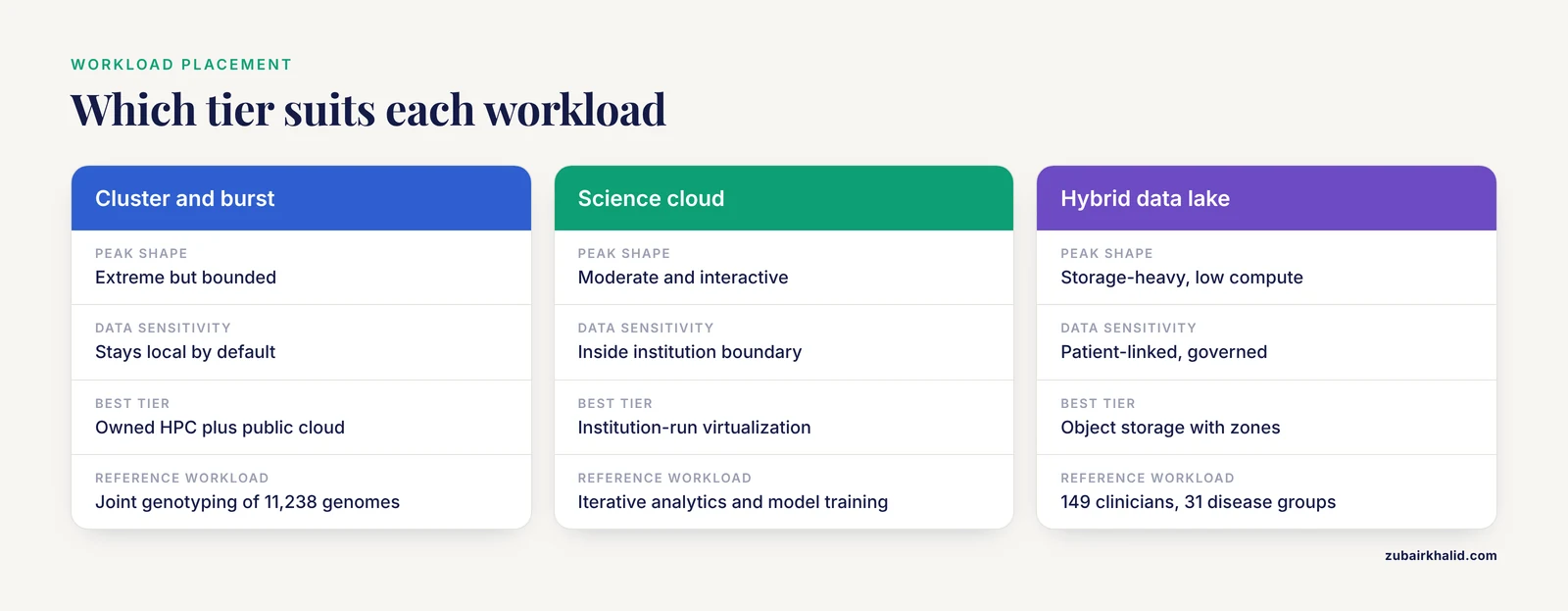
Getting hybrid cloud for bioinformatics right is mostly a workload-placement problem. Here is how common bioinformatics workloads partition.
Joint Genotyping and Large-Cohort Variant Calling
Joint genotyping, the step where per-sample variant calls are merged into a single cohort-level callset, is a known bottleneck in population-scale sequencing analysis. It requires coordinated access to data from every sample at once and benefits from massive parallel scatter-gather over genome intervals. The Kyoto hybrid system demonstrated joint genotyping of whole-genome sequencing data for 11,238 individuals as a flagship workload, using the combined system to break through the bottleneck [2]. This is the archetype of a workload worth bursting: the peak is extreme, the duration is bounded, and the intermediate data can be staged.
Workflow-Managed Pipelines and Microbial Genomics
Much modern analysis runs under standardized workflow frameworks such as nf-core and Bactopia, which the microbial genomics literature identifies as the current standard for automated pipelines spanning read preprocessing, assembly, annotation, and taxonomic classification with tools like FastQC, SPAdes, Prokka, Bakta, Kraken2, and QIIME 2 [4]. Workflow engines are the connective tissue of any hybrid deployment, because a single workflow definition can target a Slurm cluster on Monday and a cloud batch service on Friday. If your pipelines are not yet workflow-managed, fixing that is prerequisite work for any hybrid option.
Iterative Analytics and Machine Learning
Clustering, dimensionality reduction, and model training on high-dimensional biological data, such as the single-cell and multi-omics methods now common in the literature [5] [6], favor low-latency interconnects and iterative runtimes. These stages belong on the cluster or science cloud tier where MPI-class runtimes and persistent local storage live, with the cloud handling the embarrassingly parallel preprocessing that generates their inputs [1].
Clinical Operations Queries
When clinicians across disease groups need patient-level genomic results for treatment decisions, latency and access control dominate. The data lake pattern keeps a synchronized, metadata-rich copy close to the interaction layer, with the governance committee deciding who sees what [3]. This workload rarely benefits from HPC capacity at all, which is why compute-centric hybrid designs fail clinical stakeholders.
Privacy-Critical Computation
Some queries on sensitive genomes can be outsourced without decrypting them. Homomorphic encryption, a cryptographic technique that allows computation directly on encrypted values, has been applied to search for biomarker matches in encrypted genomes stored in the cloud. In one implementation, encoding a genomic database as a single element of a polynomial ring allowed a secure search-and-extract of reference and alternate sequences at a queried position in about 3.9 seconds, while halving communication cost and preventing leakage of unqueried database content [7]. This is not a general-purpose replacement for access control, but it defines a useful tier: public cloud compute for operations on data that never arrives in plaintext.
Worked Scenarios
Three published deployments illustrate how the options play out.
Scenario 1: A National Genome Center Absorbs a Million-Person Cohort
Kyoto University's Center for Genomic Medicine faced the pressure common to genomic medicine research: sequencing technology advances and cohort studies involving more than one million individuals keep increasing the volume of large-scale data, and researchers need correspondingly more compute. The center's answer was a three-tier hybrid, supercomputer plus science cloud plus public cloud, flexible enough to host heterogeneous bioinformatics tools. Its demonstration project was joint genotyping of 11,238 whole genomes, the acknowledged bottleneck step, run across the hybrid system as a reference implementation for other research centers [2].
The transferable lesson is the sequencing of decisions: first inventory which tools are heterogeneous in their resource needs, then assign tiers, then prove the design on the single most painful bottleneck step rather than on a toy workload.
Scenario 2: A Cancer Center Replaces a Clinical Warehouse with a Data Lake
The second scenario starts from a different pain. Clinical warehouses are costly to construct and brittle in the face of rapidly changing oncology research, and genomics results arrive from multiple vendors. The hybrid data lake implementation synchronized genomic data with vendor storage in the cloud, organized processing into ingestion, storage, transformation, and interaction layers, and put access control behind a governance committee. Adoption followed quickly: 149 clinicians across 31 disease groups, 240 TB covering 5,800 patients, at roughly $350 per month [3].
The transferable lesson is that storage-centric hybrid designs can be radically cheaper than compute-centric ones. Object storage with zone-based organization and strong metadata is the mechanism, and the low monthly cost came from incrementally synchronizing data rather than replicating everything wholesale.
Scenario 3: Chaining Cloud MapReduce to Cluster MPI
The third scenario comes from the compute-model side. Life science applications mix data-intensive, embarrassingly parallel stages with iterative stages where basic MapReduce performs poorly. Benchmarking across Amazon, Azure, and traditional Linux and Windows cluster environments showed encouraging performance for non-iterative cases on the clouds, while iterative stages ran efficiently on clusters under MPI. Twister, an open source iterative MapReduce system, was released and benchmarked against Hadoop and MPI on information retrieval and life science applications as a more uniform programming layer across the hybrid [1].
The transferable lesson is that a hybrid boundary can fall inside a single workflow, between stages, and that the choice should follow the structure of the mathematics, not the location of the data.
Security, Privacy, and Governance
Security in a hybrid deployment is a layering problem. Get the layers in this order.
First, classify the data. Separate de-identified research sequence data from patient-linked clinical data. The two can live in the same architecture but must never share an access path. The clinical data lake design handles this through a governance committee and a formal access workflow, which is the minimum bar for patient-linked genomics [3].
Second, control the metadata as tightly as the sequences. The data lake's patient-centered queries depend on rich metadata built from patient and genomic data. That metadata is itself sensitive, and it is what makes row-level access decisions possible [3].
Third, encrypt computation where the data cannot move. For the narrow class of operations that must run over encrypted genomes, homomorphic schemes make secure outsourcing practical. The published biomarker search protocol completes a position search and sequence extraction in about 3.9 seconds with reduced parameter sizes and communication costs compared to earlier methods [7]. Treat this as a specialized capability for specific query types, not a default.
Fourth, plan for the transfer boundary. Every byte crossing between tiers is an event to log, encrypt in transit, and rate-limit. Most institutional security reviews of hybrid designs fail here, not at the storage layer.
Fifth, schedule intelligently so security policy and workload policy agree. As biomedical services chain together into composite data flows across cloud platforms, scheduling decisions determine where data physically lands. Deep reinforcement learning approaches to resource scheduling for distributed composite services aim to satisfy reliability and trust requirements while improving processing efficiency [8]. Whatever scheduler you use, encode your data-placement rules as constraints the scheduler cannot violate, rather than as guidance your operators should remember.
Scheduling and Orchestration Across Tiers
Hybrid deployments live or die on orchestration. Three layers matter.
Workflow layer. Standardized pipelines, the nf-core and Bactopia model now standard in microbial genomics [4], give you a single definition that executes anywhere. This is the single highest-leverage investment a group can make before going hybrid.
Resource scheduling layer. Cloud platforms in biomedicine increasingly host chains of interdependent services, where biomedical companies and clinical units exchange data to create composite services. Scheduling strategies must handle complicated and diversified requirements, and deep reinforcement learning methods have been proposed to improve the reliability and efficiency of these distributed composite services [8]. For most groups, a rules-based scheduler with placement constraints is sufficient, but the research direction is worth watching as service chains grow.
Edge and fog placement. When data originates in distributed clinics or laboratories, some processing can happen near the point of collection before data reaches central tiers. Multi-omics cancer prediction schemes built on fog cloud networks model exactly this, with clinical data collection at distributed clinics feeding downstream analysis layers [6]. If your organization operates multiple collection sites, evaluate how much filtering, QC, and de-identification can happen at the edge to reduce what crosses the hybrid boundary.
What the Best Hybrid Cloud Bioinformatics Setup Costs
Cost discussion must stay grounded in published figures. The best documented number is the clinical data lake deployment at approximately $350 per month for 240 TB and 5,800 patients of storage and synchronization [3]. That figure covers the storage and sync layers of a storage-centric design.
For compute-centric designs, published work describes cost structure qualitatively rather than with figures. The relevant economic facts are these: public cloud capacity is metered per second or hour, owned capacity is amortized whether busy or idle, and data transfer between tiers carries time and bandwidth costs that grow with cohort size. A hybrid design bets that baseline load justifies owned hardware while peaks justify rental. The Kyoto deployment's design goal of flexibly scaling capacity alongside growing cohort data reflects that bet explicitly [2]. Whether the bet pays off depends on your load's peak-to-baseline ratio, which you should measure from your scheduler's history before committing to any architecture.
Common Mistakes and Limitations
These are the failure patterns that recur across hybrid deployments, stated plainly.
- Bursting without staging. Teams spin up cloud compute before intermediate data can reach it. Plan transfer as a pipeline stage with its own runtime estimate, not an afterthought.
- Treating the hybrid boundary as temporary. "We will consolidate later" rarely happens. Design identity, networking, and cost tracking as permanent features from day one.
- Ignoring egress direction. Data flowing into the cloud is usually cheap to move. Data flowing out is not. Architectures that require regular bulk returns from cloud to on-premise age badly.
- One security policy for two data classes. Research sequence data and patient-linked clinical data need different access models. The data lake deployment's governance committee exists because a single flat policy cannot serve both [3].
- Forcing every algorithm through one engine. Iterative methods under basic MapReduce waste cycles rereading data. Match engine to algorithm structure, as the Twister benchmarks demonstrated for life science workloads [1].
- Skipping the workflow layer. Hand-run analysis cannot move between tiers. Standardized pipelines are the prerequisite for every hybrid option described here [4].
- Underestimating metadata work. The clinical data lake's usefulness came from rich metadata enabling patient-centered queries, which required sustained effort [3]. Budget for it.
- Assuming cloud-native privacy is automatic. Encryption at rest does not make computation on sensitive data safe to outsource. Techniques like homomorphic biomarker search exist for specific query patterns [7], and applying them correctly is specialist work.
Limitations of the evidence itself deserve a sentence. Published hybrid deployments come from well-resourced centers, and reported figures, such as the monthly storage cost above, reflect one institution's vendor contracts and scale at one point in time. Your numbers will differ. Individual infrastructure decisions also need review by your institution's security and compliance offices, which own constraints this article cannot see.
Frequently Asked Questions
What is hybrid cloud bioinformatics in plain terms?
It is running bioinformatics workloads across both infrastructure you own, like an on-premise cluster, and rented public cloud capacity, choosing the tier per workload. A reference implementation at Kyoto University combined a supercomputer, science cloud, and public cloud specifically to handle large-scale genomic analysis [2].
What are the main hybrid cloud bioinformatics options?
The four practical options are on-premise HPC with cloud bursting, a science cloud paired with a public cloud for elasticity, a hybrid data lake for integrating clinical and genomic data, and split compute-model designs that chain cloud MapReduce stages to cluster MPI stages [2] [3] [1].
What are the biggest pros and cons of a hybrid cloud for bioinformatics?
The main pros are elastic capacity for bursty sequencing workloads, the ability to match each tool and algorithm to its best tier, and better data residency for sensitive material [2]. The main cons are integration engineering, data transfer times, doubled operational skills and bills, and an expanded security surface at every tier boundary.
Is a hybrid data lake better than a clinical data warehouse for genomics?
For organizations integrating multi-vendor clinical genomics under rapid change, the published data lake design was created because traditional clinical warehouses are costly to build and brittle. It served 149 clinicians across 31 disease groups at roughly $350 per month for storage and synchronization [3]. If your needs are purely analytic and single-source, a warehouse may still suffice.
Where does aws genomics fit in a hybrid architecture?
AWS functions as the public cloud tier in most hybrid designs, providing object storage for sequence data and elastic compute for burst capacity. Published hybrid benchmarks included Amazon alongside Azure and traditional clusters when comparing cloud and cluster performance for life science applications [1], and public cloud tiers appear in the reference hybrid deployments cited throughout this article [2] [3].
Do I need a hybrid setup if I am a small lab?
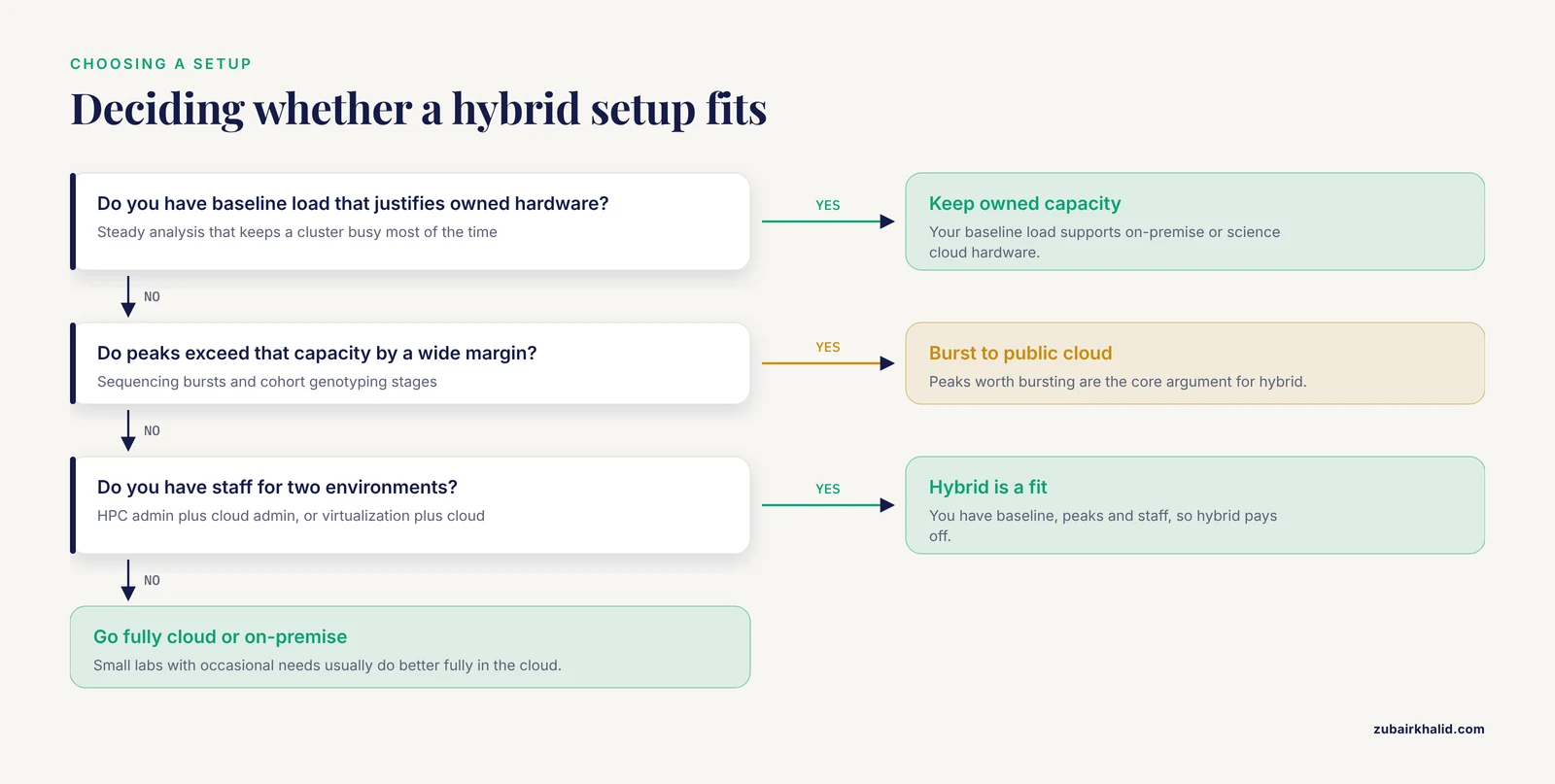
Probably not. Hybrid designs pay off when you have baseline load that justifies owned hardware, peaks worth bursting, sensitive data with placement constraints, and staff to operate two environments. Small labs with occasional analysis needs usually do better fully in the cloud, and groups with privacy constraints but modest scale often do better fully on-premise. The data lake option is a partial exception, since its zone-based design was described as suitable for organizations of all sizes integrating clinical and genomic data [3].
Sources
- Hybrid cloud and cluster computing paradigms for life science applications.
- Design and implementation of a hybrid cloud system for large-scale human genomic research.
- A hybrid cloud data lake architecture supporting the integration of clinical and genomics data.
- Advancements and challenges in bioinformatics tools for microbial genomics in the last decade: Toward the smart integration of bioinformatics tools, digital resources, and emerging technologies for the analysis of complex biological data.
- A hybrid neighborhood enhanced contrastive learning and self-knowledge distillation method for scRNA-seq data clustering analysis.
- A hybrid cancer prediction based on multi-omics data and reinforcement learning state action reward state action (SARSA).
- Secure searching of biomarkers through hybrid homomorphic encryption scheme.
- A resource scheduling method for reliable and trusted distributed composite services in cloud environment based on deep reinforcement learning.