Metadata Standards for Genomics
By Dr. Zubair Khalid, DVM, MS, PhD ·

A sequence file tells you what the bases are. Metadata tells you everything else: which sample the bases came from, where and when it was collected, from whom or from what environment, how the nucleic acid was extracted, how the library was built, which instrument ran the sequencing, and how the reads were processed. A metadata standard is an agreed set of field names, definitions, and controlled vocabularies that lets two laboratories describe the same kind of sample in the same way, so that a third party can find the data, understand them, and combine them with other studies.
The one-sentence difference that trips people up: a repository schema tells you which fields a database will accept at submission, while a minimum-information checklist tells you which fields your community has agreed are scientifically necessary for reuse. These overlap but are not the same thing. The rule of thumb for choosing: use the repository schema (NCBI BioSample or its equivalent at the archive you submit to) as the transport format, fill it in against the community checklist that matches your sample type (MIxS for sequence-associated samples, MIQE for qPCR experiments, proteomics formats from the Human Proteome Organization for mass spectrometry data), and keep the full experiment description in a portable package such as ISA-Tab that travels with your raw files. When in doubt, more structured metadata early beats elegant metadata later.
This article walks through the main genomics metadata standards options, compares their pros and cons on the criteria that actually decide projects, works through realistic scenarios, and covers the bioinformatics data management and genomics data storage practices that keep metadata usable for years.
Why Metadata Decides Whether Genomic Data Are Reusable
The FAIR principles, first published in 2016 and now the accepted reference point for research data policy, say data should be findable, accessible, interoperable, and reusable. Sequence data alone rarely fail on findability or accessibility, because archives such as GenBank, the Sequence Read Archive, and the European Nucleotide Archive make data publicly available. They fail on interoperability and reusability, and the failure point is almost always metadata.
The evidence for this is now quantitative. A systematic evaluation of 2,929 publications in human gut microbiome research, plus case studies in soil and gut systems, found that nearly half did not meet minimum standards for sequence data availability, and that poor standardization of metadata created a high barrier to harmonization and cross-study comparison. The same work proposed a tiered badge system for grading how completely studies share sequence data and metadata, along with an automated tool for evaluating adherence to reporting standards, precisely because written data availability statements turned out to be an ineffective proxy for actual data availability [1]. In other words, the field does not have a data shortage. It has a metadata shortage.
The pattern repeats across domains. A review of publicly available fungal genome assemblies argues that fungal genomics has moved from a period of data scarcity to one where the principal constraints are taxonomic bias, inconsistent annotation, and sparse metadata, with only a minority of assemblies annotated at all [2]. A review of proteomics makes the same point from the clinical side: public availability of datasets does not guarantee they can be reanalyzed or integrated, and the common failure points include gaps in metadata, tool-specific outputs, misuse of missing values, and premature claims of AI-readiness [3].
Metadata quality also determines whether downstream analysis is correct, not just possible. In a controlled comparison of hand microbiome sampling methods, the choice between swab-based and glove-based sampling changed the measured community composition, and treatment-induced changes in diversity were detected only with swab-based samples. That sampling-method detail is exactly the kind of information that must live in the metadata, because without it a reanalyst cannot tell why two studies of the same hand hygiene treatments disagree [4].
Finally, metadata gaps can encode bias. An analysis of cancer genomics literature found that 70 percent of studies included author affiliations from countries unrelated to their patient cohorts, which means any pipeline that infers patient geography from institution metadata will systematically misattribute geographic provenance [5]. This matters for precision oncology, where major consortia currently represent only 16 countries and sample less than 1 percent of 1.4 million relevant publications.
What a Metadata Standard Actually Is
People use "standard" loosely. In genomics, a metadata standard is usually one or more of five distinct things, and knowing which one you are dealing with prevents most confusion.
- A checklist (minimum-information standard). A community-agreed list of fields that must be reported for a given experiment type. Examples include the MIxS family from the Genomic Standards Consortium, MIAME for microarray experiments, and MIQE for quantitative PCR. Checklists say what to report, not how to store it.
- A terminology or ontology. A controlled vocabulary with defined terms and relationships. Environment descriptions use terms from the Environment Ontology. Human disease and phenotype descriptions use the Human Phenotype Ontology. Organism names come from taxonomy resources such as NCBI Taxonomy. Ontologies prevent the classic problem where "soil," "rhizosphere dirt," "garden earth," and "topsoil" all describe the same sample type in different studies.
- A file format or tabular template. A concrete serialization, such as ISA-Tab for describing investigations, studies, and assays, MAGE-TAB for microarray data, or mzML for mass spectrometry. Formats say how to store and move the fields.
- A repository submission schema. The exact fields a specific archive accepts. NCBI requires BioSample and BioProject records when you deposit sequencing data in the Sequence Read Archive, and the BioSample package you choose determines which attributes are required, recommended, or optional. Repository schemas change over time, so always work from the current template the archive provides rather than an old copy on a lab server.
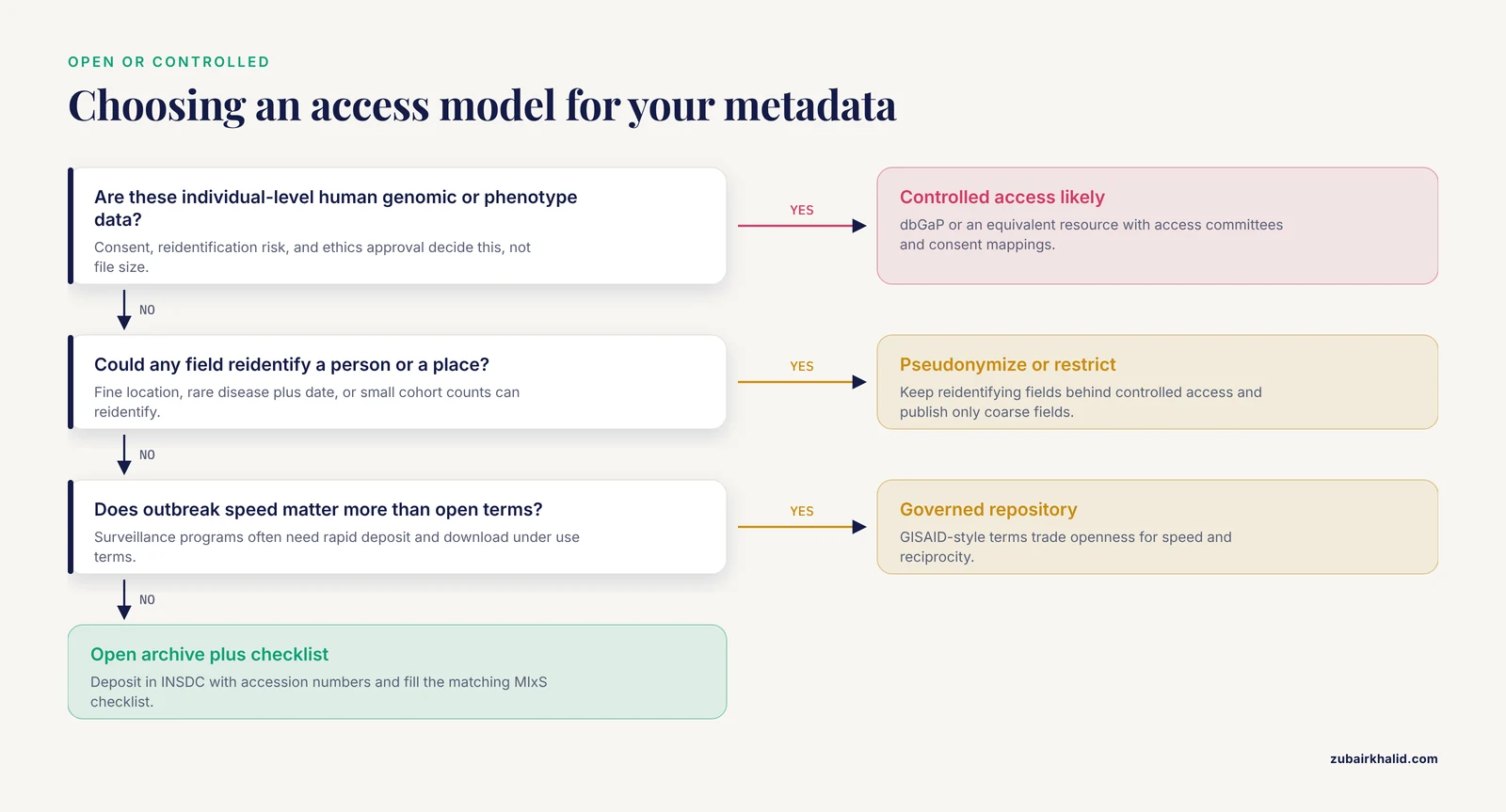
- A governance and access framework. Rules about who can see and reuse data. Fully open repositories such as GenBank sit at one end. GISAID, which became central during influenza and SARS-CoV-2 surveillance, requires registration and operates under database use terms rather than an open license. The database of Genotypes and Phenotypes (dbGaP) uses controlled access with authorized program officers and data access committees for individual-level human genotype and phenotype data.
A final category is emerging and worth tracking: standards for the secondary use of health data. A consensus-based evaluation of health data standards and harmonization tools, conducted as part of a federated data reuse project, found that existing health data standards were designed primarily for primary clinical care and leave gaps for research, regulatory, and decision-making use cases, and the study proposed a shared representation model to close those gaps [6]. If your genomics project links to electronic health record data, plan for that gap explicitly rather than assuming clinical standards will map cleanly onto research questions.
The Main Genomics Metadata Standards Options
INSDC sample schemas: BioSample, BioProject, and read archives
The International Nucleotide Sequence Database Collaboration links GenBank (maintained by NCBI in the United States), the European Nucleotide Archive (maintained by EMBL-EBI), and the DNA Data Bank of Japan. These archives exchange data daily, and together they are the backbone of public genomics data storage. Submitting sequence reads means registering a study (BioProject at NCBI), registering samples (BioSample), and submitting reads with links between the two.
The BioSample package you select defines the attribute set. A bacterial isolate package expects attributes such as organism taxonomy, strain, isolation source, collection date, and geographic location. A metagenome package expects environment descriptors. Attribute values should use controlled conventions where they exist: ISO 8601 format for dates (for example, 2025-03-14), the structured "country:region" pattern for geographic location, and latitude and longitude in decimal degrees where collection coordinates exist.
Pros. Universally recognized, free, stable, and integrated with accession numbers that journals and databases accept as evidence of deposit. Validation at submission catches missing mandatory fields before the data go public.
Cons. The schemas are deliberately general, so domain-specific detail (say, exposure metrics in an environmental study, or vaccination status in a clinical series) has to be squeezed into optional attributes or a supplementary file. Patient-level clinical detail generally does not belong in open INSDC records at all, which is the structural reason behind the next finding: an analysis of SARS-CoV-2 records in GenBank found that most lacked detailed patient metadata such as demographics and clinical outcomes, and the study had to recover such information manually from linked publications to enable genomic epidemiology analyses [7]. The sequence data were public. The context was not.
MIxS: the community checklist for sequence-associated metadata
MIxS (Minimum Information about any x Sequence) is the Genomic Standards Consortium checklist family covering genome sequences, marker gene surveys, and metagenomes. It is organized into packages by sample type, for example soil, water, host-associated, and other environments, with a small mandatory core of common fields and package-specific extensions. Marker gene survey metadata falls under MIMARKS, whole metagenome metadata under MIMS, and so on. Each package defines required fields and recommends terms from the Environment Ontology for environment descriptors.
MIxS is what turns "we sequenced some soil samples" into something a metagenomics analyst can combine with other soil studies. It is also the checklist the microbiome badge system in [1] uses as its reference point for grading metadata completeness.
Pros. The closest thing genomics has to a community consensus for sample-associated metadata. Free, well documented, and increasingly enforced by journals and funders.
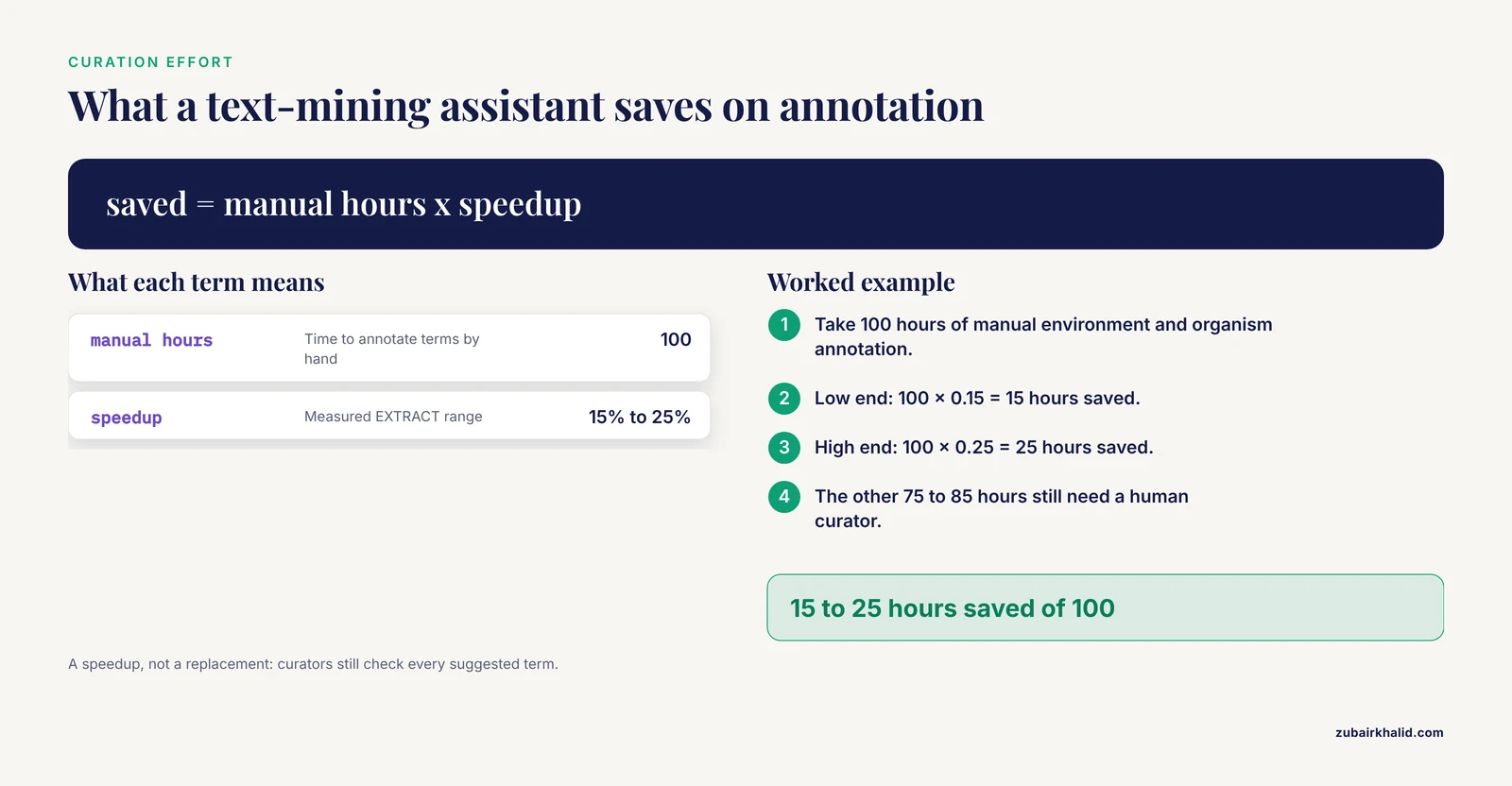
Cons. Filling it out manually is labor intensive, especially the ontology terms. Curation tools help here. EXTRACT, an interactive annotation tool for environment, organism, tissue, and disease terms, was evaluated in an interactive annotation task and sped up annotation by 15 to 25 percent while helping curators detect terms they would otherwise have missed [8]. Note the honest framing of that result: a 15 to 25 percent speedup, not a replacement for human judgment. If a vendor or internal tool promises full automation of metadata curation, treat the claim with the same skepticism.
Pros and cons in one line. MIxS maximizes interoperability at the cost of curation effort, and the effort is front-loaded, which is exactly where it is cheapest.
ISA-Tab and the ISA framework
ISA-Tab structures an experiment into three tabular layers: an Investigation file describing the overall study and contacts, a Study file describing samples and their characteristics, and Assay files describing measurements and the workflows that produced each data file. It was designed for transcriptomics and is now used broadly as a packaging format for experiments with multiple assays, including multi-omics.
Pros. Expressive enough to describe factorial designs, multiple assays per sample, and provenance chains. Human-readable, plain text, version-controllable in git. Several repositories accept ISA-Tab-based submissions.
Cons. Manual editing is painful, so most groups use editor tools, and those tools have a learning curve. ISA-Tab is a packaging format, not a vocabulary: it will happily let you store nonstandard field names unless you bind your study to a checklist and an ontology yourself.
MIAME, MIQE, and the functional genomics checklists
MIAME (Minimum Information About a Microarray Experiment) defined the pattern that later checklists follow: state the sample, the hybridization design, the array or assay technology, the raw and processed data files, and the analysis. MAGE-TAB is the tabular format used to deliver MIAME-compliant data to archives such as ArrayExpress. MIQE (Minimum Information for publication of Quantitative real-time PCR Experiments) does the same for qPCR, and its requirements, such as reporting primer sequences, reaction conditions, and efficiency, are enforced by many journals as author guidelines rather than by repositories.
Pros. Mature, well understood, and directly tied to journal compliance.
Cons. These checklists predate cloud workflows and were written for single-platform experiments. For a study that combines sequencing, imaging, and clinical data, you will use MIQE and MIAME as references for specific assay types rather than as the organizing framework for the whole project.
GISAID and pathogen surveillance metadata
For outbreak pathogens, the de facto shared resource during the COVID-19 pandemic was GISAID, which hosts millions of SARS-CoV-2 genomes alongside submission fields for collection date, location, host, and lineage assignments. Its access model trades openness for speed and reciprocity: registered users can deposit and download rapidly, with terms governing reuse and reidentification.
Pros. Rapid sharing at outbreak timescales, consistent core fields, and integration with lineage and variant trackers.
Cons. Governance terms limit some redistribution and secondary analysis, and the record-level fields are lean by design. The GenBank comparison in [7] applies to both repositories in different ways: host-associated clinical and demographic context is thin in public pathogen records generally, and extracting it from linked literature requires substantial manual effort, which is precisely why that study built a structured, enriched metadata resource from publication-linked GenBank records [7]. If your pathogen genomics project needs patient-level covariates, budget for a separate, ethically approved metadata pipeline rather than expecting the sequence repository to carry them.
dbGaP and controlled-access phenotype metadata
dbGaP (the database of Genotypes and Phenotypes) archives genotype and phenotype data from human studies under controlled access. Its metadata layer includes study descriptions, phenotype variable definitions, and study documents, all of which support discovery and retrieval. Retrieval quality matters: an analysis of dbGaP showed that text classification using n-gram features and study metadata identified relevant heart, lung, and blood studies more effectively than keyword search alone, positioning metadata-aware retrieval as a practical complement to document search [9].
Pros. Appropriate for individual-level human data, with consent and access infrastructure already in place, and standardized phenotype variable documentation.
Cons. Controlled access adds administrative latency, and the study-level metadata are heterogeneous because they come from thousands of independent studies. Harmonizing phenotypes across dbGaP studies remains manual work.
GA4GH interoperability schemas
The Global Alliance for Genomics and Health develops schemas and APIs for exchanging genomic and clinical data across institutions, including structured representations of phenotypic information built on the Human Phenotype Ontology and data-use condition models that describe what a dataset may be used for. In practice, you encounter these standards when building federated systems or when a funder requires machine-readable data-use statements.
Pros. Machine-readable consent and data use, which is becoming necessary as health data reuse scales.
Cons. Implementation is engineering work, and adoption is still uneven across institutions [6].
Proteomics and imaging formats from adjacent fields
If your genomics project includes mass spectrometry proteomics, the relevant formats and reporting guidelines come from the proteomics standards community, and the same reusable-by-design logic applies: plan biospecimen context, metadata, spectral evidence, quality control, and workflow provenance together from the outset of the study rather than reconstructing them for reviewers later [3]. For radiological imaging linked to genomic data, the Image Biomarker Standardization Initiative defines how radiomics features should be computed and reported, and open frameworks that comply with those standards and run in containerized workflows on cloud platforms make the image side auditable alongside the genomic side [10].
Side-by-Side Comparison
| Standard | Scope | Maintained by | Best fit | Main drawback |
|---|---|---|---|---|
| INSDC BioSample/SRA schema | Sample and read-level attributes for public archives | NCBI, EMBL-EBI, DDBJ (INSDC) | Any sequencing submission | General-purpose, thin on domain detail |
| MIxS (MIMS, MIMARKS) | Community checklist for sequence-associated sample metadata | Genomic Standards Consortium | Microbiome, environmental, host-associated sequencing | Curation burden, ontology terms |
| ISA-Tab | Investigation, study, and assay packaging | ISA framework community | Multi-assay studies, reproducibility packages | Requires editor tooling, vocabulary not enforced |
| MIAME/MAGE-TAB, MIQE | Microarray and qPCR reporting | Functional genomics and qPCR communities | Single-platform functional genomics, journal compliance | Predate cloud and multi-omics designs |
| GISAID fields | Pathogen surveillance metadata | GISAID | Outbreak sequencing, rapid sharing | Governance terms, lean record-level fields |
| dbGaP | Genotype and phenotype study archiving | NCBI | Human genetic studies with consented phenotypes | Controlled-access latency, cross-study heterogeneity |
| GA4GH schemas | Cross-institution genomic and clinical exchange | GA4GH | Federated and regulated data sharing | Engineering cost, uneven adoption |
| Proteomics (PSI) and radiomics (IBSI) formats | Mass spectrometry and imaging feature reporting | HUPO-PSI, IBSI | Multi-omics and image-genomic studies | Another vocabulary set to learn per assay |
No single standard wins the table. The best genomics metadata standards options work as a stack: a checklist for scientific completeness, a repository schema for transport, ontologies for vocabulary, and an access framework for governance.
Pros and Cons on the Criteria That Decide Real Choices
When teams ask which metadata standard is best, they are usually weighing five criteria. Here is how the options trade off.
Expressiveness versus curation burden. ISA-Tab and GA4GH schemas are the most expressive. BioSample attributes are the cheapest to complete. MIxS sits in between: more specific than a repository schema, less expressive than a full investigation package. If your study has a complex design (multiple sites, repeated sampling, paired tissue types), pay the ISA-Tab cost. If it is a straightforward survey, repository schema plus checklist is enough.
Openness versus privacy. INSDC repositories and MIxS assume open data. GISAID and dbGaP assume governed access. This is not a technical preference, it is an ethical and legal boundary. Human host metadata with reidentifying potential belongs behind controlled access, and the SARS-CoV-2 experience shows what happens when that boundary is drawn too conservatively in the other direction: clinical context vanishes from public records and must be reconstructed later [7].
Vocabulary depth. MIxS with Environment Ontology terms and GA4GH schemas with Human Phenotype Ontology terms have real vocabularies behind them. Free-text repository attributes do not. The difference shows up the first time you try to merge studies, which is the entire point of the FAIR exercise.
Tooling support. Repository submission portals validate their own schemas, which is a significant advantage: errors surface at submission, not at review. ISA-Tab depends on editor tools. MIxS increasingly benefits from text-mining assistants like EXTRACT [8] and from pipelines that generate metadata tables directly from laboratory information systems. In the multi-omics world, tooling is the weak point in a different way: integration methods differ widely in required input formats, and packages like moiraine exist precisely to standardize preprocessing and formatting across integration tools while carrying sample and feature metadata through to the visualizations [11].
Longevity and discoverability. Deposits in permanent archives with accession numbers outlive lab servers, hard drives, and personnel. Resources such as Gene Expression Nebulas 2.0, which now holds 668 datasets, more than 102,000 samples, over 23 million cells, and manually curated metadata across 100 species, demonstrate the compounding value of standardized, curated metadata at the resource level: the curation is what makes cross-species, cross-tissue, and cross-disease comparison possible [12]. Your single study contributes to that ecosystem only if its metadata survive the trip.
Worked Scenarios
Scenario 1: A human gut microbiome amplicon study
You are submitting 240 16S rRNA gene amplicon libraries from a dietary intervention trial. Use the INSDC metagenome package for BioSample registration, fill the MIxS marker gene survey (MIMARKS) fields, and record, per sample: collection date in ISO 8601 format, geographic location, host species, body site, diet intervention arm, antibiotic exposure in the preceding months, and extraction kit lot. The extraction kit and library protocol fields are not decoration. Batch effects from extraction kits are real and a reanalyst will need them to model or adjust for batch.
Given the evidence that nearly half of microbiome publications fail minimum data availability standards and that metadata harmonization is the dominant barrier to cross-study comparison [1], aim for the top tier of the badge system rather than the minimum: deposit raw reads, publish the metadata table alongside the study, and describe the analysis workflow in enough detail to rerun. If you have no time for manual ontology annotation, run your environment and host descriptions through a text-mining assistant to speed term extraction by the measured 15 to 25 percent rather than skipping annotation entirely [8].
Scenario 2: SARS-CoV-2 or other pathogen surveillance
You are sequencing 5,000 viral genomes for a public health program. Deposit sequences and core fields (collection date, location at the granularity permitted, host, sequencing technology) into the appropriate surveillance repository and GenBank in parallel. Accept now that patient-level detail such as demographics, vaccination status, and outcomes will not live in the sequence records, and plan a separate, consent-governed metadata pipeline if epidemiological analyses need it. The literature-derived enrichment study in [7] shows both the size of the gap and the feasibility of closing it for published subsets: structured extraction from linked publications recovered sample collection details, demographics, treatments, serology, vaccination status, and outcomes that the repository records lacked. If geographic provenance matters to your analysis, capture it at collection time from the case record, not from author affiliations or submission forms, because institution-based inference misattributes provenance in the large majority of studies [5].
Scenario 3: A clinical translational study with linked phenotypes
You have consented patient samples with sequencing, proteomics, and electronic health record follow-up. Put individual-level genotype and phenotype data in dbGaP or an equivalent controlled-access resource with consent mappings. Use Human Phenotype Ontology terms for phenotypic descriptions so they are computable across studies. For the health record linkage, budget explicitly for the interoperability gap between primary-care standards and secondary research use identified in the federated health data feasibility study [6], and treat phenotype harmonization as a project phase with its own timeline, not a bonus task. The proteomics review in [3] is a good checklist for what to plan up front in this design: biospecimen context, missing-value handling, batch structure, and workflow provenance, because those are the documented points of failure when such datasets are later reused.
Scenario 4: An environmental exposure study feeding AI models
You are combining sequencing, exposure measurements, and geospatial data. Follow the practical sequence recommended for environmental health sciences: plan standards use early, adopt established templates rather than inventing field names, and use institutional resources where they exist [13]. Record exposure measurements with instrument, units, detection limits, and timestamps in the metadata, not just in the paper. This matters because standards adoption is what allows emerging AI and machine learning approaches to consume the data at all [13]. And when you later train models on literature-mined metadata, remember the geographic attribution failure rate in [5]: automated extraction of patient or sample origin is genuinely hard, with reported macro F1 around 55 percent for patient-origin extraction in cancer genomics, so validate the extracted metadata before treating it as ground truth.
How Metadata Standards Fit Into Genomics Data Storage and Bioinformatics Data Management
Metadata standards define the content. Bioinformatics data management defines how the content stays attached to the data through years of storage, migration, and reuse. Four practices make the standards pay off.
Store metadata with the data, in plain text. The raw file layout should include a per-sample metadata table (CSV or TSV) whose column names match the checklist fields you committed to, plus the ISA-Tab files if your design warrants them. Free-text formats survive format churn far better than proprietary spreadsheets tied to one analyst's laptop. Keep per-file checksums so any migration can be verified, and version the metadata table in version control alongside the code, because metadata edits are analysis events.
Keep field names stable and controlled. Downstream tools consume metadata by field name. A comparative genomics report generator lets users sort, filter, and color genomes by metadata fields inside its interactive output [14]. A fast genome collection visualizer applies metadata filters to restrict what is displayed [15]. A multi-omics pipeline includes sample and feature metadata directly in result visualizations [11]. Each of these breaks, silently or loudly, when the same concept is called "collection_date" in one table and "SamplingDate" in another. Choose names once, document them in a README inside the data package, and resist renaming them mid-project.
Make provenance a metadata category of its own. Provenance is the record of how a data file was produced: software versions, reference genomes, parameters, containers. Containerized, unit-tested workflows that run identically on cloud platforms and local hardware, as implemented in medical imaging analysis frameworks with standardized feature computation [10], are the model to copy for sequencing pipelines. When provenance is recorded in the same structured way as sample metadata, a reanalyst can reproduce the exact processing chain instead of reverse engineering it from methods text.
Plan the access model with the metadata model. Decide at project start which fields are open, which are controlled-access, and which are pseudonymized. Changing this after data are deposited is slow and sometimes impossible. The choice interacts with storage: controlled-access metadata need infrastructure that enforces authorization, while open metadata can live in the archive alongside the reads.
Common Mistakes and Limitations
Writing a data availability statement instead of depositing data. The microbiome evaluation found that such statements are an ineffective proxy for actual data availability, with nearly half of surveyed publications failing minimum standards [1]. Deposit the data, get the accession numbers, and put the numbers in the paper.
Retrofitting metadata after publication. Metadata collected from memory or from a paper's methods section months after sampling is systematically worse than metadata captured at the bench. Build the metadata table before the first sample is collected, and have whoever handles the sample fill the row the same day.
Recording method details as free prose instead of fields. The hand microbiome study demonstrates why this matters analytically: the sampling method itself determined whether treatment effects were detectable at all [4]. "Swab" versus "glove" is a metadata field, not a methods paragraph, and no amount of downstream statistics can recover a field that was never recorded.
Inferring geography from institutions. Author affiliation or submitting-lab location is not sample provenance. The cancer genomics literature analysis showed most studies carry affiliations unrelated to their patient cohorts, so metadata-based geographic inference misattributes provenance systematically [5]. Record collection location as a first-class field.
Trusting repository defaults to carry domain detail. Archive schemas accept optional attributes but do not require the domain-specific fields your analysis will need. Repository compliance and scientific completeness are different thresholds, and only one of them makes your data reusable.
Treating AI-readiness as automatic. Gaps in metadata, tool-specific output formats, and uncorrected or overcorrected batch structure are the documented reasons public omics datasets resist reanalysis and integration [3]. Claiming a dataset is machine-learning-ready without those checks is one of the specific failure modes that review calls out.
Ignoring the secondary-use gap in health data standards. If your project links genomic data to clinical records, existing health data standards cover primary care better than research reuse, and the gap is documented by consensus evaluation rather than anecdote [6]. Allocate time for a mapping layer.
Assuming one standard covers everything. Even well-resourced, well-motivated communities show uneven metadata coverage across subfields, as the fungal genomics review documents for annotation and metadata [2]. Expect to combine standards, and write down the combination you chose.
The core limitation to state plainly. Standards reduce, but do not eliminate, the judgment calls in describing biological material. Two curators can annotate the same sample differently within any standard, which is why benchmarks, badge tiers [1], and curated reference resources [12] exist. Metadata standards are infrastructure, and infrastructure demands maintenance.
Frequently Asked Questions
What are genomics metadata standards?
They are agreed sets of field names, definitions, and controlled vocabularies for describing genomic samples, experiments, and analyses so that data can be found, understood, and combined across studies. Examples include the MIxS checklists, INSDC repository schemas, ISA-Tab, and dbGaP documentation.
Which metadata standard should I use for a microbiome study?
Use the MIxS checklist for your sample type alongside the BioSample schema of the archive you submit to. Deposit raw reads with accession numbers, publish the metadata table, and aim for the highest data-sharing tier rather than the minimum [1].
What is the difference between a checklist, an ontology, and a file format?
A checklist says which fields to report, an ontology supplies the controlled terms for those fields, and a file format specifies how the fields are stored and moved. You typically need all three: MIxS fields, Environment Ontology terms, and ISA-Tab or a repository template, for example.
Do patient-level metadata require controlled access?
Yes for individual-level human genomic data with reidentifying potential, which is why resources such as dbGaP use authorized access committees. Core nonidentifying fields such as collection date and coarse location can go into open surveillance records, but the SARS-CoV-2 experience shows that clinical and demographic detail is usually absent from open pathogen records and must be handled through a separate consented pipeline [7].
Can metadata curation be automated?
Partially. Text-mining assistants such as EXTRACT speed environment and organism term annotation by a measured 15 to 25 percent and catch terms that manual curation misses, but they assist rather than replace human curators [8]. Validate any literature-mined metadata before using it as ground truth, especially geographic attributes [5].
How much metadata is enough at submission?
At minimum, complete every mandatory field of the repository schema and every required field of your community checklist. Beyond that, add every variable your own analysis depends on, including batch, protocol, and method fields, because metadata completeness is what separates reusable data from merely deposited data [1], [2].
Sources
- Tier-based standards for FAIR sequence data and metadata sharing in microbiome research.
- Progress and disparities in fungal genomics in the long-read era.
- Making proteomics reusable by design: interoperability standards for multi-omics and clinical translation.
- Comparison of Standard Culture-Based Method to Culture-Independent Method for Evaluation of Hygiene Effects on the Hand Microbiome.
- A FAIR gold-standard benchmark for geographic entity recognition in cancer genomics literature for biomedical NLP.
- Bridging Gaps in Standards for the Secondary Use of Health Data: Exploratory Standard, Tool Assessment, and Feasibility Study.
- Enriching Public Pathogen Genomic Records With Patient Metadata: Quantitative Study and Exploratory Case Analysis.
- EXTRACT: interactive extraction of environment metadata and term suggestion for metagenomic sample annotation.
- Text Categorization of Heart, Lung, and Blood Studies in the Database of Genotypes and Phenotypes (dbGaP) Utilizing n-grams and Metadata Features.
- Artificial intelligence apps for medical image analysis using pyCERR and cancer genomics cloud.
- moiraine: an R package to construct reproducible pipelines for the application and comparison of multi-omics integration methods.
- Gene Expression Nebulas 2.0: an updated resource of gene expression profiles by incorporating more datasets, annotations, and functionalities.
- Accelerating environmental health sciences through data and metadata standards to support FAIR principles.
- BLITSFR: scalable comparative genomics with self-contained interactive single file report.
- Fast and inexpensive visualization of genome collection at scale.