Building a Data Quality Management Plan for Genomics Projects
By Dr. Zubair Khalid, DVM, MS, PhD ·

By the end of this article you will be able to draft a complete data quality management plan (DQMP) for a genomics project, wire automated quality control (QC) into your analysis pipeline, define the metrics and thresholds you will track, and put governance, storage, and audit procedures in place so the plan survives contact with real staff and real deadlines.
To follow the walkthrough you should have on hand:
- A short description of your project, its data types (for example whole-genome sequencing, RNA-seq, SNP array genotyping), and its funder or institutional data requirements
- A location where raw and processed data will live, whether an on-premise storage server, a high-performance computing cluster, or a cloud bucket
- A workflow engine such as Nextflow or Snakemake, plus a QC toolchain: FastQC, MultiQC, samtools, Picard, and PLINK2 or a comparable genotyping QC package
- A named person (often a data steward or bioinformatician) who will own the plan
A DQMP is a project-specific document that states, in advance, what "good data" means, how quality will be measured at every stage, who is responsible for each check, and what happens when a check fails. It is the operational layer beneath a broader data management plan (DMP), the document that describes how data will be collected, documented, described, shared, and preserved across the project lifecycle [1]. Genomics makes this planning urgent because modern sequencing and AI-driven analyses generate vast, complex datasets that demand deliberate stewardship to protect integrity, privacy, and accessibility [2].
Why Genomics Projects Need a Formal Quality Plan
Three pressures make an informal approach fail in genomics.
First, funders and institutions increasingly require a DMP as part of the research process, and reviewers expect plans to address accessibility, quality, and longevity of data, not just storage logistics [1]. A quality section that says "data will be checked for quality" is not a plan. A plan names the metric, the tool, the threshold, the responsible person, and the corrective action.
Second, quality problems compound silently. A degraded RNA extraction, a swapped sample plate, or a mislabeled reference genome build propagates through every downstream result. Biobanking work has shown that QC and sample suitability must be documented and validated to ensure data integrity and establish contexts for interpretation of results, which is why standardized collection, processing, and storage procedures matter across proteomic and genomic communities [3].
Third, reanalysis is the norm in genomics. Cohorts grow, methods improve, and collaborators join. Projects with ongoing genotyping, such as genomic prediction programs, need long-term data integrity so that samples from new runs can be integrated with old ones without breaking comparability [4]. Large-scale resources show what this looks like at scale. The Kaiser Permanente Research Bank recruited and consented more than 400,000 participants (449,122 in total) and made genomic data, biospecimens, longitudinal records, and survey data available for research use, which is only feasible with structured quality and governance procedures baked in from the start [5].
What Goes in the Plan: A Reusable Template Structure
Use this nine-section skeleton as your genomics data quality management plan template. It works for a three-person lab or a surveillance network. Fill it in, version it, and store it beside your code.
- Project overview and data inventory. Data types, volumes, throughput, data sensitivity class (for example de-identified versus identifiable human data), and the funder or regulatory mandates that apply, including GDPR or local data protection requirements where relevant [1].
- Quality objectives. What "fit for purpose" means for this project, stated per data type.
- Metrics and thresholds. The specific QC metric, tool, and threshold at each pipeline stage, defined before data arrives (see the table in Step 2).
- Pipeline and tooling. Workflow engine, software versions, container images, reference genome build and its checksum, and the QC tools embedded at each stage.
- Storage, provenance, and integrity. Storage tiers, backup schedule, retention period, checksum verification procedure, and metadata standards.
- Validation gates and failure handling. What stops a sample or batch from moving forward, who is notified, and what corrective actions are allowed.
- Roles and governance. Data steward, bioinformatics lead, laboratory liaison, and how decisions about quality exceptions get made and recorded.
- Monitoring, audit, and improvement. Review cadence, audit triggers, and the improvement cycle used to revise the plan.
- Budget and sustainability. Storage growth, compute, personnel time, and the cost drivers of running QC at projected throughput.
This is the template format that maps most directly onto what funders ask for and what auditors look for. The next section turns it into concrete decisions.
Building Your Plan, Step by Step
Step 1: Inventory Your Data and Define Quality Dimensions
List every data type and assign it the quality dimensions that matter. For sequencing data the recurring dimensions are:
- Accuracy. Do base calls and genotypes reflect the true biological state? Measured through per-base quality scores, genotype quality, and concordance checks.
- Completeness. Are expected samples, reads, or loci present? Measured through read counts, call rates, and coverage.
- Consistency. Would the same sample processed twice give the same result? Measured through replicate concordance and batch-effect checks.
- Identity. Is each file attached to the right subject? Measured through genotype-based sample identity checks and barcode verification [6].
- Traceability. Can any result be traced back to raw data, software versions, and parameters? Achieved through provenance records and versioned pipelines.
For human subjects work, add privacy dimensions. Data governance, access control, accountability, and traceability are core aspects of stewardship for large-scale genomics and AI applications, and they belong in the same plan as your technical metrics rather than in a separate binder nobody opens [2].
Step 2: Define Metrics and Thresholds per Pipeline Stage
The core of the plan is a table like this. Thresholds shown are illustrative placeholders. Set your own values per assay and record the rationale in the plan, because appropriate values depend on platform, library type, and study design.
| Stage | Data type | Metric | Tool | Example threshold (illustrative) |
|---|---|---|---|---|
| Sample receipt | Any | Sample ID match, metadata completeness | LIMS check | 100% IDs resolved before extraction |
| Raw reads | Illumina sequencing | Per-base quality, adapter content, GC distribution | FastQC | Flag any module marked "warn" or "fail" for review |
| Raw reads | Any | Per-sample aggregate QC summary | MultiQC | Review batch-level outliers |
| Alignment | DNA-seq, RNA-seq | Mapping rate, duplication rate, insert size | samtools flagstat, Picard | Flag samples below lab norms set during pilot |
| RNA-seq | Transcriptomics | Library complexity, 3' or 5' bias, gene body coverage | RNA-seq QC modules in pipeline | Review samples with extreme bias before counting |
| Genotyping array | SNP array | Sample call rate, SNP call rate, heterozygosity, sex check | SNPQC, GTQC, PLINK2 | Flag samples or markers below thresholds set in the protocol |
| Variant calls | WGS, WES | Transition/transversion ratio, depth distribution, contamination estimate | bcftools stats, Picard | Review samples outside batch norms |
| Structural outputs | Protein structures, other standards | Schema and dictionary compliance | mmCIF Validator or domain validator | Zero blocking errors before deposition |
Two source-grounded points justify this table's shape. RNA-seq analysis pipelines place quality control first, before preprocessing and alignment, because ensuring the integrity of RNA-seq data lays the groundwork for all subsequent analysis [7]. For genotyping arrays, thorough QC is described as key to generating high-integrity data and robust results, and automated pipelines exist precisely because manual QC is complicated and labor-intensive [8]. Quality control of genotypes in genome-wide association studies prevents spurious results and maintains long-term data integrity, with the emphasis placed on automating storage, filtering, and manipulation so integrity holds through the whole process [9].
Step 3: Implement Automated QC in the Pipeline
Manual QC does not scale and does not get documented. Embed QC as pipeline rules that always run and always emit a machine-readable summary. The following walkthrough uses a Nextflow-style structure with FastQC and MultiQC, which are standard tools.
Run raw-read QC per sample:
fastqc -o qc/fastqc -t 8 reads/SAMPLE_A_R1.fastq.gz reads/SAMPLE_A_R2.fastq.gzExpected output in qc/fastqc/: one HTML report and one zip per file, for example SAMPLE_A_R1_fastqc.html. Open one report and confirm the modules you listed in your plan are the ones you actually review.
Aggregate across the batch:
multiqc qc/fastqc qc/alignment -o qc/multiqc_run01Expected output: qc/multiqc_run01/multiqc_report.html plus multiqc_data/multiqc_general_stats.txt. That machine-readable table is what your plan's review step consumes. A typical row looks like:
Sample        %Dup  %GC  avg_length  total_sequences
SAMPLE_A_R1   14.2  51   150         23,940,112
Explain the parameters that matter:
-osets the output directory. Create it first or FastQC will error.-t 8sets threads. Match it to your available cores.- For MultiQC, the directories you pass are searched recursively for recognized tool outputs, which is why keeping QC outputs in consistent subdirectories matters.
Common errors with exact messages and fixes:
No analysis results found in 'qc/fastqc'from MultiQC. The path is wrong or the FastQC run failed. List the directory, rerun FastQC, and check for the_fastqc.zipfiles before retrying MultiQC.ERROR: Could not find or access reads/SAMPLE_A_R1.fastq.gzfrom the shell. A filename typo or a sample sheet mismatch. Fix the sample sheet, since that sheet is itself a quality-controlled artifact in your plan.- FastQC marks "Per base sequence quality" as warn or fail. In RNA-seq this is common near read ends due to sequencing chemistry and transcript depletion effects. Your plan should say in advance which warnings trigger sample exclusion versus which are recorded and accepted, so the same warning does not get argued about sample by sample.
Step 4: Lock Down Storage, Provenance, and Integrity
This is where bioinformatics data management and genomics data storage policy meet the plan.
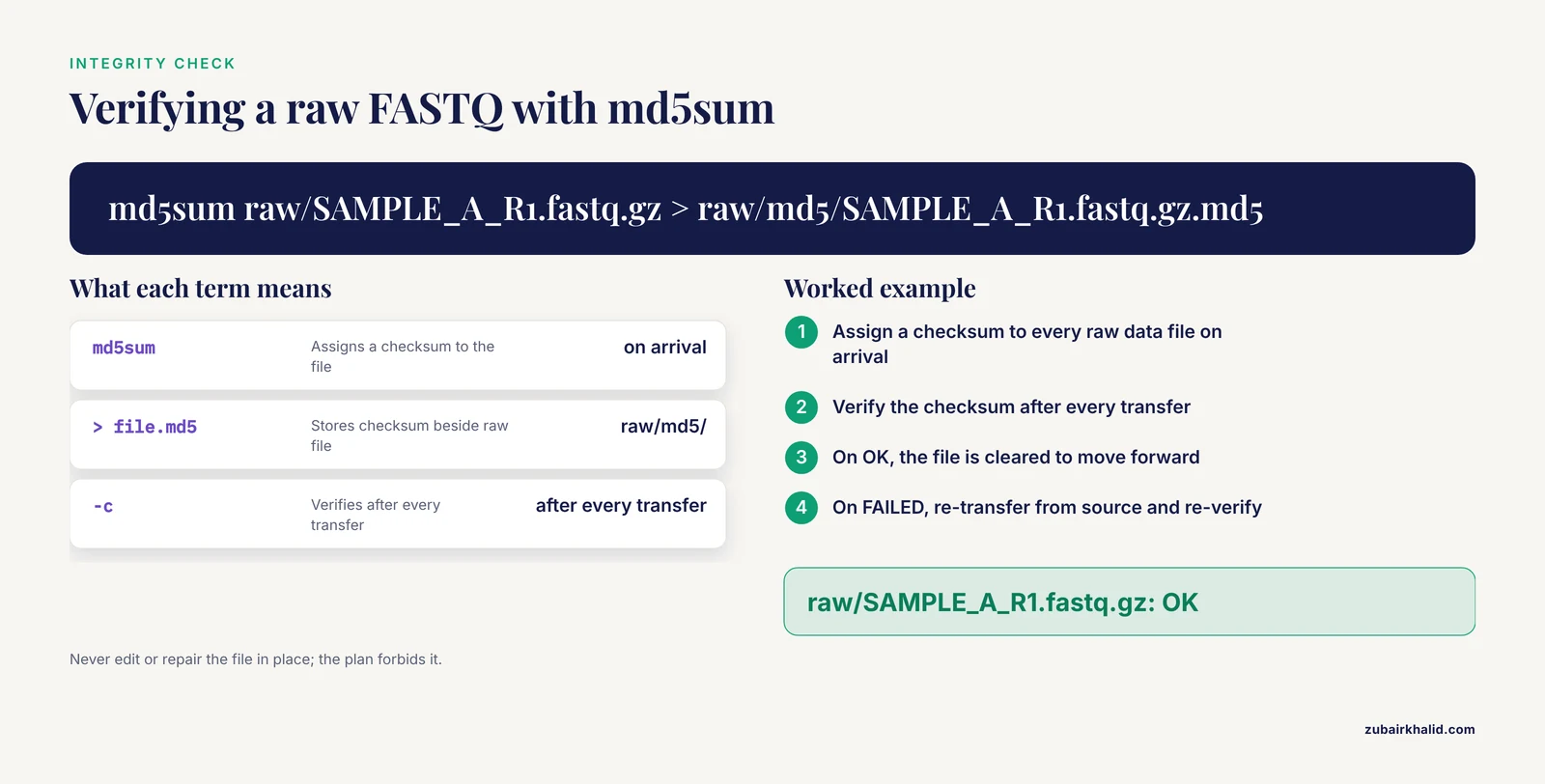
Checksums. Assign a checksum to every raw data file on arrival and verify after every transfer.
md5sum raw/SAMPLE_A_R1.fastq.gz > raw/md5/SAMPLE_A_R1.fastq.gz.md5
md5sum -c raw/md5/SAMPLE_A_R1.fastq.gz.md5
Expected output on success:
raw/SAMPLE_A_R1.fastq.gz: OKOn failure you get:
raw/SAMPLE_A_R1.fastq.gz: FAILED
md5sum: WARNING: 1 computed checksum did NOT match
The fix is never to edit the file. Re-transfer from the source, then re-verify. Write this rule into the plan so nobody "repairs" a corrupted BAM in place.
Storage layout and retention. Define a directory contract, for example raw/, processed/, references/, metadata/, qc/, and logs/, and state which directories are immutable. Raw data are immutable. References live in one versioned place with recorded checksums, because a silent reference change invalidates every comparison. State retention periods and the archival tier (tape, cold object storage, or a community archive) for long-term preservation, since longevity of data is a stated goal of data management planning [1].
Provenance. Record workflow engine version, container digests, reference versions, and full command lines with each run. Data stewardship and curation frameworks treat traceability and accountability as first-class requirements, not conveniences [2]. In practice this means your pipeline writes a provenance report per run and your plan names where those reports are kept.
Capacity planning. Storage is a recurring cost, and throughput drives it. Genomic surveillance work validated across multiple WHO regions demonstrated significant cost reductions per sample as throughput increased, underpinning the economic case for optimizing sequencing platform use [10]. Apply the same logic to storage. Plan storage growth from projected sample throughput, not from current month usage.
Step 5: Set Validation Gates and Sample Identity Checks
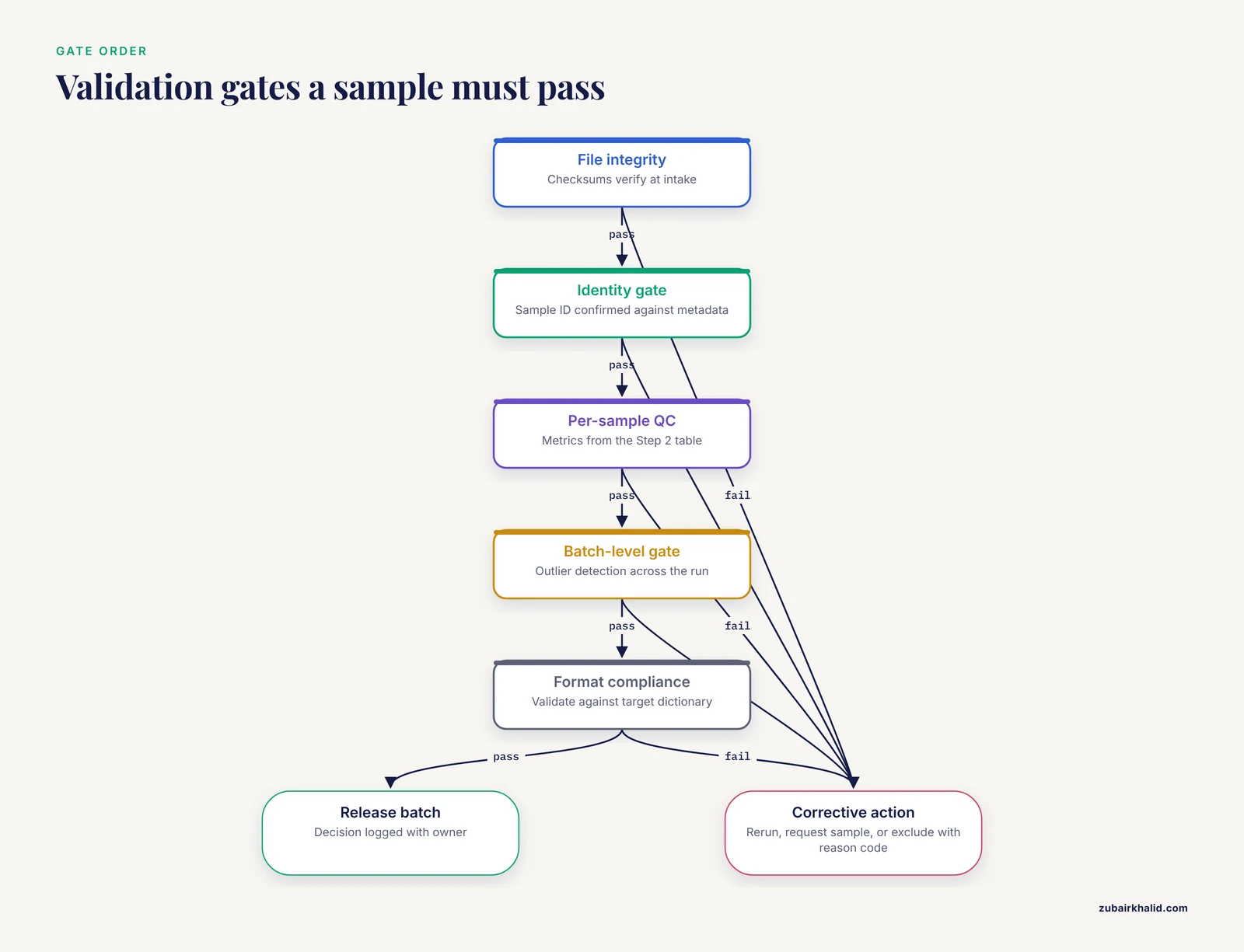
A validation gate is a check that must pass before data proceeds. Define gates in this order:
- File integrity gate. Checksums verify. Failures stop the sample at intake.
- Identity gate. Sample identity is confirmed against metadata. The PGP-UK multi-omics reference panel implemented quality control and validation procedures specifically to ensure data integrity and exclude sample mix-ups, which is the standard you should aim for [6]. For genotyped cohorts, genotype-based identity and sex checks are the practical tools.
- Per-sample QC gate. The metrics from your Step 2 table. For SNP array data, automated pipelines such as SNPQC apply a wide range of quality metrics with user-defined filtering thresholds, generate a comprehensive QC report, and store genotypic, phenotypic, and quality metrics in a database so later runs can be integrated [4]. GTQC similarly automates genotyping QC steps and produces a detailed HTML report covering a broad spectrum of metrics before downstream analysis [8].
- Batch-level gate. Outlier detection across the run. One bad sample is a sample problem. Ten in one plate is a process problem, and the gate should trigger the corrective action workflow, not just a note.
- Format compliance gate. For data destined for public archives or structured exchange, validate against the governing standard before submission. The mmCIF Validator performs comprehensive checks of PDBx/mmCIF files against the dictionary defining schema, data types, enumerations and relationships, and it ships both as an editor extension and a standalone Python script for batch processing and integration into automated CI/CD pipelines, catching errors before deposition and reducing delays [11]. The general principle transfers: validate against the target format's dictionary before anything leaves your group.
For each gate, record in the plan: the exact command or rule, the threshold, the person notified on failure, the allowed corrective actions (rerun extraction, request new sample, exclude with reason code), and where the decision is logged.
Step 6: Assign Roles, Training, and Governance
Name people, not committees. The minimum viable structure:
- Data steward. Owns the plan document, the metadata standards, and the access-control register.
- Bioinformatics lead. Owns the pipeline, the QC thresholds, and the reference versions.
- Laboratory liaison. Owns sample receipt, extraction documentation, and reporting lab-side deviations.
- Project lead. Approves exceptions and signs off on batch releases.
Governance questions to answer explicitly in the plan: who can write to raw/ (nobody, after checksum verification), who can approve excluding a sample, and how access control maps to roles. Recent reviews of AI-based genomics and high-throughput screening identify data governance, ownership, access control, and accountability as central pillars of stewardship, precisely because these datasets are too large and too sensitive for ad hoc handling [2].
Where genomic results touch clinical care, structure the human side of quality too. The ESMO Precision Oncology Working Group defined five components critical to the molecular tumour board process, including interdisciplinary expertise spanning oncologists with genomic expertise, molecularly trained pathologists, and clinical geneticists, and structured reporting of genomic-informed recommendations, management of potential germline alterations, and guidance for additional testing [12]. If your project feeds clinical interpretation, your quality plan should specify who reviews variant calls and how reports are structured.
Step 7: Plan Monitoring, Audit, and Corrective Action
A plan nobody re-reads decays. Put three mechanisms in the document:
- Scheduled review. Revisit thresholds and the plan itself at a fixed cadence, for example every six months or at each major pipeline version bump.
- Triggered audit. Any failed batch gate, any checksum failure, or any metadata discrepancy triggers a recorded review, even if resolved informally.
- A defined improvement cycle. One widely used structure is Plan-Do-Study-Act, in which a change is planned, implemented on a small scale, its effects measured, and the results folded back into practice [13]. Apply it to your QC process itself. If the identity gate caught two mix-ups last quarter, ask whether receipt handling needs a change, not just whether the gate works.
Keep a simple log with columns for date, trigger, finding, action, owner, and status. This log is the artifact that turns your plan from a document into a functioning system.
Step 8: Budget and Sustain the Plan
Quality management costs money and the plan should say so. Follow the structure used in genomic surveillance costing work, which built a systematic cost estimation approach and validated it in public health laboratories across three WHO regions, with scenarios covering validating past expenditure, routine use, cost optimization, and scaling up sequencing services [10]. Your plan's budget section should cover:
- Storage growth per year at projected throughput, split across raw, processed, and archival tiers
- Compute hours for QC and pipeline runs per batch
- Personnel time for stewardship, review, and audits
- One-time setup costs for automation (containers, workflow setup, LIMS integration)
The costing exercise in surveillance genomics demonstrated significant per-sample cost reductions at higher throughput [10], which means your budget should model several throughput scenarios rather than one, so the plan survives both growth and funding dips.
A Worked Mini-Example
Consider a 96-sample RNA-seq project on a single flow cell. Here is what the plan's key decisions look like in practice.
The quality objective: differential expression calls reliable enough for pathway analysis, with no sample mix-ups.
The metrics, drawn from a standard RNA-seq pipeline structure where QC precedes preprocessing and alignment, and alignment precedes differential expression and functional analysis [7]:
Gate 1  checksums pass for all 192 FASTQ files (96 samples, paired-end)
Gate 2  sample IDs in sample_sheet.csv match LIMS export, 96/96
Gate 3  per-sample FastQC run, MultiQC summary reviewed
Gate 4  alignment stats within norms established in a 6-sample pilot:
        mapping rate, duplication, insert size, gene body bias
Gate 5  batch-level outlier review in MultiQC before quantification
The pipeline stub:
fastqc -o qc/fastqc -t 16 reads/*.fastq.gz
multiqc qc/fastqc -o qc/multiqc_flowcell1
multiqc qc/alignment -o qc/multiqc_align_flowcell1
Then the review step reads the aggregated stats:
column -t qc/multiqc_flowcell1/multiqc_data/multiqc_general_stats.txt | less -SIf sample S047 shows a mapping rate far below the other 95 samples while its FastQC looks clean, the plan's corrective action says: check the reference version and parameters first, then request re-extraction for S047, log the event, and proceed with 95 samples rather than blocking the batch. That decision rule, written down before the run, is what separates a plan from a hope.
Common Mistakes and Limitations
- Defining thresholds after seeing the data. If you set call rate cutoffs after looking at your own distributions, the QC step becomes theater. Set thresholds from assay expectations and pilot data before the full run, then revisit them on schedule.
- QC without a decision rule. Generating MultiQC reports that nobody is required to act on is the most common failure mode. Every metric in the plan needs an owner and a consequence.
- Mutable raw data. Anything that can overwrite a raw file will eventually do so. Make
raw/write-once, checksum it on arrival, and verify after every move. - Reference genome drift. Switching reference builds mid-project without recording it breaks comparability. Pin the reference with a checksum in the plan and version it like software.
- Sample mix-ups treated as rare bad luck. They are process failures. The PGP-UK resource built genotype-based validation specifically to exclude mix-ups in a multi-omics reference panel [6], and genotyping QC frameworks store metrics in databases precisely so identity and integrity can be tracked across runs [4].
- Automation-free QC. Manual QC protocols are described as complicated and labor-intensive in the genotyping literature, which is the direct motivation for packages like SNPQC and GTQC that automate metric calculation and reporting [4][8]. Automate before your sample count makes manual review impossible.
- Ignoring format validation until submission. Pre-deposition validation against community dictionaries streamlines archival submission and reduces delays [11]. Validate early, in CI, not the week before the deadline.
- Privacy bolted on last. For human data, access control, accountability, and traceability are stewardship requirements, not paperwork afterthoughts [2][1].
- No budget line for quality. QC compute, storage growth, and steward time are real costs. Surveillance genomics costing work shows why throughput scenarios belong in financial planning [10].
- A limitation to state plainly. A data quality plan assures the integrity of the data and the process. It does not substitute for qualified biological or clinical interpretation of results, which for clinical genomics belongs with appropriately trained professionals in structured settings such as molecular tumour boards [12].
Frequently Asked Questions
What is a genomics data quality management plan?
It is a project document that defines what quality means for each data type, the metrics and thresholds that measure it, the automated checks that enforce it, the people responsible for each decision, and the corrective actions taken when checks fail.
Is there a free genomics data quality management plan template I can adapt?
Yes. The nine-section skeleton in this article is free to copy, and open-source tools exist to help draft the underlying data management plan that a quality plan sits within, a point covered in reviews of DMP practice [1].
What quality metrics should every sequencing project track?
At minimum, per-base and per-sample read quality from FastQC with a MultiQC aggregate, alignment statistics such as mapping rate and duplication, and, for genotyping data, call rates, heterozygosity, and identity checks, as reflected in standard RNA-seq and genotyping QC pipelines [7][4][9][8].
How does a data quality management plan relate to a data management plan?
A data management plan covers the full lifecycle, including collection, documentation, sharing, preservation, and compliance with funder and privacy mandates [1]. The quality management plan is the detailed, operational section that specifies metrics, tools, thresholds, gates, and governance for quality specifically.
How do I prevent sample mix-ups in a genomics project?
Use barcode verification at receipt, enforce an identity gate based on genotype concordance before analysis, and record every check. Multi-omics resources have implemented exactly this kind of validation to exclude sample mix-ups and ensure data integrity [6].
What storage and backup setup does genomics data need?
Immutable raw data with checksums on arrival, versioned references, a documented directory contract, tiered storage with an archival layer for long-term preservation, and backups tested by actual restoration. Traceability and storage systems are core stewardship concerns for large genomic datasets [2].
How much does data quality management cost?
Plan for storage growth, QC compute, and steward personnel time, and model several throughput scenarios. Genomic surveillance costing work validated across public health laboratories showed significant per-sample cost reductions as throughput increased, which is why scenario-based budgeting beats single-point estimates [10].
How often should a data quality management plan be reviewed?
On a fixed schedule, such as every six months, plus immediately after any failed batch gate, checksum failure, or major pipeline version change, using a structured improvement cycle to fold lessons back into the document [13].
Sources
- Data Management Plans in the genomics research revolution of Africa: Challenges and recommendations.
- Data stewardship and curation practices in AI-based genomics and automated microscopy image analysis for high-throughput screening studies: promoting robust and ethical AI applications.
- Developments in biobanking workflow standardization providing sample integrity and stability.
- SNPQC--an R pipeline for quality control of Illumina SNP genotyping array data.
- The Kaiser Permanente Research Bank as a Genomic Data Resource.
- The Personal Genome Project-UK, an open access resource of human multi-omics data.
- RNA-Seq Data Analysis.
- GTQC: Automated Genotyping Array Quality Control and Report.
- Quality control for genome-wide association studies.
- Genomics costing tool: considerations for improving cost-efficiencies through cross scenario comparison.
- mmCIF Validator: a comprehensive validation tool for structural biology data files.
- ESMO Precision Oncology Working Group recommendations on the structure and quality indicators for molecular tumour boards in clinical practice.
- Patient Understanding of Tumor Genomic Testing: A Quality Improvement Effort.