Genomics Data Provenance Capture: A Practical Guide
By Dr. Zubair Khalid, DVM, MS, PhD ·

Genomics data provenance capture is the systematic recording of where every dataset came from, every process that touched it, and every parameter, software version, and instrument involved along the way. In practice, it is a machine-readable audit trail that links a final variant call or expression matrix back to the original sample, the raw reads, and each computational step between them.
Modern genomics runs on chains of transformation. A sequencer produces image files, a basecaller produces FASTQ files, an aligner produces BAM files, a caller produces VCF files, and an analyst produces tables and figures. Each link in that chain involves choices: which reference genome, which aligner build, which quality filters, which thresholds. When those choices go unrecorded, results become impossible to repeat, impossible to defend, and impossible to interpret months later. Reviews of data stewardship in AI-based genomics identify traceability and accountability among the core practices that separate trustworthy datasets from liabilities, alongside governance, privacy, access control, and curation [1]. This guide explains what genomics data provenance capture means, what to record, which standards and tools do the recording for you, and how to interpret the records once you have them.
What Does Genomics Data Provenance Capture Mean?
Provenance, in the general sense, means the record of origin and custody of something. A painting has provenance when its ownership history is documented. A dataset has provenance when its processing history is documented. Genomics data provenance capture is the deliberate, usually automated, act of writing that history down as the analysis runs, rather than reconstructing it after the fact from memory and terminal scrollback.
The term answers a specific question for a specific audience. If a reviewer asks how a somatic variant call was produced, or a regulator asks which software version scored a clinical sample, or a colleague asks why your differential expression result differs from theirs on the same raw data, provenance capture is the practice that lets you answer with evidence instead of recollection.
Two related phrases trip up newcomers. Genomics data provenance capture explained usually refers to the conceptual model: what counts as provenance and how it is structured. Genomics data provenance capture interpretation refers to the reverse operation: reading a provenance record to determine what happened to a dataset, whether the analysis was sound, and why two runs diverged. Capture happens during execution. Interpretation happens after. Both depend on the same underlying record, so the design choices you make at capture time determine what interpretation is even possible later.
The Core Model: Entities, Activities, and Agents
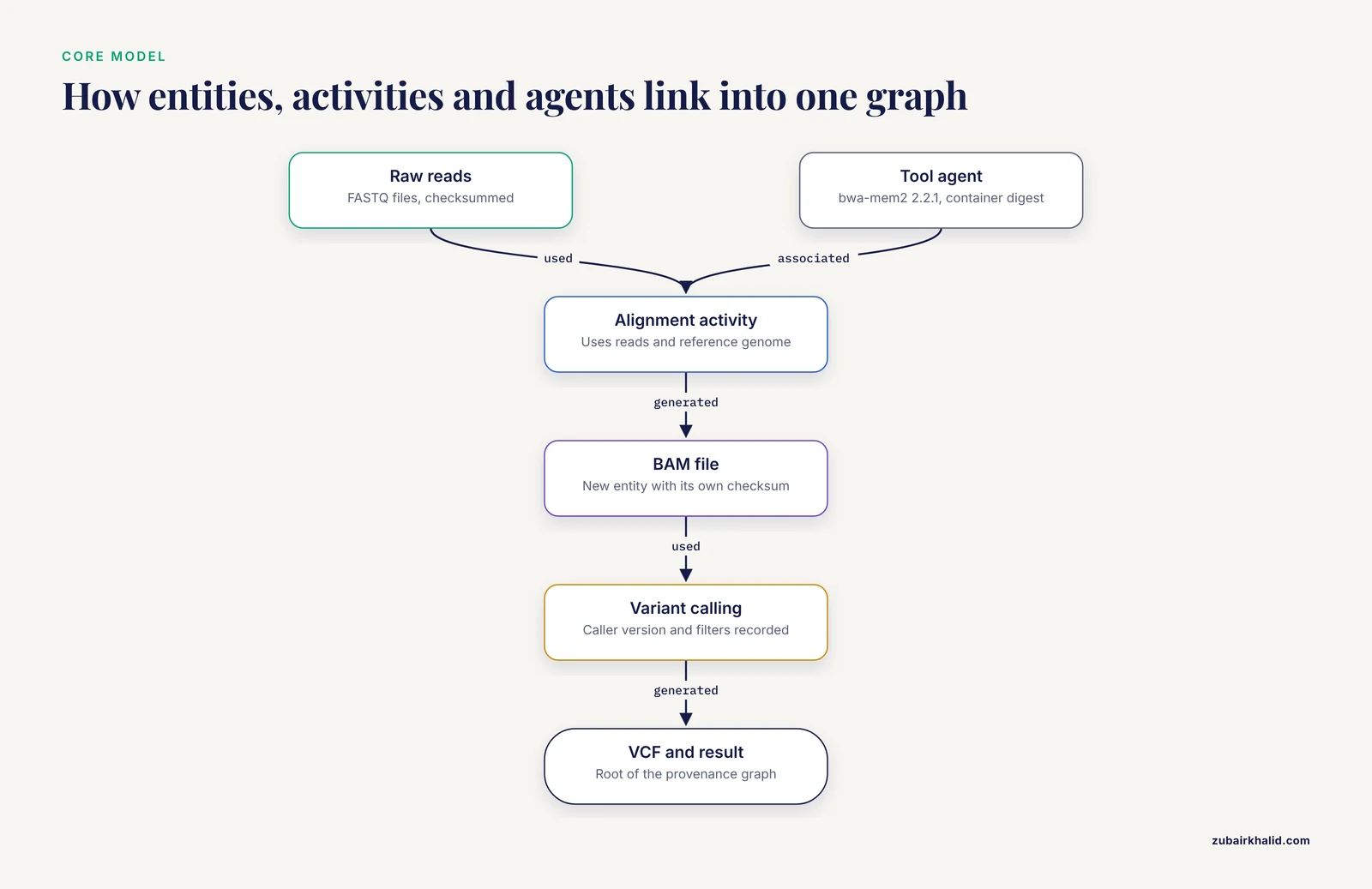
Nearly every modern provenance framework descends from the W3C PROV model, a standard for representing provenance as a directed graph of three kinds of nodes [2].
Entities are the things data flows through or is stored in. A FASTQ file, a reference genome, a BAM file, a VCF file, a QC report, and a count matrix are all entities. Each entity should be identifiable, most practically by a checksum such as SHA-256 plus a filename.
Activities are the processes that transform entities into other entities. Alignment, quality trimming, duplicate marking, variant calling, and normalization are activities. An activity has a start time, an end time, and a set of parameters.
Agents are the responsible parties. A person, a workflow engine, a software tool at a specific version, an instrument, or an organization can all be agents.
The relationships between them carry the meaning. An activity used an entity as input, was generated by producing a new entity, and was associated with an agent. A downstream entity was derived from its inputs. Chaining these relationships across a whole pipeline produces a directed graph whose leaves are raw reads and whose root is the published result. The graph itself is the provenance record.
A concrete record for one alignment step looks like this in a simplified JSON form:
{
  "activity": "align_reads",
  "tool": "bwa-mem2",
  "version": "2.2.1",
  "container_digest": "sha256:9f2c1e...",
  "started_at": "2026-03-14T08:21:07Z",
  "ended_at": "2026-03-14T09:03:44Z",
  "used": [
    {"entity": "sample_A_R1.fastq.gz", "sha256": "e3b0c4..."},
    {"entity": "sample_A_R2.fastq.gz", "sha256": "4d7a1b..."},
    {"entity": "GRCh38.fa", "sha256": "1a2b3c..."}
  ],
  "parameters": {"threads": 16, "mode": "mem"},
  "generated": {"entity": "sample_A.bam", "sha256": "7f8e9d..."}
}
That single record answers questions that oral tradition in a lab cannot: which read files fed this alignment, which genome build, which tool build, when it ran, and what came out. Multiply it across a pipeline and you have complete computational provenance.
Why Provenance Capture Matters in Genomics
Reproducibility is the headline reason. A case study that implemented the same complex genomics workflow under three different workflow definition approaches found that each approach carried hidden assumptions about the execution environment, and those assumptions produced insufficient documentation that ultimately caused workflow execution to fail when others tried to rerun it [3]. The authors concluded that reproducing, adapting, or even repeating a bioinformatics workflow in any environment requires substantial technical knowledge of that environment, plus rigorous compliance with reproducibility requirements, and they recommended tracking provenance to capture exactly those requirements [3]. Unrecorded assumptions are invisible until someone depends on them.
Precision medicine adds a regulatory dimension. The BioCompute framework was developed precisely because genomic findings in clinical and regulatory contexts must be robust, reproducible, and communicated in a standardized way that extends beyond wet-lab procedures to computational methods [4]. BioCompute Objects standardize reporting of genomic analysis provenance across domains, including a provenance domain, a usability domain, an execution domain, a verification kit domain, and an error domain, so that scientists, regulators, test developers, and clinicians can relay, repeat, and compare computation instances [4].
Surveillance and public health add a harmonization dimension. During the 2022 and 2024 mpox epidemics, teams building genomic surveillance found that contextual data, meaning sample metadata, epidemiological and clinical data, lab results, and method information, was often unstructured and highly variable in format, granularity, and terminology, requiring laborious manual cleanup before it could be integrated for public health decision-making. The response was a standardized contextual data specification that defines how provenance-relevant context should be recorded so that sequence data can be interpreted consistently [5].
Finally, large-scale stewardship. Reviews of data stewardship in AI-driven genomics consistently group traceability with data governance, quality management, privacy, ownership, access control, and curation as the practices required to keep vast NGS and imaging datasets intact, private, and accessible [1]. Provenance capture is the traceability layer of that stack.
Provenance, Metadata, Checksums, and Other Confusable Terms
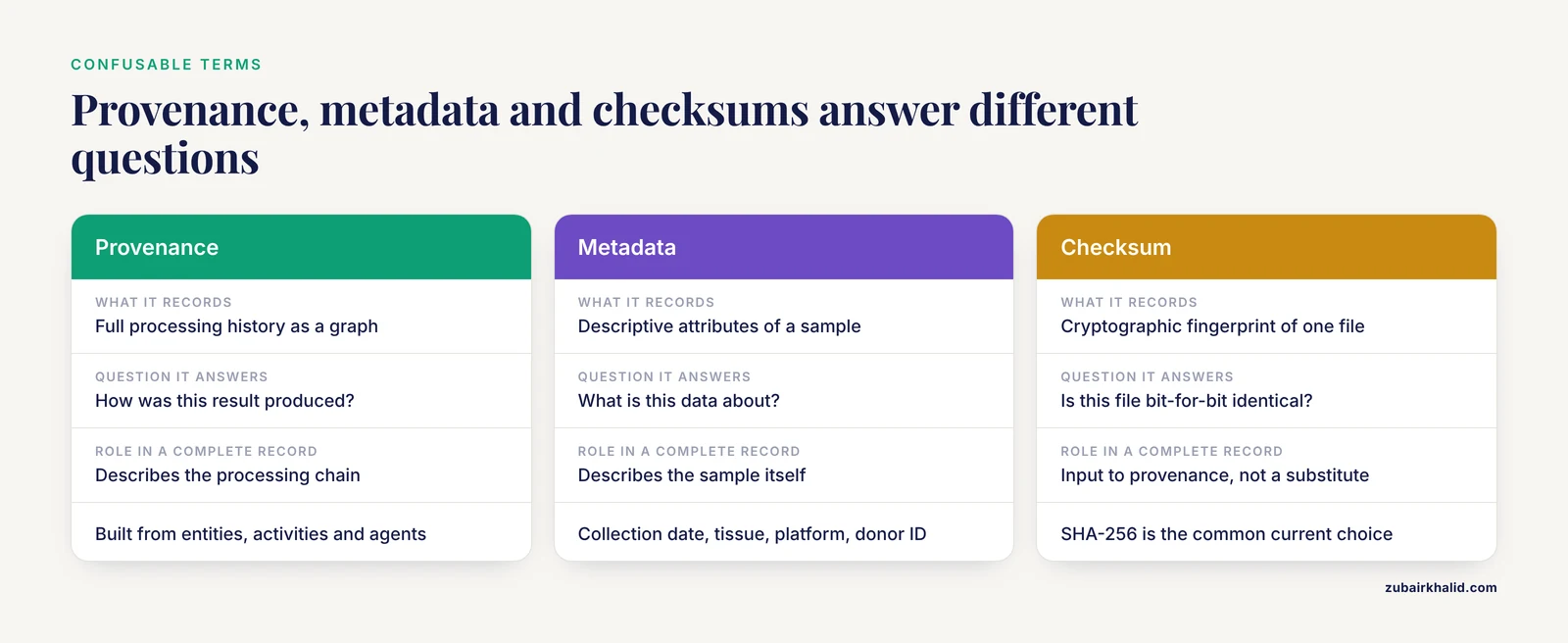
Students and even working analysts often blur several concepts together. They overlap, but they answer different questions.
| Term | What it records | Typical question it answers |
|---|---|---|
| Provenance | Full processing history as a graph of entities, activities, and agents | How was this result produced, by whom, with what inputs and settings? |
| Metadata | Descriptive attributes of a sample or dataset (collection date, tissue, platform, donor ID) | What is this data about? |
| Checksum | A cryptographic fingerprint of one file, such as SHA-256 | Is this file bit-for-bit identical to the one I expect? |
| Audit log | A time-ordered list of system events | Who touched the system and when? |
| Reproducibility | The ability to reobtain the same result from the same inputs and method | Can this be repeated? |
| Chain of custody | Documented physical or logical custody of a sample | Where has this specimen been? |
Checksums are inputs to provenance, not substitutes for it. A checksum proves a file is unchanged. It says nothing about how the file was made. Metadata describes the sample. Provenance describes the processing. A complete record needs all of them, which is why frameworks layer them rather than merge them.
What to Capture at Each Stage of a Genomics Pipeline
Before the Sequencer: Sample and Biobank Provenance
Provenance begins before data exists as bits. Standardization efforts in biobanking emphasize that quality control and sample suitability must be documented and validated to ensure data integrity and to establish the context for interpreting results, with standardized collection, storage, and processing methods practiced across the community so that datasets remain comparable and shareable [6]. Concretely, that means recording donor or specimen identifiers, collection date and method, tissue type, storage conditions and duration, thaw events, extraction protocol, and lot numbers for kits. If those facts live only in a freezer spreadsheet and someone's memory, no amount of computational provenance can recover them later. Pre-analytical history is part of the provenance graph, and the graph should record it as faithfully as it records aligner versions.
Raw Data Ingest: Checksums and Run Information
At ingest, compute a checksum for every raw file and store it alongside the file. SHA-256 is the common current choice. Record the instrument, run ID, flow cell, lane, read structure, and basecall parameters as reported by the sequencing facility. Raw data should be treated as immutable. Every downstream file derives from it, which makes the raw file checksum the anchor of the entire provenance graph.
Quality Control and Preprocessing
Quality control steps generate both provenance and records worth keeping permanently. An RNA-seq pipeline chapter describing the full workflow from quality control through preprocessing, alignment, differential expression, and functional analysis stresses that QC lays the groundwork for everything downstream, which is exactly why QC outputs belong in the provenance record [7]. Capture the tool, version, and full parameter set for adapter trimming, read filtering, and per-sample QC summaries such as per-base quality distributions and adapter content.
For genotyping arrays, the same principle applies with different metrics. Automated QC pipelines for Illumina SNP array data apply a wide range of quality metrics with user-defined filtering thresholds and generate a comprehensive QC report plus a filtered dataset, while also building a database to store genotypic, phenotypic, and quality metrics to ensure data integrity across ongoing genotyping runs [8]. Dedicated R packages now automate array QC and produce detailed HTML reports covering a broad spectrum of genotype quality metrics, which makes the QC step itself auditable rather than manual and scattered [9]. Whichever QC system you use, the thresholds you chose are provenance. A filtered dataset is not interpretable without the filter values that produced it.
Alignment and Primary Analysis
Record the reference genome and its build (for human work, the specific GRCh38-derived resource, including any masked or decoy variants), the index build date, the aligner and its exact version, thread counts, and any non-default parameters. Reference genome identity is one of the most consequential and most frequently lost provenance facts. Two alignments against nominally the same build but different resource versions can differ materially, and without a recorded checksum on the reference FASTA you cannot tell.
Downstream Statistical and Interpretive Steps
Variant calling, expression quantification, differential expression, and functional enrichment each consume intermediates and parameters. Record caller versions and filter criteria, model formulas and contrasts for differential expression, and the gene ontology database version and release date used for functional analysis, since annotation databases change and interpretation changes with them [7]. Integrated clinical pipelines illustrate the standard of care here: robust bioinformatics pipelines for alignment, SNP, InDel, and CNV detection with quality-control metrics analyzed at each step against a validated training dataset, explicitly to ensure data integrity for clinical applications [10].
Parameter Exploration and Benchmarking
When a pipeline exists partly to compare tools and settings, provenance capture becomes the organizing principle. HiC-bench, a platform for reproducible Hi-C analysis, was designed around parameter exploration and benchmarking, embedding quality assessment and visualization tasks so investigators can confirm that slight changes in parameters or methods do not change study conclusions [11]. That guarantee is only possible because every explored combination is captured as a distinct, attributable run.
Standards and Tools for Capturing Provenance
You can write provenance by hand, and you should not. The field has converged on a small set of interoperable standards.
W3C PROV. The foundational data model. Provenance is expressed as entities, activities, and agents with typed relationships, serializable in JSON-LD, RDF, or protobuf. Most other standards build on it.
CWLProv and Research Objects. The Common Workflow Language (CWL) ecosystem defines CWLProv, a standard-based format that represents a complete workflow enactment. It combines an interoperable CWL workflow definition, structured provenance in the W3C PROV model, and aggregation of all outputs, inputs, and metadata into a research object, a portable bundle that satisfies graduated levels of provenance from basic attribution to fully re-executable analysis [2]. Running a CWL workflow through cwltool with provenance tracking enabled produces this bundle automatically. The review behind CWLProv derived its requirements from published best practices for workflow design, sharing, and publishing, precisely because incomplete provenance capture and poor interoperability between platforms were blocking effective sharing and publication of computational analyses [2].
BioCompute Objects. A framework for standardized reporting of genomic analysis provenance, organized into explicit domains: provenance, usability, execution, verification kit, and error [4]. BioCompute Objects are maintained openly as a GitHub organization (github.com/biocompute-objects) and are designed for communication among scientists, regulators, test developers, and clinicians, which makes them the natural choice where analyses face regulatory review or clinical reuse [4].
Workflow engines with built-in capture. Nextflow, Snakemake, Cromwell, and cwltool can each emit run metadata, task-level command lines, software environment descriptions, and output hashes. The exact mechanism differs per engine, so the practical rule is to pick an engine whose provenance output you have actually inspected, then commit that output to your storage alongside results. The workflow case study cited earlier found that workflow definition approaches alone do not guarantee reproducibility because of implicit environment assumptions, which is why engine-emitted provenance should be supplemented with container digests and explicit reference data versions [3].
Contextual data specifications. For pathogen surveillance and similar collaborative settings, community specifications define how contextual fields should be structured and harmonized, reducing the manual cleanup burden that otherwise blocks integration and interpretation of sequence data [5].
Data model harmonization. Where genomic data must join clinical data, harmonization itself needs to be documented. The All of Us Research Program, building a nationwide cohort of about a million patients' electronic health records and genomic data, standardized its clinical data around the OMOP common data model, and site-to-site transformations such as i2b2-to-OMOP conversions driven by shared ontologies demonstrate how data movement between models is itself an activity that belongs in the provenance graph [12].
A practical minimum stack for a genomics group looks like this: a workflow engine for execution, containers with pinned digests for software, checksums for all inputs and outputs, engine-level provenance logs archived with results, and CWLProv or BioCompute Objects where sharing or regulatory submission is anticipated [2][4].
A Worked Example: Provenance Across an RNA-Seq Pipeline
Consider a standard bulk RNA-seq analysis following the canonical pipeline: quality control, preprocessing, alignment to a reference genome, differential expression analysis, and functional interpretation [7]. Here is what provenance capture adds at each stage.
Step 1, QC. The run produces per-sample reports. Provenance records the QC tool, its version, the raw file checksums it inspected, and the timestamps. The QC summary tables are themselves entities linked into the graph.
Step 2, preprocessing. Trimming and filtering transform raw reads into cleaned reads. Provenance records adapter and quality parameters, minimum length thresholds, and the new file checksums. If a collaborator later questions why read counts dropped, the graph answers with parameters rather than guesswork.
Step 3, alignment. As shown in the JSON example above, the alignment activity links cleaned reads, the checksummed reference genome, the aligner version, and the resulting BAM. The alignment phase is pivotal for decoding the origins and functions of sequences, which makes its provenance the hinge of the whole analysis [7].
Step 4, quantification and differential expression. Provenance records the quantification tool, the annotation release, the count matrix checksum, the statistical model (for example, a design formula with condition and batch terms), the contrast definitions, and the multiple-testing correction method. Reproducing a differential expression result without the model specification is impossible, and the model specification is provenance.
Step 5, functional analysis. Gene ontology and pathway analyses depend on annotation database versions [7]. Capturing the database release date prevents the common failure mode where an enrichment result quietly changes because the background gene set changed underneath it.
The end product is not just a figure. It is a figure plus a graph that says exactly how the figure came to exist. That graph is what a reviewer, a collaborator, or your own future self queries.
Interpreting Provenance Records
Genomics data provenance capture interpretation is the skill of reading the graph after the fact. Four interpretations come up constantly in practice.
Diagnosing failed or changed runs. When a rerun produces different outputs, walk the graph from the divergence point backward. Compare tool versions, container digests, parameter sets, and input checksums at the first node where the records differ. The workflow case study that motivated formal provenance recommendations documented exactly this failure pattern: undocumented environment assumptions led to execution failures that a captured graph would have exposed immediately [3].
Auditing quality decisions. QC provenance lets an auditor retrace which samples were filtered and why. Automated QC reports with comprehensive metrics, like those produced by modern genotyping QC packages, are interpretable only alongside the thresholds and protocol versions that generated them [9][8]. Interpretation means pairing the report with the thresholds.
Regulatory and clinical review. In regulated settings, interpretation is a structured walk through the analysis record. BioCompute's domain structure is designed for this: a reviewer checks the usability domain for intended purpose, the execution domain for how the computation ran, the verification kit domain for validation materials, and the error domain for known limitations [4]. Structured provenance turns "trust me" into a checklist.
Assessing fitness for reuse. When you receive someone else's genomics data, the provenance record is your due-diligence instrument. Missing reference build, missing aligner version, or missing QC thresholds are red flags for reuse decisions, and their absence is itself an interpretive finding.
Genomics Data Storage and Bioinformatics Data Management
Provenance records are data, and they need storage planning like any other data. Three principles govern this in practice.
Store provenance with the data it describes. A provenance bundle separated from its outputs is archaeology. Research objects and CWLProv bundles were designed specifically so that workflow outputs, inputs, definitions, and provenance aggregate into one shareable package [2]. Follow the same pattern even with ad hoc pipelines: a results directory is not complete until its provenance files are inside it.
Plan for growth. Reviews of data stewardship in AI-based genomics treat storage systems as a first-class concern, because NGS and high-throughput imaging generate datasets whose sheer scale stresses governance, curation, and access control [1]. Provenance logs are typically small relative to sequence data, but per-task logs at scale add up, so define retention tiers. Keep full task-level provenance for active projects, compress and archive it with project closure, and keep checksums and summary-level provenance permanently.
Databases beat folders for longitudinal work. Settings with ongoing sample flow, such as continuously genotyping laboratories, benefit from databases that store genotypic, phenotypic, and quality metrics together, ensuring integrity and easy integration of samples from subsequent runs [8]. Cloud-based environments can serve the same role for shared resources, as demonstrated by an open multi-omics reference panel of ten individuals distributed with a REST API and two cloud platforms to enable integrated analysis [13].
Harmonize before merging. When combining data across sites or over years, document model transformations as provenance activities in their own right, the way large cohort programs document i2b2-to-OMOP conversions with explicit ontology mappings [12].
Common Mistakes and Limitations
Capturing provenance at the end. The most common failure. Reconstructing what happened from shell history and memory produces gaps precisely where the interesting decisions were made. Capture during execution, automatically.
Trusting mutable tags. Recording bwa or a container tagged latest records almost nothing. Versions drift. Pin exact versions and container digests, or your provenance graph describes a tool that may no longer exist.
Ignoring pre-analytical history. A complete computational graph over samples whose collection and storage conditions were never documented is a graph over an unknown. Biobanking standardization exists because sample handling history determines interpretability of downstream results [6].
Treating spreadsheets as provenance. A lab notebook spreadsheet has no schema, no checksums, no timestamps, and no link to files. It is a starting point for curation, not a provenance system. Structured, tool-emitted records are the standard [2].
Assuming the workflow engine solves everything. Engine logs capture what ran. They do not capture why, what the analyst intended, or environment assumptions baked into the workflow definition itself. The documented failure modes from real workflow implementations support supplementing engine output with explicit environment, reference, and intent documentation [3].
Never interpreting the records. Teams sometimes capture provenance dutifully and never build the habit of reading it. Run a periodic drill: pick a two-month-old result and reconstruct its full history from the graph. If you cannot, the capture has gaps you want to find before a reviewer finds them.
Overlooking harmonization provenance. Merged datasets carry the provenance of their merge. Cross-model transformations and field mappings need recording, or downstream users inherit silent inconsistencies [12].
A practical limitation to plan for. Provenance capture adds operational overhead at capture time and storage cost over time, and no single standard covers everything. CWLProv targets workflow enactment [2], BioCompute targets communicable analysis records [4], and contextual specifications target surveillance metadata [5]. Real infrastructures layer them. Budget time for that layering rather than expecting one tool to do all of it.
Quick Review
- Provenance is a graph of entities, activities, and agents, standardized in the W3C PROV model, and capture means writing that graph during execution rather than reconstructing it later [2].
- Checksums, versions, containers, reference builds, parameters, and timestamps are the minimum capture set at every pipeline stage.
- Pre-analytical sample history from collection and biobanking is part of provenance and must be documented with the same rigor as software versions [6].
- CWLProv packages workflows, inputs, outputs, and PROV provenance into portable research objects [2]. BioCompute Objects structure the same information into regulatory-friendly domains [4].
- QC reports are only interpretable alongside the thresholds and tool versions that produced them [9].
- Interpretation of provenance means walking the graph to diagnose divergence, audit quality decisions, support regulatory review, and judge fitness for reuse [3][4].
- Store provenance with its data, plan retention tiers, and prefer databases for longitudinal genotyping and multi-omics programs [8][13].
Frequently Asked Questions
What does genomics data provenance capture mean?
It means systematically recording the origin and processing history of genomic datasets: which samples produced the raw reads, which software, versions, parameters, and reference data transformed them, and who or what executed each step. The result is a machine-readable audit trail connecting a final result back to the original sample.
Is provenance the same thing as metadata?
No. Metadata describes attributes of a sample or dataset, such as tissue, collection date, or sequencing platform. Provenance describes the processing, meaning the chain of computational and physical operations applied to the data. A complete infrastructure records both, linked together.
Which tools capture provenance automatically?
Workflow engines such as CWL tools, Nextflow, Snakemake, and Cromwell emit run-level and task-level records, and CWLProv produces a standardized provenance bundle for CWL workflows [2]. For regulated or shared analyses, BioCompute Objects provide the standardized reporting layer on top [4]. Containers with pinned digests and checksums on all files supply the environment and integrity facts those records need.
Do I need provenance capture for clinical or regulated genomics work?
Yes. Standardized reporting of genomic analysis provenance is the basis for communication among scientists, regulators, test developers, and clinicians, and frameworks such as BioCompute exist specifically to make computation instances easy to relay, repeat, and compare in those settings [4]. Clinical pipelines also embed stepwise quality-control verification to ensure data integrity [10].
How do I add provenance capture to an existing pipeline?
Start with three moves that require no rewrite: compute and store SHA-256 checksums for every input and output, record tool versions and container digests at each step, and archive your workflow engine's run logs with the results. Then adopt a formal format such as CWLProv or BioCompute Objects when you need portability or regulatory-grade documentation [2][4].
How much provenance should I keep, and for how long?
Keep full task-level provenance with results for the life of the project, and keep checksums plus summary-level provenance permanently, since raw data immutability plus checksums anchors everything downstream. Storage planning should account for provenance as part of overall genomics data storage, because stewardship reviews identify storage systems, curation, and traceability as joint requirements for large NGS datasets [1].
Sources
- Data stewardship and curation practices in AI-based genomics and automated microscopy image analysis for high-throughput screening studies: promoting robust and ethical AI applications.
- Sharing interoperable workflow provenance: A review of best practices and their practical application in CWLProv.
- Investigating reproducibility and tracking provenance - A genomic workflow case study.
- Enabling precision medicine via standard communication of HTS provenance, analysis, and results.
- The Mpox contextual data specification package: a data curation toolkit to support collaborative pathogen genomic surveillance.
- Developments in biobanking workflow standardization providing sample integrity and stability.
- RNA-Seq Data Analysis.
- SNPQC--an R pipeline for quality control of Illumina SNP genotyping array data.
- GTQC: Automated Genotyping Array Quality Control and Report.
- An integrated approach for analyzing clinical genomic variant data from next-generation sequencing.
- HiC-bench: comprehensive and reproducible Hi-C data analysis designed for parameter exploration and benchmarking.
- Data model harmonization for the All Of Us Research Program: Transforming i2b2 data into the OMOP common data model.
- The Personal Genome Project-UK, an open access resource of human multi-omics data.