Object Storage vs. Data Lakes for Genomic Data
By Dr. Zubair Khalid, DVM, MS, PhD ·

Object storage is a storage layer that keeps genomic files as durable, addressable objects, while a genomic data lake is a logical architecture built on top of storage (almost always object storage) that adds cataloging, metadata, and queryable links between raw data and its biological context. The rule of thumb is simple: if your main job is to put and get large sequencing files reliably and cheaply, object storage is the answer. If your main job is to find, filter, and correlate samples across phenotypes, studies, and derived results, you need a data lake, and that lake will sit on top of object storage rather than compete with it.
This article defines both options on their own terms, compares them on the criteria that decide real infrastructure choices, walks through worked scenarios, and lists the mistakes that most often derail genomic storage projects in cloud bioinformatics.
Two Definitions That Prevent Most Confusion
The phrase "genomic data lake vs object storage" appears constantly in planning documents, and much of the confusion comes from comparing two things that sit at different layers of the stack. Object storage is a concrete storage technology. A data lake is an architectural pattern. You can have object storage without a data lake, but you cannot build a practical data lake at genomics scale without object storage underneath.
What Object Storage Means
Object storage (products such as Amazon S3 and its many compatible services, or self-hosted systems like MinIO and Apache Ozone) stores data as discrete objects. Each object has three parts: the bytes of the file itself, a flat unique identifier called a key, and a small set of key-value attributes known as object metadata. There is no folder hierarchy in the filesystem sense, no locking of individual byte ranges, and no query engine. You interact with the store over an HTTP-based API, most commonly the S3 API, using operations like PUT, GET, and LIST.
Three properties make object storage the default substrate for sequencing data:
- Durability at scale. Objects are replicated or erasure-coded across many disks and nodes. A well-run object store is designed so that losing a drive or a node does not lose data, which matters when a single lane of a sequencing instrument produces hundreds of gigabytes that are expensive or impossible to regenerate.
- Flat scalability. The key space is effectively unlimited. Whether you hold 200 BAM files or 200 million, the same API and the same operational model apply. Evaluation work on object storage infrastructure consistently frames it as a replacement for traditional file and block systems precisely because of how it handles growing collections [1].
- Cost tiering. Most managed object stores let you move objects between storage classes, from hot access to archival tiers, with retrieval fees and minimum retention windows. Raw FASTQ files that nobody has opened in two years are the classic archival candidate.
Genomics workloads map onto this model well because sequencing outputs are large, immutable, write-once artifacts. A CRAM file for one sample is created once, checksummed, and then read many times by analysis jobs. That access pattern is exactly what object storage optimizes for.
What a Data Lake Means
A data lake is a repository design that ingests data in its raw, heterogeneous form and layers structure on top of it later, an approach sometimes called schema-on-read. Instead of forcing every incoming dataset into a fixed relational schema at load time, the lake preserves the original format (FASTQ, BAM, CRAM, VCF, BGEN, spreadsheets, images) and attaches rich metadata that describes each asset: which sample it came from, which study, which library prep, which consent terms, which pipeline version produced any derived files.
The data lake concept arose because big data ecosystems shifted from selective storage toward preserving large volumes of heterogeneous data for later exploitation [2]. Applied to genomics, that shift is driven by a specific scientific need: genotype data is only useful when it can be correlated with phenotype data. A recent effort illustrates the point directly. GeniePool continuously downloads raw human NGS data from the Sequence Read Archive using SRAtoolkit, preprocesses it with the GATK pipeline, stores the results in a cloud data lake, and exposes them through a REST API and a website so clinicians and researchers can query NGS samples together with their associated attributes and studies [3]. The object bytes live in storage. The lake is what makes them findable and joinable with phenotypic context, which is something allele frequency databases like gnomAD do not provide because they lack correlated phenotype data [3].
So the difference between a genomic data lake and object storage is layer, not rivalry. Object storage answers "where do the bytes live and how do I move them." The data lake answers "what are these bytes, where did they come from, what happened to them, and what can I ask about them."
Side-by-Side Comparison
| Criterion | Object Storage | Genomic Data Lake |
|---|---|---|
| What it is | A storage technology exposing objects over an HTTP API | An architecture that combines raw storage with cataloging, metadata, and query layers |
| Primary unit | An object (file bytes, key, attributes) | A governed dataset with lineage and metadata bindings |
| Data model | None, keys and opaque bytes | Schema-on-read, often with table formats or catalogs on top |
| Query support | None built in, you copy data out and process it | Direct, for example a REST API or SQL-style queries over metadata and derived tables [3] |
| Best-fit genomic content | FASTQ, BAM, CRAM, VCF, reference genomes, intermediate pipeline artifacts | Sample-to-phenotype links, study metadata, variant call sets organized for cohort queries |
| Small-object performance | Can degrade on millions of tiny objects unless the system decouples metadata handling [4] | Depends on the query layer, which is why lake designs separate metadata services from bulk data |
| Governance | Bucket policies, encryption, access lists | Provenance, consent tracking, and policy enforcement tied to the data itself [5] |
| Failure mode if used alone | A swamp of unnamed files that nobody can interpret | Higher engineering cost, since ingestion and cataloging must be built and maintained [2] |
| Relationship to the other | The foundation layer | Built on top of object storage, not instead of it |
The table's last row is the one most planning documents get wrong. When teams debate genomic data lake or object storage, they are usually debating how much architecture to put above the storage layer, not which storage to buy.
Object Storage for Genomic Data in Depth
Strengths for Sequencing Workloads
Sequencing produces a predictable data lifecycle. Instruments write BCL files, a demultiplexing step converts them to FASTQ, alignment produces BAM or CRAM, variant calling produces VCF, and each stage hands off to the next. Almost every artifact in that chain is large (megabytes to tens of gigabytes), immutable after creation, and read in bulk. Object storage handles this pattern with minimal operational overhead.
Consider what a sequencing core actually needs from storage:
- Write throughput that keeps up with instruments. A high-output sequencer can generate terabytes per run, and the storage layer must absorb that without becoming the bottleneck.
- Stable identifiers. Checksums such as MD5 or SHA-256 stored alongside each object let pipelines verify integrity after any transfer, which is standard practice for reference data and raw reads.
- Cheap retention. Raw reads are the one thing you can never regenerate from downstream files. Object storage's low per-gigabyte cost, especially in archival tiers, makes indefinite retention of raw data financially feasible.
Evaluations of private cloud object storage deployments have specifically measured performance, availability, and scalability of content-addressable object storage services, treating object storage as an increasingly accepted replacement for traditional file and block systems [1]. That framing matches genomics: the question is rarely whether object storage can hold the data, but whether its read and write access under realistic load meets pipeline demands.
Limits You Must Plan Around
Object storage has three limits that genomics teams hit repeatedly.
Small-file workloads suffer. Secondary analysis produces many small objects: per-lane QC reports, per-amplicon metrics, small VCF shards. Object stores historically keep object data in files and object metadata in a separate key-value store, and writes must go through separate phases for crash consistency, which raises I/O latency. Systems such as FrigateBird were built precisely to decouple metadata and data services so that large numbers of small objects stay fast under read, write, and query load [4]. Compaction of deleted objects can also sharply lower performance while the system is busy serving normal traffic. For genomics, the practical lesson is to aggregate small outputs into larger tarballs or consolidated tables before they hit the object store, or to route them to a different store entirely.
There is no semantic layer. An object store cannot answer "give me all female samples over 50 with whole-genome CRAM files and consent for oncology reanalysis." That answer requires a catalog mapping objects to samples, studies, and consent states. Object storage gives you the keys. Everything else is your job.
Prefix listing has limits. Large collections with poor key design make LIST operations slow and expensive. Genomics teams learn to encode sample, study, and run identifiers into key hierarchies deliberately, for example s3://cohort-wgs/sample=SAMPLE001/run=RUN42/sample001.cram, because later query layers depend on that structure.
Self-Hosted Object Storage
Managed services are not the only path. Apache Ozone is a distributed object store that can be integrated with workflow orchestration such as Argo Workflows running in Kubernetes-compatible environments, separating long-term storage from compute. In one tested architecture, Spark jobs accessed Ozone directly through its native client and the ofs:// file interface without an intermediate S3 gateway, and the computational scenario completed with total execution time less than 5 percent higher than a Hadoop-based comparison while retaining independent scaling of storage and compute [6]. For organizations with existing on-premises compute and data residency constraints, this separation-of-storage-and-processing pattern is a workable middle ground.
Genomic Data Lakes in Depth
What the Lake Adds
A genomic data lake adds four capabilities that raw object storage lacks:
- Ingestion pipelines with governance. Data arrives from instruments, collaborator uploads, public archives, and clinical systems in different formats and at different frequencies. Formalizing ingestion through a defined architecture, rather than ad hoc scripting, is the core engineering problem of lake operation, and recent work models ingestion variability (source types, frequencies, transformation needs, loading strategies) explicitly so configurations can be managed per project [2].
- Phenotypic and genotypic correlation. The GeniePool design demonstrates the payoff: raw SRA samples are processed through a GATK pipeline and stored so that each NGS sample is accessible with the study and sample attributes attached, queryable through both an API and a website [3].
- Derived-data management. QC summaries, variant calls, expression matrices, and annotations all become first-class queryable entities with lineage back to the raw reads that produced them.
- Multi-user access patterns. Clinicians, analysts, and computational biologists want different views of the same underlying data. A lake serves them from common storage through purpose-built interfaces.
What the Lake Costs
Data lakes demand continuous engineering. Ingestion pipelines must handle format drift and source changes. Metadata must be populated or the lake degrades into an uncurated dump, which is the most common failure mode. Query layers must be built, secured, and tuned. The ingestion literature frames this as a systematic engineering problem with documented variability, precisely because informal, ad hoc ingestion is the default behavior that produces unusable lakes [2].
Where Non-Relational Stores Fit in the Lake
Not everything in a lake belongs in object files. Genomic data that gets queried frequently, for example genotypes for active breeding or clinical cohorts, often lands in document-oriented databases. One evaluation of MongoDB for storing genomic information in formats including Illumina Final Report, PLINK, FASTQ, and VCF found sublinear query running time as the number of samples and markers grew, along with unified management of heterogeneous formats and searches over specific genomic regions. The same study found that importing 50 million SNPs in PLINK format was faster with an existing relational schema, and that data conversion into either system is a costly step that must be budgeted for large applications [7]. The takeaway for lake designers is that the lake can and should mix stores: object storage for bulk artifacts, specialized databases for the subsets that get queried constantly.
The Lakehouse Pattern: Table Formats on Object Storage
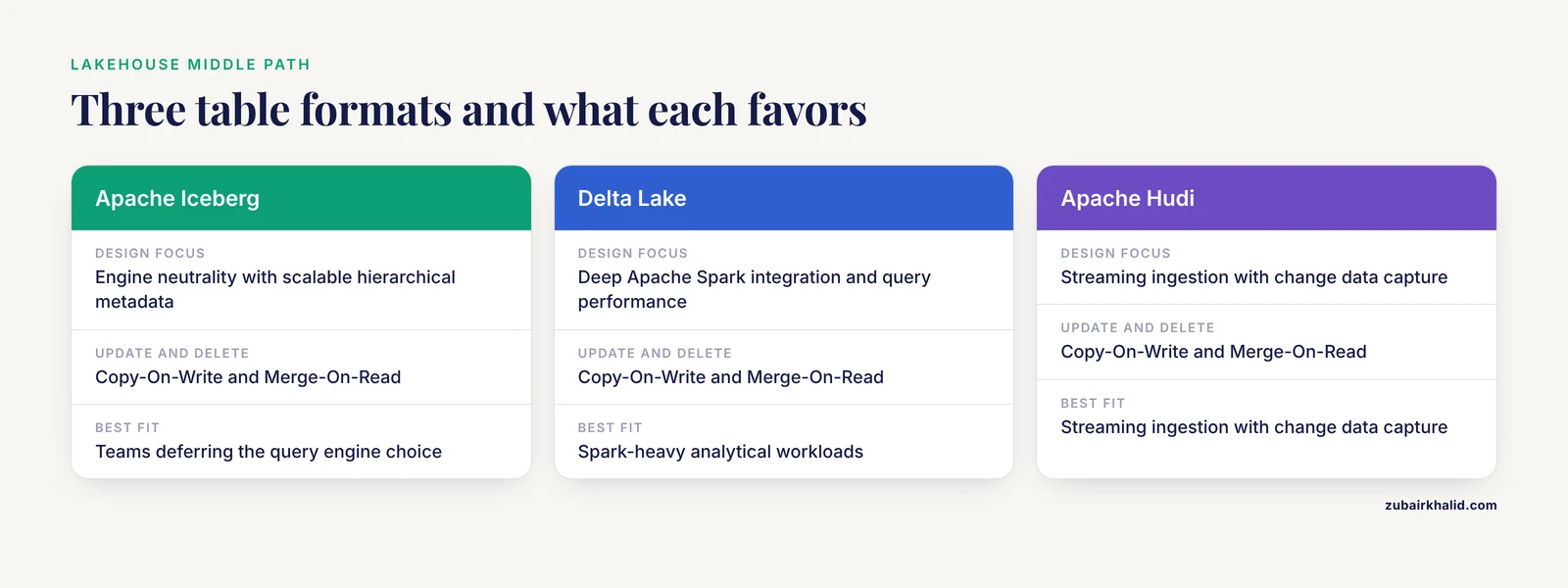
Between "raw object store" and "full data lake" sits a middle option that has become the default for large analytics workloads: open lakehouse table formats. Apache Iceberg, Apache Hudi, and Delta Lake layer ACID transactional semantics, schema evolution, and advanced metadata management directly on top of cloud object storage, addressing the fundamental constraints of traditional data lakes while keeping their cost profile [8].
Each format embodies a distinct philosophy:
- Apache Iceberg emphasizes engine neutrality with scalable hierarchical metadata, so compute engines other than Spark can read the same tables [8].
- Delta Lake focuses on deep Apache Spark integration and optimized analytical query performance [8].
- Apache Hudi specializes in streaming ingestion with efficient change data capture support [8].
All three provide update and delete mechanisms through Copy-On-Write and Merge-On-Read strategies, which matter for genomics when you need to retract a sample, correct a phenotype record, or update an annotation without rewriting an entire table [8].
Empirical benchmarking supports treating these formats as production-ready on object storage. A recent study benchmarked Iceberg, Hudi, and Delta Lake on Apache Spark against a shared MinIO object storage backend, measuring append-only write latency, analytical query latency, and CDC-style upsert latency across multiple update rates, along with storage layout characteristics such as data file counts and metadata file counts, with all results captured as reproducible artifacts [9]. For a genomics team, the practical reading is that variant call tables, sample-level metrics, and phenotype joins can live in a transactional lakehouse format on top of the same object store that holds the CRAM files, eliminating the old split between "analytics database" and "file store."
Decision Criteria: When to Use Each Option
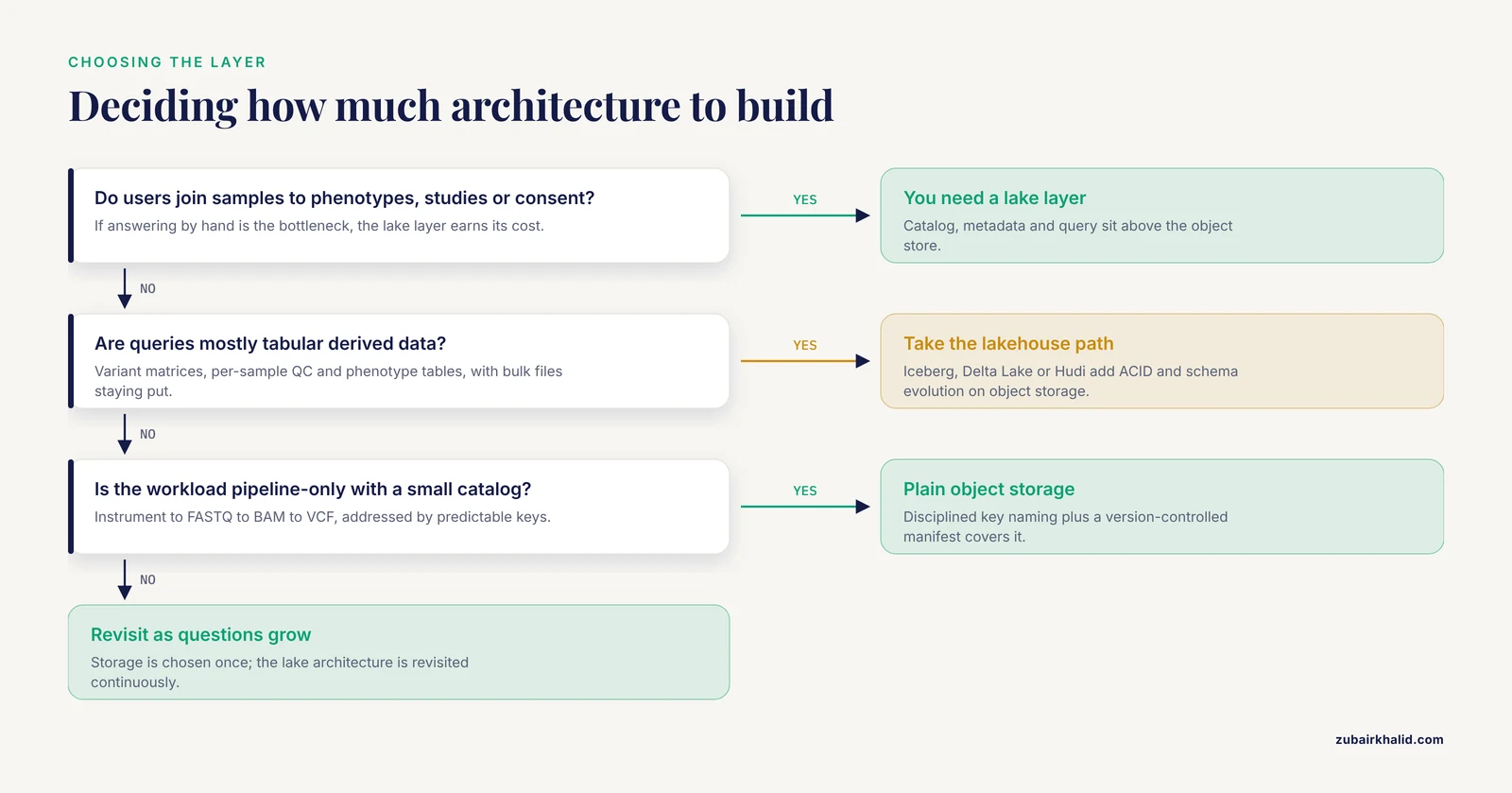
Choose Plain Object Storage When
- Your workload is pipeline-oriented. Data flows instrument to FASTQ to BAM to VCF, and each artifact is addressed by a predictable key. You rarely need to ask ad hoc questions across samples.
- Your team is small and your catalog lives in a spreadsheet, a LIMS export, or a simple index you maintain manually.
- Cost per stored gigabyte is the dominant constraint, as in long-term archival of raw reads.
- Downstream consumers are compute jobs, not people. Pipelines speak S3 APIs natively, and most workflow managers treat object storage as their primary scratch and staging layer.
Choose a Genomic Data Lake When
- Phenotype-genotype correlation is the point of the database. If your users ask questions that join variant data to clinical attributes, study metadata, or cohort definitions, you need the lake layer [3].
- You ingest from many heterogeneous sources at different frequencies and need a formal, repeatable ingestion architecture rather than one-off scripts [2].
- Multiple user communities need different views of the same data, for example an API for programs and a web interface for clinicians, as GeniePool provides [3].
- Provenance, consent, and access policy must attach to the data itself and survive copying between environments, which pushes you toward lake-level governance structures [5].
Choose the Lakehouse Middle Path When
- Your queries are mostly analytical over tabular derived data (variant matrices, per-sample QC, phenotype tables) but your bulk files must stay in object storage.
- You need ACID guarantees and schema evolution on those tables without operating a separate warehouse.
- You want to defer choosing a query engine, in which case Iceberg's engine-neutral design is the usual starting point [8].
A useful framing: object storage is a decision you make once and rarely revisit. The data lake architecture is a set of decisions you revisit continuously as ingest sources, query patterns, and governance requirements change.
Worked Scenarios
Scenario 1: A Five-Person Lab With One Sequencer
Output is a few hundred samples per year. The lab runs a standard alignment and variant calling pipeline, produces per-sample VCFs, and the biologist reads the results. Plain object storage with disciplined key naming (project/sample/run/filetype) plus a version-controlled manifest file covers everything. Building a lake here would produce a metadata layer nobody maintains. The honest answer to "genomic data lake or object storage" for this team is object storage, revisited when cross-sample questions outgrow the manifest.
Scenario 2: A Population-Scale Reanalysis Effort
Imagine continuously ingesting raw human NGS data from a public archive, preprocessing every sample through GATK, and making the results queryable with study and sample attributes. That is not hypothetical, it is the GeniePool architecture, which uses SRAtoolkit for download, GATK for preprocessing, a cloud data lake for storage, and a REST API plus web service for access [3]. Plain object storage could hold the bytes, but without the lake layer the collection would be inaccessible to the clinicians and researchers who are its intended audience, since raw-format files in large archives are effectively inaccessible to non-expert users [3]. This is the canonical case for a genomic data lake.
Scenario 3: A Clinical or Forensic Database With Strict Sharing Rules
A forensic population statistics database must expose allele frequencies, Hardy-Weinberg equilibrium results, and heterozygosity calculations for STR and identity-SNP markers while streamlining upload and download. The diversID project implements exactly this on cloud computing, using stringent filtering to maintain data quality and cloud infrastructure to simplify data transfer for users [10]. The storage requirement here is a structured, queryable, access-controlled layer over the genotyping results, closer to a governed lake section than a raw object bucket.
Scenario 4: An Immune Repertoire Commons
Immune repertoire sequencing produces large, complex datasets requiring specialized preprocessing, V(D)J gene segment assignment, repertoire characterization, and comparison tools. VDJServer demonstrates the cloud pattern: a data commons for public and private sharing of repertoire data, with a complete analysis suite behind a browser interface designed for immunologists and clinicians [11]. The architecture combines bulk object storage for raw sequence data with a service layer that exposes analysis and visualization, again illustrating that the useful artifact is the architecture above storage, not the storage alone.
Scenario 5: On-Premises With Residency Constraints
A hospital or national center cannot use a public cloud. The Apache Ozone plus Argo Workflows architecture described earlier gives the same layering benefit on-premises: distributed object storage decoupled from containerized compute, with direct native access for Spark and performance close to a conventional Hadoop deployment [6]. The lake layer can then be built on the same storage with catalog tools of the team's choosing.
Architecture Notes for Cloud Bioinformatics
Cloud bioinformatics platforms, including AWS genomics workloads, converge on a small set of patterns worth naming.
Separate storage from compute. Every architecture described above, whether managed or self-hosted, separates where data lives from where it is processed [6]. This is the enabling decision for elastic pipelines: compute nodes scale up for a run and disappear afterward while the data persists.
Keep raw data immutable and derived data cataloged. Raw FASTQ and reference genomes go into object storage, often with checksums and version-pinned references. Derived tables go into lakehouse formats where updates, retracts, and schema changes are transactional [8].
Design keys and partitioning before the first byte lands. Later query layers, whether a lakehouse table or a metadata catalog, inherit the layout you choose on day one. Restructuring petabytes is the most expensive mistake in this field.
Aggregate small files. Because fine-grained small objects strain object store internals, from multi-phase metadata writes to compaction stalls [4], pipeline designers should consolidate small outputs into columnar tables or bundled archives.
Budget for compression as a separate decision. Storage volume can be reduced meaningfully at the sequence level. The TCompress approach converts biological sequences to a binary representation and then applies standard text compression tools such as GZip, 7-Zip, and PeaZip, reporting compression efficiency improvements of up to 30 percent over traditional techniques, with the best results on longer and more complex sequences [12]. Compression interacts with format choice, since CRAM already encodes reference-based compression, so measure against your actual baseline rather than adopting any tool on headline numbers alone.
Do not force everything into one store. The MongoDB evaluation showed that a document store handles heterogeneous genomic formats and frequent queries on growing cohorts well, while bulk SNP import in PLINK format was faster into a relational schema, and conversion into either system is expensive at scale [7]. Modern lake architectures are polyglot by design.
Governance and Access Control Above the Storage Layer
Genomic data carries obligations that ordinary scientific data does not: consent scope, recontact permissions, jurisdiction of origin, and re-identification risk. Object storage provides coarse tools such as bucket policies and encryption, but those tools do not travel with the data or express per-sample conditions.
Two research directions illustrate where governance is heading. Attribute-based encryption lets data be encrypted for many recipients so that only those whose attributes satisfy a defined access policy can decrypt, while sticky policies attach the access policy directly to the data itself and use a trusted authority to evaluate and enforce it. A comparative evaluation in an IoT middleware context found both approaches offer distributed, customizable enforcement, with different tradeoffs in performance and robustness [13]. Those mechanisms map naturally onto genomic lakes, where consent terms differ sample by sample.
At the multi-omics scale, systematic review work has proposed layered governance frameworks combining a permissioned blockchain ledger, smart-contract-based consent and access control, privacy-preserving cryptography, decentralized identity, and off-chain bulk storage, precisely because centralized role-based access control struggles with single points of failure, opaque consent enforcement, weak provenance, and brittle cross-jurisdiction interoperability [5]. Whatever technology a team adopts, the architectural principle stands: access policy must be represented in the metadata layer of the lake, not scattered across bucket permissions.
Common Mistakes and Limitations
Building a lake with no ingestion discipline. The most common data lake failure is an ad hoc pile of files with no catalog. Formalizing ingestion, with explicit modeling of source types, frequencies, transformations, and loading strategies, is what separates a lake from a swamp [2].
Assuming the lake replaces the object store. Teams that plan a "data lake instead of S3" usually discover that the lake's raw zone is object storage anyway. The debate about the difference between a genomic data lake and object storage resolves once you see them as layers.
Ignoring small-file pathology. Feeding millions of small objects directly into an object store invites latency from multi-phase metadata writes and compaction contention [4]. Consolidate before storing.
Underestimating data conversion. Moving genomic data into any queryable system, relational or non-relational, requires format conversion, and conversion time is a real cost at tens of millions of markers [7]. Prototype the conversion path before committing.
Choosing a table format by popularity. Iceberg, Delta Lake, and Hudi make different tradeoffs in engine neutrality, Spark integration, and streaming ingestion [8]. Benchmark against your own Spark version and update patterns, as the reproducible benchmarking methodology in the recent empirical study demonstrates.
Overwriting metadata handling in-house. Object store internals, such as where metadata lives relative to data, materially affect I/O performance under load, which is why production systems now decouple metadata and data services [4]. Prefer mature stores over custom forks.
Treating governance as a bucket policy problem. Per-sample consent cannot be expressed as a bucket rule. Plan for policy attached to data and evaluated by an enforcement point, following the ABE and sticky-policy patterns [13] or layered governance frameworks [5].
A note on limitations of the evidence base. Much of the published comparison work in this area comes from adjacent domains, including document preservation, IoT middleware, and general big data platforms, adapted here to genomic workloads. Results are transferable in principle but exact performance figures depend on workload shape, hardware, and software versions. Validate against your own data before committing infrastructure budgets.
Frequently Asked Questions
Can I use object storage alone without building a data lake?
Yes. If your workload is pipeline-driven, with predictable file flows and a small catalog you can maintain by hand, object storage with disciplined key naming and checksums is sufficient. Many labs operate productively for years this way, and they migrate to a lake only when cross-sample querying demands it.
When should a lab move from plain object storage to a genomic data lake?
Move when users start asking questions that join samples to phenotypes, studies, or consent states, and answering those questions by hand has become the bottleneck. The GeniePool project is the reference case: raw archive data became genuinely useful to clinicians only after a lake layer provided attribute-linked, API-queryable access [3].
Does a data lake replace my relational LIMS database?
No. A lake complements a LIMS. The LIMS remains the system of record for sample tracking and workflow state. The lake handles bulk artifacts and analytical queries, and it can mix store types internally, since document stores and relational schemas each win on different genomic workloads [7].
What are lakehouse table formats and do I need them?
They are open formats (Apache Iceberg, Delta Lake, Apache Hudi) that add ACID transactions, schema evolution, and metadata management on top of object storage [8]. You need them if you run frequent analytical queries or updates over tabular derived data such as variant matrices or sample metrics. If you only store and stream immutable files, plain object storage remains adequate.
How does this apply to AWS genomics architectures?
AWS genomics workloads standardly use S3-compatible object storage as the durable substrate for reads, alignments, and call sets, with compute provisioned separately and torn down per run. The same separation of storage and processing underlies both managed and self-hosted designs, including on-premises combinations of Apache Ozone and Kubernetes-native workflow orchestration [6].
How do I handle consent and access control in a shared genomic data lake?
Represent consent and policy in the metadata layer rather than only in bucket permissions. Attribute-based encryption and sticky policies are two established mechanisms that bind access rules to the data itself with an enforcement authority [13], and layered governance frameworks combine ledgers, smart contracts, and off-chain storage for multi-omics sharing at larger scale [5].
Sources
- Comparison of Performance, Availability and Scalability of a Private Cloud Storage Infrastructure Service for Document Preservation
- A Feature Model-Based Reference Architecture for Data Lake Ingestion: A Variability Management Approach
- GeniePool: genomic database with corresponding annotated samples based on a cloud data lake architecture
- FrigateBird: Decoupling Metadata/Data Services for Continuously Fast Object Storage
- Big Data Governance for Multi-Omics Data Sharing: A Blockchain, Smart Contract, and Off-Chain Storage Framework
- Architecture of Separate Storage and Processing of Big Data
- Practical implications of using non-relational databases to store large genomic data files and novel phenotypes.
- Modern Table Formats for Data Lakehouse Architectures: A Comprehensive Analysis of Apache Iceberg, Delta Lake, and Apache Hudi
- An Empirical Study of Open Lakehouse Table Formats on Object Storage
- A cloud-based solution for managing next-generation sequencing data to comprehend forensic population statistics.
- VDJServer: A Cloud-Based Analysis Portal and Data Commons for Immune Repertoire Sequences and Rearrangements.
- Advancing Genomic Data Management through TCompress: An Innovative Method for Sequence Compression of Biological Sequence Compression Algorithm using Text-Compression Tools
- Attribute-based encryption and sticky policies for data access control in a smart home scenario: a comparison on networked smart object middleware