The Ultimate List of Free Bioinformatics Tutorials
By Dr. Zubair Khalid, DVM, MS, PhD ·

Free bioinformatics tutorials are no-cost, structured lessons that teach you how to analyze biological data with computers, using open-source software, public datasets, and step-by-step protocols you can reproduce yourself. They span sequence analysis, genomics, transcriptomics, proteomics, and machine learning, and a good one ends with a finished analysis rather than a certificate of attendance.
Bioinformatics blends biology, statistics, computer science, and information technology to process and analyze genomic data [1]. Demand for people with those skills keeps growing, yet most undergraduate institutions struggle to fit bioinformatics into life science curricula because instructors face technical hurdles and a shortage of specialized expertise [1]. Free tutorials fill that gap for students, and they serve working scientists as well. Environmental biotechnology now depends on bioinformatics to track microbial diversity and pollutant degradation in metagenomes and environmental DNA [2]. Food microbiology laboratories classify entire communities with tree-based machine learning models [3]. Proteomics groups train deep learning models on public mass spectrometry data to predict peptide behavior [4]. The list below gathers free, verifiable training resources, weighted toward options documented in peer-reviewed papers or maintained by publicly funded infrastructure, and then shows you how to arrange them into a path that ends in real competence rather than a folder of abandoned bookmarks.
What Are Free Bioinformatics Tutorials?
Every usable tutorial contains the same five parts: a biological question, a dataset you can download, software with access or installation instructions, a numbered protocol, and an interpretation section that tells you what the output means. Miss one of those parts and you are reading marketing, not teaching. If you want free bioinformatics tutorials explained in one line, think of each one as a guided reproduction of a real analysis, with the authors' decisions exposed at every step so you can question them, change them, and see what happens.
The entries in this guide are working examples of free bioinformatics tutorials rather than a link dump, because a tutorial you can verify against a publication beats one you must take on faith.
What the Word Free Actually Covers
Free operates at three levels, and all three matter. First, tuition costs nothing, which separates these resources from subscription platforms and paid bootcamps. Second, the software is open source, meaning its license grants you the right to run, inspect, and modify the code. The fRagmentomics package, for example, ships under the GNU General Public License version 3.0 [5]. Third, the data are public, so the exercise never depends on access to a laboratory's proprietary samples. A tutorial locked behind a paywall or dependent on private data stops being reproducible the moment you leave the institution that paid for it, which defeats the entire purpose of self-study.
Terms Often Confused With Bioinformatics
Three neighboring fields cause most of the confusion. Computational biology emphasizes modeling, building mathematical or simulated representations of biological systems, and the PI-FEP tutorial review described later sits closer to that tradition [6]. Biostatistics emphasizes experimental design and inference, deciding what data can and cannot support, and the MSqRob tutorial insists that design comes before analysis [7]. Health informatics deals with clinical records and care systems rather than molecular data. A free bioinformatics tutorial sits at the center of these fields, teaching you to move molecular measurements, DNA reads, protein spectra, single-cell profiles, through processing steps until they become a defensible biological conclusion.
The Ultimate List of Free Bioinformatics Tutorials
The table orients you before the detailed entries. Every resource named below is free to access, and each is anchored to a published description so you can confirm what it teaches before investing your time.
| Tutorial type | Format | What you practice | Entry point in this list |
|---|---|---|---|
| Point-and-click platform | Web browser, no installation | Taxonomic classification, read mapping, sample metadata | BV-BRC antimicrobial resistance exercise [1] |
| Peer-reviewed tutorial article | Reading plus supplied R scripts | Experimental design, protein quantification statistics | MSqRob tutorial [7] |
| Cloud notebook series | Google Colab, cell by cell | Data preparation, peptide embeddings | proteomicsML notebooks [4] |
| Pipeline walkthrough | Command line with Nextflow | End-to-end sequencing analysis | CircRNAFlow chapter and repository [8] |
| Specialized pipeline documentation | Reading plus optional execution | Quality control for difficult data types | EVscope [9] |
| Package vignette | R console, worked examples | One tool learned deeply | fRagmentomics [5], GEDI 2.0 [10] |
| Tutorial review article | Theory plus step-by-step protocol | Molecular simulation concepts | PI-FEP review [6] |
| National training network | Workshops and community events | Structured curricula and mentoring | RSBI and ELIXIR-linked training [11] |
Point-and-Click Platforms That Need No Installation
The Bacterial and Viral Bioinformatics Resource Center (BV-BRC), one of three Bioinformatics Resource Centers funded by the National Institute of Allergy and Infectious Diseases (NIAID), publishes web-accessible course-based materials for general microbiology, infectious disease, genomics, and similar undergraduate and graduate classes [1]. Its flagship activity for newcomers is a three-part exercise on antimicrobial resistance, the genes that let bacteria survive antibiotics, built around six publicly available metagenomic samples collected from wild and domestic animal populations [1]. Metagenomics means sequencing all genetic material in a community sample directly, without culturing organisms first. Students contrast the gut microbiomes of those animals and the resistance genes they carry, running two end-to-end web services called Taxonomic Classification, which assigns sequencing reads to organisms, and Metagenomic Read Mapping, which aligns reads against reference sequences to identify genes [1].
Educators report that technical issues and lack of expertise are the main barriers to teaching bioinformatics, and a hosted platform removes both at once [1]. Nothing installs, nothing breaks, and you learn the logic of a metagenomic analysis, from raw reads to community composition to resistance gene profiles, before you ever fight a software dependency. That ordering, concept before configuration, is why this category comes first.
Peer-Reviewed Tutorial Articles You Can Work Through
Two journal articles double as complete courses. The first is the MSqRob tutorial on experimental design and data analysis in label-free quantitative proteomics, where liquid chromatography coupled to mass spectrometry (LC/MS) measures protein abundances without chemical labels [7]. The tutorial leads with the statistical concepts needed to design proteomics experiments, then walks through analysis with a free, open-source R package implementing peptide-level robust ridge regression, a method that estimates protein differences while down-weighting inconsistent peptide measurements [7]. Its graphical user interface and interactive diagnostic plots expose anomalies in the data and flaws in the analysis, and the authors released well-documented scripts that run in bash mode on GitHub so the workflow can drop into automated pipelines on cluster computers [7]. The lesson that transfers beyond proteomics is simple, think about design before you touch code.
The second is a tutorial review on Path Integral-Free Energy Perturbation (PI-FEP) simulations, which presents the theoretical background and a step-by-step computational procedure for determining kinetic isotope effects, meaning how replacing hydrogen with deuterium changes a reaction's rate, in proton transfer reactions occurring in water [6]. The review grew out of a collaborative effort in a Computational Chemistry course at the University of Minnesota, where two intramolecular proton transfer reactions served as classroom exercises, and it relies on two publicly available software packages, CHARMM and QBICS [6]. Choose this if your direction is molecular simulation and enzyme mechanism rather than sequencing.
Cloud Notebook Tutorials for Machine Learning
proteomicsML offers extensive demonstrative tutorials that close the gap between the proteomics and machine learning communities, and its peptide embedding series stands out [4]. Four Google Colab notebooks walk users through five approaches for converting peptide amino acid strings into the numeric vectors that machine learning models require, a transformation called an embedding [4]. The series exists because data preparation is the step most often omitted from deep learning educational materials, even though the choice of embedding can decide whether a model learns anything useful at all [4]. You need a browser and a free notebook account, nothing installed locally, which makes this the gentlest available introduction to machine learning on biological data.
Pipeline Walkthroughs With Companion Repositories
CircRNAFlow is a free, open-source pipeline built on Nextflow, a workflow engine that chains tools into reproducible steps [8]. It takes paired-end FASTQ files, the standard raw output of a sequencing run, and produces tables and graphical reports describing circular RNAs, ring-shaped RNA molecules that participate in gene regulation by sponging microRNAs, binding RNA-binding proteins, and in some cases carrying protein-coding sequences [8]. The book chapter together with its companion GitHub repository forms the tutorial, and the tool chain teaches the classic genomics sequence: FastQC for quality control, Flexbar for trimming adapters, Bowtie2 and STAR for aligning reads to a reference genome, DCC for detecting circular RNAs from chimeric reads, CircTest for comparing circular RNA expression against host gene expression across sample groups, then ClusterProfiler, CRAFT, and deepTarget for functional characterization [8]. Running it once teaches you how real pipelines assemble small, single-purpose tools into something larger than any of them.
EVscope targets a harder data type, total RNA sequencing from extracellular vesicles, the membrane-bound particles that cells release and that carry RNA between tissues [9]. Such data suffer from low RNA abundance, heavy fragmentation, and contamination from co-isolated free DNA and bacterial RNA, so generic RNA-seq workflows mislead. EVscope is an open-source pipeline that integrates quality control, library structure analysis, contamination assessment, read alignment, strandedness detection, UMI-based deduplication, RNA quantification, and genomic DNA contamination correction across 27 major steps, and it applies an optimized expectation-maximization algorithm that improves the assignment of multi-mapping reads, reads that match several genomic locations at once [9]. It also generates expectation-maximization-based BigWig coverage files for downstream analysis, a capability the authors note is absent from existing tools of that type [9]. Reading its documentation is itself a tutorial in why specialized data demands specialized workflows.
Package Vignettes and Official Documentation
GEDI 2.0 performs batch correction, latent representation learning, and clustering-free differential expression, meaning it tests for gene differences between conditions without depending on how cells were clustered, for multi-sample, multi-condition single-cell experiments within one generative model [10]. Its developers ship source code, documentation, a reproducible codebase, and tutorials on GitHub, with interfaces in both R and Python [10]. The reimplementation matters for learners with modest hardware: benchmarks across datasets up to 500,000 cells and 10,000 features showed a 40% to 63.6% mean reduction in peak memory, 2.98-fold mean single-threaded speedups, and up to 11.5-fold acceleration with parallel execution, all while preserving numerical equivalence with the original method [10]. A tool that fits on your laptop changes what you can practice at home.
fRagmentomics is a user-friendly R package, distributed through GitHub, Anaconda, and Bioconductor, that characterizes cell-free DNA fragments overlapping small mutations, starting from an aligned sequencing file in BAM format [5]. Liquid biopsy, the analysis of tumor-derived genetic material circulating in blood plasma, relies on such fragment features as fragment size, genomic position, and end motifs, the short base patterns at fragment ends [5]. For each overlapping fragment the package reports size, end motifs, and mutational status, plus additional fragment-level and read-level information [5]. It accepts multiple mutation input formats, tolerates both one-based and zero-based coordinate conventions, and computes fragment sizes in an indel-aware manner that optionally preserves soft-clipped bases, the unaligned ends of reads [5]. Documentation and a tutorial accompany the package, connecting tutorial-level skills directly to a clinical translation area.
National Training Networks and Professional Societies
The Romanian Society of Bioinformatics (RSBI), founded in 2019, shows what national organization adds to self-study [11]. The society grew from scattered professionals into a collaborative organization with three roles, building community and engaging the public, running a national training approach with increasing interaction with European training resources, and advocating participation in European bioinformatics infrastructures, culminating in the Romanian Bioinformatics Cluster with the mission to act as an ELIXIR National Node [11]. Its published account is refreshingly honest, reporting successful training, public engagement, and policy projects alongside data federation initiatives that failed, framed explicitly as learning experiences for future implementations [11]. The transferable lesson is that many countries run similar societies and infrastructure nodes offering free workshops, webinars, and community events, and a structured free bioinformatics course often lives there rather than in a commercial catalog.
Where the Skills Land: Applied Case Studies
Tutorials are the vehicle, application is the destination, so it helps to see where the road leads. In environmental biotechnology, bioinformatics integrates genomics, computational tools, and artificial intelligence to analyze metagenomes and environmental DNA, the genetic material organisms shed into soil and water, uncovering microbial diversity, pollutant degradation pathways, and ecological resilience, with open challenges in managing large-scale data and building user-friendly platforms [2]. People who train on free resources feed directly into that work.
In food microbiology, researchers classified 872 fungal metataxonomic samples, meaning marker-gene profiles of fungal communities, from table olives using three tree-based machine learning models, Classification and Regression Trees (CART), Random Forest (RF), and Extreme Gradient Boosting (XGB), against three targets, processing type, country of origin, and olive cultivar [3]. Random Forest proved the most accurate, with overall accuracy above 75% and a kappa coefficient, a chance-corrected agreement measure, above 0.65, and the country-of-origin model reached 89% accuracy with a kappa of 0.86 [3]. The tree-based structure also identified the fungal genera contributing most to classification, including Citeromyces, Candida, and Pichia [3]. Within a year of steady tutorial work, an analysis of exactly this shape is achievable with public data and free libraries.
How a Free Bioinformatics Tutorial Is Built, Step by Step
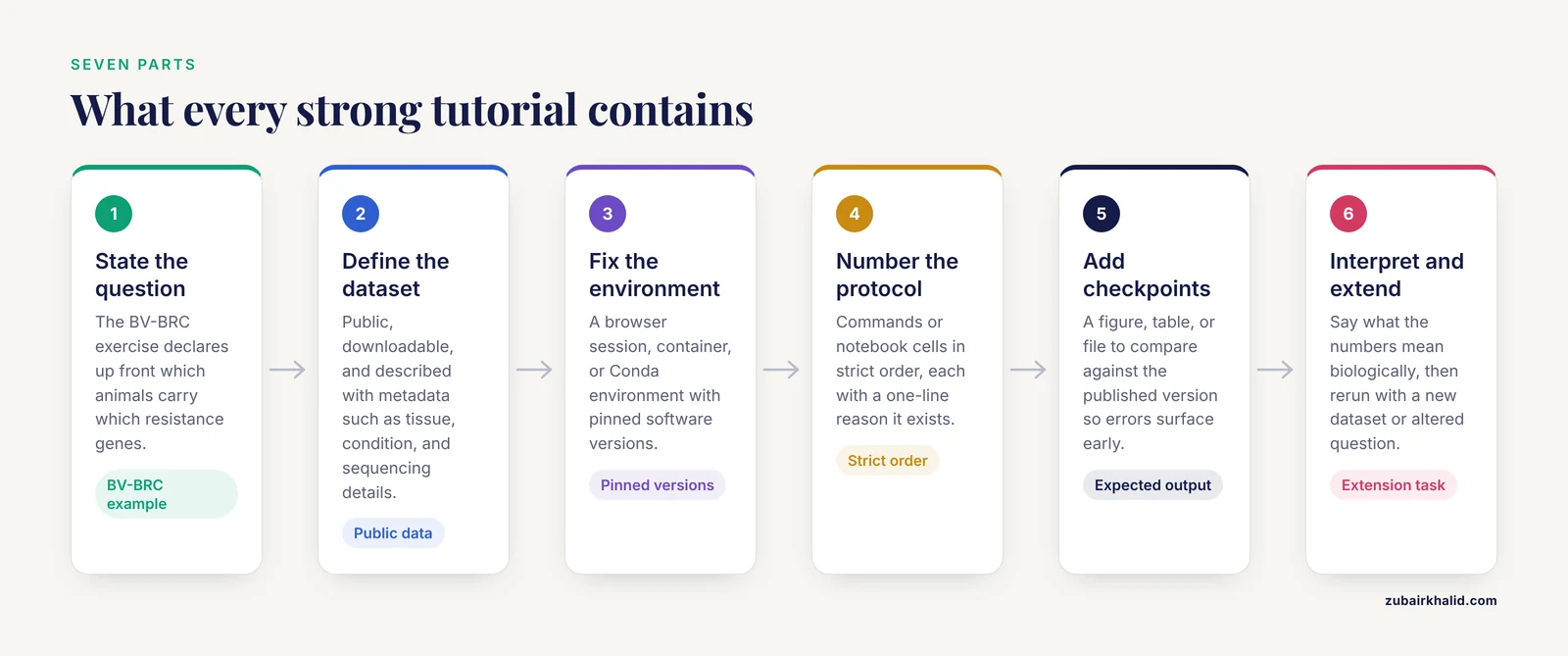
Seven components recur across every strong tutorial, and knowing them lets you judge quality in minutes.
- A stated biological question. The BV-BRC exercise declares its question up front, which animals carry which resistance genes, so every later step has a reason [1].
- A defined dataset. Public, downloadable, and described with metadata, the sample-level information such as tissue, condition, and sequencing details.
- An environment with fixed versions. A browser session, a container, or a Conda environment with pinned software versions, so your results match the authors' results.
- A numbered protocol. Commands or notebook cells in strict execution order, each with a one-line explanation of what it does and why it exists.
- Checkpoints with expected output. A figure, table, or file you can compare against the published version, so errors surface immediately instead of compounding silently.
- Interpretation. What the numbers mean biologically and, just as valuable, what they do not mean.
- Extension tasks. A new dataset or an altered question that forces you to adapt the workflow rather than copy it.
Walk the CircRNAFlow chain as an example of a protocol in motion. Your paired-end FASTQ files enter FastQC, which reports per-base sequencing quality and flags overrepresented adapter sequences. Flexbar trims those adapters away. Bowtie2 and STAR align the cleaned reads to a reference genome, with STAR handling the spliced alignments that RNA data require. DCC scans for chimeric reads, reads whose two halves map to distant genomic locations, the signature of a back-spliced circular RNA. CircTest then asks whether each candidate circle is genuinely more abundant than its host gene's linear transcript and whether that pattern differs between sample groups. ClusterProfiler, CRAFT, and deepTarget finish by predicting what the confirmed circles might regulate [8]. Each stage has a characteristic failure mode, and a good tutorial shows you the failure, not only the success.
The BV-BRC exercise demonstrates the same skeleton in point-and-click form, moving students from raw metagenomic samples through community composition profiles to identified resistance genes [1]. The peptide embedding notebooks demonstrate it for machine learning, taking raw peptide sequences, transforming them through a chosen encoding into numeric matrices, and only then introducing models that predict fragmentation spectra or chromatographic retention time [4]. The pedagogical point repeats across all three: decisions made before the flashy step, in design, in trimming, in representation, determine the quality of the final result.
Sequencing Tutorials Into a Learning Path
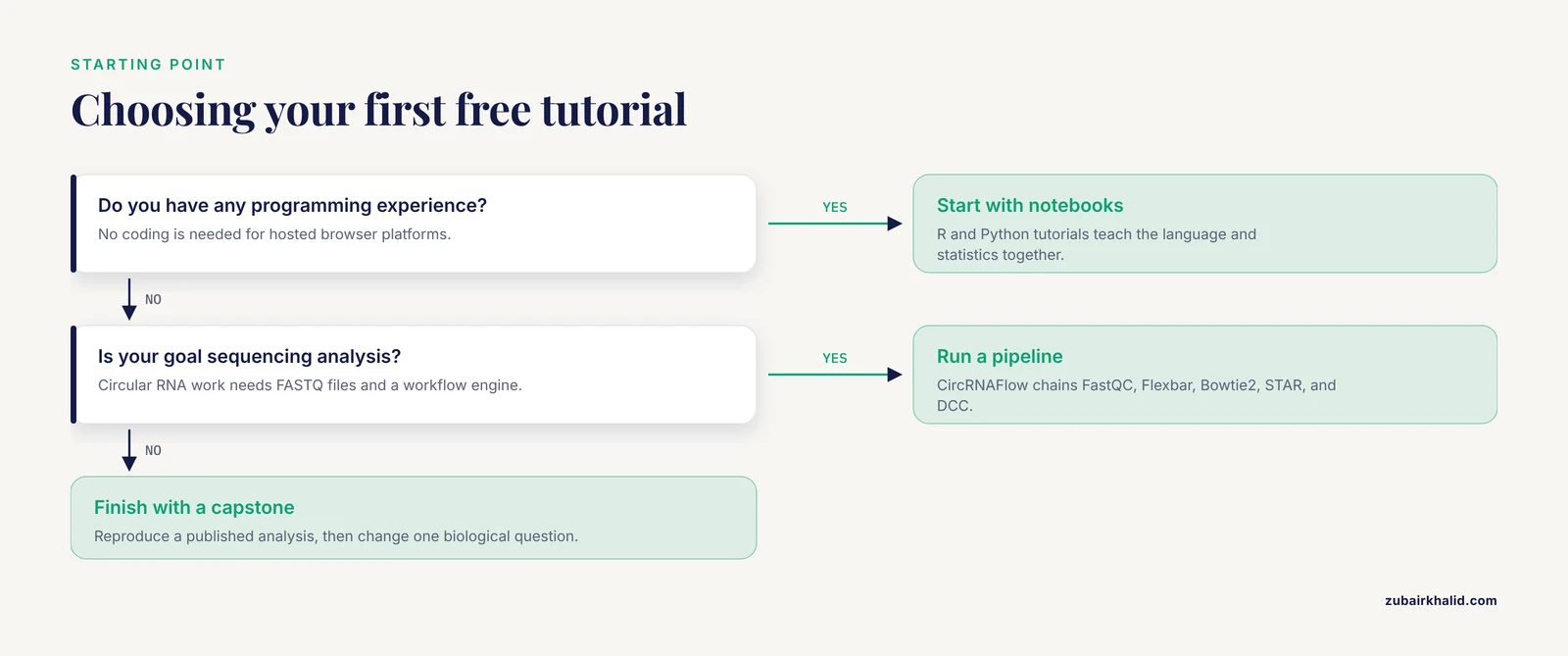
If your goal is to learn bioinformatics rather than to collect browser tabs, sequence matters more than volume.
Stage 0, foundations. Refresh the central dogma of molecular biology, transcription followed by translation, get comfortable with spreadsheets, and accept that the terminal is learnable. Install nothing yet.
Stage 1, point-and-click. Complete the BV-BRC antimicrobial resistance exercise [1]. You acquire the vocabulary, sample, read, mapping, taxonomy, and the shape of an end-to-end analysis without touching a command line.
Stage 2, scripted analysis in two languages. Work through the MSqRob tutorial in R [7] and the peptide embedding notebooks in Python [4]. The field runs on these two languages, and both tutorials teach the language and the statistics at the same time.
Stage 3, the command line. Run CircRNAFlow end to end. You will meet FASTQ files, alignment, and a workflow engine, and you will discover that much of bioinformatics is careful bookkeeping of files between steps.
Stage 4, depth in one domain. Pick a specialty and read its documentation completely. Single-cell analysis with GEDI 2.0 [10] and cell-free DNA fragmentomics with fRagmentomics [5] are two well-documented starting points. Depth in one area transfers better than shallow exposure to five.
Stage 5, capstone. Reproduce a published analysis on a public dataset, then change one biological question and rerun the whole thing. An analysis shaped like the table olive study, public community data plus a supervised classifier plus honest validation, is an ideal target [3].
Habits multiply the value of every stage. Keep a dated notebook of every command you run, place your code under version control, and re-run each analysis from an empty directory before calling it finished. Expect months of steady part-time effort rather than days, because the limiting factor is practice, not access to materials.
How Progress Is Tested in Practice
Progress in bioinformatics is observable, and six tests separate learning from watching.
Reproduction on fresh data is the real examination. Take a workflow you completed, substitute a different public dataset, and carry it through with the tutorial closed. Any step you cannot perform unaided marks a gap to revisit.
Explanation is the second test. If you cannot say why UMI-based deduplication precedes quantification in extracellular vesicle RNA work, where each unique molecular identifier tags an original molecule so that duplicates created during amplification can be collapsed [9], you have memorized keystrokes rather than learned reasoning.
Classroom scaffolding offers a third test. The BV-BRC materials were built for undergraduate and graduate teaching, which means they include the checkpoints and structure that instructors use for assessment, and you can borrow that structure for honest self-assessment [1].
A public portfolio is the fourth. Well-documented scripts that a stranger can run, the standard the MSqRob authors met when they released bash-mode scripts for cluster integration [7], double as evidence for employers and collaborators.
Community critique is the fifth. Presenting a reproduction at a society workshop or an online forum invites correction, the same mechanism national societies rely on to build capacity in their members [11].
Hiring processes themselves provide the sixth. Interviewers probe workflow reasoning, statistical judgment, and code hygiene far more often than tool trivia, so practicing the five tests above prepares you for the evaluation that actually decides outcomes.
Common Mistakes and Limitations
Practical Mistakes That Waste Months
Designing the analysis after the data already exist. The MSqRob tutorial opens with experimental design for a reason, no analysis rescues samples collected without replication, randomization, or appropriate controls [7]. Decide the design before the sequencer runs, and if you inherit someone else's data, document its design limits before analyzing.
Skipping data preparation in machine learning. Educational materials routinely omit the transformation of biological strings into model-ready numbers, yet embedding choice separates useful models from failures [4]. Budget as much effort for representation as for model architecture.
Applying generic workflows to specialized data. Extracellular vesicle RNA breaks the assumptions of standard RNA-seq pipelines through low abundance, fragmentation, and co-isolated contaminants, which is why dedicated pipelines with extensive quality control exist for it [9]. Ask what a workflow assumes about your data before you run it.
Treating point-and-click output as an endpoint. A web service returns a result, not a conclusion. The interpretation step, what a taxonomy table means for your question, is the science, and skipping it produces operators rather than analysts.
Overreading machine learning importance scores. When a tree ensemble ranks fungal genera by their contribution to classification, the ranking is a hypothesis generator that requires biological validation, not a demonstrated mechanism [3]. Report it as such.
Ignoring software versions. Analyses that run today and fail next year almost always lack recorded versions. Pin everything, then write the pins into your notebook.
Collecting tutorials without finishing any. Completion beats exposure. One finished pipeline teaches more than ten watched videos.
Misconceptions Worth Unlearning Early
Programming must come first. Point-and-click platforms invert that order deliberately, letting concept precede code.
Free means inferior. The resources above include federally funded national infrastructure [1], peer-reviewed tutorial articles [6], [7], and open-licensed scientific software [5]. Cost says nothing about rigor.
Bioinformatics is just running pipelines. The difficult parts are design, interpretation, and artifact detection, and the strongest tutorials spend most of their text on exactly those [9], [7].
A powerful computer is required. Browser platforms and cloud notebooks run on ordinary laptops, [4], and even memory-hungry single-cell methods are being reengineered for modest hardware [10].
One course completes the training. Competence compounds across repeated end-to-end projects, which is why the learning path above ends with a capstone rather than a certificate.
Limits of Self-Study
Tutorials cannot supply mentorship for high-stakes decisions, institutional computing for datasets that exceed a laptop, or the ethical review that studies involving human participants require. When your project outgrows tutorial scale, seek a mentor, a core facility, or a collaborator, and treat that transition as the normal next step rather than a personal failure.
Quick Review
- Bioinformatics combines biology, statistics, computer science, and information technology to analyze genomic data [1].
- A real tutorial contains a question, a dataset, a fixed environment, a numbered protocol, checkpoints, and interpretation.
- Sequence your learning: point-and-click first, then notebooks in R and Python, then command-line pipelines, then a capstone reproduction.
- Experimental design and data preparation determine analysis quality more than tool choice does [7], [4].
- Specialized data types, such as extracellular vesicle RNA, demand specialized workflows [9].
- Free resources include federally funded platforms, peer-reviewed tutorials, and open-licensed software [1], [7], [5].
- Measure progress by reproducing an analysis on new data with the tutorial closed, not by certificates collected.
Frequently Asked Questions
What are free bioinformatics tutorials?
They are no-cost, structured lessons that teach biological data analysis with open software and public datasets, usually ending in an analysis you have reproduced yourself. Common formats include browser-based platform exercises, journal tutorial articles with companion code, cloud notebooks, and pipeline walkthroughs.
Can I learn bioinformatics without paying for a course?
Yes. Every resource category in this guide is free to access, and the underlying software and datasets are free as well. Paid programs add scheduling and grading, not secret content.
Do I need programming experience before starting a free bioinformatics tutorial?
No. Point-and-click platforms require no coding at all, and notebook tutorials teach the programming you need as you go. Command-line fluency becomes necessary later, at the pipeline stage.
Which free tutorial should a complete beginner do first?
Begin with a browser-based exercise on a hosted platform, because it eliminates installation problems entirely. A metagenomics and antimicrobial resistance exercise built for classrooms on a federally funded resource center is a concrete starting point.
Are free tutorials enough to qualify for bioinformatics jobs?
They can take you far, because employers probe workflow reasoning, statistical judgment, and reproducible code rather than certificates. Pair your tutorials with a public portfolio of documented, completed analyses.
How do I move from tutorials to my own research project?
Choose a public dataset that interests you, reproduce a published analysis on it, then change one biological question and rerun the workflow. Take the result to a mentor or a community forum for critique before scaling up.
Sources
- Exploring antimicrobial resistance in wild and domestic animal populations: combining publicly available data with BV-BRC resources to introduce bioinformatics in an undergraduate classroom.
- Integrative Bioinformatics Approaches in Environmental Biotechnology: A Review.
- Unraveling fungal community biodiversity in table olives through tree-based machine learning classification.
- Better Inputs, Better Learning: A Peptide Embedding Tutorial for Proteomic Mass Spectrometry.
- fRagmentomics: an R package for integrating cell-free DNA fragment features with mutational status to support liquid biopsy interpretation.
- Path Integral-Free Energy Perturbation (PI-FEP) Simulations: Kinetic Isotope Effects of Proton/Deuteron Transfer Reactions in Aqueous Solution.
- Experimental design and data-analysis in label-free quantitative LC/MS proteomics: A tutorial with MSqRob.
- Circular RNA Identification and Characterization with CircRNAFlow: A Bioinformatics Approach.
- EVscope: A Comprehensive Bioinformatics Pipeline for Accurate and Robust Analysis of Total RNA Sequencing from Extracellular Vesicles.
- Atlas-level single-cell integration and clustering-free differential expression analysis with GEDI 2.0.
- From the establishment of a national bioinformatics society to the development of a national bioinformatics infrastructure.