How to Find a Bioinformatics Mentor Online
By Dr. Zubair Khalid, DVM, MS, PhD ·
By the end of this guide you will be able to define what you want from a bioinformatics mentor, build a short list of realistic candidates, send an outreach message that gets replies, and run a first working session that turns a stranger into a working mentor. You will also know the mistakes that make most first messages get ignored, and how to avoid each one.
Before you start, have three things ready: a GitHub account with at least one small finished analysis in it, a one paragraph summary of your background and goal, and a laptop where you can install software. If you do not have the project yet, this guide includes a worked example you can finish in an afternoon, and that project becomes the centerpiece of your outreach.
Why a Mentor Matters in Bioinformatics
Bioinformatics blends biology, statistics, computer science, and information technology to process and analyze genomic data [1]. That breadth is the reason mentorship matters so much here. You can learn a programming language alone, but you cannot easily learn alone which questions are worth asking, which methods a reviewer will accept, or when a pipeline result is biologically meaningless. A mentor compresses years of those judgment calls into a few conversations.
The field also has a structural training gap. Many undergraduate institutions struggle to integrate bioinformatics into their life science curricula because instructors face technical barriers and a shortage of faculty expertise [1]. If your degree program did not give you bioinformatics exposure, you are in good company, and self-directed learning with outside guidance is the normal path, not the exception.
A mentor also helps you cross disciplinary boundaries, which is where much of modern bioinformatics lives. Reviews of environmental biotechnology, for example, describe how genomics, computational tools, and artificial intelligence are now combined to analyze metagenomes and environmental DNA, and they single out the challenge of fostering interdisciplinary collaboration as a persistent obstacle for the field [2]. A mentor who has lived on both sides of a collaboration can teach you how to talk to biologists as a computational person, or the reverse.
Finally, bioinformatics is now a social activity, not a solitary one. National bioinformatics societies have formed specifically to turn scattered professionals into connected communities with shared training. The Romanian Society of Bioinformatics, founded in 2019, grew from a loose group of professionals into an organization that runs national training, engages stakeholders, and eventually led the creation of a national bioinformatics infrastructure acting as an ELIXIR national node [3]. That pattern tells you something practical: the community infrastructure around bioinformatics is real, findable, and open to newcomers who show up properly.
What a Bioinformatics Mentor Actually Does
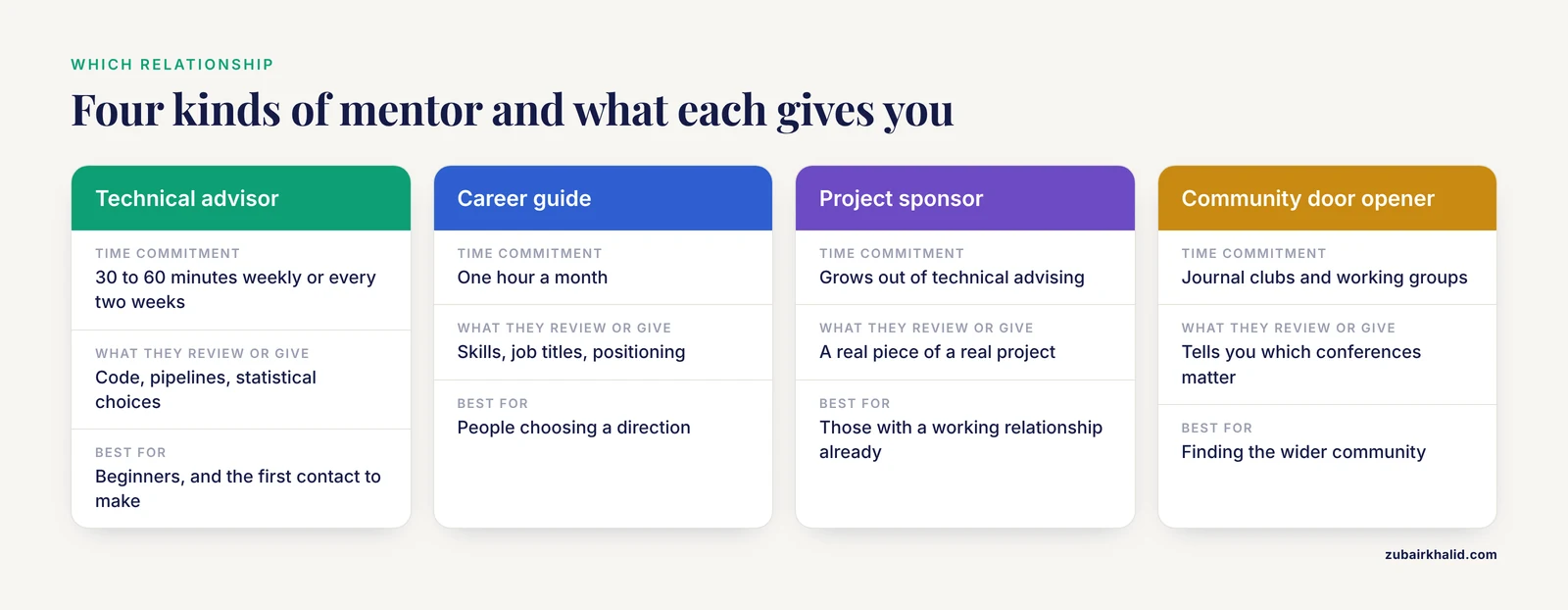
The word mentor covers several different relationships. Knowing which one you want is the first step in learning how to find a bioinformatics mentor online, because you ask a different person for each type.
The technical advisor. This person reviews your code, pipelines, and statistical choices. They answer questions like "Is my normalization defensible?" and "Why does my abundance table look like this?" You usually need one for 30 to 60 minutes every week or two.
The career guide. This person has walked the path you want and can tell you which skills matter, which job titles exist, and how to position yourself. You need one for an hour a month.
The project sponsor. This person hands you a real piece of a real project, reviews your output, and eventually writes you a recommendation or co-authors with you. This is the most valuable and hardest to get, and it usually grows out of a successful technical advising relationship.
The community door opener. This person introduces you to others, invites you to journal clubs and working groups, and tells you which conferences matter. National societies exist for exactly this purpose, connecting professionals with trainees and with public engagement and policy work [3].
Most beginners need a technical advisor first. Career guidance and sponsorship come naturally once someone has seen your work for a few months.
What to Have Ready Before You Search
Cold messages from people with no visible work rarely get answered, and they usually should not be. Prepare this baseline before you contact anyone.
A defined subfield
"Bioinformatics" is too broad to be a useful ask. Pick a direction based on what genuinely interests you, because mentors can tell the difference. Useful concrete subfields include microbiome and metagenomic analysis, antimicrobial resistance surveillance, structural biology computing, single cell genomics, ecological and environmental genomics, and machine learning on biological data. To pick well, read two or three recent open access papers in each candidate subfield and note which ones you could imagine contributing to.
Modern papers give you a realistic picture of the skills involved. A 2026 study of fungal communities in table olives, for instance, applied three tree based machine learning algorithms, Classification and Regression Trees, Random Forest, and eXtreme Gradient Boosting, to 872 fungal metataxonomic samples, with the Random Forest model classifying country of origin reaching 89 percent accuracy and a kappa coefficient of 0.86 [4]. Notice what that project requires: domain knowledge of fermented foods, compositional data handling, machine learning, and careful interpretation of which genera drive classification. If that mix excites you, supervised learning on community data is your subfield. If it sounds tedious, look elsewhere.
A minimum public footprint
You need two things online before any outreach: a repository and an identity.
Create a GitHub account and put one complete, small analysis there. A README that explains the question, the data source, the method, and what you found is worth more than three half finished notebooks. Create an ORCID identifier so your contact information is stable and findable. Update your institutional or professional profile page, or create a simple personal page, with one paragraph stating your background and current goal.
A working local environment
Install a package manager and prove to yourself you can run other people's code. The standard tool in this field is Conda, and almost every tutorial you will encounter assumes it. The minimal setup looks like this:
# Install Miniconda (Linux or macOS)
wget https://repo.anaconda.com/miniconda/Miniconda3-latest-Linux-x86_64.sh
bash Miniconda3-latest-Linux-x86_64.sh

# Create and activate a dedicated environment
conda create -n bioinfo-baseline python=3.11
conda activate bioinfo-baseline
The -n parameter names the environment. Keeping each project in its own environment is the single habit that prevents most dependency problems later. When the environment activates, your shell prompt shows (bioinfo-baseline) before your username. If conda is not recognized after installation, close and reopen your terminal, or run source ~/miniconda3/bin/activate once to initialize it.
How to Find a Bioinformatics Mentor Online, Step by Step
This is the core process. Each step produces an artifact, and together the artifacts make your outreach nearly effortless.
Step 1: Write a one sentence goal
Write a single sentence in this form: "I want to go from [current state] to [target state] within [time frame], working on [topic]." For example:
Goal: I want to go from basic Python skills to independently running a
microbiome diversity analysis on public data within 6 months, in the
area of antimicrobial resistance in animal populations.
The specificity matters. "I want to learn bioinformatics" gives a potential mentor nothing to respond to. A sentence like the one above tells them exactly what help would look like, and it takes them five seconds to decide whether they are the right person.
Step 2: Complete one structured bioinformatics course
Do not contact mentors while you are at zero. Free, web accessible, course based materials have proliferated precisely because most institutions cannot supply enough bioinformatics expertise [1]. These courses do two things for you: they give you baseline skills, and they give you a pool of mentors, because instructors and teaching assistants on such courses are people who have already opted into helping learners.
A concrete example of the style of exercise these courses use: a published undergraduate activity walks students through a three part exercise on antimicrobial resistance and metagenomics using six publicly available metagenomic samples from wild and domestic animals, analyzed entirely through two end to end web services in the Bacterial and Viral Bioinformatics Resource Center (BV-BRC), one of three Bioinformatics Resource Centers funded by the National Institute of Allergy and Infectious Diseases [1]. BV-BRC is publicly accessible, so you can replicate that exercise on your own: upload or select a public metagenomic sample, run the Taxonomic Classification service, then run the Metagenomic Read Mapping service, and write two paragraphs on the community composition and resistance genes you observed. Completing something like that gives you both a skill and a portfolio artifact.
Pick one course with a cohort or active discussion forum, finish it, and stay active in the forum for a month after it ends. People who answer your forum questions thoughtfully are your warmest possible mentor candidates.
Step 3: Build a candidate list of 15 to 25 names
Now to the actual search. Work through these channels in order, because they are ordered roughly from warmest to coldest.
Course and workshop instructors. Anyone who taught your course, answered your questions, or ran a workshop you attended.
National and regional bioinformatics societies. The Romanian Society of Bioinformatics example shows the model: societies run training programs, community events, and public engagement, and they exist to connect people within a national bioinformatics community [3]. Search for the bioinformatics society in your country or region, join it, and look at their mentoring, early career, or training committee pages. Many societies run formal mentoring programs with annual application windows.
Authors whose methods you actually used. If you completed the BV-BRC style exercise or ran a published pipeline, the corresponding authors of those papers and resources are legitimate contacts. A message that says "I ran your workflow on public data and here is what I found, and I have one question" is a genuinely good message.
GitHub contributors to tools in your subfield. Look at the commit history and issue discussions for the software your subfield depends on. People who write patient, structured answers to beginner issues on GitHub have already demonstrated the exact temperament a mentor needs.
Conference speakers and poster presenters. Many conferences now run hybrid or virtual sessions. Posters list presenter emails. A message referencing a specific poster you watched is a warm contact.
Professional social platforms. Search for people whose job title matches your target role and whose posts show they explain things clearly.
Record every candidate in a simple spreadsheet with five columns: name, subfield overlap, evidence they mentor or teach, how you found them, and your specific ask.
Step 4: Rank the list and choose five to eight first contacts
You will get replies from perhaps one in three well written messages, so start with five to eight, not fifty. Rank on four criteria.
- Subfield overlap. A metagenomics mentor is worth more to you than a more famous structural biologist.
- Evidence of mentoring. Lab pages listing trainees, conference mentoring sessions, society mentoring programs, or patient GitHub issue replies.
- Recency of activity. Someone who published or presented within the last year is more reachable than someone who has gone quiet.
- Accessibility. People whose contact information is on a lab page with an explicit note that they welcome student inquiries will respond at a much higher rate.
Step 5: Send the outreach message
Here is a template that works. Adapt every bracketed field, and keep it under 180 words.
Subject: Question from a self-taught bioinformatics learner (AMR metagenomics)

Dear Dr. [Name],

I am a [background, e.g., microbiology MS graduate] teaching myself
bioinformatics online. I recently worked through [specific thing, e.g.,
the BV-BRC metagenomics exercise on antimicrobial resistance], and I
pushed my write-up of it here: [one GitHub link].

My goal: I want to independently analyze public metagenomic data for
resistance genes within the next 6 months and eventually work in
[short term career target].

Would you be open to a single 30 minute call in the next few weeks?
I have three specific questions about [topic] that I could not resolve
from the documentation. If a call is not possible, I would be grateful
for answers to those questions over email, at whatever pace suits you.

Thank you for your time,
[Name], [location], [one line on current role or study]
Explain the parameters, because each one exists for a reason:
- The subject line names a concrete topic so the reader can triage in two seconds.
- The first sentence establishes who you are without a life story.
- The artifact link proves you do things, not just read about them. This single line separates messages that get replies from messages that do not.
- The one sentence goal matches the goal from Step 1.
- The bounded ask, one 30 minute call, is easy to say yes to. Asking "will you be my mentor" in a first message asks a stranger for an open ended commitment, and the honest answer to that is no.
- The fallback offer, answering three questions by email, gives them a cheaper way to help, and many relationships begin exactly there.
Common errors in outreach, with fixes:
- No reply within 10 business days. Send one short follow-up: "Resending in case this slipped past. Happy to hear from you whenever convenient." Then stop. Move to the next candidate.
- Bounced email.
550 Address rejectedusually means an old address. Find the author's current email on their most recent preprint or lab page rather than the oldest paper. - Generic message accidentally sent. Never send a message without the artifact link and the specific topic. A message a reader could mistake for mass mail is dead on arrival.
Step 6: Run the first conversation well
If you get the call, structure it so the mentor does not have to. Send an agenda in advance:
Proposed agenda, 30 minutes:
1. Two minute intro: my background and the goal above (2 min)
2. My three questions:
   a. Is per-sample rarefaction still standard for this data type,
      or should I use a compositional approach?
   b. How do I validate that my classification result is not an artifact
      of batch effects?
   c. Which skill should I prioritize next: statistics or workflow tooling?
3. Your advice on what a realistic 3 month target looks like (10 min)
4. Anything I should read or replicate next (5 min)
5. Close: may I check in once after I complete the next step? (2 min)
Take notes during the call and send a three bullet summary afterward with what you committed to do. This follow-up habit, more than anything else, converts a one time call into an ongoing relationship, because it shows the mentor that their time produced action.
Step 7: Convert the conversation into a working arrangement
After the second or third productive contact, propose a light structure explicitly: "Would you be open to a 30 minute call monthly for the next three months while I work through [specific project]? I will send an agenda in advance and a short summary after each call." Most mentors accept this because it is bounded, and most ongoing mentorships in this field run on roughly that cadence, with email or chat in between.
Set a 90 day plan with the mentor. A realistic first plan for a metagenomics learner has three deliverables: a reproduced analysis on public data, a written one page summary a biologist could read, and a cleaned repository another person could run. Those three artifacts map exactly onto what reviewers and employers evaluate later.
A Worked Example Project to Anchor Your Outreach
If you have no project yet, build one in an afternoon. The goal is a small, complete, honest analysis, not a novel result. This example uses public sequence data and standard tools.
conda activate bioinfo-baseline

# Install quality control and sequence handling tools
conda install -c bioconda fastqc biopython

# Create a project folder
mkdir mentor-demo && cd mentor-demo
The -c bioconda parameter tells Conda to pull packages from the Bioconda channel, the community repository where most bioinformatics software is packaged. Order matters when configuring channels, but installing with -c bioconda on a single line handles it for a small project.
Get a small public dataset from a public sequence read archive, take a single sample, and run a quality check:
fastqc demo_sample.fastq.gz -o qc_reports/Expected output in your terminal looks like this:
Started analysis of demo_sample.fastq.gz
Approx 5 mins for demo_sample.fastq.gz
Analysis complete for demo_sample.fastq.gz
FastQC writes an HTML report into qc_reports/. Open it and read two modules: per base sequence quality, which tells you where read quality degrades, and overrepresented sequences, which often flags adapter contamination. Write your observations in the README.
Then add one small scripted step, for example counting sequence lengths and GC content with Biopython:
from Bio import SeqIO
from collections import Counter

lengths = []
gc_counts = Counter()
for record in SeqIO.parse("demo_sample.fasta", "fasta"):
    lengths.append(len(record.seq))
    gc_counts["GC"] += record.seq.count("G") + record.seq.count("C")
    gc_counts["total"] += len(record.seq)

n = len(lengths)
gc_percent = 100.0 * gc_counts["GC"] / gc_counts["total"]
print(f"sequences: {n}")
print(f"mean length: {sum(lengths) / n:.1f} bp")
print(f"GC content: {gc_percent:.1f}%")
Expected output:
sequences: 1284
mean length: 437.6 bp
GC content: 52.3%
(Your numbers will differ. That is the point, they are real.) Commit everything:
git add README.md qc_reports/ gc_summary.py
git commit -m "Add quality report and GC summary for demo sample"
git push -u origin main
Errors you may hit, with exact messages and fixes:
ModuleNotFoundError: No module named 'Bio'. Biopython is not installed in the Python your notebook or script is using. Runpython -m pip install biopythoninside the same environment, and if you are in a notebook, confirm the kernel matches the environment.PackagesNotFoundError: The following packages are not available from current channels. A package name is wrong or missing from the channels you have enabled. Check the exact package name on the Bioconda website and install it explicitly with-c bioconda.Permission denied (publickey)duringgit push. Your SSH key is not registered with your Git host. Either add your public key in the host's settings or switch the remote to HTTPS.warning: adding embedded git repository. You accidentally cloned a repository inside your project. Remove the nested.gitdirectory or add the dependency as a proper subproject instead.
Where to Look: A Comparison of Channels
| Channel | What to look for | Strength | Weakness |
|---|---|---|---|
| Course instructors and forums | Teaching assistants and active answerers from a bioinformatics course you completed | Already invested in helping learners | May not share your exact subfield |
| National and regional societies | Mentoring programs, training committees, early career events | Structured, purpose built for connection [3] | Application windows and eligibility rules |
| Authors of papers you used | Corresponding authors of resources you actually ran | Your message is genuinely specific | Senior authors are busy, response can be slow |
| GitHub maintainers | Patient answers to beginner issues | Temperament already demonstrated | Interaction is public and code first |
| Virtual conference sessions | Poster presenters and session speakers | Timely, topical, often accessible | Contact windows are short around the event |
| Professional social platforms | Clear explainers in your subfield | Low friction to start | High noise, hard to judge depth |
Skills to Build While You Search
Mentors invest in people whose trajectory is visible. While you search, work on the three skill layers the current literature says the field runs on.
Workflow and data handling. Learn to move data through a defined pipeline: quality control, processing, summary statistics, and a reproducible record of every step. The BV-BRC style services, where you run taxonomic classification and read mapping as end to end workflows on public samples, teach exactly this shape of thinking [1].
Statistics and machine learning. Supervised models on biological data are now routine, and interpretable tree based methods such as Random Forest and gradient boosting are a standard entry point because you can see which features drive predictions [4]. Learning to state a model's accuracy together with a measure like the kappa coefficient, and to name the genera or features that matter most, is a skill a mentor will refine with you.
Domain framing. Reviews across application areas emphasize that the frontier work combines multiomics data with predictive modeling to answer biological questions, for example linking genomic potential to actual microbial activity in contaminated environments [2]. A mentor can teach you to frame a computational result as a biological claim, which is the skill that separates technicians from scientists.
Common Mistakes and Limitations
These are the errors that most reliably sink an online mentorship search.
Mistake 1: Mass emailing identical messages. Sending fifty generic messages yields almost nothing and can damage your reputation when recipients compare notes. Five to eight specific messages with an artifact link outperform fifty generic ones, consistently.
Mistake 2: Asking for a mentorship instead of a task. "Will you mentor me?" asks a stranger for an undefined commitment. "Can I ask you three specific questions about my analysis?" asks for thirty minutes. Earn the bigger title later.
Mistake 3: Contacting at zero skills. If you cannot yet run a quality control report or parse a FASTA file, complete a course and the worked project above first. Mentors cannot advise someone they have to teach from scratch in every session, and honest ones will tell you so.
Mistake 4: Hiding your work because it is not impressive. A small finished analysis is more persuasive than an unfinished ambitious one. Reviewers of your character, which is what a potential mentor is, value completion.
Mistake 5: Treating a chatbot as a mentor substitute. Large language models are useful for debugging and syntax, and you should use them. But they cannot tell you whether your question is worth asking, introduce you to a collaborator, or write you a recommendation letter. Use the tools for code, and use humans for judgment.
Mistake 6: Ignoring credit norms. If a mentor spends significant time on your project, discuss authorship and acknowledgment early and directly. Ambiguity about credit is one of the fastest ways to end a mentoring relationship badly.
Mistake 7: Paying for unvetted "mentorship." Paid programs are not automatically bad, but evaluate them the way you would evaluate any service: ask for past participant outcomes, check whether named mentors actually deliver the sessions, and be skeptical of guarantees of publication or employment. Free, structured routes through societies and courses exist and are the default first choice [3].
Mistake 8: No end date. Mentorship arrangements without a horizon decay into silence. Propose a defined term, such as three months, with an explicit option to renew. Renewal is easier than escape.
Limitations. The right mentoring structure depends on your field, your country, your employment situation, and your prior training, and this guide cannot account for individual circumstances. For decisions about degree programs, visas, or employment contracts, get advice from a qualified academic advisor or your institution's career services in addition to any informal mentor. Nothing here substitutes for that individualized guidance.
Frequently Asked Questions
Do I need to pay for a program to find a bioinformatics mentor online?
No. The highest yield routes, course forums, professional societies, and authors whose work you have actually used, are free. Consider paying only for a specific, verifiable program with named mentors and checkable outcomes, and treat any guarantee of publication or a job as a warning sign rather than a selling point.
How long does it usually take to find a mentor?
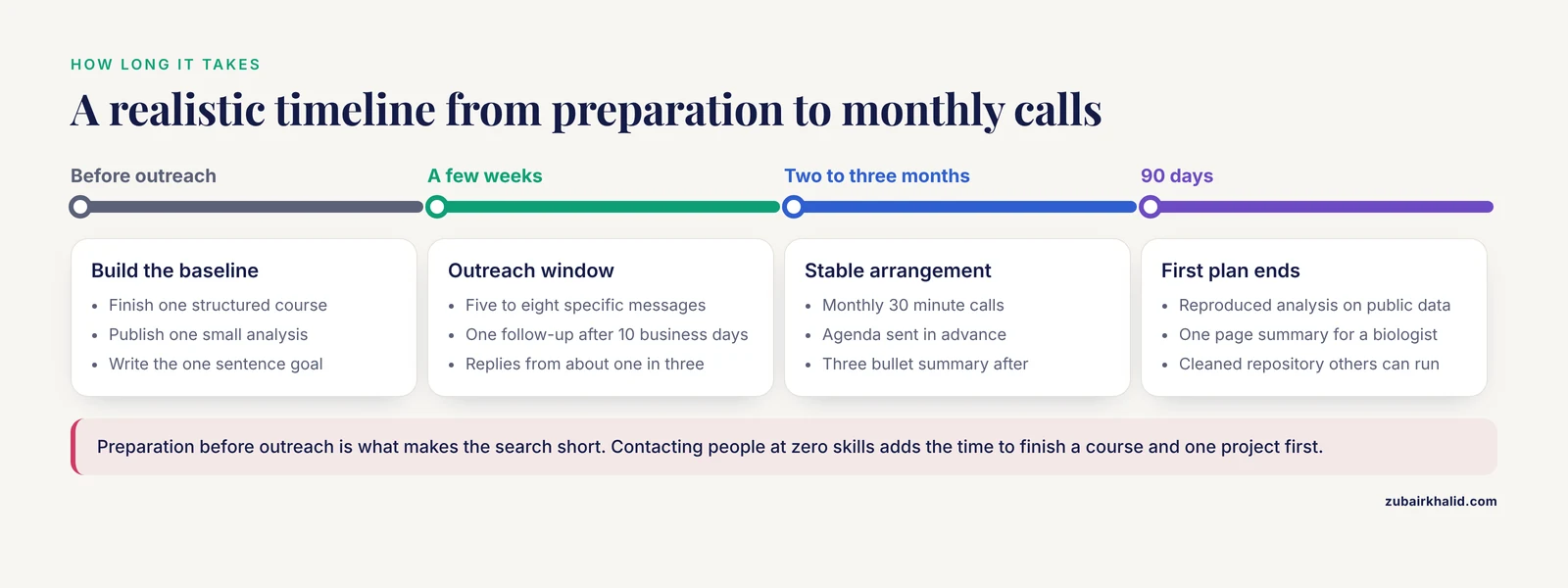
For a well prepared candidate with a public project and specific messages, a few weeks of outreach is typical, and a stable monthly arrangement usually forms within two or three months. If you are contacting people at zero skills, add the time to finish a course and one project first, because that preparation is what makes the search short.
What should go in my first message to a potential mentor?
Four things in under 180 words: who you are in one sentence, a link to one finished piece of work, your one sentence goal, and a bounded ask such as a single 30 minute call. Include a fallback offer to receive answers by email, and never attach your CV to a first cold message unless asked.
Can I find a bioinformatics mentor online if I have no lab experience?
Yes. Bioinformatics mentoring is largely computational, so what a mentor evaluates is your analysis, your code hygiene, and your communication about data. A clean public repository with a readable README substitutes completely for bench experience in a first conversation.
Should I finish a bioinformatics course before looking for a mentor?
Yes, finish at least one structured course first. Course based materials exist partly because formal programs often cannot supply the expertise, and web accessible resources now cover end to end workflows on real public data [1]. A finished course plus a small project is the minimum that makes mentor outreach worthwhile for both sides.
How do I tell whether an online mentor is legitimate?
Look for verifiable professional presence: an institutional page, an ORCID record with a publication history, a GitHub account with real contributions, or a role listed by a professional society. Be cautious with anyone who approaches you first, charges unclear fees, or promises publication or employment outcomes.
Should I ask a potential mentor for a project or for a job?
Ask for a project, never for a job, in early contact. A small, well defined project is something a mentor can grant in a single sentence, and it is also how they evaluate whether a stronger recommendation or referral is warranted later. Job requests in a first message end most conversations.
How often should I meet with an online mentor?
Monthly 30 minute calls with an advance agenda and a short written summary afterward is a sustainable default for the first few months. Increase frequency temporarily during an intense project sprint, and always end each meeting by confirming the next deliverable and date.
Sources
- Exploring antimicrobial resistance in wild and domestic animal populations: combining publicly available data with BV-BRC resources to introduce bioinformatics in an undergraduate classroom.
- Integrative Bioinformatics Approaches in Environmental Biotechnology: A Review.
- From the establishment of a national bioinformatics society to the development of a national bioinformatics infrastructure.
- Unraveling fungal community biodiversity in table olives through tree-based machine learning classification.