Federated Access for Genomic Data Sharing
By Dr. Zubair Khalid, DVM, MS, PhD ·

In federated access genomic data sharing, the question travels to the data rather than the data traveling to the questioner. Each institution keeps its own copies of genomes under its own controls, and a shared protocol lets authorized collaborators search, count, or compute across all sites without moving raw sequences to a central server. The rule of thumb for choosing is simple. If your analysis needs raw individual-level genotypes joined across many centers, either centralize the data under a signed data use agreement or move the computation to where the data already sits. If your analysis needs to discover carriers, count variants, or train a model without exposing individual records, a federated design is usually the better fit.
This guide explains what federated access actually means, walks through the main options now in production use, compares them side by side, and works through realistic scenarios so you can pick the model that matches your collaboration, your budget, and your legal constraints.
What Federated Access Actually Means
Federated access is an architecture in which participating institutions, often called nodes, retain custody of their own genomic data while exposing a controlled interface for discovery or computation. A coordinating hub indexes metadata, routes queries, and records who did what, but it never holds the underlying genotypes. The opposite model is the centralized controlled-access repository, where data owners deposit files and a data access committee approves download requests.
The Sharing Spectrum
Health data sharing is best understood as a spectrum rather than a binary choice between open and closed. At one end sit public aggregate datasets that anyone can download. Next come controlled-access repositories where researchers apply for access and sign terms. Then come federated analysis arrangements where data stays local, synthetic data products that mimic real distributions without containing real patients, and finally fully local computation behind institutional walls. A recent narrative review of biomedical open data frames the whole spectrum this way and concludes that durable progress depends less on unrestricted openness than on calibrated access, privacy-preserving architectures, clear accountability, and sustained public engagement [1].
The legal environment has pushed the field toward the federated end of that spectrum. A 2026 legal analysis of United States medical data policy argues that open sharing of weakly de-identified medical and genomic data was of dubious legality and that recent regulations have effectively ended the open-access era for such data, leaving controlled-access repositories as the dominant future model [2]. That analysis also highlights an uncomfortable economic reality. Meaningful data protections cost money, so repositories that outlive their federal grants must explore private funding models such as user fees or cloud-provider arrangements, and those transactions carry their own legal traps [2].
Why Genomic Data Resists De-identification
Genomes are inherently identifying. A genome sequence is unique to an individual, can reveal relatives, and cannot be re-generated once disclosed, which distinguishes it from most other health data. The General Data Protection Regulation (GDPR), the European privacy law that governs personal data processing in the EU, treats genomic data as inherently identifiable and imposes strict limits on transferring it to third parties or across borders [3]. This single legal fact explains much of the modern architecture of secure data sharing for genomic research collaborations.
The Push Toward Federation
Two forces converge here. Regulators restrict where genomic data may physically travel, while researchers need larger cohorts than any single center can assemble. Rare disease research illustrates the tension sharply. Finding even three or four additional carriers of an ultra-rare variant may transform a variant of uncertain significance into a confirmed pathogenic call, and no single hospital sees enough cases to do this alone [3]. Federation resolves the tension by letting each center answer queries about its own patients without exporting their genomes.
The Main Federated Access Genomic Data Sharing Options
Federated access genomic data sharing options differ in what crosses the institutional boundary. Some options move only a yes or no answer, some move variant-level results, some move model parameters, and some move nothing at all except audit records. Understanding exactly what each design exposes is the core skill in this domain.
Federated Discovery with Beacon v2
Beacon v2 is a standard developed by the Global Alliance for Genomics and Health (GA4GH) that defines a framework and data models for genomic and phenotypic data discovery. A Beacon answers structured questions such as whether a specified variant has been observed in a specified dataset, optionally filtered by phenotype, ancestry, or consent scope. The protocol is deliberately minimal so that many heterogeneous sites can implement it and a federated network of Beacons can be queried as if it were one resource [4].
For working bioinformaticians, the practical entry point is often a client library rather than raw REST calls. The pgxRpi package provides an R and Bioconductor interface to the Beacon v2 API as implemented by Progenetix, a reference implementation offering open access to somatic genomic mutation data across cancer types. The package supports querying multiple Beacon-enabled resources, so a single script can sweep a federation and return harmonized results with visualization functions attached [4]. This is the lowest-friction option in the entire field. If your question is a yes or no existence query with standard filters, a Beacon network is likely the best federated access genomic data sharing choice available to you today.
The limitation is equally clear. Beacons disclose existence and counts. They do not return genotypes, they cannot run arbitrary analyses, and naive deployments can leak information through repeated allele-frequency queries, so mature deployments add rate limits, response filtering, and access control on top of the base standard.
Federated Variant-Level Query Platforms
When existence queries are not enough, some federations expose richer results, typically variant calls stripped of direct identifiers. WiNGS-API is a federated genome and phenome data sharing platform built for rare disease gene discovery and variant classification. It has been deployed across seven centers managing more than 6,400 samples with single-nucleotide variant (SNV) calls, about 1,500 samples with copy number variant (CNV) calls, and about 500 samples with structural variant (SV) calls from long-read sequencing. The system supports sample-based analysis for variant interpretation and automated trio-based filtering that shrinks the candidate de novo variant list before clinical review. Federated queries let participating centers find additional carriers of a variant and identify false positive calls, outcomes that are not achievable with data from a single institution [3].
This option sits between Beacon and full compute federation. Variant-level records move between nodes under agreed rules, which is more exposure than an existence flag but far less than transferring whole genomes. For rare disease collaborations inside a legal jurisdiction, this middle ground is often the sweet spot.
Federated Learning and Privacy-Preserving Analytics
Federated learning (FL) trains a shared machine learning model across institutions without sharing raw patient data. Each node trains locally, and only model updates travel to an aggregating hub. This is the strongest privacy posture among the compute options, but it introduces a subtle statistical problem. When client datasets are non-IID, meaning their feature distributions or label distributions differ, federated model performance degrades badly. Researchers addressing this problem have proposed a universal dataset similarity metric that extracts model representations after a single federated training round and predicts whether collaboration will improve performance, formulating similarity assessment as an optimal transport problem with a hybrid cost function capturing feature-level differences and label distribution divergence. Privacy is preserved through a combination of secure multiparty computation (SMC), a cryptographic technique where parties jointly compute a function without revealing their individual inputs, and differential privacy (DP), which adds calibrated noise so that individual records cannot be re-derived from released outputs [5].
On the infrastructure side, FLAME is an open-source platform developed within the German PrivateAIM project that uses a hub-and-node architecture integrating privacy-enhancing technologies with a dynamic policy framework. The policy layer specifies permissions and conditions for data access and algorithm execution, and enforcement happens locally at each node. Initial deployments at German university hospitals demonstrated federated analyses on clinical and genomic data with model performance comparable to centralized approaches, along with fine-grained access control, audit logging, and low overhead [6].
Federated learning is the right choice when the deliverable is a model rather than a variant list. It is the wrong choice when the deliverable is a table of genotypes, because FL cannot conjure individual-level data that was never shared.
Federated Middleware for Controlled Access Operations
A frequent obstacle is organizational rather than algorithmic. Small institutions want to join federations but lack the staff to run data access committees, negotiate use agreements, and provision secure access systems. DS-PACK is a reusable, open-source middleware solution that semi-automates controlled access processes end to end, from data submission to access. In its architecture, a central node facilitates data discovery while distributed nodes handle data access requests, conclude agreements with data users, and provide secure access to the data. Data protection principles are built into all components, access control management is centralized while enforcement is distributed, and the system supports access through cloud-based applications. DS-PACK is in production use at the ELIXIR Luxembourg data hosting platform combined with an operational model that includes legal facilitation and data stewardship [7].
For bioinformatics data management planning, this matters because federation costs are front-loaded. Middleware like DS-PACK converts a fixed institutional investment into a semi-automated process, lowering the barrier for mid-sized centers that could never staff a full data access office.
Trusted Research Environments and Secure Computing Enclaves
The enclave model inverts federation. Instead of distributing queries to many nodes, data is concentrated inside one heavily controlled environment, and researchers come to the data. The Weill Cornell Medicine Data Core is a documented academic example covering user access, data controls, hardware, software, audit, and financial design. Within 2.5 years of launch it supported more than 200 faculty, staff, and students across nearly 60 research and education projects, and the institution published reusable tooling on GitHub so other centers could adopt the approach [8].
Enclaves are technically centralized even when many organizations contribute data, which is why they pair naturally with federated governance. Each data contributor retains legal ownership and approves use cases, while the physical data sits in one auditable location. This hybrid is common in academic medical centers that need to combine electronic health records, payer claims, and genomic pipelines for analysis [8].
Cloud Workspaces for Consortium Data Sharing
Large multi-institution consortia often land on a cloud workspace model, where datasets are staged in a common cloud environment with per-dataset access authorization. The NIH-funded Polygenic Risk Methods in Diverse Populations (PRIMED) Consortium, which works to improve polygenic risk score performance across genetically diverse populations, describes two primary data-sharing mechanisms in its published governance: coordinated dbGaP applications, where each participating study obtains access through the standard controlled-access application process, and a Consortium Data Sharing Agreement that binds members to common rules. The consortium also designated federated analyses as the fallback when individual-level data cannot be shared, and implemented technical sharing on the NHGRI Analysis Visualization and Informatics Lab-space (AnVIL) cloud platform [9].
The PRIMED experience is instructive because it shows federation and centralization operating together. Harmonized analysis happens in a shared cloud workspace, but consent boundaries and legacy dataset restrictions are respected through per-dataset authorization, and the federated option remains available for datasets that cannot move at all [9].
Blockchain and Zero-Knowledge Proof Frameworks
Two distinct uses of blockchain technology appear in genomic data sharing, and confusing them causes planning errors.
The first use is access logging. A key aspect of controlled access is secure storage and efficient query of access logs for potential misuse detection, but conventional logs suffer from single points of failure. A blockchain-based ledgering solution addresses this with immutability and decentralization. In the 2018 iDASH Secure Genome Analysis Competition, one task was to log and query user activity accessing genomic datasets across multiple sites using MultiChain, a blockchain platform offering embedded data streams for rapid secure storage. The winning solution used a storage protocol exploiting stream keys to build an efficiently queryable data frame from the chain [10]. Note that this design logs access events on the chain, not the genomes themselves.
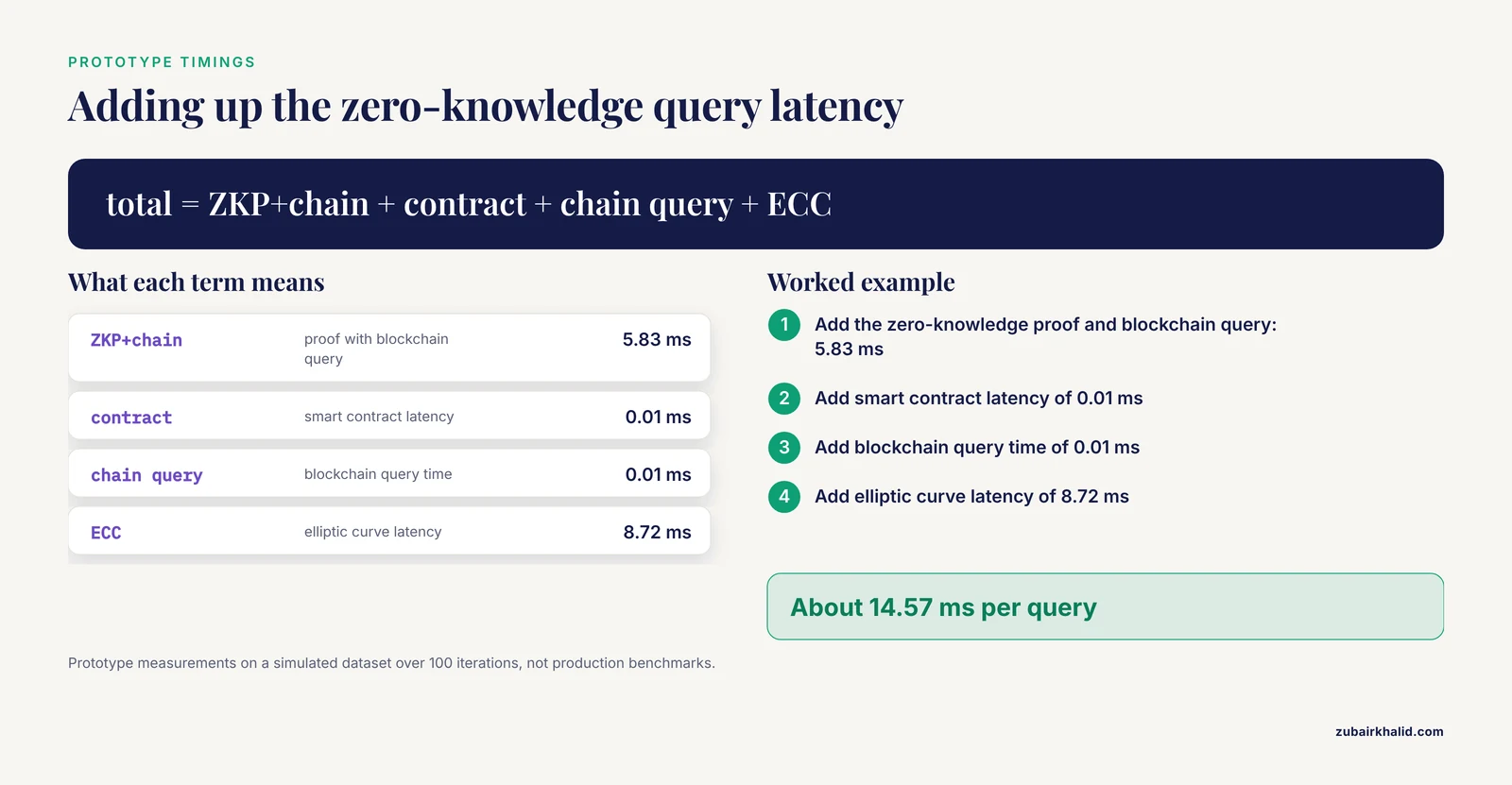
The second use is access enforcement combined with privacy proofs. A 2025 framework combines a blockchain, zero-knowledge proofs (ZKPs), smart contracts, and off-chain storage for genomic data sharing within health record systems. Zero-knowledge proofs let one party prove a statement is true without revealing the underlying data. In a proof-of-concept implemented in Python on a simulated genomic dataset, metadata stayed on the blockchain while encrypted data was placed in an emulated InterPlanetary File System (IPFS), a distributed file storage system. Rule-based access ran through smart contracts, self-executing code on the blockchain, and privacy was enforced using an interactive Schnorr protocol with elliptic curve cryptography (ECC). Empirical testing over 100 iterations reported an average zero-knowledge-proof-with-blockchain query latency of 5.83 ms, smart contract latency under 0.01 ms, blockchain query time of 0.01 ms, and ECC latency of 8.72 ms, each with 90.00% accuracy [11]. The authors position the framework for healthcare research, clinical genomics, and personalized medicine workflows [11].
Treat these numbers as prototype measurements on simulated data, not production benchmarks. The honest current status is that blockchain approaches to genomic access control are promising but early. They answer governance questions, who accessed what and under which rules, with strong tamper resistance, and they complement rather than replace the analytics options above.
Data Lakes and Hybrid Genomics Data Storage
Federation does not eliminate the need for excellent local storage. A multi-site United Kingdom oncology collaboration spanning the NHS, industry, a technology start-up, and academic partners selected a data lake architecture as its centralized repository for large-scale genomic and clinical data, and reports that the lake enabled secure, compliant, and federated storage of large-scale genomic and clinical data. Factors driving the selection included storage requirements, access control, ownership, and information governance, and the team found that early stakeholder engagement and clear governance frameworks were prerequisites for success [12]. This case is a useful reminder that the genomics data storage layer and the sharing architecture must be designed together, because a federated query against badly organized local storage simply produces bad results faster.
Dual-Use Safeguards for Shared Sequence Data
A special case deserves mention. Some sequence data has dual-use potential, meaning it can enable both beneficial research and harm. Pathogen genomes illustrate this. The genome sequence of a pathogen can enable therapeutic development and lineage tracking, as demonstrated during the COVID pandemic, but the same sequence can in principle enable malicious engineering or reconstruction of the pathogen from synthetic DNA. Standard security methods break down when data is shared internationally among many institutions with inconsistent controls. One proposed method obfuscates raw sequence data by pooling reads from different samples of the same organism, demonstrating that pooling prevents full reconstruction of any individual sample while most genomic information remains usable for legitimate analysis [13]. Pooling is a form of security through controlled granularity, and it fits naturally into federated designs where the node controls exactly how much resolution its data exposes.
Consent, Personal Data, and the Individual's Role
Federated architectures also change what individual participants can do. Personal genomic data sharing initiatives, in which individuals upload genotypes and health records to platforms such as Consent to Research, Free the Data, and Genomes Unzipped, emphasize individual control over data as a key theme. A 2015 analysis of these initiatives highlighted the challenges that arise when individuals are asked to balance the risks and benefits of sharing on their own, often without understanding the implications [14]. Modern patient-centric proposals extend this logic into clinical genomics. A symposium on clinicogenomic data stewardship concluded that clinical data governance is a multiagent problem, that governance practices need to become more patient centric, and that digital tools preserving privacy, documenting provenance, and enabling management of data as intellectual property show promise for addressing health disparities driven by underrepresentation in genomic databases [15]. Federation is not only a technical pattern here. It is the architecture that makes granular, revocable, per-person consent technically enforceable.
Side-by-Side Comparison
The table below compares the main models on the dimensions that decide real deployments.
| Model | Where data lives | What crosses the boundary | Typical access control | Best fit | Main drawback |
|---|---|---|---|---|---|
| Beacon v2 federated discovery | Each node's own storage | Existence answers, optionally filtered counts | Node-level, optionally token-based | Existence and prevalence questions across many sites | Cannot return genotypes or run analyses |
| Federated variant-level platform (WiNGS-API style) | Each node's own storage | Variant calls and structured metadata | Institutional agreements plus automated policy | Rare disease carrier matching and variant classification | Variant-level exposure requires careful legal framing |
| Federated learning (FLAME style) | Each node's own storage | Model updates and evaluation metrics | Policy framework enforced at each node | Training predictive models without sharing patients | Struggles when client datasets are non-IID |
| Federated controlled-access middleware (DS-PACK style) | Each node's own storage | Access requests, agreements, signed grants | Centralized management, distributed enforcement | Institutions lacking dedicated access offices | Middleware still requires governance staffing |
| Secure enclave or trusted research environment | One institution's controlled hardware | Researchers and approved outputs | Credentialing, auditing, egress review | Combining EHR, claims, and genomics for analysis | Technically centralized, single custodian |
| Consortium cloud workspace (AnVIL style) | Shared cloud, per-dataset authorization | Authorized users move to data | Per-dataset access grants plus consortium agreements | Large multi-institution consortia with mixed consent scopes | Requires legacy datasets to permit cloud staging |
| Blockchain and ZKP frameworks | On-chain metadata plus encrypted off-chain data | Access logs, proofs, contract state | Smart contracts plus cryptographic proofs | Tamper-evident auditing and automated policy | Early stage, prototype-level performance evidence |
| Pooled or obfuscated data sharing | Sender's control until release | Pooled raw reads | Granularity limits set by data owner | Dual-use pathogen and sensitive sequence data | Limits some per-sample analyses |
No single row wins every column. The best federated access genomic data sharing choice is the one whose exposure profile matches your question and whose governance burden matches your institution.
Choosing Between Options: The Criteria That Decide Real Choices
Question Type
Start with the scientific deliverable. An existence query maps to Beacon. A carrier search or trio-based de novo filter maps to a variant-level federation. A predictive model maps to federated learning. A joined table of genotypes and phenotypes maps to an enclave, a cloud workspace, or a centralized repository with a signed agreement. Teams that skip this step routinely build federated infrastructure and then discover their actual analysis cannot run without individual-level data.
Consent Scope and Participant Preferences
Consent language written for a single repository does not automatically authorize federated query. The PRIMED Consortium explicitly designed its mechanisms to respect participant preferences and informed consent while aggregating data from heterogeneous sources, and designated federated analyses as the alternative when consent or legacy policy forbade individual-level sharing [9]. Map every dataset's consent scope before choosing infrastructure, not after.
Regulatory Jurisdiction
GDPR's treatment of genomic data as inherently identifiable and its strict limits on third-party transfers are the driving constraints in European deployments [3]. Platforms built for this environment, such as FLAME with its policy framework addressing GDPR and HIPAA constraints, and DS-PACK with data protection principles embedded in every component, demonstrate that compliance can be architectural rather than procedural [6][7]. United States deployments face a related but distinct reality, where the legal trend now favors controlled access over open sharing and where financing privacy protections has become the binding constraint on repositories [2].
Infrastructure and Staffing Cost
The hidden cost of federation is operations. DS-PACK exists because research institutions that want to join federations often lack the resources to set up controlled access processes, and its production deployment at ELIXIR Luxembourg bundles legal facilitation and data stewardship with the software [7]. The Weill Cornell Data Core case documents that sustainable enclaves require explicit attention to financial considerations alongside the technical stack [8]. Budget for data stewards, agreement negotiation, and audit review, not just for servers.
Auditability and Provenance
Federation distributes trust, so it increases the value of tamper-evident logs. Blockchain-based access logging earned its iDASH competition win precisely because conventional logs are vulnerable to single points of failure and insider tampering [10]. Whatever model you choose, specify early who can read the audit trail, who can append to it, and how misuse investigations proceed.
Data Quality and Steward Differences
Researchers do not experience all data sources equally. A survey of 294 United States academic genetic researchers found significant differences in the requirements that government, consortium, and private database stewards place on users, with private stewards generally imposing the most restrictions and being the least likely to allow full dataset release at completion. Respondents prioritized data quality and upstream benefits such as access and database features over downstream publication limitations, and reported that the time necessary to share data was the biggest barrier to contributing data [16]. When selecting federated partners, evaluate the steward as carefully as the schema.
Interoperability and FAIR Alignment
Federated networks only work when nodes speak compatible languages. The FAIR principles, meaning data should be Findable, Accessible, Interoperable, and Reusable, provide the shared vocabulary. The AgBioData consortium, supporting more than 40 genomic, genetic, and breeding databases for agricultural research, has made data federation a core work area, producing guidelines for standardizing genetic and genomic data, SNP harmonization protocols, ontology recommendations, and an open-access FAIR data literacy curriculum [17]. Adopting FAIR practices locally is the cheapest way to make your institution federatable later.
Pros and Cons of Federated Access Genomic Data Sharing
Advantages:
- Data sovereignty is preserved. Each node controls its own genomics data storage and grants access under its own policies, which aligns with GDPR's treatment of genomic data as inherently identifiable [3].
- Regulatory exposure shrinks. Because raw genomes do not move, cross-border transfer questions shrink to questions about queries and aggregate results.
- Consent granularity becomes enforceable. Node-level policy engines can honor per-dataset and per-participant restrictions automatically rather than relying on downstream goodwill.
- Larger effective cohorts. Federated queries let a center find additional carriers and false positives that no single institution could identify alone [3].
- Tamper-evident governance. Blockchain-based logging provides immutable, decentralized records of who accessed what, addressing single points of failure in conventional audit logs [10].
- Participant agency. Patient-centric federated stewardship models give individuals documented provenance and control over their data as a form of intellectual property [15].
Disadvantages:
- Statistical fragility. Federated learning degrades when client datasets are non-IID, and deciding whether collaboration helps at all requires careful dataset similarity assessment [5].
- Operational burden. Running a node means running agreements, audits, data stewardship, and infrastructure indefinitely [7].
- Limited question space. Existence queries and variant-level lookups cannot replace analyses that need joined individual-level records.
- Hardware and software heterogeneity. Nodes run different pipelines, and variant calling differences surface as false positives in federated comparisons [3].
- Emerging cryptographic overhead. Zero-knowledge proof verification and elliptic curve operations add measurable latency, with prototype measurements in the single-digit millisecond range per operation [11].
- Unresolved security threats. Review of the genomic privacy landscape identifies persistent vulnerabilities to model inversion and membership inference attacks and urges adoption of quantum-resistant cryptographic methods such as lattice-based encryption [18].
Worked Scenarios
Scenario 1: Rare Disease Variant Classification Across Hospitals
A pediatric genetics center identifies a candidate de novo variant in one patient and needs to know whether other centers have seen it. A Beacon query answers the existence question in seconds. When existence is confirmed, the team escalates to a WiNGS-API style federation, where automated trio-based filtering narrows candidate de novo variants and sample-based analysis across the seven-center network supports reclassification of the variant from uncertain to pathogenic [3]. The federation has already demonstrated this workflow at scale, managing thousands of SNV-called samples across its nodes [3]. The right tool stack is layered. Beacon first for cheap discovery, variant-level federation second for classification evidence.
Scenario 2: Building Polygenic Risk Scores Across Diverse Cohorts
A consortium wants to aggregate cohorts from many studies to improve polygenic risk score performance across ancestries. Individual datasets carry incompatible legacy consent and pre-existing sharing policies. The PRIMED model applies: coordinate dbGaP applications for datasets that permit controlled-access sharing, execute a Consortium Data Sharing Agreement for consortium-level rules, stage shareable data on a cloud workspace, and fall back to federated analysis for datasets that cannot contribute individual-level data [9]. The lesson is that a mature consortium pre-negotiates all three paths before the first analysis request, not during one.
Scenario 3: An Academic Medical Center Unifying EHR and Genomic Pipelines
A medical center needs analysts to work with electronic health records, payer claims, and genomic pipeline outputs without downloading them. The Weill Cornell Data Core pattern fits. Build a secure computing environment with explicit user access, data controls, audit, and financial design, adopt published tooling where available, and expect adoption to grow gradually across research and education projects [8]. This is the enclave end of the spectrum, and it pairs well with federated governance when outside collaborators contribute data.
Scenario 4: Sharing Pathogen Sequence Data Internationally
A public health network needs to share pathogen genomes across borders during an outbreak, but raw sequences have dual-use potential. Pooling raw reads from multiple samples of the same organism before transfer prevents full reconstruction of any individual sample while preserving most genomic information for lineage tracking and therapeutic development [13]. Combine pooling with blockchain-logged access records so that downstream use of the shared data is auditable [10].
Scenario 5: Auditing Access to a Shared Dataset
A repository wants provable assurance that access logs cannot be silently altered. A MultiChain-based protocol using keyed data streams converts access events into an efficiently queryable ledger, an approach validated by winning its iDASH competition task [10]. The repository keeps genomes in conventional encrypted storage and reserves the blockchain for the audit layer.
Common Mistakes and Limitations
Assuming federation solves compliance automatically. A federated architecture reduces data movement but does not by itself satisfy any regulation. GDPR compliance depends on the agreements, policy enforcement, and legal facilitation wrapped around the architecture, as the DS-PACK deployment demonstrates by bundling software with legal and stewardship operations [7]. Budget for the governance layer, not only the software.
Choosing federated learning when the deliverable is a variant list. Federated learning produces models. If your clinical question requires reviewing individual genotypes, FL cannot provide them, and shoehorning the question into FL produces worse results than a variant-level federation or an enclave.
Ignoring non-IID data before committing to FL. Federated model training degrades badly when client datasets differ in feature or label distributions. Evaluate dataset similarity early. Methods now exist that predict collaboration benefit from a single federated training round without direct data access [5].
Treating Beacon counts as harmless. Existence queries leak information under repeated, crafted questioning. Production Beacons apply rate limiting, response filtering, and access control above the base protocol. A Beacon deployed without these measures is an allele-frequency oracle pointed at your patient population.
Underestimating pipeline heterogeneity. WiNGS-API's federated querying exists partly because different centers produce different variant calls, and federated comparison is what exposes the false positives [3]. Harmonize variant calling and coordinate transforms before federating, or your federation will spend its first year debugging batch effects.
Prototype numbers mistaken for production performance. The blockchain and zero-knowledge proof latencies reported in the literature come from proof-of-concept implementations on simulated data [11]. They demonstrate feasibility. They do not predict your production latency under real network conditions and real patient volumes.
Neglecting the storage layer. Federated queries run against whatever is on each node. The oncology data lake experience shows that storage architecture, access control, ownership, and information governance must be designed as a unit [12]. Federation amplifies disorganized local data management rather than fixing it.
Assuming blockchain means genomes on chain. In the documented designs, chains carry metadata, access logs, proofs, or contract state. Genomes remain in encrypted off-chain storage [11][10]. Anyone proposing to write genomic sequences onto a public chain has misunderstood the architecture.
Forgetting the quantum horizon. Current cryptographic protections against re-identification and inference attacks have known residual vulnerabilities, particularly against AI-driven methods such as model inversion and membership inference, and the field has an urgent need for quantum-resistant methods including lattice-based encryption [18]. Design your key management so that cryptographic primitives can be swapped without re-architecting the federation.
Overestimating what individuals can safely decide alone. Personal genomic data sharing initiatives ask individuals to balance their own risk and benefit, and the documented challenges show this burden often exceeds individual understanding [14]. If your federation offers participant-facing controls, invest in decision support rather than bare consent checkboxes.
Frequently Asked Questions
What is federated access in genomic data sharing?
It is an architecture where each participating institution keeps its own genomic data and exposes a controlled interface for discovery or computation, so raw genomes never move to a central server. A coordinating hub indexes metadata and routes queries while nodes enforce access policy locally.
What are the main federated access genomic data sharing options?
The main options are Beacon v2 federated discovery, federated variant-level query platforms, federated learning, federated access middleware that automates controlled-access operations, secure enclaves, consortium cloud workspaces, and blockchain or zero-knowledge proof frameworks for policy enforcement and audit logging. Most real deployments combine two or three of these.
What are the pros and cons of federated access compared with centralized repositories?
Federated access preserves data sovereignty, reduces cross-border transfer exposure, and makes granular consent enforceable, while centralized repositories offer simpler infrastructure and support analyses requiring joined individual-level records. Federation costs more to operate per node and restricts the question space, whereas centralization concentrates legal and security risk.
Is federated genomic data sharing compliant with GDPR and HIPAA?
Federation is designed to support such compliance because genomic data stays inside each node and only queries or aggregates cross the boundary. Platforms such as FLAME explicitly address GDPR and HIPAA constraints through distributed policy enforcement and audit logging, but compliance ultimately depends on agreements and governance, not architecture alone.
How do I query federated genomic resources as a researcher?
Start with a GA4GH Beacon v2 endpoint for existence queries, which you can drive from R using packages such as pgxRpi against Beacon-enabled resources. For richer collaboration, contact institutions running federated platforms directly and request node access through their data access process.
Does federated access eliminate genomic privacy risks?
No. It reduces the largest risk class, bulk transfer of identifiable genomes, but residual risks remain from aggregate queries, model inversion, and membership inference attacks, and future quantum computing threatens today's cryptography. Layer federated architecture with differential privacy, query auditing, and quantum-resistant encryption planning.
Sources
- Ethical Governance of Open Data Across Biomedical Research, Healthcare, and Public Health: Privacy, Equity, Trust, and Controlled Access.
- The law of open medical data: past application and future challenges.
- WiNGS-API: a federated genome/phenome data sharing platform enabling gene discovery and variant classification for rare diseases.
- pgxRpi: an R/bioconductor package for user-friendly access to the Beacon v2 API.
- A Universal Metric of Dataset Similarity for Cross-silo Federated Learning.
- Enabling Privacy-Preserving Federated Learning in Healthcare: The FLAME Architecture and Policy Framework.
- DS-PACK: Tool assembly for the end-to-end support of controlled access human data sharing.
- Design and Implementation of a Secure Computing Environment for Analysis of Sensitive Data at an Academic Medical Center.
- Data sharing in the PRIMED Consortium: Design, implementation, and recommendations for future policymaking.
- Using blockchain to log genome dataset access: efficient storage and query.
- A Blockchain-Based Framework With Zero-Knowledge Proof Incorporated for Safeguarded Sharing of Genomic Data Through Health Record Systems.
- Overcoming data management challenges in oncology research: Lessons from an NHS, industry, technology start-up and academic collaboration.
- Methods for safely sharing dual-use genetic data.
- Challenges of web-based personal genomic data sharing.
- Health equity innovation in precision medicine: data stewardship and agency to expand representation in clinicogenomics.
- Differences Between Government, Consortium, and Private Database Stewards Impacting the Genomic Data Market: A Survey of U.S. Academic Genetic Researchers.
- The future is FAIR: a community framework for enhanced data management and data sharing.
- Genomic privacy and security in the era of artificial intelligence and quantum computing.