How to Make Genomics Metadata FAIR
By Dr. Zubair Khalid, DVM, MS, PhD ·

FAIR data and FAIR metadata are different problems, and most genomics projects that fail reusability fail on the second one. Your FASTQ files can sit safely in a repository for decades while the sample descriptions next to them remain a mess of typos, inconsistent terms, and missing values that no downstream analysis can trust. The rule of thumb for choosing an approach: fix metadata at the point of sample collection using a community standard, deposit it in a repository that mints persistent identifiers, and budget real curation time before publication, because retrospective cleanup costs far more than prospective structure. This article walks through the options for making genomics metadata FAIR, what each costs in effort and control, and where the evidence says each one breaks down.
What FAIR Means for Genomics Metadata
FAIR is an acronym for Findable, Accessible, Interoperable, and Reusable, a set of principles published in 2016 that describe how research data and metadata should behave rather than which specific format they must use. Metadata is the structured description of your data: for a sequencing experiment, that means the organism, tissue, collection date, extraction protocol, library preparation, sequencing platform, and every clinical or environmental variable that a reuser will need to interpret the reads.
The four principles translate into concrete properties for metadata:
- Findable means the metadata carries a persistent identifier, such as a DOI or an accession, and is indexed in a searchable resource.
- Accessible means a human and a machine can retrieve the metadata through a documented protocol, typically an HTTP endpoint or an API.
- Interoperable means the metadata uses shared vocabularies, ontologies, and formats so that "collected from soil" in one study matches "soil sample" in another.
- Reusable means the metadata carries provenance, a license, and enough context that a stranger can actually redo or extend the analysis.
The distinction matters in genomics because the sequence files are largely standardized by now. FASTQ, BAM, VCF, and HDF5-based formats such as those used in single-cell workflows are well defined and well supported. The metadata side is where heterogeneity lives, and it is the side that determines whether anyone can pool your study with someone else's.
Why Genomics Metadata Fails in Practice
The evidence on this failure mode is unusually specific. A large retrospective curation effort harmonized clinical metadata from 212,027 samples across 468 studies in two major repositories, covering 93 metagenomic studies with 22,588 samples and 375 cancer genomic studies with 189,438 samples. That work documented recurring quality problems: typos, inconsistent terminologies, values placed in the wrong column, conflicting annotations for the same sample, and information inappropriately merged across attributes. Systematic ontology mapping consolidated redundant columns and increased completeness, and the harmonized result was released through the OmicsMLRepoR Bioconductor package so repository-wide queries became possible [1].
The microbiome field shows the same pattern from the reporting side. In a systematic evaluation of 2,929 publications spanning human gut microbiome research, plus case studies in soil and gut systems, nearly half of the publications did not meet minimum standards for sequence data availability, and poor standardization of metadata created a high barrier to harmonization and cross-study comparison. The evaluation also exposed that sequence data availability statements in papers were often ineffective predictors of whether data could actually be retrieved [2].
There is a subtler failure mode worth naming. Metadata does not have to be wrong to mislead. In a gold-standard benchmark of geographic entity recognition across 129 cancer genomics publications, 70 percent of studies listed author affiliations from countries unrelated to the patient cohorts, which means anyone inferring patient origin from repository metadata fields would systematically misattribute geographic provenance [3]. A metadata field that looks populated can still encode the wrong thing.
These three results frame the whole problem. Prospective standards exist, but the bulk of published data sits in non-standardized formats that need retrospective curation [1]. Reporting statements do not guarantee deposits [2]. And populated fields are not the same as correct fields.
FAIR Metadata for Genomics: Your Options
There are five realistic routes to FAIR metadata, and most mature projects end up combining two or three of them. Each option is described on its own terms first, then the comparison table and the criteria section weigh them against each other.
Option 1: Submit metadata through structured repositories at the source
The major archives, including the NCBI Sequence Read Archive and the EMBL-EBI archives, require structured sample metadata at submission time. BioSamples at EMBL-EBI is the centralized platform for storage, curation, and dissemination of biological sample metadata, and it serves as the central metadata store for multiple repositories including the European Nucleotide Archive, ArrayExpress, and the European Phenome-Genome Archive [4]. When you register samples there, each sample receives an accession, the metadata becomes queryable across datasets, and third parties can build integrations on top of it.
The strength of this option is that Findable and Accessible come almost for free. The weakness is that repository submission checks structural validity, not semantic quality. A field can be filled, required, and still ambiguous. Repository submission also happens late in most projects, which means the metadata is assembled after the fact from lab notebooks and spreadsheets, which is exactly the workflow that produces the errors documented in large-scale curation studies [1].
Option 2: Adopt a community metadata standard or checklist before you collect samples
Standards and checklists tell you which fields to capture and what values those fields should take. In genomics the relevant family includes the Minimum Information about any (x) Sequence Specification checklists for sequence metadata, the ISA-Tab tabular format for organizing investigations, studies, and assays, and domain-specific extensions. A crosswalk analysis of the German Human Genome-Phenome Archive metadata model compared it against four domain-relevant standards, including the EGA submission model, FAIR Genomes, and ISA-Tab, and found that forward mapping showed property coverage broadly aligning with MINSEQE while backward mapping revealed greater heterogeneity across models [5]. That asymmetry is the practical lesson: mapping your metadata outward onto a standard is usually easier than importing someone else's model wholesale, because every model has gaps relative to the others.
For human data under legal constraints, the GHGA project shows what this looks like at infrastructure scale. It operates a national federated infrastructure for secure sharing of human omics data and invested in semantic alignment precisely because federated systems need interoperability across technical, syntactic, organizational, and semantic layers, not just file formats [5].
The cost of this option is discipline. It requires deciding on a standard before the first sample is collected, which means the bioinformatician needs a seat at the protocol-design table rather than arriving after sequencing.
Option 3: Retrospective harmonization and curation of existing data
When data are already published or already collected, retrospective curation is the only remaining path. The large-scale harmonization effort behind OmicsMLRepoR is the clearest template: systematic ontology mapping, consolidation of dispersed columns into fewer harmonized ones, reduction of unique values, and documentation of the decisions made along the way [1]. The field is increasingly pairing manual curation with machine assistance. In cheminformatics, a hybrid approach combined manual and semi-manual curation with natural language processing to extract assay parameters, assign categories to legacy data, and link terms to ontologies using tools such as text2term, which measurably advanced the FAIRness of bioassay annotations [6]. The same pattern, automated pre-processing followed by human review of the difficult cases, transfers directly to genomics metadata, for example by extracting tissue and disease terms from free-text sample descriptions.
Retrospective curation is expensive in human effort, which is precisely why the costs should push you toward prospective structure for your next project. But it is also where most of the value sits for meta-analyses, because the hundreds of thousands of already-published samples with messy metadata are the population you want to pool [1].
Option 4: Use or build a metadata-aware platform, portal, or data package
Between the raw repository and the analysis live platforms whose whole purpose is to keep metadata attached to data through processing. bMINTY is a locally deployed web application for structured management of post-alignment workflow outputs, supporting metadata for studies, assays, analysis assets, workflow versions, and cell-level entities for single-cell assays, and it can export query results as RO-Crate packages, which are machine-readable data bundles suitable for publication as supplementary material [7]. BioSamples functions at the archive scale, connecting multi-omics data through its sample registry and enabling community-built data portals and data status trackers [4].
For consortium-scale efforts, published guidance from experienced data portal builders emphasizes a consistent set of ingredients: funders defining rules, human data wranglers acting as liaisons between submitters and engineers, a flexible and simple metadata schema, a user-centered engineering process, and concrete decisions about accessions, metrics, testing, controlled access, and licenses [8]. Community-driven curation platforms show what persistence looks like over time. VirJenDB ingested virus sequences from 16 sources, covering roughly 200 metadata or standards fields, and has curated up to 85 metadata fields across at least one curation round, linking them to 15.4 million virus sequences [9].
The tradeoff here is institutional. Platforms deliver the highest reuse value and the highest fixed cost. A single lab rarely needs to build one, but a program, consortium, or field does, and the difference between a well-governed portal and a neglected one is funding continuity and staffing, not code [8].
Option 5: Fix genomics data storage and file formats so metadata survives processing
Metadata that lives only in a spreadsheet dies the first time a pipeline reorders samples. Infrastructure choices in genomics data storage determine whether metadata stays bound to data. A recent example is Pithos, a file format designed for scientific data management in distributed cloud environments, which uses content-defined chunking for deduplication, an append-only structure for immutability and incremental updates, and built-in handling of encryption and selective access, addressing the common situation where metadata sits in separate databases or spreadsheets and datasets become fragmented and orphaned [10].
Domain-specific formats take the same idea further by baking the schema into the data standard itself. The 4D Nucleome project developed the FISH Omics Format for Chromatin Tracing, a community-developed standard for processed chromatin tracing results, created because multiplexed FISH results were difficult to share and reuse due to the lack of standard exchange specifications [11]. In proteomics, the pmultiqc QC library leverages sample metadata in the Sample and Data Relationship Format to generate metadata-aware quality control reports, which is a small but instructive example of a pipeline that consumes standardized metadata rather than ignoring it [12].
The general principle: every format conversion and every pipeline step is a chance to detach or corrupt metadata. Choosing formats and tools that carry metadata natively reduces that risk more cheaply than any post-hoc fix.
Side-by-Side Comparison of FAIR Metadata Options
| Option | What it actually is | Findable | Accessible | Interoperable | Reusable | Upfront effort | Ongoing effort | Best for |
|---|---|---|---|---|---|---|---|---|
| Repository submission | Structured metadata registration at ENA, SRA, BioSamples, or similar, with accession minting [4] | High, automatic | High | Medium, schema-level only | Medium, depends on field quality | Moderate | Low | Any project depositing sequence data |
| Community standard or checklist | MIxS-style checklists, ISA-Tab, or domain schemas adopted before collection [5] | Low on its own | Low on its own | High | High | High, at planning time | Low | New studies and consortia |
| Retrospective harmonization | Ontology mapping and manual curation of existing metadata [1] | Medium | Medium | High when done | High when done | High | High | Meta-analyses, legacy datasets, data reuse consortia |
| Platform or portal | Dedicated infrastructure for metadata curation, query, and packaging [8], [7], [9] | Very high | High | High | High | Very high | High | Consortia, data coordination centers, fields |
| Metadata-aware storage formats | Formats and containers that bind metadata to data through processing [10], [11] | Low | Medium | Medium to high | High | Moderate | Low | Pipelines, cloud-heavy projects, imaging-adjacent genomics |
Read the table by column rather than by row if you are deciding where to invest. If your reuse bottleneck is that nobody can find your data, repository submission is the cheapest fix. If it is that found data cannot be compared, standards and curation are the fix. If it is that reuse keeps breaking inside your own pipeline, storage and format choices are the fix.
Comparing the Options on the Criteria That Decide Real Choices
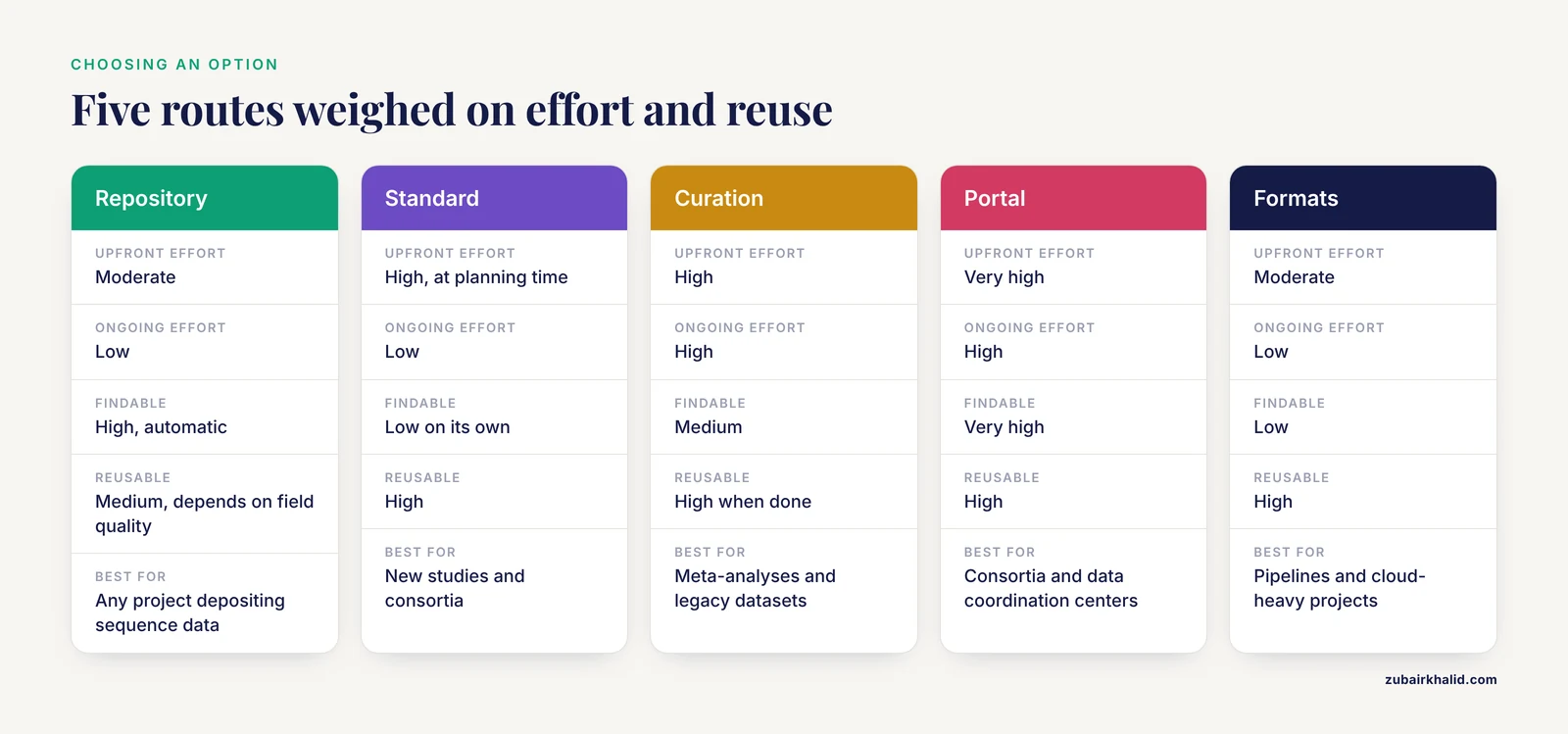
Effort timing
Prospective options concentrate effort before the experiment. Retrospective options concentrate it after publication, when the data volume is larger and the original context is decaying. The harmonization study of 468 repositories exists because prospective standards were not applied to most of those samples, and the authors frame the retrospective path as the dominant mode for published omics data for the foreseeable future [1]. If your project is at the protocol stage, everything in the comparison favors Option 2 plus Option 1. If your data already exist, Options 3 and 4 are the only ones available.
Semantic depth versus structural validity
Repository submission guarantees that required fields exist. Standards decide what the fields mean. Platforms and curation enforce both. The GHGA crosswalk work makes the point cleanly: even among serious human omics metadata models, backward mapping revealed greater heterogeneity than forward mapping, meaning each model covers gaps the others leave open [5]. No single option delivers full semantic coverage, which is why the criteria table shows Interoperable and Reusable peaking only in Options 3 and 4.
Cost profile and sustainability
Portals and curation are ongoing costs, not one-time costs. Portal guidance written by experienced builders is explicit that funding rules and sustained human data wrangling are the deciding factors, alongside technical choices [8]. For an individual lab, that means the honest pros and cons are: repository submission and standards are cheap to sustain, curation is expensive but bounded, and platform building is expensive indefinitely and should not be attempted without a funding model.
Machine readability
An increasing share of metadata consumers are not people. Portals now serve AI algorithms as well as researchers [8], and the geographic NLP benchmark exists because automated extraction from genomics literature needs FAIR-compliant gold-standard training data, which its authors created across 129 studies spanning 46 countries, tripling the geographic representation of existing consortia [3]. If you expect machine consumers, RO-Crate-style packages [7], API-accessible registries,, and standardized formats like SDRF [12] move from nice-to-have to necessary.
A Practical Workflow, Step by Step
The following sequence combines the options in the order that minimizes total effort for a typical new study.
- Write a data management plan before collection. Data management plans, file organization, metadata standards, ontology choice, repository selection, and security planning are the core strategies recommended for FAIR omics data management, with early planning and use of established templates as the practical first steps [13], [14]. Your plan should name the checklist you will use, the repository you will deposit into, and who owns curation.
- Pick the narrowest standard that fits. For amplicon or shotgun metagenomics, a MIxS-derived checklist covers environment and host fields. For human genomics, look at models aligned with EGA-style requirements and validated against MINSEQE coverage [5]. Resist the urge to design a custom schema. Custom schemas are the leading cause of the column sprawl that retrospective curators then spend months collapsing [1].
- Build the sample sheet once, correctly. Capture fields at collection, in controlled vocabularies, in one canonical file. A concrete example of the first rows:
| sample_name | collection_date | host_tax_id | tissue | env_biome |
|---|---|---|---|---|
| PT001 | 2026-03-14 | 9606 | blood | not applicable |
| SO004 | 2026-03-15 | not applicable | not applicable | ENVO soil term |
Note the explicit "not applicable" strings rather than blanks, which prevents the misplaced-value and merged-column errors documented at scale in repository metadata [1].
- Propagate the sheet through the pipeline. Every step that reorders, splits, or renames samples must read and rewrite the metadata, never regenerate it from filenames. Tools that consume standardized metadata, in the way pmultiqc consumes SDRF for QC reporting [12], make this property testable.
- Register and deposit early. Register samples in a metadata registry such as BioSamples [4] and deposit reads with their linked accessions. Deposit early enough that accessions can appear in the manuscript.
- Package analysis outputs with their metadata. Export post-alignment results, workflow versions, and genome annotation versions as RO-Crate data packages so the analysis results and the metadata travel together and can be attached as supplementary material [7].
- Budget curation hours before submission. Estimate a real number of hours for a final metadata pass: typo sweep, terminology normalization, completeness check per column. Publishing metadata that later curators must fix transfers your cost to the field [1], and reviewers and repositories increasingly check for it.
Worked Scenarios
Scenario 1: A single-lab microbiome study
A lab sequences 200 gut samples from a mouse experiment. The right combination is Option 2 plus Option 1 plus a light version of Option 5. Choose a MIxS-derived checklist, capture host, diet, cage, and treatment fields in a controlled sheet at collection, propagate it through the QIIME 2 or nf-core pipeline, and deposit at the Sequence Read Archive with sample attributes matching the sheet. Given that nearly half of evaluated microbiome publications miss minimum data availability standards [2], simply depositing correctly places this lab ahead of the field. A retrospective harmonization effort or a portal is unnecessary at this scale.
Scenario 2: A consortium generating human cancer genomic data
A multi-site consortium with controlled-access human data needs Options 2, 4, and 5. The consortium should adopt a shared schema validated by crosswalk against existing models to know in advance where gaps sit [5], run a data coordination function with named data wranglers per the portal-building guidance [8], and ensure controlled access and licensing are decided in the schema rather than negotiated per request [8]. The retrospective curation literature is the warning here: when consortia skip semantic harmonization, later integrators face the conflicting annotations and dispersed columns documented across 189,438 cancer samples [1].
Scenario 3: Reusing published data for a meta-analysis
A researcher wants to pool published metagenomic and cancer genomic cohorts. The only option is Option 3, retrospective harmonization. The realistic expectation should come from the OmicsMLRepoR effort: ontology mapping consolidates columns and increases completeness, but the process surfaces typos, inconsistent terminologies, and conflicting annotations at every step, and the harmonized resource, once built, becomes a reusable community asset [1]. Budget person-months, not person-days, and publish the harmonized table so the next meta-analyst does not repeat the work.
Common Mistakes and Limitations
- Treating the availability statement as the deposit. In the microbiome evaluation of 2,929 publications, sequence data availability statements proved ineffective as indicators that data could actually be retrieved [2]. The mistake is declaring FAIRness in the manuscript without verifying that the accession resolves and the metadata is complete.
- Confusing populated fields with correct fields. The geographic provenance benchmark showed that 70 percent of cancer genomics studies carried author affiliations unrelated to patient cohorts [3]. A filled field can still be the wrong semantic content, so spot-check fields against their true source of truth, not against whether they are non-empty.
- Designing a bespoke schema. Custom schemas feel easier for one study and guarantee pain for every later integration. The GHGA crosswalk showed that even carefully built human omics models differ substantially in backward mapping [5], so a bespoke schema maximizes the mapping burden.
- Curation without documentation. Harmonization involves judgment calls, such as how to resolve a conflicting annotation or split a merged column. The value of the large harmonization resources comes as much from the documented decisions as from the tables themselves [1]. Undocumented curation is not reusable, which means it fails the FAIR test you were applying.
- Assuming AI can skip the human pass. Automated extraction models help, but the geographic benchmark reported macro-F1 of 55 percent and micro-F1 of 46 percent for patient-origin extraction, exposing precision-recall tradeoffs that require domain adaptation [3], and the ChEMBL effort succeeded by pairing machine extraction with manual review and template-guided annotation [6]. Treat model output as a draft for review.
- Letting metadata detach during processing. Genomics data storage layouts that separate metadata from data produce orphaned files and broken reproducibility [10]. Every pipeline step should carry metadata forward, and formats that bind it natively, in the pattern of the FISH Omics Format [11], are worth adopting when they exist for your modality.
- Underestimating governance for portals. The published portal guidance identifies unsolved problems in interoperability, portal reuse, and long-term stability [8]. Building the portal is the easy part. Sustaining it with funding, wranglers, and testing is what actually keeps metadata FAIR after year two.
One further limitation applies to any human genomics metadata. Controlled-access data carry consent and privacy constraints that shape every option above, from the schema fields you can expose to the repository you can use, and these constraints must be resolved in the data management plan rather than at submission time [13], [14].
Frequently Asked Questions
What does FAIR mean for genomics metadata specifically?
It means your sample and experiment metadata carries persistent identifiers, is retrievable by humans and machines, uses shared vocabularies so studies can be compared, and includes the provenance and license needed for genuine reuse. The principles apply to metadata as strictly as to data, and in genomics the metadata is usually the weaker half.
What is the fastest way to make my sequencing metadata FAIR?
Deposit structured sample metadata through a repository such as BioSamples or the Sequence Read Archive, since this buys Findable and Accessible immediately. Interoperability still requires a standard checklist, so the fast path is one pass with a MIxS-style sheet before submission rather than an after-the-fact cleanup.
Do I need a data management plan to make metadata FAIR?
You do not need a formal document to make metadata FAIR, but you need the decisions a plan contains: the standard, the ontology, the repository, and the curation owner, all chosen before collection. Guidance for FAIR omics data management consistently places early planning and established templates at the top of the practical steps [13].
Which metadata standard should I use?
Use the narrowest community standard that covers your modality, such as a MIxS-derived checklist for sequencing metadata or ISA-Tab for investigation structure, and validate it with a crosswalk against adjacent models so you know the gaps in advance [5]. A standard others already use beats a schema that fits your study perfectly and nothing else.
Can AI tools curate genomics metadata for me?
They can draft it and they cannot finish it. Automated extraction and NLP models reach useful precision on well-defined fields and still need human review for ambiguous cases, which is the pattern that worked for large-scale annotation efforts [6], and extraction benchmarks report accuracy levels well short of unsupervised use [3]. Plan for machine pre-processing plus human adjudication.
How do I handle metadata for controlled-access human genomics data?
Separate the tiers: sample and technical metadata can often be open and FAIR, while clinical and identifiable attributes sit behind controlled access with a documented process for requesting access. Federated infrastructures such as GHGA exist for exactly this reason, pairing a detailed metadata model with secure sharing across institutions [5].
Sources
- Large-scale Manual Curation and Harmonization of Metadata from Metagenomic and Cancer Genomic Repositories: Challenges and Solutions.
- Tier-based standards for FAIR sequence data and metadata sharing in microbiome research.
- A FAIR gold-standard benchmark for geographic entity recognition in cancer genomics literature for biomedical NLP.
- BioSamples database: the global hub for sample metadata and multi-omics integration.
- Semantic alignment of the German Human Genome-Phenome Archive metadata model in Europe's genomics field.
- Integrating artificial intelligence and manual curation to enhance bioassay annotations in ChEMBL.
- bMINTY: enabling reproducible management of high-throughput sequencing analysis results and their metadata.
- Making genomic data FAIR through effective Data Portals.
- VirJenDB: a FAIR (meta)data and bioinformatics platform for all viruses.
- Pithos - a scalable and secure data container for FAIR-compliant research data management in life sciences.
- FAIR sharing of Chromatin Tracing datasets using the newly developed 4DN FISH Omics Format.
- pmultiqc: An Open-Source, Lightweight, and Metadata-Oriented QC Reporting Library for MS Proteomics.
- Accelerating environmental health sciences through data and metadata standards to support FAIR principles.
- FAIR Omics Data Management: Overview, Challenges, and Best Practices.