Bioinformatics Tutorials on Coursera vs. edX
By Dr. Zubair Khalid, DVM, MS, PhD ·
Coursera delivers most of its bioinformatics training through subscription-based, multi-course specializations that end in a graded capstone project, while edX spreads its catalog across individually auditable university courses and stacked program certificates. The rule of thumb follows directly from that structure. Choose Coursera when you want a guided sequence that walks you through projects in a fixed order, and choose edX when you want to sample rigorous university material for free and pay only for the courses that truly matter to you.
This guide compares bioinformatics tutorials on Coursera vs. edX on the factors that actually change decisions: how courses are structured, where you write code, how you are assessed, what certificates signal to employers, and how each payment model behaves over weeks and months. The audience includes students, wet-lab researchers, clinicians curious about genomics, career changers, and instructors assembling teaching modules. No platform wins outright, because both host excellent and mediocre material, and the instructor behind a course matters more than the logo on its landing page.
The Short Answer: Coursera vs edX Bioinformatics at a Glance
Both sites are massive open online course (MOOC) platforms, meaning they deliver university-style classes over the web to large enrollments, with video lectures, auto-graded quizzes, and discussion forums. Both let you audit many courses (watch the lectures and read the materials without paying). Both sell certificates. The difference between Coursera and edX bioinformatics training is therefore mostly structural rather than topical, and structure changes how you study more than most learners expect. Content overlap is high, since both platforms host genomics, sequencing-analysis, and Python-or-R-for-biology courses, so the catalog rarely decides the choice. Structure does.
| Decision factor | Coursera | edX |
|---|---|---|
| Typical bioinformatics format | Multi-course specializations ending in a capstone, plus short guided projects | Standalone university courses, plus bundled program tracks |
| Signature content style | Algorithmic problem-solving and genomic data science sequences | Statistics-heavy genomics series taught in R, plus rotating topic courses |
| Free access | Audit many courses, videos and readings only, graded work usually locked | Audit with a time-limited window that varies by course |
| Paid credential | Course and specialization certificates, subscription billing | Verified certificates per course, program certificates sold as bundles |
| Hands-on work | Browser-based guided projects, notebook assignments, peer-reviewed projects | Embedded notebooks, autograded code checks, homework on real datasets |
| Pacing | Soft, resettable deadlines, subscription rewards momentum | Self-paced, audit clock rewards quick sampling |
| Best fit | Learners who want a guided path with a defined finish line | Learners who want to sample first and pay selectively |
Three takeaways fall out of the table:
- If you stall without deadlines and a fixed order, Coursera's specialization scaffolding gives you a spine.
- If you prefer to browse, audit, and cherry-pick, edX's modular catalog respects that style.
- Whichever platform you pick, plan to practice outside it, because production bioinformatics lives on the command line and on servers, not inside a browser sandbox.
What a Bioinformatics Course Should Actually Teach You
Bioinformatics blends biology, statistics, computer science, and information technology to process and analyze genomic data, and demand for people who combine those skills keeps growing [1]. A good introductory bioinformatics course, on either platform, moves you down a predictable skill ladder rather than teaching isolated tricks.
- Sequence data formats. Most courses start with FASTQ, the standard text format that stores each read (a short fragment of DNA or RNA produced by a sequencing instrument) together with a quality score for every base. A FASTQ record occupies exactly four lines, which is why a classic shell trick counts the lines of a file and divides by four to get the read count.
- Quality control. Filtering and trimming poor-quality reads before they poison everything downstream.
- Alignment and quantification. Mapping reads to a reference genome (alignment), then counting genes per sample or calling variants (positions where a sample differs from the reference). Sequence similarity searches, for example with BLAST (the Basic Local Alignment Search Tool), usually appear here too.
- Statistics. Normalization, testing for differential expression or abundance, and correction for multiple comparisons.
- Scripting. Enough Python or R to chain steps, plot results, and stop copying and pasting by hand.
- Reproducibility. Notebooks, version control, and documented software versions, so that someone else (or you, six months later) can rerun the analysis and get your numbers.
Tool fluency spans the command line, a scripting language, and at least one browser-based system such as Galaxy, an open, point-and-click environment for building analysis pipelines without installing anything.
The same ladder scales across application domains. In environmental biotechnology, researchers combine genomics, computational tools, and artificial intelligence to study metagenomes (sequencing readouts of mixed microbial communities sampled directly from soil, water, or tissue) and environmental DNA, connecting them to pollutant degradation, biodiversity, and ecosystem monitoring [2]. A course that teaches only one niche tool leaves you fragile. A course that teaches the ladder lets you switch domains.
Access matters as much as curriculum. Many institutions still struggle to teach bioinformatics because of technical setup problems and scarce instructor expertise, which is why web-accessible platforms and browser-based analysis services have become the standard workaround in classrooms [1]. Both MOOC platforms inherit that advantage. You open a browser and start, with no server to configure.
Coursera for Bioinformatics: Strengths and Frictions
Coursera launched in 2012 out of Stanford and organizes content into shapes that matter here: single courses, Specializations (a branded bundle of several courses that ends with a hands-on capstone project), Guided Projects (short, single-session exercises in a preconfigured browser workspace, with the instructor on one side of the screen and a live tool on the other), and Professional Certificates (career-oriented course stacks, rarely bioinformatics-specific).
The bioinformatics catalog has been anchored for years by two well-known university sequences. A UC San Diego specialization teaches bioinformatics as algorithmic problem solving, with learners implementing genome assembly and read-matching logic piece by piece. A Johns Hopkins sequence tours genomic data science across command-line tools, R, Python, statistics, and a capstone. Around them sit dozens of single courses on RNA-seq (sequencing a sample's RNA to quantify gene expression), Python for biological data, and adjacent topics.
Mechanics worth knowing before you enroll:
- Most courses can be audited free, but graded assignments and the certificate stay locked.
- Specializations are usually billed as a monthly subscription, so a fast learner pays less than a slow one for identical content, and an all-access subscription exists for learners who plan to roam across topics.
- Deadlines are soft and resettable, which accommodates real life.
- Some assignments are peer-graded, meaning fellow learners score your submitted work against a rubric, which introduces variable quality.
- Financial aid applications exist for individual courses.
Strengths: forced sequencing builds foundations in order, capstones produce portfolio artifacts, guided projects let you taste a tool in one sitting, and the deadline system keeps drifting learners moving.
Frictions: subscription pricing punishes pauses, quality varies noticeably between courses inside one specialization, peer grading is inconsistent, and the audit tier excludes exactly the graded work where much of the learning happens.
edX for Bioinformatics: Strengths and Frictions
edX was founded by MIT and Harvard, also in 2012, and runs on Open edX, an open-source platform that many universities and training programs also host on their own servers. Its content shapes are single courses, Professional Certificates, XSeries (a themed bundle of courses within one discipline), and MicroMasters (graduate-level course sequences that some universities let you apply toward a campus master's degree).
For bioinformatics, the standout has long been the Harvard-hosted data analysis for the life sciences series, which teaches the statistics underneath genomics, including high-dimensional data (thousands of measured features per sample) and RNA-seq style analyses, all in R with executable notebooks embedded in the course pages. Individual courses on sequence analysis, Python-based workflows, and neighboring quantitative topics rotate through the catalog.
Mechanics worth knowing:
- The audit track is free but usually time-limited, with access expiring after a window that varies by course, so auditing rewards decisive sampling.
- Upgrading unlocks graded assignments and a verified certificate.
- Program tracks are priced as bundles.
- Fee assistance is available for learners who qualify.
Strengths: free auditing makes browsing nearly costless, notebook-based teaching mirrors how working analysts actually write code, and the quantitative depth of the flagship statistics content is a genuine differentiator.
Frictions: audit clocks create low-grade urgency, fewer forced projects mean you must design your own practice, there is no single branded bioinformatics program to follow, and you assemble your own curriculum whether you want to or not.
The Difference Between Coursera and edX Bioinformatics Training, Criterion by Criterion
Homepages advertise features. These criteria decide real choices.
Learning path structure
Coursera hands you a staircase. A specialization sequences foundations, methods, and a capstone, which protects beginners from skipping the boring-but-necessary parts. edX hands you a buffet. You can assemble the same staircase from standalone courses, but nothing stops you from enrolling in an advanced genomics course while lacking basic shell skills. If you already know precisely what you need, the buffet wins. If you do not know what you do not know, the staircase wins.
Hands-on practice environment
Both platforms teach analysis through code, but the settings differ. Coursera leans on guided projects and notebook assignments inside managed workspaces, plus peer-reviewed projects in some courses. edX leans on embedded notebooks and autograded code checks, a format that suits statistics-heavy material. Neither environment reproduces production conditions. Working bioinformaticians run pipelines on Unix servers, often through a workflow manager (software that chains analysis steps into repeatable jobs), with software versions pinned deliberately. Treat the platform sandbox as a flight simulator, then graduate to a laptop install, an institutional server, or a modest cloud instance. Browser-based research systems such as Galaxy and the Bacterial and Viral Bioinformatics Resource Center (BV-BRC), a web-accessible analysis center funded by the U.S. National Institute of Allergy and Infectious Diseases (NIAID), form a legitimate middle ground for many read-processing tasks [1].
Assessment and feedback
Auto-graded quizzes and code tests dominate on both platforms. Coursera adds peer review, which sometimes produces useful critique and sometimes produces rubber-stamp scores. edX courses tend to grade code correctness directly. On both platforms, forums are the main feedback channel, and their usefulness depends on how active course staff are, which varies widely. Neither platform offers mentorship, expert code review, or office hours in any traditional sense.
Credentials and what they signal
Coursera issues course certificates and specialization certificates. edX issues verified certificates and program certificates. Both display cleanly on professional profiles. Hiring managers in computational biology read them as evidence of exposure and persistence, not competence. Competence is demonstrated by a repository of analyses others can rerun, a short write-up of a dataset you explored end to end, or contributions to an open tool. Enroll with one of those artifacts as the goal, not the PDF.
Payment mechanics, without the sticker numbers
Coursera's subscription means the effective cost of a specialization falls the faster you finish, and the all-access tier makes sense for serial learners. edX's per-course upgrade means cost tracks how many courses you actually certify, which favors selective learners. Both offer financial assistance routes. Before paying on either platform, confirm precisely what the audit version includes, because discovering mid-course that the graded project is locked is a preventable frustration.
Content freshness and tool drift
Bioinformatics moves faster than course catalogs. Reference genomes get revised, package interfaces change, and a notebook written three years ago can fail on current software. On both platforms, read recent learner reviews, check whether the syllabus names specific tool versions, and prefer recently refreshed courses for tool-centric topics. Concept-heavy courses, such as statistics and algorithms, age gracefully. Tool-demo courses age badly.
When to Use Coursera, and When edX Fits Better
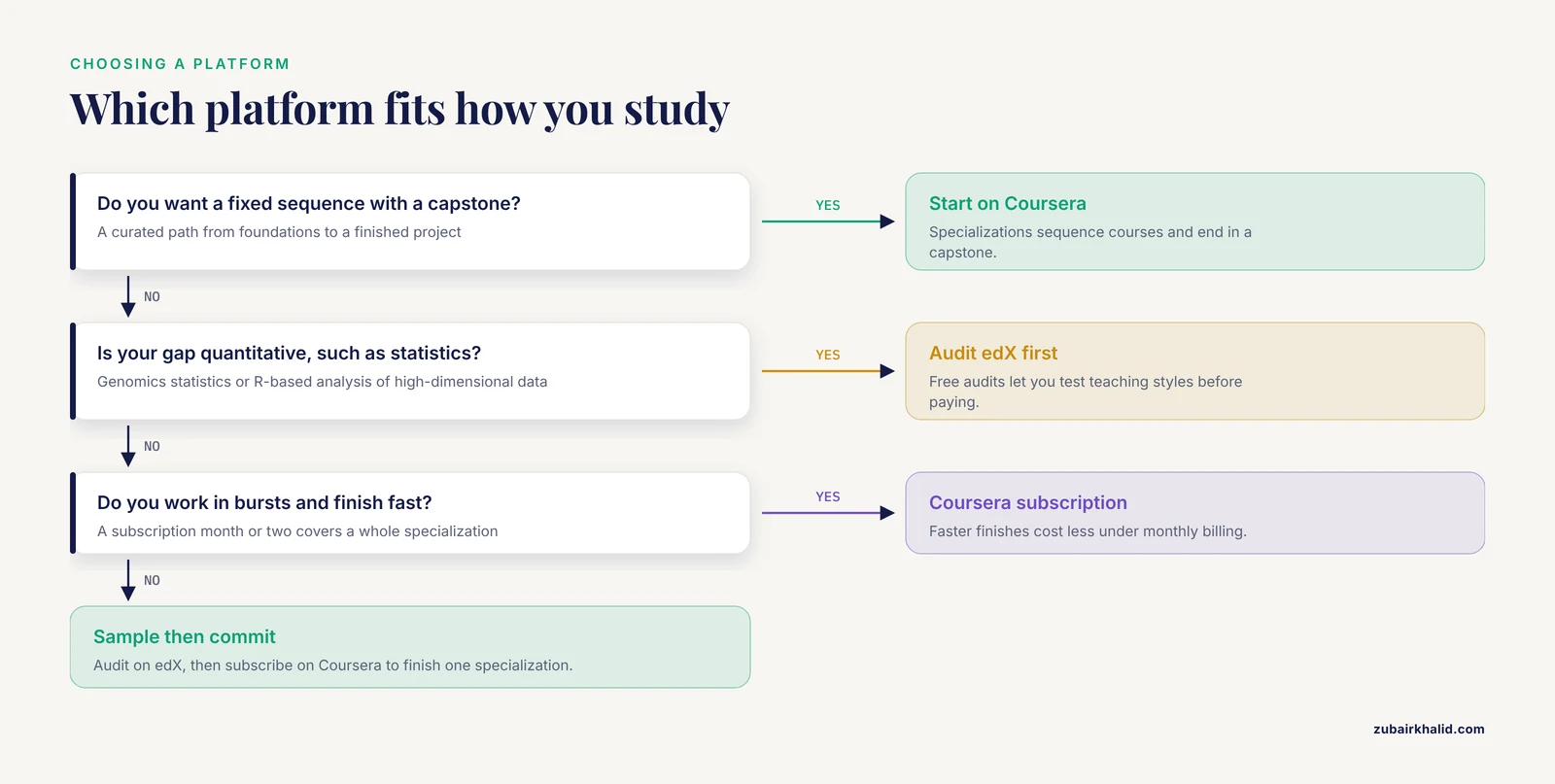
Reach for Coursera when:
- you want a curated path from zero to a finished capstone without designing your own curriculum,
- you work in bursts and can plausibly finish a specialization within a subscription month or two,
- you value short guided projects as a cheap way to test a tool before committing,
- you want one recognizable certificate chain to anchor a resume for a first bioinformatics-adjacent role.
Reach for edX when:
- you want to audit several university courses before spending anything,
- your gap is quantitative, for example statistics for genomics or R-based analysis of high-dimensional data,
- you prefer buying a few verified certificates for targeted courses over maintaining a subscription,
- you want transferable familiarity with the Open edX platform, which many institutional training programs run internally.
Worked Scenarios
A wet-lab microbiologist with her own sequencing data
She can run the assays, including 16S rRNA amplicon sequencing (PCR profiling of a marker gene to inventory bacterial communities), but has never written a script. A sensible plan: audit an introductory edX course to absorb vocabulary and the statistical mindset, spend one evening on a Coursera guided project to taste R or Galaxy, then buy one applied specialization whose capstone resembles her data. In parallel, she should practice on public data instead of waiting for her own samples. Published teaching exercises show how far browser tools now go. One undergraduate activity walked students through taxonomic classification and metagenomic read mapping for six publicly available animal-gut metagenomes, entirely inside the BV-BRC web services, with no local installation [1]. That workflow is a realistic template for a first independent analysis.
A software developer moving into genomics
He already codes, so his gaps are domain knowledge and biological statistics. The Coursera algorithm-centered specialization will feel like home, framing genome assembly and alignment as graph and dynamic-programming problems, and it explains why the tools he will later run behave the way they do. Pair it with the edX statistics series in R, because the hardest part of genomics for engineers is usually inference under messy, high-dimensional assumptions rather than syntax. His capstone and notebooks become the portfolio.
An instructor assembling a teaching module
Her constraints are classroom hours and unreliable student laptops. She can lift lecture segments from either platform as pre-class material and reserve contact time for analysis. Browser-based exercises sidestep installation chaos, and the BV-BRC antimicrobial-resistance activity mentioned above was designed for exactly this setting, pairing public data with point-and-click services in general microbiology and genomics classes [1]. Either MOOC can supply the lecture layer while the hands-on layer runs on free public tools.
A career changer who needs proof of skill
She has a biology degree, bench years, and wants employers to take the transition seriously. One completed specialization or program certificate helps, but the stronger signal is a capstone published as code with a readable README and a short results write-up. She should also plug into the professional community, because the field treats training as sustained capacity building. The Romanian Society of Bioinformatics, founded in 2019, grew from a loose professional network into organized national training efforts and a drive toward a national bioinformatics infrastructure, a trajectory that shows how careers in this field advance through communities and shared resources rather than isolated coursework [3].
Where a Bioinformatics Course Can Take You
Supervised machine learning (models trained on labeled examples to predict a category or a value) now appears routinely in microbiome and genomics research, and tree-based models are the usual entry point because they are interpretable. A recent food-microbiology study shows the pattern. Researchers profiled fungal communities from 872 table olive samples using metataxonomic data (marker-gene profiles of a microbial community) and trained three tree-based classifiers: Classification and Regression Trees (CART, a single decision tree), Random Forest (RF, a voting committee of decision trees), and Extreme Gradient Boosting (XGB, trees added sequentially to correct earlier errors). Random Forest performed best, with overall accuracy above 75 percent and a kappa coefficient (an agreement measure corrected for chance) above 0.65, and the country-of-origin model reached 89 percent accuracy with a kappa of 0.86 while flagging the fungal genera that drove each classification [4]. A learner who finishes an introductory bioinformatics course plus a beginning machine-learning module can reproduce exactly this style of analysis on public data.
The same toolkit opens doors across hiring domains. Environmental biotechnology applies these methods to bioremediation planning, biodiversity monitoring, and predictive modeling of microbial behavior in contaminated environments, while still wrestling with large-scale data management and the demand for user-friendly platforms [2]. Food microbiology, clinical microbiology, agriculture, and biopharma all run on the same core ladder taught in introductory courses.
Treat a certificate as a door opener, not a destination. National capacity-building efforts point the same direction. The Romanian society's evolution toward a national bioinformatics cluster aligned with ELIXIR, the European infrastructure for life-science data, reflects where the field invests: shared training, shared tools, and community standards [3]. Local meetups, society workshops, and open-source contributions compound faster than additional course purchases once you have finished your first two or three courses.
Common Mix-Ups When Comparing the Two Platforms
- Judging a platform by its worst course. Quality varies by instructor and university far more than by platform. A weak course on edX and a weak course on Coursera are equally weak.
- Equating the certificate with the skill. Both platforms sell records of completion. Neither certifies that you can debug a failed alignment run the night before a deadline.
- Assuming free means complete. Coursera audits usually lock graded work, and edX audits usually expire. The free tier exists for evaluation, not mastery.
- Matching the course to the wrong career stage. Beginners need the ladder. Experienced programmers need domain statistics. Buying the opposite is how courses go unfinished.
- Confusing bioinformatics with computational biology. Bioinformatics centers on processing and analyzing biological data with computational tools. Computational biology leans harder on modeling biological systems. Course titles blur the two, so read syllabi instead.
- Treating tool demos as durable skills. Interfaces change. Concepts such as alignment, normalization, and multiple-testing correction survive version updates.
How to Evaluate Any Bioinformatics Course Before You Enroll
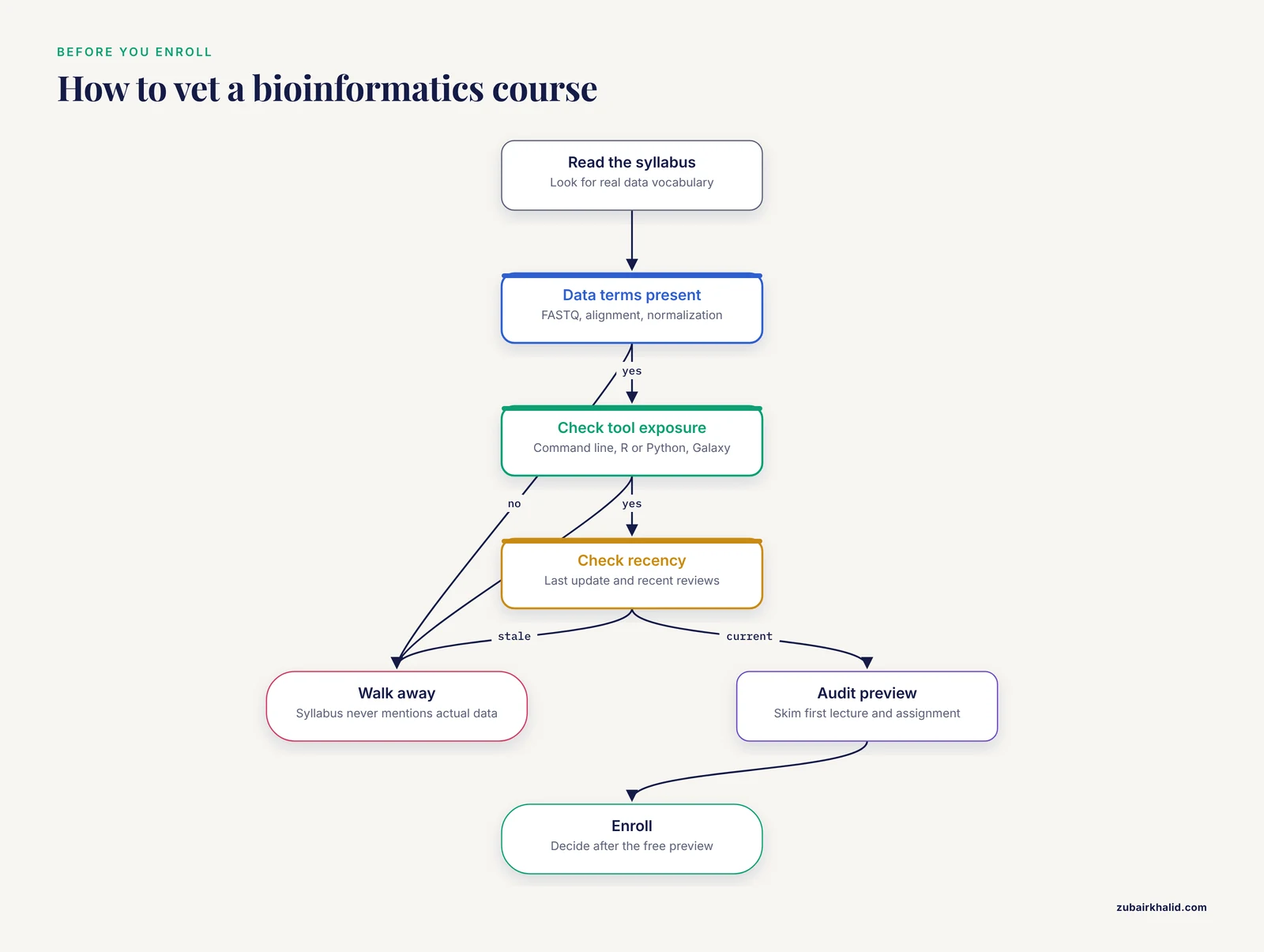
Run this checklist against any candidate on either platform.
- Syllabus vocabulary. Look for FASTQ, quality control, alignment, quantification or variant calling, normalization, and reproducibility. If the syllabus never mentions actual data, walk away.
- Tool exposure. Does it touch the command line, R or Python, and at least one browser-based system such as Galaxy?
- Real datasets. Courses built on public data produce transferable skills. Toy datasets produce illusions.
- Graded code. Autograded programming assignments beat multiple-choice-only assessment.
- Recency. Check the last content update and recent reviews for complaints about broken notebooks or outdated packages.
- Workload honesty. Multiply the stated weekly hours by the number of weeks, then add margin if you are new to programming.
- Stated prerequisites. A credible course lists them plainly.
- Instructor activity. Search the instructor's recent work. Active researchers keep material current.
- Audit preview. Start free, skim the first lecture and the first assignment, then decide.
- Exit artifact. Ask what you will own at the end: a certificate, a project, or both.
Common Mistakes and Limitations
- Paying before auditing. Ten minutes of preview prevents weeks of regret.
- Skipping the shell. Point-and-click comfort collapses the first time a tutorial says "open a terminal."
- Collecting certificates instead of building a portfolio. Three finished certificates and zero public analyses convince nobody in computational biology.
- Trusting forum answers blindly. Verify against official tool documentation, because forum threads age as badly as course notebooks.
- Underestimating compute. Modern datasets overwhelm ordinary laptops. Learn early how to work on an institutional server or a modest cloud instance.
- Watching without typing. Passive viewing feels productive and teaches little. Every hour of video deserves an hour of keystrokes.
MOOCs also carry structural limits no platform has solved. They provide little personalized mentorship, no laboratory context, and no supervision for real-world stakes. Analyses that will inform clinical decisions, regulatory submissions, or peer-reviewed publication need qualified specialist oversight that no self-paced course can supply. Catalogs shift and courses retire, so a specialization you bookmarked this semester may look different next year. Peer-graded feedback varies in quality, so treat it as one opinion rather than an assessment.
Frequently Asked Questions
Coursera or edX bioinformatics for a complete beginner?
edX is the safer first move, because free audits let you test two or three teaching styles before spending anything. Coursera becomes the better pick the moment you want a fixed, guided sequence with deadlines and a capstone. A common pattern is to audit on edX first, then subscribe on Coursera to finish one specialization properly.
Can I learn bioinformatics for free on either platform?
Yes, substantially. Both platforms allow free auditing of many courses, covering lectures and readings. The free tiers limit what matters most, namely graded assignments and certificates, and edX audits typically expire after a course-specific window. Free hands-on practice also exists outside MOOCs, through browser-based research platforms and public datasets.
Do Coursera or edX certificates help in hiring?
Modestly. They signal initiative, structured study, and exposure to standard methods, which helps at the screening stage. They do not substitute for demonstrated analyses. A public repository with two or three well-documented projects outweighs any stack of certificates in computational biology hiring.
Do I need to know Python or R before starting a bioinformatics course?
No for most introductory courses, which teach the language basics they require, but prior scripting makes everything faster. If you have never coded, spend a week on fundamentals first. If you already write code in one language, start bioinformatics immediately and pick up the second language on demand.
Which platform gives better hands-on practice with real sequencing data?
Neither dominates. Coursera offers guided projects and capstones in managed workspaces, while edX embeds executable notebooks directly in lessons, a format that suits statistics-heavy genomics. The decisive factor is the individual course, not the platform, and the best practice eventually happens outside both, on your own machine or a server with public datasets.
Can a Coursera or edX bioinformatics course replace a degree?
No. A degree provides depth, mentorship, and credentials that open formal research doors. A strong course or specialization can pivot a career, qualify you for analyst-adjacent tasks, and tell you cheaply whether graduate study in the field suits you. Treat these courses as accelerators and filters, not replacements.
Sources
- Exploring antimicrobial resistance in wild and domestic animal populations: combining publicly available data with BV-BRC resources to introduce bioinformatics in an undergraduate classroom.
- Integrative Bioinformatics Approaches in Environmental Biotechnology: A Review.
- From the establishment of a national bioinformatics society to the development of a national bioinformatics infrastructure.
- Unraveling fungal community biodiversity in table olives through tree-based machine learning classification.