The Role of Community Trust in Bioinformatics Tool Selection
By Dr. Zubair Khalid, DVM, MS, PhD ·

When a lab adopts a bioinformatics tool the community swears by and the results still look wrong, the most common cause is a benchmark mismatch. The reputation behind the tool was built on data that does not resemble your data, on versions that no longer exist, or on metrics that reward something other than what your project needs. The first thing to check is simple: find at least one independent benchmark that evaluated the tool on input similar to yours, and if you cannot find one, treat the tool's reputation as unverified rather than earned.
This article explains the role of community trust in bioinformatics tool selection, why that trust breaks down, how to diagnose a trust failure, and how to fix and prevent it. The guidance applies whether you are choosing a variant caller, a metagenomic classifier, a drug-resistance predictor, or the best bioinformatics software for a new pipeline.
What Community Trust Actually Does in Tool Selection
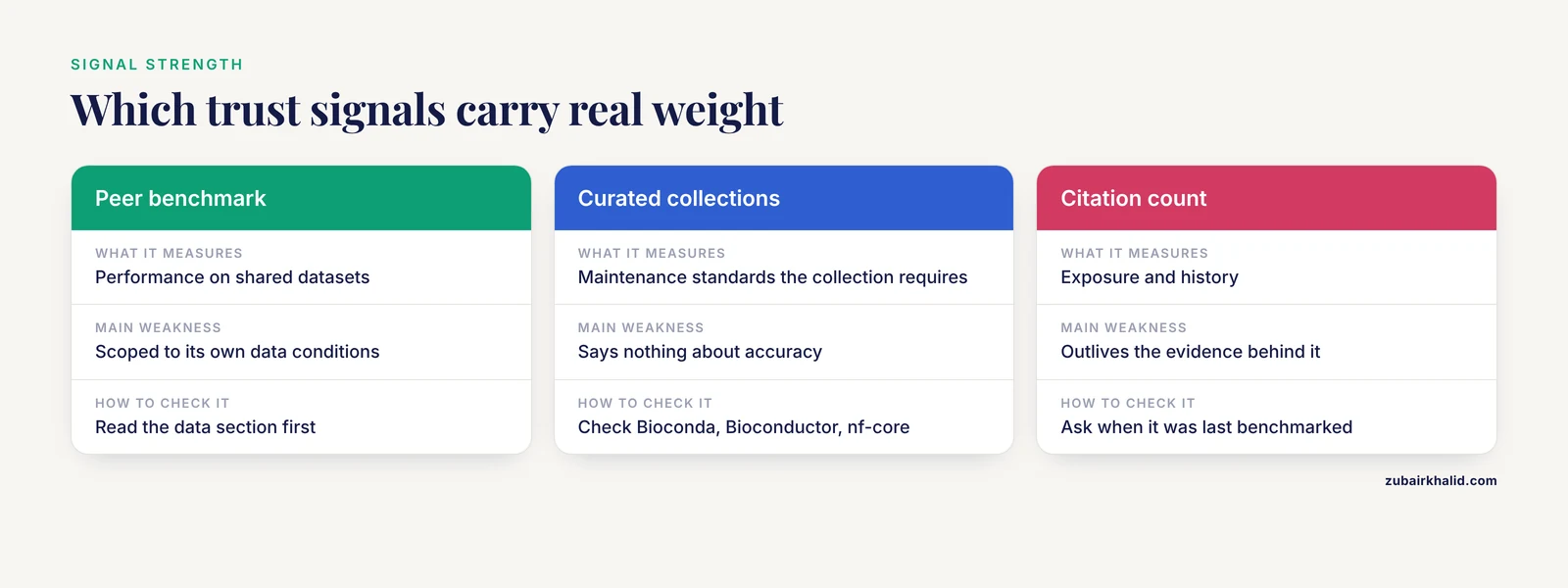
Community trust is the set of beliefs a field holds about which tools work, which tools are maintained, and which tools are safe to build a thesis or a clinical report on. Nobody can personally benchmark every aligner, assembler, caller, and classifier. Trust fills that gap. A researcher inherits the field's accumulated judgment instead of re-deriving it, which is exactly how a healthy division of labor should work.
Trust in bioinformatics tools is built from a handful of recognizable signals:
- Peer-reviewed benchmark papers and meta-analyses that compare tools on shared datasets
- Citation counts and how consistently a tool appears in the methods sections of published studies
- Packaging and curation, such as availability through Bioconda, Bioconductor, the Galaxy ToolShed, or inclusion in an nf-core pipeline
- Issue tracker activity, release cadence, and documentation quality on the code repository
- Forum reputation on Biostars, SEQanswers, and similar community sites
- Lab lineage, meaning the track record of the group that develops and maintains the tool
Each signal carries different weight. A peer-reviewed benchmark that includes your data type is the strongest signal. Citation count is the weakest, because citations measure exposure far more than they measure performance. Yet citation count is the signal most researchers check first, and that asymmetry explains most trust failures in tool selection.
Community trust also acts as a quality filter over time. Tools with poor documentation, silent bugs, or unresponsive maintainers accumulate complaints, lose users, and drop out of curated collections. Tools that survive a decade of use have usually survived contact with thousands of datasets. That survivorship is real evidence. The problem is not that community trust exists. The problem is that the signals get misread, and the next section covers where the misreading starts.
Why Tools Lose Community Trust
Tools lose trust through several distinct mechanisms, and knowing the mechanism tells you whether the loss of trust is a warning you should follow or noise you should discount.
Abandonment. A tool works for its author's dataset, gets published, and then stops receiving updates as the author moves on. Sequencing formats change, reference genomes get revised, and the tool drifts out of alignment with current practice. Abandonment is visible in the repository: the last commit predates the current reference genome release.
Database rot. Tools that classify sequences or annotate variants depend on the databases behind them, and the database determines much of what the tool can and cannot see. A study of databases used to assess metagenomic tool reliability showed that tools derive their reliability from the databases they use, and that evaluations performed within specific datasets make it difficult to compare tools directly with state-of-the-art alternatives across a broader range of data [1]. A tool can lose real-world accuracy without a single change to its code, purely because its reference data fell behind.
Benchmark retraction or contradiction. A newer, larger benchmark contradicts the one that made the tool famous. The community updates slowly, so both the old and new reputations circulate at the same time, often in the same methods section of different papers.
Reproducibility failures. A tool gives different answers on identical input across runs, versions, or operating systems. Users who hit this share it in forums, and confidence erodes faster than any benchmark can rebuild it.
Overpromising documentation. A tool claims capabilities its algorithms cannot deliver, users discover the gap on real data, and the gap becomes common knowledge. Trust rarely recovers to the level suggested by the original publication, even after the code improves.
The Most Common Trust Failures, From Frequent to Rare
The causes of misplaced community trust in bioinformatics tools follow a predictable ranking. Work down this list when a trusted tool misbehaves, because the frequent causes are cheap to check and the rare ones are expensive.
Popularity bias and citation inertia
This is the most common cause by a wide margin. A tool becomes popular, popularity attracts citations, and citations attract more popularity regardless of whether newer and better tools exist. The mechanism is preferential attachment. Reviewers recognize the tool name, methods sections copy prior methods sections, and the community's shared memory outlives the evidence that built it. A tool published in 2010 with 5,000 citations competes against a better tool published in 2024 with 40 citations, and the 2010 tool wins the methods section every time.
You can confirm this failure by asking one question: when did an independent benchmark last compare this tool against its current competitors on modern data? If the answer is never, or more than a few years ago, the citation count is measuring history rather than performance.
Benchmark dataset mismatch
The second most common cause is trusting benchmark results that were generated on data unlike yours. Benchmarks are snapshots on particular genomes, particular read lengths, particular abundance distributions, and particular truth sets. A tool that wins on short-read bacterial isolates can lose on long-read metagenomes. A tool tuned on diploid tumor samples can misbehave on hyper-diploid ones.
The benchmark-evaluation problem compounds this. Because evaluations tend to happen within specific datasets, results do not transfer cleanly, and researchers selecting tools inherit conclusions scoped to conditions they may not share. Before trusting a benchmark, read its data section before its results section. Ask what organism, what sequencing platform, what read depth, what sample complexity, and what ground truth. If any of those differ from your project in a way that matters, the benchmark's ranking is a hypothesis for your data, not a verdict.
Accuracy reported without reliability
Accuracy and reliability are different properties, and communities routinely trust the first while assuming the second. Accuracy is the proportion of correct outputs. Reliability is the consistency of those outputs across repeated runs, users, or versions.
This distinction is documented repeatedly across tool evaluation studies, including outside bioinformatics. In an evaluation of large language models on standardized psychiatry questions, each model answered the same 150 questions 10 times so that accuracy could be separated from answer consistency, because a model that is right on average but inconsistent across identical queries cannot be trusted the way a consistently right model can [2]. A physiology-focused evaluation of six large language models went further, having three independent users query each model simultaneously and averaging accuracy across users to separate model behavior from user-to-user variation [3]. In the AI-generated text detection field, a review of 34 studies found that most detectors achieved accuracy above 50 percent yet remained unreliable, with paid tools generally outperforming free ones, documented bias against non-native English speakers, and failure under paraphrasing tricks, leading the authors to conclude that users should not rely completely on these tools [4].
The lesson for bioinformatics tool selection is direct. When you evaluate a tool, run it more than once on the same input, ideally with different random seeds if the tool is stochastic, and check whether the outputs agree. A tool that flips calls between runs is unreliable no matter what its average accuracy says, and a community that has only measured average accuracy has not measured the property your pipeline depends on.
Single-metric evaluation
A third failure mode is trusting a tool because one number looks impressive. Diagnostic-style tool evaluations commonly report sensitivity, specificity, area under the receiver operating characteristic curve, and related measures, and each of those numbers answers a different question. A network meta-analysis of nine bioinformatics tools for predicting Mycobacterium tuberculosis drug resistance, drawing on 33 studies covering 14 anti-tuberculosis drugs, found that TBProfiler, TGS-TB, Mykrobe, PhyResSE, and SAM-TB all showed satisfactory performance, and that TBProfiler led on most drugs, with an area under the curve of 0.99 for rifampicin and 0.97 for isoniazid [5]. Those are strong numbers. But the same analysis reported superiority index values with very wide confidence intervals, for example an isoniazid superiority index of 3.39 with a 95 percent confidence interval of 0.20 to 11.00 [5]. A point estimate that impressive, with an interval that wide, describes uncertainty the headline number hides.
The mechanism matters for selection. A tool with high sensitivity at a permissive threshold and a tool with high specificity at a strict threshold can both post strong area under the curve values while answering opposite operational questions. Communities that trust a single reported metric end up with tools whose thresholds were tuned for someone else's false-positive tolerance.
Ignoring input complexity
Some failures of trust trace to the data, not the tool. A benchmark evaluation of copy number variation detection benchmarked six commonly used callers on a challenging hyper-diploid cancer genome, comparing results against orthogonal methods such as microarray and Bionano. The study found consistent results for copy gain, loss, and loss of heterozygosity across sequencing centers, callers, and technologies, but also found that variation in copy number calls was driven mostly by the determination of genome ploidy, and that some tools called excessive gain or loss on the hyper-diploid genome because of inaccurate ploidy assessment [6]. A lab that trusted any one of those callers on hyper-diploid input would have blamed the tool when the real problem was a data characteristic no caller handled well.
This cause is rarer than popularity bias but more damaging, because it produces confident wrong answers in exactly the samples that matter most.
Overlooking disparity between methods and instances
A subtler cause appears when a community treats all instances of a method as interchangeable. Research on membership inference attacks as privacy evaluation tools showed significant disparities both between distinct attack methods and between multiple instantiations of the same method, and proposed an ensemble framework with three strategies to combine the strengths of leading methods while accounting for those disparities [7]. Translated to tool selection generally, the finding warns that two implementations of the same nominal approach can behave differently enough that treating them as equivalent corrupts both benchmarks and user expectations.
Software supply-chain neglect
The rarest cause in daily practice, but the most consequential when it strikes, is trusting the tool while ignoring its supply chain. An evaluation of Software Bill of Materials creation tools across Python, C, Rust, and TypeScript projects checked outputs against National Telecommunications and Information Administration minimum elements and found that no tool fulfilled every requirement, so no tool could be recommended without reservation [8]. The parallel for bioinformatics is clear. A tool you trust for its algorithm can still fail you through an unpinned dependency, an abandoned library, or a container image someone rebuilt with different contents. Community trust in the visible layer of a tool says nothing about the layers underneath it.
AI-mediated recommendations
The newest trust failure arrives through large language models that recommend tools. Evaluations comparing chatbot answers against guideline documents found that outputs required verification against the authoritative source before use, and that completeness and accuracy of the responses varied [9]. A chatbot that confidently names a tool is relaying the same popularity-weighted community memory described above, compressed through a model with no guarantee of currency. Treat AI recommendations as a starting point for a literature search, never as the endpoint of tool selection.
Troubleshooting Table: Trust Signals That Conflict
The core diagnostic problems in tool selection look like contradictions between trust signals. Work each row from symptom to fix.
| Symptom | Likely cause | How to confirm | Fix |
|---|---|---|---|
| The tool has thousands of citations but results look wrong on your data | Popularity lag, reputation built on old data or old versions | Search for a benchmark from the last few years comparing it against current alternatives | Benchmark the tool against 1 to 2 current alternatives on a subset of your data before committing |
| A benchmark paper says tool A beats tool B, but your lab's experience says the opposite | Benchmark dataset mismatch between the paper's data and yours | Compare organism, platform, read length, depth, and ground truth between the benchmark and your data | Rerun both tools on an in-house subset with a truth set you trust |
| A new tool with almost no citations gives dramatically better results | Too-good-to-be-true result, possibly a bug, data leakage, or an accidental truth-set overlap | Re-run on data the tool developers never touched, with an independent truth set | Hold adoption until an independent replication exists, but record the result and share it |
| Outputs change between runs or between versions on identical input | Version drift or stochastic behavior the documentation does not disclose | Run the same input three times under pinned conditions and diff the outputs | Pin the exact version and container digest, and report versions in every methods section |
| Two high-quality benchmark papers disagree about the same tools | Different metrics, datasets, or parameterizations | Check whether both papers used the same truth sets and the same evaluation metric | Define the single metric that matches your operational goal, then re-read both papers against it |
| Forum answers contradict the official documentation | Stale forum posts about older versions, or undocumented behavior changes | Check post dates against the tool's release history and issue tracker | Ask a new question including your exact version, and check open and closed issues for the behavior |
| A web server tool goes offline mid-project | Single point of failure, common with grant-funded services | Check whether a container or source code is available for local installation | Containerize the tool or mirror an equivalent local install before the next project starts |
| High reported sensitivity, but false positives flood your pipeline | Specificity at your sample prevalence differs from the benchmark's | Compute positive predictive value directly on your own data | Adjust thresholds, or combine tools into a consensus call as large CNV studies do [6] |
| A chatbot or AI assistant recommended the tool | Popularity-weighted training data, no currency guarantee | Search for the tool in recent benchmark literature and curated collections | Verify against the developer's documentation and primary literature before adoption [9] |
A Diagnostic Sequence You Can Follow
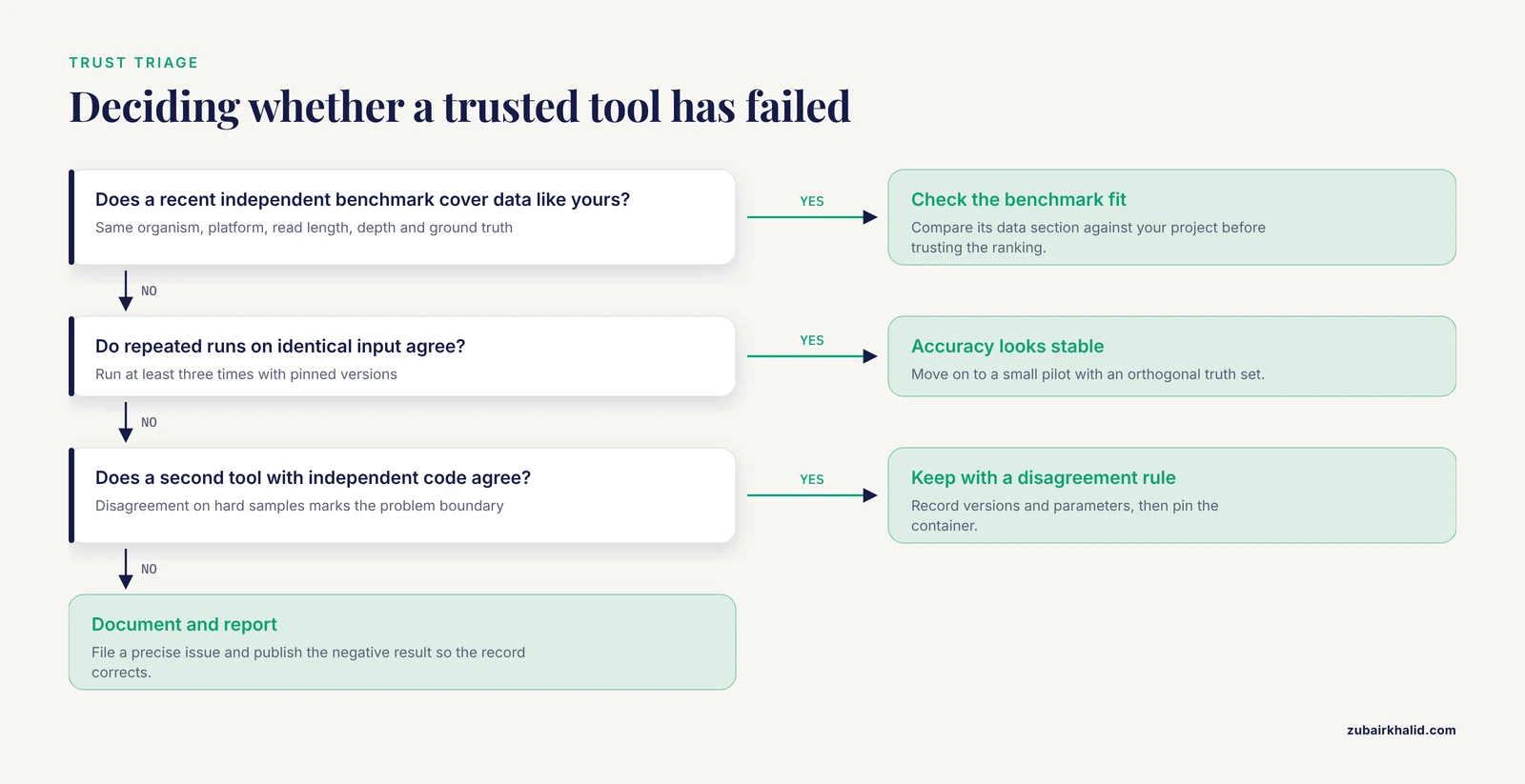
When you suspect a trust failure in a tool decision, this sequence moves from cheapest checks to most expensive.
- Define the operational question. Write down what a correct output means for your project in one sentence. Resistance called or not called, variant present or absent, species identified or not. Every later step depends on this definition.
- Check the tool's maintenance pulse. Last commit date, open issue count, release cadence, and whether the documentation matches the current release. A pulse check takes ten minutes and disqualifies many tools immediately.
- Find independent benchmarks on comparable data. Search for systematic reviews and meta-analyses before single papers, because pooled comparisons across studies are less likely to reflect one dataset's quirks. The tuberculosis drug-resistance field shows what good pooled evidence looks like, with 33 studies and 9 tools compared through network meta-analysis rather than one dataset [5].
- Separate accuracy from reliability. Run the tool at least three times on the same input. If outputs differ, quantify how much before trusting any single run. This step costs almost nothing and catches a failure class that benchmarks routinely miss.
- Run a small pilot with a truth set. Pick 10 to 20 samples where you know the right answer from an orthogonal method. Orthogonal validation, meaning confirmation by a method with independent error modes, is what the copy number variation benchmarking study used when it compared caller results against microarray and Bionano platforms [6].
- Run two tools in parallel. Agreement between two tools with independent codebases is stronger evidence than either tool's self-reported performance. The mitochondrial DNA tooling literature makes the same recommendation explicitly, suggesting integrated and parallel use of complementary tools to raise diagnostic confidence [10].
- Record versions and parameters as you go. A decision you cannot reconstruct is a decision you cannot defend, and version ambiguity is a leading reason two labs get different results from the same named tool.
- Decide, then pin. Commit to the tool, freeze the version, and containerize. Selection ends, but documentation continues.
A Practical Bioinformatics Tools Comparison Framework
A bioinformatics tools comparison is only useful if the criteria are defined before the tools are. Formal multi-criteria decision-making provides the structure, and the approach is established in software engineering, where one framework evaluated ten software reliability prediction models across four competing accuracy measures simultaneously to rank candidates rather than judging each on a single score [11]. Adapt that structure to your own selection with a fixed table of criteria.
| Criterion | What to record | Red flag |
|---|---|---|
| Accuracy on data like yours | Benchmark results on your organism, platform, and sample complexity, with confidence intervals | Point estimates without intervals, or benchmarks on unrelated data |
| Reliability across runs | Agreement between repeated runs on identical input | No published repeatability data, and developers cannot say whether the tool is deterministic |
| Input assumptions | Ploidy, coverage, read length, and reference version assumptions the tool makes silently | Undocumented assumptions, which is how hyper-diploid genomes defeat CNV callers that perform well elsewhere [6] |
| Database currency | Version and release date of every reference database the tool ships with or requires | Databases that update irregularly, since database choice governs reliability in classification tasks [1] |
| Maintainability | Last release, issue response time, license, and backing institution | One author, no releases since publication, restrictive or absent license |
| Installability | Availability through Bioconda, Bioconductor, Galaxy, or a maintained container | Web-server-only access, since a server outage can end your analysis |
| Supply-chain transparency | Pinned dependencies, published container digests, SBOM availability if the tool provides one | Unpinned environments and floating dependencies, given that even dedicated SBOM tools show completeness gaps [8] |
| Community responsiveness | Issue tracker tone and turnaround, forum presence | Closed issues with no resolutions, hostile or absent maintainer responses |
Two concrete worked examples show the framework in use.
Example 1, pooled benchmark evidence. Suppose you need a tuberculosis drug-resistance predictor. The strongest available evidence is a network meta-analysis across 33 studies rather than any single paper [5]. Reading it correctly means noticing both that TBProfiler led most drugs, with an area under the curve of 0.99 for rifampicin and 0.97 for isoniazid, and that superiority index confidence intervals were wide, meaning the ranking between leading tools is far less certain than the point estimates suggest [5]. The right selection conclusion is that several tools are defensible and the difference between them is small relative to the measurement uncertainty, which changes your decision from picking one winner to picking the most maintainable tool among several acceptable ones.
Example 2, consensus over single tools. Suppose you are calling somatic copy number variations in cancer genomes. The benchmarking evidence shows that even the best callers fail on specific genome architectures, with ploidy determination driving most between-caller variation [6]. The framework's answer is to run multiple callers and emit a consensus, which is precisely how that benchmarking study built its high-confidence call set, using results from six callers confirmed by three orthogonal methods on the reference cancer cell line HCC1395 [6]. The same logic underlies the ensemble strategies proposed in the privacy-evaluation literature, where combining methods with known disparities produced more robust results than any single method [7].
The general principle across both examples is that the best bioinformatics software for a high-stakes question is usually a small, documented panel of tools with defined disagreement rules, not a single winner.
How to Fix a Broken Trust Decision
When a tool you trusted has already produced questionable results, the fix follows a sequence.
Reproduce the failure in isolation. Rerun the tool on the smallest input that shows the problem, with the version and parameters recorded. Many apparent failures dissolve here, because the problem was an undocumented parameter change or a reference database that updated between runs.
Test an alternative on the same input. Run one current alternative, ideally one with recent independent benchmark support. Agreement between the trusted tool and the alternative on easy samples, plus disagreement on hard ones, tells you the boundary of the problem. Disagreement everywhere tells you to suspect your input data or configuration first.
Apply a consensus or ensemble where the field supports it. For variant calling and classification tasks, combining tools is an established remedy for individual tool weakness. The copy number variation literature established consensus calling across six callers with orthogonal confirmation [6]. The privacy-evaluation literature formalized ensemble strategies that account for disparities between methods [7]. The mitochondrial diagnostics literature recommends running complementary tools in parallel [10]. Choose the pattern that matches your task and state the combination rule in your methods.
Verify claims against primary sources. If the trust failure came through a secondary channel, a chatbot, a blog post, a conference hallway recommendation, go back to the developer's documentation and the primary benchmark. The chatbot evaluation literature shows that verification against authoritative documents is the step users skip, and that skipping it produces confidently wrong conclusions [9].
Escalate to the community. File a precise issue on the tool's repository with a minimal reproducible example. Maintainers fix reported bugs, and the issue becomes part of the community record that future tool selectors will read. If the tool's performance claim does not survive your testing, say so publicly in a forum or a short benchmark note. Negative results are the correction mechanism community trust runs on, and they fail when nobody publishes them.
Replace, do not patch blindly. If the tool is abandoned or its assumptions do not fit your data, migrating early is cheaper than migrating after two more years of accumulated results built on a broken foundation. Archive your old outputs with their exact versions so the migration is auditable.
Prevention Practices That Keep Trust Honest
Prevention is cheaper than diagnosis, and the practices that keep community trust accurate are all cheap to adopt.
Pin everything. Record tool versions, container digests, reference database versions, and parameter values in every analysis. Conda environment files, container images referenced by digest, and workflow engines such as Nextflow or Snakemake with version-locked containers make a result reproducible by construction rather than by memory.
Re-benchmark when the data changes. Trust transfers poorly across data types. A tool validated on your organism's short-read data in 2023 carries no guarantee to your long-read data in 2026. Re-run the pilot whenever the input profile changes materially.
Distinguish popularity from evidence in your own notes. When you record why you chose a tool, write which signal carried the decision. Choosing a tool because nf-core includes it in a maintained pipeline is defensible. Choosing it because it appears most often in methods sections is not, unless a recent benchmark backs the choice.
Measure reliability, not just accuracy. Build repeat runs into your pipelines for stochastic tools. One repeat run per sample costs little and converts an unseen failure mode into a visible one.
Contribute back. Publish your negative results and your small benchmarks. File issues. Answer forum questions with version numbers attached. Community trust in bioinformatics tools is an infrastructure the community maintains through use, and every documented result, positive or negative, strengthens it.
Prefer curated collections for default choices. Bioconda, Bioconductor, Galaxy ToolShed, and nf-core impose maintenance standards that individual repositories do not. Starting from a curated collection biases your selection toward tools someone is actively keeping alive, which is the property most predictive of future reliability.
Data Handling and Supply-Chain Safety Notes
Two hazards in tool selection are operational rather than statistical, and both deserve a deliberate check.
First, genomic and clinical data carry privacy obligations. Human genomic data are identifiable, and tools or web servers that upload your reads to third-party infrastructure may violate the consent terms and institutional agreements your data were collected under. Before adopting any web-based tool for human data, confirm where the data go, whether they are retained, and whether your data access agreement permits it. Controlled-access sharing through recognized repositories, not ad hoc uploads to tool websites, is the standard route.
Second, container images and dependency trees are attack surfaces. An image pulled from a public registry by tag rather than digest can change contents silently, and abandoned dependencies accumulate unpatched vulnerabilities. Pin by digest, pull from trusted registries, and treat the supply-chain findings from SBOM tool evaluations, where even dedicated tools showed completeness gaps against minimum required elements, as evidence that automated provenance tools reduce but do not eliminate the risk [8].
Common Mistakes and Limitations
- Treating GitHub stars as validation. Stars measure attention. Only independent benchmarks on comparable data measure performance.
- Reading the abstract of a benchmark paper and skipping the data section. The data section is where transferability lives. The abstract is where the headline number lives.
- Benchmarking on data already used to tune the tool. This produces optimistic numbers that vanish on new data. Reserve held-out samples the developers never saw.
- Interpreting sensitivity and specificity without prevalence. A tool with strong sensitivity and specificity can still generate mostly false positives on rare outcomes in your population. Compute positive predictive value on your own data.
- Confusing a listicle with a benchmark. Best-of lists, including well-ranked blog posts, usually reflect popularity and recency of the author's experience rather than systematic comparison. Use them to build a candidate list, then apply benchmark evidence.
- Assuming newer means better. New tools carry implementation bugs old tools have already shed. Novelty is a reason to test more carefully, not a reason to trust more readily.
- Switching tools mid-project without archiving. Results generated under two tool versions in one project are hard to interpret and harder to defend. Archive versioned outputs before any migration.
- Limitation. The evidence base for any specific tool decision is project-specific, and individual analyses require domain-specific judgment from someone who knows the data, the organism, and the clinical or research context. The framework here tells you how to structure that judgment, not what the answer will be.
Frequently Asked Questions
What does community trust mean in bioinformatics tool selection?
It is the collective judgment a field holds about which tools are accurate, maintained, and safe to build on, communicated through citations, benchmarks, curated collections, forums, and lab lineage. It lets researchers adopt validated tools without benchmarking everything themselves, and it works well when its underlying signals are read correctly.
Why do highly cited bioinformatics tools still give wrong results?
Citations measure exposure, not current performance, and a tool's reputation can outlive the evidence that built it. When the tool's original benchmark data differ from yours in organism, platform, or complexity, its proven accuracy does not transfer, and newer tools may have surpassed it without yet accumulating citations.
How do I compare bioinformatics tools fairly?
Define your operational question first, then evaluate candidates against fixed criteria: accuracy on data like yours with confidence intervals, reliability across repeated runs, input assumptions, database currency, maintainability, and installability. Run at least two tools in parallel on a small held-out set with an independent truth set, and record versions throughout.
What is the difference between accuracy and reliability in tool evaluation?
Accuracy is the proportion of correct outputs. Reliability is the consistency of outputs across repeated runs, users, or versions. A tool can be accurate on average and still unreliable, flipping answers between identical runs, which is why evaluations that repeat the same input many times can pass on average accuracy while still documenting inconsistency.
How many tools should I run on the same dataset?
For routine work, two independent tools with a defined disagreement rule is the practical minimum. For high-stakes questions such as clinical variant calling, published practice supports running more, as when a cancer genomics benchmark built a high-confidence call set from six copy number callers confirmed by three orthogonal methods.
How do I know if a benchmark paper applies to my data?
Read its data section before its results section. Compare organism, sequencing platform, read length, depth, sample complexity, and ground truth definition against your project. Pooled analyses across many studies transfer better than single-dataset benchmarks, but any benchmark is a hypothesis for your data until you confirm it on a subset yourself.
What should I do when the community favorite underperforms on my data?
First reproduce the failure in isolation with pinned versions and parameters, then test a current alternative on the same input. If the alternative holds up, document the comparison, migrate with archived outputs, and report your negative result publicly so the community record gets corrected rather than silently stale.
How can I protect my analysis when a tool is deprecated or a web server shuts down?
Before you depend on any tool, confirm that source code or a container is available for local installation. Containerize the tool, pin the image digest, and record the reference database versions it uses. If you are already mid-project when a server goes offline, recover the source or an archived image, rerun a small subset to confirm version equivalence, and document any outputs that could not be reproduced.
Sources
- A comprehensive study of databases to assess the reliability of metagenomic tools
- Assessing the Accuracy and Reliability of Large Language Models in Psychiatry Using Standardized Multiple-Choice Questions: Cross-Sectional Study
- Evaluating the Accuracy and Reliability of Large Language Models (ChatGPT, Claude, DeepSeek, Gemini, Grok, and Le Chat) in Answering Item-Analyzed Multiple-Choice Questions on Blood Physiology
- Accuracy and Reliability of AI-Generated Text Detection Tools: A Literature Review
- Diagnostic yield of nine user-friendly bioinformatics tools for predicting Mycobacterium tuberculosis drug resistance: A systematic review and network meta-analysis
- Evaluation of somatic copy number variation detection by NGS technologies and bioinformatics tools on a hyper-diploid cancer genome
- Membership Inference Attacks as Privacy Tools: Reliability, Disparity and Ensemble
- Accuracy Evaluation of SBOM Tools for Web Applications and System-Level Software
- Evaluating the accuracy and reliability of AI chatbots in disseminating the content of current resuscitation guidelines: a comparative analysis between the ERC 2021 guidelines and both ChatGPTs 3.5 and 4
- Bioinformatics Tools for NGS-Based Identification of Single Nucleotide Variants and Large-Scale Rearrangements in Mitochondrial DNA
- A Novel Framework to Evaluate Software Reliability Prediction Models Using Multi-Criteria Decision-Making