Biostars vs. Bioinformatics Stack Exchange
By Dr. Zubair Khalid, DVM, MS, PhD ·

Biostars is a community-driven bioinformatics forum where questions, tutorials, and open discussion coexist, while Bioinformatics Stack Exchange is a strict question-and-answer site built on the Stack Exchange engine, where every post must be one narrow, answerable question. The rule of thumb is simple: use Biostars when you want discussion, context, tool comparisons, or a tolerant place to learn, and use Bioinformatics Stack Exchange when you have a precise technical problem and want a single, community-vetted answer.
Both sites are free, both are public, and both have been active since 2011. People who ask about them usually want to know three things: which site will actually answer their question, which site will treat a beginner kindly, and whether they can use both. This article answers all three. It explains each platform on its own terms, compares them on the criteria that decide real choices, walks through worked scenarios, and lists the mistakes that sink most first-time questions.
The Short Answer
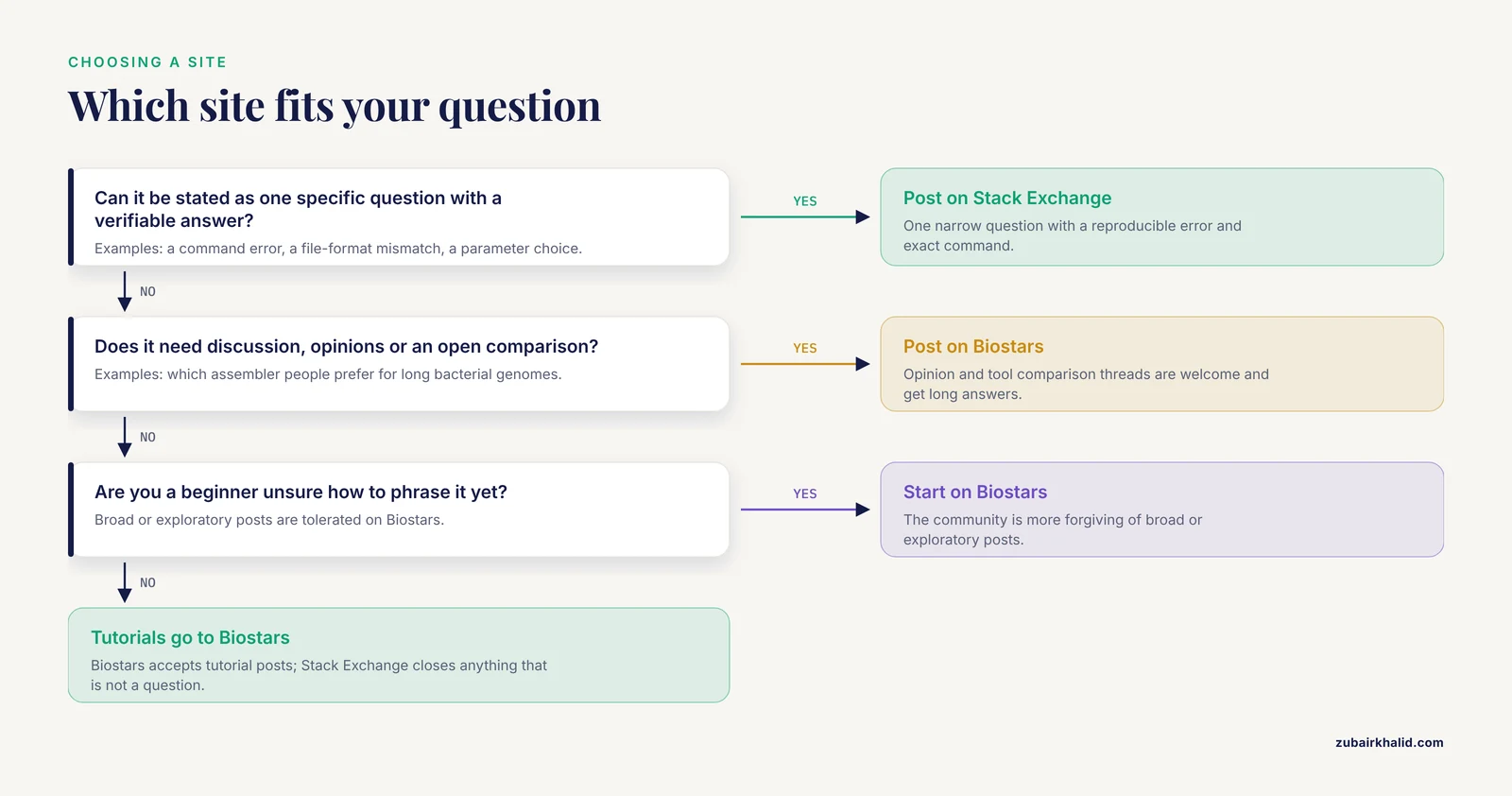
If you are deciding between Biostars or Bioinformatics Stack Exchange for a single question, use this decision path:
- Can your problem be stated as one specific question with a verifiable answer, such as a command error, a file-format mismatch, or a parameter choice? Post it on Bioinformatics Stack Exchange.
- Does your post need discussion, opinions, or an open-ended comparison, such as "which assembler do people prefer for long bacterial genomes"? Post it on Biostars.
- Are you a beginner who wants to learn bioinformatics and is not sure how to phrase the question yet? Post it on Biostars, where the community is more forgiving of broad or exploratory posts.
- Do you want to write a tutorial or share a workflow? Biostars accepts tutorial posts. Bioinformatics Stack Exchange does not, because anything that is not a question gets closed.
Many experienced bioinformaticians use both. The difference between Biostars and Bioinformatics Stack Exchange is less about which is better and more about which fits the shape of what you want to say.
What Biostars Is
Biostars is a question-and-answer site for bioinformatics, genomics, and computational biology. It was launched in 2011 by Istvan Albert, a researcher at Penn State University, and it runs on custom software rather than a shared network engine. Registration is free, and anyone can read the site without an account.
Biostars has several features that make it feel like a forum rather than a pure Q&A engine:
- Post types. In addition to plain questions, Biostars supports posts labeled as Tutorials, News, Tools, and Forum discussions. A user can write a multi-page walkthrough of a RNA-seq pipeline and publish it directly on the site. This is a genuine difference from Stack Exchange, where tutorials are off-topic by design.
- Reputation points. Users earn points when others upvote their posts. Points unlock privileges such as voting and editing, but the thresholds are gentle and the atmosphere is casual.
- Comments and replies. Biostars distinguishes between an "answer" (a direct response to the question) and a "comment" (a side note or clarification). This maps well to how scientists actually talk.
- Light moderation. A small group of moderators handles spam and serious problems, but the community largely polices itself through voting. Off-topic or low-effort posts are usually downvoted or answered briefly rather than closed.
- Tolerance for beginners. Homework-style questions and broad "how do I get started" posts appear regularly. The community often answers them with pointers to documentation, courses, or prior threads rather than closing them.
The practical consequence is that Biostars behaves like a professional common room. A typical page shows a question, a short answer, a threaded comment exchange, and sometimes a follow-up where the original poster reports what worked. Search the site for almost any tool name, such as samtools, DESeq2, fastp, or kraken2, and you will find years of accumulated threads covering the same errors you are likely to hit.
What Bioinformatics Stack Exchange Is
Bioinformatics Stack Exchange is one of the topic-specific sites in the Stack Exchange network, the same platform family that runs Stack Overflow. It went through the standard Area 51 proposal and public beta process and has been an active site since 2011. Like all Stack Exchange sites, it is free to read, free to join, and content is published under a Creative Commons share-alike license, which means answers can be reused with attribution.
The Stack Exchange engine imposes a strict format, and that format is the site's defining feature:
- One question per post. Each post must contain a single, self-contained question. Multi-part questions get asked to split.
- Close votes. Experienced users can vote to close a question for specific reasons: duplicate, off-topic, unclear, homework without effort, opinion-based, or too broad. Closed questions can be reopened if edited into shape.
- Accepted answers. The person who asked can mark one answer as accepted, which puts a green checkmark next to it and tells future readers which answer solved the problem.
- Bounties. If a question sits unanswered, the asker can attach a reputation bounty to attract attention. This is a standard Stack Exchange feature that Biostars does not replicate in the same way.
- Reputation-gated privileges. New users start with limited abilities, such as a limited number of questions per day, and earn privileges like voting, commenting, and editing as reputation grows. This slows down spam and low-effort posts.
- Markdown formatting. Code blocks, links, and images are rendered from Markdown, which makes it easy to paste a command, an error message, or a snippet of R or Python and have it display cleanly.
The practical consequence is that Bioinformatics Stack Exchange reads like a reference library. Questions are edited, duplicates are merged, and the top answer under a well-asked question is often the closest thing to a canonical answer you will find for free. The trade-off is that the site is smaller than Biostars and questions that do not fit the format get closed quickly.
Biostars vs. Bioinformatics Stack Exchange: Side-by-Side Comparison
| Feature | Biostars | Bioinformatics Stack Exchange |
|---|---|---|
| Platform | Custom software, independent site | Stack Exchange network engine |
| Post types | Questions, answers, tutorials, news, tool announcements, forum discussions | Questions and answers only |
| Question format | Flexible, multi-part questions tolerated | One narrow question per post, enforced by close votes |
| Moderation | Light, community voting plus a small moderator team | Structured, close votes, duplicate merging, editing |
| Homework questions | Generally tolerated if effort is shown | Often closed as homework unless the question shows research effort |
| Tool comparison questions | Welcome, often get long opinionated threads | Usually closed as opinion-based |
| Tutorials | Supported as a post type | Not supported, off-topic |
| Accepted answers | Askers can upvote and mark acceptance | Askers mark one accepted answer with a checkmark |
| Bounties | Not a core feature | Standard feature for unanswered questions |
| Beginner friendliness | High, broad questions get answered | Moderate, broad questions get closed |
| Answer depth | Variable, conversational | Often precise, edited, and canonical |
| Community size | Larger, more daily traffic | Smaller, more selective |
| Best for | Discussion, tool comparisons, learning, tutorials | Specific technical questions, reproducible errors, canonical answers |
| Main risk | Answers vary in quality and age | Strict format, questions closed for being too broad |
The Differences That Decide Real Choices
Moderation and quality control
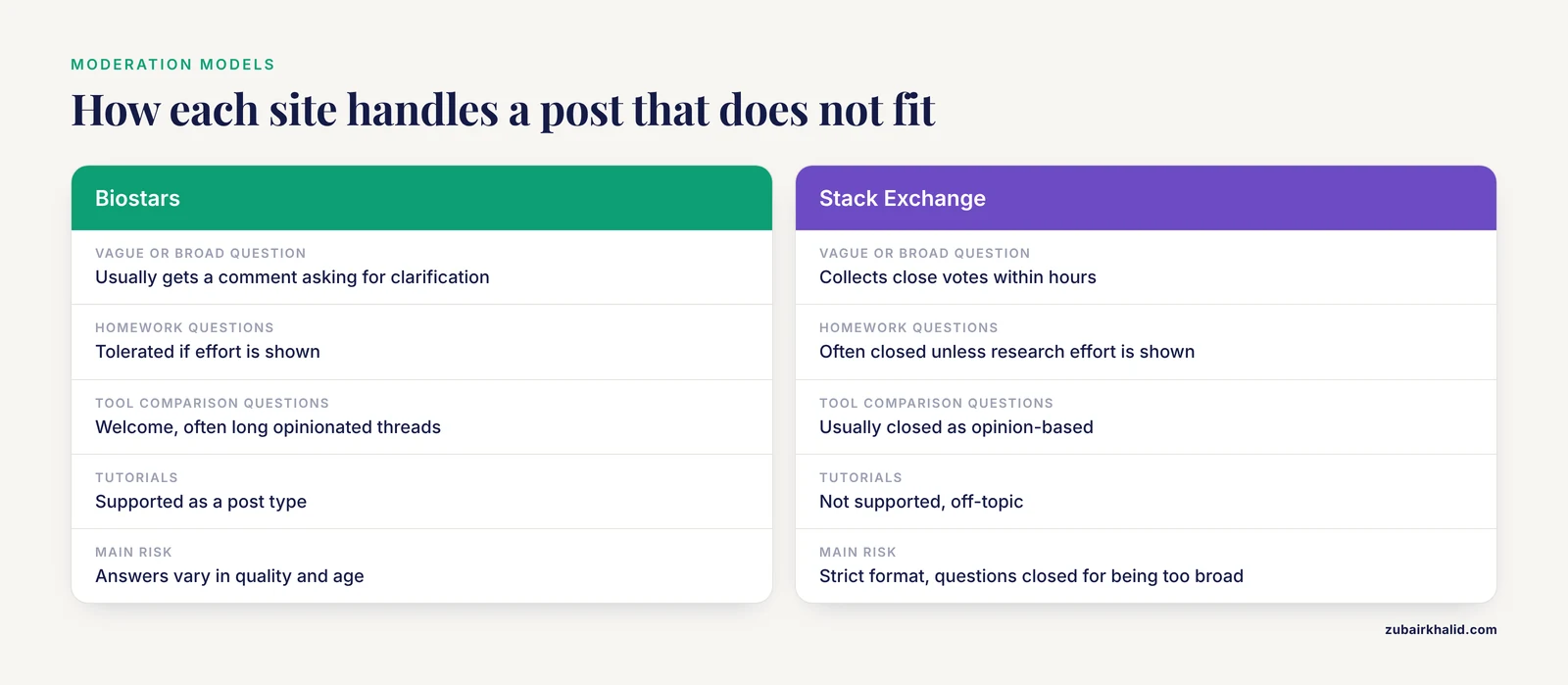
The difference between Biostars and Bioinformatics Stack Exchange is sharpest in how each site handles a post that does not fit. On Biostars, a vague question usually gets a comment asking for clarification, and the thread continues. On Bioinformatics Stack Exchange, the same question collects close votes within hours, and if it reaches the threshold it is closed with a stated reason and a link to a duplicate if one exists.
Neither model is wrong. The Stack Exchange model produces a cleaner archive because weak questions are filtered out and good ones are edited. The Biostars model produces a more complete record of real conversations, including the messy ones, because almost nothing is removed. If you are asking a question, the moderation model affects how much care you must put into the first draft. On Stack Exchange, a sloppy first draft often means a closed question. On Biostars, it usually means a slow or confused answer.
Question scope and format
Bioinformatics Stack Exchange enforces the "one question, one answer" rule. A post like "How do I analyze my metagenomic data?" will be closed as too broad. A post like "Why does kraken2 report reads classified to both a genus and a species node, and how do I count them correctly?" will survive, because it has one answer that can be verified against the tool's documentation.
Biostars accepts both. The broad version of the question will get replies asking about your data, your sequencing platform, and your research goal, and the thread will turn into a consultation. That is valuable when you genuinely do not know what your question is yet, and it is the main reason beginners gravitate to Biostars.
Tone and community
Biostars reads like a collegial lab meeting. Answers often include personal experience, opinions about tools, and follow-up discussion. Bioinformatics Stack Exchange reads like a technical reference. Answers tend to be direct, cite documentation, and avoid opinion. Neither tone is better, but they suit different moods. If you want to understand why people prefer one workflow over another, Biostars gives you that texture. If you want to know what a specific flag does, Stack Exchange gives you a cleaner answer.
The community dimension of bioinformatics extends well beyond these two sites. National bioinformatics societies have built formal training and community structures around the same need, and the Romanian Society of Bioinformatics, founded in 2019, is one documented example of a professional society that grew from scattered practitioners into an organization running national training and public engagement programs [1]. Online forums fill the day-to-day gap that formal societies and courses cannot, which is why both platforms remain heavily used.
Discoverability and search
Both sites rank well in search engines for bioinformatics error messages, which makes them de facto documentation. When you paste a cryptic error from bwa, STAR, or featureCounts into a search engine, hits from both sites appear. The difference is in what you find at the destination. Stack Exchange threads usually have a clear accepted answer near the top. Biostars threads may have several answers of varying quality, and the best answer is not always the one with the most points, so you need to read the whole thread.
For your own questions, this matters in reverse. If you want your problem and its solution to be findable by the next person with the same error, Stack Exchange's format does that more reliably. If you want a conversation that documents the reasoning, Biostars does that.
Depth of topics covered
Both sites cover the full range of modern bioinformatics: sequence alignment, assembly, variant calling, transcriptomics, metagenomics, single-cell analysis, machine learning, and workflow engines. The scope of what gets discussed is wide. A recent study of table olive fungal communities, for example, used tree-based machine learning models, including Classification and Regression Trees, Random Forest, and Extreme Gradient Boosting, to classify samples by processing type, country, and cultivar, with Random Forest models reaching above 75 percent overall accuracy and the country-of-origin model reaching 89 percent [2]. Questions at that level of sophistication, such as how to tune a Random Forest model for compositional omics data, appear on both platforms, and Biostars tends to have the longer methodological discussions.
When to Use Biostars
Use Biostars in these situations:
- You are learning bioinformatics. Biostars is the more forgiving place to ask "how do I learn bioinformatics" or "what should I learn first, R or Python". The community answers with reading lists, course recommendations, and honest career advice. Structured options exist too, and educators have been working to make bioinformatics teachable at scale. One undergraduate course design combined publicly available metagenomic data with web-accessible analysis services from the BV-BRC, one of the NIAID-funded Bioinformatics Resource Centers, to let students explore antimicrobial resistance in animal gut microbiomes without needing to install anything [3]. Threads on Biostars regularly point to resources like this.
- You need a tool comparison. "Which aligner should I use for long reads?" or "Is anyone using Nextflow in production for RNA-seq?" are opinion questions, and Biostars is where they get long, useful, multi-voice answers.
- You want to share a workflow. Tutorials are a first-class post type on Biostars. If you wrote a step-by-step guide for a pipeline, publishing it there puts it in front of the right audience.
- Your question is exploratory. If you are not sure whether your problem is statistical, computational, or biological, Biostars users will help you figure that out in the comments.
- You are following up on a conversation. Biostars threads can evolve over days, with the original poster reporting back. That back-and-forth is harder to sustain on Stack Exchange.
When Bioinformatics Stack Exchange Fits Better
Use Bioinformatics Stack Exchange in these situations:
- You have a reproducible error. You ran a command, it failed, you can paste the exact command and the exact error. This is the site's core use case. Format the command in a code block, include versions, and state what you expected versus what happened.
- You want a canonical answer. Stack Exchange's accepted-answer system and duplicate merging mean the best answer to a common question accumulates at one URL. If you want your question to become the reference for others, this is the platform.
- Your question is about a specific parameter or behavior. "What does the
-qparameter mean in this context?" or "Why does this tool count multimappers twice?" have single verifiable answers. - You want your answer to be reusable. Stack Exchange content is published under a share-alike license, so answers can be quoted in documentation, courses, and papers with attribution.
- You are willing to invest in the question. The site rewards effort. A question with a minimal reproducible example, tool versions, and a clear title gets answered fast. A question without those gets closed.
Worked Scenarios
Scenario 1: A DESeq2 error during differential expression
You run DESeq2 in R on a count matrix and get an error about factor levels or missing metadata. You can paste the code, the error, and the session information. This is a perfect Bioinformatics Stack Exchange question: one problem, one verifiable answer, reproducible. Post it there with a title like "DESeq2 throws 'factor levels' error when creating DESeqDataSet from count matrix". The same question would also do fine on Biostars, but on Stack Exchange it is more likely to become a findable reference for the next person.
Scenario 2: Choosing an assembler for a new project
You are starting a bacterial genome project and want opinions on whether to use a hybrid assembly approach with long and short reads. There is no single correct answer. This is a Biostars question. Expect a thread with several experienced users describing their setups, the assemblers they use, and the trade-offs they hit. On Stack Exchange, this question would likely be closed as opinion-based.
Scenario 3: A beginner asking how to start
You are a biology student who wants to learn bioinformatics and does not know where to begin. This is a "when to use Biostars" case by definition. Ask on Biostars, and you will get a reading list, advice on which programming language to start with, and pointers to free courses. Formal education is catching up too, but slowly. Educators report persistent barriers to integrating bioinformatics into undergraduate life science curricula, including technical infrastructure and instructor expertise, which is why web-accessible, course-based materials built on platforms like the BV-BRC are being developed to lower the entry cost [3]. Until structured courses are universal, community forums remain the most accessible first step, and Biostars is the friendlier of the two.
Scenario 4: A cluster job that fails silently
Your job scheduler submits a Nextflow pipeline, and the pipeline dies with no useful error. You suspect an environment or resource issue. This is a specific, diagnosable problem, so it belongs on Bioinformatics Stack Exchange, with the exact command, the scheduler, the error output, and the pipeline version. If it turns out to be a broad "how do I troubleshoot Nextflow" question, the community will tell you to narrow it, and you can edit the post.
Scenario 5: Sharing a tutorial you wrote
You wrote a walkthrough for running a taxonomic classification workflow on public metagenomic data. That is a tutorial, not a question. Biostars accepts tutorial posts directly. On Stack Exchange, you would have to frame it as a self-answered question, which is allowed but awkward, or publish it elsewhere and link to it. The same content, published as a Biostars tutorial, sits alongside the site's other tutorials and accumulates votes over time.
Using Both Platforms to Learn Bioinformatics
If your goal is to learn bioinformatics, treat the two sites as complementary layers rather than competitors. The comparison is not really "Biostars vs. Bioinformatics Stack Exchange" for a learner. It is "forums plus structured learning".
A practical sequence looks like this:
- Start with a structured course or resource. Free, web-accessible options exist. The BV-BRC activity described in the education literature, where students use public metagenomic samples from wild and domestic animals to compare gut microbiomes and antibiotic resistance genes through two end-to-end web services, is one example of a designed entry point that requires no local installation [3]. University courses, ELIXIR training materials in Europe, and NCBI tutorials are other standard starting points.
- Use Biostars as your reading room. Search it before you ask. Years of threads on every common tool are there, and reading them teaches you the vocabulary and the typical failure modes.
- Use Bioinformatics Stack Exchange as your reference. When you hit a specific error, search it first. If the question exists, the accepted answer is usually reliable. If it does not, ask it well and it becomes a permanent resource.
- Ask only after you have tried. On both sites, the fastest way to a good answer is to show what you tried, what happened, and what you expected. This is true on Stack Exchange to the point of being enforced, and it is true on Biostars as a social norm.
The broader context is that bioinformatics as a field is actively building its training and community capacity. Professional societies are formalizing what forums do informally, and the literature on national bioinformatics development describes a progression from community building to training programs to shared infrastructure [1]. Environmental applications show the same pattern from the demand side, with reviews noting that bioinformatics now underpins pollution control, biodiversity monitoring, and bioremediation, and that the field still struggles with large-scale data management and the need for user-friendly platforms [4]. Forums are part of that user-friendly layer, and knowing how to use them well is a genuine professional skill.
Common Mistakes and Limitations
These are the errors that sink most first-time questions on both platforms, and the honest limits of forums in general.
Cross-posting the same question to both sites. This is the most common etiquette violation. Pick one site, wait, and if you get no answer after several days, either add a bounty (Stack Exchange) or rephrase and try the other site with a note that you asked elsewhere. Cross-posted identical questions annoy both communities and can lead to duplicated, diverging answers.
Asking without searching first. Both sites have existed since 2011. A large fraction of new questions are duplicates. On Stack Exchange, duplicates get closed with a link. On Biostars, they get a comment pointing to the old thread. Search both sites before asking, and read the top threads on your error message.
Posting a question with no reproducible example. "My pipeline fails, help" is unanswerable. Include the exact command, the tool and version, the input format, the full error text, and what you expected. On Stack Exchange, this is close to mandatory. On Biostars, it is the difference between a fast answer and silence.
Dumping data or code without context. Pasting 500 lines of output helps no one. Reduce to the smallest example that reproduces the problem. This skill, called creating a minimal reproducible example, is worth learning for its own sake because it often reveals the bug before you post.
Treating forums as free consulting. Forums answer questions, not projects. A question like "analyze my dataset and tell me which genes are differentially expressed" will get closed or ignored on both sites. The line is simple: you do the work, the community helps when you are stuck.
Posting confidential or human data. Never post patient data, unpublished proprietary sequences, or anything covered by a data agreement. Both sites are public and indexed by search engines. Anonymize or use synthetic data.
Expecting instant answers. Both sites are staffed by volunteers in different time zones. A good question on Biostars often gets a first answer within hours, but a complete answer can take days. Stack Exchange bounties exist precisely for the unanswered case.
Trusting old answers blindly. Software changes. An answer from 2015 about a tool's default behavior may be wrong today. Check the date, check the tool version, and verify against current documentation. This matters more on Biostars, where old threads stay visible, than on Stack Exchange, where answers can be edited and updated.
A broader limitation. Forums are peer advice, not authoritative review. The field's own literature notes persistent gaps between computational predictions and validated biological reality, and reviews of environmental bioinformatics emphasize that interdisciplinary collaboration and careful interpretation remain unsolved challenges [4]. An answer on either site is one expert's opinion unless it cites documentation or data. For anything that feeds a publication, verify the claim against the tool's official documentation and the primary literature.
Frequently Asked Questions
Is Biostars or Bioinformatics Stack Exchange better for beginners?
Biostars is better for beginners. It tolerates broad questions, hosts tutorials, and the community answers "how do I start" posts with reading lists and course advice. Bioinformatics Stack Exchange is better once you can phrase a narrow technical question, because its format rewards precision and closes vague posts.
Can I ask homework questions on these sites?
Yes, with conditions. Biostars generally tolerates homework questions if you show your attempt and ask a specific question. Bioinformatics Stack Exchange often closes homework questions that show no research effort, so include what you tried and where you got stuck.
Which site gets answers faster?
Biostars usually gets a first response faster because it has more daily traffic and a more conversational culture. Bioinformatics Stack Exchange can be slower, but its answers tend to be more precise, and you can attach a bounty to an unanswered question to attract attention.
Can I ask tool recommendation questions?
On Biostars, yes, and those threads are often the most valuable content on the site. On Bioinformatics Stack Exchange, tool recommendation questions are usually closed as opinion-based, so reframe them as a specific technical question about a named tool instead.
Do I need an account to read or post?
You can read both sites without an account. To post a question or answer on either site, you need a free account. On Biostars, registration is direct. On Bioinformatics Stack Exchange, you can register through the shared Stack Exchange network account, which also works on Stack Overflow and other sites in the network.
How do I write a question that gets answered?
Include a descriptive title, the exact command or code in a code block, the tool name and version, the full error message, the input format, what you expected, and what you have already tried. Search both sites first to avoid a duplicate. This formula works on both platforms and is effectively required on Bioinformatics Stack Exchange.
Sources
- From the establishment of a national bioinformatics society to the development of a national bioinformatics infrastructure.
- Unraveling fungal community biodiversity in table olives through tree-based machine learning classification.
- Exploring antimicrobial resistance in wild and domestic animal populations: combining publicly available data with BV-BRC resources to introduce bioinformatics in an undergraduate classroom.
- Integrative Bioinformatics Approaches in Environmental Biotechnology: A Review.