How to Choose the Right Biological Database for Your Research
By Dr. Zubair Khalid, DVM, MS, PhD ·

A biological database is either a raw archive that stores data exactly as submitters deposited it, a curated knowledgebase where specialists verify entries and attach evidence, or a specialized reference built around one focused question. The rule of thumb: choose the database that matches your molecule type and your analysis tool's expected input, check its curation level and coverage for your organism, then record its exact version before you analyze anything.
Bioinformatics, the use of computational methods to store, retrieve, and analyze biological data, inherits every error in its references. A flawless pipeline run against the wrong database produces confident, reproducible nonsense. The best biological databases for bioinformatics are rarely the largest ones. They are the ones whose scope, curation standard, and file format fit the question you actually asked.
This guide covers the main biological databases for bioinformatics, the criteria that separate a correct choice from a merely convenient one, six worked scenarios drawn from recent studies, the pros and cons of each category, and the mistakes that most often invalidate an analysis.
What a Biological Database Is
A biological database is an organized, maintained collection of biological data, such as DNA and protein sequences, three-dimensional structures, gene expression measurements, or metabolic pathways, paired with tools to query and retrieve it. Three properties separate a database from a loose pile of files:
- Maintenance. Someone curates, updates, and versions the content.
- Identifiers. Each entry carries a stable accession number, a permanent ID you can cite in a paper.
- Query access. You can search it through a web interface, an API (application programming interface, a way for programs to request data directly), or a bulk download.
Most resources fall into one of five functional categories, and the category determines what you can trust an entry to tell you:
- Primary archives store submissions as received. GenBank at NCBI (the US National Center for Biotechnology Information), ENA in Europe, and DDBJ in Japan exchange data daily under the International Nucleotide Sequence Database Collaboration, so a sequence deposited at any one appears in all three.
- Curated knowledgebases add expert review. Staff merge duplicate entries, correct annotation, and attach evidence, such as whether a protein's function was shown experimentally or inferred by similarity.
- Specialized databases focus on one biological question, such as bioactive peptides or immune epitopes.
- Raw data repositories store the unprocessed output of instruments, such as sequencing reads and mass spectrometry files, so others can reanalyze them.
- Tool reference databases are the reference sets that specific software expects as input, such as the protein sequence file a search engine matches spectra against.
Two vocabulary terms come up constantly. Curation means human or automated expert review that adds, corrects, or validates annotation. Metadata is the descriptive information attached to an entry, such as the species, tissue, assay type, and growth conditions that produced the data. Metadata quality decides whether an entry is usable for your purpose, a point that recent evaluations of specialized databases keep confirming [1].
Biological Databases for Bioinformatics: Your Main Options
Each option below solves a different problem. The descriptions explain what each one stores, who maintains quality, and when to reach for it.
Primary Sequence Archives: GenBank, ENA, and DDBJ
These archives hold nucleotide sequences exactly as authors and sequencing centers submitted them, along with submitter-written annotation. Their strengths are completeness and immediacy. Newly published sequences appear here first. Their weaknesses are redundancy (multiple entries representing the same underlying sequence, often from overlapping submissions) and annotation of uneven quality, because the submitter, not a central team, wrote it.
Use an archive when you need to confirm that a sequence exists, retrieve a specific published accession, or deposit your own data. Do not use an archive as a clean analysis set without filtering. For that, use a curated derivative.
Curated Knowledgebases: RefSeq, UniProtKB, PDB, KEGG, and GO
RefSeq, maintained by NCBI, provides curated, non-redundant reference genomes, transcripts, and proteins for named organisms. It is the reference that most alignment and classification tools expect.
UniProtKB splits into two sections. Swiss-Prot contains manually reviewed entries with evidence tags stating whether each function was determined experimentally or inferred. TrEMBL contains computationally annotated entries awaiting review. The evidence tag is the difference between a fact and a prediction.
PDB stores experimentally determined three-dimensional structures of proteins and nucleic acids, solved by methods such as X-ray crystallography, cryo-electron microscopy, and NMR spectroscopy. It contains only structures someone has solved, so absence from PDB does not mean absence in nature.
KEGG maps genes to metabolic and signaling pathways. The Gene Ontology (GO) is an ontology, a controlled vocabulary of gene function terms with defined relationships, used to interpret a list of genes as biological themes. Both are interpretation layers on top of sequence data.
Specialized and Domain-Specific Databases
Specialized resources trade breadth for depth. BIOPEP-UWM collects bioactive peptide sequences (peptides are short chains of amino acids) and serves as a standard first screen in food-derived peptide research [2]. Antimicrobial peptide (AMP) databases collect peptides with experimentally tested antibacterial activity, and a 2026 evaluation found that these resources differ substantially in content, redundancy, and the experimental metadata they record, which complicates fair comparison of the prediction tools built on top of them [1]. Epitope databases collect the molecular fragments that immune cells recognize, and they feed a large ecosystem of B-cell and T-cell epitope predictors [3]. An epitope is the specific part of an antigen (a molecule the immune system recognizes) that an antibody or T-cell receptor binds.
The pattern to remember: specialized databases vary in quality far more than the major archives, because many are maintained by small teams with irregular funding. Check the last update date before you build anything on one.
Raw Data Repositories: SRA, GEO, and PRIDE
Raw repositories hold instrument output rather than interpreted results. The Sequence Read Archive (SRA) stores sequencing reads, GEO stores gene expression and related functional genomics data, and PRIDE (the PRoteomics IDEntifications Database) stores mass spectrometry-based proteomics data, both identifications and raw files [4]. Proteomics means the large-scale study of proteins in a sample, their identities and quantities. These repositories are the starting points for reanalysis, method development, and meta-analyses. They are also where metadata quality varies the most, because deposition requirements are minimal compared with curation.
Reference Databases Bundled with Analysis Tools
Many tools are inseparable from a reference. A metagenomic taxonomic classifier assigns sequencing reads to organisms by matching them against a reference database, and its accuracy is a property of the tool-reference pair, not the tool alone [5]. A proteomics search engine identifies peptides by matching fragmentation spectra against a protein sequence database you supply [4]. When you choose such a tool, you are choosing its reference too. Ask what the reference contains, how it was built, and when it was last updated.
Side-by-Side Comparison
The table below is the core of the decision. Find the row that matches your data type, then read the drawback column before you commit.
| Database or category | What it stores | Curation model | Best for | Main drawback |
|---|---|---|---|---|
| GenBank, ENA, DDBJ | Nucleotide sequences with submitter annotation | Submitter-deposited, minimal central review | Confirming a sequence exists, retrieving accessions, depositing data | Redundant entries, uneven annotation |
| RefSeq | Curated reference genomes, transcripts, proteins | NCBI curation plus automated pipelines | Alignment, annotation, classification against a stable reference | Lags the archives, coverage varies by organism |
| UniProtKB (Swiss-Prot and TrEMBL) | Protein sequences with function, domains, evidence | Manual review (Swiss-Prot), automated (TrEMBL) | Protein function annotation with explicit evidence levels | Reviewed coverage is a small fraction of known proteins |
| PDB | Experimentally solved 3D structures | Central validation through the wwPDB partnership | Structural analysis, docking, model building | Only solved structures, biased toward easier targets |
| KEGG, GO | Pathways and function terms | Curated ontologies | Interpreting gene or protein lists as biological themes | Mapping quality depends on organism coverage |
| SRA, GEO, PRIDE | Raw reads, expression data, MS proteomics files | Submitter-deposited, minimal curation | Reanalysis, method development, meta-analyses | Large files, variable metadata |
| BIOPEP-UWM | Bioactive peptide sequences | Literature-derived curation | First-pass screening of food- and body-derived peptides [2] | Small scale, literature bias |
| AMP and epitope collections | Peptides and epitopes with experimental context | Mixed, heterogeneous metadata | Hypothesis generation, benchmark construction [1] [3] | Redundancy, inconsistent experimental metadata |
Criteria That Decide the Real Choice
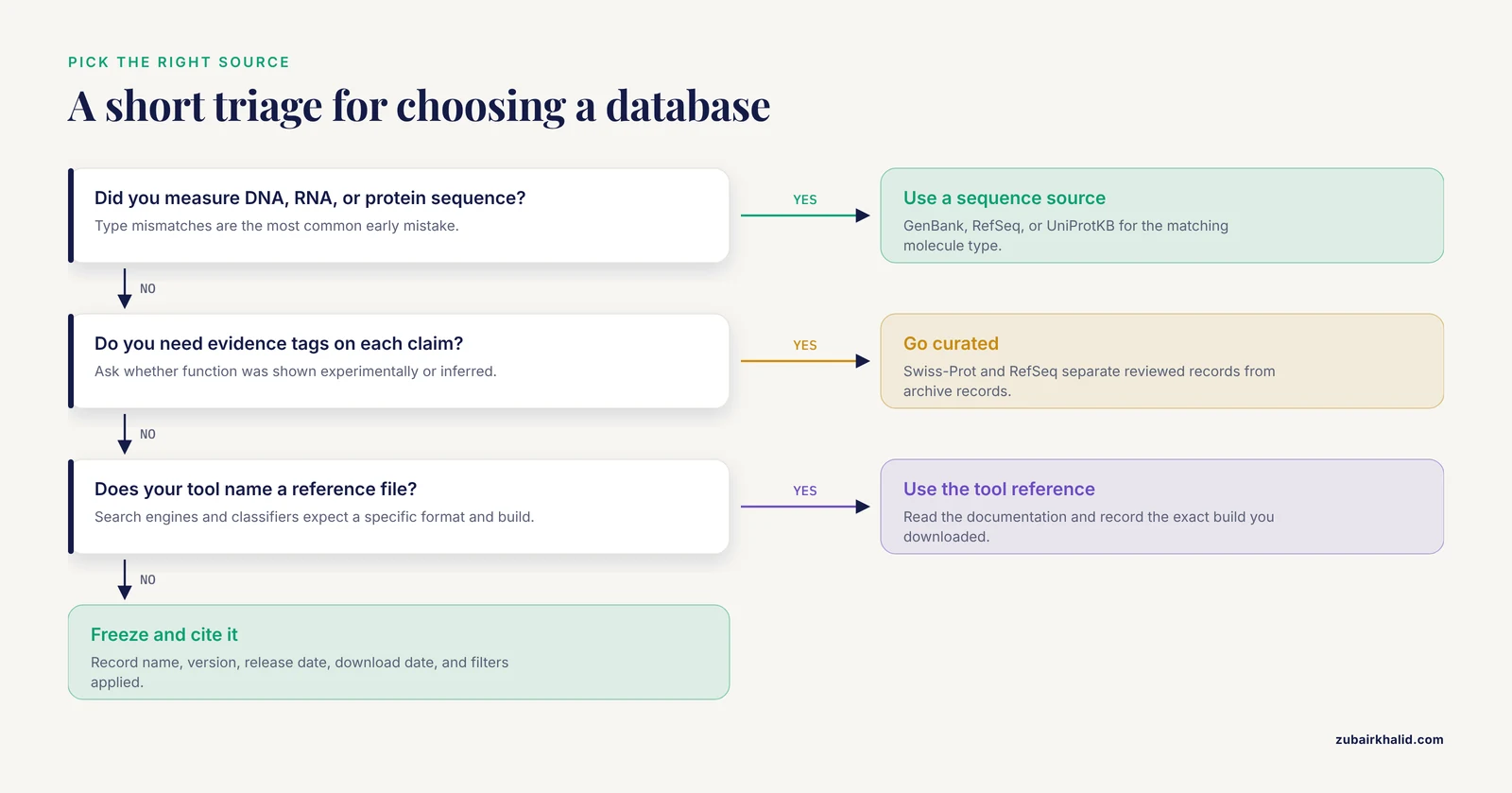
Category knowledge gets you close. These eight criteria finish the job.
1. Match the molecule and data type
Start with what you measured. DNA questions need nucleotide references, protein questions need protein databases, structural questions need PDB, pathway questions need KEGG or GO. Most early mistakes are type mismatches, such as searching raw shotgun reads against a protein database without the translation step, or expecting a peptide database to contain full-length proteins.
2. Check the curation level and evidence
For every entry, ask whether the claim is experimental or inferred. UniProt marks this explicitly. RefSeq separates curated reference records from archive records. When you build an analysis set, curated sources reduce noise and archive sources add completeness. Decide deliberately which trade you are making, and write the decision down.
3. Interrogate redundancy and metadata
Redundant near-duplicate entries distort any analysis that treats entries as independent observations. The danger peaks when a database becomes a training or test set. A 2026 assessment of antimicrobial peptide resources documented exactly this problem, with heterogeneous datasets and inconsistent evaluation protocols producing data leakage and inflated performance estimates for the tools built on top of them [1]. Data leakage means information from the evaluation set influenced training, so reported accuracy overstates real-world accuracy. Before you use a specialized database as a dataset, count near-duplicates and read what metadata each record carries.
4. Match your organism
Coverage runs deep for humans, mice, rats, E. coli, and Arabidopsis, and thin beyond them. If you work on a non-model species, check whether the database holds a reference assembly or proteome for your organism at all, and whether entries come from your species or from close relatives. Method evaluations increasingly call this out. A rat plasma proteomics study noted that abundant protein depletion methods widely used for human samples have limited application in animal species, and it validated its approach specifically in rat plasma with reference database comparisons [6]. The same logic applies to databases. A human-centered reference can quietly mislabel proteins from another species.
5. Match the tool's expected input
Every tool specifies what its reference must look like. Proteomics search engines need a protein sequence file in FASTA format, a plain-text format where each sequence begins with a header line starting with the > character, and they typically add decoy sequences (reversed or scrambled fakes) to estimate the false discovery rate, the expected proportion of false identifications [4]. Metagenomic classifiers each expect their own reference structure, and a systematic benchmark found that accuracy and runtime differ enough across tools that the tool-reference pair is the real unit of choice [5]. Read the tool documentation before downloading anything.
6. Version, release, and reproducibility
Databases change constantly. An analysis run against UniProtKB in January and the identical analysis in June can produce different protein identifications from the same data. Record the database name, exact version or release number, release date, download date, and any filtering you applied. Keep the downloaded files frozen. Reviewers increasingly ask for this, and your own follow-up studies will need it.
7. Access mode and scale
One record? Use the web interface. A few thousand records? Use the API. Genome-scale? Use bulk FTP downloads. Matching access mode to scale saves hours and avoids accidental rate-limit violations. Whatever the mode, put the retrieval step in a script so it can be rerun exactly.
8. Published benchmark evidence
Prefer tools and resources with standardized, published evaluations. A 2026 systematic review benchmarked metagenomic classifiers on a standardized dataset derived from NCBI RefSeq, which is what made fair comparison possible at all [5]. In the antimicrobial peptide field, the absence of a standard evaluation framework is itself the headline finding, and the field's response is to define one [1]. When no benchmark exists for your tool, build a small one before you trust it on your data.
A five-question preflight before you commit: What molecule did I measure? Is each claim experimental or inferred? Does the database cover my organism? What input does my tool expect? What version am I using?
Worked Scenarios
Six recent studies show the decision in practice. Each pairs a data type with the databases that made the analysis work.
Scenario 1: Assigning taxonomy to metagenomic reads
Suppose you have shotgun metagenomic reads, meaning sequencing of genetic material taken directly from a sample such as soil or gut contents without culturing the organisms first. Your task is taxonomic classification, assigning each read to an organism. A 2026 systematic review identified 31 metagenomic taxonomic classification tools, put nine through functional and methodological filters, and benchmarked those nine on a standardized dataset derived from NCBI RefSeq [5]. The results argue against any single default. TAMA, CAMITAX, and PhyloFlash achieved higher accuracy for prokaryotes, while ViWrap and PhaBOX performed better for viral classification. SqueezeMeta earned high F1 scores, a single number combining precision (how many called taxa were correct) and recall (how many true taxa were found), across most domains, though its assembly-based architecture (it first reconstructs longer sequences from reads) limited it on highly diverse samples. MegaPath-Nano was least affected by increased mutation rates, and runtimes varied widely, with domain-specific and machine learning-based tools generally faster. The database decision here is inseparable from the tool decision. Pick the classifier whose domain strengths match your sample, confirm which reference it uses, and state both in your methods.
Scenario 2: Reprocessing a public proteomics dataset
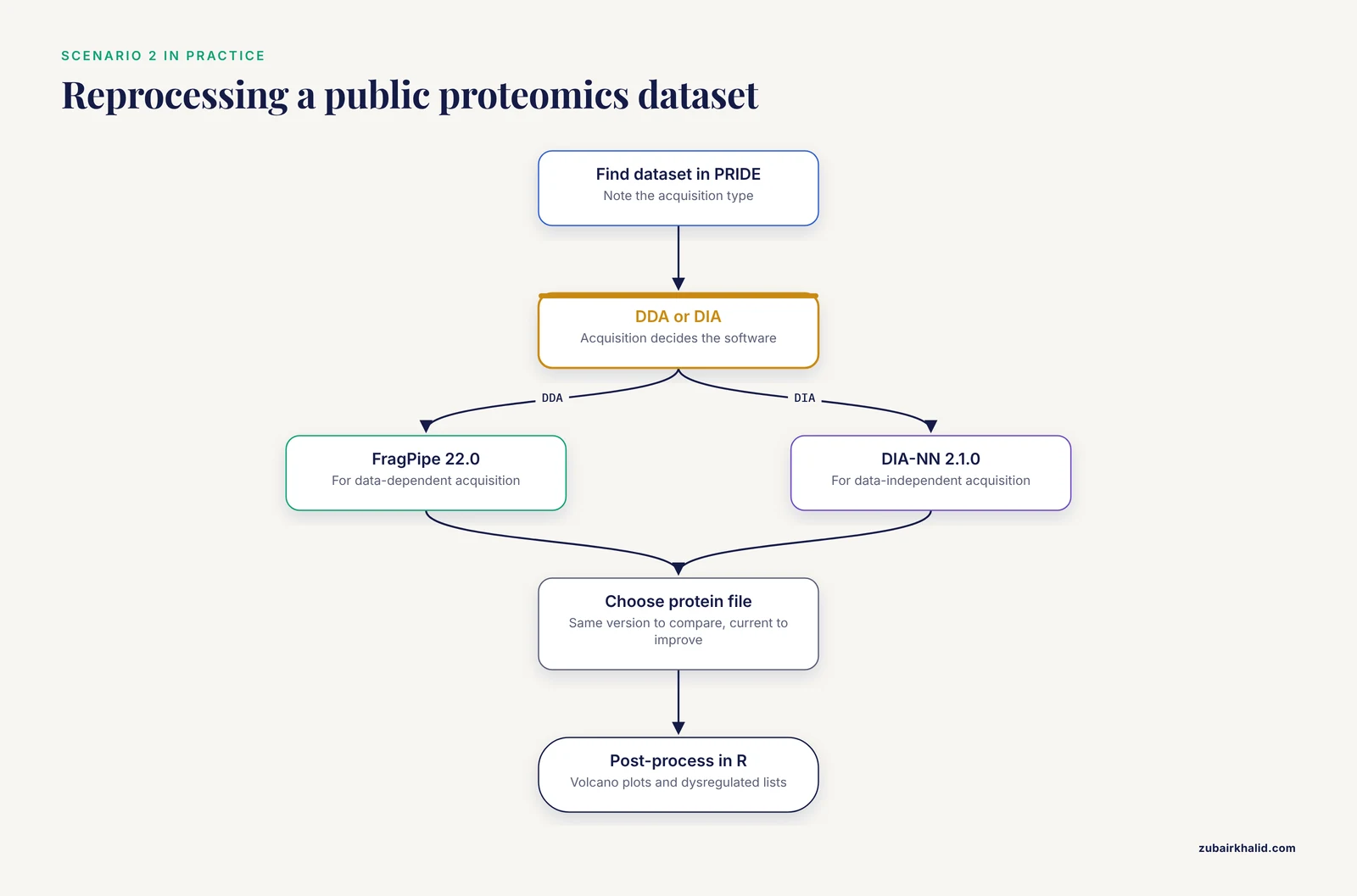
You want dysregulated proteins from a public mass spectrometry dataset. Start in PRIDE and note the acquisition type. Data-dependent acquisition (DDA) fragments the most abundant ions one selection at a time, while data-independent acquisition (DIA) fragments all ions across wide mass windows regardless of abundance. The acquisition type dictates the software. A published beginner-level workflow demonstrates FragPipe version 22.0 for DDA data and DIA-NN version 2.1.0 for DIA data, both free tools, with post-processing such as volcano plots and dysregulated protein lists done in R [4]. Your remaining database choice is the protein sequence file the search engine matches spectra against. Use the same proteome version as the original study if you intend to compare results, use a current version if you intend to improve on them, and say which in your methods.
Scenario 3: Low-input plasma proteomics in a non-model organism
Plasma proteomics fights a dynamic range problem, where a handful of abundant proteins swamp detection of low-abundance ones, and the fight is harder with only microliters of input and a non-human species. One evaluation used 20 microliters of plasma from healthy and type 2 diabetes model rats and compared two enrichment methods, Mag-Net and ENRICH-iST, each paired with an optimized liquid chromatography mass spectrometry (LC-MS) method, which separates molecules in a column and measures them by mass [6]. Both identified more than 5,000 proteins. Mag-Net identified more proteins with high precision and preferentially enriched extracellular vesicle proteins (vesicles are membrane-bound particles released by cells), while ENRICH-iST captured low-abundance proteins more evenly. The evaluation leaned on extracellular vesicle database comparison and Gene Ontology analysis to interpret the differences. The lesson for database choice is that method, reference databases, and organism form one package. Evaluate the package on your species and input volume, not on human benchmarks alone.
Scenario 4: Screening fermented-food peptides for umami activity
A study of tauco, an Indonesian fermented soybean product, identified peptides by LC-MS/MS (tandem mass spectrometry, which fragments molecules to recover sequence information), then chained databases and predictors to prioritize candidates [2]. Identified peptides were screened against the BIOPEP-UWM database and an umami prediction model (umami is the savory basic taste), then the survivors passed through ToxinPred for toxicity, AllerTop for allergenicity, and ProtParam for the GRAVY score (a hydropathy measure) and the instability index (a stability estimate). Final candidates were docked, meaning their binding to a target was computationally predicted, against the T1R1/T1R3 umami receptor with AutoDock Vina 1.2.7. From 196 identified peptides, three candidates (PDATGHTA, LDAGGV, and ESLCASGA) showed predicted umami thresholds below 5 mmol/L, with binding affinities from -7.689 to -9.323 kcal/mol, where more negative values indicate tighter binding, and PDATGHTA the strongest of the three. The chain worked because each database had a defined role. Treat the outputs as a ranked shortlist for wet-lab confirmation, not as confirmed umami peptides.
Scenario 5: Building a fair benchmark for prediction tools
A systematic review of computational B-cell and T-cell epitope prediction cataloged 148 AI-based prediction models published between 2015 and 2026 and organized the field into twelve distinct prediction tasks [3]. The recurring failures were evaluation failures: fragmented practices, models rarely tested across a comprehensive range of datasets, too little comparison against existing predictors, and systematic under-use of the public databases that already exist. Reviews of antimicrobial peptide predictors describe the same pattern, with data leakage and inconsistent protocols inflating reported performance [1]. If you are building a benchmark, the database decisions are the benchmark. Pull positives from a single curated source, control redundancy, keep experimental metadata such as assay type consistent, and hold out a test set that no model saw during training.
Scenario 6: Designing a multi-omics study
A biomarker protocol for neonatal encephalopathy research plans whole genome sequencing, DNA methylation analysis by bisulfite sequencing (a method that reveals methylation, chemical marks on DNA that regulate gene activity), bulk and single-cell RNA sequencing (measuring gene expression across a whole sample or cell by cell), proteomic and metabolomic profiling (the large-scale study of small molecules called metabolites) of dried blood spots by LC-MS, placental microbiome analysis (the community of microbes at that site), and placental histopathology (microscopic tissue examination) [7]. Seven data streams means at least seven reference decisions: a genome reference for the sequencing, a methylome reference for methylation calls, transcript references for the RNA work, a protein sequence database for the mass spectrometry, and a microbiome reference for the placental samples. Studies like this make the point explicit. Database selection is a study-design decision made before the first sample is run, not an implementation detail discovered during analysis.
Biological Databases for Bioinformatics: Pros and Cons
The category-level tradeoffs, summarized:
| Category | Pros | Cons |
|---|---|---|
| Primary archives | Complete, current, stable accessions, accepts new data quickly | Redundant, uneven annotation, noisy for analysis |
| Curated knowledgebases | Clean, evidence-annotated, non-redundant, tool-compatible | Lag behind archives, organism coverage varies |
| Specialized databases | Deep coverage of one question, often include predictions | Small teams, irregular updates, heterogeneous metadata |
| Raw data repositories | Enable reanalysis and method development, preserve original measurements | Large files, minimal curation, metadata varies |
| Tool-bundled references | Matched to the tool, convenient, reproducible within a pipeline | Provenance can be opaque, updates tied to tool releases |
Two observations cut across the table. First, the pros and cons of curated sources and archives are complementary, which is why mature analyses often use both, archives for completeness and curated sets for cleanliness. Second, the cons of specialized databases bite hardest in practice, because their metadata gaps stay invisible until you try to combine them with another resource [1]. The best biological databases for bioinformatics are the ones whose drawbacks you can live with, not the ones with no drawbacks.
How to Learn Bioinformatics Database Skills
If you want to learn bioinformatics, database literacy is the highest-leverage starting skill, because every downstream method assumes you chose sensible references. A practical first month:
- Pick one archive and one knowledgebase per molecule type. GenBank and RefSeq for nucleotides, UniProtKB for proteins, PDB for structures.
- Learn three retrieval modes. Web search for one record, an API for a few hundred, bulk download for genome-scale work.
- Practice on real files. Download a proteome and count its records at the command line with
grep -c ">" proteome.fasta, then inspect the first entries withhead. Small commands like these are the daily bread of database work. - Run one full reanalysis. The published beginner workflow for PRIDE proteomics data, using FragPipe for DDA or DIA-NN for DIA, walks through search, post-processing, and interpretation end to end [4].
- Document as you go. Database name, version, release date, download date, filters applied.
When you evaluate a bioinformatics course, hold it to the same standard. Look for one that makes you choose between databases, defend the choice, and record versions, not one that hands you a single preloaded reference and never names it. Tool execution without database judgment produces analysts who can run everything and justify nothing. Official documentation and user forums for the major archives resolve most format questions faster than any tutorial.
Common Mistakes and Limitations
These are the mix-ups that most often ruin an otherwise sound analysis:
- Treating databases as interchangeable. GenBank and RefSeq answers differ, Swiss-Prot and TrEMBL answers differ, and metagenomic classifiers disagree by design because their references differ [5]. Name the database every time you name the result.
- Building training sets without redundancy control. Near-duplicate entries that appear in both training and test data leak information and inflate accuracy, the core failure documented for antimicrobial peptide predictors [1] and echoed across epitope prediction [3].
- Using predictions as ground truth. TrEMBL annotations, toxicity scores, docking affinities, and taxonomic calls are all estimates. Chaining them, as the tauco peptide study did, is fine for ranking candidates and wrong for claiming facts [2].
- Skipping version records. A result you cannot reproduce because the reference changed is a result you do not have.
- Assuming human-grade coverage for every species. Methods and references validated in human samples need revalidation in other organisms, as the rat plasma evaluation showed [6].
- Trusting a tool without asking what trained it. Under-use of public databases and thin comparisons against existing predictors remain standard complaints in prediction-tool reviews [3]. Ask which database a model was trained on and whether its benchmark controlled redundancy.
- Confusing presence in a database with presence in nature. PDB holds only solved structures, archives contain submitter errors, and every resource over-represents well-studied organisms.
On limitations: even the best databases lag reality, contain errors, and skew toward easy-to-measure phenomena. Computational outputs, including docking scores, toxicity predictions, and taxonomic assignments, are hypotheses that require experimental confirmation, and individual project decisions deserve input from a specialist in the relevant domain. Budget for that confirmation, and treat database choice as the first and cheapest place to prevent errors rather than the last place to catch them.
Frequently Asked Questions
What is the difference between a primary archive and a curated database?
A primary archive stores sequences exactly as submitters deposited them, while a curated database adds expert review that merges duplicates, corrects annotation, and attaches evidence. Archives maximize completeness and speed. Curated databases maximize reliability, at the cost of lagging behind the archives.
Which biological databases should a beginner learn first?
Start with one archive and one knowledgebase per molecule type: GenBank and RefSeq for nucleotides, UniProtKB for proteins, and PDB for structures. Add one raw repository, such as SRA or PRIDE, to practice reanalysis on public data.
How do I know if a database is current and trustworthy?
Check the release version and date on the resource's homepage, look for a named curation team or consortium, and read how the resource documents its evidence and update schedule. Resources that publish benchmarks or validation analyses deserve extra confidence.
Can I use prediction scores in a database as experimental facts?
No. Treat every predicted value, whether a function inferred by similarity or a toxicity score, as a hypothesis until an experiment confirms it. Never use predicted entries as ground truth when training or evaluating a model, because that practice inflates measured performance.
How do I make my database choices reproducible?
Record the database name, exact version or release date, download date, organism strain, and any filtering steps in your methods. Keep the downloaded files frozen, and rerun your analysis against those exact files rather than against a live query.
Do I need different databases for DNA, RNA, and protein work?
Yes. Each data type has its own archives and knowledgebases, and multi-omics projects need one reference per modality. Plan a shared identifier system, such as gene IDs that map across resources, so the results can be connected.
Sources
- Antimicrobial Peptide Databases and Prediction Tools: Toward a Standard Evaluation Framework.
- Identification and Virtual Screening of Umami Peptides in HPLC Fractions of Tauco by LC-MS/MS and Bioinformatics Tools.
- Computational identification of B- and T-cell epitopes: a unified task taxonomy and review of databases, datasets, predictive pipelines, and gaps.
- Navigating the Mass Spectrometry-Based Proteomic Data Using Free Computational Tools.
- A systematic review and benchmarking of modern metagenomic tools for taxonomic classification.
- Method Evaluation of Liquid Biopsy Proteomics for Limited Plasma Volume.
- Protocol: A multi-factorial, multi-centre study, for biomarker identification in healthy controls for comparison to babies with moderate-severe NESHIE.