Publication Record vs. Community Trust in Bioinformatics Tools
By Dr. Zubair Khalid, DVM, MS, PhD ·

A publication record is the peer-reviewed evidence trail a bioinformatics tool accumulates over time, while community trust is the collective judgment of working scientists who have run the tool on real data, hit its edge cases, and found out whether it holds up. The simplest rule of thumb for choosing between them when you evaluate software is this: use the publication record to build your shortlist, and use community trust to make the final pick. A strong paper tells you the method worked once, on the authors' data, under conditions the authors controlled. Community trust tells you whether the tool survived contact with hundreds of labs that did not read the fine print.
Neither signal is sufficient on its own. A tool with an elegant paper and no users may never have survived a single messy dataset outside the original lab. A tool with a devoted user base but no published validation may be a convenient wrapper around an unvalidated heuristic. This article explains what each signal actually measures, how to read a bioinformatics tool publication track record without fooling yourself, how community trust forms and decays, and how to weigh the two when you compare bioinformatics tools for a real project.
What a Publication Record Measures
A publication record is the set of papers describing a tool, the venues where those papers appeared, the benchmarks reported in them, and the follow-up literature that cites or reuses the tool. Peer review means that independent experts in the field examined the manuscript before publication and checked the method, the experiments, and the claims for obvious flaws. In bioinformatics, the typical tool paper follows a predictable shape: a description of the algorithm, a benchmark against two to five competing tools on a dataset the authors chose, a table of accuracy metrics, and a conclusion that the new tool is faster, more sensitive, or easier to use than the alternatives.
That shape has consequences. The benchmarks in a tool paper were designed, in most cases, by people with a professional incentive to show their method in a favorable light. The competing tools may be run with default settings rather than tuned settings. The test data may be the kind of data the new method handles best. None of this makes the paper dishonest. It makes the paper a strong starting point and a weak endpoint.
The strongest publication records share three features. First, the tool has been evaluated in independent comparative studies, not only in papers from its own developers. A systematic review and network meta-analysis of nine bioinformatics tools for predicting Mycobacterium tuberculosis drug resistance, drawing on 33 studies, found that several tools performed well overall and that one tool, TBProfiler, stood out with high accuracy across most of the 14 anti-tuberculosis drugs tested, with areas under the curve around 0.96 to 0.99 for drugs such as isoniazid, rifampicin, and ethambutol [1]. That kind of head-to-head, multi-study evidence is far more persuasive than any single tool paper, because the comparison was designed by reviewers rather than by the developers.
Second, the tool has been tested under conditions that stress it. A benchmarking study of six copy number variation (CNV) callers, meaning software that detects large deleted or duplicated stretches of a genome, evaluated the tools on a hyper-diploid cancer genome and cross-checked results against orthogonal methods such as microarrays. The study found that most tools agreed on copy gains, losses, and loss of heterozygosity, but that the biggest source of disagreement was the tools' internal estimation of genome ploidy, the total number of chromosome copies in the tumor [2]. A paper like this tells you not just which tool to pick but under what conditions the tools fail, which is exactly the information you need before a clinical or high-stakes analysis.
Third, the record shows honest reporting of failure modes. A 2025 evaluation of two free tools for mitochondrial DNA analysis, Mitopore and MitoSAlt, tested them on patients with previously confirmed pathogenic variants and reported that each tool showed high sensitivity for the variant classes it targets, while recommending that the tools be used in parallel rather than as substitutes for each other [3]. Recommendations like that, which narrow rather than inflate the claimed use case, are a good sign that the authors are describing the tool they built rather than the tool they wish they had built.
What Community Trust Measures
Community trust is a different kind of evidence. It is the accumulated judgment of people who have installed the tool, run it on data that was not part of any benchmark, filed bug reports, asked questions on forums, and decided whether to use it again on the next project. Community trust lives in places that peer review does not reach: issue trackers, mailing lists, conference hallway conversations, lab notebooks, and the informal advice senior analysts give junior analysts.
Community trust captures properties that tool papers rarely measure at all. Does the software install without a fight on three-year-old hardware? Does the developer answer a bug report within a week? Does the tool produce the same result when you rerun it with the same inputs? Does the documentation match the current version of the code? A published benchmark cannot test these things, because they emerge over years of use by people whose datasets, operating systems, and deadlines the developers never imagined.
Structured community evaluation does exist, and it is worth seeking out when you assess a tool. The BioCreative VII COVID-19 text mining tool interactive demonstration track recruited seven developer teams and more than 30 volunteer users, including bench scientists and bioinformaticians, to test text mining systems and feed structured feedback to the developers about performance and usability [4]. This model, where real users exercise a tool and the results flow back into development, is one of the few formal mechanisms that bridges publication-style evaluation and community experience. When a tool has participated in an event like this, the proceedings are a useful supplement to the original paper.
Community trust also has failure modes. Popularity is not correctness. A tool can become widely used because it ships first, integrates with an existing pipeline, or has a memorable name, while a methodologically superior competitor sits unused because its authors wrote a paper and moved on. Conversely, a small dedicated user community can be a sign of a specialized but excellent tool rather than a weak one. The signal you want from the community is not volume of users but depth of experience: evidence that people with data like yours have used the tool repeatedly and have published or posted the results of doing so.
Side-by-Side Comparison
The table below places the two signals next to each other on the dimensions that decide most real-world tool choices.
| Dimension | Publication track record | Community trust |
|---|---|---|
| What it is | Peer-reviewed evidence: papers, venues, benchmarks, citations, independent evaluations | Accumulated user judgment: adoption, maintenance, support responsiveness, survival on messy data |
| Where you check it | Journals, preprint servers, citation databases, systematic reviews | Issue trackers, forums, conference talks, pipeline documentation, colleagues |
| How it is earned | Rigorous method description, honest benchmarks, replication by independent groups | Years of dependable behavior, fast bug fixes, clear documentation, active maintenance |
| What it predicts well | Whether the core algorithm is sound and the claimed accuracy was real on the test data | Whether the tool will work in your environment, on your data, next month |
| Blind spots | Author-chosen benchmarks, stale comparisons, default-setting biases, no usability data | Popularity bias, selection of users who tolerate rough edges, no formal error control |
| Typical failure mode | Method never validated outside the developer's datasets | Widely adopted tool with an unrecognized systematic flaw |
| Decay rate | Slow, the paper does not change, but its conclusions go stale as competitors improve | Fast, trust erodes when maintenance lapses or a better tool appears |
| Best used for | Shortlisting candidates, understanding the algorithm, citing in your own paper | Final selection, estimating operational risk, planning support and troubleshooting |
| Cost to verify | Reading time, moderate | Installation and test runs, higher |
How to Read a Bioinformatics Tool Publication Track Record
The phrase bioinformatics tool publication track record describes more than a single paper. It describes the whole evidentiary history of a tool, and there are several options for how to evaluate it. The following subsections break the record into the parts that carry the most weight, so you can judge which candidate has the best bioinformatics tool publication track record for your specific use case rather than in the abstract.
Where and When the Work Was Published
Venue and date matter, but less than most people assume. A paper in a specialist methods journal with a demanding review process carries more evidentiary weight than a preprint, but a widely used preprint with hundreds of independent citations can outrank a polished paper nobody builds on. Date matters in the opposite direction from what newcomers expect. An old paper is not a strike against a tool. Many of the most trusted programs in sequence alignment and quality control were published more than a decade ago and have accumulated enormous numbers of independent validations since. What matters is whether the tool's most recent independent evaluation is recent enough to reflect the current competitive landscape. A comparison published in 2015 does not tell you how the tool performs against software released in 2023.
What the Paper Benchmarked Against
Read the benchmark section of any tool paper with three questions in mind. Were the competitors run with settings their own documentation recommends, or with defaults that favor the new tool? Was the test data representative of your data, in organism, read length, genome ploidy, sequencing platform, and error profile? Did the authors report sensitivity and specificity, meaning the ability to detect true features and avoid false positives, or only a metric that flatters the new method? A publication record built entirely on self-run benchmarks against untuned competitors is a weak record, no matter how prestigious the journal.
Accuracy Versus Reliability in Published Claims
Tool papers and evaluation studies frequently distinguish two properties that casual readers merge. Accuracy is how often a tool gives the right answer. Reliability is how consistently it gives that answer across repeated runs, users, or input variations. A cross-sectional study of three large language models answering 150 standardized psychiatry multiple-choice questions ran every question ten times per model and treated accuracy and reliability as separate outcomes, finding that a model can produce a respectable average accuracy while its individual answers vary from run to run [5]. A study of six large language models on blood physiology questions applied the same logic, administering a 40-item test through three independent users per model and defining reliability as the share of questions every user answered identically [6]. The lesson for bioinformatics is direct. When you read a publication, ask whether the reported numbers describe a single run, an average over many runs, or the worst case across runs. A tool whose published accuracy is a mean over variable outputs is a different operational proposition from one with deterministic, reproducible output.
The same distinction explains why headline accuracy can mask unreliability in adjacent fields. A literature review of 34 studies of AI-generated text detection tools found that although most detectors achieved accuracy above 50 percent, they were unreliable in practice, with performance degrading on paraphrased text and with documented bias against non-native English writers [7]. Translated to tool selection, an average accuracy figure without a reliability or consistency measure is an incomplete report, and you should treat it as such regardless of how impressive the mean looks.
Post-Publication Citations and Independent Evaluations
Citations to a tool paper are a mixed signal, but independent evaluations are not. A citation count includes every paper that mentions the tool in a methods table, including papers by the original authors. What you want to find are publications in which a third party benchmarked the tool against competitors and published the results, whatever those results were. Systematic reviews are especially valuable here because they aggregate many independent tests under a single protocol. The tuberculosis resistance study discussed above is a model of this evidence class [1], and comparative benchmarks of CNV callers on a reference cancer cell line serve the same function in cancer genomics [2]. When such an evaluation exists for a tool you are considering, read it before you read the tool's own paper.
How Community Trust Actually Forms
Understanding the mechanics of community trust helps you evaluate it rather than merely sense it.
Hands-On Evaluation Events
Community challenges and interactive demonstrations put tools in front of users who did not write them. The BioCreative COVID-19 demonstration track is instructive precisely because it was exploratory. Rather than scoring systems on a fixed test set, it created a two-way channel in which volunteer users with a broad range of backgrounds tested systems and reported on usability, and developers learned which features users actually wanted [4]. Evidence from participation in such events is a midground signal: more structured than forum anecdotes, more realistic than a developer-run benchmark.
Maintenance Signals
The strongest community trust indicators are behavioral, not reputational. Check the date of the last substantive commit, not the last commit. A repository with a dependency bumped every month and no feature changes since 2021 is effectively unmaintained. Look at how the project responds to issue reports, whether releases follow a versioning scheme, whether breaking changes are documented, and whether the tool runs in a container that pins its dependencies. None of this appears in any publication, and all of it determines whether your pipeline survives the next server migration.
The Database Variable
For many tools, especially in metagenomics, the reference database is as important as the algorithm, and the community knows this even when publications underplay it. A study of reference databases for assessing metagenomic tool reliability showed that the suitability of the database directly shapes whether a classifier can resolve low-abundance species, separate closely related species, and handle high-diversity environmental samples [8]. The same study observed a structural weakness in the literature: tools are often evaluated on specific datasets chosen by their developers, which makes it difficult to compare them directly with the current state of the art. In practice, a metagenomic classifier with a devoted following and a meticulously curated database can be the more trustworthy choice even when a newer tool posts better numbers on its own benchmark. Database curation is a form of community trust made tangible, because someone has to do the unglamorous work of keeping the reference set current and correct.
Comparing the Two Signals on the Criteria That Decide Real Choices
When you perform a serious bioinformatics tools comparison, the decision usually turns on four criteria. Each criterion weights the two signals differently.
Accuracy on Your Data, Not the Paper's Data
Published accuracy is a claim about someone else's dataset. Your dataset has its own quirks, and no reviewer ever saw them. The honest position, supported by the comparative literature, is that a tool's published accuracy is a hypothesis about your data. The tuberculosis study established that one resistance-prediction tool led a field of nine across 33 studies [1], but even that conclusion came with confidence intervals wide enough to demand local validation. The CNV benchmark demonstrated that a single biological property, inaccurate ploidy estimation, could push otherwise reliable tools into calling spurious copy gains and losses on hyper-diploid genomes [2]. The practical rule is to run your top two or three candidates on a small, well-characterized subset of your own data before committing. Publication record tells you which candidates deserve that hour of your time. It cannot substitute for it.
Reproducibility and Stability
Reproducibility means you get the same result when you rerun the analysis. For deterministic tools this is mostly a versioning and dependency problem. For tools with stochastic or model-based output, including the growing class of interfaces to large language models, the problem is intrinsic. The psychiatry LLM study showed measurable variation in answers across ten identical prompts [5], and the blood physiology study built its reliability metric on the same observation, that multiple independent invocations of the same model on the same questions do not always agree [6]. When a tool in your pipeline has this property, community reports about day-to-day consistency, gathered across many users, are more informative than the developer's single showcase run. A paper cannot tell you how often the tool drifts. A forum thread full of users comparing outputs can.
Usability and Support
A tool you cannot run is a tool you do not have. Usability and support quality appear in the community signal almost exclusively. The BioCreative demonstration track was designed explicitly to inform system designers about performance and usability as experienced by users, including bench scientists, and to suggest new features in response [4]. The developers who participated received something no benchmark can produce: an inventory of the places where real users stumbled. When you evaluate candidates, look for equivalent evidence that developers have engaged with users outside their own institutions. Documentation that answers the questions beginners actually ask is itself a trust artifact, because it shows the developers have watched beginners use the tool.
Multi-Criteria Decisions
Most tool choices involve several competing criteria at once, such as accuracy, speed, memory use, and output format compatibility. Multi-criteria evaluation frameworks formalize this. A software reliability research study proposed a framework based on multi-criteria decision making (MCDM), a family of methods for ranking options against several simultaneous criteria, and applied it to ten software reliability prediction models evaluated across four performance measures, finding that the ranking depended on how the criteria were aggregated and that the framework supported explicit, defensible model selection [9]. You do not need formal MCDM machinery to pick a bioinformatics tool, but the underlying discipline transfers. Write down your criteria and their relative weights before you look at any tool, or the first tool you see will silently set your priorities for you.
Worked Scenarios
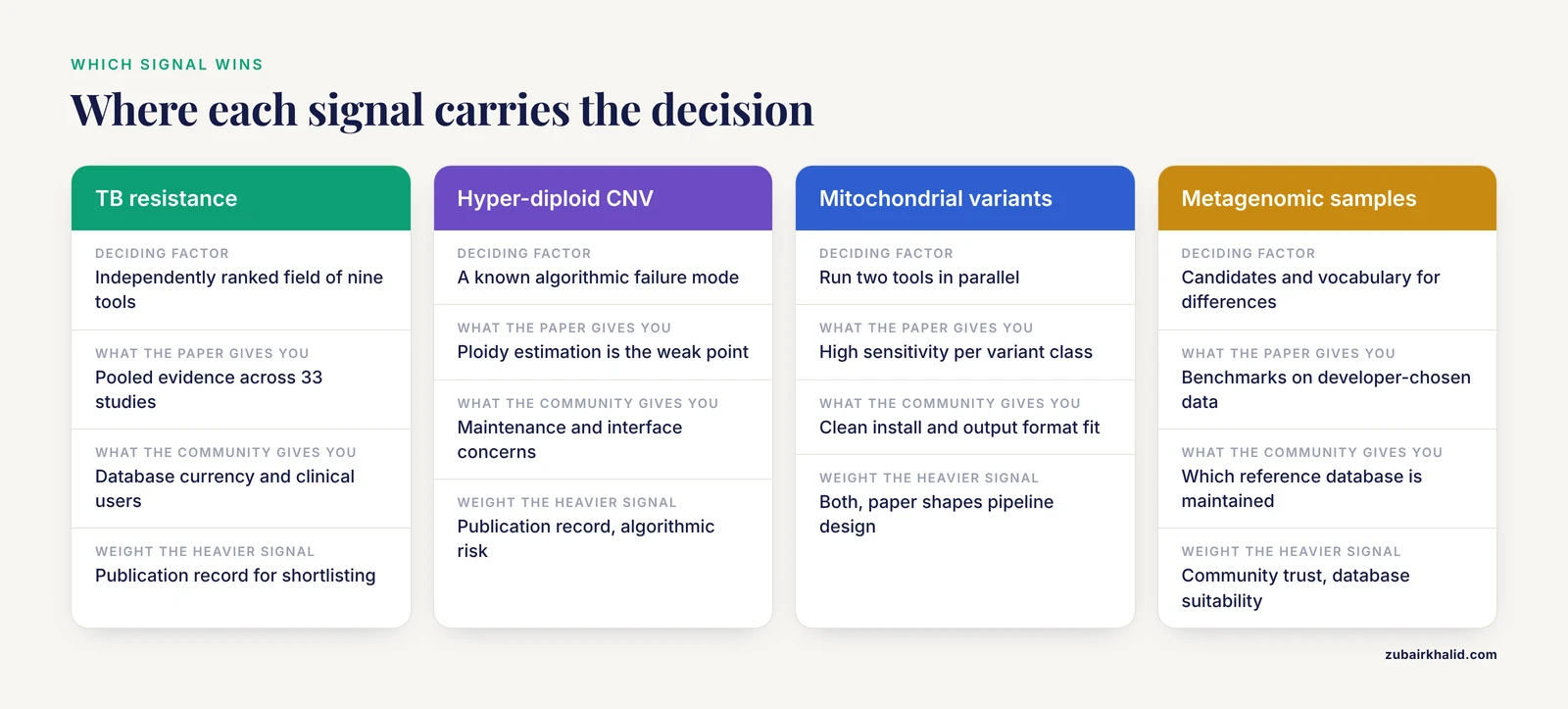
Abstract principles settle nothing. The following scenarios show how the publication track record versus community trust trade-off resolves in concrete situations.
Scenario One: Choosing a Drug Resistance Predictor for Clinical Mycobacterium Sequencing
You need to predict antituberculosis drug resistance from genome sequences, and the stakes include patient treatment. Start with the publication record. The network meta-analysis across 33 studies gives you a ranked, independently sourced field of candidates and identifies TBProfiler as the standout performer with area under the curve values near 0.97 to 1.00 for the most clinically important drugs [1]. This is exactly the situation where a publication record should dominate shortlisting, because the evidence was synthesized under a formal protocol rather than assembled from forum impressions. Then apply the community filter. Check whether the tool's database of resistance mutations is being updated, whether the version you would deploy is the version the studies tested, and whether laboratories with clinical accreditation report using it. High published accuracy plus stale reference data is a worse position than strong published accuracy plus active curation, and only the community signal tells you which you have.
Scenario Two: CNV Calling on a Hyper-Diploid Tumor Genome
Your sample is a cancer genome with abnormal chromosome counts. The comparative literature tells you the failure mode to worry about: tools that misestimate ploidy call excessive gains and losses even when their performance is otherwise sound [2]. Here the publication record earns its keep in a different way. It does not simply rank tools, it tells you the conditions under which each tool breaks. That lets you design a validation run that targets the known weakness, for example by checking whether a candidate's ploidy estimate matches what you see from an orthogonal measurement. Community trust contributes maintenance and interface concerns, but the decision-critical information in this scenario came from a benchmark, because the failure is algorithmic rather than operational. This is the profile of a case where you should weight the publication record more heavily than usual.
Scenario Three: Diagnostic Mitochondrial Variant Detection
You are setting up mitochondrial DNA variant analysis in a diagnostic context, where heteroplasmy, the coexistence of mutant and wild-type mitochondrial genomes in varying proportions, makes calls difficult. Two recently evaluated free tools, Mitopore and MitoSAlt, showed high sensitivity and specific accuracy for the variant types they target, and the evaluators recommended running them in parallel rather than choosing one [3]. This is a scenario where the publication record, read carefully, changes your pipeline design rather than just your tool choice. The community signal then answers the operational questions: which tool installs cleanly on your cluster, which produces output your downstream annotation scripts accept, and which has users you can consult when an ambiguous result appears.
Scenario Four: Metagenomic Classification of Environmental Samples
Your samples are high-diversity environmental communities. The published comparisons of classifiers were mostly run on developer-selected datasets, which the database evaluation literature flags as a direct obstacle to comparing tools against the current state of the art [8]. In this setting, the publication record gives you candidates and the vocabulary to describe their differences, but the deciding variable is database suitability, and database suitability is best judged by communities that work on environments like yours. This is the profile of a case where community trust, especially the trust embedded in which database each tool's user base maintains and documents, should outweigh headline benchmark numbers. A defensible approach is to test your shortlisted classifiers on a mock community with a known composition, using a reference database whose contents you have inspected yourself.
Publication Track Record Pros and Cons
Every bioinformatics tool publication track record option, from a single conference paper to a decade of independent evaluations, carries a characteristic set of strengths and liabilities. Listing them makes the trade-offs explicit.
Pros of relying on the publication record:
- Peer review filters out methods that are internally inconsistent or unsupported by the data shown.
- Papers document algorithms and settings, which makes results explicable and citable.
- Systematic reviews and independent benchmarks give you comparative evidence designed by neutral parties, as the tuberculosis tool analysis demonstrates [1].
- Stress-test studies reveal specific failure conditions, such as the ploidy estimation problem in CNV calling [2], which you can then design around.
Cons of relying on the publication record:
- Developer-run benchmarks favor the developer's tool in setup, tuning, and dataset selection.
- Publication conclusions go stale as competing tools and reference databases evolve.
- Papers measure accuracy under controlled conditions and say little about reliability across repeated runs, which studies in other domains show can be the decisive weakness [5], [6].
- A strong paper guarantees nothing about installation, maintenance, or support.
Pros of relying on community trust:
- Community experience covers the operational properties papers never test: installation, rerun stability, support responsiveness, and behavior on unusual inputs.
- Interactive evaluations with volunteer users, such as the BioCreative demonstration track, provide structured usability evidence [4].
- For database-dependent tools, the state of the community-curated reference data is often the best proxy for real accuracy [8].
Cons of relying on community trust:
- Adoption is driven partly by convenience and timing, so a popular tool is not necessarily the most accurate one.
- Community opinion skews toward users whose workflows survived, which hides silent failures in pipelines nobody audited.
- Trust forms slowly and locally, so a genuinely better new tool can sit untrusted for years, and forum consensus can outlive the conditions that produced it.
- Averaged user impressions, like averaged accuracy scores, can hide inconsistency between individual runs or invocations.
The last point deserves a note from adjacent literature. Research on privacy auditing tools found significant disparities both between different attack methods and between repeated instantiations of the same method, and proposed ensembles that aggregate across instantiations to produce more stable conclusions [10]. The transferable idea is that when a method's outputs vary between runs, combining multiple runs or multiple tools is a more robust strategy than trusting any single run, or any single community anecdote, as ground truth. Practitioners who use two or three orthogonal tools and require agreement before believing a call are applying this principle without needing the formal framework.
Common Mistakes and Limitations
The following mistakes account for most bad tool decisions in practice.
- Treating journal prestige as a proxy for tool quality. A paper's venue certifies the review process it passed, not the software's behavior on your data. Independent evaluation matters more than the journal name.
- Importing benchmark numbers directly into your expectations. An area under the curve of 0.99 in a published meta-analysis describes pooled studies, not your sample type [1]. Expect to confirm performance locally, on a subset you can verify.
- Ignoring the reference database as a component of the tool. For metagenomic classifiers and variant callers alike, the database is load-bearing. An evaluation of metagenomic databases showed that database choice determines whether tools can resolve low-abundance and closely related species at all [8]. A tool is only as current as its data.
- Confusing a single showcase run with reproducible behavior. Studies that ran identical questions through models multiple times found measurable inconsistency between runs [5], [6]. If a tool's output varies between invocations, one good run in a paper tells you very little.
- Mistaking popularity for validity. Community trust is evidence, but it is evidence about operational reliability and user satisfaction, not about biological correctness. A widely used tool can harbor a systematic bias that no casual user notices, which is why the stress-test literature exists.
- Reading only the tool's own papers. The publication record includes adversarial and neutral literature. If your search for independent evaluations of a tool returns nothing, that absence is itself information, and it should lower your confidence accordingly.
- Letting the first tool you encounter set your criteria. Without a written list of requirements, you will evaluate each new candidate against the previous candidate rather than against your actual needs, which is the failure mode that multi-criteria frameworks were designed to prevent [9].
- Trusting averaged evaluations of flexible, conversational tools as if they were deterministic. Expert-panel assessments of a chatbot in a clinical specialty found adequate accuracy but poor completeness in its answers, with improvement only after re-evaluation cycles [11], and a comparison of chatbot answers against resuscitation guidelines assessed completeness and currency as separate dimensions from accuracy [12]. When a tool generates variable, natural-language or heuristic output, ask about completeness and consistency as separate questions rather than collapsing everything into a single accuracy figure.
Two limitations bound all of the advice above. First, the comparative studies cited here examine particular tools in particular domains at particular times, and their rankings do not transfer automatically to other domains or to future versions of the software. Second, no general article can substitute for validation on your own data. For analyses with clinical or regulatory consequences, follow the validation requirements of the relevant professional and regulatory bodies for your setting, and treat every published number as a starting point for that validation rather than the end of it.
A Practical Decision Workflow
The following sequence converts the two signals into a repeatable procedure.
- Define your criteria and weights in writing before evaluating anything. Include accuracy, reliability, usability, maintenance status, database currency, and fit to your computing environment.
- Search for independent comparative evaluations of the candidate tools, prioritizing systematic reviews and benchmarks by groups unaffiliated with the developers [1], [2].
- Read the tool's own paper last, and read its benchmark section skeptically, checking competitor tuning and dataset choice.
- Inspect community signals: recent substantive commits, issue tracker responsiveness, versioning discipline, documentation quality, and container availability.
- For database-dependent tools, inspect the reference data directly, checking its coverage, currency, and documentation [8].
- Run your top two or three candidates on a small, well-characterized subset of your own data, repeating runs where outputs may vary and preferring tools or ensembles that agree across runs [10],.
- Record the versions, parameters, and results so your decision is itself reproducible.
This workflow assigns each signal the role it plays best. The publication record narrows the field and explains the algorithms. Community trust ranks the finalists operationally. Your own validation run makes the final call, which is where the decision was always going to be made.
Frequently Asked Questions
Does a bioinformatics tool need a publication before I should use it?
No, but the absence of a publication raises the burden of validation you must do yourself. Unpublished tools range from informal scripts to serious methods whose papers are in progress, and community experience can substitute for peer review when it is deep and specific. For high-stakes analyses, prefer tools with at least one independent evaluation, published or documented, before production use.
Which matters more for the best bioinformatics software, citations or community adoption?
Neither dominates in general. Citations indicate scholarly influence, community adoption indicates operational survival. The best predictor of a good experience is a combination: a tool with at least one strong independent evaluation and an active, responsive user base. A tool strong on only one dimension deserves scrutiny on the other before you build a pipeline around it.
How do I judge a bioinformatics tool publication track record fairly?
Read the whole record, not just the flagship paper. Look for independent benchmarks, systematic reviews, stress tests under adversarial conditions, and whether recent evaluations still rank the tool competitively. Check whether published accuracy claims include reliability measures such as consistency across repeated runs, and treat single-run results with caution.
Can I trust a tool whose paper is strong but whose code has not been updated in years?
Sometimes. Stable, mature tools with frozen code can be perfectly dependable, and many foundational bioinformatics programs change rarely for good reason. The risk is not age itself but the combination of age with an unresponsive author, a stale reference database, or an environment change that breaks the tool silently. Verify that the tool still runs correctly in your current environment before trusting it.
How should I validate a tool on my own data?
Select a small subset of your data where the correct answer is known from an independent method or prior characterization. Run each shortlisted tool, ideally more than once if outputs can vary, and compare results against the known answer and against each other. Record versions and parameters exactly. Agreement across tools and runs increases confidence, while disagreement points to the specific conditions under which a tool fails.
What is the fastest way to gauge community trust in a tool?
Check three things in order. First, the issue tracker, for response times and how the maintainers handle bug reports. Second, the most recent substantive code change and release history. Third, mentions of the tool in recent talks, pipeline documentation, or forum threads by users with data similar to yours. If all three look healthy, community trust is likely warranted, subject to your own validation run.
Sources
- Diagnostic yield of nine user-friendly bioinformatics tools for predicting Mycobacterium tuberculosis drug resistance: A systematic review and network meta-analysis
- Evaluation of somatic copy number variation detection by NGS technologies and bioinformatics tools on a hyper-diploid cancer genome
- Bioinformatics Tools for NGS-Based Identification of Single Nucleotide Variants and Large-Scale Rearrangements in Mitochondrial DNA
- Overview of the COVID-19 text mining tool interactive demonstration track in BioCreative VII.
- Assessing the Accuracy and Reliability of Large Language Models in Psychiatry Using Standardized Multiple-Choice Questions: Cross-Sectional Study
- Evaluating the Accuracy and Reliability of Large Language Models (ChatGPT, Claude, DeepSeek, Gemini, Grok, and Le Chat) in Answering Item-Analyzed Multiple-Choice Questions on Blood Physiology
- Accuracy and Reliability of AI-Generated Text Detection Tools: A Literature Review
- A comprehensive study of databases to assess the reliability of metagenomic tools
- A Novel Framework to Evaluate Software Reliability Prediction Models Using Multi-Criteria Decision-Making
- Membership Inference Attacks as Privacy Tools: Reliability, Disparity and Ensemble
- Assessing the Accuracy, Completeness, and Reliability of Artificial Intelligence-Generated Responses in Dentistry: A Pilot Study Evaluating the ChatGPT Model
- Evaluating the accuracy and reliability of AI chatbots in disseminating the content of current resuscitation guidelines: a comparative analysis between the ERC 2021 guidelines and both ChatGPTs 3.5 and 4