Bioinformatics Program Accreditation: What It Means and Why It Matters
By Dr. Zubair Khalid, DVM, MS, PhD ·

Bioinformatics program accreditation is the formal, external review of a university degree or certificate program against published standards for curriculum, faculty, infrastructure, and student outcomes, performed by a recognized accrediting body rather than by the school itself. An accredited program has demonstrated to independent reviewers that it delivers what it promises, and that judgment is renewed on a regular cycle rather than granted once and held indefinitely.
The stakes are practical for anyone deciding where to learn bioinformatics. A graduate program consumes years of your working life along with a substantial tuition bill, and employers, graduate admissions committees, and credential evaluators all screen for accreditation before they look at anything else. Credit transfer between schools, eligibility for federal financial aid, and acceptance of your coursework toward future credentials all trace back to accreditation status. The bioinformatics label adds a specific risk, because the field moves faster than most curricula, and two programs with identical names can differ enormously in how much real computational work they require of students. Independent review is the closest thing higher education offers to a quality seal, but the seal has to be read correctly, and this guide shows you how to read it.
Bioinformatics Program Accreditation Explained
What does bioinformatics program accreditation mean in everyday terms? Think of it as peer review for degrees. Faculty and practitioners from the discipline, trained by an accrediting body, judge whether a program meets standards that the academic and professional community has agreed on. The reviewers are volunteers drawn from other universities and from industry, they follow published criteria, and they base their judgment on documents and interviews rather than on reputation or marketing.
Two layers of review exist, and they answer different questions. Institutional accreditation asks whether the college or university as a whole is sound, financially stable, and capable of delivering the programs it sells. Programmatic accreditation, sometimes called specialized or professional accreditation, asks whether one specific degree program, such as a Master of Science in bioinformatics, meets the standards of that discipline. A program can operate inside a fully accredited university and still never have been reviewed as a bioinformatics program, because nobody ever examined its curriculum, laboratories, and faculty through a bioinformatics lens.
A workable interpretation of bioinformatics program accreditation comes down to three questions. Which body performed the review? Which standards did it apply? Which unit did it review, the institution or the program? Recruitment materials often blur these distinctions. A banner that says "Accredited University" tells you nothing about whether the bioinformatics curriculum was ever examined by anyone who works in the field.
Accreditation is also periodic. Accreditors grant status for a defined term and require fresh evidence at each renewal, along with interim reports and notice of major changes such as a new fully online delivery format. A program that earned accreditation a decade ago and has not been revisited since is not in the same position as one reaffirmed last year. Status can carry conditions, warnings, or probation, and it can be withdrawn.
Finally, accreditation is voluntary in the legal sense. No law forces a university to submit a program for specialized review. Schools do it because the payoff is real, including credibility with applicants, smoother credit transfer, and continued access to students who depend on financial aid, and because institutional accreditation is effectively mandatory for any serious degree-granting institution in the United States.
Terms Often Confused With Accreditation
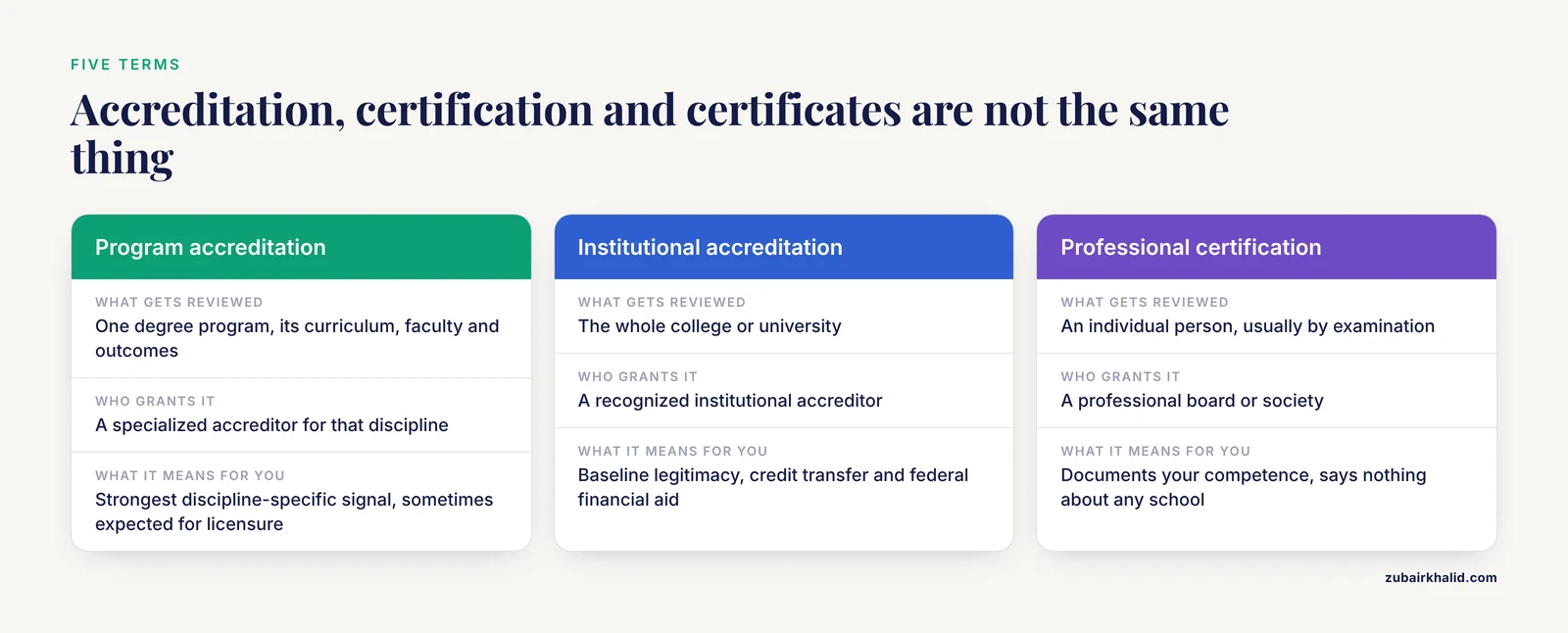
Applicants mix up five terms constantly, and the confusion has financial consequences. The table below separates them.
| Term | What gets reviewed | Who grants it | What it means for you |
|---|---|---|---|
| Program accreditation (programmatic) | One degree program, its curriculum, faculty, and outcomes | A specialized accreditor for that discipline | Strongest discipline-specific signal, sometimes expected for licensure or certification routes |
| Institutional accreditation | The whole college or university | A recognized institutional accreditor | Baseline legitimacy, credit transfer, and federal financial aid eligibility |
| Professional certification | An individual person, usually by examination | A professional board or society | Documents your competence, says nothing about any school |
| Certificate program | Completion of a short course sequence | The university itself | Useful for skills, not the same as accreditation |
| Rankings, badges, and endorsements | Reputation metrics or marketing claims | Media outlets or vendors | Not peer review, not a substitute for accreditation |
A worked example makes the distinctions concrete. Suppose a school advertises a twelve-credit online certificate in bioinformatics and notes that the university is accredited. That sentence is accurate and nearly empty. The certificate itself was probably never reviewed by a specialized accreditor, because short certificates rarely are. What you actually know is that the institution behind it passed an institutional review. Whether the bioinformatics course sequence teaches current methods is a separate question you must answer by reading the syllabi.
How Program Accreditation Works, Step by Step
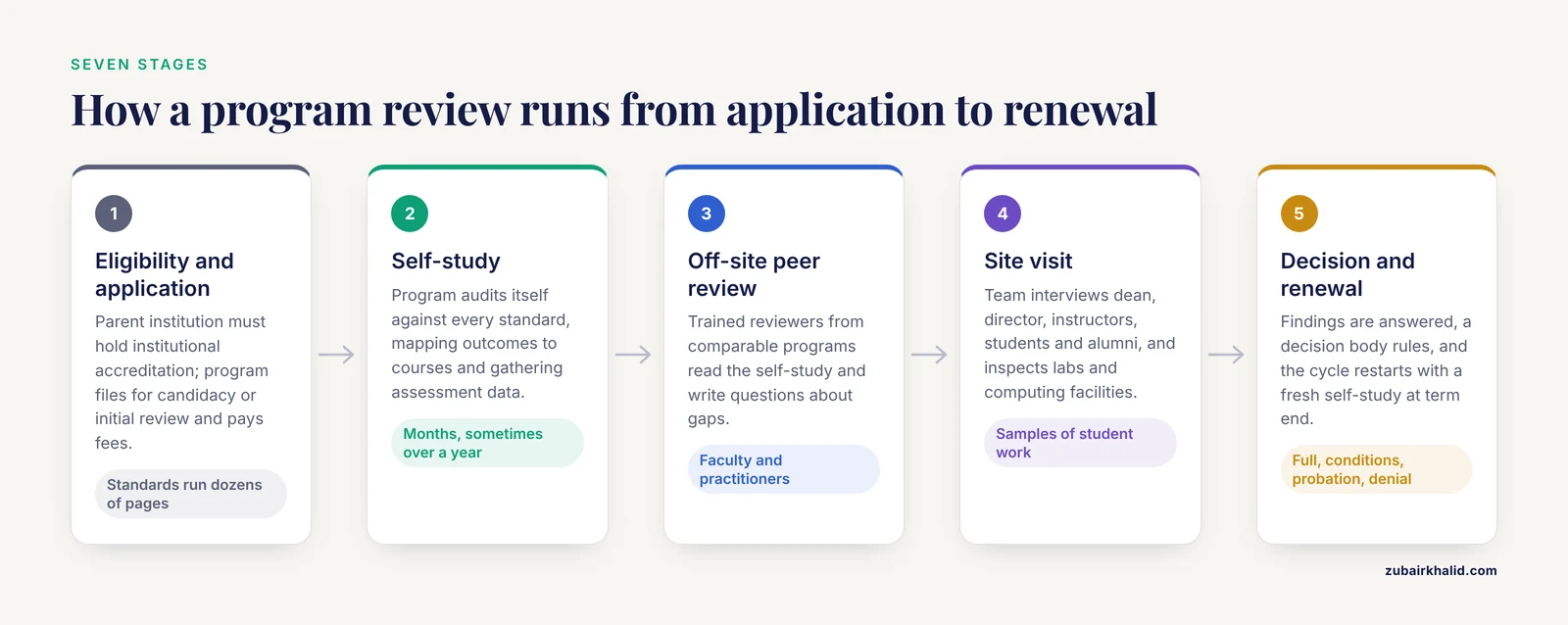
The machinery looks similar across accreditors, although names and cycle lengths differ. Seven stages cover almost every review.
- Eligibility and application. A programmatic accreditor normally requires the parent institution to hold recognized institutional accreditation first. The program then files for candidacy, a pre-accreditation status for newer programs, or for initial review, pays fees, and receives the current standards document, which can run to dozens of pages covering outcomes, faculty, curriculum, facilities, and assessment.
- Self-study. The program spends months, sometimes more than a year, auditing itself against every standard. The self-study maps each required learning outcome to the courses that teach it, documents faculty credentials and workload, describes laboratories and computing resources, and presents assessment data showing what students actually learned. This document becomes the backbone of the entire review.
- Off-site peer review. Trained reviewers, typically faculty and practitioners from comparable programs elsewhere, read the self-study against the standards and write questions. Weak claims, gaps in assessment data, and inconsistencies between the marketing copy and the syllabi surface here.
- Site visit. A visiting team interviews the dean, the program director, instructors, current students, and often alumni and employer advisory board members. The team inspects teaching laboratories and computing facilities and pulls samples of student work to check that the self-study describes reality. Online programs receive the same treatment, with added attention to how remote students access software, data, and advising.
- Findings, response, and decision. The team drafts a report listing strengths, weaknesses, and specific compliance shortfalls. The program responds, sometimes correcting deficiencies with documentation and sometimes committing to a timeline. The accreditor's decision body then chooses among outcomes such as full accreditation, candidacy status, accreditation with conditions, probation, or denial.
- Monitoring between reviews. Accredited programs file annual or interim reports and must notify the accreditor of substantive changes, meaning a materially different curriculum, a new location, or a new delivery mode. Small problems trigger letters requiring correction, larger ones trigger focused visits.
- Renewal or withdrawal. At the end of the term, the cycle restarts with a fresh self-study. A program that stops meeting standards can be placed on probation or lose accreditation entirely, and accreditor directories record those outcomes publicly.
Evidence of student learning drives the whole process. Accreditors increasingly want programs to define measurable outcomes, assess them with rubrics, which are structured scoring guides, act on the results by changing courses, and then measure again. That closed loop, not the age of the school or the size of its endowment, is what the review is designed to test.
Who Reviews Bioinformatics Programs?
The United States has no federal ministry that approves degrees. Quality assurance is delegated to independent accreditors, whose own legitimacy is checked by two bodies, the US Department of Education and the Council for Higher Education Accreditation, usually abbreviated CHEA. An accreditor recognized by either can plausibly claim to run a rigorous process. An accreditor recognized by neither deserves suspicion, whatever its website says.
The first layer is institutional. Six large commissions, historically organized by region, review entire institutions. Examples include the Higher Learning Commission, the Middle States Commission on Higher Education, and the Southern Association of Colleges and Schools Commission on Colleges. If a university lacks this baseline accreditation, its students generally cannot access federal financial aid, and other schools will hesitate to accept its credits.
The second layer is programmatic, and this is where bioinformatics gets complicated. The field has no single dedicated accreditor that every program answers to. Instead, the accreditor of record depends on where the program lives within the university.
- Programs housed in computer science or engineering colleges sometimes pursue review by ABET, the major accreditor for engineering, computing, and applied science programs, under that body's computing criteria.
- Programs oriented toward hospitals and health systems may sit near health informatics, where the Commission on Accreditation for Health Informatics and Information Management Education, CAHIIM, operates.
- Programs framed around population health can fall under the Council on Education for Public Health, CEPH.
- Laboratory-oriented programs, including medical laboratory science degrees that increasingly touch molecular methods, answer to the National Accrediting Agency for Clinical Laboratory Sciences, NAACLS.
Professional societies shape expectations without accrediting anyone. The American Medical Informatics Association has published core competency recommendations for biomedical informatics training that many programs borrow as a benchmark, and disciplinary societies in genetics and microbiology publish similar curricular guidance.
Outside the United States, the picture changes again. Most countries run national quality-assurance agencies or ministerial review systems, and foreign accreditation does not transfer automatically into US hiring or admissions contexts. Credential evaluation services exist precisely to bridge that gap for individual degrees.
One warning belongs here. Entities exist that will accredit almost anything for a fee, and their acronyms look convincing on a brochure. Before you weight any accreditation claim, confirm that the accreditor itself is recognized, a step covered later in this guide.
What Accreditors Expect a Bioinformatics Curriculum to Teach
Accreditation standards for computing-adjacent and life-science programs converge on the same categories, defined learning outcomes, a curriculum sufficient to reach them, qualified faculty, adequate infrastructure, and evidence that outcomes are actually assessed. For a bioinformatics program, the curriculum question is where most of the action sits, and it helps to know the core topics reviewers expect to see mapped.
Foundations. Molecular biology and genetics, enough to understand what sequencing data represents, plus statistics and probability at a level that supports hypothesis testing on high-throughput data. Programs weak on either pillar produce graduates who can run tools but cannot judge the outputs.
Programming and data handling. Working fluency in Python or R, comfort on the Unix command line, and basic relational database skills including SQL. Version control with Git belongs here, because reproducibility is now treated as a baseline professional habit rather than an advanced option.
Sequence and genome analysis. Pairwise alignment and BLAST searches, where BLAST is the Basic Local Alignment Search Tool used to find similar sequences in public databases, multiple sequence alignment, phylogenetic inference, genome assembly and annotation, RNA-seq differential expression analysis, and variant calling from aligned reads. RNA-seq refers to experiments that count sequencing reads to measure gene expression, and variant calling means identifying differences between a sample's genome and a reference genome.
Public data resources. NCBI's GenBank and Sequence Read Archive, EMBL-EBI's suite of databases and tools, and UniProt for curated protein information. These are the shared infrastructure of the entire field, and familiarity with them is assumed in nearly every job posting.
Reproducible workflows. Workflow managers such as Nextflow or Snakemake, environment and container tools such as Conda and Docker, and disciplined project organization. The goal is that a classmate, or a future employer, can rerun your analysis and reproduce your numbers.
Responsible practice. Privacy obligations for human genomic data, honest reporting of negative results, and awareness of the limits of automated predictions.
Infrastructure standards matter as much as topic lists in this field. Reviewers will ask where students run analyses, whether on a university high-performance computing cluster, the shared server system that handles large analysis jobs, on cloud credits, or on ordinary laptops, and whether teaching uses real datasets with realistic messiness rather than sanitized toy examples.
A concrete picture of working-level skill comes from public health practice. At Sciensano, the Belgian national public health institute, bioinformaticians built a Galaxy-based analysis portal for microbial genomics, combining community tools with more than 50 custom tools and push-button pipelines that carry a bacterial isolate's whole-genome sequencing data through quality control, de novo assembly, sequence typing, and antimicrobial resistance prediction, then return an interactive HTML report to the bench scientist [1]. Whole-genome sequencing means reading the entire DNA sequence of an organism, de novo assembly means reconstructing that genome from short reads without a reference template, and sequence typing means assigning the isolate to a known epidemiological type. The push-button design is deliberate. It lets microbiologists without command-line skills get answers, which is exactly why such platforms also make excellent teaching environments. A strong bioinformatics program produces students who can press the buttons and explain what each button does, why read quality thresholds matter, and when a typing result should not be trusted. That distinction between operating a pipeline and understanding one is a good proxy for the difference between a weak program and a strong one, whatever the accreditation status of either.
What Accreditation Does and Does Not Guarantee
Accreditation sets a floor, not a ceiling, and the floor can lag far behind the field. One recent study makes the point with unusual clarity.
A 2026 nationwide review published in the Journal of Microbiology and Biology Education examined how far accredited medical laboratory science programs in the United States have adapted their curricula to molecular diagnostics, bioinformatics, and artificial intelligence, using Rogers' Diffusion of Innovation framework, a model describing how innovations spread from innovators through early adopters to the early majority [2]. The researchers reviewed the websites of 489 accredited programs and surveyed 67 program directors. On the websites, 46.3 percent of programs offered molecular diagnostics coursework, while bioinformatics content appeared on 0.8 percent and artificial intelligence content on 0.2 percent [2]. The directors rated sequencing-based and AI-based tools as increasingly important for workforce readiness, yet reported steep barriers, limited curriculum time (86.6 percent), lack of faculty expertise (68.7 percent), budget constraints (68.7 percent), and insufficient infrastructure (67.2 percent) [2]. Programs that had added molecular diagnostics required more total credits and longer durations than those that had not [2]. Within the diffusion framework, molecular content had reached the early majority while computational topics remained confined to early innovators, and the directors called for standardized national curriculum guidelines and expanded faculty training [2].
Read those numbers as a caution about the meaning of the word accredited. Every program in that dataset belonged to an accredited, standardized profession with an established programmatic accreditor, and bioinformatics content was still nearly absent. Accreditation verified that the programs met their accreditor's standards. It did not guarantee that those standards, or the curricula built to satisfy them, reflected the computational reality of modern laboratory work.
The lesson transfers directly to bioinformatics degrees. An accreditor's standards are written by committees and revised on multi-year schedules, while tools, file formats, and best practices in computational biology change month to month. A program can be fully compliant and still teach a workflow that industry replaced two years ago. Conversely, a program can be excellent and slightly out of compliance on a documentation requirement. Accreditation status is one signal among several, and the strongest signal remains the published curriculum, the faculty's current research, and the visible evidence of hands-on computational work.
How Accreditation Is Checked in Practice
From the Reviewer's Side
Reviewers distrust assertions and look for artifacts. Typical evidence includes syllabi matched to outcome maps, graded samples of student work with rubric scores, capstone reports, where a capstone is the integrative final project required by many degree programs, minutes from employer advisory boards, faculty CVs with recent scholarly activity, and placement or further-education tracking where the program collects it. During the site visit, the team cross-examines documents against people, asking students whether they actually used the computing cluster the self-study describes, or asking recent graduates how well a particular course prepared them for their current job. Programs that treat assessment as a paperwork exercise tend to fail this cross-check, because students describe reality more candidly than brochures do.
The strongest evidence pattern in a bioinformatics program is visible student work on real data. Reviewers respond well to portfolios showing analyses carried from raw sequencing reads through quality control to a defensible biological conclusion, the same arc that working laboratories build into their production pipelines [1]. A course list alone, however current, proves less than a drawer full of student projects.
From the Applicant's Side
You can run a version of the same audit in an afternoon.
- Ask the admissions office, in writing, to name the accrediting body for the institution and for the bioinformatics program specifically.
- Search that accreditor's public directory for the exact program name, degree level, and campus. Directories list sanctions and probation as well as clean approvals.
- Confirm that the accreditor is recognized by the US Department of Education or listed by CHEA.
- Separate the two claims that appear in recruitment material, institutional accreditation and programmatic review, and ask which one each sentence refers to.
- Read the published curriculum against the core topics described earlier, then email the program director and ask where students get compute access and what datasets the capstone uses.
Programs that answer those questions quickly and specifically are telling you something that goes beyond their accreditation status.
Why Accreditation Matters for Your Career
For students, the consequences cluster into four practical areas.
Money. Institutional accreditation is the gate for federal financial aid. Unaccredited institutions cannot disburse federal loans and grants, which means the sticker price of an unaccredited program is effectively the full price, with no aid offset.
Mobility. Credits from accredited institutions transfer far more readily, and graduate admissions committees treat accredited coursework as trustworthy. If there is any chance you will later pursue a doctorate, change specialties, or relocate, accreditation protects those options.
Employment screening. Human resources departments and credential verifiers check accreditation routinely, particularly for roles in regulated settings such as clinical laboratories, public health, and pharmaceutical development. A degree from an unaccredited program can be filtered out before a human ever reads your project portfolio.
Skill signal. This is where bioinformatics adds its own twist. Employers in genomics-intensive settings need people who can actually analyze data, and that demand is documented. Public health and clinical diagnostic laboratories adopting whole-genome sequencing report that finding staff with adequate bioinformatics expertise is a genuine bottleneck, which is precisely the gap that well-trained graduates fill [1]. Accreditation contributes by forcing programs to define outcomes and prove that students reached them, but your interview will still turn on what you can do at a terminal, so choose a program where doing the work is unavoidable.
The relationship between accreditation and skill runs in the direction applicants often miss. Accreditation verifies that a program has a defensible system intended to produce competence. The system can be defensible while the content stays thin, which is why the curriculum-reading habit described above matters more than any logo.
Common Mistakes and Limitations
Mistakes in this area are predictable, which makes them avoidable.
- Reading "accredited university" as "accredited program." Recruitment copy frequently borrows the institution's status. Ask which unit holds which accreditation, and get the answer in writing.
- Assuming accreditation guarantees current computational content. A nationwide review of accredited laboratory science programs found accredited status coexisting with near-total absence of bioinformatics content in the surveyed curricula [2]. The lesson generalizes. Verify the course list yourself.
- Confusing certificates, certifications, and accreditation. A certificate is a completion document issued by a school, a certification is an examination-based credential earned by an individual, and accreditation is a status held by an institution or program. None of the three substitutes for another.
- Trusting unrecognized accreditors. An impressive acronym is not evidence. Recognition by the US Department of Education or CHEA is the filter.
- Assuming foreign accreditation transfers automatically. It does not, and credential evaluation exists because equivalence must be established case by case.
- Treating accreditation as permanent. Status runs in cycles, carries conditions, and can lapse. Check the accreditor's current listing rather than a marketing page that may be years old.
- Choosing on accreditation alone. Fit matters, including research mentors, elective depth, compute access, and whether graduates leave with portfolios. Two accredited programs can differ more than an accredited program and an unaccredited one.
One limitation deserves a plain statement. Accreditation reviews a program's inputs and documented outcomes, not your individual trajectory, and no credential substitutes for building skill through deliberate practice. Individual career outcomes depend on effort, mentorship, and market conditions.
Quick Review
- Accreditation is independent, periodic, peer review against published standards, and it attaches to either an institution or a single program.
- Institutional accreditation covers the whole school and gates federal financial aid, programmatic accreditation covers one degree.
- Bioinformatics has no single dedicated accreditor in the United States, so the accreditor of record depends on whether the program sits in computer science, public health, health informatics, or laboratory science.
- Verify every claim in the accreditor's public directory, then confirm the accreditor's recognition by the US Department of Education or CHEA.
- Accredited status does not guarantee modern computational content, so read the actual course list and syllabi.
- Certification evaluates individual people, accreditation evaluates programs, and certificates are neither.
- Strong programs make you do the work, raw sequencing reads in, defensible biological conclusions out, with version control and reproducible workflows throughout.
Frequently Asked Questions
What does bioinformatics program accreditation mean?
It means an independent accrediting body reviewed the program against published standards covering curriculum, faculty, infrastructure, and student outcomes, and confirmed that the program meets them. The status is periodic, so it reflects a recent evaluation rather than a one-time award.
Is there a single accreditor that specializes in bioinformatics programs?
No. In the United States, bioinformatics programs are reviewed under whatever umbrella houses them, typically institutional accreditation combined with programmatic review in computing, health informatics, public health, or laboratory science. Ask which body reviewed the specific program you are considering.
Does accreditation matter if I plan to learn bioinformatics through a short bioinformatics course?
Accreditation attaches to degree and certificate programs, not to individual short courses or massive open online courses. Judge a standalone bioinformatics course by its syllabus, the instructor's background, and whether you finish real analyses on real data.
How do I check whether a bioinformatics program is really accredited?
Ask the school to name the accrediting body in writing, find the program in that accreditor's public directory, and confirm the accreditor is recognized by the US Department of Education or CHEA. Keep institutional and programmatic claims separate while you check.
Is an unaccredited bioinformatics program ever a reasonable choice?
For a degree that needs to transfer, qualify for federal aid, or satisfy future admissions or employer screening, the risks outweigh the benefits. For informal continuing education with no credential at stake, an unaccredited offering can still teach valuable skills.
What is the difference between accreditation and certification in bioinformatics?
Accreditation evaluates an institution or program, while certification evaluates an individual person through an examination or credentialing process. An accredited program can prepare you for a certification, but the two labels describe different things.