How to Handle Information Overload in Bioinformatics
By Dr. Zubair Khalid, DVM, MS, PhD ·

The core difference between struggling with bioinformatics information overload and managing it well is this: overload comes from treating every dataset, method, and paper as something you must process personally, while the workable alternative is building systems that filter, reduce, and automate the information before it ever reaches your desk. The rule of thumb is simple. If a task repeats more than three times, automate it. If a dataset has more features than you can inspect by eye, reduce it. If a method appears in more than three papers you respect, learn it properly, and ignore the other forty that do the same job.
This article walks through the main options for handling information overload in bioinformatics, compares them on the criteria that decide real choices, works through concrete scenarios, and lists the mistakes that cost people the most time. The advice applies whether you process clinical sequencing data, single-cell transcriptomics, imaging, or multi-omics study results.
What Information Overload in Bioinformatics Actually Looks Like
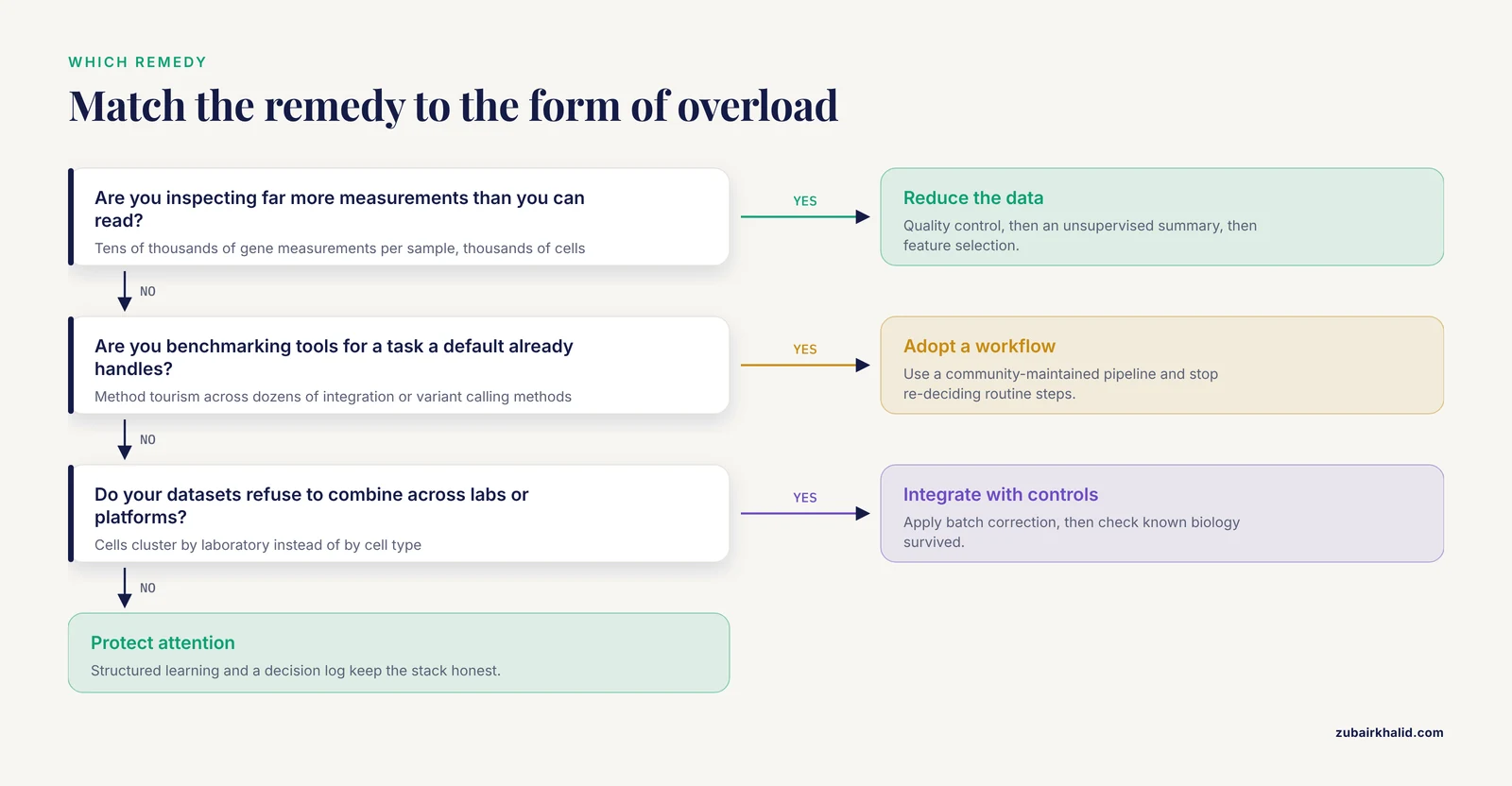
Overload in this field takes three distinct forms, and each one needs a different remedy. Recognizing which form you face is the first practical step.
Data volume overload. Sequencing technologies now generate datasets far larger than any analyst can examine directly. Computational biology regularly acquires large quantities of data describing cell types and states from many sources and many methods, and that volume comes at the price of increasing complexity, driven by the multiplication of data types and by batch effects that hinder combining data within common analyses [1]. A single RNA-seq experiment can return tens of thousands of gene expression measurements per sample. A single-cell experiment multiplies that by thousands of cells. Nobody reads all of it. The professionals who cope well are the ones who accept that most measurements will never be individually inspected and who design analyses around that fact.
Method overload. Dozens of methods have been proposed in the last decade for data integration alone, relying on different machine learning paradigms, and new preprints appear weekly [1]. The same pattern repeats in variant calling, differential expression, batch correction, and machine learning for biomarkers. The failure mode is method tourism: spending weeks benchmarking tools for a task that a well-established default handles adequately.
Cognitive overload. This is the human-side problem. Emergency medicine researchers describe clinicians making rapid decisions with limited information under cognitive overload, and note that artificial intelligence can reduce that load by automating data retrieval and surfacing essential details quickly [2]. A bioinformatician juggling sample sheets, parameters, papers, Slack threads, and reviewer comments sits in the same position. Attention, not storage, is the bottleneck.
These three forms interact. Data volume creates method proliferation, method proliferation creates cognitive load, and cognitive load makes you prone to errors that standardized systems would have caught. Handle them in that order.
The Main Options at a Glance
There are five practical options for managing information overload in bioinformatics work. Most analysts eventually use several in combination. The table below is the core of this article, and the sections that follow explain each option on its own terms.
| Option | What it solves | Best fit | Main drawback | Typical effort |
|---|---|---|---|---|
| Standardized workflows | Inconsistency and manual rework across repeated analyses | Labs running the same pipeline on many samples routinely | Upfront setup cost, less flexibility for one-off analyses | High once, low afterward |
| Dimensionality reduction and feature selection | Too many variables to interpret or model | High-dimensional omics data, biomarker discovery, gene expression panels | Risk of discarding biologically meaningful signal | Moderate |
| Data integration and batch correction | Datasets from different sources that refuse to combine cleanly | Multi-omics projects, single-cell meta-analyses, multi-batch studies | Integration methods can erase real biological differences if misapplied | Moderate to high |
| AI and machine learning decision support | Prioritizing what deserves human attention | Prediction tasks, triage of candidates, missing modality imputation | Validation burden, opaque models, implementation complexity | High |
| Structured learning and curation habits | Method overload and the firehose of new papers | Anyone starting out, or changing subfields, or staying current | Ongoing time commitment with no immediate deliverable | Low per week, continuous |
Read this table as a decision aid, not a ranking. The best bioinformatics information overload strategy for a core facility running hundreds of sera per week is different from the best strategy for a graduate student analyzing one dataset for a thesis chapter.
Option 1: Standardized, Reproducible Workflows
A workflow, in this context, is a pipeline that chains together quality control, processing, and reporting steps so the same analysis runs the same way every time. Tools such as Nextflow and Snakemake, and community collections such as nf-core, exist to make this practical, and this is established infrastructure knowledge rather than a claim from any single study.
The clearest published demonstration of why this matters for information overload comes from genomic surveillance. During the COVID-19 pandemic, genomic programs traced transmission chains, discovered new viral lineages and mutations, and assessed them for infectiousness and treatment resistance, all of which depended on accurate genome sequences produced at scale [3]. Amplicon sequencing on Illumina platforms became a routine bioinformatics task for reconstructing SARS-CoV-2 genomes, yet routine did not mean easy. Specific challenges arose when lineage-determining mutations fell near primer sites, and researchers at the German public health institute packaged their solutions into CoVpipe2, a workflow covering quality control, mapping, variant calling, and consensus generation, with added features for detecting mixed samples and recombinants [3].
The lesson for overload is not about SARS-CoV-2 specifically. The CoVpipe2 authors documented the pitfalls they had to solve explicitly, including primer clipping, detecting heterozygous variants, and handling low-coverage regions and deletions [3]. Those pitfalls are exactly the kind of information that, without a standardized workflow, lives in one senior analyst's head and leaks away every time that person changes jobs. A workflow converts scattered tacit knowledge into an executable, versioned artifact.
Pros:
- Eliminates the largest source of cognitive load in routine work, which is deciding, again, how to process a sample type you have processed a hundred times.
- Makes parameter changes and version upgrades auditable, which matters when results feed publications or public health reports.
- Allows new team members to contribute in days rather than months, because the decision points are explicit.
- Surfaces failures early. A workflow with built-in quality control flags a bad library before it contaminates downstream interpretation.
Cons:
- Building one well takes real time, and the temptation is to keep patching ad hoc scripts forever instead.
- Standardization can mislead. A pipeline that runs cleanly end to end can still produce wrong answers if the protocol-specific assumptions baked into it do not match your data. CoVpipe2 exists precisely because generic pipelines missed amplicon-specific problems near primer sites [3].
- Maintenance is a continuing obligation. Reference genomes change, tool versions change, and an unmaintained workflow decays into a new source of confusion.
The practical recommendation: adopt a community-maintained workflow for standard task types before writing your own, and reserve custom development for the steps genuinely specific to your protocol.
Option 2: Dimensionality Reduction and Feature Selection
When the problem is not how you process data but that the data has too many variables to reason about, the answer is to reduce it deliberately. Dimensionality reduction compresses many correlated measurements into a smaller number of summaries. Feature selection goes further and keeps only the variables that carry signal for the question at hand.
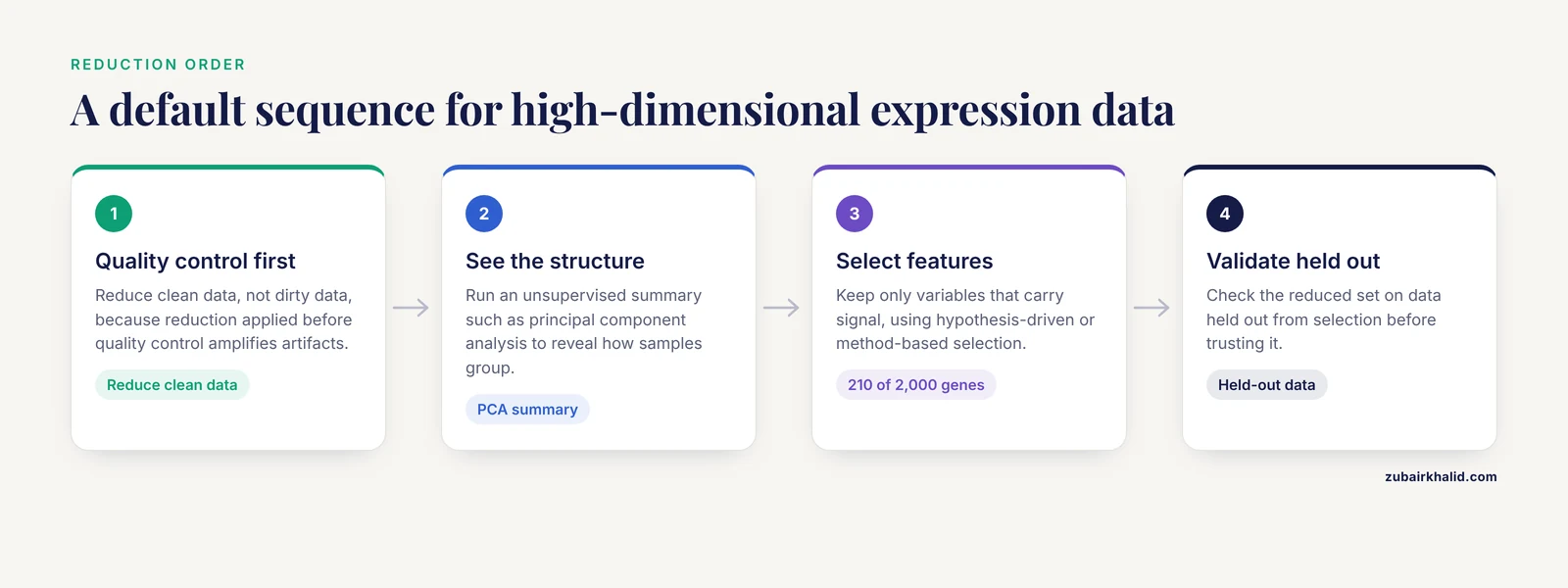
The scale of the problem is easy to state. Gene shaving, the task of identifying a meaningful subset of genes from the very large number in the human genome, has long been recognized as an essential but challenging tool for biomedical researchers because of both genome size and the complexity of biological networks [4]. Classic linear methods fail on nonlinear and multi-view datasets, which is why a kernel-based gene shaving approach built on the influence function of kernel canonical correlation analysis was proposed. In a colon cancer microarray analysis, that method identified a significant subset of 210 genes out of 2,000 candidates while outperforming existing state-of-the-art methods on metrics including true positive rate, false discovery rate, and area under the curve [4].
The practical value is not the specific number but the ratio. Reducing 2,000 candidate genes to a 210-gene set that a team can actually validate, discuss, and follow up on is the difference between a result and a spreadsheet.
A related lesson about restraint comes from malaria surveillance research. Antibody responses to Plasmodium falciparum persist after infection, which makes serology attractive for measuring past exposure, but identifying which antibody responses actually mark the timing and intensity of exposure remains difficult, particularly among adults who have been re-exposed many times and therefore show similarly high responses to many antigens [5]. More measurements did not automatically mean more answers. The informative subset had to be found with dedicated machine learning methods, not read off a heatmap [5].
Pros:
- Makes results interpretable by humans, which is a requirement for any downstream decision.
- Reduces statistical burden. Fewer features means fewer multiple-testing corrections and more power per test.
- Often improves prediction, because noisy features actively hurt most models.
Cons:
- Every reduction is a bet about what matters, and the bet can be wrong. A feature discarded as noise in one context can be the key variable in another.
- Feature selection methods differ enough in their assumptions that results are not interchangeable between them.
- Reduction applied before quality control amplifies artifacts rather than removing them. Reduce clean data, not dirty data.
A reasonable default sequence for high-dimensional expression data: quality control, then unsupervised summary such as principal component analysis to see structure, then hypothesis-driven or method-based feature selection, then validation on held-out data.
Option 3: Data Integration and Batch Correction
Integration addresses a different overload problem. You have several datasets that individually make sense but refuse to combine, because they come from different laboratories, platforms, or batches. Working with this amount of data comes at the price of complexity caused by the multiplication of data types and batch effects, which hinders joint usage of all available data in common analyses [1].
Integration methods learn a joint representation that embeds datasets of different origins or modalities so that downstream analyses can proceed on combined data [1]. Machine learning innovations drove most of the progress here, and the field now has dozens of methods organized around different paradigms, which is itself a source of overload that a review like this one exists to cut through [1].
Three concrete examples show the range of the problem and its solutions.
In single-cell genomics, the exponential growth of single-cell RNA-sequencing datasets across conditions creates a strong incentive to combine them, but datasets from different laboratories or technologies carry batch effects interwoven with biological variation. A domain adaptation-based method called SCIDRL learns low-dimensional representations invariant to batch effect, and across thirteen simulated and real datasets it performed well in two particularly hard situations, integrating batch-shared rare cell types while preserving batch-specific ones, and integrating datasets with different cell compositions [6].
In multi-omics studies, the problem shifts. Integrative analysis promises better modeling of disease biology than single-omics analysis, but technology variations produce inconsistent distributions across the different omics layers, and existing discriminant methods force a compromise between correlation and discrimination. PANDA, a joint discriminant analysis method, learns consistent discriminant latent representations for each omics layer, jointly maximizing between-class and minimizing within-class variation in a common space while modeling cross-omics relationships [7].
In imaging, the same issue appears as staining variation. Hematoxylin and eosin staining does not exclusively label nuclei and cytoplasm, and the color variation between H&E and fluorescent staining makes cross-analysis difficult for AI algorithms. A workflow using color normalization and nucleus extraction allowed an H&E-trained segmentation model to be applied to fluorescent images, reaching 89.6 percent accuracy on H&E images and 80.5 percent on fluorescent-stained images for recognizing specific breast cancer tumor features [8].
Pros:
- Unlocks sample sizes and modalities that no single dataset provides.
- Batch-aware integration is often the only way to reproduce a finding across cohorts, which is the core of credibility.
Cons:
- Integration can erase genuine biology along with batch effect. Overcorrected data looks beautifully aligned and quietly wrong. The integration literature itself flags important pitfalls when working with these tools [1], and conservative analysts always check that known biological differences, such as an expected cell type present only in one condition, survive the correction.
- Every integration method embeds assumptions about what counts as technical variation. Misclassifying real signal as batch effect is a silent failure.
- Multi-omics integration adds another layer of difficulty, because the omics layers differ in scale, noise structure, and sparsity, which is exactly the inconsistency PANDA was designed to address [7].
The practical rule: integrate only after establishing that the biology you care about is preserved, using positive controls you can verify by eye.
Option 4: AI and Machine Learning as Decision Support
The fourth option treats overload as a triage problem and delegates triage to models. In emergency medicine, where clinicians face cognitive overload and must decide rapidly with limited information, researchers see promise in three areas: AI that streamlines information gathering by automating data retrieval, AI-driven clinical decision support that offers real-time insights and prioritizes differential diagnoses, and AI-powered feedback loops that provide targeted education and outcome feedback [2]. The same authors are direct about the other side of the ledger. Implementing AI safely in that high-pressure setting is challenging and complex, and requires thoughtful design and meticulous attention to ethical and practical concerns [2].
Bioinformatics has direct analogues. Rather than measuring everything, predict what you cannot easily measure. LoopPredictor is a working example. Experimental assays such as HiChIP and ChIA-PET accurately identify long-range contacts between enhancers and promoters, but they are technically challenging, expensive, and time-consuming, which makes investigating enhancer topology difficult in uncharacterized cell types. LoopPredictor, an ensemble machine learning model trained on H3K27ac and YY1 HiChIP data with multi-omics features, predicts cell type-specific enhancer-mediated loops and promoter-promoter interactions with a modest feature input requirement, performing comparably to experimentally generated H3K27ac HiChIP data [9]. The model converts an information problem, a contact map you do not have, into a prediction problem that cheaper inputs can answer.
Radiation oncology research describes the same high-dimensional pattern from the other direction, combining clinical, biological, imaging, and treatment-specific data to predict tumor control probabilities or the risk of radiation-induced side effects, with radiomics and radiogenomics emerging as distinct but complementary fields and harmonization of high-dimensional data identified as a central challenge [10].
Pros:
- Models can process the full firehose and surface only the items that matter, which directly attacks cognitive load [2].
- Prediction can substitute for measurement, saving cost and time when the experiment is expensive or impractical [9].
- Feedback loops built on model outputs can accelerate learning across a team, not just within one analyst's head [2].
Cons:
- A model that prioritizes badly is worse than no model, because it launders its errors into an authoritative-looking ranking. Validation on data independent of training is not optional.
- Opaque models resist the sanity checks that catch silent failures. Where interpretability matters, interpretable designs exist, and the field increasingly builds them deliberately.
- Implementation consumes more effort than prototyping suggests. The gap between a promising notebook and a reliable deployed tool is where most AI projects stall [2].
Treat AI as a filter with an audit trail, never as an oracle. Every AI-mediated decision about what to look at should be reconstructable.
Option 5: Structured Learning and Curation Habits
The first four options are technical systems. The fifth is personal, and it addresses method overload and the literature firehose. If you want to learn bioinformatics in a way that reduces overload rather than adding to it, structure matters more than volume.
A structured bioinformatics course beats a playlist of tutorials for one specific reason: a good course imposes a sequence. You learn quality control before variant calling, mapping before variant interpretation, and statistics before machine learning, so each new method lands on an existing frame instead of floating free. Beginners who skip the sequence experience every new tool as an independent emergency, which is the purest form of method overload.
The same logic applies to staying current. Useful habits that working analysts converge on:
- Read one methods review per quarter in your subfield, chosen for breadth rather than novelty. A systematic review of data integration paradigms, read once, replaces months of scattered paper-skimming [1].
- Follow benchmarking papers rather than method papers. A benchmark that tested thirteen integration scenarios tells you more about what to use than thirteen individual method papers [6].
- Keep a decision log. When you choose a tool, record what you chose, why, and what you rejected. Six months later, this log is the antidote to re-litigating settled decisions.
- Adopt a one-in, one-out rule for tooling. You do not learn a new batch correction method until you can state what is wrong with your current one.
Pros:
- Compounds. Every hour of structured learning reduces the cognitive cost of every future analysis.
- Cheap in money, and the only option on this list that also helps with problems you have not encountered yet.
Cons:
- Slow to pay off, which makes it the first thing busy people cut.
- Poorly chosen courses can waste months. Prefer courses that make you run real analyses over ones that only show slides.
- Curation habits are invisible work. Nobody reviews your decision log, so discipline has to come from you.
Comparing the Options: Pros and Cons on the Criteria That Decide Real Choices
When people evaluate bioinformatics information overload options in practice, four criteria decide the choice more than any feature list: how fast it pays off, how durable the benefit is, how much risk it carries, and whether it fits a team or only an individual.
Speed to benefit. Curation habits help within days but plateau. Dimensionality reduction helps within a single analysis cycle. Workflows take weeks to build and then pay off permanently. AI systems take the longest, because validation and deployment dominate the timeline [2].
Durability. Workflows and structured learning are the most durable, because they survive staff turnover and project changes. A dimensionality reduction result is project-specific. An integration recipe may need rework with every new batch or platform.
Risk. Integration and AI carry the highest risk of silent failure, since both can produce plausible output that is subtly wrong. Workflows fail loudly, which is safer. Feature selection fails by omission, and its failures surface during validation if validation actually happens.
Team fit. Workflows and curation logs are team assets. The other three options work at any scale, though AI decision support shows its largest benefit in settings with many decision makers, which is why the emergency medicine literature emphasizes it [2].
A combined strategy outperforms any single option. The strongest common pattern in productive groups is a standardized workflow carrying the routine load, deliberate dimensionality reduction keeping outputs interpretable, integration methods used sparingly and checked with positive controls, machine learning triage applied where measurement is impractical, and structured learning keeping the whole stack honest.
Worked Scenarios
Scenario 1: A public health lab drowning in sequencing runs. A lab receives hundreds of viral amplicon samples per week, and analysts reconcile primer trimming issues by hand, differently each time. This is data volume plus process inconsistency. The fix is a standardized workflow that encodes the protocol-specific pitfalls, such as clipping primers correctly and handling low-coverage regions and deletions, into reproducible steps, exactly the role CoVpipe2 filled for SARS-CoV-2 reconstruction [3]. After adoption, analyst attention shifts from repeated manual decisions to the small fraction of samples the workflow flags.
Scenario 2: A graduate student with 20,000 genes and no story. The student has a differential expression table nobody can read. This is dimensionality overload. The sequence is quality control, an unsupervised summary to reveal structure, then principled feature reduction. Seeing 2,000 candidates collapse to a manageable, validated subset of roughly two hundred genes, as demonstrated in colon cancer data with kernel-based gene shaving [4], turns an unusable table into a testable hypothesis.
Scenario 3: Combining single-cell datasets from three labs. A consortium wants to pool its datasets, but the combined plot shows cells clustering by laboratory instead of by cell type. This is batch effect, and the remedy is an integration method built for it, validated against the two hard cases, rare cell types and differing cell compositions [6]. The check before trusting any result: confirm that a cell type known to exist in only one condition has not been integration-corrected out of existence.
Scenario 4: A multi-omics cancer study where the layers disagree. An analyst joins transcriptomic and epigenomic data and the joint model performs worse than either alone, because the layers have inconsistent distributions. This is the compromise problem that joint discriminant methods such as PANDA target, learning omics-specific common spaces while modeling cross-omics relationships [7]. The alternative, forcing layers into one shared preprocessing recipe, usually discards signal.
Scenario 5: A question that needs an experiment you cannot afford. A team wants enhancer-promoter contacts in a rare cell type for which no contact map exists. Running HiChIP is expensive and slow. The prediction route, using a model like LoopPredictor to infer cell type-specific loops from modest inputs, converts the missing data into a predicted annotation with known performance relative to experimental data [9]. Predicted annotations get flagged as predictions in downstream text, and a targeted experiment validates only the top candidates.
Scenario 6: A solo analyst drowning in new papers. The analyst has forty open browser tabs and no decision log. This is method overload. The remedies are the curation habits from Option 5, anchored by a quarterly deep read of a systematic review in the subfield, such as the machine learning paradigms review of omics integration [1], and a hard rule against adopting a new tool without a stated deficiency in the current one.
Common Mistakes and Limitations
Confusing batch effect with biology, in both directions. Analysts new to integration either correct away a real difference or leave a technical artifact standing as a discovery. Reviewing the systematic definitions and pitfalls of integration methods before applying one costs an afternoon and prevents months of misdirection [1].
Assuming methods transfer automatically across organisms and contexts. In plant genomics, genomic selection tools developed for diploid species did not simply carry over to polyploid crops such as banana, where marker quality, dominance, epistasis, and genotype-by-environment interactions create problems the diploid tools were never designed for [11]. The general lesson: a method validated in one biological regime is a hypothesis in another, and the validation has to be redone.
Treating pipeline success as evidence of correctness. A workflow that completes without errors has only proven that the code ran. The amplicon sequencing literature shows how specific, protocol-dependent failure modes, such as mutations near primer sites, can pass silently through a generic pipeline and corrupt lineage-level conclusions [3]. Build positive controls into every pipeline run.
Skipping the reduction step and presenting raw dimensionality as rigor. A table of 20,000 p-values is not more thorough than a validated 200-gene signature. It is less usable, and unvalidated noise reduces predictive performance rather than improving it, which is the motivation underlying formal gene shaving methods [4].
Deploying prediction models without validation or interpretability planning. The clinical AI literature is explicit that implementation is the hard part, not modeling, and that safe, human-centered deployment demands attention to ethical and practical design [2]. In bioinformatics the same standard applies. A model that enters production without held-out validation will eventually prioritize the wrong thing, and nobody will know when it started.
Letting the tool decide the question. Overload pushes people toward whatever analysis is easiest to run. The question comes first, then the data, then the method. Every scenario above reverses the usual failure order.
A limitation of all five options. None of them substitutes for domain judgment. Dimensionality reduction discards what a model cannot see, integration removes what its assumptions call technical, and AI ranks what it was trained to rank. A human who understands the biology remains the final filter, and individual analyses with clinical or experimental consequences need review by someone with the relevant domain expertise before any decision is made on them.
Frequently Asked Questions
What is the fastest way to reduce bioinformatics information overload?
Automate anything you have done more than three times by putting it into a versioned workflow. This single change removes the largest recurring block of manual decisions and, as the genomic surveillance experience with standardized pipelines shows, converts scattered know-how into something the whole team can use and audit [3].
Which bioinformatics information overload options work for a beginner?
Structured learning and standardized workflows. Start with a bioinformatics course that makes you run real analyses in a logical sequence, then adopt community-maintained pipelines rather than writing scripts from scratch. Beginners should defer custom integration and machine learning until the fundamentals are solid, because those options carry the highest risk of silent error.
Does machine learning help with information overload or add to it?
Both, depending on implementation. Machine learning reduces cognitive load when it filters, prioritizes, or predicts, as demonstrated in clinical decision support and in models that replace expensive experiments with predictions [2] [9]. It adds to overload when teams prototype models they cannot validate or explain, so the benefit only arrives with disciplined validation and interpretability planning.
How do I deal with datasets from different sources that will not combine?
Use a data integration or batch correction method appropriate to your data type, then verify with positive controls that genuine biological differences survived the correction. Batch effects from laboratory and technology differences are the documented cause of datasets refusing joint analysis, and methods from domain adaptation to joint discriminant learning exist specifically for this [1] [6] [7].
What is the best bioinformatics information overload strategy for a small team?
A standardized workflow for routine processing, one deliberate dimensionality reduction step per project, and a shared decision log. Skip heavy AI infrastructure until the team has stable pipelines. The combination covers data volume, interpretability, and method churn without requiring dedicated engineering staff.
How much time should I spend each week staying current in bioinformatics?
One to two protected hours. Spend it on one benchmarking or systematic review paper rather than many method papers, since a single review of integration paradigms or a benchmark across thirteen datasets replaces weeks of scattered reading [1] [6]. Pair that reading with a decision log so that what you learn changes what you actually run.
Sources
- Omics data integration in computational biology viewed through the prism of machine learning paradigms.
- Leveraging artificial intelligence to reduce diagnostic errors in emergency medicine: Challenges, opportunities, and future directions.
- Lessons learned: overcoming common challenges in reconstructing the SARS-CoV-2 genome from short-read sequencing data via CoVpipe2.
- Gene shaving using a sensitivity analysis of kernel based machine learning approach, with applications to cancer data.
- Novel bioinformatic methods and machine learning approaches reveal candidate biomarkers of the intensity and timing of past exposure to Plasmodium falciparum.
- Integration of single cell data by disentangled representation learning.
- Joint multi-omics discriminant analysis with consistent representation learning using PANDA.
- Deep-learning based breast cancer detection for cross-staining histopathology images.
- Predicting unrecognized enhancer-mediated genome topology by an ensemble machine learning model.
- Radiomic and radiogenomic modeling for radiotherapy: strategies, pitfalls, and challenges.
- Perspective for genomic-enabled prediction against black sigatoka disease and drought stress in polyploid species.