Bioinformatics: University vs. Bootcamp vs. Online Course
By Dr. Zubair Khalid, DVM, MS, PhD ·

Bioinformatics, the use of programming, statistics, and databases to answer questions from biological data, can be learned three ways, and the difference fits in one sentence: a university degree buys depth and a recognized credential over years, a bootcamp buys speed and a portfolio over weeks to months, and an online course buys flexibility and single skills at your own pace.
Rule of thumb: choose the university path when your target jobs require the credential, choose a bootcamp when you already have a science or programming background and need to become productive fast, and start with online courses when you are testing the field or adding one skill to a role you already hold.
This guide works through the bioinformatics bootcamp vs university decision alongside online courses, compares the three on the criteria that decide real outcomes (time, credential weight, structure, and what employers actually screen for), walks through four worked scenarios, and closes with a practical skill-building checklist with real commands and the mistakes that waste the most money.
Bioinformatics Bootcamp vs University: The Short Answer
The difference between a bioinformatics bootcamp and a university program is what each one buys. University buys depth and credential. A bootcamp buys speed and a portfolio. Online courses buy flexibility and specific skills.
Choose a university program if:
- Your target job postings list a master's or doctorate as a requirement, which is common for research scientist, faculty, and many pharmaceutical discovery roles.
- You want to understand why methods work rather than only how to run them.
- You can commit years and tuition, and you want the advising, network, and lab access that come with a department.
Choose a bootcamp if:
- You already hold a degree in biology, medicine, or another relevant field, and the missing piece is computational skill.
- You want to move into an analyst or research-support role within roughly a year.
- You learn by building and can give an intensive program your full attention for its duration.
Choose online courses if:
- You want to sample the field before spending serious money.
- You need one specific skill, such as differential expression analysis for an RNA-seq experiment (sequencing a sample's RNA to measure gene expression), for the job you already have.
- You are self-directed enough to assemble your own sequence of courses and projects.
Most real careers mix all three. A common and effective sequence is free online courses first, then a bootcamp or a master's, then continuous online learning for the rest of your career, because methods in this field change faster than any curriculum.
What Bioinformatics Actually Requires
Every educational path is a different strategy for covering the same skill stack. Judge any program, and your own progress, against these six areas.
The six-part skill stack
- Programming. Python dominates machine learning and pipeline scripting, R dominates statistics and visualization, and most job postings want at least one of them at working fluency. In R, the Bioconductor collection is the standard package set for genomics tasks such as differential expression.
- The command line. Sequencing data lives on Linux servers. You need bash basics, file redirection, and comfort running tools such as samtools, the standard utility for working with aligned sequencing files.
- File formats and scale. FASTQ stores raw sequencing reads with per-base quality scores, FASTA stores reference sequences, BAM stores reads aligned to a reference genome, and VCF stores called genetic variants. A single sequencing run can produce tens to hundreds of gigabytes, so you learn to stream, subset, and summarize data rather than open it in a spreadsheet.
- Statistics. Hypothesis testing, linear models, and multiple-testing correction, because a genome-wide experiment tests thousands of hypotheses at once and uncorrected p-values will mislead you.
- Domain biology. Gene structure, regulation, protein function, and experimental design. Without this layer you can execute a pipeline flawlessly and still answer the wrong biological question.
- Reproducibility. Version control with git, isolated software environments with conda, and workflow systems such as Snakemake or Nextflow that record every step so a collaborator can rerun your analysis exactly.
Job-ready, in practical terms, means you can take a folder of raw FASTQ files and, without supervision, produce a quality report, a count matrix or variant calls, a statistical comparison, and a short written interpretation, all of it rerunnable by someone else on a different computer.
A worked micro-example
Suppose you have sequenced the 16S ribosomal RNA gene, a standard marker for bacterial species identification, from an unknown isolate, and you want to find its closest known relatives. The standard tool is BLAST, maintained by the National Center for Biotechnology Information (NCBI), which searches your sequence against public sequence databases:
blastn -query 16S_assembly.fa -db nt -outfmt "6 qseqid sseqid pident length" -max_target_seqs 20One command, four skills: command line, file formats, a public database, and the judgment to interpret percent identity (how much of your sequence matches each database hit). The free reference material for this layer is genuinely good, including NCBI's tool documentation, the training portal at EMBL-EBI, and the curated protein knowledgebase at UniProt. Any path you choose is judged by whether it gets you fluent at this level and then moves you well beyond it.
The University Path
What university programs cover
University routes include a bachelor's with a computational concentration, a master's in bioinformatics or computational biology (typically one to two years in the United States), a PhD (typically four to six years), and shorter graduate certificates. Coursework goes past tools into foundations: sequence alignment algorithms, profile hidden Markov models (the statistical workhorse behind sequence family searches), statistical genetics, machine learning theory, and structural biology, usually capped by a thesis or a multi-semester research project in a faculty lab.
Two practical notes. First, many working bioinformaticians entered through adjacent degrees in computer science, statistics, or biology rather than a program with bioinformatics in the title, and employers know to look there. Second, a graduate certificate, often completed online in under a year, sits between a degree and a stack of online courses and carries a university's name on the transcript.
Where the university path wins
- Credential. For research-heavy industry roles, faculty positions, and many government positions, an advanced degree is required or the default expectation. No other path substitutes for it.
- Depth. You learn why methods work, which is what lets you design an analysis instead of assembling one and hoping it holds up under review.
- Research access. Rotations, thesis work, and the possibility of publications. A first-author paper is a credential no bootcamp can issue.
- Structure and network. Multi-year deadlines, advisors who know your weaknesses, seminar culture, and a career office that has placed graduates before you.
Where it falls short
- Time and cost. Years rather than months, and tuition makes it the most expensive of the three paths by a wide margin.
- Tooling pace. Curricula update slowly. Expect to self-teach current environment and workflow tools regardless of how good the program is.
- Admission friction. Grades, prerequisites, and application cycles gate entry, which matters if you need to move now.
Who should choose it
Choose the university path if your target roles list an advanced degree, if you aim at research leadership or a faculty track, or if you are early in your career and can absorb the years. One common exception: if you already hold a PhD in biology, a second full degree is rarely the right move. A graduate certificate or a bootcamp usually fits better.
The Bootcamp Path
What a bootcamp is
A bootcamp is an intensive, cohort-based program, full-time for several weeks or part-time evenings for a few months, that teaches through projects rather than theory lectures. Bioinformatics and genomics bootcamps typically cover the command line, Python or R, core next-generation sequencing (NGS) analyses such as RNA-seq differential expression and variant calling, and a capstone project on real data. Formats range from in-person intensives to live-online cohorts, and quality varies more between providers than between formats.
The strongest public evidence for the format
The clearest evidence that this format can produce working skill comes from peer-reviewed benchmarking. CAGI, the Critical Assessment of Genome Interpretation, is a community challenge in which teams submit blind computational predictions that organizers later score against experimental measurements. A 2025 CAGI challenge, described in the journal Human Genetics, targeted the ARSA gene, which encodes arylsulfatase A, a lysosomal enzyme whose activity can be measured directly in the laboratory. Organizers used 219 missense variants of unknown significance (VUS), meaning DNA changes that swap a single amino acid and whose clinical impact is not yet established, each with an experimentally measured effect on enzyme activity. Fifteen teams submitted predictions, and organizers also scored entries from established and recently released prediction models [1].
A model developed by participants of a genetics and coding bootcamp, trained with standard machine-learning tools in Python, demonstrated superior performance among the submissions [1]. Read that carefully before you spend money anywhere: a winning entry in a peer-reviewed prediction challenge came from bootcamp participants using standard tools, not from exotic infrastructure.
Where the bootcamp path wins
- Speed to productivity. Weeks to months instead of years.
- Portfolio over transcript. You finish with projects on real data, which is what many applied-role hiring screens actually examine.
- Cohort momentum. Deadlines and peers, the two ingredients self-paced learning lacks.
- Current tooling. Independent providers tend to teach modern environment and workflow tools because their reputation depends on graduates being useful immediately.
Where it falls short
- Variable credential weight. A bootcamp certificate carries little weight where a degree is required, and quality varies widely between providers. Ask for graduate outcomes and verify them.
- Compressed theory. Statistics and algorithm design get thinned out. You can finish able to run the standard pipeline yet unable to tell when it is misleading you.
- Assumed prerequisites. Most programs expect basic programming or a biology background. Arriving with neither is the most common way to waste the tuition.
- A narrow evidence base. The benchmark result above covers one gene and one assay type, so treat it as encouraging evidence rather than proof that any given program reproduces it.
When to use a bioinformatics bootcamp
A bootcamp is the right tool under specific conditions:
- You already have domain knowledge (a biology, medical, or chemistry background) and need computational skills, or you have the coding and lack the biology.
- You have a defined near-term goal, such as moving from the bench into a genomics core facility, an analyst role, or a research associate position.
- You can commit full attention for the program's duration and keep building projects afterward.
- You have verified the program's outcomes rather than its marketing.
It is the wrong tool if the jobs you want require a degree, or if you cannot clear the prerequisites before day one. In those cases, a term of online courses to prepare, or a direct application to a master's program, serves you better.
The Online Course Path
The four formats
- Self-paced platform courses. Short video-plus-exercise series on Python, R, or one pipeline, typically hours to a few weeks of material each.
- MOOCs. Massive open online courses, university-built and usually free or cheap to audit, with optional paid certificates.
- University-run online certificates. For-credit or non-credit sequences that approach a master's content without the admissions bar.
- Documentation-driven learning. The free manuals and tutorials published by the field's own infrastructure, including NCBI's documentation and handbooks, EMBL-EBI's training portal, and UniProt's guides. These are maintained by the organizations that run the databases you will use daily, and several are better than paid introductions.
Where online courses win
- Cost and commitment. The lowest of the three paths, with many free options.
- Precision. You learn exactly the skill you are missing, this week, on the data you actually have.
- No admissions friction. You can start tonight.
- Permanence. This is the only path that never ends. Every working bioinformatician keeps learning online because methods move faster than any curriculum.
Where they fall short
- Completion. Without deadlines, most learners stall. The material is rarely the problem, the structure is.
- No feedback loop. Nobody reviews your code or your statistical reasoning unless you seek that out deliberately.
- Fragmentation. A self-assembled curriculum from a dozen courses tends to leave gaps in exactly the places beginners do not know to look, mainly experimental design and statistics.
If you go this route, a workable order is Python or R fundamentals, then command line basics, then a statistics course covering hypothesis testing and linear models, then one domain pipeline course such as RNA-seq or variant calling, then a self-designed capstone on public data. That sequence closes the fragmentation gap on purpose instead of by accident.
Who they fit
Self-directed learners, professionals adding one skill to a current role, students preparing prerequisites before a bootcamp or master's program, and anyone testing whether they enjoy this work before paying for structure.
Side-by-Side Comparison
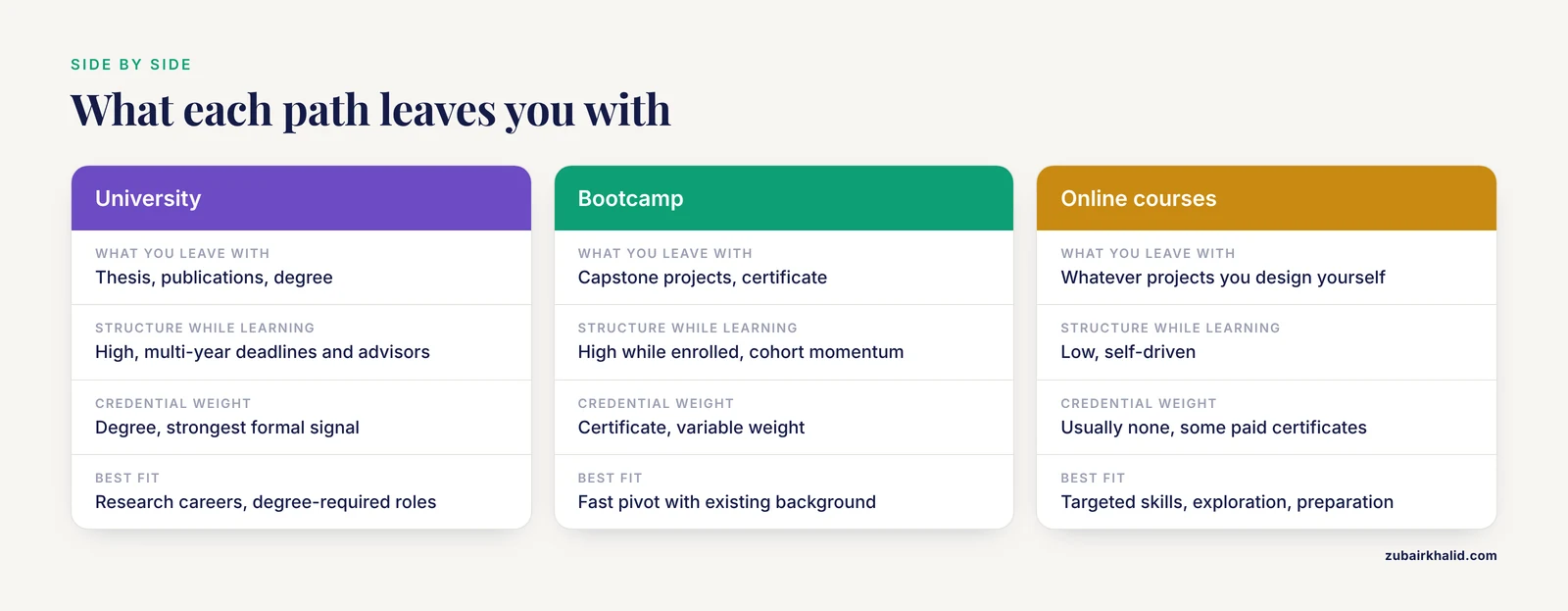
| Criterion | University degree | Bootcamp | Online courses |
|---|---|---|---|
| Typical duration | 1 to 2 years (master's), 4 to 6 (PhD) | Weeks to a few months | Hours to weeks per course |
| Relative cost | Highest (tuition) | Middle | Lowest, many free options |
| Theory depth | Deep (algorithms, statistics) | Practical, compressed theory | Varies by course |
| Credential | Degree, strongest formal signal | Certificate, variable weight | Usually none, some paid certificates |
| Structure | High, multi-year | High while enrolled | Low, self-driven |
| Career support | Advising, alumni network | Sometimes included, verify it | Rarely |
| Prerequisites | Formal admissions bar | Usually coding or biology expected | None |
| What you leave with | Thesis, publications, degree | Capstone projects, certificate | Whatever projects you design yourself |
| Best fit | Research careers, degree-required roles | Fast pivot with existing background | Targeted skills, exploration, preparation |
Choosing a bioinformatics bootcamp or university program (or neither) collapses to three decision variables: does your target job require the credential, how much time can you commit, and what do you already know. Cost, teaching style, and everything else follow from those three.
The paths are complements rather than rivals. The study behind the bootcamp result drew a broader conclusion worth internalizing: models trained with modest resources can accurately classify VUS in genetic and clinical research [1]. Demonstrated working skill is the currency of this field, and each path is simply a different way to mint it.
How to Decide: Four Worked Scenarios
Scenario 1: A biology undergraduate who likes computers
You are a second- or third-year biology major, you enjoyed genetics, and you have written almost no code.
Call: university, most likely, with online courses as the on-ramp.
Why: you have time, research-track doors open widest with a degree, and admissions committees reward undergraduate research experience.
First moves: finish a free Python course this semester, join a lab that analyzes its own data, and work through free problem sets such as the Rosalind bioinformatics challenges. Apply to master's programs, or, if a faster entry appeals, line up a bootcamp for after graduation with a portfolio already started.
Scenario 2: A wet-lab researcher whose experiments now generate sequencing data
You are a postdoc or staff scientist. Your lab's RNA-seq experiments are either sent out or sitting unanalyzed, and you need to own the analysis.
Call: online courses now, a bootcamp if analysis becomes a core job function.
Why: you have deep domain knowledge, so the missing layer is narrow and practical. A multi-year degree buys little that your training has not already given you.
First moves: learn the command line, then run a documented RNA-seq workflow end to end on public data from NCBI's Sequence Read Archive, the public repository for raw sequencing data, picking up conda and git as you go. If your role solidifies around analysis, a bootcamp converts scattered skills into a coherent, portfolio-ready practice.
Scenario 3: A software engineer moving into biotech
You can code in your sleep and have never run a gel.
Call: online courses and targeted reading for the biology, a bootcamp only if it is biology-forward, a degree only if you want research-track roles.
Why: your gap is domain knowledge and statistics, not syntax. Programs that spend most of their hours teaching Python to biologists will bore you and leave your actual gap open.
First moves: a molecular biology crash course, then reproduce a published analysis from its public data. Biotech employers hiring engineers screen for whether you understand the assays behind the data.
Scenario 4: A clinician or veterinarian who wants genomic literacy
You interpret genomic reports or soon will, and you want to understand where the numbers come from, possibly run your own analyses.
Call: online courses plus a short applied workshop or bootcamp focused on variant interpretation.
Why: you need enough statistics and pipeline literacy to read a report critically, not a research career. Calibrate expectations too: classifying variants of unknown significance remains an open problem, and continued advances in variant effect prediction are needed to demonstrate that machine learning methods can accurately determine the clinical impact of VUS [1].
First moves: a course on variant interpretation fundamentals, then a project annotating variants from a public VCF file with standard tools.
Questions to Ask Before You Pay Anyone
Whichever container you choose, interrogate the program with these six questions:
- What did graduates of the last two cohorts get hired or admitted to do, and can you see named examples or talk to alumni?
- Which tools does the curriculum teach, and are they current (conda, git, Snakemake or Nextflow, rather than a point-and-click-only syllabus)?
- What are the stated prerequisites, and do you meet them today?
- How much time is project work on real data versus lectures?
- Who teaches, and do they still work in the field?
- What statistics get taught, beyond running a package's defaults?
A program that answers all six concretely is probably worth the money. A program that answers with marketing adjectives is not, whatever the format.
Building the Skill Stack on Any Path
These steps make learning stick on any of the three routes. They assume a Unix-like environment (a macOS terminal, Linux, or Windows with WSL, the Windows Subsystem for Linux).
1. Set up an isolated environment. Conda installs bioinformatics tools without breaking your system Python:
conda create -n bioinfo -c conda-forge -c bioconda python=3.11 fastqc multiqc salmon samtools
conda activate bioinfo
2. Put everything under version control from day one:
git init
git add analysis.R
git commit -m "Add differential expression script"
3. Run one complete analysis on public data. A classic first project is transcript quantification with salmon, a pseudoalignment tool, meaning it matches reads to transcripts without full base-by-base alignment, that estimates gene expression from RNA-seq reads:
salmon index -t transcripts.fa -i salmon_index
salmon quant -i salmon_index -l A -1 sample_R1.fq.gz -2 sample_R2.fq.gz -o sample_quant
Check read quality with fastqc, aggregate the reports across samples with multiqc, and write down what the biology says before you trust the numbers.
4. Wrap the analysis in a workflow manager. Snakemake or Nextflow turns your manual steps into a rerunnable pipeline. A Snakemake project runs with:
snakemake -j 85. Practice on public data. NCBI's Sequence Read Archive and Gene Expression Omnibus, its repository for gene expression datasets, hold millions of datasets, most linked to a published paper, so you can check your results against the original authors.
6. Build a portfolio, not a pile of certificates. Two or three projects, each with a clear README, a pinned environment, and a short written interpretation of the biology, will do more for you in an interview than a folder of completion badges. The interpretation matters most, because running a pipeline is now the easy part and knowing what the result means is the job.
Common Mistakes and Limitations
Starting a bootcamp without prerequisites. Most programs assume basic programming or biology. Spend a month on free courses first, or you will pay tuition to learn Python from zero at bootcamp prices.
Collecting certificates instead of projects. Completion badges signal attendance. Employers and admissions committees open project repositories.
Skipping statistics. The most common technical failure in self-taught bioinformaticians is treating thousands of simultaneous tests as if they were one. Learn multiple-testing correction early.
Assuming newer means better. In the ARSA CAGI challenge, state-of-the-art deep learning methods provided only a small, though statistically significant, improvement over less elaborate techniques [1]. Master simple, well-understood methods first, then reach for heavier machinery when the problem demands it.
Underestimating domain knowledge. A flawless pipeline on a badly designed experiment produces a confident wrong answer. If your biology is weak, budget real time for it.
Ignoring reproducibility until someone asks. Pin your package versions, version-control your scripts, and write the README the day you finish the project, not the week before an interview.
Treating any single credential as a guarantee. No path guarantees a job. Outcomes depend on your prior background, the local market, and the portfolio you build alongside the credential. Talk with people who hold the jobs you want before you pay for anything, and judge every program, including the evidence cited in this article, on its actual scope rather than its promise.
Frequently Asked Questions
Is a bioinformatics bootcamp enough to get a job?
Often yes for applied analyst and research-support roles, especially when you pair the certificate with a portfolio and already hold a relevant degree. It is not enough for roles that list an advanced degree as a requirement, such as most research scientist and faculty positions.
Can you learn bioinformatics through online courses alone?
Yes, and the free documentation from NCBI, EMBL-EBI, and UniProt is strong enough to build on. The catch is that you must supply the structure, the feedback, and the project sequence yourself, which is where most self-paced learners stall.
Do I need a PhD to work in bioinformatics?
No. Analyst, software, and genomics core facility roles regularly hire master's graduates and bootcamp-plus-portfolio candidates. A PhD becomes the default expectation mainly for independent research and faculty roles.
When is a bioinformatics bootcamp the better choice?
When you already have a science or coding background, need job-ready skills in months rather than years, and have verified a specific program's graduate outcomes. It is the wrong choice when the credential itself is the gate for the jobs you want.
Which do employers value more, a degree or a bootcamp?
Neither wins universally. Research-facing roles default to degrees, while applied roles increasingly screen on demonstrated projects and code. Read ten postings for the job you want and let them decide for you.
How long does it take to learn bioinformatics?
Weeks to reach basic pipeline fluency with intensive study, months to become genuinely useful on real projects, and years for independent research-level judgment. The range is wide because the answer depends on your starting point and target role.