How to Write a Literature Review When You Have Too Many Sources
By Dr. Zubair Khalid, DVM, MS, PhD ·

Having too many sources for a literature review is a design problem, not a reading problem, and the fix is choosing a review type that matches your question before you read another paper. The rule of thumb is simple: if your sources share one narrow question, run a systematic or meta-analytic path, if they scatter across many questions, run a scoping or narrative path, and if they disagree with each other, run a critical path. Picking the path first tells you how many sources you actually need, what you can safely discard, and when to stop collecting.
This guide walks through the main review types, the practical trade-offs between them, a screening workflow for cutting a bloated source list down to a workable core, and worked examples drawn from published reviews in the life sciences. It closes with the mistakes that stall dissertations most often and short answers to the questions students ask most.
Why Your Source List Exploded in the First Place
Before choosing a strategy, diagnose why the pile grew. There are three common causes, and each points to a different cure.
Your question is genuinely broad. If you asked "what do we know about X," the honest answer is a map, not a verdict. Broad questions are normal early in dissertation planning, and they call for scoping or narrative reviews that organize the field rather than settle it.
Your search was efficient but your question was fuzzy. A well-built database search on a vague topic retrieves thousands of records. One published review retrieved 15,024 articles and found that only 41 met its inclusion criteria [1]. The search worked. The filter had not been defined yet.
Your field uses inconsistent terms. Vocabulary inflation multiplies sources artificially. A critical review of ride-sharing and safe-ride programs found that the literature used those two terms interchangeably even though the programs are not synonymous, which meant searches on either term alone would miss studies or double-count them [2]. When key terms overlap sloppily in your field, you will collect near-duplicates of the same evidence under different names until you sit down and define what each term actually means.
Knowing which of these describes your situation is the first real decision of the review. Everything after it gets easier.
Your Options When You Have Too Many Sources for a Literature Review
Six review types cover almost every graduate and professional need. The table below compares them on the criteria that actually decide which one you should run.
| Review type | Core question it answers | Typical scale | Pros | Cons | Choose it when |
|---|---|---|---|---|---|
| Narrative review | What is the story of this field? | Dozens to a few hundred sources | Flexible, fast to start, reads well, good for coursework and thesis chapters | Selection of sources is subjective, hard to replicate, weak for firm claims | You need orientation in a broad, scattered field |
| Systematic review | What does all identified evidence say about one precise question? | Often hundreds to thousands screened, tens included | Transparent, reproducible, publishable, highest evidentiary weight | Slow, protocol-driven, unforgiving of scope creep | Your question is narrow enough to state as inclusion and exclusion criteria |
| Scoping review | What exists, and where are the gaps? | Very large, 100 or more included studies is common | Handles huge and heterogeneous literatures, ideal for mapping an unfamiliar area | Does not grade evidence quality or pool results, so it cannot answer "does it work" | You have too many sources that address too many different subquestions |
| Critical review | Which side of a disagreement does the weight of evidence favor? | Moderate, selected for argument relevance | Produces an argument, not just a summary, and handles contradictory literatures well | Risks cherry-picking if you do not state the criteria for judging | The literature is divided and you can articulate why |
| Integrative review | How do findings from different methods fit together? | Moderate to large | Legitimately mixes experimental, qualitative, and theoretical work | Methodologically demanding, requires explicit quality appraisal of mixed study types | Your topic spans bench, clinical, and organizational evidence |
| Meta-analysis | What is the pooled quantitative effect? | Screened like a systematic review, subset pooled | Strongest single claim you can make, gives one number with a confidence interval | Only works when studies are statistically combinable, and pooling hides real differences between studies | Effect sizes and comparable outcomes exist across studies |
The published literature illustrates each path. A comparative effectiveness review screened 114 studies across 22 comparisons and graded every primary outcome for strength of evidence before drawing conclusions [3]. A scoping review of trainee mistreatment screened 856 records down to 71 included studies and used them to map where interventions existed and where gaps remained [4]. A critical comparative review pitted 11 legacy compounds against 18 alternatives across seven evidence dimensions to ask whether substitution reduced risk or merely shifted it [5]. And a long-running narrative review series covered non-insulin diabetes drugs from 1990 to 2021 as a curated historical account rather than an exhaustive census [6]. All are legitimate. They simply answer different questions.
Narrative Review
The narrative review is the default assignment format and the default first chapter draft. You select sources for relevance and quality, organize them by theme or chronology, and build an argument. Its strength is flexibility. You can fold in a landmark 1985 paper and a 2026 preprint without justifying either against a protocol. Its weakness is exactly that freedom, because a skeptical reader cannot tell which studies you skipped or why.
The main failure mode with too many sources is writing an annotated bibliography instead of a narrative. A narrative review earns its name when each paragraph makes a claim and the sources serve as evidence for it, not when each paragraph summarizes one more paper in publication order.
Systematic Review
A systematic review answers one precisely worded question by identifying all eligible evidence, screening it against stated criteria, appraising its quality, and synthesizing the results. The defining feature is that another person could repeat your search and reach the same set of studies.
Searches are documented in detail. One review of alternative transportation programs reported its search using the PRISMA-S checklist (an official reporting standard for search strategies), searched six databases, and applied inclusion criteria spanning academic and grey literature from 1980 to 2023, ending with 32 included studies [2]. Grey literature means reports, theses, and organizational documents that sit outside standard journal databases, and including it protects against publication bias, the tendency for positive findings to reach print more often than negative ones.
Systematic reviews demand eligibility criteria you can defend. A review of artificial intelligence models for early sepsis detection excluded pediatric studies, studies without quantitative performance metrics, and unpublished work, which left 52 studies out of everything the search retrieved [7]. Notice how each exclusion rule removed a whole category of ambiguity at once. That is the technique to copy: define criteria that cut by kind, not by individual judgment call.
Scoping Review
A scoping review maps what evidence exists rather than adjudicating what it proves. When your problem is too many sources pointing in too many directions, scoping is usually the best fit, because its output is a categorized map instead of a verdict.
Scoping reviews absorb scale that would sink other designs. The mistreatment review just cited processed 856 records into 71 studies and sorted them into education and training interventions versus programs and policies [4]. A review of sexual and reproductive health interventions included 101 studies drawn from 95 research projects and organized them by delivery strategy, target population, and outcome [8]. A review of occupational therapy outcome measures for preschool children with autism identified 74 different measures and, crucially, mapped every one onto the framework of the International Classification of Functioning, Disability and Health, an official WHO classification system, which converted a pile of instruments into a structured picture of what the field measures and what it ignores [9]. The framework was the difference between 74 unrelated facts and one organized argument.
Critical Review
A critical review exists because literatures disagree. Its raw material is contradiction, and its product is a reasoned judgment about where the weight of evidence sits.
Comorbidity research offers a classic case. A critical review of mood disorders among patients with eating disorders found that reported comorbidity rates differed widely across studies because assessment methods and diagnostic criteria varied, few studies included control groups, and earlier reviews had argued from symptoms and biology without systematically examining prevalence data at all [10]. That review did not just summarize the disagreement. It diagnosed the methodological reasons for it, which is what critical reviews are for. A more recent critical review asked whether replacing legacy PFAS chemicals (a class of persistent environmental pollutants) with alternatives actually reduced risk, compared 11 legacy and 18 alternative compounds across persistence, mobility, bioaccumulation, toxicity, and exposure dimensions, and concluded that substitution often shifted risk between endpoints rather than eliminating it [5]. Both reviews turned chaos into a claim by comparing like with like across an explicit set of dimensions.
Integrative Review
An integrative review synthesizes studies that use different methods, which is common in health services and organizational research where clinical trials, qualitative interviews, and program evaluations all speak to one topic. Its central challenge is fairness across study types. The review of self-organizing teams in long-term care searched four databases, appraised empirical studies with the MMAT (the Mixed Methods Appraisal Tool) and systematic reviews with JBI checklists (official instruments from the Joanna Briggs Institute), then organized the 41 included articles using four structure concepts drawn from organization theory: centralization, specialization, formalization, and functional concentration [11]. The theoretical framework did the sorting work that a pile of PDFs could never do on its own.
Meta-Analysis
A meta-analysis pools effect estimates from comparable studies into a single weighted estimate. It sits on top of a systematic review rather than replacing one, and it only makes sense when studies report outcomes in combinable form. A systematic review and meta-analysis of immunosuppressive therapy combined with eltrombopag for severe aplastic anemia pooled odds ratios with 95 percent confidence intervals and formally assessed bias risk in the component trials [12]. If your sources report incompatible outcomes, different populations, or no effect sizes at all, a meta-analysis is not an option however large your pile is. The scale of the pile never justifies pooling studies that cannot be pooled.
How to Choose: The Criteria That Decide Real Cases
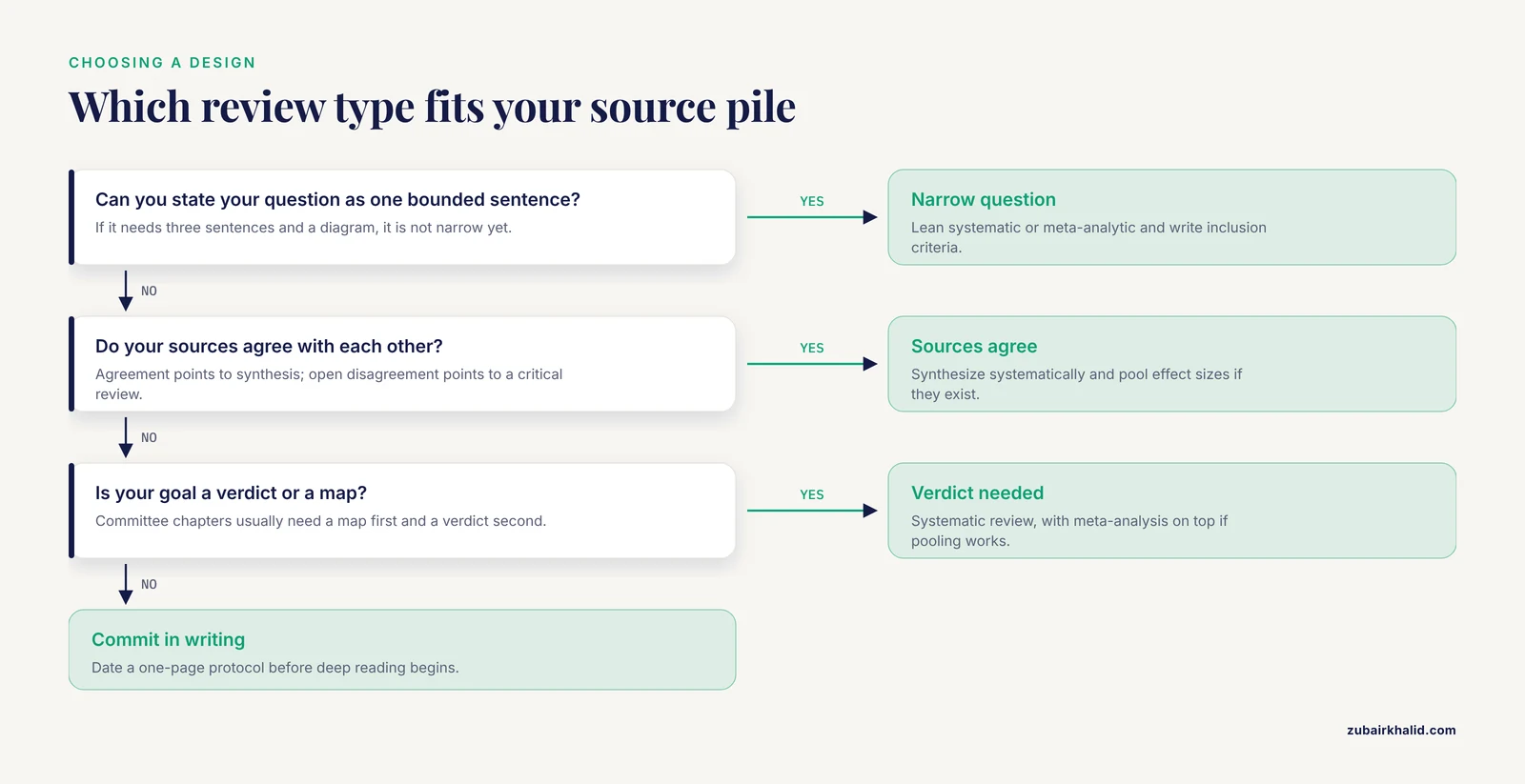
Four questions settle the choice in practice.
Can you state your question as a sentence with defined boundaries? If yes, lean systematic or meta-analytic. If your question needs three sentences and a diagram to explain, lean scoping or narrative. Reviewers of dissertations apply exactly this test.
Do your sources agree or fight? Agreement points toward systematic synthesis and, if effect sizes exist, pooling. Disagreement points toward a critical review whose job is explaining the disagreement, as the comorbidity review did [10].
Is your goal a verdict or a map? Verdicts need systematic reviews. Maps need scoping reviews. Graduate students who need to finish a dissertation literature review chapter almost always need a map first and a verdict second, in that order.
Will the result be read by a committee or by the field? Committee chapters tolerate narrative structure. Journal submission in evidence-based fields generally demands a registered, protocol-driven systematic or scoping design.
The Screening Workflow: From Thousands of Records to a Workable Core
Whatever design you choose, the mechanics of cutting the pile down are the same. Real reviews publish their numbers, and those numbers tell you what to expect.
Step 1. Document the Search Before You Trim It
Record every database, every date range, and every filter. Use the PRISMA-S reporting standard as your checklist, as the alternative transportation review did across six databases [2]. Also search beyond databases. The co-creation review in health professional education searched six databases with no date limit and then hand-searched the reference lists of included papers and near-miss papers, a technique called snowballing [13]. A qualitative synthesis of systems leadership advice went further, starting with 84 texts found in database and grey-literature searches and then adding 80 snowballed references for a final total of 164 [14]. Snowballing from a strong core of papers is often more productive than another broad database sweep, and it is how you stop searching.
Step 2. Set Exclusion Rules That Cut by Category
The best exclusion rules eliminate whole classes of records with one stroke. The sepsis prediction review excluded all pediatric studies and all studies lacking a quantitative metric in a single rule each [7]. The perinatal depression review screened 15,024 retrieved articles down to 41 with inclusion criteria stated up front [1]. Write your rules before looking at titles, because rules written mid-screening bend toward the papers you want to keep.
Step 3. Expect and Plan for Definitional Chaos
When you finally read the survivors, expect the definitions to wobble. The peri-operative quality indicator review collected 657 studies and grey literature sources, extracted 615 indicators, and still found inconsistent definitions and varying thresholds for the same indicator across studies [15]. The eating disorder comorbidity review traced its contradictory prevalence estimates directly to differences in assessment methods and diagnostic criteria [10]. Build a terminology table early, with one row per key concept and one column per paper, and record each paper's definition in its own words. This table becomes the spine of your synthesis and the heart of your discussion of limitations.
Step 4. Extract Findings, Not Summaries
The unit of synthesis is the finding, not the paper. The Making Numbers Meaningful project extracted 53 distinct findings from 35 unique studies reported in 32 papers [16]. One paper can carry several findings, and several papers can support the same finding. Build a matrix with one row per finding, columns for each supporting or contradicting source, and a column for the strength of each source. Reviewers in evidence-based medicine grade that strength formally using the GRADE approach, which labels outcomes as high, moderate, low, or insufficient quality evidence [3]. Even an informal version of this habit, marking each finding as strongly or weakly supported, separates a real review from a reading log.
Step 5. Organize With an Explicit Framework
A framework is the single most powerful tool for a source pile that resists ordering. The frameworks used in published reviews include official classification systems such as the ICF for outcome measures [9], established theory such as the four organizational structure dimensions for team research [11], and constructed dimension sets such as the seven hazard dimensions used to compare PFAS compounds [5]. Any of these patterns works if it is explicit, applied to every source, and stated in your methods. A pile sorted into named buckets is a literature review. An unsorted pile is a folder.
Step 6. Know When to Stop
Stopping rules come from your protocol, not from your stamina. Stop when new searches return mostly records you have already screened or rejected, when snowballing from recent papers yields no new sources, and when your framework has a labeled bucket for every included study. Published reviews stop at defined dates for exactly this reason, whether that cutoff is May 2023 [11] or August 2024 [13].
Worked Scenarios
Scenario 1. A PhD student with 900 PDFs on one enzyme family. The question is narrow and the literature is divided about mechanism. The right design is a systematic review with a critical component. Screen by category, exclude reviews and commentaries from the evidence pool while citing them in the introduction, appraise the remaining primary studies, and grade conclusions. The 15,024-to-41 funnel of the perinatal depression review shows that an enormous retrieval count is normal, not a sign of failure [1].
Scenario 2. A master's student assigned a review of a field they have never worked in. The question is broad and the student needs orientation before any verdict is possible. A scoping review is the honest answer. Follow the mistreatment review pattern: screen broadly, include more studies than a systematic review would, and organize results into a map of what exists and what is missing [4]. The gaps identified become the justification for the thesis project itself, which is exactly how scoping reviews feed dissertation planning.
Scenario 3. A researcher updating an old review. The peri-operative indicators review updated a review published 10 years earlier, kept a consistent format so results could be compared across decades, and found the proportion of evidence-backed indicators had risen from 47 percent to 82 percent while validity testing remained rare [15]. If someone has reviewed your topic before, updating rather than restarting saves months and gives you a built-in before-and-after result.
Scenario 4. A student whose committee asked for "a critical review of the literature." Select sources by relevance to the argument, build the dimension table that explains why studies disagree, and write toward a judgment. The PFAS substitution review is the model, because every included compound was compared on the same seven dimensions and the conclusion followed from the pattern across them [5].
Common Mix-Ups
Confusing "more sources" with "more rigor." A systematic review's authority comes from transparency and reproducibility, not from the size of the retrieval. Thirty-two well-selected studies can carry more evidentiary weight than three hundred loosely chosen ones.
Treating a scoping review as a failed systematic review. They answer different questions. A scoping review that maps 101 studies of adolescent health interventions is not a lesser version of pooling them, it is a different deliverable [8].
Summarizing papers instead of synthesizing findings. If your draft has one paragraph per paper, you have an annotated bibliography. Extract findings and group them, as the reviews that reported 53 findings from 32 papers demonstrate [16].
Searching only one database. Nearly every published review cited here searched at least four databases, and the norm in health sciences is six or more, spanning MEDLINE, Embase, CINAHL, Web of Science, and the Cochrane Library [11] [13] [1].
Letting interchangeable terms fragment your synthesis. Define your key terms explicitly, and note where the literature itself uses them inconsistently, because that inconsistency may be one of your findings [2].
Common Mistakes and Limitations
The most expensive mistake is starting to write before choosing a review type, because every hour of writing done under the wrong design gets discarded. Commit to a design in writing, with a dated one-page protocol, before deep reading begins.
The second mistake is screening without recorded numbers. Keep a simple count of records identified, screened, excluded with reasons, and included. Published reviews report these figures as a matter of course, and your committee or a journal editor will ask for them.
The third mistake is ignoring quality variation among included studies. Heterogeneity, the statistical term for variability between study results, is often the real story. A meta-analysis of antipsychotic effectiveness found that apparent benefits depended on which rating scale was used, and many comparisons yielded only insufficient or low-quality evidence even after 114 studies were examined [3]. The perinatal depression review could not fully explain its heterogeneity because, as its authors put it, there were too many mediating variables [1]. When your sources conflict, say so plainly and explain the methodological reasons, rather than averaging them into a false consensus.
A final limitation applies to every review: your conclusions are bounded by your search date, your databases, your language restrictions, and your inclusion criteria. One review noted that including only English publications likely meant relevant articles in other languages were missed [1]. State those boundaries in your limitations section, then move on. And as with any research guidance, individual projects vary enough that your advisor's judgment about scope and design should override any general rule.
How This Fits Into Finishing Your Dissertation
For graduate students, the literature review is usually the chapter that delays everything else, and the cure is almost always a scope decision rather than more reading. Build the review choice into your dissertation planning the same way you build experiments into a timeline. Set a design decision date, a screening completion date, and a writing start date, and treat the screening funnel numbers as milestones you can report to your committee. Students who know how to finish dissertation chapters on schedule are usually the ones who decided early what the review would and would not cover. A bounded review you finish beats an exhaustive review you abandon, and every published review in this article shipped precisely because its authors drew a line and stopped.
Frequently Asked Questions
How many sources are too many for a literature review?
There is no fixed number, because the right count depends on your design. Published systematic reviews routinely retrieve tens of thousands of records and include a few dozen, as when one review screened 15,024 articles down to 41 [1]. The pile becomes a problem only when it has no design attached. If you cannot state the criteria that would remove a given paper, the count is unmanageable no matter what the number is.
What is the fastest way to narrow a large list of sources?
Apply category-level exclusion rules in a fixed order, usually by title first and abstract second. Rules such as "exclude pediatric studies," "exclude studies without quantitative outcomes," or "exclude non-English publications" each remove large blocks at once, which is how reviews moved from 856 records to 71 included studies [4] and from 15,024 records to 41 [1]. Never narrow by reading full papers, because full-text reading is the slowest filter you own.
What is the difference between a scoping review and a systematic review?
A scoping review maps what evidence exists and identifies gaps, while a systematic review tests a precise question against all eligible evidence and grades its quality. A scoping review can legitimately include 101 heterogeneous studies organized by delivery strategy and population [8], whereas a systematic review applies tighter eligibility criteria and quality appraisal, often with instruments like MMAT and GRADE [11] [3]. Choose scoping when the field needs a map and systematic when the field needs a verdict.
Do I need to read every paper in full before deciding what to keep?
No. Full-text reading is reserved for the survivors of title and abstract screening. Skimming methods sections for eligibility signals, then reading deeply only the studies that enter your synthesis matrix, is how reviews process hundreds of records. Snowballing reference lists from your strongest papers can also reveal that most of your pile traces back to a small core of influential studies [13] [14].
How does choosing a review type fit into dissertation planning?
Choosing the review type is the first milestone of dissertation planning, because it determines your inclusion criteria, your timeline, and your writing structure. A scoping review produces the gap map that justifies your research questions, and a systematic review chapter demonstrates methodological competence your committee can verify. Set the design decision before your reading phase, and set a stop date for searching, so the review feeds the rest of the dissertation instead of delaying it.
Can I combine more than one review type in one project?
Yes, and the published literature does it routinely. A systematic review can include a meta-analysis of its pooled results [12], a critical review can embed systematic search methods, and an integrative review can borrow a theoretical framework from any tradition [11]. The rule is to declare the primary design, follow its reporting standards for that portion, and label each component clearly in your methods so readers know which standards governed which part.
Sources
- Uptake rate of interventions among women who screened positive for perinatal depression: A systematic review and meta-analysis.
- Two programs, too many names? A critical review of ride-sharing and safe-ride programs as alternatives to impaired driving.
- Antipsychotics in adults with schizophrenia: comparative effectiveness of first-generation versus second-generation medications: a systematic review and meta-analysis.
- Structures and Interventions to Address Trainee Mistreatment in Graduate Medical Education: A Scoping Review.
- Do alternative PFAS reduce risk or shift it? A critical comparative review of persistence, mobility, bioaccumulation, toxicity, exposure, and safer substitution criteria.
- Non-Insulin-Based Drug Entities Used to Treat Diabetes Type 2 Disease (T2DM), Based on Natural Products from All Sources.
- Artificial Intelligence-Based Predictive Modeling for Early Detection of Sepsis in Hospitalized Patients: A Systematic Review and Meta-Analysis.
- Lay health-worker delivered and technology-based interventions for sexual and reproductive health among adolescents and young adults in low- and middle-income countries: a scoping review.
- Occupational Therapy Outcome Measures in Preschool Children With Autism Spectrum Disorders: A Scoping Review.
- [[Comorbidity between eating disorders and mood disorders: review].](https://pubmed.ncbi.nlm.nih.gov/16598962/)
- Failure or success of self-organizing teams in long-term care organizations: an integrative systematic literature review on the role of the organization structure.
- Efficacy and safety of immunosuppressive therapy combined with eltrombopag for severe aplastic anemia: a systematic review and meta-analysis.
- Learner-Educator Co-creation of Student Assessment in Health Professional Education Courses: A Scoping Review.
- Systems Leadership: a qualitative systematic review of advice for policymakers.
- Quality indicators for structure and process in peri-operative care: a systematic review.
- How Difference Tasks Are Affected by Probability Format, Part 1: A Making Numbers Meaningful Systematic Review.