Thesis Defense Presentation Template
By Dr. Zubair Khalid, DVM, MS, PhD ·

By the end of this article you will be able to build a complete defense deck from a proven slide-by-slide structure, budget your speaking time with a simple calculation, compile a working LaTeX Beamer template, import a text outline straight into PowerPoint, and rehearse in a way that measurably improves your performance. Training matters here. In a three-year cohort study of 816 nursing thesis evaluation rubrics, students who completed a full online workshop on oral defense scored 8.76 out of 10 on average, while students who attended nothing scored 8.02, and students who attended every session scored 0.70 points higher in a multivariable model [1]. A template plus rehearsal is the cheapest version of that workshop you can give yourself.
Before you start, have the following on hand:
- PowerPoint, Google Slides, Keynote, or LaTeX with the Beamer class installed
- Your institution's defense rules (time limit, formatting requirements, whether the committee sees slides in advance)
- Your thesis file, your figure files, and your key statistical output
- A timer or stopwatch app for rehearsal
- A plain-text editor for the outline import method shown below
What a Thesis Defense Presentation Template Actually Does
A thesis defense presentation template is a fixed skeleton of slides with placeholder titles, a consistent visual theme, and a built-in time budget. It solves three problems at once. It forces you to decide what belongs in the talk before you start designing anything. It keeps fonts, colors, and figure sizes consistent so the committee reads your data instead of your formatting. And it converts an open-ended writing task into a series of small, checkable slots.
The oral defense itself is an old and formal exercise. When the physician Ferenc Pápai Páriz was inaugurated at the University of Basel in October 1674, he defended a Latin thesis summarizing three gynecological cases, and modern scholars still find that defense text worth translating and studying 350 years later [2]. The setting has changed, but the structure survives: you present your work, and examiners probe it in front of you. A good template respects that structure instead of fighting it.
One caution about expectations. A template organizes your content. It does not write your content, and it does not guarantee a grade. The sizeable gap in the Spanish cohort study between workshop attendees and non-attendees reflects practice and feedback, not slide design alone [1]. Treat the template as the container and rehearsal as the active ingredient.
The Standard Format, Slide by Slide
The thesis defense presentation template format below fits the common 15 to 25 minute talk that most master's programs and many doctoral programs allow before questions. Adjust the counts for your own time limit using the budget formula later in this article. The sequence follows the classic research narrative: motivation, gap, question, method, evidence, interpretation, limits, conclusion.
- Title slide (1 slide). Thesis title, your name, program, committee names, and the date. No content beyond that. Committees often glance at this slide while settling in.
- Roadmap (1 slide). Four to six items telling the committee the shape of the talk. Keep it literal. "Background, question, methods, results, limitations, conclusions" is enough.
- Background (2 to 4 slides). Only the literature the committee needs to understand your question. Define every technical term the first time it appears, both on the slide and out loud.
- Knowledge gap and research question (1 slide). One sentence stating what was unknown, then one sentence stating your question or hypothesis. This is the slide committees quote back at you during questions, so word it carefully.
- Methods (2 to 4 slides). Study design, sample, key materials or instruments, and the analysis plan. State your primary outcome and your statistical approach plainly. Sample sizes, model types, and software versions belong here.
- Results (4 to 7 slides). One message per slide. Lead each slide title with the finding itself, for example "Knockdown reduced proliferation by 40 percent" rather than "Proliferation results."
- Discussion and interpretation (1 to 2 slides). What the results mean, how they compare with prior work, and what alternative explanations remain.
- Limitations (1 slide). Name your two or three most serious limitations yourself before an examiner does. This reads as maturity, not weakness.
- Conclusions and future work (1 slide). Answer your research question in one sentence, then list two or three concrete next steps.
- Acknowledgments (1 slide). Funders, advisors, technicians, and collaborators.
- Backup slides (3 to 6 slides). Extra methods detail, full statistical tables, extra figures. These come after your closing slide and exist only to answer predictable questions without derailing the flow.
Two formatting rules carry most of the visual value of any scientific presentation template for defense. First, one message per slide, stated in the slide title. Second, minimum readable type: body text at roughly 24 point or larger and figure axis labels no smaller than the smallest text you would be willing to read on a printed page. If a figure needs a magnifying glass, redesign the figure.
Building Your Template, a Numbered Walkthrough
Option A, LaTeX Beamer (repeatable and version-controllable)
Beamer is the LaTeX document class for presentations. It produces PDF slides, which removes font and version problems on the defense-room computer entirely.
Step 1. Create a file called defense.tex with this skeleton.
\documentclass{beamer}
\usetheme{Madrid}
\usecolortheme{seahorse}
\title{Full Thesis Title Goes Here}
\subtitle{Master's Thesis Defense}
\author{Your Name}
\institute{Your Department, Your University}
\date{November 11, 2026}

\begin{document}

\begin{frame}
  \titlepage
\end{frame}

\begin{frame}{Roadmap}
  \begin{itemize}
    \item Background
    \item Research question
    \item Methods
    \item Results
    \item Limitations and conclusions
  \end{itemize}
\end{frame}

\begin{frame}{Background: one message per title}
  \begin{itemize}
    \item Point one, with citation
    \item Point two, with citation
  \end{itemize}
\end{frame}

\begin{frame}{Research question}
  \begin{block}{Question}
    State your question in one sentence here.
  \end{block}
\end{frame}

\begin{frame}{Methods}
  \begin{itemize}
    \item Design:
    \item Sample:
    \item Analysis:
  \end{itemize}
\end{frame}

\begin{frame}{Results: lead with the finding}
  \begin{itemize}
    \item Finding one, with the number in the title
  \end{itemize}
  % \includegraphics[width=\textwidth]{figure1.pdf}
\end{frame}

\begin{frame}{Limitations}
  \begin{itemize}
    \item Limitation one
    \item Limitation two
  \end{itemize}
\end{frame}

\begin{frame}{Conclusions}
  \begin{itemize}
    \item One-sentence answer to the research question
    \item Next step one
    \item Next step two
  \end{itemize}
\end{frame}

\appendix

\begin{frame}{Backup: full statistical table}
  % \input{tables/main_model.tex}
\end{frame}

\end{document}
Step 2. Compile it.
pdflatex defense.texStep 3. Check the expected output. You should get a PDF named defense.pdf with a title slide showing your name and date, a themed roadmap slide, and one frame per section. The \appendix command marks everything after it as backup material, and the \againframe trick lets you jump to a backup slide during questions.
Step 4. Add your figures as PDF or PNG files and replace every placeholder line. Comment lines starting with % will not print, which makes the file its own to-do list.
A common compile error looks like this:
! LaTeX Error: File `beamerthememetropolis.sty' not found.That appears when the template you copied uses the Metropolis theme and your TeX distribution lacks it. Either install the theme package through your TeX distribution's package manager, or switch to a built-in theme such as Madrid or Frankfurt, which ship with every standard distribution.
Option B, PowerPoint outline import (fastest path to a full skeleton)
PowerPoint can build slides directly from an indented text file, which turns the slide plan above into a working deck in under a minute.
Step 1. Open a plain-text editor such as Notepad or TextEdit in plain-text mode and type your outline. Slide titles sit at the left margin. Bullets are indented with one tab.
Title slide
Your Name
Thesis Defense
Roadmap
	Background
	Research question
	Methods
	Results
	Conclusions
Research question
	State the question in one sentence
Methods
	Design
	Sample
	Analysis plan
Step 2. Save the file with a .txt extension and plain-text encoding.
Step 3. In PowerPoint, go to the Home tab, click the arrow under New Slide, and choose "Slides from Outline." Select your text file.
Step 4. Check the result. Every left-margin line becomes a slide title, and every tab-indented line becomes a bullet on the slide above it.
The most common failure here is silent rather than a pop-up error box. If your editor inserted spaces instead of real tab characters, PowerPoint imports the entire outline as titles of separate slides or as one giant text block. The fix is to delete the indentation, press the Tab key at each bullet level, and re-import. A second frequent symptom is that quotation marks and apostrophes appear as odd characters after import when the file was saved in a non-Unicode encoding. Resave the file as UTF-8 and import again.
Option C, Google Slides or a free thesis defense presentation template
A free thesis defense presentation template from your university's communications office, from Google Slides' template gallery, or from your graduate school is usually the fastest route. Screen it against three criteria before committing. Does it have a plain background that will not fight your figures? Can you delete the decorative elements in one pass? Does it include backup-slide layouts? University-produced templates also tend to respect institutional rules on logos and fonts, which saves a correction cycle with your committee.
The Timing Budget, with a Worked Calculation
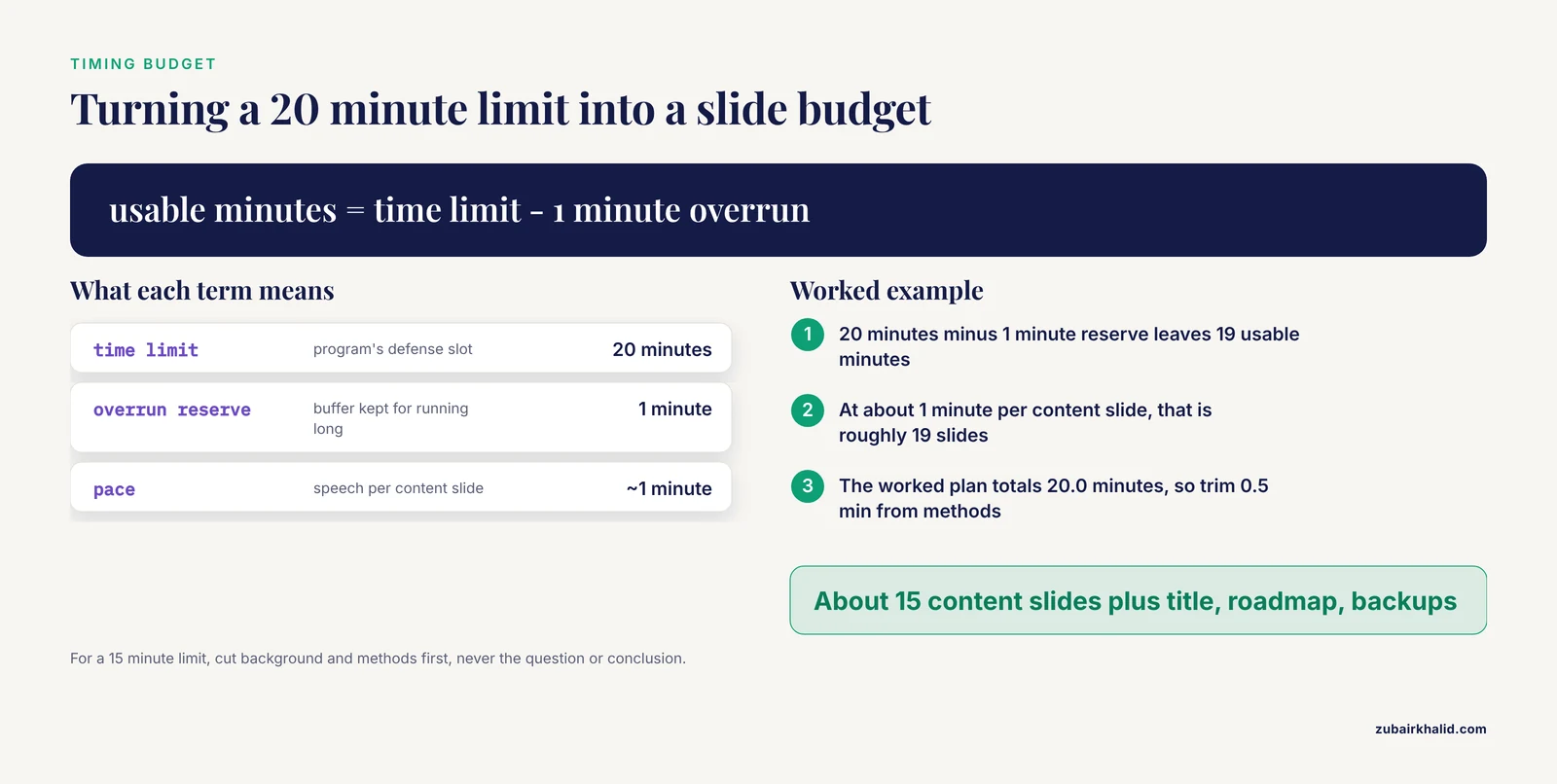
Time is the constraint that shapes everything else in a defense deck. The rule of thumb most speakers can sustain comfortably is roughly one minute of speech per content slide, with dense results slides closer to ninety seconds. Convert your program's time limit into a slide count before you design anything.
Worked example for a 20-minute talk:
Time limit:            20 minutes
Reserve for overrun:   minus 1 minute  -> 19 usable minutes
Pace assumption:       ~1 minute per content slide

Slide budget:
  Title            0.5 min
  Roadmap          0.5 min
  Background (3)   3.0 min
  Question (1)     1.0 min
  Methods (3)      4.0 min
  Results (5)      7.0 min
  Discussion (2)   2.5 min
  Limitations (1)  1.0 min
  Conclusion (1)   0.5 min
                   --------
  Total           20.0 min  -> trim 0.5 min from methods
If your limit is 15 minutes, cut background and methods first, never the question slide or the conclusion. If your limit is 45 minutes or more, as is common for doctoral defenses, expand the results section and the backup deck rather than padding the background.
The table below summarizes the template's key slots and how they scale.
| Slide slot | Purpose | Share of a 20-minute talk | Worked time |
|---|---|---|---|
| , - | , - | , - | , - |
| Title | Orientation | 2 to 3 percent | 0.5 min |
| Roadmap | Structure signpost | 2 to 3 percent | 0.5 min |
| Background | Minimum context needed | 12 to 15 percent | 3.0 min |
| Research question | The sentence everything serves | 5 percent | 1.0 min |
| Methods | Credibility | 18 to 20 percent | 4.0 min |
| Results | The evidence | 30 to 35 percent | 7.0 min |
| Discussion | Meaning and alternatives | 10 to 12 percent | 2.5 min |
| Limitations | Preempt examiner criticism | 5 percent | 1.0 min |
| Conclusion | The answer | 3 percent | 0.5 min |
Presenting Your Statistics Without Overreaching
Results slides live or die on how you describe uncertainty and significance. State the effect, the direction, the measure of precision such as a confidence interval, and the P value, in that order, on every key result slide. Resist the temptation to present every number your software produced. Choose the analyses that answer the question on your research-question slide and relegate the rest to backup.
The statistical controversy of recent years is worth knowing before a statistician on your committee raises it. Prominent academic statisticians have argued for discouraging reliance on statistical significance testing, and that debate has produced real confusion among investigators about where the statistical community stands. A widely cited commentary in a cancer research journal argues that the deeper problem is human nature, the tendency of scientists to believe their own theories and present data in the most favorable light, and that statistical testing used correctly retains an important and valuable place in the scientific tradition, supported by the current push for transparency and reproducible research [3]. The practical translation for your defense is simple. Report exact P values rather than only threshold statements, pair them with effect sizes and confidence intervals, describe in advance the analyses you planned before you saw the data, and never let a slide imply more certainty than the design supports.
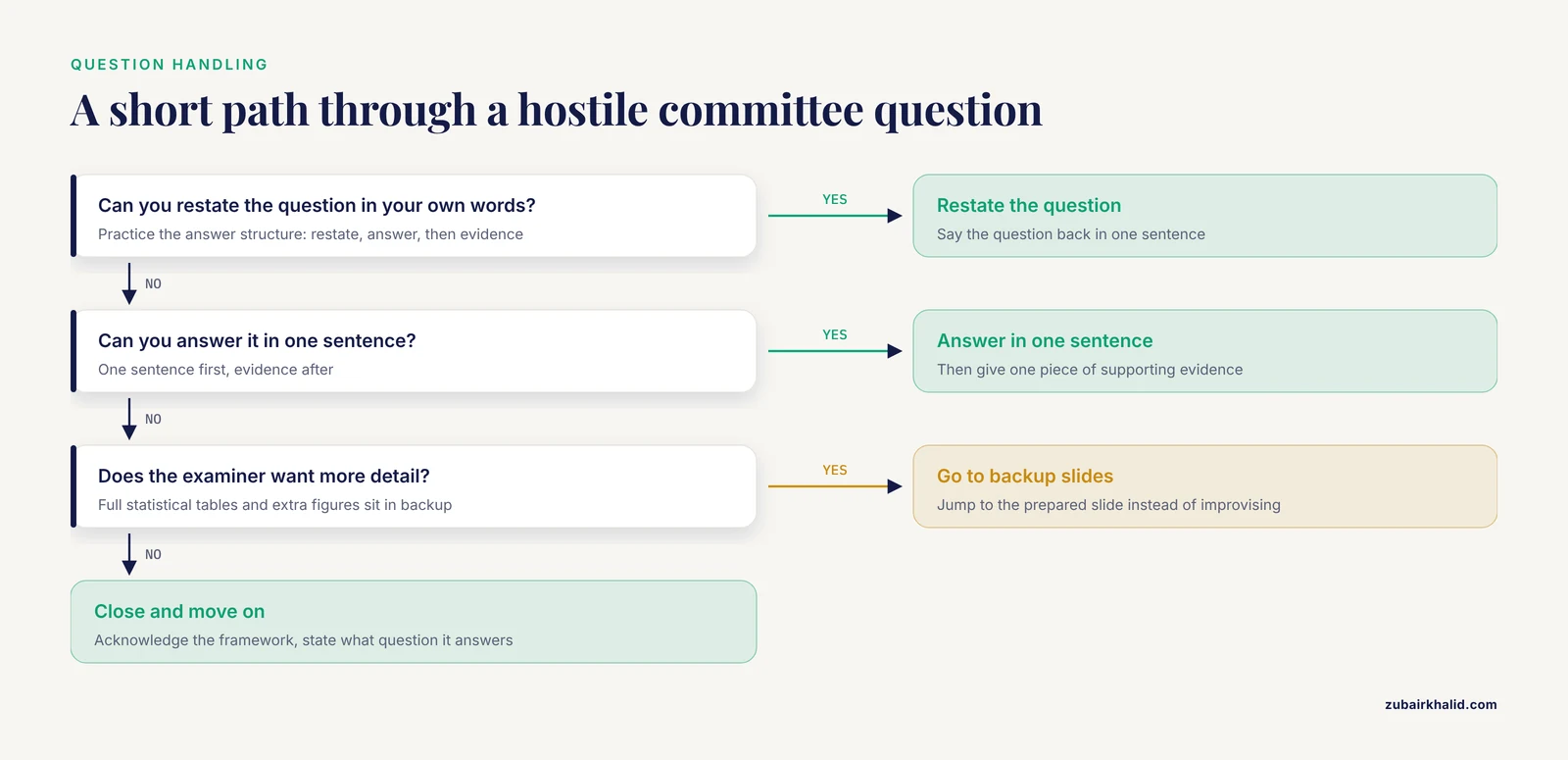
If an examiner asks why you did not use some alternative analysis framework, the strongest answer acknowledges the framework, states what question it answers, and explains why your chosen analysis answers your question. That kind of answer signals training rather than defensiveness.
Rehearsal, Stress, and What Actually Moves Your Grade
Defense day produces a genuine physiological response, not just nerves. In a study of physiotherapy students, the bachelor's thesis defense triggered a large anticipatory anxiety response measured in the days before the event, activated the sympathetic nervous system during the defense itself, and showed measurable stress reactivity, yet subjective distress did not correlate with academic performance variables [4]. In other words, feeling stressed is normal, and feeling stressed does not predict a bad outcome. Students juggling a double degree showed a more habituated autonomic response, consistent with the idea that repeated exposure to evaluative events blunts the physiological spike [4].
That finding points directly at the most useful intervention available to you: rehearsal under realistic conditions. The cohort study from the Spanish nursing school is the clearest evidence that structured practice pays. Across three academic years, students who attended a short online workshop targeting oral presentation and defense skills earned higher oral defense grades than non-attendees, and attendance of the full workshop was associated with a 0.70-point advantage on a 10-point scale in multivariable analysis [1]. A practical rehearsal protocol modeled on what such training teaches:
- Deliver the full talk aloud, standing, with your timer running, at least three times before the defense.
- Record one run on video and watch it with the sound on. Note filler words, slides you rush, and slides where you lose your place.
- Recruit a colleague or advisor to ask three hostile questions per run. Practice the answer structure: restate the question, answer it in one sentence, then give one piece of supporting evidence.
- Rehearse your transitions between slides verbally. Most rambling answers start as failed transitions.
- Do one run with a small audience if possible, since the anticipatory anxiety response in the days before a defense is well documented and familiarity lowers it [4].
If your program offers a defense preparation workshop, attend all of it. The dose-response pattern in the cohort data, with full attendance outperforming partial attendance and no attendance [1], is exactly what you would expect from a skills intervention.
Related Research Templates Worth Setting Up
Two adjacent research template files make the defense itself easier because they make the months before the defense easier.
Lab notebook template PDF. A lab notebook template pdf is a pre-formatted page, printed or filled digitally, with fixed fields for the date, experiment title, hypothesis, reagent lot numbers, protocol deviations, raw observations, and a signature line. Its defense value is direct: when an examiner asks how you handled an outlier or when a reagent lot changed, you answer from a dated, signed record instead of from memory. Set one up as a single-page PDF with a header block and a ruled table, duplicate it for each experiment, and file it in date order. Electronic laboratory notebooks do the same job with timestamps, but the printed template remains the fallback when instruments or wifi fail.
Analysis and results tracker. A simple spreadsheet or document listing each research question, the analysis performed, the output file, the figure number, and the slide number where the result appears. This research template doubles as your backup-slide index during questions. When a committee member asks for the sensitivity analysis, you know within seconds whether it exists and where it lives.
Common Mistakes and Limitations
Copying a decorated template before checking institutional rules. Some programs require specific title formats, disallow animations, or require you to submit slides in advance. A beautiful template that violates your program's rules costs a resubmission cycle.
Putting your literature review on slides. The background section should compress years of reading into the two or three papers the committee needs. Twenty background slides tells the committee you could not prioritize.
Reading the slides aloud. Committees read faster than you speak. If the slide contains the full sentence, the audience finishes reading before you finish speaking and stops listening. Slides carry keywords and figures. You carry sentences.
Designing slides during rehearsal week. Build the deck early so that most of your remaining time is rehearsal, which is the component with measured benefit. Deck polishing in the final week produces diminishing returns and cuts sleep.
Hiding limitations. Examiners find limitations regardless. Stating them yourself, with your plan for addressing them, converts a hostile question into a collaborative one.
Overclaiming from statistics. Writing "this proves" on a slide with an unadjusted comparison invites a P value debate you may not want. Use "suggests" and "is consistent with" where they are accurate, and report precision alongside significance.
Ignoring the clock. A talk that runs long eats your own question time. Some committees treat a blown time limit as a planning failure, which is a defensible reading.
One honest limitation of templates themselves. No template can tell you what your specific committee will value, whether your field expects chalk-and-whiteboard derivations during questions, or whether your program's oral defense weighs presentation skills as heavily as the written thesis. Individual programs differ, and your advisor and recent graduates from your own lab are the best source for those local specifics. Where your situation involves institutional requirements or formal accommodations, check with your graduate office rather than a template.
Frequently Asked Questions
What is a thesis defense presentation template?
It is a pre-structured slide skeleton, usually 12 to 20 slides plus backups, that maps the standard defense narrative from background through conclusions so you fill slots instead of designing from a blank file.
How many slides do I need for a thesis defense?
Plan roughly one content slide per minute of speaking time, so a 20-minute talk supports about 15 content slides plus a title, a roadmap, and 3 to 6 backup slides.
What should the format of each slide include?
Every content slide needs a title that states the finding or message, minimal body text in large type, numbered figures with labeled axes, and citations for any claim drawn from the literature.
Are free thesis defense presentation templates good enough?
Yes, if they meet three tests, which are a plain background that does not fight your figures, layouts you can easily strip of decoration, and compliance with your institution's logo and formatting rules.
How do I handle hostile committee questions?
Restate the question in your own words, answer it in one sentence, support the answer with one piece of evidence, and route requests for detail to your backup slides rather than improvising.
How should I present P values and statistics on my slides?
Report exact P values with effect sizes and confidence intervals, state which analyses were planned in advance, and use cautious language such as "is consistent with" when the design cannot establish causation.
How far in advance should I rehearse my defense?
Start full timed rehearsals at least two to three weeks before the defense so you can run the talk aloud several times, record and review at least one run, and practice hostile questions with a colleague.
What is a lab notebook template PDF and why does it matter for my defense?
It is a pre-formatted notebook page with fixed fields for dates, hypotheses, reagent lots, deviations, and signatures, and it lets you answer provenance questions from a dated record instead of from memory during questioning.
Further Reading
Sources
- An online workshop is effective in improving the oral defense of the bachelor's thesis in nursing students. A real-world cohort study.
- [[Translation from Latin to Hungarian of the thesis of Ferenc Pápai Páriz at the 350th anniversary of his defense and medical inauguration at the University of Basel].](https://pubmed.ncbi.nlm.nih.gov/39550727/)
- In Defense of P Values.
- The Effect of Studying a Double Degree in the Psychophysiological Stress Response in the Bachelor's Thesis Defense.