Scope Creep in Research Questions: How to Spot and Stop It
By Dr. Zubair Khalid, DVM, MS, PhD ·
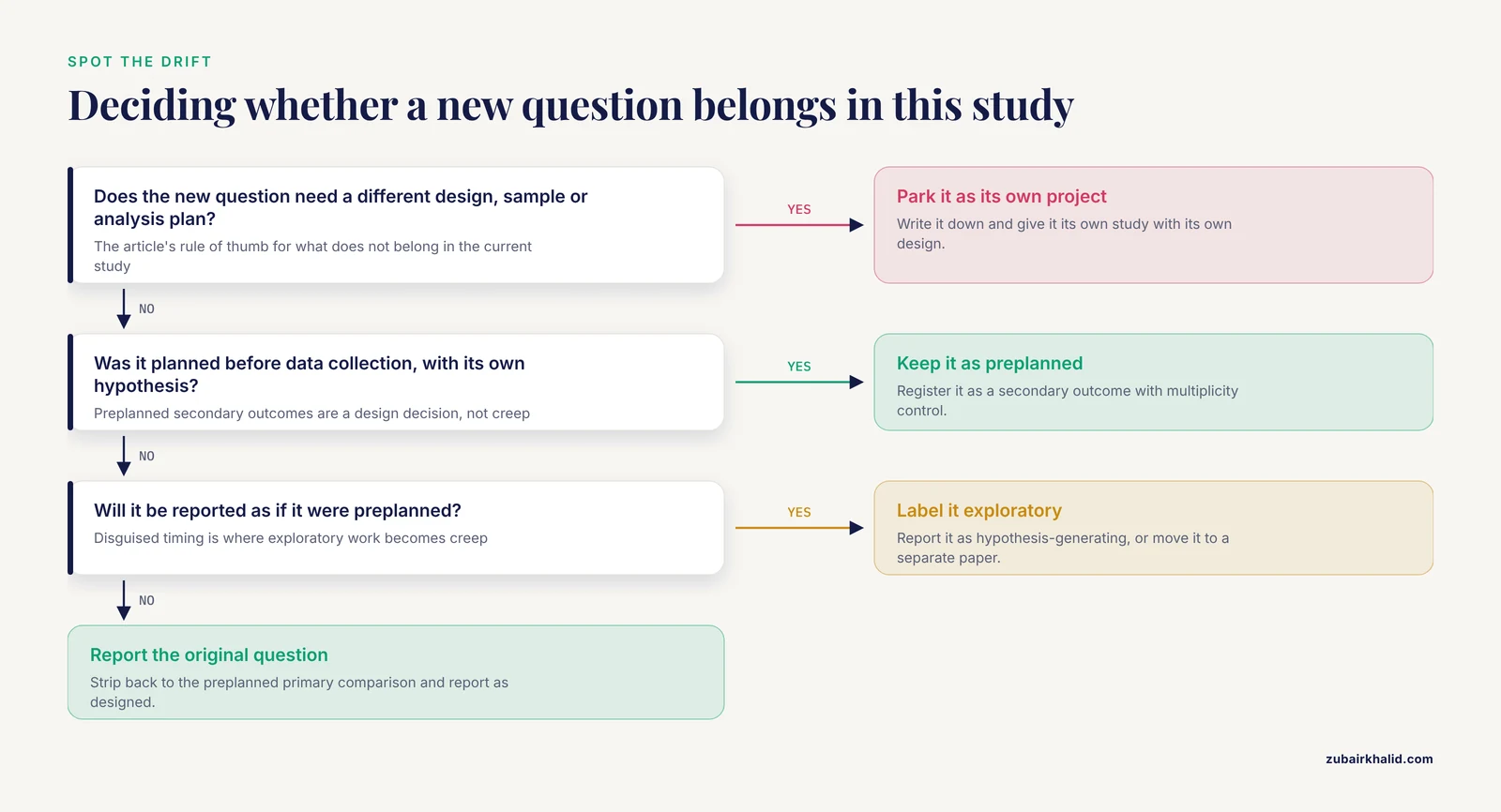
Scope creep in research questions is the slow drift of a study away from the single question it was designed to answer, toward side questions it was never powered, sampled, or structured to answer. The rule of thumb is simple. If a new question needs a different design, a different sample, or a different analysis plan, it does not belong in the current study. Park it, write it down, and give it its own project.
This article explains what scope creep looks like in real life science, why even careful researchers fall into it, how to write a research question that resists drift, and what to do when you realize mid-project that your question has grown a second head. The examples come from biology, medicine, and the life sciences, but the mechanics are the same in any field.
What Scope Creep in Research Questions Actually Means
A research question is the contract between your idea and your data. Everything downstream, including the sample size, the endpoints, the statistical tests, and the claims you can make in the discussion, is supposed to serve that contract. When the contract quietly changes, the study stops being able to answer any of its questions well.
The term scope creep comes from project management, where it describes uncontrolled expansion of a project's goals after work has started. Research borrowed the term because the pattern is identical. A team plans a focused experiment, and then colleagues, reviewers, pilots, or the researchers' own curiosity keep adding "one more thing we can look at while we have the data."
Scope creep in research questions is not the same as data creep, although the two overlap. Data creep describes the repurposing of collected data for uses beyond the conditions under which it was originally gathered, which raises its own ethical problems around consent and oversight [1]. Scope creep is broader. It includes new subgroups, new covariates, new outcomes, and new hypotheses added to a study after the design is fixed, whether or not the data themselves are reused.
The clearest documented example in the life sciences literature comes from practice-based research networks. In an evaluation of the Agency for Healthcare Research and Quality Master Contract Program, the authors report that funding officers whose zeal for specific results led to heavy handed approaches produced significant scope creep and unrealistic expectations in contracted studies [2]. The lesson generalizes. When someone outside the research team can add goals to a study without changing its budget, timeline, or design, creep is almost guaranteed.
The consequences are not cosmetic. Statistical guidance for clinical research is blunt on this point. The number of preplanned significance tests should be kept small and post hoc analyses should be avoided, because every unplanned test added after the fact erodes the meaning of the p-values the study was built to support [3]. A study that answers five questions poorly is worse than a study that answers one question well, because reviewers, editors, and readers can usually tell the difference.
Why Research Questions Drift
Scope creep rarely arrives as a decision. It arrives as a series of small, reasonable-sounding additions. Four pressures drive most of it.
Curiosity and sunk data. Once data exist, every column looks like a free analysis. Modern biology makes this worse. Sequencing and omics methods have become so cheap and sensitive that generating whole transcriptomes or proteomes is now routine, and commentators in animal science warn that the resulting data flood cannot deliver on its promise without hypothesis-driven research that connects the omics data to actual biological experiments [4]. In other words, the technology makes it easy to measure everything first and ask questions later, which is the exact inverse of a well-formed research question.
Big data culture. Multi-omics and large-scale integrative studies generate genuinely comprehensive pictures of biological processes, and gastroenterology research is a good example of a field where that integration is scientifically justified [5]. The pitfall is that the same paper cataloging those opportunities also catalogues the common errors in study design, execution, and analysis that big data projects invite [5]. Scale tempts researchers to bolt exploratory aims onto a study that was designed for one narrow comparison.
Stakeholder pressure. Funders, clinicians in a network, a department head, or an industry partner may each want their own question answered by your study. The AHRQ Master Contract experience shows how external enthusiasm for particular results converts directly into scope creep [2]. Graduate students experience a version of this with advisors. Every lab meeting can add an aim.
Statistical illiteracy about what the data can support. Many researchers do not fully understand what their planned analysis can and cannot tell them, which makes it hard to recognize when a new question exceeds the design [3]. Common analytical errors, such as unnecessary dichotomization of continuous variables or applying prediction methods to answer association questions, distort conclusions in ways that only become visible at review stage [6]. A question that was never asked at the design stage often cannot be answered by the data at all, no matter how many analyses are run.
How to Write a Research Question That Resists Scope Creep
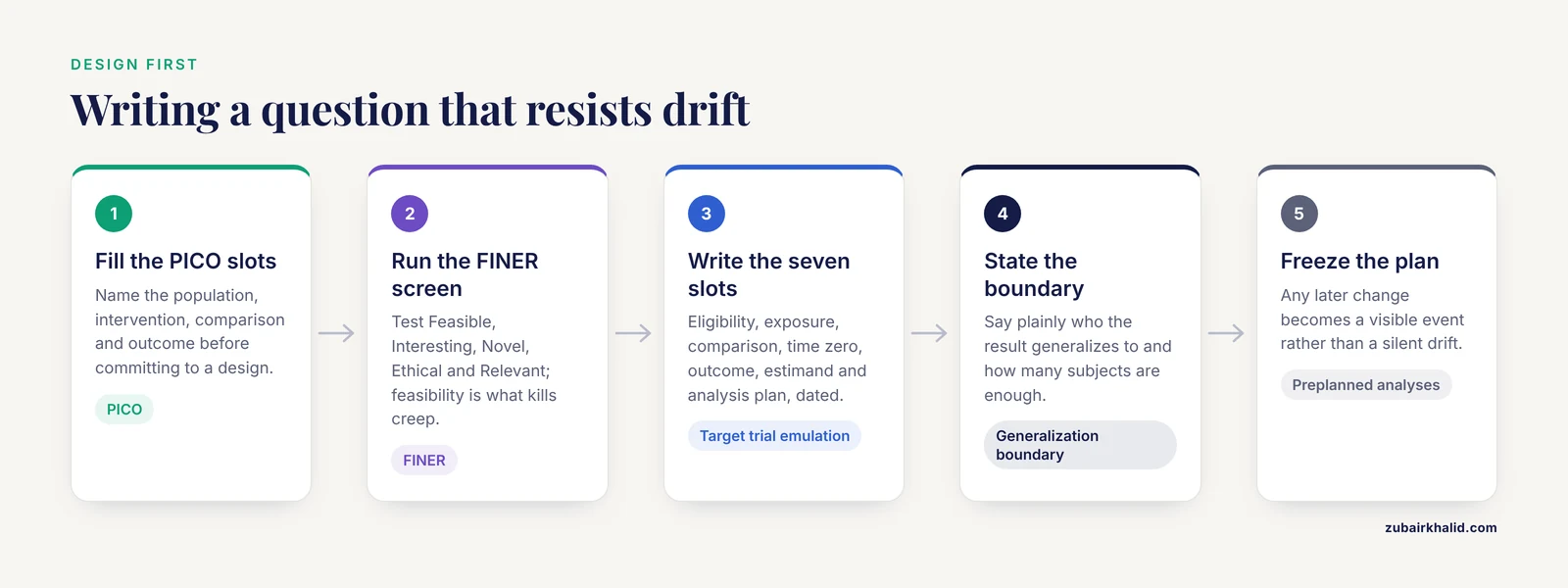
The best defense against creep is a question built with tight joints. Two frameworks dominate the practical literature on how to write a research question, and they work together.
PICO defines the parts. PICO stands for Patient or population, Intervention, Comparison, and Outcome. For a basic biology or preclinical question, the same slots work with different labels, for example model organism or cell type, perturbation, control condition, and measured endpoint. Frameworks like PICO help you confirm that all relevant components of the question are covered before you commit to a design [7].
FINER tests the joints. FINER stands for Feasible, Interesting, Novel, Ethical, and Relevant. The Feasible criterion is the one that kills creep, because a question can be fascinating and still be unanswerable with the time, funding, sample, and skills you actually have [7]. When a collaborator proposes adding an outcome, run it through FINER. If it fails on feasibility, it fails.
A worked example makes this concrete. Suppose a graduate student starts with the vague idea "I want to study the gut microbiome and stress." A PICO-structured version of a biology research question might read:
- Population: adult male C57BL/6 mice, aged 8 weeks, housed under standard conditions
- Intervention: chronic restraint stress, 2 hours daily for 14 days
- Comparison: identically handled non-stressed controls
- Outcome: relative abundance of two named bacterial genera in fecal samples, measured by 16S rRNA amplicon sequencing at day 14
That is a question a design can answer. The creeping version of the same project reads very differently: "How does stress affect the gut microbiome, behavior, metabolism, and immune function?" Each added noun quietly demands new assays, new endpoints, new sample sizes, and new statistical machinery. The FINER screen catches this immediately, because four organ systems and a behavioral battery are not feasible within the same animals, budget, and timeline.
Methodologists in specialized areas say the same thing in field-specific language. Reviews of fecal microbiota transplantation in rodents emphasize that the technique lacks standardization and requires careful experimental design, with many parameters decided up front according to the research topic [8]. Reviews of botanical natural product research similarly insist that researchers address a defined set of critical questions about material selection and characterization before any in vitro, in vivo, or clinical evaluation begins [9]. In both fields, the advice amounts to the same discipline. Decide the question, then let the question dictate the methods, not the other way around.
One more rule from clinical trial methodology belongs in every question-writing toolkit. Before initiating a study, you should be able to answer three things plainly. What is the research question, to which patients or subjects should the result be generalized, and is the number of subjects sufficient to draw a valid conclusion [3]. If you cannot state the generalization boundary, you have not finished writing the question, and any claim beyond that boundary is creep before it even happens.
Controlled Question vs Creeping Question: A Side-by-Side View
The table below contrasts the same project at two moments, before creep and after it. Use it as a diagnostic. If your current protocol resembles the right-hand column in more than two rows, your research question has already drifted.
| Criterion | Controlled research question | Scope-crept research question |
|---|---|---|
| Question wording | One sentence, one comparison, named population and endpoint | Compound sentence with "and" joining two or more outcomes or populations |
| Endpoints | One primary endpoint, defined before data collection | Several co-primary endpoints, or a primary endpoint that changed after data review |
| Analyses | Preplanned, small number of tests | Growing list of post hoc tests, subgroup splits, and re-analyses |
| Covariates | Each covariate included with a stated reason | Indiscriminate lumping of every available variable into the model |
| Feasibility (FINER) | Answerable with existing sample, budget, timeline | Requires new assays, new animals or subjects, or new expertise |
| Statistical risk | Error rate controlled by design | Inflated false positive risk from multiplicity and data dredging |
| Review outcome | Conclusions match the question | Reviewers flag overreach, spurious findings, or uninterpretable results |
| Honest title | "Effect of X on Y in Z" | "Multi-omic profiling reveals novel insights into..." |
The last row is not a joke. Papers whose titles promise far more than their design can deliver are usually papers whose research questions crept during analysis, and peer review is often the first place anyone notices [7].
Locking the Question: Design-First Tools from Causal Inference
The strongest available toolkit for preventing question drift comes from causal inference, specifically the target trial emulation framework. The idea is to explicitly specify the protocol of the hypothetical randomized trial that would ideally answer your question, and then design your actual study to match it as closely as possible. For observational cardiovascular research, this means committing in writing to seven components: eligibility criteria, treatment strategies, assignment procedures, time zero definition, outcomes, the estimand, and the statistical analysis plan [10]. The same framework has been applied to atrial fibrillation registries, where emulating the design principles of an ideal randomized trial helps observational studies avoid common methodological pitfalls [11].
You do not need to be running a drug study to borrow this habit. Write down the seven slots for your own study, whatever the field. Eligibility, exposure or intervention, comparison, time zero, outcome, the quantity you are estimating, and the analysis plan. Once those are written and dated, any proposed change becomes a visible event rather than a silent drift. The framework's authors describe this as a shift from a model-driven to a design-first approach, which is exactly the posture that resists creep [10].
The statistical side of the lock is equally concrete. Analyses should be preplanned, their number kept small, and post hoc additions avoided, because unplanned testing converts noise into apparent signal [3]. Reviews of statistical practice in observational cancer research list data dredging among the most damaging of ten common analytical errors, alongside problems such as immortal time bias and mishandled missing values [12]. Data dredging is not usually malice. It is almost always scope creep with a p-value.
Warning Signs: How to Spot Scope Creep Early
Creep announces itself in the language of your protocol and drafts. Watch for these patterns.
The word "and" in your question. A research question with two conjunctions is usually two studies wearing one coat. Split it.
Covariates nobody can justify. In neuroimaging and psychology, analysts routinely lump covariates such as reaction time, demographics, and morphometric measures into models without stating why each one is there. A detailed examination of this practice shows that indiscriminate covariate inclusion can bias effect estimates upward or downward, mask real effects, flip signs, or manufacture spurious results, and that domain knowledge rather than statistical convenience should drive covariate selection [13]. If you cannot say out loud why a covariate is in your model, it is creep, not rigor.
Continuous variables getting chopped. Dichotomizing a continuous measurement, for example splitting a blood marker at an arbitrary cut point, is listed among the commonly made errors that can distort results and conclusions in clinical research [6]. This maneuver often appears late, when the original continuous analysis disappoints and someone suggests "just looking at high versus low." That is the question drifting to find a friendlier beach.
The analysis section grows after the results arrive. A growing list of subgroup analyses, alternative endpoints, and secondary models, each adopted only after the previous one failed, is textbook data dredging [12]. The study is no longer testing a question. It is shopping for one.
The title promises a theory of everything. Multi-omics integration is legitimate science when planned, but reviews of omics methodology warn that researchers must understand the limitations of these techniques, and that quality control questions about databases and methods must be asked before the experiment, not after [4]. A paper on one enzyme that ends with claims about a whole pathway is usually a paper that crept.
The outcomes no longer match what participants or samples were recruited for. This is where scope creep touches ethics. Research with transgender and non-binary communities has documented how scales, framing, and research focus that participants did not sign up for can alienate the very people a study depends on [14]. A changed question can be a changed burden, and changed burdens need re-consent, not just a new table.
Worked Scenarios
Three short scenarios show how creep develops and how each one gets handled.
Scenario 1. The rodent microbiome study. A team designs an experiment asking whether fecal microbiota transplantation from stressed donor mice transfers anxiety-like behavior to recipient mice. The question is clean. Midway through, a collaborator suggests also profiling the recipients' plasma metabolomics, since the samples are being collected anyway. The team has a choice. If metabolomics can be added as a genuinely preplanned secondary outcome with its own hypothesis and its own multiplicity control, it can be registered as such before analysis. If it would become an untargeted fishing expedition, it belongs in a separate exploratory dataset or a separate paper. FMT methodology reviews stress that parameter choices differ by research topic and that avoiding common pitfalls requires deciding them in advance [8]. The team's decision rule should be the one from the start of this article: does the new question use the same design, sample, and analysis plan? Metabolomics does not. Park it.
Scenario 2. The registry study that grew. A researcher plans to ask one question of a cancer registry, whether surgery type X is associated with better 30-day outcomes than surgery type Y in a defined patient group. Large databases genuinely allow questions that trials cannot address, and their strengths include large samples and real-world diverse populations [15]. The danger is that a registry contains hundreds of variables, and the temptation to report associations across many of them, adjusted for many covariate sets, is enormous. The top-ten list of statistical errors in cancer registry research names data dredging and convenience sampling among the recurring failures that undermine reproducibility [12]. The researcher who locks the question, fixes the covariate set with documented reasons for each variable in the spirit of causal inference guidance [13], and prewrites the analysis plan, can use the registry well. The researcher who browses the registry for significant findings has let the dataset write the research question, which is creep in its purest form.
Scenario 3. The struggling clinical trial. A randomized controlled trial for a severe eating disorder faces enrollment shortfalls and attrition. The TRIANGLE trial team has written openly about how such pressures tempt researchers to loosen eligibility, change assessment metrics, and redefine outcomes on the fly [16]. Each of those moves is scope creep wearing crisis clothing. Their published recommendations, which include early qualitative work to identify patient barriers and careful consideration of assessment metrics before the trial, are essentially anti-creep measures. They fix the question and adapt the operations around it, rather than reshaping the question to fit whatever the operations managed to produce.
A fourth, quieter pattern appears in evidence synthesis. Meta-analyses have multiplied rapidly in some fields, and methodologists warn that a meta-analysis can be the right tool at the wrong time, particularly when clinical heterogeneity across included studies is high and inclusion criteria were defined loosely [17]. A review team whose inclusion criteria expand to fill the literature is conducting scope creep at the level of the evidence base itself. The fix is the same. Define the question, write the criteria, and hold the line.
Your Options When Creep Happens: Pros and Cons
Once you notice drift, you have three realistic options. Each has honest trade-offs, and this is where the practical pros and cons matter.
Option 1. Cut back to the original question. You strip the protocol back to the preplanned primary comparison and report the study as designed.
- Pros: the study retains its statistical validity, its conclusions match its power, and reviewers will find the paper internally consistent. This is the option that best protects the meaning of your p-values and confidence intervals [3].
- Cons: politically awkward. Collaborators who contributed the extra aims may feel dismissed, and genuinely interesting exploratory patterns get shelved rather than reported.
Option 2. Split into one confirmatory study and one exploratory study. The preplanned analysis answers the original question. The unplanned findings are labeled explicitly as hypothesis-generating and reported as such, or moved into a separate paper.
- Pros: nothing is wasted, transparency is preserved, and exploratory findings are clearly flagged so readers do not over-interpret them. This mirrors the structured, pre-specified vs exploratory distinction that trial methodology recommends [3].
- Cons: exploratory results carry less weight, may be harder to publish as a standalone, and require discipline in language. Calling an exploratory finding "novel" when it was dredged is just creep with better vocabulary.
Option 3. Reframe the whole study as a new question and re-design. If the drift happened early enough that no data were collected, the honest move is to rewrite the research question properly, re-run it through PICO and FINER, and re-plan.
- Pros: you end up with a coherent design and a question the study can actually answer [7].
- Cons: costs time, may require new ethics review or re-registration, and is impossible once data collection has started. After data exist, this option is no longer available, and pretending otherwise is where reproducibility problems begin.
There is no fourth option in which the crept analyses are quietly reported as if they were planned all along. That path is the one that produces the errors reviewers and methodologists keep documenting across fields [6], [12].
Common Mistakes and Limitations
Even researchers who understand scope creep make predictable errors while trying to manage it.
Mistaking exploration for a question. Exploratory analysis is a legitimate scientific activity. The mistake is presenting exploratory output as if it answered a pre-specified question. The distinction lives in timing. What was planned before data collection is confirmatory. What was noticed afterward is exploratory, whatever the prose says.
Adding "just one" secondary outcome repeatedly. One secondary outcome is a design decision. Six of them, each added at a different lab meeting, is creep with paperwork.
Letting statistical convenience drive model building. Covariates chosen because they are available, or because they move a p-value, rather than because domain knowledge justifies them, introduce the biases described in the causal inference literature, including masking and sign flipping [13].
Confusing big data with big questions. A larger dataset does not widen the scope of a well-formed question. It narrows the uncertainty around the same question. Projects that treat data volume as license for more claims tend to reproduce the design and analysis errors documented in multi-omics and database research [5], [15].
Assuming creep only happens to other people's studies. The documented cases range from government contracted networks [2] to flagship clinical trials [16]. Drift is a property of research as a social process, not a marker of weak researchers.
One limitation of this guidance deserves a plain statement. The frameworks here, PICO, FINER, and target trial emulation, are tools for structuring your own decisions. They cannot tell you which biological question matters most in your field, and they cannot substitute for the domain expertise and mentorship that shape a good biology research question. Individual projects need individual judgment, and a methods checklist is a floor, not a ceiling.
Frequently Asked Questions
What is scope creep in a research question?
It is the unplanned expansion of a study's goals after the design is fixed, so the study ends up trying to answer questions its sample, endpoints, and analysis plan were never built to address. The result is usually weakened conclusions, inflated false positive risk, and reviewer criticism.
How do I write a research question that will not creep?
Build it with PICO to cover population, intervention, comparison, and outcome, then test it with the FINER criteria, especially Feasible [7]. Write the question as one sentence with one comparison, define the primary endpoint before data collection, and state who the results generalize to [3].
Is every unplanned analysis an example of scope creep?
No. Unplanned analyses become creep when they are reported as if they were preplanned or used to draw confirmatory conclusions. Labeled, transparent exploratory analysis is acceptable scientific practice. The problem is timing being disguised.
What is the difference between scope creep and data creep?
Scope creep is the expansion of a study's questions and aims. Data creep is the reuse of collected data for purposes beyond the conditions of the original collection, which raises distinct ethical issues around consent and oversight [1]. A study can suffer one without the other, though both often travel together.
How many questions can one study legitimately answer?
One primary question, answered by a preplanned analysis, is the standard that keeps error rates controlled, with a small number of preplanned secondary questions if the design genuinely supports them [3]. If additional questions need different designs or samples, they need different studies.
When is scope creep actually useful?
The observations and ideas that surface during a creeping study are often the raw material for the next, well-designed study. The useful move is not to smuggle them into the current paper, but to log them, evaluate them with FINER, and let them become the sharply focused research questions of future projects.
Sources
- Modeling Ethics: Approaches to Data Creep in Higher Education.
- The Agency for Healthcare Research and Quality (AHRQ) Practice-Based Research Network (PBRN) relationship: delivering on an opportunity, challenges, and future directions.
- Significance tests in clinical research-Challenges and pitfalls.
- Symposium review: Omics in dairy and animal science-Promise, potential, and pitfalls.
- Big Data in Gastroenterology Research.
- Avoiding pitfalls in conducting hand surgery research - potential consequences of common errors in statistical analyses.
- Back to the basics: Guidance for formulating good research questions.
- Investigating causality with fecal microbiota transplantation in rodents: applications, recommendations and pitfalls.
- Selection and characterization of botanical natural products for research studies: a NaPDI center recommended approach.
- A Practical Guide to Target Trial Emulation: Connecting Randomized Trials and Real-World Data in Cardiovascular Research.
- The importance of the design of observational studies in comparative effectiveness research: Lessons from the GARFIELD-AF and ORBIT-AF registries.
- Top ten errors of statistical analysis in observational studies for cancer research.
- Through the lens of causal inference: Decisions and pitfalls of covariate selection.
- Ethical HIV research with transgender and non-binary communities in the United States.
- Strengths and limitations of large databases in lung cancer radiation oncology research.
- Every mistake is a treasure: Lessons learned from the TRIANGLE trial for anorexia nervosa.
- Meta-analyses in sport and exercise science: sometimes the right tool at the wrong time?