The 60-Second Elevator Pitch for Your Scientific Poster
By Dr. Zubair Khalid, DVM, MS, PhD ·

By the end of this article you will be able to build, time, and deliver a 60-second pitch that turns a passive poster visitor into an active conversation. You will have a fill-in template, a worked example built from a published study, a timing script, a word-budget table, and a checklist for checking that your pitch actually works. To follow along, have three things on hand: your poster abstract or draft, a timer on your phone, and a way to record yourself, such as the voice memo app on your phone or the recorder built into a free video meeting tool.
What the 60-second pitch is, and what it is not
An elevator pitch is a spoken summary you can deliver in about one minute, roughly the time you would share an elevator with a stranger. At a poster session, the listener is a person who has just walked up to your board and is deciding within seconds whether to stay or move on. The 60-second pitch for your scientific poster is the version of your research that earns those next five minutes.
A pitch is not a condensed abstract. An abstract is written for readers who can reread it. A pitch is spoken once, to one person, under noisy conference conditions. It carries less detail and more motivation. It answers one question above all others: why should this person care about your work?
A pitch is also not a performance. Judges, senior researchers, and fellow students do not want a memorized monologue. They want a clear opening that invites them to ask questions. Your pitch should end with an opening, not a close.
Why poster sessions reward a prepared pitch
Poster sessions are structured communication exercises, and they are increasingly treated that way in formal training. Course-based undergraduate research experiences, which embed open-ended research projects into ordinary classes, now routinely assess students with analytical rubrics for written reports, posters, and oral presentations alongside the lab work itself [1]. In one semester-long cancer biology course, students who combined molecular lab work with structured scientific writing reported stronger confidence in interpreting and communicating scientific data, and the course design deliberately tied communication practice to research practice [1]. The lesson transfers directly to conference preparation. A poster is a communication product, and a pitch is the spoken half of that product.
Preparation also changes what happens at the booth. Visitors who hear a clear first minute ask better follow-up questions, because they now know where your work sits. Visitors who hear a rambling opening often nod politely and leave. You control which of those two outcomes happens.
The scientific poster elevator pitch template format
The template has five slots. Each slot answers one question the listener is silently asking. Copy this structure into a text file and fill it in:
[HOOK]      One sentence that makes the listener care.
[PROBLEM]   The question your field could not yet answer.
[WHAT I DID]  Your approach in plain words, no methods jargon.
[FINDING]   Your single most important result, with a number if you have one.
[SO WHAT]   What this changes, plus an invitation to keep talking.
That is the whole scientific poster elevator pitch template format. Five slots, five sentences, about 130 words total. The word budget comes from speaking speed. Most people deliver prepared spoken text at roughly 120 to 150 words per minute, so 60 seconds holds about 120 to 150 words. Budget each slot against that ceiling rather than writing until it feels long enough.
| Slot | Question it answers | Word budget | Typical failure |
|---|---|---|---|
| Hook | Why should I care? | 15 to 20 words | Opens with the poster title instead of a claim |
| Problem | What was missing? | 20 to 25 words | Recites the full literature review |
| What I did | How did you test it? | 25 to 30 words | Lists every method and reagent |
| Finding | What did you find? | 25 to 30 words | Buries the result under caveats |
| So what | What now? | 25 to 30 words | Ends flat, with no invitation |
If your draft exceeds 150 words, cut from the middle slots first. Listeners forgive a light methods sentence. They do not forgive a missing result.
The five slots explained
Hook. Start with a claim, a surprising fact, or a question the listener can relate to. "Every year, residents finish pediatric training without knowing how much cancer training they actually got" is a hook. "This study evaluated resident exposure" is not.
Problem. Name the gap in one sentence. Someone in your field should nod at this sentence. Someone outside your field should still understand it.
What I did. Describe your approach the way you would describe it to a smart friend in a different department. Save the method details for the poster itself. The pitch points at the poster. The poster carries the detail.
Finding. State one result. If you have a number, use it. If your results are preliminary, say what direction they point and that data collection continues. Never imply a conclusion the data cannot support, because the first sharp listener in the room will catch it.
So what. Connect the finding to something the listener values, then hand the conversation over. "I would love to hear how this matches what you see in your clinic" works better than "thank you for listening."
Worked example: distilling a real published study
Here is the template applied to an actual study, so you can see the compression in action. The source study examined whether inpatient pediatric hematology and oncology exposure was associated with resident confidence and knowledge, at a single center, during the 2025 accreditation curriculum change [2]. Its abstract runs several hundred words. The pitch needs about 130.
[HOOK]      "Every new pediatrician will meet a child with cancer or a
            blood disorder before a specialist does. The question is
            whether their training prepared them."

[PROBLEM]   "New 2025 accreditation requirements cut inpatient
            hematology-oncology rotation time, and nobody had measured
            what that does to resident readiness."

[WHAT I DID] "We asked 14 faculty to name the competencies general
            pediatricians actually need, then surveyed 44 residents
            across three exposure levels, from zero to 840 hours, with
            a 27-item confidence survey and an 8-question knowledge
            test."

[FINDING]   "Confidence tracked exposure, but knowledge did not. The
            highest-exposure group stood out on confidence, yet test
            scores were similar across groups, and residents missed
            more than half the questions on five of the eight topics
            faculty prioritized."

[SO WHAT]   "So hours alone are not the fix. Curriculum redesign should
            target specific knowledge gaps. I'd love to hear how this
            compares to what you see in your own training programs."
Notice what the compression did. The published abstract reports the response rate as 44 of 89 residents, or 49.4 percent [2]. The pitch drops the denominator because it adds no meaning for a stranger in 60 seconds. The abstract reports statistical test names and exact p values. The pitch keeps the direction of the finding and drops the test names, because the spoken version needs the conclusion, not the machinery. You can always point to the poster, which retains the full numbers, the cohort design, and the statistical comparisons [2].
This is the pattern for every scientific poster elevator pitch template example you will ever build: keep the claim, the gap, the approach in one breath, the headline result, and the implication. Everything else lives on the poster.
A 7-step walkthrough to build your pitch
Step 1. Write the finding first
Open a text file and write your single most important result as one sentence, with a number if you have one. Everything else in the pitch exists to set up this sentence, so write it before the rest. If you cannot write it, you are not ready to pitch, and that is useful information before the conference, not during it.
Step 2. Fill the template top to bottom
Paste the template and fill each slot. Do not polish while filling. Draft the five sentences in under ten minutes, then walk away.
Template file: pitch.txt

[HOOK]      ...
[PROBLEM]   ...
[WHAT I DID] ...
[FINDING]   ...
[SO WHAT]   ...
Expected output after filling:
[HOOK]      We found that X changes Y.
[PROBLEM]   Nobody knew whether Y responds to X because...
[WHAT I DID] We tested this by...
[FINDING]   X changed Y by N units/measures, the largest effect we saw.
[SO WHAT]   This means Z, and I want to compare notes on...
Step 3. Count the words
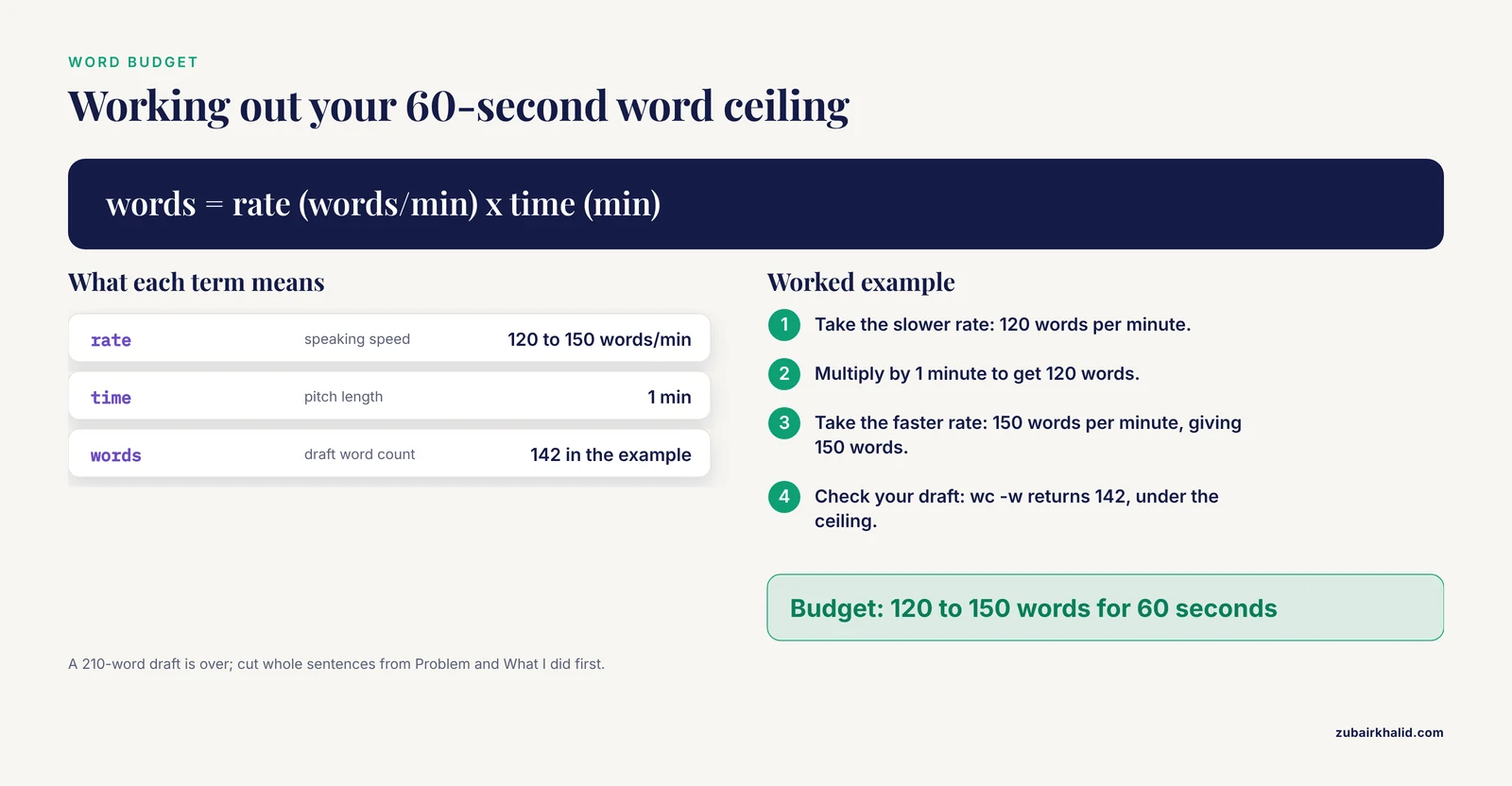
Paste the filled template into any word processor and check the word count. Subtract any word over 150.
A quick manual check works too:
$ wc -w pitch.txt
142 pitch.txt
The output 142 sits under the 150-word ceiling, so the draft passes. If you see 210, cut whole sentences, not words. The middle slots, Problem and What I did, shed words fastest.
Step 4. Add the timing script
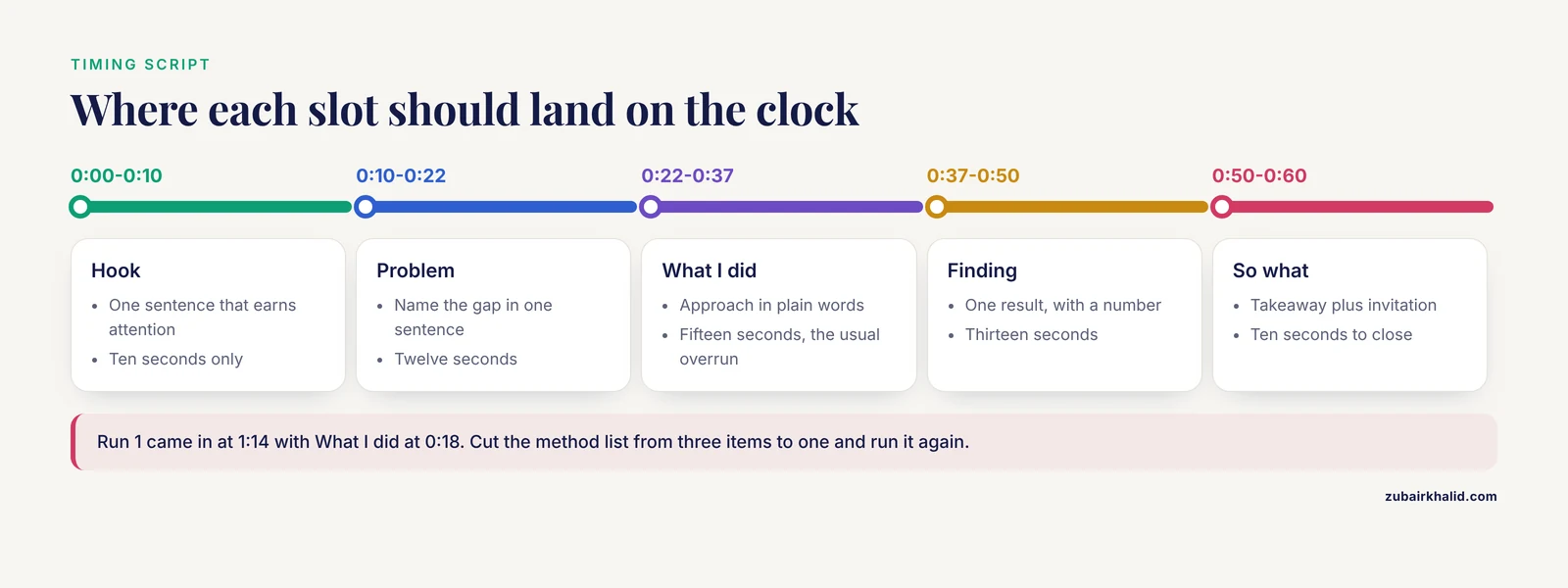
Assign each slot a target window so you can diagnose overruns by position rather than by guesswork:
0:00-0:10   Hook
0:10-0:22   Problem
0:22-0:37   What I did
0:37-0:50   Finding
0:50-0:60   So what + invitation
Step 5. Record and time yourself
Open your voice memo app, start the timer, and deliver the pitch once, aloud, standing up. Standing changes your breathing and your pace. Play the recording against the timing script. Expected output after a good run looks like this in your notes:
Run 1:  1:14  (Hook 0:12, Problem 0:16, What I did 0:18, Finding 0:17, So what 0:11)
Run 2:  1:02
Run 3:  0:58
Run 1 ran 14 seconds over. The What I did slot was the culprit, which is the most common one. Cut the method list from three items to one and try again.
Step 6. Stress-test with a non-expert
Deliver the pitch to a friend outside your subfield. Ask them to tell you, in their own words, what you found. If they cannot restate your finding, the Finding slot failed, and no amount of polish will fix it. Rewrite that sentence until a non-expert can repeat it back.
Step 7. Rehearse the follow-up, not just the pitch
The pitch is the first minute. Plan for the second. Pick the three questions you most want to be asked, and the three you least want to be asked, and prepare short answers for each. Your poster sections map to those answers, so practice pointing at the relevant panel as you answer. Practicing pitch plus follow-up together is what separates people who perform well at their first poster session from people who freeze after minute one.
How to make a scientific poster that supports the pitch
A pitch points at a poster. If the poster cannot carry the detail your pitch promises, the conversation stalls. Research poster design follows a few settled conventions, and your pitch should be written to match them.
Structure the poster around the same five beats. Title at the top, a short problem statement in the upper left, methods flowing downward, results as the visual center, and a takeaway banner near the bottom. When your spoken slots match the poster's visual order, you can gesture down the board as you talk, and the listener reads along with you.
Put the finding in the title. A title that states the result, such as "Confidence Rises With Exposure While Knowledge Scores Do Not," orients every passerby before you speak. A title that reads like a section label, such as "An Evaluation of Resident Training," orients no one.
Design for reading distance. Body text should be readable at arm's length, headings readable from several feet away, and the title readable across the aisle. These proportions are standard guidance across poster design references, and they matter for the pitch because you will physically point at figures while talking. Tiny text forces you to paraphrase the poster, which doubles your cognitive load mid-conversation.
Make figures carry the argument. One clear graph of your headline result is worth three paragraphs of text. Label axes, units, and group names so the figure survives without narration. In structured training programs, posters are scored with rubrics that reward exactly this clarity, alongside the oral presentation itself [1], which is a useful signal about what reviewers value.
Leave white space and a takeaway. A poster crammed edge to edge signals anxiety. A poster with a bold takeaway line and room to breathe signals confidence, and it gives your So what slot something to point at.
Common Mistakes and Limitations
Opening with the poster title. The listener just read your title. Repeating it wastes your best ten seconds. Open with the hook instead.
Reciting the abstract. Written abstracts carry statistical machinery, full cohort descriptions, and citation chains. Spoken pitches cannot. Compress to the five slots and let the poster hold the rest.
Burying the result. If your Finding slot arrives after 45 seconds of methods, most listeners have already drifted. Move the result earlier if you struggle with pacing.
Overclaiming. A pitch delivered with more confidence than the data support invites exactly the questions you cannot answer. State the result at the strength the evidence allows. In the worked example above, the honest finding is that confidence and knowledge moved in different directions, which is a more interesting claim than a clean win would have been, and it survived contact with the actual numbers [2].
Memorizing word for word. Memorized pitches shatter when interrupted. Memorize the five slot labels and the first sentence of each slot. Improvise the rest from the poster.
Ignoring the timer. Sixty seconds is a design constraint, not a suggestion. Poster sessions put visitors in motion. A pitch that runs two minutes loses its listener at ninety seconds even if the content is excellent.
Skipping the practice audience. The gap between reading a pitch aloud in your head and delivering it to a stranger is large and only closes with rehearsal. Two live run-throughs beat twenty silent ones.
One limitation to keep in mind: this template is a communication tool, not a scientific one. It can make your work clear. It cannot make preliminary data stronger than they are, and individual conference norms, from judging rubrics to session length, vary. Check your meeting's own poster guidance before finalizing.
Adapting the pitch to different audiences
The template stays fixed. The vocabulary shifts.
Faculty judges and reviewers. Keep the plain-language hook, then allow slightly more method detail in the What I did slot, because this audience will probe design choices. End the So what slot with the limitation you are already aware of, before they find it. Volunteering the weakness reads as rigor.
Researchers outside your subfield. Spend your Problem slot on why the question matters to the field in general, not the technical gap in your niche. Replace subfield jargon with the closest everyday word.
Industry and career contacts. Emphasize the So what slot. What does the result enable, what would the next step require, and what are you looking for next? People at poster sessions hire, collaborate, and refer. Make it easy for them to see the use case.
The general public and students. Keep the hook and finding, compress the problem to one everyday sentence, and drop every acronym. If a term needs a definition, either define it in four words or cut it.
Frequently Asked Questions
How many words should a 60-second elevator pitch have?
Aim for 120 to 150 words. Most speakers deliver prepared text at roughly 120 to 150 words per minute, so anything longer pushes you past one minute or forces rushed delivery.
What is the scientific poster elevator pitch template format?
The format has five slots in order: a hook that earns attention, the problem your field could not answer, your approach in plain words, your single most important finding, and a takeaway that invites further conversation. Budget about 15 to 30 words per slot.
Where can I get a free scientific poster elevator pitch template?
Use the five-slot template in this article, which is free to copy into any text file or note app. Pair it with the timing script and the word-budget table above, and you have the complete template without paying for anything.
How is an elevator pitch different from my poster abstract?
An abstract is written, dense, and meant to be reread. A pitch is spoken once, carries about a tenth of the detail, and ends by opening a conversation rather than closing an argument.
Should I memorize the pitch word for word?
Memorize the structure and the first sentence of each slot, not the full script. Word-for-word memorization breaks the moment a listener interrupts, which they will.
What should I do after the pitch ends?
Ask the listener a question, point to the poster panel that answers the follow-up they are most likely to raise, and have three prepared questions of your own ready. The pitch buys you the conversation. The poster and your follow-up answers carry it.
How do I adapt the pitch for judges versus the general public?
Keep the five slots and change the vocabulary. For judges, add method detail and volunteer a known limitation. For the public, cut every acronym, keep the hook and finding, and end with why the result matters in daily life.
Does the pitch change for virtual or poster sessions held online?
The five slots stay the same, but delivery changes. You pitch to a webcam, so the timing matters more, eye contact should go to the camera, and you share your screen instead of pointing at a board. Rehearse with the actual video tool you will use.
Sources
- An innovative course-based undergraduate research experience (CURE) in HPV-associated cervical cancer: integrating molecular oncology research and scientific writing in undergraduate education.
- Inpatient Exposure, Confidence, and Knowledge in Pediatric Hematology/Oncology: Evaluating General Pediatric Residents During 2025 ACGME Curriculum Change.