How to Handle a Reviewer Who Is Factually Wrong
By Dr. Zubair Khalid, DVM, MS, PhD ·

Peer review is the process in which independent experts evaluate a manuscript before publication. Most of the time, the feedback you receive improves the paper. Sometimes it does not. A reviewer states that a reagent cannot be used the way you used it, claims your cited paper says the opposite of what it actually says, or insists on a "fact" that has been superseded by a decade of newer work. If you are facing that situation, you need a reviewer factually wrong response that is firm about the evidence and generous about the person.
The most likely cause, in order of frequency, is simple: the reviewer misread your manuscript. Reviewers work under time pressure, often read manuscripts late at night, and frequently review outside their exact subfield. Before you assume the reviewer lacks competence or good faith, check whether your manuscript actually says what you believe it says. Open the submitted version, not the file on your laptop. Find the sentence the reviewer is reacting to. Read the paragraph around it. A surprising share of "wrong" reviewer comments dissolve the moment you realize your own wording invited the misreading, and a surprising share of the rest trace to the reviewer recalling a related paper instead of the one they cited.
This article gives you a diagnostic sequence, a troubleshooting table, the mechanisms behind each kind of reviewer error, response letter language you can adapt, and the prevention habits that reduce the chance of the same dispute in the next round.
First, Establish That You Are Right
The worst outcome in peer review is not a wrong reviewer. It is a wrong author. If you push back on a correct comment with confidence, you lose credibility for every later exchange in that round. So the first step is verification, and it has four parts.
- Quote the reviewer exactly. Copy their sentence into your notes word for word. Paraphrasing from memory is how authors argue against a comment the reviewer never made.
- Identify the basis of the claim. Does the reviewer cite a specific paper, refer to a guideline, or assert the fact from experience? A claim with a citation is checked one way. A claim without one is checked another way.
- Go to the primary literature. Read the paper the reviewer cited, in full, not the abstract. If the reviewer cited no paper, search the statement yourself. Look for the most recent authoritative source, such as a consensus guideline from a professional body, a standard textbook, or a landmark study, rather than the first result that agrees with you.
- Write down the verdict honestly. Sort the comment into one of three bins. Bin one, the reviewer is right and I was wrong. Bin two, the reviewer is partially right and my manuscript is ambiguous. Bin three, the reviewer is factually wrong.
Only bin three justifies a correction in your reviewer response letter, and even then, the response should be framed as clarification rather than defeat.
Factual Error Is Not the Same as Disagreement
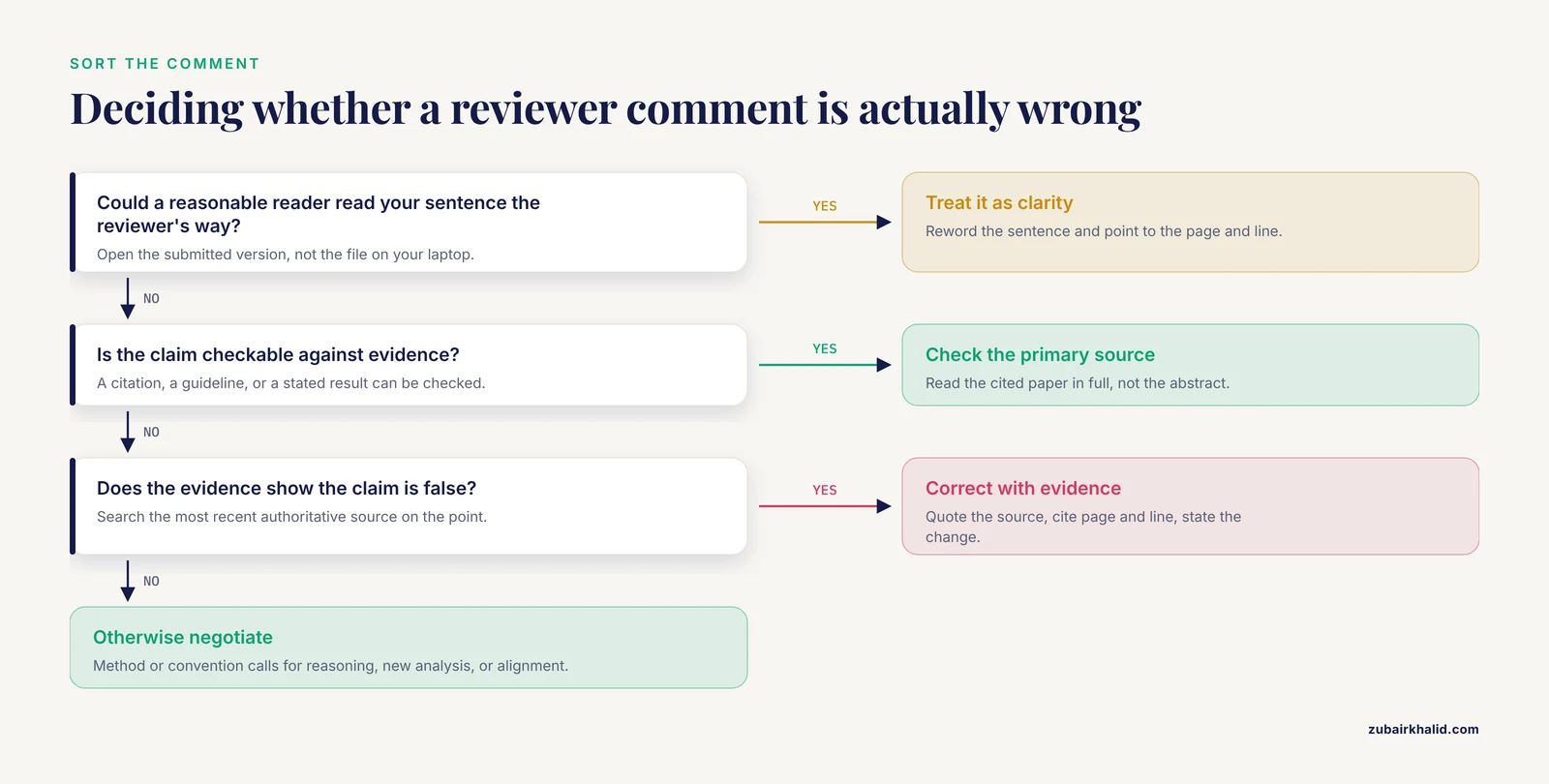
Before you draft anything, separate three situations that authors routinely confuse.
A factual error is a claim that can be checked against evidence and shown to be false. Examples include a reviewer stating that your assay detects something it does not, that a landmark trial reported the opposite result, or that your sample size calculation used the wrong formula. Factual errors have a correct answer.
A methodological disagreement is a difference of judgment about what is acceptable practice. The reviewer might argue that a different statistical model would have been better or that a control condition was unnecessary. Both positions can be defensible. There is no single fact of the matter.
A convention difference is a difference in the norms of a subfield. Thresholds, nomenclature, and reporting style often vary between journals, countries, and generations of researchers. The reviewer may be applying the conventions of their field to yours.
The response strategy differs for each. A factual error calls for evidence. A methodological disagreement calls for reasoning, compromise, or new analysis. A convention difference calls for either adopting the journal's convention or politely explaining yours. Treat every comment as a factual error and you will start arguments you cannot win.
Troubleshooting Table: Symptoms, Causes, and Fixes
The table below is the core of the article. Work down the symptom column until you find the row that matches your situation.
| Symptom | Likely cause | How to confirm | Fix |
|---|---|---|---|
| The reviewer contradicts something your manuscript plainly states | Misreading, often from skimming | Search the submitted PDF for the reviewer's claim. Find the exact sentence | Point to the page and line number, quote your own text, and soften any ambiguous wording in the revision |
| The reviewer asserts a fact with no citation | Half-remembered knowledge or a convention from another subfield | Search the recent literature yourself, including consensus guidelines | Provide one or two authoritative citations and a brief explanation, or accept the comment if the literature supports the reviewer |
| The reviewer cites a paper that says the opposite of what they claim | Citation made from memory, or a citation produced by an AI writing tool | Retrieve the paper and read the relevant section | State specifically which result or sentence of the cited paper supports your position, and quote it in the response letter |
| The reviewer's cited paper does not exist at all | Fabricated reference, increasingly common when reviewers draft comments with generative AI tools | Search the title, authors, and journal in PubMed, Google Scholar, and the publisher's site | Say neutrally that you could not locate the cited work, provide the correct literature, and flag the pattern to the editor |
| The reviewer claims your method is invalid | Outdated knowledge, since a technique may have been superseded or rehabilitated since the reviewer trained | Check recent methodology reviews and manufacturer technical documentation | Cite current validation studies showing the method is accepted, and describe what changed since the older practice |
| The reviewer applies thresholds or definitions that differ from your field's convention | Convention difference between subfields | Compare the reviewer's value with the reporting guideline or standard used in your target journal | Either adopt the journal's convention or explain your convention with a citation from your field |
| Two reviewers directly contradict each other | Different subfield norms, or one reviewer's factual error | Compare both comments side by side against the literature | Answer each separately, agree with the correct one, and give the editor a short note explaining the conflict |
| The comment is hostile, vague, and uncheckable | Reviewer fatigue, a conflict of interest, or a low-quality review process | Look for a factual core, however small, that can be addressed | Address the factual core, remain neutral in tone, and raise concerns about the review itself with the editor rather than in the response letter |
Causes, From Most Common to Rarest
Understanding the mechanism behind each failure mode helps you fix the manuscript, not just the comment.
Misreading the manuscript
This is the most common cause by a wide margin. A reviewer reading six manuscripts in a weekend holds your paper in short-term memory alongside five others. Details blur. A negative result becomes a positive one. A limitation you disclosed becomes an oversight you hid. The mechanism is ordinary human cognition under time pressure, not hostility. The fix is usually a single sentence in your response letter pointing to the exact page and line, plus a revision that makes the point harder to miss, such as moving a key caveat out of a footnote and into the results section.
Outdated knowledge
Science moves. A reviewer who last engaged deeply with a topic ten years ago may genuinely believe a technique is invalid, a protein has a single function, or a treatment is contraindicated, because that was true when they trained. The mechanism is memory anchoring. People trust their stored knowledge and rarely re-verify facts they feel certain about. The fix is a gentle, citation-backed update. Phrase it as the field having moved, not as the reviewer having fallen behind. For example, "Since the studies the reviewer references, subsequent work has shown that X, as summarized in Y. We have added this reference and adjusted the discussion on page 7."
Subfield convention differences
Terminology, statistical thresholds, and reporting expectations vary across subfields and across journals. A reviewer from a clinical background may expect different effect measures than a reviewer from basic science. The mechanism is that each of us treats the norms of our own training as defaults rather than choices. The fix is to check the target journal's author guidelines and any applicable reporting standard, then either comply or explain your convention with a supporting citation.
Conflation with another paper
Reviewers read hundreds of papers a year. A reviewer may confidently attribute a finding, a limitation, or a flawed conclusion to your manuscript because they are actually remembering someone else's. The mechanism is source confusion, a well-documented memory phenomenon. The fix is the same as for a plain misreading, quote your own text precisely, but you should also make sure your framing distinguishes your contribution from closely related work, because ambiguity there invites the conflation.
Statistical misunderstanding
Some of the sharpest disputes involve statistics. A reviewer may claim your test was inappropriate, your correction for multiple comparisons was missing, or your confidence intervals were interpreted incorrectly. Sometimes the reviewer is wrong, for example by insisting on a test that does not fit the design. Sometimes the reviewer is right. The mechanism on both sides is that statistical practice contains legitimate schools of thought, and authors under deadline pressure sometimes apply a test out of habit rather than fit. The fix is to re-derive your analysis from your study design, document the reasoning, and either reanalyze or explain your choice with reference to a standard statistical text or the journal's statistical guidelines. If you are unsure, consult a biostatistician before responding, because this is the category where confident wrong answers damage papers the most.
Fabricated or unverifiable citations
A newer failure mode has entered peer review. Some reviewers draft parts of their reports with generative AI tools, and those tools can invent references that look plausible but do not exist. The mechanism is that language models produce fluent text and cannot verify whether a citation points to a real paper. If a cited paper cannot be found in PubMed, Google Scholar, or the publisher's archive, treat it as possibly fabricated. Handle it carefully. State the verification attempt neutrally, supply the correct literature, and inform the editor privately, because the same reviewer may be producing unreliable comments on other manuscripts as well.
Conflict of interest or bad faith
This is the rarest cause. A reviewer who competes directly with your work may delay or distort their review. Journals ask reviewers to declare competing interests for exactly this reason. The mechanism is straightforward motivated reasoning. You cannot prove intent from the text of a review, so do not accuse. Address the factual claims on their merits and, if the pattern of comments looks obstructive, write to the handling editor, who is the person responsible for reviewer conduct and selection.
A Diagnostic Sequence You Can Follow
When a comment arrives that seems wrong, run it through this sequence before writing a word of your response.
- Restate the comment in your own words. If you cannot restate it, you do not yet understand it, and your response will misfire.
- Locate the manuscript text the comment targets. Note the page, paragraph, and line number.
- Ask what a reasonable reader would take that sentence to mean. If a reasonable reader could read it the way the reviewer did, the comment is a clarity problem, not a factual error.
- Identify the reviewer's evidence. Citation, guideline, personal assertion, or nothing.
- Verify against the strongest available source. Primary literature, consensus guidelines from a professional body, or a standard textbook. Check the date of the source, because recency matters in fast-moving areas.
- Classify the comment. Factual error, methodological disagreement, convention difference, or clarity problem.
- Choose the response mode. Evidence for factual errors, reasoning or new analysis for methodological disagreements, convention alignment for convention differences, and rewording for clarity problems.
- Draft the response, then sleep on it. Responses written within an hour of reading a comment are noticeably more combative than responses written the next morning.
How to Respond to Peer Reviewers: The Response Letter
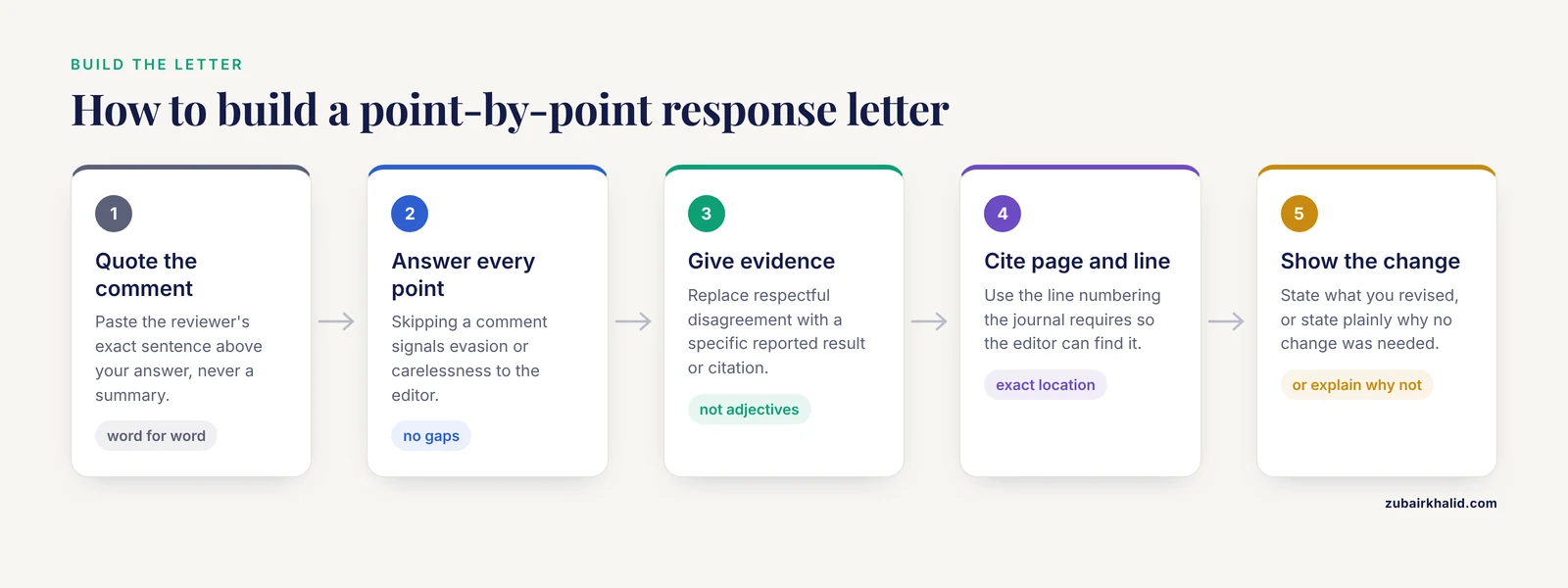
The reviewer response letter, sometimes called a rebuttal letter, is a point-by-point document in which you quote each reviewer comment and reply beneath it. Its purpose is to let the editor see, at a glance, that every comment received a substantive answer. Editors read these letters closely, and a well-built letter often matters more than the revision itself.
Follow these structural rules.
- Quote the reviewer first. Paste their exact comment, in italics or quotation marks, above your answer. Never summarize a comment you intend to correct.
- Answer every point. Skipping a comment signals either evasion or carelessness.
- Give evidence, not adjectives. "We respectfully disagree" convinces no one. "The cited study reported a median survival of 14 months in the treatment arm" does.
- Cite page and line numbers. Point the reviewer to the exact location in the revised manuscript, using the line numbering required by the journal.
- Show the change. After your explanation, state what you changed in the manuscript, or state why no change was needed.
- Stay respectful in the opener. Thank the reviewer for the comment before you contradict it.
Here is a worked template for a factual error, using a hypothetical example.
Reviewer comment 3: "The authors claim that PCR cycle threshold values below 30 indicate high viral load. This is incorrect. Ct values below 30 indicate low viral load." Response: "We thank the reviewer for engaging closely with this section. In real-time quantitative PCR, the cycle threshold (Ct) is the amplification cycle at which fluorescence crosses the detection threshold. Because each cycle approximately doubles the amount of amplified target, fewer cycles required to reach detection correspond to more starting template. Lower Ct values therefore indicate higher starting viral load, which is the standard interpretation in diagnostic virology. We have reworded the sentence on page 5, lines 12 to 14, to make this relationship explicit and have added a citation to a standard diagnostic virology reference."
That structure works because it teaches, cites, locates, and revises in four sentences, without ever telling the reviewer they failed to understand PCR.
When the reviewer made no factual error but their comment still deserves an answer, mirror the structure with reasoning instead of evidence. When the reviewer is partially right, concede the correct portion explicitly and early. Conceding a true point costs nothing and buys credibility for the points you contest.
When to Involve the Editor
The handling editor, the editor who manages your manuscript day to day, is the arbiter when reviewers disagree or when a review is defective. Contact the editor directly, in a separate message from your response letter, in these situations.
- Two reviewers give factually contradictory instructions and you cannot satisfy both.
- A reviewer's key claim rests on a citation that does not exist.
- A comment is abusive, personal, or entirely unrelated to the manuscript.
- You have credible reason to suspect an undisclosed conflict of interest.
- The reviewer demands new experiments that exceed what the editor asked you to address.
Keep the message factual and short. Quote the problematic comment, state your verification, and ask for the editor's guidance. Editors deal with these situations regularly and would rather know early than discover the problem in an appeal.
A Short Note on Professional Conduct
There is a real hazard in this process, and it is reputational rather than chemical. Reviewer reports and your responses are confidential documents. Do not post a reviewer's comments on social media, do not name the reviewer in conversations with colleagues outside your immediate collaboration, and do not attempt to identify and contact the reviewer yourself. Journals treat a breach of review confidentiality as a serious offense, and public disputes over reviews, even when the reviewer was wrong, tend to damage the author's standing more than the reviewer's. Keep every exchange inside the journal's system.
Prevention: Writing That Survives Reviewers
The cheapest way to fix a reviewer factually wrong response is to prevent the misreading that caused it.
- Define every term at first use. Most misreadings begin with a term the reviewer understood differently. If your field uses "validation" or "strain" or "significance" in a specific way, define it in the first paragraph where it appears.
- State your key claims in the abstract in plain language. Reviewers form their reading of the paper early. If the abstract is ambiguous, every later comment inherits the ambiguity.
- Put limitations in the discussion, prominently. A reviewer who finds an unstated limitation writes a sharper comment than one who finds you already addressed it.
- Anticipate the three most likely objections. After drafting, list the three comments you least want to receive. Then either preempt them in the manuscript or prepare your evidence before submission.
- Get an outside read before submission. A colleague from an adjacent subfield will catch the assumptions a reviewer might misread, because they share the reviewer's outside perspective.
- Use the cover letter. Tell the editor what the paper is and is not. Scope misunderstandings at review time often trace back to a manuscript that looked broader in the abstract than it was in the results.
Common Mistakes and Limitations
Authors handling a wrong reviewer comment make predictable errors. Avoid these.
Arguing tone instead of content. A sarcastic or triumphant response can be technically correct and still fail, because the editor reads tone as a proxy for how you will behave in future rounds and in print.
Citing a paper you have not read. If you respond to a citation with a counter-citation pulled from a search result, you risk repeating the reviewer's mistake in reverse. Read the papers you cite in a rebuttal.
Conceding everything to end the argument. Some authors, exhausted by review, accept every comment including the wrong ones. This can warp the manuscript's conclusions. Correct factual errors even when the correction is uncomfortable to deliver.
Assuming the reviewer is wrong because you do not like the comment. Dislike is not evidence. Run the diagnostic sequence. A substantial fraction of comments that feel wrong are actually right, or right about a real weakness even when stated clumsily.
Fighting the review in the manuscript instead of the letter. Do not make silent changes that contradict a reviewer's comment and hope no one notices. Editors compare versions. Explain the disagreement openly in the response letter.
Treating one bad review as a broken system. Individual reviews vary widely in quality. The limitation of the whole process is that reviewers are unpaid or minimally compensated volunteers with limited time, so comment quality varies from excellent to careless. Your job is to extract the signal, correct the factual errors with evidence, and let the editor manage the reviewer. Individual decisions about your specific manuscript always rest with the editor and the journal's policies, and this article describes general practice rather than the rules of any particular journal.
Frequently Asked Questions
What is a reviewer factually wrong response?
It is a reply in your reviewer response letter that corrects a reviewer's factual error using evidence while remaining professional in tone. The response quotes the comment, presents verifiable support such as a primary citation, points to the relevant manuscript location, and states what was changed in the revision.
How do I know whether the reviewer or I am wrong?
Verify against the primary literature before responding. Retrieve any paper the reviewer cited and read the relevant section in full, then search for the most recent authoritative source on the claim. If the evidence supports you, correct the record. If it supports the reviewer, revise the manuscript.
Should I just accept a wrong comment to avoid conflict?
No, and doing so can damage the manuscript's accuracy. Accept comments that are correct, negotiate comments that are matters of judgment, and correct factual errors with citations. Editors expect authors to defend their work with evidence, and a respectful correction does not count against you.
Can I contact the reviewer directly?
No. Reviewer identity is confidential to the journal, and authors should never attempt to identify or contact a reviewer. All communication goes through the handling editor and the journal's submission system.
What if the reviewer cites a paper that does not exist?
Check the title, authors, and journal in PubMed, Google Scholar, and the publisher's archive. If the paper cannot be located, state neutrally in your response that you could not find the cited work, supply the correct literature, and notify the editor privately, since fabricated citations sometimes indicate that a reviewer drafted comments with an AI tool.
What should I do when two reviewers contradict each other?
Evaluate each comment against the literature independently, agree with the one the evidence supports, and explain the conflict to the editor in a separate note. Editors are accustomed to reconciling contradictory reviews and can consult an additional reviewer if needed.
When should I go to the editor instead of the reviewer?
Contact the editor when reviewers contradict each other, when a citation appears fabricated, when a comment is abusive or unrelated to the manuscript, when you suspect an undisclosed conflict of interest, or when the reviewer demands work far beyond the scope of a revision. Route these concerns through a short, factual message quoting the relevant comments.
Can a wrong reviewer comment lead to rejection?
It can, if the factual error goes uncorrected and shapes the editor's decision. That is why correcting factual errors in the response letter matters. If a manuscript is rejected over a disputed point, a factual, well-documented appeal to the editor is the appropriate next step.