How to Interpret Minor Reviewer Comments on Data Presentation
By Dr. Zubair Khalid, DVM, MS, PhD ·

A minor comment on data presentation asks you to change how your results are shown or described, not whether the underlying science stands. In practice, these comments request clarity, consistency, or completeness in your figures, tables, and statistical reporting, and almost all of them can be resolved with targeted edits plus a point-by-point reviewer response letter.
This article gives you a working framework for reviewer comment data presentation minor interpretation, a table for classifying each comment, and templates for replying. It also explains the statistical logic behind the most common presentation requests, so you can tell a cosmetic fix from a comment that quietly carries bigger consequences.
What a Minor Comment on Data Presentation Actually Means
Peer review is the process in which independent experts evaluate a manuscript before publication. When an editor sends a decision letter, the reviewers' comments are usually grouped or labeled by weight. A major comment questions the validity of the work itself, for example the study design, the controls, or whether the conclusions follow from the data. A minor comment typically concerns presentation, clarity, or small gaps in reporting.
So, what does reviewer comment data presentation minor mean in plain terms? It usually means one of the following:
- The reviewer could not quickly understand a figure, table, or statistic, even though the data behind it are sound.
- Something is displayed inconsistently, such as different units across figures or error bars described in one figure but not another.
- A standard element of reporting is missing, such as the number of samples behind each data point or the definition of the error bars.
- The wording around a result overstates or understates what the figure shows.
The word minor describes the reviewer's judgment about effort, not importance. A minor comment can still block acceptance if it is ignored. Editors often treat an unanswered minor comment as a sign that the authors did not engage carefully with the review, and that impression can affect how the revised manuscript is handled.
The usual categories of minor presentation comments
Minor comments on data presentation cluster into a small number of recurring types. Learning these categories is the fastest route to confident reviewer comment data presentation minor explained reasoning, because each type has a standard fix.
- Cosmetic and typographic. Typos in axis labels, inconsistent fonts, low-resolution images, or a figure legend that does not match the symbols in the plot.
- Clarity of display. Missing axis labels, unlabeled units, overcrowded panels, or color schemes that are hard to distinguish.
- Statistical presentation. Error bars that are not defined, missing confidence intervals, significance stars without the underlying test statistics, or p values reported without effect sizes.
- Consistency across the manuscript. The same condition called different names in the text and the figure, or the same dataset presented as a bar chart in one figure and a scatter plot in another without explanation.
- Completeness of reporting. A group mentioned in the methods but absent from the figures, raw data relegated nowhere, or a table lacking the sample size for each row.
- Scaling and normalization choices. Logarithmic versus linear axes, normalized versus raw values, or a transformation the reviewer thinks should be stated or reconsidered.
Why Reviewers Separate Major From Minor Comments
Editors typically choose among four outcomes: accept, minor revision, major revision, or reject. A minor revision decision tells you the editor sees a direct path to publication, usually with a second look by the editor or a quick check by a reviewer rather than a full re-review.
That classification has practical meaning for you. It says the reviewers found the questions sound, the methods defensible, and the conclusions supported. What remains are fixes at the level of display and description. Many authors misread this signal in one of two directions. Some celebrate and rush the revision, skipping comments. Others panic and treat every wording suggestion as a threat to the paper's core claims. Both reactions misinterpret the same message. A minor revision is a strong positive signal paired with a work list.
The proportion of comments that address presentation rather than substance is often large, and that is normal. Reviewers read the manuscript as a future reader will. If a figure requires reverse engineering to decode, the reviewer flags it, because published papers are read far more often than they are written.
The Science Behind Presentation Comments
Presentation comments are not bureaucratic fussiness. They exist because the way data are displayed determines what a reader can conclude from them. Two published examples show exactly how this works.
Example 1: Statistical presentation conventions in a published comment
In a comment article on surgical trials for hemorrhoidal disease, Brown and Watson reported dichotomous outcomes as relative risk with 95% confidence intervals, and continuous outcomes as weighted mean differences, also with 95% confidence intervals [1]. Each term has a precise meaning. A relative risk (RR) is the ratio of the probability of an outcome in one group to the probability in another. A 95% confidence interval (CI) is the range within which the true value would fall 95% of the time if the study were repeated. A weighted mean difference combines continuous measurements across studies, weighting each by its precision.
These presentation conventions exist because they let readers judge both the size and the uncertainty of an effect. In the same article, the authors reported substantial heterogeneity between the pooled trials, quantified as an I² of 90.5% [1]. Heterogeneity (I²) describes how much of the variation between study results is due to real differences between the studies rather than chance. Presenting that number alongside the pooled estimate is a presentation decision, and it changes how a reader interprets the same effect estimate. When a reviewer asks you to report confidence intervals, define your error bars, or state your heterogeneity statistics, the request is grounded in exactly this logic. The display carries inferential weight.
Example 2: When a presentation suggestion deserves a full re-analysis
A comment on data presentation can also become an invitation to test something quantitatively. In a reply published in the International Journal of Psychophysiology, Wackermann and Allefeld responded to a commentary by Pei and colleagues on global descriptors of brain electrical activity, which are summary measures that characterize brain functional states [2]. Pei and colleagues had proposed modifying a measure of spatial complexity, Omega, by applying epoch-wise and channel-wise normalization of the input data to unit power before calculation [2].
Rather than simply accepting or rejecting the proposal, the authors ran numerical simulations and re-analyzed real electroencephalography (EEG) data. The simulations showed that both the original and modified methods accurately estimated small numbers of signal sources but systematically underestimated the count as the number grew, and the modified method yielded only a minor relative improvement [2]. The analysis of real EEG data showed that the two measures differed meaningfully mainly where artefactual inhomogeneities in channel variances affected the recordings. On that basis, the authors suggested a combined procedure, equalizing channel variances record-wise before computing Omega, as the optimal strategy [2].
Normalization here means rescaling data so that each channel or epoch contributes a comparable amount of signal power. This case study teaches three lessons about minor comments:
- A reviewer's presentation or processing suggestion can be tested, not just adopted.
- The word minor in scientific writing often refers to the size of a quantified effect. The modified measure gave a minor relative improvement, which is a measured statement, not a dismissal.
- A well-handled comment can produce a better method even when the reviewer's original proposal is only partly adopted. The authors ended with a combined procedure that neither side had proposed at the start.
Classifying Your Comments: A Working Table
When the decision letter arrives, sort every comment into one of these categories before you edit anything. The table summarizes the recurring minor presentation comments, what the reviewer is really asking, and the standard fix.
| Comment type | Typical wording | What the reviewer is really asking | Standard fix |
|---|---|---|---|
| Cosmetic | "Typo in Figure 2 axis label" | Basic proofreading | Correct it, confirm in the response letter |
| Clarity of display | "Panels A and C are hard to distinguish" | A reader-friendly figure | Redesign the panel, increase contrast, enlarge fonts |
| Units and axes | "Please state the units on the y-axis" | Unambiguous measurement reporting | Add units, define the scale, state log or linear |
| Error bars and statistics | "Define the error bars in Figure 3B" | What the variability represents | State SD, SEM, or 95% CI, and the n behind each point |
| Effect size reporting | "Provide confidence intervals for the key comparisons" | Magnitude and precision, not just p values | Add CI values in the figure legend or table |
| Consistency | "The condition names differ between text and Figure 4" | One vocabulary across the manuscript | Standardize terminology everywhere |
| Completeness | "Where is the control group described in the methods?" | All data accounted for | Add the group to the relevant figure, table, or supplement |
| Scaling or normalization | "Consider normalizing the traces before comparison" | Whether the display choice affects interpretation | Test the suggestion, show the comparison, explain your choice |
The last row deserves the most thought. As the Wackermann and Allefeld example shows, a normalization comment can change results, so it should be answered with analysis rather than a one-line concession [2]. Most other rows require minutes to hours of work each.
How to Respond to Peer Reviewers: The Response Letter
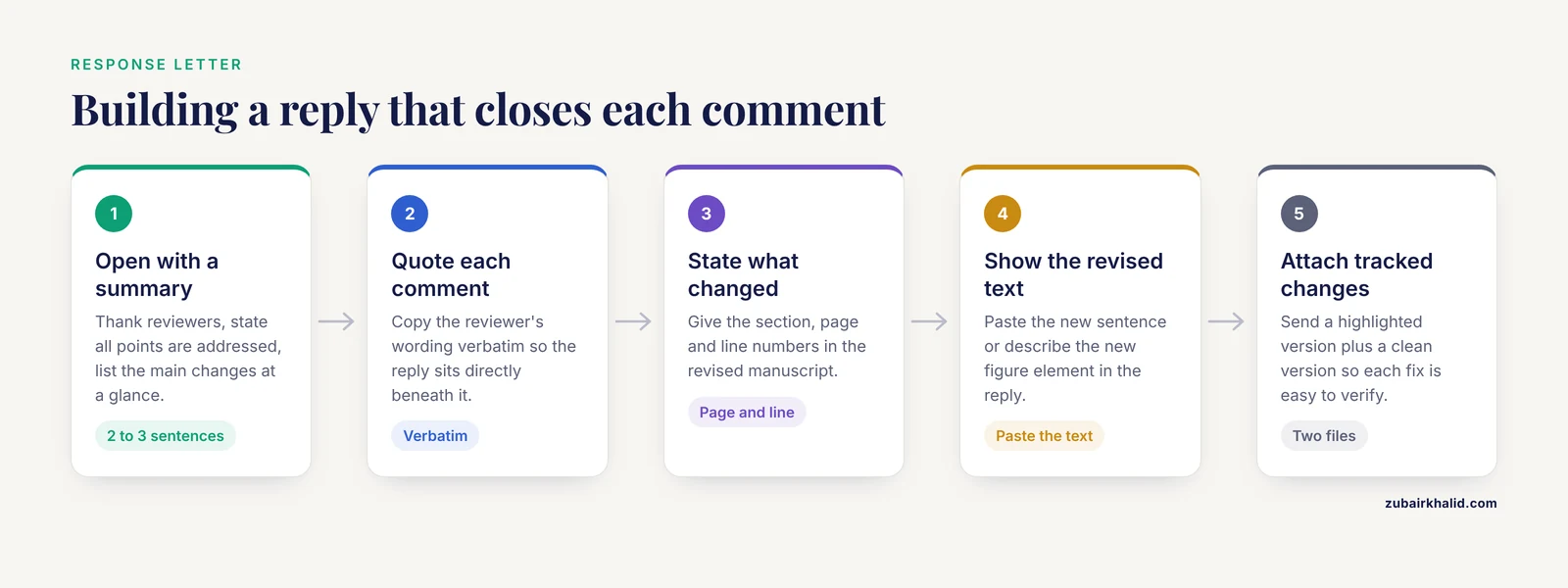
The reviewer response letter is the document that determines whether your revision is accepted smoothly. Editors and reviewers read it before they re-read the manuscript. A good letter has three parts.
1. A short opening summary
Open with two or three sentences thanking the reviewers, stating that you have addressed all points, and listing the major changes at a glance. Keep it free of defensiveness.
2. A point-by-point reply
Quote each comment verbatim, then respond directly beneath it. For every comment, use this pattern:
- State what you changed. Give the section, page, and line numbers in the revised manuscript.
- Show the revised text. Paste the new sentence or describe the new figure element.
- Explain, if you disagreed. Give your reasoning and, where possible, evidence.
A worked example. Suppose a reviewer writes, "Please define the error bars in Figure 3B and state the number of independent samples." A complete reply looks like this:
Reviewer 1, Comment 4: "Please define the error bars in Figure 3B and state the number of independent samples." Response: We have revised the Figure 3 legend to read, "Error bars represent standard error of the mean across 6 independent biological replicates per group." The sample size for each group is now also stated in the Methods, page 8, lines 12 to 14.
That reply is three sentences long and closes the comment permanently. Compare it with a reply that says only "Done," which forces the reviewer to hunt through the manuscript to verify the change.
3. A tracked-changes manuscript
Most journals expect the revised manuscript with changes highlighted, plus a clean version. Mark every edit connected to a comment so the reviewer can verify each fix in seconds.
Tone rules that carry weight
- Answer every comment, including the ones that look like typo flags. A skipped comment reads as an ignored reviewer.
- If you disagree, disagree with evidence. Cite a published method, run the alternative analysis the reviewer suggested, and show the comparison. The reply by Wackermann and Allefeld is a model here, because they evaluated the proposed change empirically and reported where it helped and where it did not [2].
- Keep the tone collaborative. Reviewers volunteer time, and a courteous letter builds goodwill for the inevitable next round.
- Never let the response letter contradict the manuscript. If you changed a value, the letter and the paper must both show it.
When a Minor Comment Hides a Major Concern
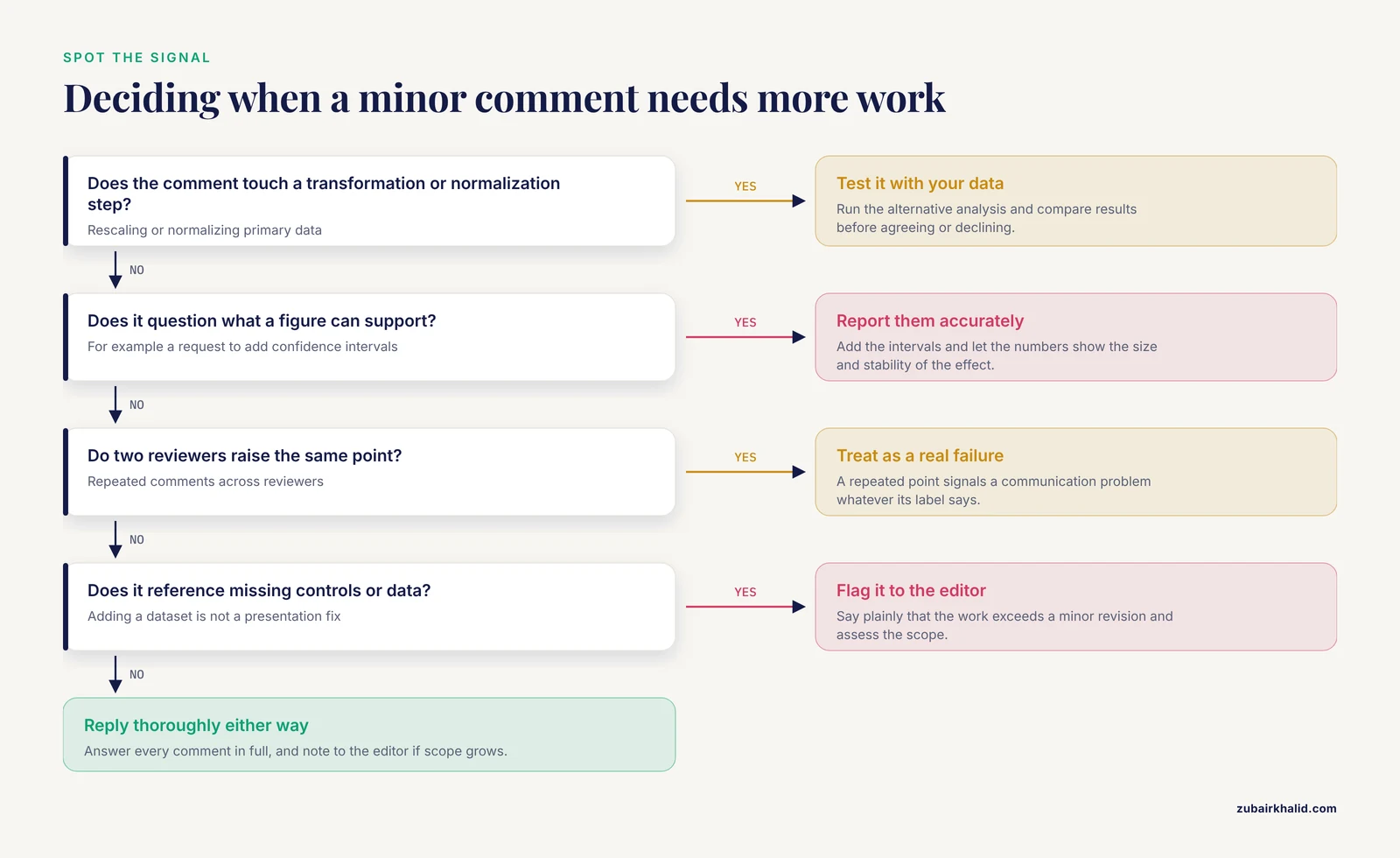
Reviewer comment data presentation minor interpretation includes learning to spot the small number of minor-labeled comments that deserve major-level attention. Watch for these signals:
- The comment touches a transformation or normalization step. As shown in the EEG example, a normalization proposal changed how two complexity measures compared, and the honest answer required simulations and re-analysis of real recordings [2]. If a comment asks you to rescale, transform, or re-plot your primary data, check whether any conclusion could shift.
- The comment questions what a figure can support. A request to add confidence intervals is sometimes a polite way of saying the effect looks small or unstable. Report them accurately and let the numbers speak.
- Two reviewers raise the same point. Repeated comments almost always indicate a real communication failure, whatever their individual labels say.
- The comment references missing controls or missing data. Adding a dataset is not a presentation fix. Flag it to the editor if it expands the scope of the work.
In these cases, the right move is not to argue the label. Reply thoroughly, and if the work required exceeds a minor revision, say so plainly in a note to the editor. Editors respond well to a realistic scope assessment.
Common Mistakes and Limitations
- Treating minor comments as optional. Every comment needs an explicit reply. Unanswered comments are the most common cause of a second revision round.
- Fixing the figure but not the text. If you change an axis, a normalization, or an error bar definition, update the legend, the Methods, and any sentence in the Results that describes the figure. Inconsistent fixes generate new comments.
- Changing numbers silently. Any value that changes between the original and revised manuscript must be visible in the tracked changes and explained in the letter.
- Arguing tone. A reply that says the reviewer misunderstood the figure may be factually right and strategically wrong. Rewriting the figure so no reader can misunderstand it solves the actual problem, which is that future readers would struggle too.
- Over-conceding. Adopting every suggestion without evaluation can weaken a paper. Test suggestions that affect analysis, and keep your original choice when the evidence supports it.
- Assuming all journals use the same rubric. The major and minor distinction, response format, and revision timelines vary by journal. Read the specific guide for authors and the decision letter before planning your revision. This article describes general patterns in peer review, and each manuscript and journal pairing has its own context.
What Is Still Uncertain
Peer review is a human judgment process, and no universal rubric defines what counts as minor. Two reviewers can label the same comment differently, and editorial styles differ across journals and fields. Quantitative studies of reviewer agreement show only moderate consensus between reviewers on many manuscripts, which means the major and minor labels are best treated as guidance about effort rather than precise verdicts on quality. What remains stable across the process is the presentation logic itself. Clear units, defined error bars, stated sample sizes, and consistent terminology reduce ambiguity for every future reader, which is the goal the comments are pointing toward.
Frequently Asked Questions
What does a minor reviewer comment on data presentation mean?
It means the reviewer wants a change to how results are displayed or described, such as clearer axis labels, defined error bars, or consistent terminology, while accepting that the data and conclusions themselves are sound. Minor comments concern the reporting layer of the paper rather than its scientific foundation.
Do I have to address every minor comment?
Yes. Address every comment with either a change or a reasoned rebuttal. Skipping even a small comment signals carelessness and can slow your manuscript through extra revision rounds.
What is the difference between minor and major revision?
Minor revision means the editor expects acceptance after small corrections, often without full re-review. Major revision means the reviewers identified substantive concerns about methods, analysis, or conclusions that require significant new work and usually another full review.
How do I write a reviewer response letter?
Quote each comment verbatim, respond directly beneath it, state exactly what you changed with page and line numbers, and paste the revised text. Open with a brief summary of the main changes and include a tracked-changes manuscript so every edit is easy to verify.
Can I disagree with a minor comment?
Yes, respectfully and with evidence. State your reasoning, and where the comment concerns analysis or display choices, show a comparison that supports keeping your original approach. Disagreement backed by data is standard and respected in peer review.
How long should I take to complete minor revisions?
Journals usually set a deadline in the decision letter, commonly a few weeks for minor revisions. Check your letter and, if you need more time, email the editor before the deadline to request an extension rather than submitting late.
Can a minor comment change my conclusions?
Occasionally, yes. Comments that ask you to normalize, transform, or re-plot data can alter how results appear and occasionally how they should be interpreted. Test such suggestions with your data before agreeing or declining, and report what you find.
Should I mark the changes I made in the revised manuscript?
Yes. Most journals expect a tracked-changes version alongside a clean version. Highlighting each edit lets reviewers verify your fixes quickly, which shortens the re-review and reduces the chance of new comments.