How to Resolve Terminology Conflicts in Cross-Disciplinary Research
By Dr. Zubair Khalid, DVM, MS, PhD ·

The most common cause of a terminology conflict in cross-disciplinary research is simple polysemy. Two fields use the same word for two different things, and nobody notices until the data are merged, the manuscript is drafted, or the prototype fails. The first thing to check is whether each collaborating group has ever written down a definition of the disputed term. In most teams, the answer is no. Each discipline carries an implicit definition that was never questioned because everyone in the originating field shares it.
This guide walks through the causes of terminology conflicts in research, from the most common to the rarest, gives you a diagnostic sequence you can run in a single meeting, and lays out the solutions that have worked in real collaborations, from shared glossaries to formal harmonization frameworks. The examples come from published cross-disciplinary projects in medicine, engineering, materials science, and data science, because resolving terminology conflicts in cross-disciplinary research is a documented, solved problem once you know where to look.
Why Terminology Conflicts Happen
Terminology conflicts arise from a small set of recurring mechanisms. Identifying which one you are dealing with tells you which fix to apply. Here they are, ordered roughly by how often they appear in real collaborations.
Same word, different meanings
This is the classic failure. The word "tolerance" means immunological non-responsiveness to a hepatologist, dimensional precision to a mechanical engineer, and a drug-dosing state to a pharmacologist. In chronic hepatitis B research, the term "immune tolerant" has been applied so differently across liver societies, clinical settings, and research domains that a recent multinational group called for a unified nomenclature, noting that discordant terminology complicates clinical trial design and confuses providers, patients, and researchers alike [1]. The same field can even conflict with itself. Terms such as "resolved infection," "occult infection," and "functional cure" for hepatitis B surface antigen loss are used inconsistently across guidelines and publications [1].
The mechanism is historical. Each field's vocabulary evolved to solve that field's problems, and words were borrowed and repurposed along the way. Nothing went wrong. The vocabularies simply never had to interoperate before your collaboration existed.
Same concept, different words
The mirror-image problem. Two groups measure the same thing and call it by different names. One registry records "date of diagnosis," another records "date of first pathology confirmation," and a third stores only the year. When Australian and United States registries collaborated on medullary thyroid cancer data, they used a formal harmonization process, defined as standardizing raw data from multiple sources by resolving differences in format and terminology to create a unified dataset [2]. That project categorized every data field as an exact match, a close match, or a low match against a shared target definition, which is exactly the discipline needed when synonymy is the problem [2].
Undefined terms used as if they were defined
This cause is sneakier because the conflict is invisible until someone audits definitions. A scoping review of yoga therapy in United States clinical research found that only 27 percent of included studies defined yoga therapy, and only 23 percent distinguished it from general yoga practice, even though a professional body had published a formal definition and scope of practice years earlier [3]. The term was in the title of every paper. The definition was in almost none of them. When reviewers screened and extracted data for that review, disagreements were resolved by consensus with a third reviewer, which is the standard procedural fix for interpretive conflicts [3].
Conceptual boundaries that were never drawn
Some terms persist in the literature while hiding a genuine conceptual ambiguity. Digital biomarker research is the clearest recent example. The field has applied the identical term to continuous physiological measurement such as continuous glucose monitoring, to algorithmic prediction of biological states such as voice-based analysis of dopaminergic function, and to purely behavioral correlates such as the association between GPS-derived mobility and depression scores. Researchers analyzing this problem argue that the "bio-" in digital biomarker should refer to a property of the measurement itself, meaning the marker must be derived from biology, and that behavioral correlates without demonstrated biological grounding should instead be called digital phenotypes or digital health indicators [4]. The distinction matters because each category requires a different validation pathway, and lumping them together obscures what evidence a claim actually needs [4].
A parallel case exists in nanobiology. Plant-derived nanovesicles are frequently conflated with plant extracellular vesicles, but the first are typically obtained by breaking plant tissue open, which yields a mixture of intracellular and extracellular vesicles, while the second are naturally secreted. Inconsistent terminology and isolation methods in this area have directly hindered reproducibility and clinical translation [5].
Granularity and format mismatches
Even when everyone agrees on the concept, the recorded data can disagree. One group codes strength as a free-text string, another as two numeric fields. One group's "smoking status" column contains three categories, another's contains eleven. In medication data, this problem is severe because drug strings encode clinically critical attributes, including strength, dosage form, route, and release characteristics, all packed into one inconsistent string that must be mapped to a standardized concept before different datasets can be pooled [6].
Evolving definitions over time
Vocabulary drifts. A term that meant one thing in 2010 means something narrower or broader in 2025, and a collaboration spanning older and newer literature inherits both meanings. Scientometric analyses can make this drift visible. A review of Mediterranean diet research in China identified three distinct phases of the field, from replication through public-health expansion to cross-disciplinary innovation, and documented lexical drift in which earlier keyword clusters gave way to newer ones centered on different scientific questions [7]. Bibliometric tools such as keyword co-occurrence mapping are now standard ways to detect when a field's terminology has shifted under a collaboration's feet [7].
Cross-language and cross-cultural divergence
When collaborators work in different languages, translation introduces a second layer of divergence. Cross-cultural adaptation of measurement instruments handles this with a defined sequence: independent forward translations, synthesis, back-translation, expert committee review, and final approval, with terminology discrepancies resolved through consensus [8]. The back-translation step is the diagnostic engine. If the meaning does not survive the round trip, the terminological conflict becomes visible on paper rather than hiding in a conversation.
Troubleshooting Table: Symptoms, Causes, Confirmation, and Fixes
Use this table as the core diagnostic reference when a terminology conflict surfaces in your collaboration.
| Symptom | Likely cause | How to confirm | Fix |
|---|---|---|---|
| Merged dataset has more categories than any single source did | Same concept, different words (synonymy) | Spot-check five records per source against each source's codebook | Build a crosswalk table mapping every local term to one shared target term, and mark unmatched terms as low matches [2] |
| Team meetings keep circling back to the same disputed word | Same word, different meanings (polysemy) | Ask each subgroup to write its definition in one sentence, independently, then compare | Adopt or coin field-qualified terms, for example "immune tolerant phase (virologic definition)" versus "immune tolerant phase (histologic definition)" [1] |
| Two studies with the same title term report incompatible results | Term used but never defined | Check the methods sections of both papers for an explicit definition | Require an explicit definition statement in every protocol and manuscript; most studies skip this step [3] |
| Reviewers or editors question what your key variable actually measures | Conceptual boundary never drawn | Test the definition against edge cases: does a borderline example fall inside or outside the term? | Split the umbrella term into named subcategories, each with its own validation pathway [4] |
| Automated matching or machine learning mapping produces erratic results | Granularity and format mismatch | Examine the raw strings the model receives, including embedded attributes like strength or route | Use a retrieval-then-reranking pipeline against a standardized vocabulary, with deterministic tie-breaking rules [6] |
| Replication attempts in a partner lab fail | Method and terminology drift between groups | Compare written protocols line by line, including isolation or processing steps | Publish and adopt standardized, workflow-specific protocols with reported performance benchmarks [9] [5] |
| Non-native English speakers interpret a protocol differently from native speakers | Cross-language divergence | Run an independent back-translation and compare it to the original | Follow the forward translation, synthesis, back-translation, and expert committee sequence with consensus resolution [8] |
| Older papers in your review seem to describe something different from newer ones | Definition drift over time | Map keyword usage across publication years with a bibliometric tool | State which definition era each cited study belongs to, and define the era boundaries explicitly [7] |
| Everyone assumes someone else owns the vocabulary decision | Governance gap | Check whether any document names who approves definition changes | Assign a named terminology steward and a change-approval process at project kickoff |
A Diagnostic Sequence You Can Run in One Meeting
When a conflict surfaces, work through these five steps in order. Most conflicts resolve by step three.
- Write the definitions down, independently. Ask every subgroup that uses the disputed term to write its definition in one or two sentences, without consulting the others. If the definitions diverge, you have found the conflict. If they converge, the problem is elsewhere in the pipeline, likely in the data format or the measurement protocol.
- Find the source of each definition. Trace each written definition back to its origin: a specific guideline, a specific textbook chapter, a specific instrument manual, or a senior mentor's habit. The HBV terminology effort found that definitions varied across professional societies and research domains, which means the trace usually terminates at a real, citable document rather than at an error [1]. Knowing the origin tells you whether the conflict is between authorities, between eras, or between fields.
- Test the definitions against edge cases. Take three borderline examples and ask which definition classifies each one which way. This is the step that exposes conceptual ambiguity that polite conversation misses. The digital biomarker debate was resolved precisely this way, by asking whether a behavioral measure has a demonstrated biological basis and routing it to a different term and validation pathway depending on the answer [4].
- Decide the governance question. Someone must have authority to approve the final definition and to approve future changes. Without a named decision-maker, the conflict recurs at every milestone. Consensus resolution with an independent third reviewer is a workable lightweight model for small teams [3].
- Record the decision where work happens. A definition that lives in an email thread does not exist. Put it in the shared protocol, the data dictionary, and the manuscript methods section, and version it like code.
Solutions That Have Worked in Published Collaborations
Shared data dictionaries and match grading
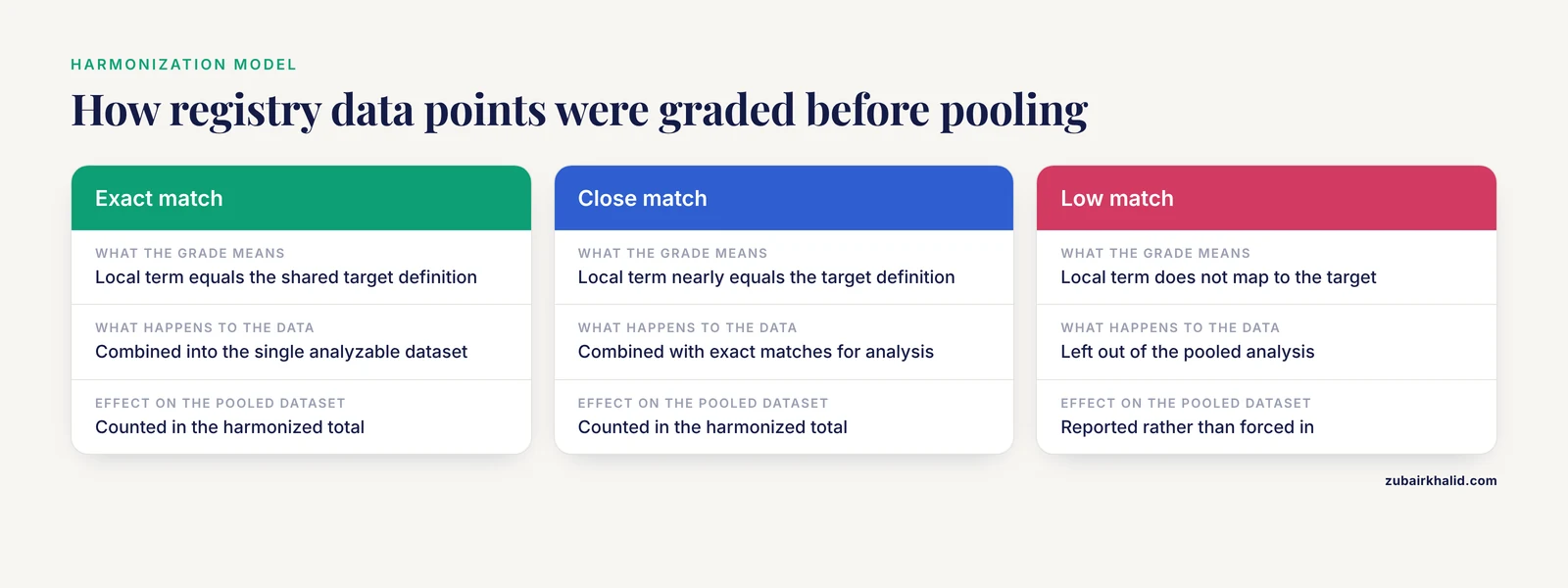
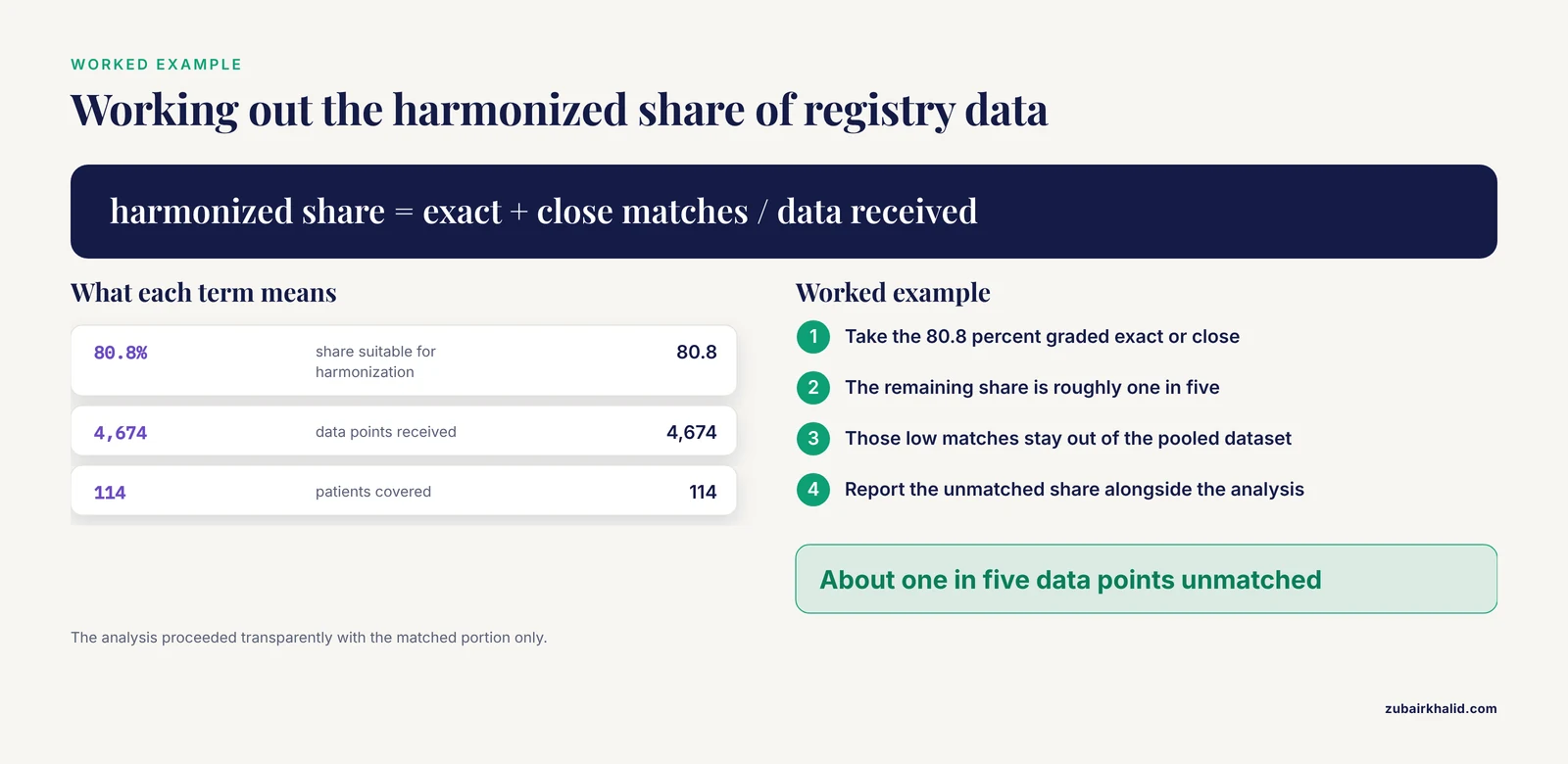
The registry harmonization model is the most transferable solution for quantitative collaborations. In the medullary thyroid cancer project, three clinical networks in Australia and the United States used the Maelstrom guidelines for retrospective data harmonization, graded every received data point as an exact, close, or low match, and combined exact and close matches into a single analyzable dataset. Of the data received, 80.8 percent proved suitable for harmonization, covering 114 patients across 17 hospitals and 4,674 data points [2]. The grading system is what makes the solution honest. You are not pretending the terms are identical. You are documenting exactly how close they are and letting the analysis account for it [2].
Controlled vocabularies and standardized data models
When the volume of terms exceeds what a spreadsheet crosswalk can manage, map to an established standard. Observational research commonly uses the OMOP Common Data Model, in which local drug codes must be mapped to standardized RxNorm concepts. Because drug strings encode strength, dosage form, route, and release characteristics in unpredictable arrangements, researchers have built automated mapping pipelines that retrieve candidate concepts with a bi-encoder model, rerank them with a fine-tuned late-interaction model, and apply deterministic tie-breakers that extract clinically salient cues so that near-ties resolve reproducibly [6]. The design lesson generalizes beyond drugs: when terminology mapping must be repeatable, the tie-breaking rules must be deterministic, not judgment calls made anew each run [6].
Definitional splits with matched validation pathways
When a term is genuinely doing two jobs, split it and give each piece its own quality standard. The digital biomarker proposal does exactly this: biologically derived markers require technical accuracy validation against established biological reference standards, while candidate biomarkers inferred from behavior require biological criterion validation before that status is claimed, and purely behavioral indicators are named and treated differently [4]. The HBV nomenclature proposal applies the same logic at the field level by distinguishing terminology for clinical care from terminology for research and drug development, since the two contexts need different levels of precision [1].
Explicit methodological standardization
Some conflicts are really protocol conflicts wearing terminology costumes. In cross-disciplinary atomic force microscopy research, effective implementation is often challenged by technical complexity and varied domain expertise among collaborators, and the published response is a set of validated approaches covering experimental protocols through quantitative data analysis, written specifically to ensure reproducibility across material science domains [9]. Similarly, the plant nanovesicle field documented workflow-specific optimizations, such as optimized polyethylene glycol precipitation delivering roughly four to five fold higher vesicle yields and aqueous two-phase systems delivering multi-fold higher recovery while eliminating more than 95 percent of protein contaminants, precisely so that different laboratories could compare results from comparably prepared materials [5]. The terminology fix and the protocol fix are the same fix: write down the exact procedure and the exact name for it, and cite the version.
Consensus processes with the right people in the room
For field-level conflicts, the durable solution is a formal consensus process. The HBV proposal calls for a multistakeholder process that creates a unified, practical nomenclature and intentionally includes people with lived experience of the disease, so that the resulting language is meaningful to patients as well as to researchers [1]. Cross-cultural instrument adaptation reaches consensus through an expert panel spanning multiple countries, which prevents one country's usage from silently becoming the standard [8].
Structured collaborative formats that force definitional precision
Some conflicts resolve fastest when collaborators must build something together under time pressure with clear deliverables. Hackathon-based cross-disciplinary programs in soft matter research were developed specifically because inconsistencies in metrics, definitions, and analysis algorithms across research groups had hindered the identification of performance intersections among dynamic biomaterial systems. These programs enforce a flat hierarchy, pairing participants from high school students to faculty, and require clearly defined goals and deliverables so that participants collectively contribute to data acquisition, coding, testing, and dissemination [10]. The mechanism is straightforward: you cannot write shared analysis code with a partner whose definition of the input variable differs from yours, so the coding session surfaces and forces resolution of the terminology conflict in hours rather than months [10].
Structured communication audits in high-stakes settings
In clinical simulation research, the conflict is not between fields but between what team members believe shared words mean during emergencies. An Agency for Healthcare Research and Quality Patient Safety Learning Laboratory studying obstetric and neonatal care examined ten labor and delivery units, found significant heterogeneity in their size, design, and organization, and identified common lapses in verbal communication during obstetric emergencies [11]. The laboratory's methods, including interviews, focus groups, direct observation, and task analysis, are a template for auditing whether a team's working vocabulary matches its actual practice [11].
Research Collaboration Tools That Support Terminological Alignment
Tooling does not replace the governance decisions above, but it makes the decisions durable. Practical options used across the projects discussed here include:
- Version-controlled glossaries. A plain-text or wiki glossary in a version control repository, with a named steward who approves changes. Every definition change is a tracked commit with a rationale.
- Shared data dictionaries with match grades. A spreadsheet or database that lists every variable, every source's local term, the target standardized term, and the match grade (exact, close, or low), following the harmonization pattern described above [2].
- Standardized data models and vocabularies. Adopt an existing common data model and its standardized vocabulary where one exists for your domain, and map local terms into it rather than inventing a private standard [6].
- Bibliometric mapping software. Keyword co-occurrence and co-citation tools can reveal how a field's vocabulary clusters and drifts over time, which is useful for diagnosing definition drift and for situating a new collaboration within existing usage [7].
- Structured team science formats. Scheduled working sessions with explicit deliverables, modeled on the hackathon format, that force real-time definitional alignment [10].
- Translation and back-translation workflows. For multilingual teams, a documented adaptation process with independent translators and an expert committee [8].
Scientific collaboration succeeds or fails on these shared artifacts far more often than on goodwill. A team that can point to a dated, versioned glossary resolves disputes in minutes. A team that cannot relitigates the same word at every meeting.
Prevention Practices
Prevention costs less than repair. These practices, drawn from the published examples above, belong in every cross-disciplinary project plan from day one.
- Write definitions before writing protocols. At project kickoff, list the ten to twenty terms the project cannot function without and define each in writing. This is the single highest-yield habit, because most conflicts trace back to a term everyone assumed was shared.
- Name a terminology steward. One person approves definition changes. Consensus is the process, but a named owner prevents drift.
- Choose or build a data dictionary before collecting data. Prospective harmonization is cheaper than retrospective harmonization, and the match-grading discipline of the registry model applies prospectively too [2].
- Map to existing standards where they exist. Search for an established common data model, ontology, or professional definition in your domain before inventing new terms. Professional-body definitions exist in many fields, and studies that ignore them create avoidable fragmentation [3].
- Version definitions like code. Date every definition, record its source, and note when it supersedes an earlier one. Definition drift across years is a documented phenomenon and is detectable and manageable only with versioning [7].
- Back-translate critical documents. Any protocol, consent form, or instrument used across languages should undergo independent back-translation and expert review [8].
- Audit communication against practice. Periodically observe whether the team's spoken usage matches the written glossary, using the interview, focus group, and direct observation methods validated in team performance research [11].
- Report your definitions in every manuscript. State the definition of every key term in the methods section, with a citation to its source. This makes your work interpretable to collaborators outside your field and prevents your paper from becoming someone else's terminology conflict [4].
A note on data safety. Terminology harmonization in clinical research involves sharing patient-level data across institutions. Before any crosswalk or mapping work begins, confirm that data sharing agreements are in place, that identifiers have been removed or coded according to the agreements, and that the harmonized dataset is stored only in approved environments. Data governance failures are harder to undo than terminology failures.
Common Mistakes and Limitations
- Assuming fluency equals shared meaning. Highly experienced collaborators from different fields are the most likely to harbor different implicit definitions, because their vocabularies are the most deeply ingrained. Seniority does not protect against polysemy.
- Resolving the conflict verbally only. A definition agreed in a meeting and never written into the protocol, data dictionary, and manuscript will reappear as a conflict within weeks.
- Treating a terminology problem as a data cleaning problem. If you fix mismatched categories in the dataset without fixing the underlying definitions, the next data collection cycle regenerates the same conflict.
- Splits without validation pathways. Splitting an ambiguous term into subcategories only helps if each subcategory has a defined measurement and validation approach. Naming new terms without specifying how each is validated recreates the original ambiguity [4].
- Imposing one field's vocabulary as neutral. The dominant field's terms feel neutral to the dominant field. Consensus processes that include all stakeholder groups, including end users and people with lived experience where relevant, produce nomenclature that survives contact with the whole team [1].
- Ignoring translation as a source of conflict. Teams that share a working language but not a first language routinely discover late that a key term translated differently in each subgroup's internal documents. The back-translation check is cheap insurance.
- Expecting perfection. Even well-executed harmonization leaves a substantial fraction of data unmatched. In the medullary thyroid cancer registry case, roughly one in five data points could not be harmonized, and the analysis proceeded transparently with the matched portion [2]. Report what did not match rather than forcing it in.
- Individual clinical decisions. Where collaborations touch patient care, terminology alignment supports research and communication but does not replace clinical judgment. Individual cases require the appropriate licensed clinician.
Frequently Asked Questions
What is the most common cause of terminology conflicts in research?
The most common cause is polysemy, meaning the same word carrying different established meanings in different fields. The second most common is synonymy, meaning the same concept carrying different names. Both are historical artifacts of independent vocabulary development, not errors by any team.
How do I know whether a disagreement is a terminology conflict or a real scientific disagreement?
Run the independent definition test. Ask each party to write down its definition of the disputed term in one sentence, separately. If the definitions differ, the disagreement is terminological, and resolving it may dissolve the scientific disagreement. If the definitions match but predictions differ, the disagreement is genuinely scientific.
What is data harmonization and when do I need it?
Data harmonization is the process of standardizing raw data from multiple sources by resolving differences in format and terminology, so the data can be analyzed together for a common purpose. You need it whenever you pool datasets collected independently, whether across laboratories, registries, or countries.
Can automated tools resolve terminology conflicts for me?
Automated tools can execute mapping at scale, but they require a target standard, curated training examples, and deterministic tie-breaking rules to produce repeatable results. They accelerate the fix. They do not decide what your terms should mean.
How do we handle a term that two authoritative sources define differently?
Record both definitions with their citations, choose one for the project with a documented rationale, and state the choice explicitly in your methods section. For field-level disputes, a multistakeholder consensus process is the accepted route to a unified nomenclature.
What should a project glossary contain?
Each entry should include the term, the agreed definition in one or two sentences, the source or rationale for the definition, the date it was adopted, the name of the approver, and any terms it explicitly excludes or contrasts with. Version the document so changes are tracked.
How do cross-language teams prevent translation-driven terminology conflicts?
Use a structured adaptation process: independent forward translations, synthesis, back-translation by a different translator, expert committee review, and final approval, with discrepancies resolved by documented consensus. The back-translation step is what exposes meaning that was lost or shifted.
When should a team split one contested term into two?
Split a term when edge cases keep being classified differently by reasonable people, or when different subcategories require different validation or measurement standards. Give each new term a distinct name, an explicit definition, and its own quality criteria, then retire the original umbrella term from project documents.
Sources
- Time for a globally unified chronic HBV terminology?
- Data Harmonization for Collaborative Research Among Australian and US Registries: A Case Study in Medullary Thyroid Cancer (MTC).
- Yoga therapy in U.S. clinical research: A scoping review of definitions and alignment with professional standards.
- Toward terminological clarity in digital biomarker research.
- Plant-Derived Nanovesicles: Resolving Conceptual Confusion, Overcoming Isolation Challenges, and Advancing Translational Potential.
- Efficient Drug Terminology Mapping with Bidirectional Late-Interaction Reranking and Deterministic Reordering.
- Mediterranean diet research trajectories in China (2006-2025): a scoping review and scientometric analysis to localize global nutrition models.
- Cross-cultural adaptation of the expanded protocol of orofacial myofunctional evaluation with scores protocol for Spanish-speaking populations.
- Atomic Force Microscopy for Cross-Disciplinary Materials Research.
- Hacktive matter: data-driven discovery through hackathon-based cross-disciplinary coding.
- The Value of a Cross-Disciplinary Approach to Human and System Performance Research in Obstetrics and Neonatology: AHRQ's Patient Safety Learning Laboratory.