How to Define Roles and Responsibilities in a Research Team
By Dr. Zubair Khalid, DVM, MS, PhD ·
By the end of this guide, you will be able to build a complete research team roles and responsibilities template, assign a single accountable owner to every recurring task in your project, store that document in version control so it survives staff turnover, and run a structured review that keeps it current. You will also learn how to adapt the same template format to a two-person lab, a multi-center data harmonization consortium, and a fully remote student team.
To follow the walkthrough, you need three things on hand: a plain-text editor (Notepad, TextEdit, VS Code, or Nano all work), a shared location your whole team can reach (a Git repository, an institutional cloud drive, or a project wiki), and a one-page roster of everyone on the project with their names, titles, and time commitments. No paid software is required. Everything in this article can be done with free tools.
Why Role Clarity Matters in Scientific Collaboration
Modern science is a team activity. Large interdisciplinary projects aim to produce harmonized datasets that no single laboratory could generate alone, and success depends on a shared language across disciplines, harmonized protocols, common data elements, and agreed processes for deciding what gets standardized [1]. None of that happens if team members are unsure who decides, who executes, and who reviews.
A case-based analysis of a three-year, multidisciplinary artificial intelligence project in nursing research reached a striking conclusion: team structure, not technical sophistication, was the most critical determinant of success. That team credited deliberate role design, investment in cross-disciplinary translation, and realistic resource planning for finishing a technically demanding project [2]. The lesson generalizes. A brilliant analysis plan fails when two people both assume the other owns the dataset.
Research capacity itself is usually assessed at three connected levels: the individual, the team, and the organization [3]. A roles document is the connective tissue between them. It tells an individual what they are responsible for, tells the team how work flows between members, and tells the institution what infrastructure and training the project actually needs.
Role clarity also protects the human side of scientific collaboration. Teams that study their own communication find that respect, trust, integrity, openness, and the habit of asking and answering questions are the qualities members value most [4]. A written roles document supports those qualities directly, because ambiguity about ownership is one of the fastest ways to erode trust in a team.
Core Roles in a Research Team
Most research projects draw from the same pool of roles. Titles vary between fields and institutions, so treat the descriptions below as functions to fill, not job titles to copy.
- Principal investigator (PI). Holds overall scientific and administrative accountability, secures funding, and makes final decisions when the team cannot reach consensus. In multidisciplinary work, deliberate role design should position the domain scientist as an intellectual leader, not a figurehead [2].
- Co-investigators and co-leads. Own a defined workstream, such as participant recruitment, assay development, or statistical analysis.
- Postdoctoral researchers and graduate students. Execute day-to-day experiments or analyses, and typically own protocol drafting and first-draft writing.
- Research staff and technicians. Handle sample processing, data collection, equipment maintenance, and regulatory paperwork.
- Data manager or bioinformatician. Owns the pipeline that moves raw data to analysis-ready data, a responsibility that becomes critical in harmonization projects spanning multiple laboratories [1].
- Statistician or methodologist. Owns the analysis plan and verifies that results are reproducible.
- Project manager or coordinator. Tracks milestones, schedules meetings, and maintains the roles document itself.
- External collaborators and advisory members. Community partners, survivor advisors, clinicians, or industry scientists who contribute lived or practical expertise. Transdisciplinary teams that include advisory groups report that intentional team-building and clear communication norms matter as much as technical division of labor [4].
Smaller teams combine these functions. A two-person lab might fold the coordinator and data manager duties into the PI's role. What cannot be dropped is the accountability itself. Every task needs a name next to it.
The Research Team Roles and Responsibilities Template
Template Format
The template format below uses YAML, a plain-text format readable by both humans and simple scripts. Storing the template in YAML rather than a word processor means you can check it automatically for missing owners, and you can diff changes between versions. A Markdown companion file holds the prose context.
# roles.yml
project: "Gut microbiome and colorectal cancer biomarkers"
version: "1.0"
last_reviewed: "2026-11-11"
review_cycle: "quarterly"

people:
  - name: "Dr. A. Reyes"
    title: "Principal Investigator"
    time_fraction: "0.25"
  - name: "J. Okafor"
    title: "Postdoctoral Fellow"
    time_fraction: "1.00"
  - name: "M. Tran"
    title: "PhD Student, Year 2"
    time_fraction: "0.75"
  - name: "S. Patel"
    title: "Data Manager"
    time_fraction: "0.50"

tasks:
  - name: "Protocol amendments and approvals"
    people:
      - name: "Dr. A. Reyes"
        role: "A"
      - name: "J. Okafor"
        role: "R"
      - name: "M. Tran"
        role: "C"
    due: "within 5 business days of draft"

  - name: "Sample collection and biobanking"
    people:
      - name: "M. Tran"
        role: "R"
      - name: "J. Okafor"
        role: "A"
    due: "weekly, Mondays"

  - name: "Raw data ingest and quality checks"
    people:
      - name: "S. Patel"
        role: "R"
      - name: "S. Patel"
        role: "A"
    due: "within 48 hours of upload"

  - name: "Statistical analysis plan"
    people:
      - name: "J. Okafor"
        role: "R"
      - name: "Dr. A. Reyes"
        role: "A"
      - name: "M. Tran"
        role: "C"
    due: "before first data lock"
Each task uses four role codes, drawn from the standard responsibility-assignment tradition:
- A (Accountable). Exactly one person who answers for the outcome and resolves disputes.
- R (Responsible). People who do the work.
- C (Consulted). People whose input is sought before decisions.
- I (Informed). People told after decisions or milestones.
The rule that makes the whole document work is simple: every task has exactly one A. When a person is both doing and owning a task, list them twice with both codes, as the data ingest task does above.
Worked Example of the Filled Template
The block above is already a research team roles and responsibilities template example for a mid-sized academic lab. Notice three features you should copy. First, every person has a time fraction, so the document doubles as a workload check. If you add every fraction and exceed the head count, someone is overcommitted. Second, every task has a due cadence, which turns vague responsibilities ("help with data") into schedulable work. Third, the version and review date sit at the top, so anyone joining the team can see instantly whether they are reading a current document.
For a larger consortium, extend the same format with a sites: block. Multi-center projects that harmonize data across laboratories need named owners not only for tasks but for the harmonization framework itself, including protocol versions, metadata standards, and the process for deciding what gets harmonized [1].
Step-by-Step: Building and Maintaining the Template
Step 1. Inventory the work. List every deliverable (manuscript, dataset, regulatory submission) and every recurring task (sample processing, backups, meeting agendas). Aim for 15 to 40 tasks. Fewer means you have skipped real work. More usually means you listed one-off subtasks.
Step 2. Group tasks into roles. Cluster related tasks. If five tasks all require statistics, you have found the "statistician" role even if no one holds that title.
Step 3. Assign exactly one A per task. Do this in a live team meeting, not by email. Disagreement at this step is useful, because it surfaces conflicts before work begins.
Step 4. Write the file. Save the YAML above as roles.yml and add a short Markdown companion, README.md, that records decisions the YAML cannot hold, such as why a task was reassigned.
Step 5. Put it under version control. Run:
mkdir mylab-roles
cd mylab-roles
git init
git add roles.yml README.md
git commit -m "Add initial roles and responsibilities template"
Expected output for the final command:
[main (root-commit) a1b2c3d] Add initial roles and responsibilities template
 2 files changed, 48 insertions(+)
 create mode 100644 roles.yml
 create mode 100644 README.md
The short hexadecimal string (a1b2c3d in this example) is your commit hash. Anyone can later run git log to see who changed which role assignment and when.
Step 6. Validate the file automatically. The single-owner rule is easy to break by accident. Check it with a short script:
import yaml

with open("roles.yml") as f:
    team = yaml.load(f, Loader=yaml.SafeLoader)

problems = []
for task in team["tasks"]:
    a_count = sum(1 for p in task["people"] if p["role"].upper() == "A")
    if a_count == 0:
        problems.append(task["name"] + ": NO accountable person")
    if a_count > 1:
        problems.append(task["name"] + ": " + str(a_count) + " accountable people")

if problems:
    print("\n".join(problems))
else:
    print("OK: every task has exactly one accountable person")
Run it with python check_roles.py. Healthy output:
OK: every task has exactly one accountable personOutput after a careless edit:
Raw data ingest and quality checks: 2 accountable peopleStep 7. Schedule the review. Set the review_cycle field and honor it. Quarterly works for most projects. Re-review immediately after anyone joins, leaves, or changes time fraction.
Choosing a Responsibility Format
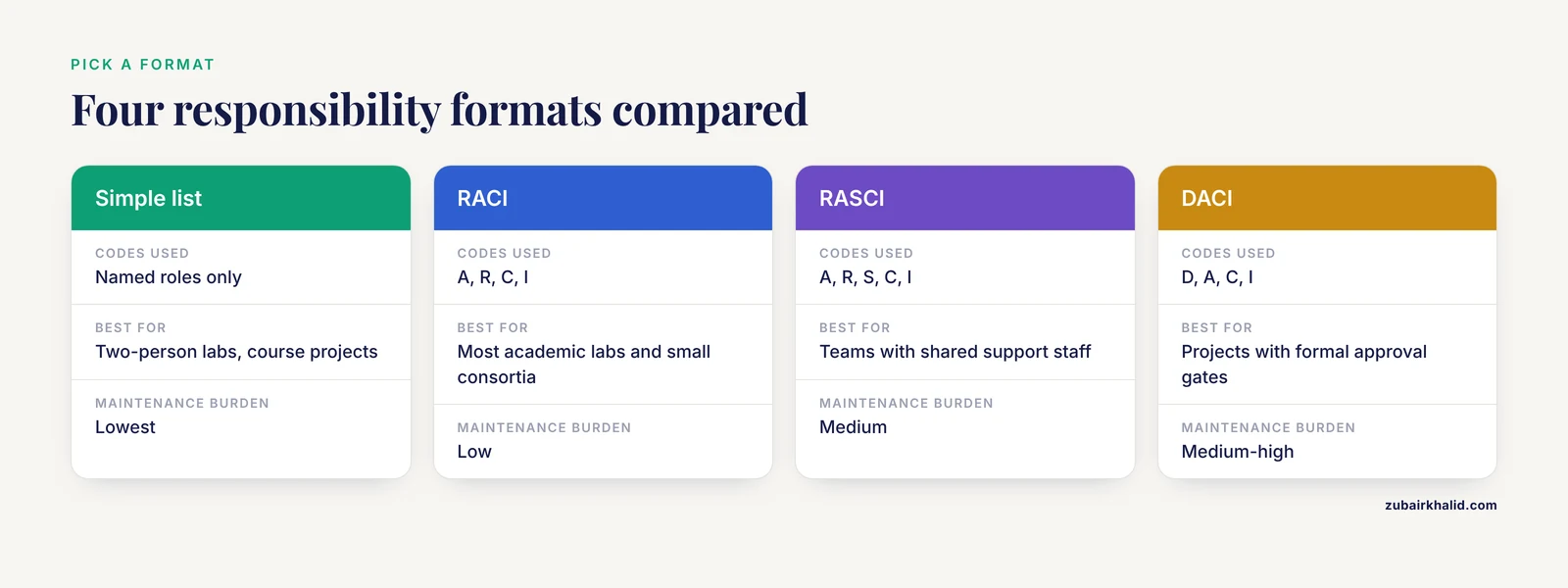
The A-R-C-I scheme above is one option among several. Pick the lightest one your team will actually maintain.
| Format | Codes used | Best for | Maintenance burden |
|---|---|---|---|
| Simple roles list | Named roles only | Two-person labs, course projects | Lowest |
| RACI | A, R, C, I | Most academic labs and small consortia | Low |
| RASCI | A, R, S (Support), C, I | Teams with shared support staff | Medium |
| DACI | D (Driver), A, C, I | Projects with formal approval gates | Medium-high |
Whatever you choose, the invariant stays the same. One accountable name per task. A matrix where everyone is consulted on everything is a matrix no one reads.
Version Control and Reproducibility as Shared Responsibilities
Role definitions and reproducible workflows reinforce each other. Guidance on reproducible research outlines five practical steps: project organization and file structure, use of README documentation, clear traceability from raw to analytic datasets, use of syntax for all data cleaning and management, and reproducible generation of tables and reports [5]. Each of those steps is a task in your template, with an owner.
A standard structure looks like this:
project/
  raw_data/      # never edited, write-protected
  data/          # analysis-ready datasets, built by scripts
  analysis/      # all cleaning and analysis code
  results/       # tables and figures, generated by code
  docs/          # protocols, meeting notes
  README.md      # how everything connects
Two rules turn this folder tree into a responsibility system. First, no one edits files in raw_data by hand. Manual data cleaning, point-and-click analyses, and copy-pasted table values increase error rates and impede collaboration, which is exactly why syntax-based workflows are recommended [5]. Second, the README documents the pipeline so that a new member can trace any result back to its source file. Writing a usable README is a named task in the template, owned by the data manager in the worked example.
In a harmonization project, these habits scale up to shared metadata standards and common data elements across sites [1]. The role that matters most is often the least glamorous one: whoever owns the data dictionary and enforces it.
Research Collaboration Tools for Distributed and Remote Teams
Remote and hybrid teams are now standard in scientific collaboration, and they change how role documents must work. Reviews of remote work find that successful collaboration in distributed settings depends heavily on digital communication tools, and that common challenges include weaker cohesion, communication gaps, isolation, uneven technological proficiency, and trust and accountability concerns [6]. Research on virtual teams reaches the same practical conclusion: distributed teams need deliberately expanded communication and coordination practices compared with co-located ones [7].
Map your research collaboration tools to the roles document so that each tool has an owner and a stated purpose:
- Synchronous communication (video calls, chat) for decisions and unblocking. Owned by the coordinator.
- Asynchronous documentation (wiki, shared drive, Git repository) for anything that must outlive a meeting. Owned by the data manager or PI.
- Project tracking (shared task board) mirroring the tasks in
roles.yml. Owned by the coordinator. - Electronic lab notebook or code repository for protocols and analysis code. Owned by whoever runs that platform for the lab.
Fully remote teams need one addition: relationship maintenance. An instructor who built an online astronomy research team of students who never met in person found that strengthening relationships is both more difficult and more vital without physical presence, and that members need a deeper grasp of the scientific process to compensate for the missing hallway conversations [8]. Build a recurring, named task for informal connection, and give it an owner, or it will quietly disappear.
Crisis conditions sharpen the same lesson. Case studies of remote teams operating under martial law in Ukraine found that psychological support, deliberate communication routines, and adapted team-building practices were what kept collaboration and morale alive [9]. You will likely never face those conditions, but the underlying point holds in ordinary life: when a team is under strain, the soft tasks need owners too.
Building the Human Side: Trust, Communication, and Leadership
A template assigns work. Leadership determines whether people follow it.
Emotional intelligence, the set of competencies that includes self-awareness, self-regulation, empathy, and social skill, is strongly associated with leadership effectiveness in team settings. A survey of 100 professionals found that leaders perceived as higher in emotional intelligence were seen as more empathetic and more ethical, and were better at fostering trust, resolving conflicts, and inspiring commitment [10]. For a PI, the practical translation is this: when you reassign a task in the template, explain why, in person where possible.
Structured team-building training produces measurable communication gains. In a quasi-experimental study of nursing students, participants who completed team-building training improved effective communication in the cognitive aspect by 85.7 percent and in the psychomotor aspect by 76.2 percent, while control students showed no improvement [11]. Teams that met to analyze their own communication found that both the content and the style of messages, explicit value statements, and intentional team-building efforts shaped how the collaboration functioned [4]. The actionable habit is small and cheap: open your quarterly roles review with ten minutes on how the team communicates, not just who does what.
Skill development is also a team responsibility. A study comparing learning models in environmental science courses found that a research team-based learning model outperformed both research-based learning and team-based learning in strengthening students' research skills [12]. If your team includes students, assign them real tasks with real accountability rather than shadow work, and the template becomes a training tool. Institutions assessing their own research capacity consistently identify training, funding, infrastructure, and publication support as the components researchers consider vital [3], so treat gaps in your roster as training requests to take to your department, not just as hiring problems.
Blended approaches, mixing online and face-to-face interaction, have been shown to support effective small-group teamwork in educational settings [13], which is useful if your team spans campuses.
Adapting the Template Across Team Types
Small labs (two to five people). Skip the full RACI codes and use the simple roles list format from the table above. One page is enough. The single-owner rule still applies. The most common small-lab failure is the assumption that "we both know who does what," which lasts exactly until a grant deadline.
Multi-center consortia. Add a sites: block, and assign each site a local data lead. Harmonization frameworks require buy-in and sustained effort from all members [1], so give the cross-site coordination work explicit owners at both the center level and the project level. Programs that embedded dedicated research teams into clinical settings found this approach particularly effective at building linkages, collaborations, and skills, and found that capacity grew slowly wherever the team's activities and environment were poorly aligned with its goals [14].
Cross-disciplinary and community-engaged teams. Deliberate role design should position domain scientists as intellectual leaders while investing in translation infrastructure, meaning scheduled time for members to explain their field's assumptions to everyone else [2]. Transdisciplinary teams report that "learning each other's language" is a core activity, not an accident [4]. Add a standing task called "cross-disciplinary translation" and rotate the owner. Teams working with minoritized communities additionally need members with cultural and linguistic competence, and benefit from defining that competence as an explicit role requirement rather than an afterthought [15].
Inclusive teams with members with intellectual disability. Teams that include co-researchers with lived experience report that deliberate team-building and skills training are what make inclusion genuine rather than symbolic [16]. Practically, this means pairing inexperienced co-researchers with a named mentor and writing tasks in accessible language inside the same template everyone else uses.
Common Mistakes and Limitations
- Assigning two accountable people "because it is shared work." Shared accountability means no accountability. If two people genuinely co-lead, split the task or pick one A and mark the other R.
- Listing people instead of tasks. A roster with job titles is not a roles document. The unit of assignment is the task.
- Writing the template once and never reviewing it. An out-of-date roles document is worse than none, because people trust it and act on stale information. Honor the review date.
- Treating soft tasks as optional. Onboarding, mentoring, documentation, and relationship maintenance are tasks. Unassigned soft tasks are the first thing that dies in a busy semester.
- Confusing consultation with approval. A C (Consulted) gives input. Only the A decides. Blurring this line recreates the ambiguity the template exists to remove.
- Keeping the document in email or chat. Attachments scattered across threads have no version history. If a tool cannot show you who changed what and when, it is the wrong home for this file.
- Ignoring workload signals. If one name appears as R on half the tasks, the template is telling you about a burnout risk before the burnout happens. Read it as a workload audit each quarter.
- Expecting a template to fix a trust problem. The document records agreements. It cannot create them. Teams that surface respect, trust, integrity, and openness as explicit values report stronger collaboration than teams that rely on goodwill alone [4].
One limitation belongs in the open. A roles template governs internal project organization. It does not replace institutional policies on authorship, research ethics, or data governance, which your office of research or equivalent body controls. Individual personnel conflicts that persist after a structured roles review usually need your institution's human resources or ombuds office, not another edit to the YAML file.
Frequently Asked Questions
What is a research team roles and responsibilities template?
It is a short, version-controlled document that lists every recurring task in a project and names exactly one accountable person for each, plus the people responsible, consulted, and informed. This article provides a free research team roles and responsibilities template in YAML format that you can copy and adapt.
What should a good template format look like?
A good template format has four parts: a people roster with time commitments, a task list with role codes, a review date with a review cycle, and a companion README explaining decisions. Plain-text formats such as YAML or Markdown work best because they can be checked by scripts and tracked with version control.
What is the difference between a role and a responsibility?
A role is a cluster of related tasks, such as data manager, while a responsibility is a single task with a named owner, such as running weekly quality checks on incoming data. Define roles first, then assign each responsibility to exactly one accountable person within a role.
How do I assign roles in a two-person lab?
Use the simple roles list format and split the work by workstream rather than by task. One person typically owns data collection and the other owns analysis and writing, with the PI accountable for regulatory and financial tasks regardless of lab size.
How often should we revisit the roles document?
Review it quarterly for most projects, and review it immediately whenever someone joins, leaves, or changes their time commitment. Set the review cycle in the template itself so the commitment is visible to the whole team.
What roles matter most in a multi-center data harmonization project?
The most critical roles are a project-level data harmonization lead, a local data lead at each site, and an owner for the shared data dictionary and metadata standards. Harmonization succeeds when processes for deciding what to standardize are explicit and when every site has a named person implementing the agreed workflows locally.
How do I handle a role conflict between a PI and a co-investigator?
Raise it in the quarterly review, walk through the specific task in the template, and have the PI exercise final decision authority as the accountable owner, ideally with a short written record of the decision. Persistent conflicts beyond task ownership usually require departmental mediation rather than another template revision.
How do remote teams keep role definitions working?
Mirror the roles document in shared research collaboration tools, assign an owner to each tool and meeting type, and schedule deliberate relationship-maintenance tasks. Remote teams depend on digital communication for coordination, so unclear ownership of communication channels is the first failure point to guard against.
Sources
- A Guide to Developing Harmonized Research Workflows in a Team Science Context
- A team science blueprint for nurse-led artificial intelligence research: Lessons from building AI tools to detect stigmatizing language in obstetric records.
- Exploring Research Capacity and Capacity Building Needs Among Faculty Members and Personnel of AIMS: Inputs for Effective Research Training Plan for AIMS
- Learning Each Other’s Language and Building Trust: Community-Engaged Transdisciplinary Team Building for Research on Human Trafficking Operations and Disruption
- Statistical Considerations for Research Reproducibility: Strategies for Building Transparent Analytic Workflows.
- The Impact of Remote Work on Building Effective Teams: Exploring the Challenges of Fostering Team Cohesion in Remote Work Environments, A brief review of literature
- Building Effective Virtual Teams: Expanding OD Research and Practice
- Building an Online Astronomy Research Student Team at Stanford Online High School
- TEAM BUILDING IN REMOTE TEAMS UNDER MARTIAL LAW: CHALLENGES AND OPPORTUNITIES
- THE IMPORTANCE OF EMOTIONAL INTELLIGENCE IN LEADERSHIP FOR BUILDING AN EFFECTIVE TEAM
- Improving Effective Communication Competence Through Team Building Training in Nursing Students: Quasi Eksperimen Study
- Building students’ research skills in environmental science courses with research team-based learning
- Building Effective Small -Group Team Working Skill through Blended Learning at Malaysia Tertiary Institution
- An evaluation of the 'Designated Research Team' approach to building research capacity in primary care
- Building Effective Research Teams When Conducting Drug Prevention Research with Minority Populations
- Building an inclusive research team: the importance of team building and skills training.