Reproducibility Training for Research Teams
By Dr. Zubair Khalid, DVM, MS, PhD ·

By the end of this guide, your research team will be able to run a baseline reproducibility audit, set up shared version control and pinned software environments, run a supervised reproduction of a published paper, calibrate subjective judgments across reviewers, and measure whether the training actually changed behavior. You will also walk away with a reproducibility checklist your team can apply to every new project.
You will need a few things on hand before you start: Git installed on every team member's machine, R (version 4.x or later) or Python (version 3.9 or later) depending on your stack, access to a shared repository host such as GitHub, GitLab, or a self-hosted equivalent, and one published paper from your field that shares its data and code publicly. A container tool such as Docker or Apptainer is useful but optional for the first round of training.
Why Reproducibility Training Matters
Reproducible research means that an independent person, given the same data and code, can rerun an analysis and obtain the same numerical results. It is distinct from replication, which means repeating a study from scratch to see whether the finding holds, and from robustness, which asks whether a result survives reasonable changes to the analysis.
The evidence on how well published research survives independent checking is mixed, and the details matter for training design. In a large reproduction project, researchers reran the original analyses of 110 articles published in leading economics and political science journals, all of which had mandatory data and code sharing policies. More than 85 percent of published claims were computationally reproducible. Robustness checks told a more demanding story. Of statistically significant estimates, 72 percent remained significant and in the same direction under reanalysis, and the median reproduced effect size was 99 percent of the originally published effect size [1]. Computational reproducibility, in other words, is achievable at high rates when data and code exist. Robustness is where results get tested harder, and that is where training pays off most.
A second finding from that same project deserves attention from anyone designing training: independent research teams with more experience found lower levels of robustness in the papers they checked [1]. Experience teaches reviewers to push harder. That is exactly the skill a training program should build deliberately rather than leave to chance.
There is also direct experimental evidence about how teams should divide labor between humans and AI tools during reproduction work. Researchers randomly assigned 288 scientists to 103 teams that reproduced published quantitative social science results under three conditions: human-only teams, AI-assisted teams using ChatGPT as a collaborative tool, and AI-led teams where the model operated with minimal human oversight. Human-only and AI-assisted teams achieved comparable reproduction rates of 94 percent and 91 percent, and both substantially outperformed AI-led teams, which managed only a 37 percent reproduction rate, detected fewer errors of every category, and needed more time. Human-only teams identified significantly more major coding errors than AI-assisted teams [2]. The lesson for training is concrete. Teach people to reproduce results with their own judgment engaged, and treat AI assistants as collaborators that a trained human checks, not as autonomous analysts.
What a Training Program Should Cover
Effective reproducibility training for research teams has four pillars. Each maps to a documented failure mode in the literature.
Technical reproducibility. Version control, environment pinning, and scripted pipelines so that anyone can rerun the analysis. This is the foundation.
Error detection. The ability to read someone else's code and spot mistakes. Human-only review teams caught more major coding errors than any AI-assisted configuration in the randomized trial described above [2], which means code-reading is a trainable skill worth investing in directly.
Calibration of subjective judgment. Many research tasks, from rating adverse events to scoring the quality of a clinical session, involve human judgment. Five trained and experienced Global Trigger Tool teams in Norway reviewed the same 200 inpatient records and agreed on whether at least one adverse event occurred in only 57.5 percent of them, with moderate agreement (Fleiss' kappa of 0.48 and Gwet's AC1 of 0.65). The study authors concluded that reviewer calibration and training needed strengthening [3]. The same lesson applies to any team whose output depends on ratings. A related study of the Team Formulation Quality Rating Scale in inpatient mental health teams showed what good calibration looks like. When at least two trained raters scored 19 recorded team formulation sessions, the total scale showed excellent inter-rater reliability with an intraclass correlation coefficient of .926 [4]. Structured rating instruments plus practice against a shared standard produce consistent judgments.
Honest uncertainty about methods themselves. Even the tools we use to standardize work need scrutiny. A workshop at the 18th Annual International Biocuration Conference on AI in biocuration identified reproducibility issues and a lack of open, domain-specific training datasets as key hurdles for integrating machine learning into curation workflows, and participants called for clear data provenance, transparency, and avoidance of over-reliance on AI-generated data [5]. Training should include a module on documenting where data and model outputs come from, so the team never treats an unverified automated result as ground truth.
Step-by-Step: Building the Training Program
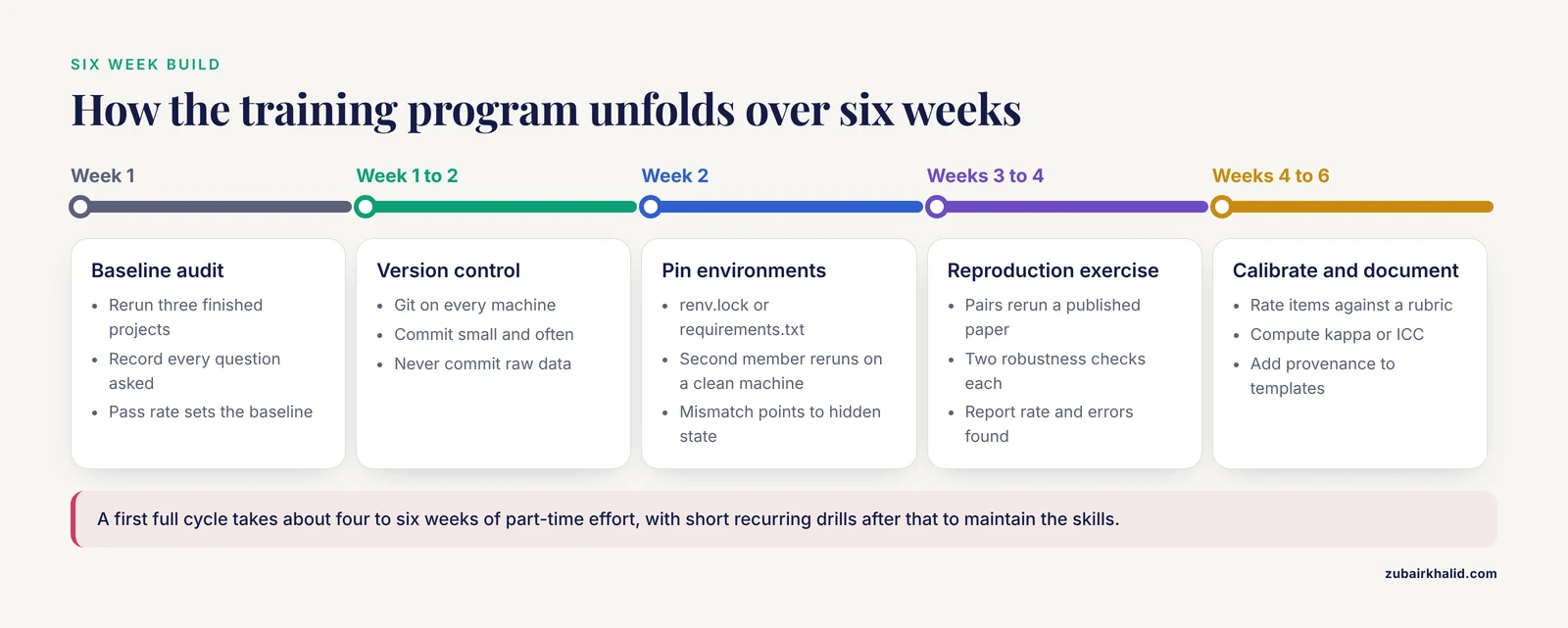
This walkthrough takes a team from zero to a completed reproduction exercise in roughly four to six weeks of part-time effort.
Step 1: Run a Baseline Audit (Week 1)
Pick three completed projects from your own team. For each, ask one question: can a team member who did not work on the project rerun the final analysis from the deposited materials and get the same numbers? Time how long the attempt takes and record every point where the person had to ask the original analyst a question.
Score each project on a simple scale. A project passes if the rerun completes without any contact with the original analyst and the key numbers match. It partially passes if the rerun completes only after questions or manual fixes. It fails if the rerun cannot be completed.
The pass rate becomes your baseline. If your team is like most, at least one of the three projects will fail, and the failure points will tell you exactly which skills to train first.
Step 2: Install and Teach Version Control (Week 1 to 2)
Every team member runs the following on their machine:
git --version
git config --global user.name "Your Name"
git config --global user.email "[email protected]"
git init
git add analysis.R
git commit -m "Initial analysis script"
Expected output for the last command looks like this:
[main (root-commit) a1b2c3d] Initial analysis script
 1 file changed, 42 insertions(+)
 create mode 100644 analysis.R
The parameters that matter here are the commit message, which should describe what changed and why, and the staging step, which controls exactly which files enter history. Teach three habits: commit small, commit often, and never commit raw data files that belong in a data repository.
A common error at this stage looks like this:
fatal: not a git repository (or any of the parent directories): .gitThis means the command was run outside a folder initialized with git init. The fix is to change into the project directory first or run git init in the current folder.
Step 3: Pin the Software Environment (Week 2)
Reproducibility fails most often because two machines run different software versions. For R teams, use the renv package:
install.packages("renv")
renv::init()
renv::snapshot()
Expected output from renv::snapshot():
- The project is out-of-sync -- there are no modified dependencies.
- Lockfile written: renv.lock
The renv.lock file records the exact package versions used. Anyone restoring the project later runs renv::restore() and gets the same versions.
For Python teams, generate a pinned environment file:
pip freeze > requirements.txt
conda env export > environment.yml
A line in a pinned requirements.txt looks like pandas==2.2.1, where the double equals sign fixes the exact version. The parameter that matters is the version pin itself. Leaving it unpinned, written as pandas, lets a future rerun install a different release and silently change results.
Check the result by having a second team member restore the environment on a clean machine and run the pipeline. If the key output numbers differ from the original, the environment was not the problem and the pipeline itself has hidden state, which is the next thing to fix.
Step 4: Run a Supervised Reproduction Exercise (Weeks 3 to 4)
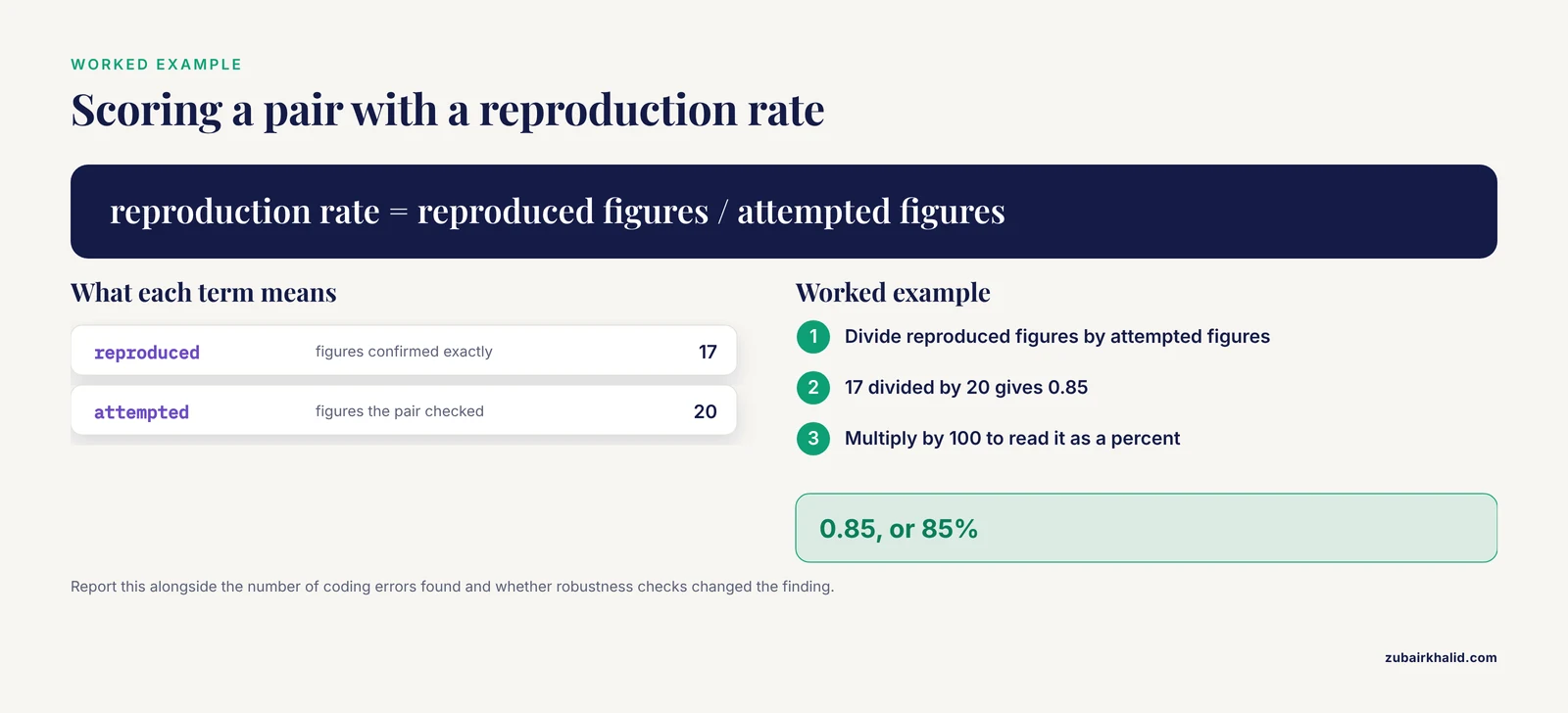
This is the core of reproducibility training for research teams. Assign each pair of team members one published paper with public data and code, ideally from a journal in your field. Their task is to rerun the published analysis, verify the headline numbers, and then attempt two robustness checks of their own design, such as an alternative control variable or a different subset of the data.
Score the exercise with a reproduction rate, computed as a simple fraction. If a pair attempts to verify 20 reported figures and confirms 17 of them exactly, the calculation is:
reproduction rate = reproduced figures / attempted figures
                  = 17 / 20
                  = 0.85, or 85%
Report three numbers per pair: the reproduction rate, the number of coding errors found, and whether the robustness checks changed the direction or significance of the finding. In the large randomized trial of reproduction teams, human-only and AI-assisted teams both succeeded at the core reproduction task at high rates, while fully autonomous AI-led teams fell far behind and missed errors across every category [2]. Structure the exercise so humans do the reading and the judgment, and any AI tool is used under direct supervision.
Expect the exercise to surface humbling results in your own field. Across 110 reproduced economics and political science articles, reanalysis showed that 72 percent of statistically significant estimates stayed significant and in the same direction under robustness checks [1]. A robustness check that flips a result is not a failure of the exercise. It is the single most instructive event a team can experience together.
Step 5: Calibrate Subjective Judgments (Week 4 to 5)
If your work involves ratings, coding of qualitative data, event classification, or any judgment-based scoring, run a calibration session. Select five to ten items, have every team member rate them independently using a written rubric, then compute agreement.
For a two-category judgment such as defect present or absent across several raters, you can compute chance-corrected agreement. The formula for observed agreement among raters on a single item is the count of raters agreeing divided by the number of raters. Fleiss' kappa then corrects that observed agreement for the agreement expected by chance:
kappa = (P_observed - P_expected) / (1 - P_expected)Compare your team's kappa against the documented benchmark from the five-team Global Trigger Tool study, where agreement on the presence of at least one adverse event across five independent teams was moderate, with Fleiss' kappa of 0.48 [3]. If your team scores near that level, the practical response is not alarm. It is a recurring calibration cycle: discuss disagreements, refine the rubric wording, and re-rate a fresh item set.
For continuous or ordinal quality scores, use the intraclass correlation coefficient (ICC), which estimates the proportion of variance in ratings attributable to the objects being rated rather than to rater disagreement. The Team Formulation Quality Rating Scale study provides the reference point. Trained raters using a structured instrument achieved an ICC of .926 for the total scale, which the authors characterized as excellent reliability [4]. The training implication is direct. Vague rubrics produce disagreement. Written, itemized instruments with worked examples produce agreement.
A frequent error in this step is computing agreement before the rubric is finalized. Fix the rubric first, pilot it on two or three items, revise the wording where raters diverge, and only then measure.
Step 6: Document Provenance and Close the Loop (Week 5 to 6)
Add a data provenance section to every project template. For each input file, record where it came from, who received it, when, and under what access conditions. The biocuration workshop recommendations apply here to any data-intensive team. They emphasized clear data provenance and transparency, new skills for human-AI collaboration, and avoiding over-reliance on AI-generated data [5]. A provenance entry is one line per source, for example: cohort_metadata.csv, received from collaborator X on 2026-03-14, approved data use agreement DUA-2026-041.
Close the loop by repeating the Step 1 audit on three new projects every six months and comparing pass rates to baseline.
Step 7: Evaluate the Training Itself
Treat your training program like a study. Measure knowledge before and after. A validated communication training program for healthcare providers used a pre-post design with a questionnaire that showed strong content validity, with a content validity index above 0.80, and good internal consistency, with a Cronbach's alpha of 0.912, before detecting significant skill improvements after a single training session [6]. You do not need that exact instrument. You need the design: a short knowledge test before training, the same test after, and a skills measure drawn from your reproduction exercises.
Retention also matters. A quasi-experimental study of 119 medical students who completed a two-hour gamified tabletop session assessed knowledge again six months later, with 95 students available at follow-up, providing evidence that short, low-cost, structured formats can produce measurable knowledge retention [7]. For a research team, the analog is a quarterly one-hour reproduction drill rather than a single annual workshop.
Step 8: Standardize Against External Benchmarks When Possible
Where your field runs formal challenges or shared-task evaluations, participate. The EPVS Challenge at MICCAI 2024 evaluated automated segmentation of enlarged perivascular spaces in MRI across 100 training, 50 validation, and 50 testing scans from multiple international sites, with all annotations following the STRIVE protocol to ensure standardized ground truth, and performance evaluated using the dice similarity coefficient, absolute volume difference, recall, and precision [8]. Challenge participation forces a team to freeze a method, document it precisely, and accept independent scoring. That discipline transfers directly to internal work. When you report a method, write it to the standard an external evaluator would need, with every preprocessing step and metric defined before results are computed.
Choosing Training Formats
Different formats train different skills. The table below summarizes the options and what the evidence says about each.
| Format | Skill trained | Best used when | Evidence anchor |
|---|---|---|---|
| Supervised paper reproduction | Error detection, code reading | Team has basic scripting skills | Human review teams caught more major coding errors than AI-led teams [2] |
| Robustness reanalysis drill | Statistical judgment | Team already reproduces numbers reliably | Robustness was weaker than raw reproducibility across 110 published articles [1] |
| Calibration and rating sessions | Consistent subjective judgment | Output depends on human ratings | Trained raters with a structured scale reached an ICC of .926 [4] |
| Cross-team blind review | Inter-team consistency | Multiple teams do the same task type | Five teams agreed on adverse event occurrence in 57.5 percent of records [3] |
| Gamified tabletop drill | Rapid knowledge uptake and retention | Time and budget are limited | A two-hour tabletop session showed knowledge retention at six months [7] |
| Pre-post knowledge testing | Program evaluation | Any format | Validated pre-post instruments detected significant gains after one session [6] |
A Reproducibility Checklist for Every Project
Print this reproducibility checklist and attach it to every project folder. A project is ready to hand off or publish when every box can be checked by someone who did not do the analysis.
- All raw data files are stored in a dedicated, access-controlled location with documented provenance.
- No analysis step was performed by hand in software with an unlogged GUI. Every transformation exists as a script.
- The code runs top to bottom from a clean start with no manual reordering of cells or steps.
- Package versions are pinned in a lockfile such as
renv.lockorrequirements.txt. - Random processes carry a fixed, recorded seed.
- A second team member has rerun the pipeline on a different machine and matched the key output numbers.
- The commit history explains what changed and why at each stage.
- Every figure and table in the manuscript traces to a specific script and output file.
- Subjective judgments were made by at least two trained raters against a written rubric, with disagreements resolved by a documented rule.
- Any AI-assisted output was verified by a human against the underlying data before entering the analysis.
- Data and code deposit locations are recorded, with access conditions noted.
- The robustness checks performed are listed, including any that changed the result.
Common Mistakes and Limitations
Treating reproducibility as a software problem only. The largest documented gap is not between a paper's code and its reported numbers. It is between a result and its robustness. With 72 percent of significant estimates surviving robustness checks in the large reproduction project [1], the harder skill your team needs is statistical judgment, not just pipeline hygiene.
Delegating verification to AI without trained humans in the loop. The randomized trial showed AI-led teams reproduced only 37 percent of findings and missed errors across all categories, while human judgment remained indispensable for reliable empirical verification [2]. An untrained team that adopts AI tools before building its own review skills will inherit that failure mode.
Skipping calibration for judgment-based tasks. Moderate agreement between experienced, trained teams on adverse event occurrence, with Fleiss' kappa of 0.48 across five teams reviewing the same records [3], shows that experience alone does not produce consistency. Calibration sessions are not optional overhead. They are the mechanism that produces reliability.
Writing vague rubrics. A rubric that says "rate the quality of the discussion" cannot be calibrated. Break it into named items, the way the Team Formulation Quality Rating Scale separates collaboration, life events, goals, and closing practice into distinct scored components [4].
Assuming shared vocabulary across sites and countries. Multi-country measurement work found that asset-based indices need an unambiguous, clearly defined variable list, and that consulting local teams when selecting those variables reduces data collection errors [9]. The general rule is that any instrument used across teams, sites, or languages needs explicit definitions agreed by the people who will apply it, not just by the designers.
Measuring training with self-report alone. Confidence questionnaires feel good and change little. Pair them with an objective measure, such as reproduction rates on a fresh paper before and after training, following the pre-post design used in validated training evaluations [6].
Running training once. A single workshop produces knowledge that fades. The six-month follow-up design used in the tabletop training study exists precisely because retention decays [7]. Schedule short recurring drills instead of one long event.
Expecting documentation to survive on goodwill. Individual cases and projects vary, and the biggest limitation of any training program is turnover. Institutionalize the checklist and the audit schedule in onboarding documents so the practice survives personnel changes rather than living in one senior person's habits.
Tips for Sustaining the Practice
Make reproduction a assigned role, not a virtue. Rotate a "reproducer" through the team whose job for one month is to rerun other members' pipelines and report friction. Rotate the role so everyone experiences both sides.
Keep reproduction exercises low-stakes. Frame findings from internal reproduction attempts as wins for the team, never as evidence against the analyst. The moment reproduction becomes punitive, people will stop sharing code honestly, and the program dies.
Anchor new hires in the exercise. Have every new team member complete one supervised paper reproduction in their first month. It teaches the codebase conventions, the tooling, and the error-detection mindset simultaneously.
Review the checklist annually. As your stack changes, so do the failure points. Update the checklist items based on what the twice-yearly audits actually catch.
Frequently Asked Questions
What is reproducibility training for research teams?
It is a structured program that teaches a research team to make their analyses rerunnable by others, to detect errors in code and reasoning, to calibrate subjective judgments, and to document data provenance, typically built around supervised reproduction exercises and a standard checklist.
How long does it take to train a team?
A first full cycle takes about four to six weeks of part-time effort, covering version control, environment pinning, one reproduction exercise, and one calibration session, with short recurring drills after that to maintain the skills.
What is the difference between reproducibility, robustness, and replication?
Reproducibility means the same data and code produce the same numbers. Robustness asks whether the result survives reasonable changes to the analysis. Replication means repeating the study from scratch with new data to see whether the finding holds.
Should our team use AI tools during reproduction work?
Yes, as supervised assistants rather than autonomous analysts. Experimental evidence shows human-only and AI-assisted teams perform far better at reproduction and error detection than teams led by AI with minimal oversight.
How do we measure whether the training worked?
Use a pre-post design. Test knowledge before and after training, and track objective performance measures such as internal reproduction rates, error counts found in exercises, and inter-rater agreement on calibration items.
What belongs in a reproducibility checklist?
At minimum, pinned software versions, scripted analyses with a fixed random seed, documented data provenance, a successful independent rerun by a second team member, dual rating of subjective judgments, and a list of robustness checks performed.
How often should we run reproduction exercises?
Run a short drill quarterly and a full supervised paper reproduction for each new team member in their first month, with a three-project audit every six months to track whether the practice is holding.
What is the first step if our team has no version control?
Install Git, initialize a repository in one active project, and commit the existing analysis scripts as they are. Do not reorganize anything first. The goal in week one is a working habit, not a perfect structure.
Sources
- Reproducibility and robustness of economics and political science research.
- AI-assisted teams outperform AI-led teams but not human-only teams in assessing research reproducibility in quantitative social science.
- Assessing Inter-Rater Agreement Across Five Teams Applying the Global Trigger Tool to Review 200 Inpatient Medical Records.
- Inter-rater reliability of the Team Formulation Quality Rating Scale (TFQS) in inpatient mental health teams.
- AI in biocuration: challenges, opportunities, and a roadmap for sustainable integration.
- Improving Care for People With Aphasia: Communication Training for Healthcare Providers.
- MassCas tabletop game as a training tool in mass casualty incidents for undergraduate medical students: a quasi-experimental study with knowledge assessment at 6-month follow-up.
- Standardized evaluation of automatic methods for perivascular spaces segmentation in MRI - MICCAI 2024 challenge results.
- Measuring wealth for health research in rural and urban settings in three African countries: Findings and recommendations from a multi-country study.